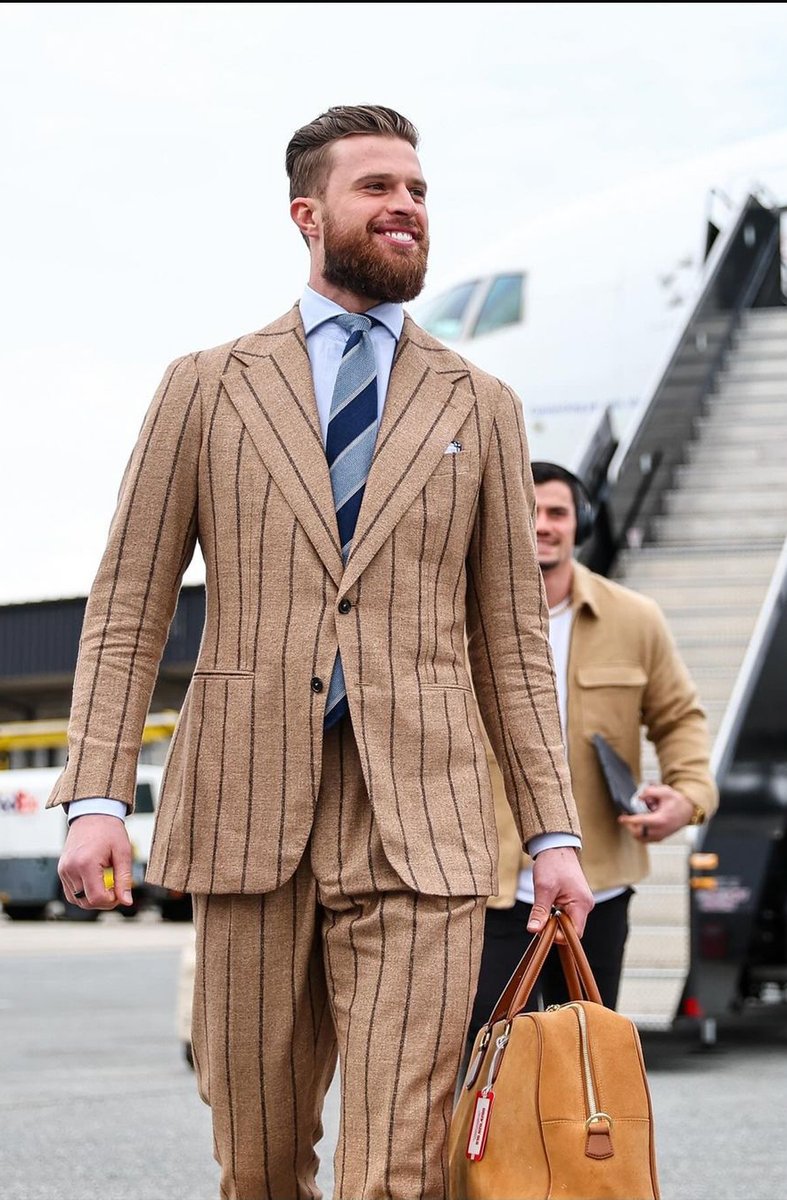
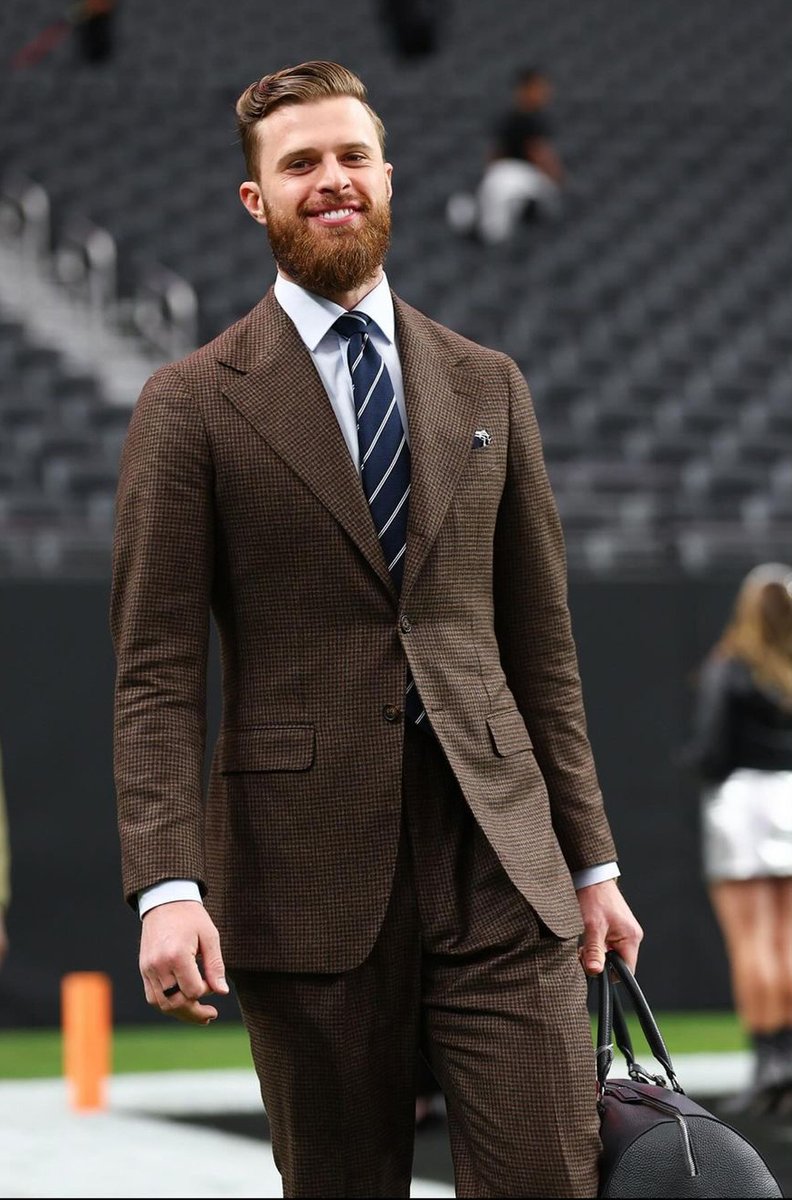
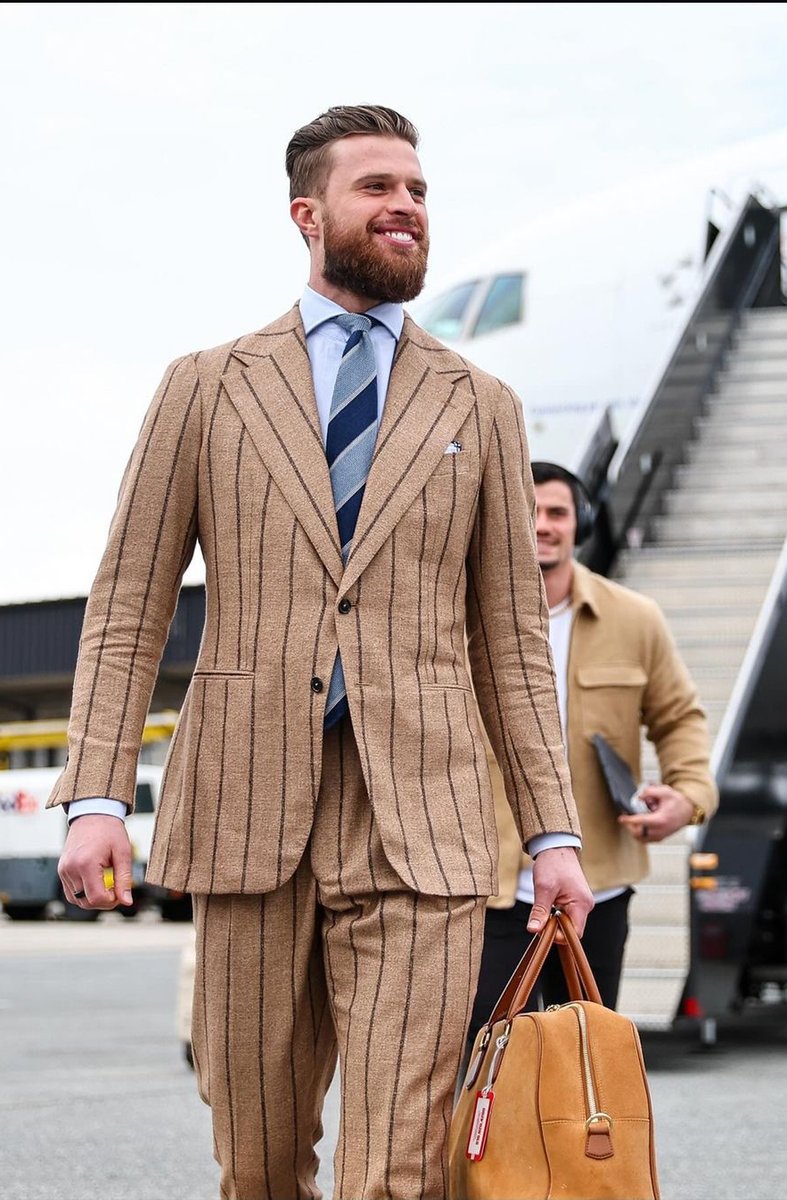
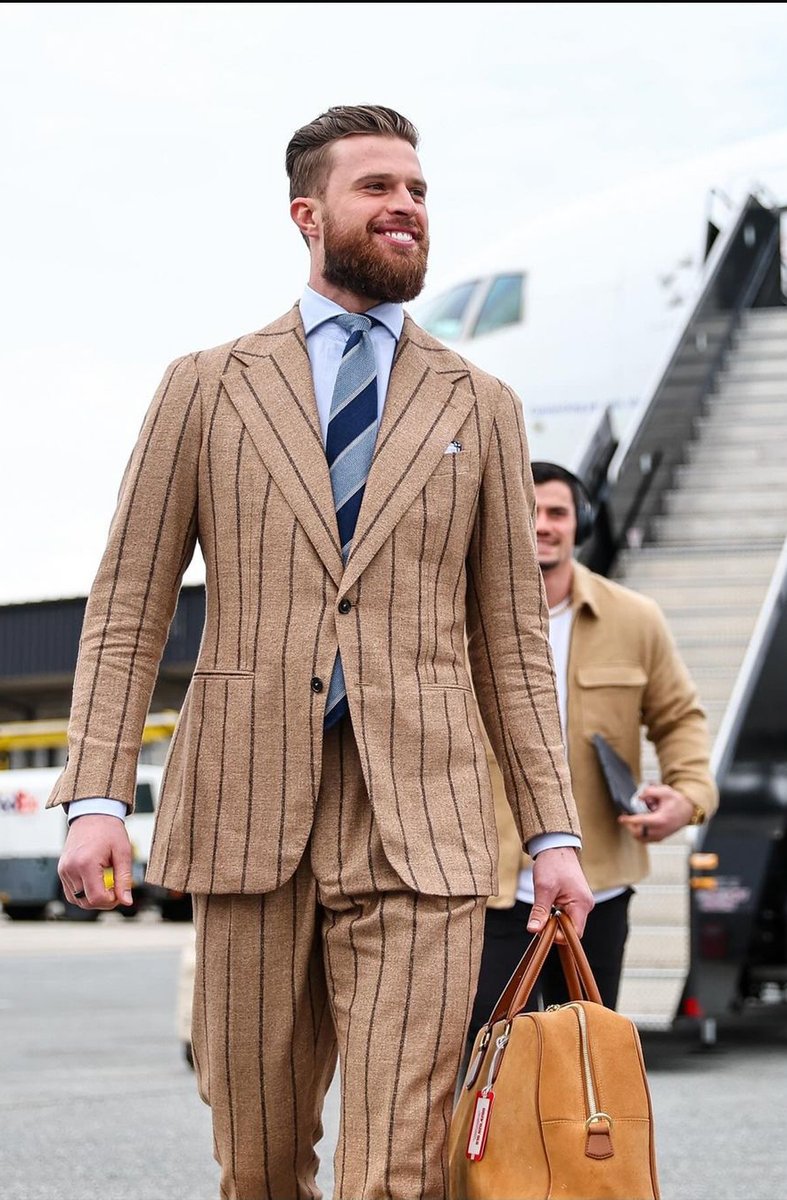
People keep asking me to comment on Harrison Butker's clothes, as he seems to be a clotheshorse. Some note that his clothes look "off." In almost every instance, it's because his clothes are too small. I will demonstrate. 🧵
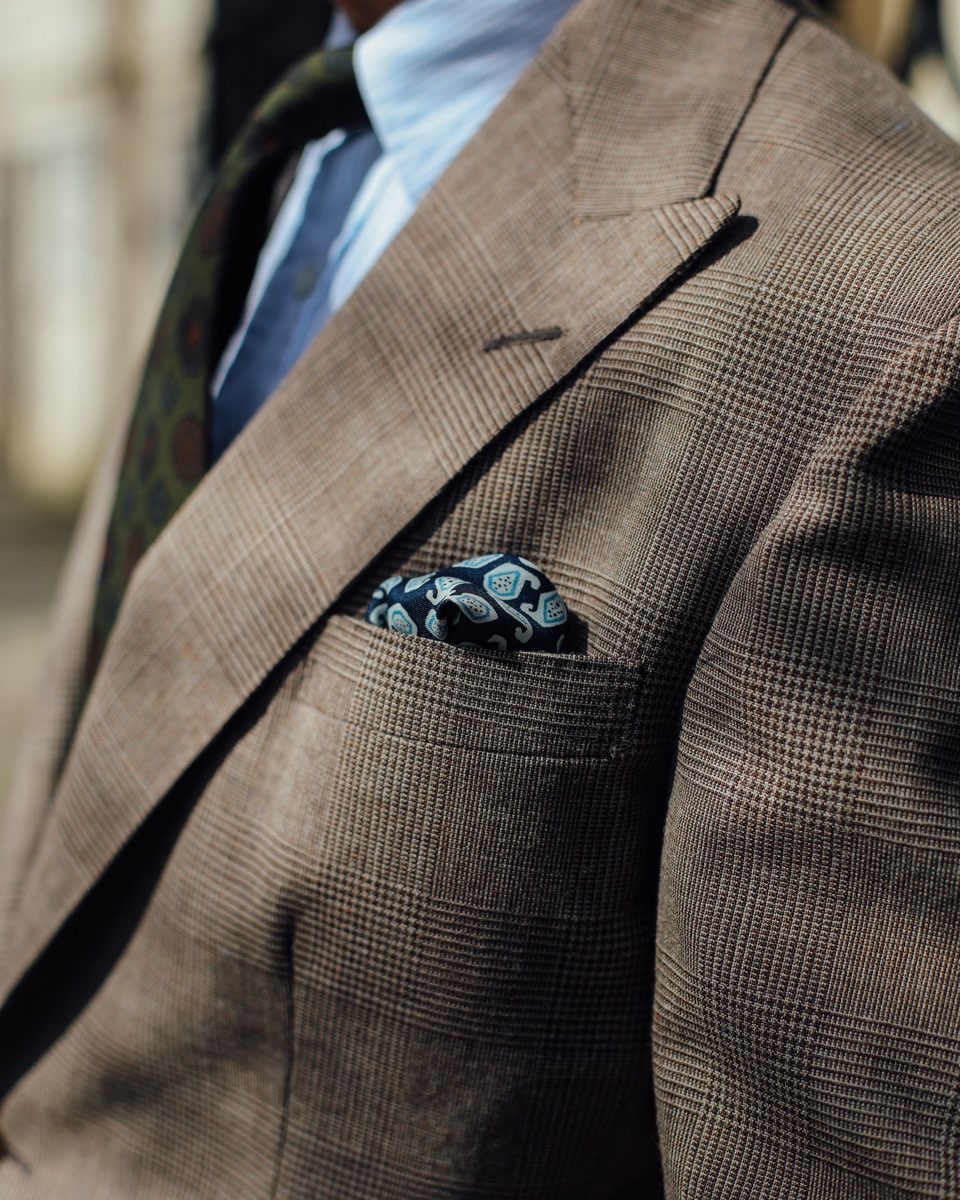
In some cases, the outfits look bad because of poor styling decisions. These are bad fabrics. If you are starting to build a better wardrobe, it can be a good idea to avoid hard-finished fabrics with patterns. Without a fuzzy nap, the patterns can have very hard lines.
For example, compare the glen check woolen flannel on the left to the stripe on the right. A fuzzy nap will soften the lines, especially if the pattern is already not in high contrast. Mutes the blow.
But in most cases, what people are picking up on is the effect of shrinking an outfit. Some of Harrison's outfits are good, and they're good mostly because the cuts are larger and longer. For example, which of these two looks better to you? Note the jacket length.
What about this?
How about these two?
When you shrink a tailored outfit, you narrow the shoulders, shorten the jacket, raise the buttoning point, reduce the waist suppression, and emphasize the hips by heavily tapering the trousers. You end up looking like a bell.
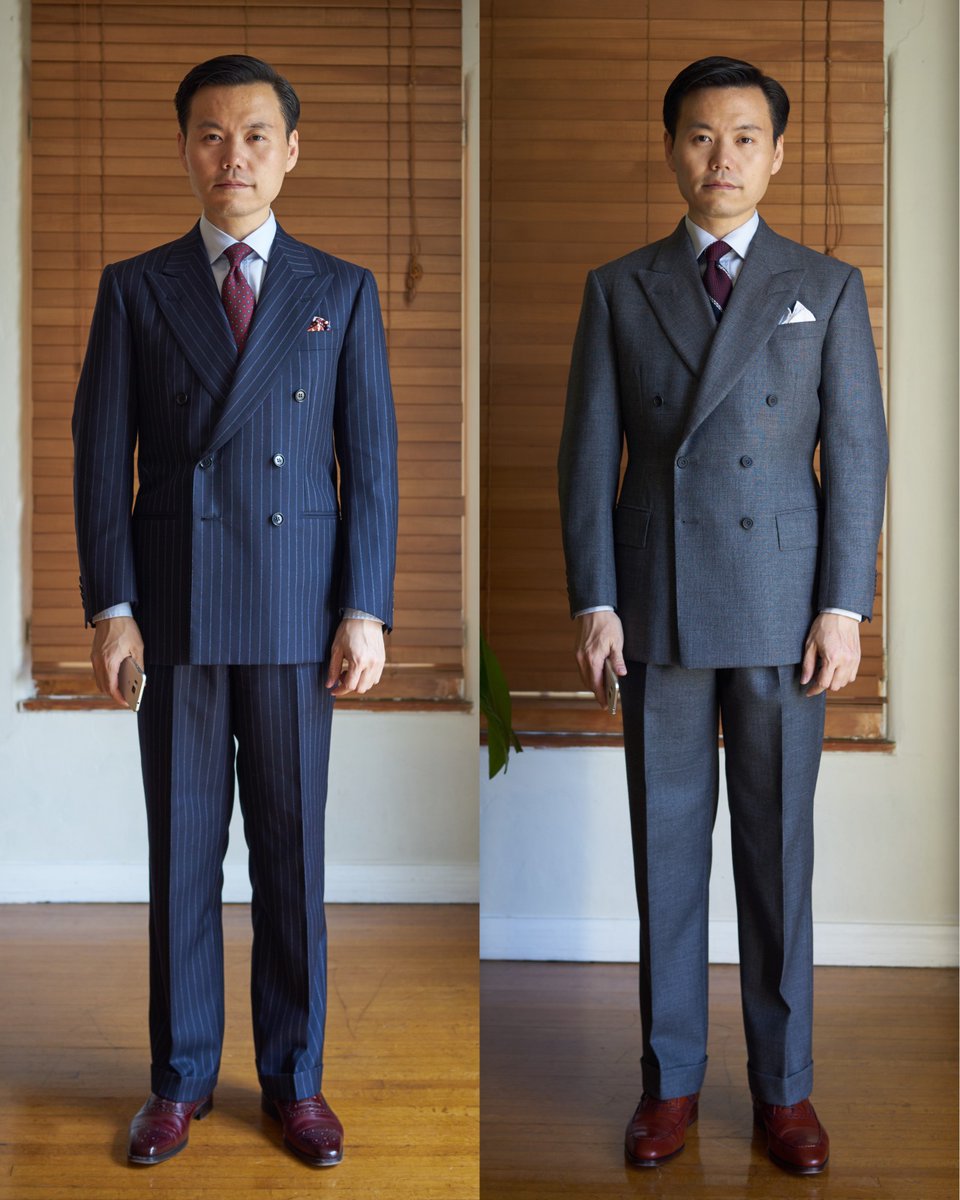
Compare this to a more traditional silhouette, where you widen the shoulders, lengthen the jacket, lower the buttoning point, create more waist suppression, and loosen the pants. The result is a V-shaped torso on columnar legs.
Some of Harrison's outfits are quite nice when they follow these principles and when he chooses more muted fabrics. His taste is not sophisticated enough yet for him to venture too far from these safe colors and muted patterns.
For instance, these fabrics are ugly. The effect is made worse by the heavily tapered trousers. Taste level is very low.
The influence of bad ready-to-wear trends and 2010 menswear editorials is also evident in the cut of these overcoats. They are too slim and too short, and again, they lack verve.
Consider them to a longer, more traditional cut.
Harrison's outfits would be improved if he stuck to more traditional cuts and conservative fabrics. If he wants to venture further, he should choose a skilled tailor with good taste and not open his mouth. The less he inserts himself in the process, the better.
• • •
Missing some Tweet in this thread? You can try to
force a refresh

No one will see the label inside your clothes or know who made the fabric. So, it's more important to develop an eye for what looks good than to rely on brand names. In this thread, I will show some good spring/ summer fabric for tailoring. 🧵
Since woolen yarns hold heat, spring/summer clothes are typically made with worsted fabrics. That means that they don't have a fuzzy nap (i.e., they're not hairy, like tweed). Without a nap, a strong pattern can have very vivid lines, which often look ugly.
For this reason, a full suit in a patterned spring/summer fabric can be difficult to wear. One solution is to go for a very subtle pattern in low contrast, such as puppytooth, five-point star, or a hairline weave. These are always unimpeachable.
People are misunderstanding my point. It's not that brown shoes are wrong with dark suits. It's that tan shoes, in particular, are wrong with dark suits. It's also not about naval history but rather regional traditions. I will explain in this thread. 🧵
The suit was a British invention that spread around the world through the rise of Empire. So it's natural that England, and London in particular, set the standards for how to wear a coat and tie. During this period, certain traditions, cuts, and styles emerged.
As I've mentioned before, one such tradition is that men had wardrobes divided between city and country. City was for business, where men wore dark worsted suits with white shirts and black oxfords. Country was for sport, where they'd wear tweeds, tattersalls, and brown derbies,
Color works in a very specific way when it comes to fashion. But before I go on, I don't want my following thread to color your views. So let's start by asking: Which of these two outfits looks better to you? Choose before going on. 🧵
IMO, color should not be treated as a kind of abstract pseudo-science (e.g., blue looks good with brown). While those principles may be true, they are secondary to a more important consideration: the social language of clothing. What's the aesthetic you're operating in?
Let's take traditional tailoring. As I've mentioned before, many of our traditions for men's tailoring come from Britain, where men of a certain social class had wardrobes divided between city and country. Men wore stuff like navy suits in the city and brown tweeds in the country
i dont understand how this is the alpha male look nowadays. if these clothes were any tighter, they'd be inside him
Again, I disagree that wearing tight clothes necessarily makes for a more masculine silhouette. People should pay more attention to how clothes create shapes on your body. And even if you have a very masculine, athletic figure, tight clothes make for a more feminine silhouette
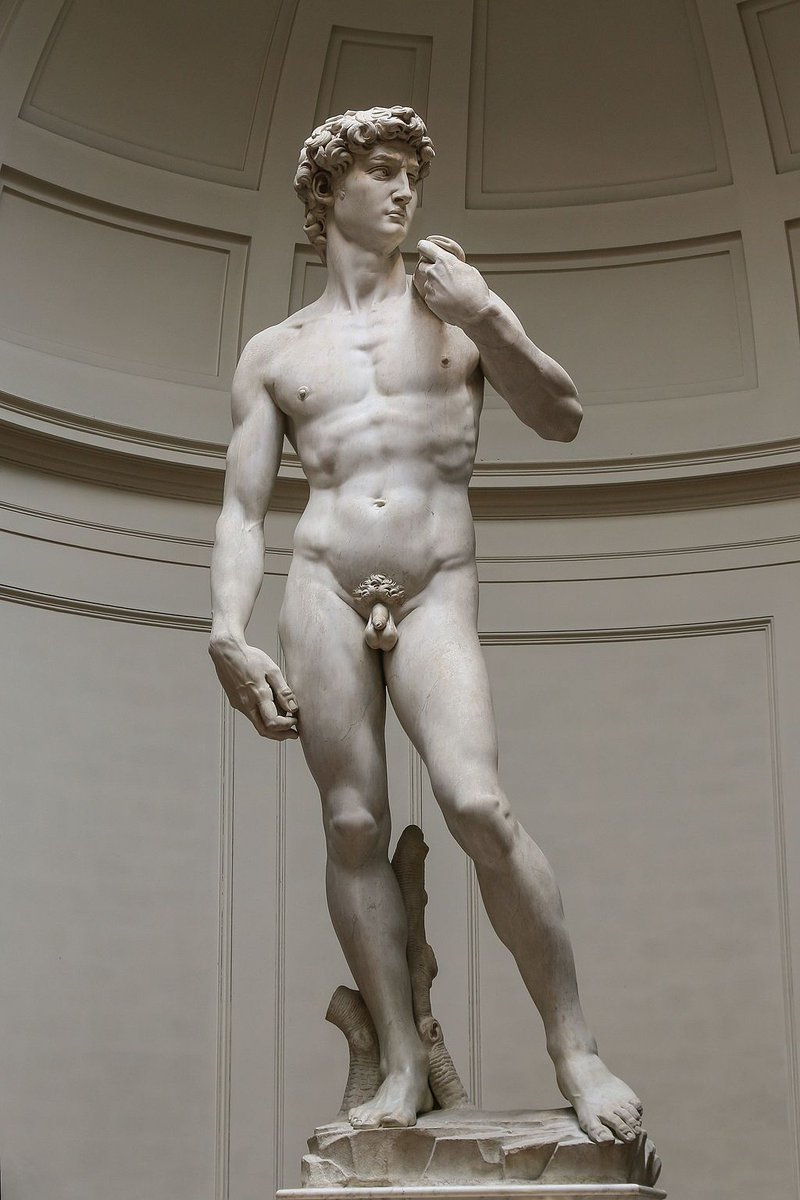
To clarify, these shapes do not necessarily mean anything for the people beneath the clothes. But in classic Western aesthetics, the masculine form is shoulders wider than the hips. The feminine silhouette is the opposite.
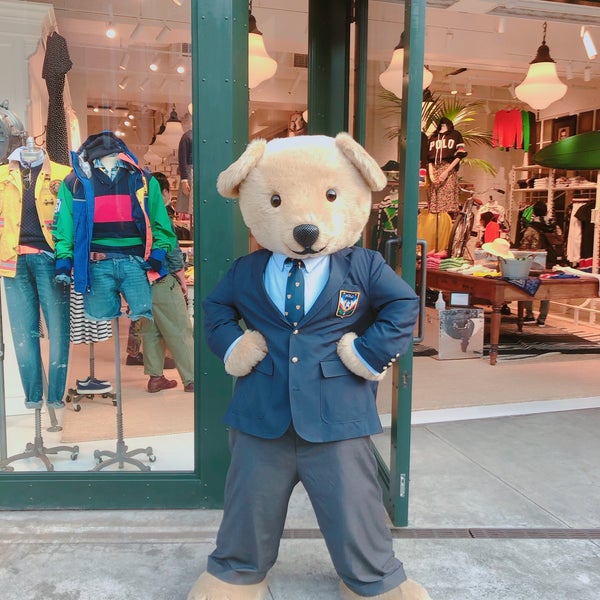
The producer of Ben Shapiro's show reached out to me to see if I'd like to discuss Ben's attire on his show. Like with Piers Morgan, since Ben invited feedback, I will do a thread comparing him to a menswear icon—this time, Ralph Lauren's Polo Bear. 🧵
Unlike his colleagues, Ben's tailoring is not bad. Jackets have shape and fit him well. Compare his jacket to Peterson's, which looks like it was dunked in water (the small collar gap on Ben would be filled if he wore a dress shirt). Tonal seersucker in the second pic is cool
Unfortunately, a tailor can only do so much. They only make your clothes, not put them on you. For men of a certain social class, this task would have been historically performed by a valet. Such a relationship was hilariously depicted in the British TV show Jeeves and Wooster
For a brief moment in 2018, J. Crew offered these "canoeist smocks" inspired by something elite British naval officers wore during WWII. The design was so cool—the kind of thing you'd typically only see from specialty Japanese brands.
The brand is in a much better position now than it was in 2020 (when it filed for bankruptcy). For a moment, it almost became like Old Navy. But the company's outerwear designs now are less risky, less exciting, and less complex. They use simple patterns and seams.
When people talk about quality, they often talk about the garment's fabric or durability. I often think of quality in terms of the garment's complexity. This smock was available in ripstop cotton ($298) or Ventile ($450). Not cheap, but well-made and tons of details for money.