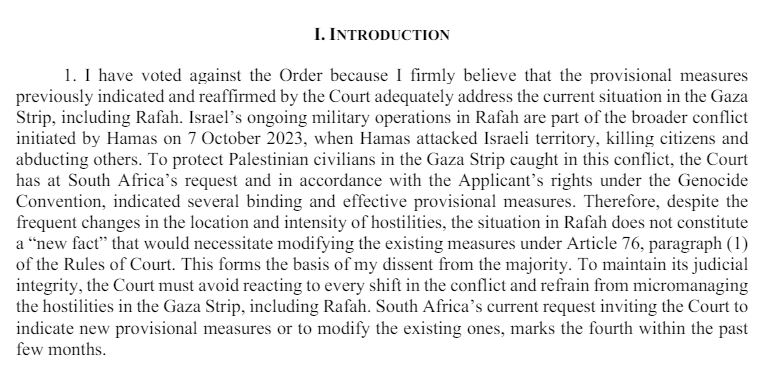
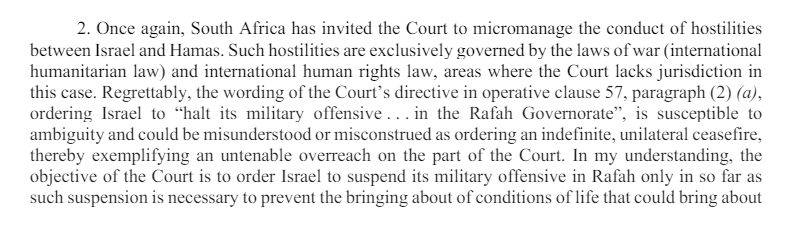
There seems to be disagreement among some ICJ Judges as to how exactly this sentence should be read.
I read it as meaning that Israel has to halt its offensive in Rafah, period. And it should also halt "any other action which may inflict on the Palestinians conditions of life that could bring about their physical destruction".
Judges Sebutinde, Aurescu and Barak however seem to think it means that Israel should halt its offensive *and* any other action in Rafah *only* to the degree it would inflict on Palestinians conditions of life that could bring about their desctruction
Judge Tladi reads it as meaning that Israel should halt its *offensive* in Rafah, period. Meaning that *defensive* operations against Hamas actions emanating from Rafah would be allowed.
The rest of the Judges stayed silent, which is most unhelpful.
Any Oxford Comma experts out there? It's your time to shine!
• • •
Missing some Tweet in this thread? You can try to
force a refresh

Ok let's give a quick glance at the individual opinions shall we?
Judge Sebutinde: Rafah offensive is not a "new fact" but "part of the broader conflict initiated by Hamas on 7 October 2023"
Judge Sebutinde argues that South Africa wanted the Court to "micromanage" the hostilities, and that the Court's order should not be misconstrued as "ordering an indefinite, unilateral ceasefire"
Court: has to decide if there has been a change in circumstances and if this change warrants modifying the PM
The situation in Gaza has deteriorated since the March Order. Court: "the concern that it expressed in its decision wrt developments in Rafah has materialised and that humanitarian situation is to be categorised as disastrous"
Tracking State reactions to the arrest warrants issued by the ICC OTP against Israeli and Hamas leaders, a thread 🧵
First, a reminder on method: I will only collect statements from HoS, HoG, and MFA, except for specific cases of specially affected states. I will also collect UNSC and UNGA statements. Statements by IOs do not count for individual members, unless signed individually by states
Occupation follows the logic of a temporary administration of territory until a final post-war settlement can be achieved. Israel signed peace with Egypt 45 years ago, and yet continued the occupation of Gaza, thus turning it into an act of aggression against Palestine
Why did the occupation continue? Because it follows a different logic - the logic of Nakba: the systematic and illegal domination, ethnic cleansing, settlement and annexation of Palestinian territory
Claims that Gaza is not occupied need to address this fact. Are Palestinians in Gaza free from the logic of Nakba? Or was the 2005 Withdrawal simply a more “practical” way of dealing with Hamas while not relinquishing domination over the area?
I think @harari_yuval is righ when he describes Zionism as an example of "19th century European nationalism", but I think he is wrong when he argues there is nothing racist about (all) 19th century European nationalisms. Some thoughts.
The main idea of European nationalisms is, as @harari_yuval says, that the group constitutes a nation, a condition which grants it self-determination rights. But 19th century European nationalism existed on the bedrock of the Westphalian "nation-state"
The purpose of such nationalist fervor was to protect the nation through the establishment of a nation-state: Poland for the Poles, Hungary for the Hungarians, Italy for the Italians, Germany for the Germans, etc. This is a call for cultural homogeneity, not diversity