Good morning from Trump’s NY criminal trial where the longest line yet is waiting to hear closing arguments.
It’s DAY number….ok, so I lost count.
Whatever day it is, I’ll be here, live tweeting it all gavel to gavel for @lawfare.
Join me, won’t you? 🧵⚖️
It’s DAY number….ok, so I lost count.
Whatever day it is, I’ll be here, live tweeting it all gavel to gavel for @lawfare.
Join me, won’t you? 🧵⚖️
It’s a Green Day, with nary a protester in sight at Collect Pond Park.
Well, except for one: a man holding a sign with the number of children killed and injured in Gaza, wearing a large metal crucifix, and yelling antisemitic things.
Well, except for one: a man holding a sign with the number of children killed and injured in Gaza, wearing a large metal crucifix, and yelling antisemitic things.

Follow @katherinepomps, aka the David Attenborough of the NY Trump trial press corps, for the urban wildlife beat 👇
https://twitter.com/katherinepomps/status/1795423503803449618
Update from the press overflow courtroom: it is STEAMY.
Stay hydrated out there, y’all.
Stay hydrated out there, y’all.
While we wait for summations, revisit where we left off in our last dispatch: the defense rested after Costello's tumultuous testimony and both sides jockeyed with Justice Merchan for the most favorable jury instructions (which we will hear tomorrow).
lawfaremedia.org/article/a-witn…
lawfaremedia.org/article/a-witn…
As I stretch my fingers to settle in for a marathon day of live tweeting, a reminder that this thread, as all threads, are powered by you.
Please consider supporting me, @AnnaBower, and everyone at @lawfare do what we do best. We can't thank you enough.
givebutter.com/c/trumptrials/…
Please consider supporting me, @AnnaBower, and everyone at @lawfare do what we do best. We can't thank you enough.
givebutter.com/c/trumptrials/…
@AnnaBower @lawfare It's 8:58 a.m., and America's Favorite Paralegals ™️ arrive.
They're America's favorites for a reason: They're always the first to arrive and last to leave. They've earned the honorific.
They're America's favorites for a reason: They're always the first to arrive and last to leave. They've earned the honorific.
I spot a reporter in the press overflow catching a few zzz's before we start.
As one of the grisled, veteran journalist characters said in Civil War (which I saw last night), "You want to get sleep when you can. You never know what's going to happen."
As one of the grisled, veteran journalist characters said in Civil War (which I saw last night), "You want to get sleep when you can. You never know what's going to happen."
At 9:18 a.m., ADA Josh Steinglass, whom we expect to deliver closing arguments, arrives.
I wonder how much sleep he got last night. But then again, he's appeared cool and in control the entire trial thus far. This is both unprecedented and mundane for the seasoned prosecutor.
I wonder how much sleep he got last night. But then again, he's appeared cool and in control the entire trial thus far. This is both unprecedented and mundane for the seasoned prosecutor.
Per the pool, Trump is out in the hallway now, repeating his talking points about how Justice Merchan is "conflicted" and corrupt, and attacking the gag order.
In the hallway, Trump also read from conservative op-eds, including one from Jonathan Turley and another from Andy McCarthy.
I have not yet heard if he has read my @newrepublic piece, but I haven't given up hope: newrepublic.com/article/181606…
I have not yet heard if he has read my @newrepublic piece, but I haven't given up hope: newrepublic.com/article/181606…
@newrepublic At 9:25 a.m., Trump walks in, bold red tie, and he sits between defense counsel Todd Blanche and Emil Bove. Susan Necheles is to Bove's left.
They all appear in good spirits.
They all appear in good spirits.
Thanks to @JayShams, we have an update on the Greek chorus: Trump's usual crew (Jason Miller, Boris Epshteyn, Alina Habba, Susie Wiles, etc) is joined today by Don Jr., Eric Trump, Lara Trump, Tiffany Trump, son-in-law Michael Boulos, and commentator Deroy Murdock.
At 9:31 a.m., the usually punctual Justice Merchan arrives (a minute late!), and it's All Rise.
Steinglass and Blanche make the typical introductions.
Steinglass and Blanche make the typical introductions.
Good morning counsel, good morning Mr. Trump, Merchan says, and mentions for the record that he sent both parties the Court's proposed jury charges.
Before we get started, Merchan asks for time estimates on summations.
Blanche says around 2.5 hours, maybe less, and Steinglass says, while it will be responsive to the defense's, about 4.5 hours—and an audible, exhausted groan washes over the entire press overflow room.
Blanche says around 2.5 hours, maybe less, and Steinglass says, while it will be responsive to the defense's, about 4.5 hours—and an audible, exhausted groan washes over the entire press overflow room.
As we wait for the jury, Justice Merchan reminds the parties: "Please do not go into the law. Stay away from the law. Do not explain the law. That'll be my job—I'll take care of that."
Jury is back, & Merchan greets them and gives instructions: You will now hear summations, following that I'll instruct you on the law, then you'll begin your deliberations. Under our law, defense must sum up first, followed by prosecution. Lawyers may not speak to you after that
Summations are an opportunity for lawyers to submit for your consideration the facts, evidence and the inferences and conclusions that may be drawn from it—it's up to you whether it's reasonable, logical, and consistent with the evidence.
Merchan continues: You are the finders of fact, and it is for you and you alone to determine the facts from the evidence. Thus, you should remember that whatever the lawyers say and however they say it, it is simply arguments for your consideration. During summations, lawyers...
...recollection of evidence may differ. It is your own recollection that matters. Under our law, I’m responsible for explaining the law, not the lawyers. It’s your duty to follow my instructions. During summations, sustained objections will be stricken, and you must disregard it.
He ends with scheduling: we may not finish today, but we may be able to if we work late. It's up to the jury whether we run late today, but no big deal if not—we can wrap it up tomorrow morning.
And with that, Blanche stands to deliver Trump's closing argument.
And with that, Blanche stands to deliver Trump's closing argument.
I hope that everyone had a nice long weekend, Blanche begins. He starts by thanking the jury—for their service, for paying close attention all day every day.
Our criminal justice system is unique, he says, in that a group of citizens decide the facts.
Our criminal justice system is unique, he says, in that a group of citizens decide the facts.
The screen is obscured in press overflow courtroom, because this is still an anonymous jury. So we can't see Blanche, who is likely addressing the jury at close range, but we can hear him.
Blanche continues: Trump is innocent, he did not commit any crimes, and the DA has not met their burden of proof. Period.
You should want and expect more, Blanche tells the jury, than the testimony of Cohen, than something beyond the word of a woman that something happened in 2006, than Keith Davidson, an attorney who was just trying to extort money from Trump in the leadup to the election.
This case is about documents—it's a "paper case"—it's not about an encounter with Stormy Daniels 18 years ago, one that Trump has repeatedly denied, Blanche continues. It's not about an 8 year old NDA that was signed...
...The reason why we're here is whether and to what extent President Trump, while he was living in the WH as the leader of the free world made payments to his personal attorney from his personal ledger were intended to defraud. The answer to those questions is: absolutely not.
The bookings were accurate, there was no intent to defraud, Blanche says, & beyond that, there was no conspiracy. The proof there doesn't add up.
We see Blanche now in a small inset, and evidence up on the screen. It looks like an org chart, with invoices, vouchers, and checks.
We see Blanche now in a small inset, and evidence up on the screen. It looks like an org chart, with invoices, vouchers, and checks.
Blanche says that he will talk about Cohen a lot today—that shouldn't surprise you. The words that Cohen spoke matter, he entreats the jury.
The chart has Cohen's invoices in one box, with an arrow pointing at a Trump Org box with vouchers and checks.
The chart has Cohen's invoices in one box, with an arrow pointing at a Trump Org box with vouchers and checks.
Blanche begins with two (but not all) of the key elements—1st - the documents contain false entries, and 2nd that Trump acted with an intent to defraud—because if they don't find those elements, the jury can stop right there. Acquittal.
Blanche: Two key elements (false entries + intent to defraud), and three types of documents (invoices, vouchers, and checks).
We start with INVOICES.
We start with INVOICES.
Blanche: Let’s talk about invoices. They were prepared and sent by Cohen, Trump Org accountants stamped them. Then there were vouchers prepared by Tarasoff, using a system called MDS, the vouchers were the results of invoices.
Not a single invoice was sent to Trump directly, Blanche says. Of course the government will say that you know that Trump saw these invoices, bc Tarasoff said she will staple them to the back of checks—though she didn't have specific recollection about invoices related to these..
..particular charges. Tarasoff told you about her general practice, but general practice, ladies and gentlemen, is not. proof. beyond. a. reasonable. doubt., Blanche says, punctuating each of those words.
Next slide in Blanche's powerpoint presentation: he points out that Cohen always invoiced "for services rendered," because (and this isn't in dispute) Cohen at the time was rendering services to Trump, as his personal attorney.
The government wants you to believe that Cohen wasn't working for the $35k, he was working for free, Blanche says incredulously.
"Cohen lied to you," Blanche says. "Cohen Lied. To. You." he repeats.
"Cohen lied to you," Blanche says. "Cohen Lied. To. You." he repeats.
Even if the amount of work that Cohen was doing in 2017 was minimal, there was a retainer agreement—that's how retainer agreements work, Blanche says, referencing Cohen's other consulting gigs, including with Novartis (over $1m for only 6 interactions).
When the govt talks to you about invoices, Blanche says, when you see "for services rendered," that's a true statement—period. It wasn't secret. Cohen "broadcast this fact to the world."
Blanche: This was not a secret. Michael Cohen was Trump's personal attorney. Period.
Blanche: This was not a secret. Michael Cohen was Trump's personal attorney. Period.
So far, Blanche's delivery has been even, calm, but his voice raises in volume and intensity now as he talks about Cohen: "That. Was. A. LIE."
Blanche reads an email from Weisselberg to Cohen, in a mocking tone: "You never stopped on for a bro hug. Anyway, please prepare the agreement we discussed so we can pay you monthly."
Blanche's message is consistent: Cohen billed for services rendered, and there was a verbal retainer agreement.
"As you heard from multiple witnesses," Blanche says, the lack of a written retainer "doesn't matter"—objection, Steinglass says, loudly and strongly. Sustained.
"As you heard from multiple witnesses," Blanche says, the lack of a written retainer "doesn't matter"—objection, Steinglass says, loudly and strongly. Sustained.
Cohen was President Trump's personal attorney. Period, Blanche says for emphasis.
Another aspect of Blanche's summation so far has also been remarkably consistent: his fondness for saying "PERIOD." ...period.
Another aspect of Blanche's summation so far has also been remarkably consistent: his fondness for saying "PERIOD." ...period.
Trump gave Cohen $50k for "some online poll" and by the way stole some of that, Blanche says. Usually the simplest answer is the right one: that the story that Cohen told you on that witness stand was not true. That really he was being paid $35k/month to be his attorney in 2017.
Now the vouchers, which were run on an antiquated system, even for 2017, Blanche says. There's no evidence that Trump knew about this voucher system. No evidence—not a single word.
Blanche continues, wondering aloud how the govt will address lack of evidence about Trump's knowledge of the voucher system.
When the govt reads to you quotes from books that are more than a decade old, Blanche continues, "You should be suspicious...Proof beyond a reasonable doubt does not include passages from a book."
Recall the brief testimony from staff from Trump's book publisher.
Recall the brief testimony from staff from Trump's book publisher.
Still on the vouchers, Blanche points out on screen how Tarasoff logged them in the system (from the dropdown menu): LEGAL EXPENSE.
To be fair, it does look like quite an antiquated accounting system. My heart goes out to the accounting staff working with clunky software.
To be fair, it does look like quite an antiquated accounting system. My heart goes out to the accounting staff working with clunky software.
Blanche zeroes in on the McConney email: "Please pay from the Trust"—this was post-inauguration, Feb 2017, a confusing time when all of Trump's assets moved into the Trust to avoid conflicts of interest. (A move which by the way, paints a prudent, careful, rule following picture)
As we remember, Don Jr and Eric were Trust signatories, and this is one of the documents for which Trump was charged for a felony, Blanche says—if there was some sort of conspiratorial agreement, why didn't we also hear from Trump's sons?
That is reasonable doubt, Blanche says.
That is reasonable doubt, Blanche says.
After the first 3 payments were made from the Trust, someone realized that Cohen is Trump's personal attorney, so they switched to Trump's personal account, Blanche says, depicting it as an honest mistake that was fixed when found—that's just what happens, he says.
With this section of his closing, Blanche seems to be picking apart specific charges—attacking a few of the 34 counts in particular—rather than all of the charges as a whole.
You shouldn't think that the word retainer specifies or differentiates reason for the payment, Blanche says. It's just a word that was generated by the MDS system.
The Trust checks behind us, Blanche moves on to the Trump-signed checks starting April 2017, during which Trump was very busy—he was running the country. Westerhout said sometimes Trump would look at the checks, but sometimes he would not. Sometimes checks stacked up half an inch
You can't convict President Trump because sometimes he looked at invoices—that he had full knowledge of what was happening? Blanche stops, backtracks, seeming to lose his train of thought, but then regains his momentum: That is a stretch ladies and gentlemen.
It matters where Trump was during this time, Blanche says: he was busy, moving around, constantly interrupted, he was president of the United States. The govt wants you to take a "leap" that Trump was part of this "scheme"—that he somehow was in on that, is absurd.
Blanche continues a bit longer with the "Trump was busy" argument before switching back to "Cohen is a liar" argument.
Even without Cohen, Blanche says, there's reasonable doubt, but how can you convict Trump based on the words of Michael Cohen?
Even without Cohen, Blanche says, there's reasonable doubt, but how can you convict Trump based on the words of Michael Cohen?
What the People did for the past 5 weeks is ask you to believe the man who testified 2 weeks ago: Michael Cohen. Cohen, in turn, asked you to ignore the emails, ignore what the invoices said.
Blanche returns to the "how could Cohen work for free" argument.
Do you believe for a second, Blanche rhetorically asks the jury, that after getting stiffed on his bonus in 2017, that Cohen thought, "I'm gonna work for free"? (The incredulous tone returns.)
Do you believe for a second, Blanche rhetorically asks the jury, that after getting stiffed on his bonus in 2017, that Cohen thought, "I'm gonna work for free"? (The incredulous tone returns.)
During this section of summation, the slide title reads: "Case Turns on Cohen" with a pic of Cohen's testimony of the Weisselberg meeting.
Blanche points out that Cohen didn't even pretend Trump was part of the conversation, he only said it's gonna be a wild ride in DC.
Blanche points out that Cohen didn't even pretend Trump was part of the conversation, he only said it's gonna be a wild ride in DC.
The idea that Trump would agree to pay Cohen $420k, even though he only owed him $130k, is absurd Blanche says. Cohen wants you to believe that Trump saw this paper (which includes $50k to RedFinch, which Trump didn't want to pay), and then said "out of the blue" let's double it.
"That. Is. Ab. Surd." Blanche continues, hammering on about how much we heard about how closely Trump watched his finances. By the way, his version of events of the campaign are belied by other evidence, he says.
Still under the slide heading Case Turns on Cohen, Blanche displays the First Republic statement w/ handwritten notes.
"The point of this document is that it contains lies," Blanche says.
The word of the day is LIES. Period!
"The point of this document is that it contains lies," Blanche says.
The word of the day is LIES. Period!
Blanche now turns to the gross up, and displays Cohen's testimony about it: "I didn't know. And to be honest, I didn't really even think about it. I just wanted to get my money back."
What proof/evidence do you have that this gross up had anything to do with taxes? Blanche asks.
What proof/evidence do you have that this gross up had anything to do with taxes? Blanche asks.
The slide header still reads Case Turns on Cohen.
Blanche displays the photo of Cohen at the White House in Feb 2017—Cohen told us that he's going to the Oval Office for the first time in his life, Blanche says in an awed tone, and you want us to believe they discussed checks?
Blanche displays the photo of Cohen at the White House in Feb 2017—Cohen told us that he's going to the Oval Office for the first time in his life, Blanche says in an awed tone, and you want us to believe they discussed checks?
But just 6 days after that supposedly confirmatory meeting about the checks and payments in the Oval Office, Blanche says, Cohen emails McConney: Jeff, Please remind me of the monthly amount?
Blanche displays a splitscreen of the First Republic statement and notes and McConney's notes on Trump stationery, pointing out discrepancies and gaps, calling into question the big conspiracy.
Blanche asks why we even have this evidence: McConney didn't get rid of them, he didn't try to destroy them—this is a case about false filings, and yet the supposed evidence of the false filings were in the records of Trump's personal account and McConney's payroll cabinet.
Setting aside the first element for now, Blanche moves to the next element: that Trump made or caused these entries with an intent to defraud. There is no evidence of that, he says.
There's no intent to defraud, Blanche continues, displaying the 1099 to show the money went from Trump's account to Cohen's. There's nothing false or misleading in the 1099—if there was some deep-rooted intent to defraud, why was it reported to the IRS as exactly what it was?
The slide header now reads No Intent to Defraud, and Blanche displays a 5/3/2018 tweet as proof of that claim
(Ok, so I included that first response from @DeanObeidallah in my screenshot just now, though Blanche only showed the tweet...)
(Ok, so I included that first response from @DeanObeidallah in my screenshot just now, though Blanche only showed the tweet...)

Now to the object offense.
There's no crime, period, Blanche says, but even if you get to ask yourself to ask yourself about any conspiracy to influence the 2016 election, you will find that Trump is not guilty.
There's no crime, period, Blanche says, but even if you get to ask yourself to ask yourself about any conspiracy to influence the 2016 election, you will find that Trump is not guilty.
Blanche continues with the object offense: The charges relate to 2017 documents, and the government wants you to believe that Trump did this to conceal his successful candidacy in 2016, the year before.
But even so, Blanche says, every campaign is a conspiracy of people working together to help somebody win an election. You still need to prove that this was done by "unlawful means." He breaks it down, beginning with start of the alleged conspiracy: the Aug 2015 meeting w/ Pecker
Blanche depicts the "catch-and-kill" scheme as routine: This is the same thing AMI has been doing for decades, and for Pres Trump since the 90s—Pecker told you that they purchased story all the time, about Tiger Woods, Mark Wahlberg, and others—it was just good business.
The slide header now reads—AMI: Standard Operating Procedure.
It's not uncommon for campaigns to work with the media, it's a regular practice, and it's not surprising, says Blanche. You want to amplify the good things about the candidate, & expose the bad things about opponents.
It's not uncommon for campaigns to work with the media, it's a regular practice, and it's not surprising, says Blanche. You want to amplify the good things about the candidate, & expose the bad things about opponents.
Blanche runs through other catch-and-kill schemes Pecker mentioned in his testimony, incl about Rahm Emmanuel (whom Blanche describes as Ari Emmanuel's brother, who is a "big power broker, apparently")—that's why Pecker thought the Trump situation was legal. Objection, sustained.
As far back as 1988, Pecker said he had helped surpress a story for Trump, Blanche says, repeating 1988, then doing the math (incorrectly) "that's 17 years ahead of the August 2015 meeting."
(Quick calculator math tells me it's 27 years actually.)
(Quick calculator math tells me it's 27 years actually.)
The next slide header: President Trump: Good for Business.
Blanche continues: The idea that sophisticated people like Trump and Pecker thought that positive stories in the National Enquirer could influence the 2016 election is preposterous.
Blanche continues: The idea that sophisticated people like Trump and Pecker thought that positive stories in the National Enquirer could influence the 2016 election is preposterous.
Next header: No Election "Influence"
Blanche displays a sentence from the DA's opening: "Many of these headlines and the stories behind them were even shown to Cohen and the defendant in advance"—but Pecker only offered a "general discussion" of helping Trump, says Blanche.
Blanche displays a sentence from the DA's opening: "Many of these headlines and the stories behind them were even shown to Cohen and the defendant in advance"—but Pecker only offered a "general discussion" of helping Trump, says Blanche.
And anyway, many of the Enquirer's stories were "recycled," published elsewhere, Blanche says. The idea that the Enquirer could corruptly, criminally influence an election by republishing stories that had been out there in other forms should hopefully make you shake your head.
Remember the word "catch-and-kill"? Blanche asks. How that was the heart of the agreement?
They didn't even discuss catch-and-kill at the August 2015 meeting, Blanche says citing Pecker and Cohen testimony—there were no financial arrangements discussed then.
They didn't even discuss catch-and-kill at the August 2015 meeting, Blanche says citing Pecker and Cohen testimony—there were no financial arrangements discussed then.
Next header: "Catch and Kill"
Pecker testified, Blanche says, that the first time he heard the term was from a prosecutor—then on redirect revised that to reading it in an article—but either way, not mentioned in the allegedly conspiratorial meeting.
Pecker testified, Blanche says, that the first time he heard the term was from a prosecutor—then on redirect revised that to reading it in an article—but either way, not mentioned in the allegedly conspiratorial meeting.
Blanche hits on a point related to the so-called "catch and kill" scheme, and hits on it again, and again.
Pecker said that half the stories the National Enquirer bought, they didn't publish. Half the stories, Blanche repeats, and then a third time: Half the stories.
Pecker said that half the stories the National Enquirer bought, they didn't publish. Half the stories, Blanche repeats, and then a third time: Half the stories.
We now see a blank slide with the header: Sajudin.
It's the first of the three catch-and-kill schemes, and also, I might add, a convenient one for the defense, because no one disputes that the doorman's story was completely fabricated.
It's the first of the three catch-and-kill schemes, and also, I might add, a convenient one for the defense, because no one disputes that the doorman's story was completely fabricated.
Sajudin's story could've sold 10 million magazines, Blanche says Pecker had testified.
The first opportunity Pecker gets to work this conspiracy to help Trump he thinks, 'I'm publishing this'—what kind of a conpiracy is that? Blanche asks, his voice raising, more animated now.
The first opportunity Pecker gets to work this conspiracy to help Trump he thinks, 'I'm publishing this'—what kind of a conpiracy is that? Blanche asks, his voice raising, more animated now.
Blanche's idea here is that this first catch and kill scheme was nothing of the sort—Pecker caught it, fully intending to publish it if it was true, but only "killed" it because it wasn't.
"That. Is. Not. A. Catch. And. Kill. It's just not," Blanche says.
"That. Is. Not. A. Catch. And. Kill. It's just not," Blanche says.
Under the same slide header—Sajudin—Blanche doesn't miss an opportunity to bang on about the "Cohen is a liar" argument.
Blanche: On direct he says one thing. On cross he says another. He's not telling the truth. He's lying.
Blanche: On direct he says one thing. On cross he says another. He's not telling the truth. He's lying.
Blanche moves on to the second catch-and-kill, and the slide header changes: McDougal.
"This was not a catch-and-kill either," Blanche says. Everyone said the same thing: McDougal herself didn't her story published. She wanted to kickstart her career and be on magazine covers.
"This was not a catch-and-kill either," Blanche says. Everyone said the same thing: McDougal herself didn't her story published. She wanted to kickstart her career and be on magazine covers.
You later learned that one of McDougal's friends forced her hand, Blanche continues, but to be clear it was not McDougal's intention to publish her story.
The reason why this matters, Blanche says, is that there was never any risk that McDougal's allegations would influence the election, because she didn't want them published in the first place.
Trump is sideways in his seat, which he has only done on occasion during the trial, when he's at full attention.
He faces Blanche's back, watching him closely, as Blanche stands at the lectern facing the jury, documents scattered on the podium in front of him.
He faces Blanche's back, watching him closely, as Blanche stands at the lectern facing the jury, documents scattered on the podium in front of him.
After two sustained objections from Steinglass, Blanche's momentum flags slightly, but he picks it back up quickly and reminds the jury that Pecker received immunity from prosecutors in exchange for his testimony.
Blanche announces what he wants to discuss next: AMI's non-prosecution agreement (still under the slide header McDougal). Remember what Merchan said: That agreement is evidence of nothing as relates to Trump's guilt—objection, sustained, & Merchan asks Blanche to please rephrase.
With that in mind, what does McDougal story tell you? Blanche asks, returning to an old reliable argument: it's just more evidence that Cohen is a liar. He told you time and time again about conversations he claimed he had around this agreement that are just not true.
An unsurprising throughline through almost every segment of Blanche's closing: Cohen the liar.
Let's talk about another lie, Blanche says, remember when he said he had lunch with Pecker in Sept 2016 Ladies and gentlemen, that lunch did not happen.
Let's talk about another lie, Blanche says, remember when he said he had lunch with Pecker in Sept 2016 Ladies and gentlemen, that lunch did not happen.
So why does that lunch-non-lunch matter?
Blanche explains: Key meetings and key conversations are remembered with clarity from 2016—think about that, clear memories from 2016? ya gotta check that.
Every time Blanche talks about Cohen, he puts on a "c'mon man" kind of tone.
Blanche explains: Key meetings and key conversations are remembered with clarity from 2016—think about that, clear memories from 2016? ya gotta check that.
Every time Blanche talks about Cohen, he puts on a "c'mon man" kind of tone.
We stay with the McDougal header, and Blanche discusses the Oval Office recording, which Cohen says he took as evidence Trump would pay back Pecker, but there was just one problem: Cohen says he never actually played it for Pecker.
Now the logistics of the recording: Cohen explained to you, Blanche continues, that he put on his voice notes, and that Rhona Graff came "in and out" of that meeting.
Graff testified, but there wasn't a single question as to whether she remembered that meeting, Blanche says.
Graff testified, but there wasn't a single question as to whether she remembered that meeting, Blanche says.
Blanche plays some of the clip with Graff in it, stops it, then says the recording cuts off, yet Graff was not asked a single question about the meeting.
He plays more of it now, we hear Cohen say "transfer of all the stuff"—that was supposedly about AMI's box of Trump stories.
He plays more of it now, we hear Cohen say "transfer of all the stuff"—that was supposedly about AMI's box of Trump stories.
Blanche plays more of the recording:
If $150k was already determined, Blanche says, then why does Cohen say to Trump "We'll have to pay him something."
Blanche characterizes the call as a whole as Cohen and Trump talking past each other.
If $150k was already determined, Blanche says, then why does Cohen say to Trump "We'll have to pay him something."
Blanche characterizes the call as a whole as Cohen and Trump talking past each other.

Now Blanche discusses the use of financing and cash, and says that Cohen testified that cash just means no financing—but the prosecution is focusing on cash because it sounds a lot more criminal and sinister if there are duffel bags of cash.
Supposedly the recording cuts off bc a phone call comes in, Blanche says, so the last word you hear is "Check"—we don't hear anything else, Trump could've said "Check...with my people" but we'll never know what was said.
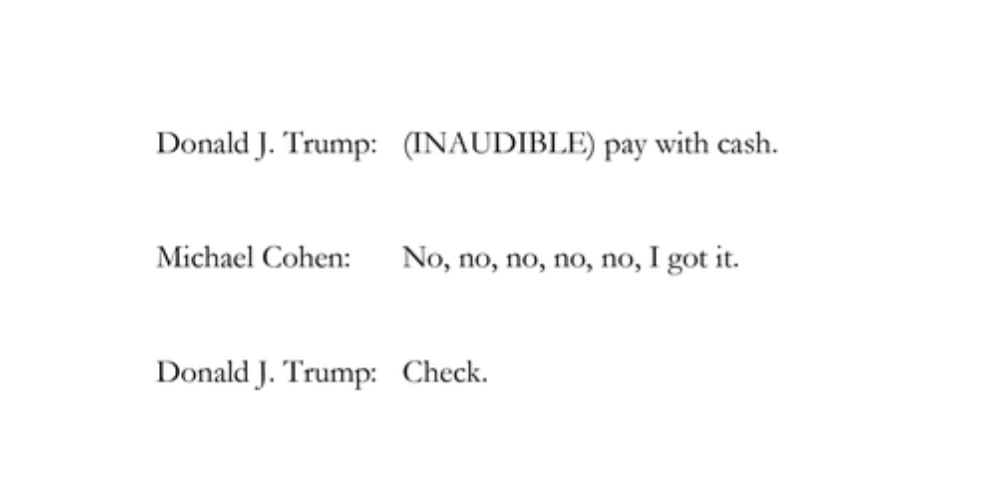
Blanche plays the end of the clip, and there's actually another few words from Cohen though it's not on the transcript. Cohen told you that it was from a bank manager at Capitol One, Blanche says, and that he interrupted this very important meeting to take it.
Here's the thing: Cohen didn't actually take that call, and there's not a dispute about that, Blanche says, and pulls up Cohen's phone records at the time, and a line says NIOP (incoming call):CFNA (call forward no answer):VM (voicemail).
He lied to you about answering that call, Blanche says. Would it have been a big deal for Cohen to say, it was a long time ago I don't remember? No, but Cohen didn't do that. He lied to you.
If anything, the McDougal story tells you a lot about Mr. Cohen.
If anything, the McDougal story tells you a lot about Mr. Cohen.
We turn, at last, to Stormy Daniels.
Trump repeatedly denied it took place, Blanche says, and yet the story was published in 2011—long before 2016, long before Aug 2015 meeting at Trump Tower—so how could it have influenced the election? People already knew about the allegations
Trump repeatedly denied it took place, Blanche says, and yet the story was published in 2011—long before 2016, long before Aug 2015 meeting at Trump Tower—so how could it have influenced the election? People already knew about the allegations
Even Cohen believed the Daniels story threat was an extortion tactic, Blanche says, and it was another opportunity for Cohen to "take advantage"—he made a decision to pay Daniels the money and didn't tell Trump about it—he just wanted to take credit for it at a later date.
The only person who said that President Trump knew all about this is Michael Cohen himself, Blanche says. There's no other evidence. There's no way you can find that Trump knew about this other than believing Michael Cohen's words—period.
The slide header now reads Daniels: The Story Was Already Public.
It doesn't matter if it was the Dirty, DailyMail, In Touch Magazine, Blanche says—by the election, Daniels' story was already public.
It doesn't matter if it was the Dirty, DailyMail, In Touch Magazine, Blanche says—by the election, Daniels' story was already public.
Blanche is flipping the 2016 pre-election timing on its head: as evidence that Daniels was using the timing to extort Trump, rather than Trump worrying about the timing to influence the election.
Blanche shows texts btwn Davidson and Howard: He wants to help Daniels and Rodriguez get money, says Blanche—that's not a conspiracy involving Pecker, Trump, and Cohen. And anyway, you didn't hear from Rodriguez and Howard—so a lot of this is speculation from the prosecution.
Blanche continues to talk about the more unsavory sides of Davidson and Howard: the Hulk Hogan affair, the meetings with a sex tape broker, and similar things that probably give everyone the ick.
As Blanche comes to a natural pause in his speech, Merchan gently cuts in and asks if it's a good time to take a break.
It is, and we break for 15.
Update: it is still *quite* steamy and sticky in here.
It is, and we break for 15.
Update: it is still *quite* steamy and sticky in here.
At 11:45 a.m., Trump strides back into the courtroom, his entourage in tow, and two minutes later, Justice Merchan returns, asking Blanche how we're doing on timing.
I'm on pace, he replies, estimating about 30 more minutes.
Merchan also mentions jurors have agreed to work late.
I'm on pace, he replies, estimating about 30 more minutes.
Merchan also mentions jurors have agreed to work late.
Jury now back, Blanche continues with the "Daniels situation in 2016." The slide header simply reads: Daniels. The question for you is: was what happened with Daniels in 2016 consistent with the conspiracy that the People tell you Cohen, Trump, and Pecker entered into in 2015?
Blanche displays Daniels' two denial statements: prosecution wants you to believe these were coerced, but Daniels decided to go public after these statements, because she was supposedly trying to protect herself from a threat someone made to her in a gym parking lot in 2011.
We fast forward to 2018, when Blanche says something happened that was worth a lot more than $135k—Larry Flynt offered to pay Daniels' legal fees to encourage her to "make her false accusations" public.
Blanche plays the "settler's remorse" clip.
Blanche plays the "settler's remorse" clip.

At the end of the day, what really happened is someone offered more money to Daniels, says Blanche,someone offered to pay her legal fees—then she wrote a book, she has a podcast and a documentary. This was about extortion, and it ended very well for Daniels, financially speaking.
There's nothing wrong, illegal, or sinister about a nondisclosure agreement, Blanche continues.
He has restarted his summation with the calm delivery with which he began it. His volume raises and lowers within a limited range. He's even-keeled.
He has restarted his summation with the calm delivery with which he began it. His volume raises and lowers within a limited range. He's even-keeled.
Blanche continues to discuss Dylan Howard's role: he had nothing to do with this conspiracy and had no motivation for Trump to succeed in the election.
So what really happened? Blanche asks.
After the Access Hollywood tape came out, Daniels and Rodriguez "seize and opportunity"—they go back to Howard and say now's the time to strike.
After the Access Hollywood tape came out, Daniels and Rodriguez "seize and opportunity"—they go back to Howard and say now's the time to strike.
So again, we're here talking about a conspiracy between Pecker, Cohen, Trump to catch and kill stories, Blanche says, his voice laden with mock exhaustion.
He gets loud, animated, gesticulating as he drifts from the microphone: "That's not catch and kill!"
He gets loud, animated, gesticulating as he drifts from the microphone: "That's not catch and kill!"
Now to the AH tape: this was an extremely emotional time for Trump, Blanche says. Nobody wants their family exposed to that type of story—doesn't matter if you're a presidential candidate, Apprentice host, or regular person—and Hicks testified to that.
The slide header still reads Daniels as Blanche continues to explain that the AH tape was cause for emotional distress, not a motive to commit a crime.
Blanche says that the only different version comes from one witness. Yup, you guess it, Cohen.
Blanche says that the only different version comes from one witness. Yup, you guess it, Cohen.
BLANCHE: The Access Hollywood tape is being set up in this trial to be something that it is not. It was one of many stressful stories and issues that came up in the 2016 election. It was not a doomsday event.
Back to Daniels, as Blanche asks openly why the DA didn't call her to testify at the grand jury but called her to testify in the trial. Why? To inflame her emotions, to embarrass Trump—objection, overruled—that's why, ladies and gentlemen.
Blanche displays two lines from Oct 2017, Cohen to Davidson, as supposed evidence that Trump didn't know about the Daniels payments until well after the fact:
"Who else would do that for sombody?"
"I wasn't gonna play, penny wise pound foolish."
"Who else would do that for sombody?"
"I wasn't gonna play, penny wise pound foolish."
Another lines from Cohen to Davidson:
"The amount was just not really that significant."
"The amount was just not really that significant."
Blanche stays true to his Cohen-is-a-liar throughline, turning to Cohen's testimony that he didn't want a job in the administration.
"But that was a lie—another lie," Blanche says with a dramatic flourish.
"But that was a lie—another lie," Blanche says with a dramatic flourish.
Next slide we see a bit of Costello's testimony, when he says Cohen said numerous times that Trump knew nothing about those payments—at the time, Cohen was "suicidal," according to Costello. A very stressful time, post-FBI raid, SDNY charges looming.
BLANCHE: I don't know how many lies are enough lies to just reject Mr. Cohen's testimony. Big or small, meaningful or unmeaningful.
We see the NDA and sidecar agreement, still under the slide header Daniels, as Blanche points out that Trump actually never signed the agreement.
If he never signed it, how could it ever be enforced? Blanche asks.
If he never signed it, how could it ever be enforced? Blanche asks.
What Trump knew in 2016, you only know from one source—Blanche stops himself, I've said that a few times, but it matters, then continues—and that's Michael Cohen.
He's trying to hang as much of the prosecution's case as humanly possible on the shaky tree of Cohen's credibility.
He's trying to hang as much of the prosecution's case as humanly possible on the shaky tree of Cohen's credibility.
I've spoken to Trump on Oct 24 at 8:02pm, Blanche says, impersonating Cohen in a mocking voice, despite the call log displaying a call with Schiller.
This was his sworn testimony, Blanche says, his voice raising to the highest decibel thus far: THIS. WAS. A. LIE.
This was his sworn testimony, Blanche says, his voice raising to the highest decibel thus far: THIS. WAS. A. LIE.
Blanche seizes on the small "gotcha" moment during Cohen's cross, when it came out that the 14 year old had been harrassing Cohen, though Cohen still said the call to Schiller was about Daniels.
"That is PUR-JUR-Y," Blanche booms.
"That is PUR-JUR-Y," Blanche booms.
We put that into evidence, and now you know what the truth, Blanche continues on about the Schiller call. Is there the same amount of evidence for absolute proof of lies that this man told you? No, for that we have an oath. The oath matters—to most. He lied.
After a very brief sidebar, Blanche resumes.
The slide header now simply reads: Cohen. Blanche is discussing "another lie" about a phone call with Melania Trump, though he concedes that it's not "the biggest lie in the world."
The slide header now simply reads: Cohen. Blanche is discussing "another lie" about a phone call with Melania Trump, though he concedes that it's not "the biggest lie in the world."
There's a lot of ways you can judge the credibility of a witness—but before you judge a witness, accept what they're saying, evaluate it the way you do in everyday life...Blanche says, but he drifts from the microphone again so it's difficult to catch the rest.
Cohen has repeatedly—repeatedly—lied under oath, Blanche says, launching into a litany of Cohen's lies: He lied to his family, to his kids, to his banker. He lied—Blanche stops himself—if you believe what he said on the stand, he lied to the FEC...
...He's literally like the MVP of liars. He lies constantly. He's lied to Congress, business associates, his bosses, federal judges. In fact, he's also a thief. He literally stole on his way out the door—stole—tens of thousands of dollars from the Trump Org—a felony.
Lies now aside, Blanche turns to Cohen's true feelings about Trump. For that, he plays clips from Mea Culpa. Cohen's voice cuts in abruptly, it's grating and frantic:
"Picturing Donald Trump going through the booking process, having his mugshot taken, fills me with delight"
"Picturing Donald Trump going through the booking process, having his mugshot taken, fills me with delight"
We march back through some of Blanche's themes on Cohen's cross: Cohen profited millions off of Trump's case—a witness who hates the defendant is actively making money off of that hatred and following what other witnesses say—objection, sustained.
Cohen is lying simply to benefit and protect Cohen—nobody else, period.
I'm...I'm almost done, Blanche says, mentioning that he's about to run through 10 reasons for Reasonable Doubt (the new slide header).
I'm...I'm almost done, Blanche says, mentioning that he's about to run through 10 reasons for Reasonable Doubt (the new slide header).
1-Invoices: Cohen created those invoices. They're accurate, and there's no evidence that Trump had an intent to defraud. No evidence Trump knew they were sent, none were addressed to him.
2-Valentines Day 2017 vouchers and checks: no proof that Trump sought anything Tarasoff did as vouchers. Two of the checks he never even saw or signed, the others he signed while running the country.
3-No Intent to Defraud: There was a 1099 form, Trump tweeted what happened, and he submitted a form to the office of government ethics.
4-No Intent to Commit or Conceal: no evidence of intent to unlawfully influence 2016 election, to willfully violate FECA, no tax law violation bc Cohen didn't understand gross up, and no falsification of biz records anyway (1099s not false, no knowledge invoices)
5-No Illegal Agreement to Influcence the Election: remember, for jury to believe this happen, Blanche says, an illegal conspiracy to criminally influence the election—objection, sustained—and Weisselberg wasn't at the initial Pecker meeting.
6-AMI Would Have Run Sajudin's Story: that's not catch-and-kill
7-McDougal Did Not Want Her Story Published: she wanted to be on magazine covers, that's not catch-and-kill.
8-Daniels' Story Was Already Public: that's not catch-and-kill.
7-McDougal Did Not Want Her Story Published: she wanted to be on magazine covers, that's not catch-and-kill.
8-Daniels' Story Was Already Public: that's not catch-and-kill.
9-Manipulation of Evidence: there are a lot of docs, a lot of evidence in this case, but prosecution has made mistakes, and we have caught them—10/'16 Melania Trump texts, 10/'16 Schiller texts about 14-yr-old, and Daus testimony about Cohen's phones, which he wiped, resynced.
And the grand finale, surprise, surprise, is Cohen.
10-Cohen is The Embodiment of Reasonable Doubt: he is biased and motivated to tell you a story that isn't true.
10-Cohen is The Embodiment of Reasonable Doubt: he is biased and motivated to tell you a story that isn't true.
Have you guys heard of GOAT? Blanche asks the jury. Greatest of All Time? Beyond all peers? Michael Cohen is the GLOAT: the Greatest Liar of All Time.
The press, I should say, is chuckling heartily at that.
The press, I should say, is chuckling heartily at that.
He raised his right hand And. He. Lied. To. Each. Of. You., Blanche continues. You cannot convict someone, to send someone to prison—objection, sustained—based on the word of Michael Cohen.
Blanche thanks the jury for listening for so long, and flatters them about paying such close attention: This is not a referendum of how you feel about Trump, who you voted for in 2016 or who you plan to vote for in 2024. The verdict has to do with the evidence you heard here.
If you do that, if you focus on the evidence you heard in this courtroom, this is a very quick, and easy, not guilty verdict, Blanche says, thanking the jury.
That's it for the defense.
He takes his seat next to Trump, and Merchan delivers his typical pre-lunch instructions.
That's it for the defense.
He takes his seat next to Trump, and Merchan delivers his typical pre-lunch instructions.
Jury gone, Steinglass rises to ask for a curative instruction related to Blanche's prison comment. He also says defense used the ruling to not give limiting instruction re: retainer agreements as a sword, rather than shield, and have now misstated NY law.
Merchan chastises Blanche for the prison comment as Someone who's been a prosecutor and defense attorney as long as he has, Blanche should know it's highly inappropriate, simply not allowed—period—and hard for him to believe that was accidental.
He will give curative instruction
He will give curative instruction
SPOTTED: several men saddled with bags of McDonalds headed into the courtroom.

As we exit, a protester speeds by on an electric scooter. There’s only one politician guilty of breaking NY election law 17-152, and that’s Ritchie Torres!, he tells to the press.
At 1:57 p.m., Trump is back at the defense table, chatting with Blanche to his right, as Bove, to his left, listens on, leaning in slightly. Susan Necheles arrives a few minutes later, bag in hand, and takes her seat to Bove's left.
Across the aisle, Steinglass reviews a stack of papers in front of him, locked in focus.
Soon it will be his time to shine.
Soon it will be his time to shine.
Merchan is back as well, and he breaks the silence by asking whether the People have a draft of the proposed instruction.
Hoffinger stands to answer: Not only was Blanche's comment highly improper, but your Honor specifically precluded any argument by the defense about..
Hoffinger stands to answer: Not only was Blanche's comment highly improper, but your Honor specifically precluded any argument by the defense about..
...potential punishment in March ruling so he was already on notice.
Hoffinger continues with the proposed instruction on the retainer agreement as well, saying Blanche misstated the law, relayed on testimony that has more to do with California law.
Hoffinger continues with the proposed instruction on the retainer agreement as well, saying Blanche misstated the law, relayed on testimony that has more to do with California law.
Blanche stands to respond first to the prison statement jury instruction—about which he has no objection—instead he chooses to wage a battle over the retainer agreement.
Merchan says he'll give the prison statement instruction as written, but will not issue instructions on the retainer agreement—for it to come from the bench will draw more attention to it than it's worth, he says.
Let's get the jury.
Let's get the jury.
Jury back, Merchan delivers his instruction: during the defense summation, you heard Blanche ask in substance that you not send the defendant to prison—that comment was improper and you must disregard it...if there is a guilty verdict, it will be my job to sentence.
Your Honor, counsel, members of the jury, good afternoon, Steinglass begins.
This case is about a conspiracy—to influence the 2016 election—and a cover up to disguise the payments to Stormy Daniels.
This case is about a conspiracy—to influence the 2016 election—and a cover up to disguise the payments to Stormy Daniels.
Steinglass runs through the elements: 1-false biz records, 2-intent to influence election through unlawful means, and 3-cause or direct false biz records with intent to defraud.
But first, he turns to what this case is not about—which he calls sideshows. E.g, call summaries, which the defense called into question. There's nothing sinister here, he says, and it's a strange accusation coming from a defense who made a call log and double counted some calls.
Not every call is reflected in those exhibits—not by a longshot, Steinglass says. We don't have certain phone numbers, and outgoing calls from Cohen's landlines (despite what Blanche just told you, Steinglass says).
A phone record proves that a particular call happen—but the absence doesn't prove that a particular call did not happen, Steinglass says. And there's no record of encrypted calls btwn users—that's the whole point of encryption.
And of course, Steinglass says, some of these conversations took place in person, specifically not to leave a record.
Bottom line: the absence of a record doesn't mean it didn't happen. (If I got my triple negative straight there)
Bottom line: the absence of a record doesn't mean it didn't happen. (If I got my triple negative straight there)
Steinglass turns to Daniels: her first goal was to get the story on record, to protect herself and her family (recall that convo with the laywer, who said get out in front of this?)
Sure, she chose to tell her story and get paid, Steinglass concedes, but that's a far cry from the extortion narrative we just heard from Blanche.
Think what you want about Davidson, and the practice of trading on stories of sexual relationships, maybe you think it's sordid, but in the end that doesn't really matter, says Steinglass, bc you don't get to falsify business records.
Extortion is not a defense, he says.
Extortion is not a defense, he says.
Consider the utterly damning testimony of David Pecker, the defendant's friend of four decades, Steinglass continues. If you accept it, that's one of the elements right there—conspiracy to unlawfully influence the 2016 election—you don't need Cohen to prove that one bit.
Consider Pecker's testimony as a whole—not the two questions the defense showed during their summation, Steinglass says, and also consider that Pecker has no incentive to lie here, and yet his testimony is utterly devastating, much like Hope Hicks, McConney, etc.
Many witnesses in fact still love Trump, says Steinglass, and they may even have an incentive to skew their testimony in Trump's favor. Yet, they provided damning evidence.
On the flip side of that, Steinglass says, you may think some witnesses have an incentive to damage Trump. The defense has taken every effort to destroy Daniels' credibility—they've shamed her, suggested her story has changed over the years (It has not, he says), demonized her.
Sure, parts of her testimony were "cringe-worthy," he says, bc that whole episode in the suite was "uncomfortable." Some of the details—e.g. contents of the toiletry bag—those are the kind of details that kind of ring true, the ones you'd expect someone to remember, he says.
In his opening, Steinglass says, Blanche said Daniels' testimony doesn't matter—that's a bridge too far. Prosecution doesn't have to prove sex happened, but it proves Trump knew what happened in that hotel suite. And if it was irrelevant, why'd they work so hard to discredit her?
Steinglass says Daniels' story is messy, difficult to hear, but that's the point—that's what they didn't want the American voter to hear.
In the simplest terms, Daniels is the motive, he says.
In the simplest terms, Daniels is the motive, he says.
Steinglass moves briskly to the other problematic witness: Cohen.
We all agree, and still agree, that you should take this all into account when assessing his credibility, he says. The defense says that Cohen is biased, he says, but Guess what? We agree with that.
We all agree, and still agree, that you should take this all into account when assessing his credibility, he says. The defense says that Cohen is biased, he says, but Guess what? We agree with that.
Cohen did the defendant's bidding for years, he was his right hand man, his consigliere, then Trump turned on him, Steinglass says. Anyone in Cohen's shoes would want to hold Trump accountable.
And what of the motive for Cohen to reduce his prison sentence? Well never got that sentence reduction, and yet he's still here providing information, Steinglass says.
The next reason the defense tells you to reject Cohen's testimony, is that he stole from the Trump Org, says Steinglass, who then the prosecutor runs through the $50k RedFinch episode. That's stealing, we agree, he says, and Cohen was mad about Trump cutting his bonus.
It's true he was never charged for that, says Steinglass, but he's also the one who brought it to everyone's attention—he volunteered it. But none of this matters.
It's not a defense that one of the conspirators is guilty of stealing from another, he says.
It's not a defense that one of the conspirators is guilty of stealing from another, he says.
Steinglass points out here the defense wants to have it both ways: Blanche said Cohen actually stole $60k because it was grossed up, but also said all that money was for services rendered: if that's true, he's getting paid, not paying back RedFinch.
Steinglass says that Cohen has paid a dear price: He's been convicted of multiple felonies, can't own taxi medallions, fined, disbarred, not to mention the steady stream of online attacks from the defendant and his supporters.
I'm not asking you to feel bad for Michael Cohen, he made his bed, Steinglass says. But you can't blame him for making money on the one thing he has left: his knowledge of the inner workings of the Trump phenomenon.
Steinglass continues to rehabilitate Cohen, who he says was happy after his personal attorney to the president appointment, happy enough to keep the parties to these NDAs in line for another 15 months. He continues with the defense's argument against Cohen re: lying under oath.
You should consider all of these things when assessing Cohen's credibility, but ask yourself whether to shut yourselves off completely. Another accusation: Cohen lied to Congress, but he lied to protect Trump.
Some would call that chutzpah, Steinglass says.
Some would call that chutzpah, Steinglass says.
Now to that "aha" moment of the Schiller call, Steinglass says, and imitates Blanche when he says the defense wants you to think that's per-jur-y.
To them, that is "The Big Lie," he continues, getting a "wow" from a member of the press.
Steinglass is landing some blows.
To them, that is "The Big Lie," he continues, getting a "wow" from a member of the press.
Steinglass is landing some blows.
Steinglass now demonstrates that everything could've happened on that call btwn Schiller and Cohen by acting it out—even waiting a few seconds for Schiller to hand the phone to Trump—showing it could've easily been done.
It's a convincing simulation.
It's a convincing simulation.
Steinglass shows the Cohen-Trump recording transcript, and says: These guys know each other well. They speak in coded language.
documentcloud.org/documents/2463…
documentcloud.org/documents/2463…
Even if you're not convinced they didn't talk about the Daniels matter in the call, says Steinglass, a far less sinister explanation is that Cohen just mixed up the dates. It wasn't a critical moment in time. It was one update of many.
The defense wants it both ways here too: They're telling you Cohen would say anything to get Trump convicted, while also telling you that his testimony isn't enough. It's actually neither, Steinglass says. If Cohen came in here to lie, he could've easily gone further.
Steinglass gives a subtle example: when discussing whether or not Trump slept with McDougal while negotiating the NDA, Cohen says Trump merely responded "She's a beautiful woman." He could've lied here—he didn't.
Another example, the Weisselberg meeting, Steinglass says Cohen could've said Trump said "Let's cook the books," or took a more active role in the plot. Cohen didn't do any of this—why? Because he's limited "by what actually happened," Steinglass says.
STEINGLASS: Cohen was more of the defendant's fixer than his lawyer. He had a legal title, but he wasn't in the legal department. He didn't answer to the general counsel, but to Trump directly. He got the jobs no one else wanted—the jobs Trump wanted kept quiet. He was the buffer
The defense goes on and on about Cohen, Steinglass says, but we didn't pick Michael Cohen. We didn't pick him up at the witness store—getting a genuine chuckle from the press.
"It's difficult to conceive of a case with more corroboration than this one," Steinglass says.
Eventually, Steinglass says, Cohen came to realize that loyalty was not a two-way street, Costello was a double agent sent to discourage Cohen from cooperating—it became clear to him that he was set up to be the fall guy...
...Cohen decided to prioritize himself and his family and come clean. And he’s been doingn so for the last six years. He apologized to the American people for lying and suppressing information.
The defense want to make this about Cohen, but that's a deflection, Steinglass says.
The defense want to make this about Cohen, but that's a deflection, Steinglass says.
This case is not about Michael Cohen, this case is about Donald Trump, says Steinglass, and whether he falsified documents to cover up the election law violation. Cohen is like a tour guide through the physical evidence, but those documents don't lie, and they don't forget.
You don't need Cohen to connect these dots—but as the ultimate insider, he can help to do just that, Steinglass says. In order to understand what's going on here, you need to roll up your sleeves and get into these documents.
He shows us a slide with a detailed timeline.
He shows us a slide with a detailed timeline.
The Aug 2015 meeting in Trump Tower is the "prism through which you should view the evidence in this case"—three rich and powerful men meeting to become more powerful by controlling the flow of information that will reach the voters, Steinglass explains.
During this Trump Tower meeting, Steinglass says, they settled on three aspects of the conspiracy: 1-accentuate the positive, promote the campaign by colluding; 2-an agreement to publish stories attacking Trump's opponents, timed for max impact, which wasn't normal press function
But the real gamechanger of this meeting, Steinglass says, is number 3: the catch-and-kill—once money starts changing hands, that's federal election campaign violation.
Oddly, despite that seeming explanation of the law, no objection from the defense.
Oddly, despite that seeming explanation of the law, no objection from the defense.
What they did is the definition of catch and kill, whether you use the phrase or not, Steinglass says. This is not, as Blanche suggested, buying a story you may or may not decide to print. This is buying a story you don't intend to print so that no one else can.
The defense said this is just called democracy, but in reality, Steinglass says it was the complete opposite: it was the subversion of democracy. Democracy rests on the fundamental premise that voters have access to information about those candidates—the purpose of the...
...Trump Org meeting was to manipulate and defraud the voters, to pull the wool over their eyes.
Steinglass also says not all contracts are legal—a contract to kill your wife, for example, would not be. (another chuckle from the press)
Steinglass also says not all contracts are legal—a contract to kill your wife, for example, would not be. (another chuckle from the press)
No matter how many times the defense says otherwise, says Steinglass, this is not business as usual. Sure, Pecker may have crossed the line with Schwarzenegger, but that doesn't mean he didn't cross the line here too.
Plenty of people feel like, says Steinglass, who cares that Trump slept with an adult film star before the election, but the issue is that the voters should have the information to decide whether they care or not.
Once AMI purchased stories in coordination with or on behalf of a campaign, that becomes a campaign contribution, Steinglass says. This corrupt bargain cannot be overstated—it turned out to be one of the most valuable contributions that anyone ever made to the Trump campaign.
This very well could have been what got Trump elected, Steinglass says.
He's elevating the argument here—it's not a seedy hugh-money case, it's a high-minded voter misinformation case, with our very democracy at stake.
He's elevating the argument here—it's not a seedy hugh-money case, it's a high-minded voter misinformation case, with our very democracy at stake.
Steinglass returns to the timeline to run through the three catch-and-kill schemes (Sajudin, McDougal, Daniels), taking it a slice at a time.
We start in 2015 - AMI Pays Dino Sajudin for Exclusive Rights to His Story.
We start in 2015 - AMI Pays Dino Sajudin for Exclusive Rights to His Story.
Steinglass pulls up Pecker's testimony, in which he said he would've published the story (biggest story since the death of Elvis), but would've waited until after the election—because that's what they agreed to do, even though they risked getting scooped.
When the prosecution asked Pecker why AMI was paying $30k for an untrue story, Pecker had said if the story got out to another publication, it would have been very embarrassing to the campaign.
That is not a normal press function, Steinglass says. That's catch and kill.
That is not a normal press function, Steinglass says. That's catch and kill.
Steinglass runs through all the features of the Sajudin NDA that show it was to help the campaign, and not typical practice: instead of a 3-month exclusivity period, it was in perpetuity, and the $1m indemnity clause to "put the fear of God" in him. In other words, to lock it up.
STEINGLASS: This was overt election fraud. An act in furtherance of the conspiracy to promote Mr Trump's election by unlawful means—one of the many ways. It was an illegal corporate campaign contribution made by AMI, in collusion with the campaign.
That brings us to Catch and Kill Volume 2, the Karen McDougal side, Steinglass says, marching forward with the timeline—now to June 2016.
Recall, Trump had just clinched the nomination, and Davidson texted Howard about a "blockbuster" Trump story.
Recall, Trump had just clinched the nomination, and Davidson texted Howard about a "blockbuster" Trump story.
While reviewing 06/2016 texts btwn Pecker and Howard, Steinglass says, "Sometimes they speak in code, but you don't need to be a codebreaker to decipher some of these."
Steinglass marshals call summaries, text transcripts, and other evidence to retrace the McDougal saga. All the while, Cohen kept calling Pecker—he seemed agitated, anxious, Steinglass says. Cohen wants to speak to Howard on the phone, why? Because he needs to update The Boss.
Steinglass is on a roll now, his animation and pace picking up speed—so much so that the court reporter asks him to slow down just a bit.
He apologizes, backtracks just a bit, then keeps on rolling.
He apologizes, backtracks just a bit, then keeps on rolling.
Another text now from Howard, re: the McDougal story: "I won't let it out of my grasp."
There's not a lot of room for debate here, says Steinglass, Howard is acting in cahoots with the candidate to kill the story.
There's not a lot of room for debate here, says Steinglass, Howard is acting in cahoots with the candidate to kill the story.
Back to Pecker's testimony: The defendant found out about the McDougal story from Cohen, Steinglass says, who said "keep The Boss updated."
Steinglass goes to the point of Pecker's testimony about a call with Trump, who said he didn't want to purchase the story, because stories like that often get out.
And I guess he was right about that, Steinglass quips.
And I guess he was right about that, Steinglass quips.
Steinglass continues to weave the McDougal catch and kill, sprinkling in interactions between Howard, Davidson, Pecker, and Cohen, always finding ways to argue Trump's awareness. At one point, Steinglass says that Cohen was not authorized to buy lunch without Trump's approval.
One possible weakness of Steinglass's summation so far: the sheer scope of the story he's trying to tell, and the breakneck speed at which he's telling it.
We see text after text, email after email, transcripts from witness testimony, and interlocking timelines.
We see text after text, email after email, transcripts from witness testimony, and interlocking timelines.
Steinglass continues through 2016, when Pecker balked at Cohen's suggestion that he pay for the McDougal story. But Cohen reassured him, Steinglass says, saying don't worry, the Boss will take care of you.
By August 2016, when finalizing the McDougal story details, Howard doesn't call his boss, Pecker, but Trump's fixer, Cohen—because it's the candidate from whom he needs signoff, not Pecker. Further evidence of campaign collusion and unlawful campaign contributions.
Steinglass attacks Blanche's argument that McDougal wanted to jumpstart her career with magazine covers: these provisions were "window dressing," he says, they were there to disguise the true nature of the contract. Built-in plausible deniability for campaign finance violations.
Steinglass runs through AMI's non-prosecution agreement with SDNY, drawing on the statement of admitted facts, which is to help the jury assess Pecker's credibility and get context of surrounding events.
Critical in the non-prosecution agreement, Steinglass says, is the fact that Pecker was willing to sacrifice AMI's bottom line in service of Trump's campaign—there's no way to get around this devastating fact. This was the very antithesis of a normal, legitimate press function.
That is the very definition of an unlawful corporate campaign violation, Steinglass says. Remember, Pecker testified that he valued the content portion of the deal at $25k, and the life rights at $125k. AMI purchased life rights at the request of and for the defendant.
In Pecker's testimony—not just Cohen's, Steinglass adds, Pecker was getting agitated that he wasn't getting his $150k reimbursement, so Cohen recorded Trump. A recording which the defense has gone to laughable lengths to cast doubt on.
Some of these "laughable lengths" included the defense's claim that Cohen's phone wasn't put into a Faraday bag—remember that ridiculous cross-examination? Steinglass says mockingly.
News flash: people use their phones, Steinglass says.
News flash: people use their phones, Steinglass says.
In any case, why would Cohen destroy the evidence for a crime that he already admitted to and served time for? Steinglass asks rhetorically. Don't accept this invitation to muddy the waters.
It's also funny that the defense wants you to rely on certain parts of the phone, but not the parts that don't look good for the defendant, Steinglass says, pointing out yet another instance in which the defense wants to have it both ways.
We get to the point in the timeline of the Cohen Oval Office recording, which Steinglass calls nothing short of jaw-dropping. He plays the clip, nearly in full.
This recording shows the defendant's cavalier willingness to hide this payoff, Steinglass says.
This recording shows the defendant's cavalier willingness to hide this payoff, Steinglass says.
Steinglass encourages jurors to play it as many times as loudly as you want, to hear Trump say 150 on the tape. This shows the defendant suggesting paying in cash—it doesn't matter whether it's no financing or a bag of cash—the point is he's trying not to leave a paper trail.
Likely because of the complicated story, Steinglass keeps restating the main plot, almost like a refrain: this shows a presidential candidate actively engaging in a scheme to influence the election in a scheme with AMI to catch and kill the McDougal story, he intones.
Here is another false business record, Steinglass says showing a Resolution Consultants invoice, continuing his common refrain, "in service of this conspiracy to promote or prevent an election."
After an objection—sustained—Steinglass continues for a bit, until Merchan cuts in.
Time for a break.
A reporter nearby lets out a long sigh, and begins to chug a bottle of water.
Time for a break.
A reporter nearby lets out a long sigh, and begins to chug a bottle of water.
How's it going Mr Steinglass, how much time left, Merchan asks.
We're about a third of the way through, Steinglass says, and the press lets out an exclamation of disbelief.
A third?! I hear a few reporters ask loudly, to no one in particular.
We're about a third of the way through, Steinglass says, and the press lets out an exclamation of disbelief.
A third?! I hear a few reporters ask loudly, to no one in particular.
Merchan back at the bench, he announces his intention to break next at 5:30 p.m., provided that's convenient.
Another groan from the press, as the immense weight of realizing the long evening ahead of us fully sets in. My stomach grumbles ominously.
Another groan from the press, as the immense weight of realizing the long evening ahead of us fully sets in. My stomach grumbles ominously.
Trump and Necheles remain seated at the defense table (though they're not interacting) during a brief sidebar. Necheles chats with someone off camera to her left.
Tiffany and Eric Trump take their seats as the sidebar finally breaks up.
Tiffany and Eric Trump take their seats as the sidebar finally breaks up.
They're discussing shceduling for the rest of the day, what's best for the jurors, Merchan says. We'll take a break at 5, then pick it back up at 5:30 or so, then we'll "see how everyone's doing."
I should say to the defense, if I was indeed Soros-funded I would be wearing *much* flashier clothes.
In other words, if you see me draped in head-to-toe Gucci in the courtroom tomorrow, you'll know who pulls the strings.
In other words, if you see me draped in head-to-toe Gucci in the courtroom tomorrow, you'll know who pulls the strings.
https://x.com/ericlach/status/1795444612946853901
The jury retakes the box, and the marathon summations continue.
For 4 weeks before the election, Steinglass resumes, the campaign was rocked to its core by the Access Hollywood tape, which depicted a presidential nominee glibly discussing grabbing women by the genitals.
For 4 weeks before the election, Steinglass resumes, the campaign was rocked to its core by the Access Hollywood tape, which depicted a presidential nominee glibly discussing grabbing women by the genitals.
The defense downplayed it, but Steinglass reminds everyone that Hope Hicks testified that it eclipsed a story of a Category 4 hurricane—which would put the AH tape on par with a Category 5 hurricane in that case.
The video was vulgar, to say the least, Steinglass says.
The video was vulgar, to say the least, Steinglass says.
The Post released the video on 10/7/2016, and Steinglass zooms into an even more fine-grained view of the timeline, day-by-day, sometimes by the hour. Steinglass plays Trump's video apology he posted on Twitter that night, just after midnight on Oct 8.
Steinglass runs through a bevy of "communications between the campaign staff and the conspirators"—the details aren't important, he just wants to give the impression of a flurry of activity, including the request to remove the "Donald Trump, Playboy Man" story.
This is not catch and kill exactly, Steinglass says, but they are purging the internet at the direction of and for the benefit of the campaign.
In other words, not exactly a normal press function either.
In other words, not exactly a normal press function either.
More call logs: one call from Trump to Cohen, asking Cohen to spin the story as "locker room talk"—a spin, Steinglass reminds us, that Melania Trump recommended.
Concerns about the impact the tape might have on women voters piled up in the days after its release. At the time, the race could not have been closer, says Steinglass. The tape was capable of costing Trump the election—and he knew it.
Steinglass plays a clip from a Trump campaign rally, and displays his tweets, giving the impression of a candidate in crisis, going full spin cycle.
One Trump tweet reads, "Nobody respects women more than me" and someone in the gallery lets out an ahahaaaaaaaaa.
One Trump tweet reads, "Nobody respects women more than me" and someone in the gallery lets out an ahahaaaaaaaaa.
You can't examine the Access Hollywood debacle with the benefit of hindsight, as Blanche would like the jury to do when he said well, he won—but that's not exactly true, Steinglass says. It caused pandemonium in the Trump campaign.
Against this backdrop, the Daniels story proved an acute concern: Stormy Daniels was a walking, talking reminder that the defendant was not only words, Steinglass says, a refutation of his "locker room talk" defense. She would have totally undermined Trump's spin.
After marching linearly through the 2016 timeline, Steinglass backs up to June and July, texts btwn Rodriguez and Howard, to show why she went back to him after the AH tape is released. After she went back to Howard: a flurry of calls btwn Cohen, Howard, Pecker.
Steinglass works his way through the 10/8/16 text message negotiations between Rodriguez and Howard. Neither Daniels nor Rodriguez reached out to Trump or Cohen—they were brokering a story with AMI, where they thought it would be published, Steinglass says.
Howard texts Pecker about the deal, but Pecker balks: "We can't pay 120k" Literally one minute after that back-and-forth, Howard calls Cohen. After a few more calls, then Howard's text to Pecker: "Spoke to MC. All sorted. Now removed. No fingerprints."
We wade through call logs, Signal DMs, text messages, emails—a flurry of activity between Cohen, Pecker, Hicks, etc.
It's a slog, though that's exactly what Steinglass promised this would be way back during jury selection. Remember those days? We were so young, so full of promise
It's a slog, though that's exactly what Steinglass promised this would be way back during jury selection. Remember those days? We were so young, so full of promise
Whatever else you can say about this defendant, he's a savvy business man—one who knows you have to give a reason to open a business account, and he knew that his fixer would have to give a false one to open it, Steinglass says.
Davidson was clear about how he interpreted Cohen's statement of 'I'll just do it myself,' Steinglass says—he understood it was coming from Donald Trump, or some corporate affiliation thereof.
We're really going day-by-day at this point.
It's 4:32 p.m., and Steinglass is only at 10/17/16.
I'm sure I don't have to remind anyone that the actual alleged falsification of business records didn't occur until months later in 2017.
It's 4:32 p.m., and Steinglass is only at 10/17/16.
I'm sure I don't have to remind anyone that the actual alleged falsification of business records didn't occur until months later in 2017.
Progress: we've made it to 10/25/16, a flurry of calls and texts between Howard, Davidson, Rodriguez.
Then, Steinglass pulls up Pecker's testimony, in which he says he told Cohen he wouldn't pay for the story and suggests that Cohen buy the story and take it off the market.
Then, Steinglass pulls up Pecker's testimony, in which he says he told Cohen he wouldn't pay for the story and suggests that Cohen buy the story and take it off the market.
One call in the communications flurry sticks out: on Oct 25, a rare call btwn Cohen & Weisselberg, remember the two men exchanged only 6 calls in 3 years, and 2 of them happened in the lead up to the Daniels pay off.
After the Weisselberg-Cohen call, Steinglass shows a call log as evidence of a call between Cohen and Trump.
Steinglass pauses for effect: This is damning right? This is half an hour before Cohen goes across the street to do the final paperwork for the payoff.
Steinglass pauses for effect: This is damning right? This is half an hour before Cohen goes across the street to do the final paperwork for the payoff.
We crawl ahead, to when the deal is signed on 10/28/16, 11 days before the election.
Recall that Davidson didn't think the drastic $1m indemnity class was enforceable—that's how "out of whack" it was.
Recall that Davidson didn't think the drastic $1m indemnity class was enforceable—that's how "out of whack" it was.
Steinglass addresses the absence of Trump's (or DD's) signature: It wasn't necessary to have a binding NDA against Daniels, and Davidson had no reason to insist once the money was wired—what did he care? The objective was to keep Daniels quiet period & they had enough to do that.
STEINGLASS: It's no coincidence that the sex happened in 2006, but the payoff didn't happen until Oct 2016. That's because the defendant's primary concern was not his family, but the election.
Next slide: 11/4/16 WSJ Article re: Karen McDougal
Cohen rallied the troops to issue denials, another flurry—and I mean a real flurry, Steinglass adds—between the conspirators and the campaign. He says he'll rush through it just to give the impression of circling wagons.
Cohen rallied the troops to issue denials, another flurry—and I mean a real flurry, Steinglass adds—between the conspirators and the campaign. He says he'll rush through it just to give the impression of circling wagons.
Call summaries flash on screen then off, as Steinglass rapidly says Cohen calls Pecker, Davidson calls Howard, Schiller reaches out to Howard, etc etc etc.
"Hope you're getting all this," Steinglass jokes.
"Hope you're getting all this," Steinglass jokes.
Before we break, Merchan thanks the jury for the efforts they made today to work as late as necessary, childcare arrangements and the like, then excuses them.
I was watching the jurors, Merchan says, they seem pretty alert to me. I don't think we're losing anyone, so we'll try to finish this out tonight.
We take a "slightly longer" break—20 minutes.
Until then, I'm going scrounging for food.
We take a "slightly longer" break—20 minutes.
Until then, I'm going scrounging for food.
Lawfare's game of musical chairs continues. I'm in the main courtroom now, having tagged out with @katherinepomps.
This is an endurance sport.
This is an endurance sport.
An update from the press pool: this is the longest day yet, and people are clearly pushing their devices to the limits.
Reporters struggle to find open outlets, though many share chargers with each other.
Reporters struggle to find open outlets, though many share chargers with each other.
Hoffinger re-enters through the side door holding two bottles of water. She hands one to Steinglass, who takes it gratefully.
As I said this morning: stay hydrated y'all.
As I said this morning: stay hydrated y'all.
At 5:12 p.m., Trump returns, entourage in tow.
Unrelated, I am now thinking about the McDonalds I saw entering the courtroom earlier, having not found food during the short break.
Unrelated, I am now thinking about the McDonalds I saw entering the courtroom earlier, having not found food during the short break.
Merchan has been back at the bench for some time, but we're still waiting on the jury to return.
It's 5:22 p.m. in New York City baby, and we are still here.
It's 5:22 p.m. in New York City baby, and we are still here.
At last, the jury's back, and Steinglass retakes the podium. Good afternoon everyone, he says, though it's starting to feel like early evening at best.
The slide now reads: Payments and Cover Up.
The slide now reads: Payments and Cover Up.
Enter the false business records, Steinglass says. Make no mistake, Cohen wanted the credit for making the Daniels payments, but he also wanted his money back.
He shows Pecker testimony, in which he says Cohen even asked him to intervene with Trump on his behalf.
He shows Pecker testimony, in which he says Cohen even asked him to intervene with Trump on his behalf.
Davidson testified that Cohen said "that fucking guy is not even paying me the $130k back," and Steinglass now says that Trump himself even knew that Cohen wanted his money back, calling Cohen during the winter holiday to soothe his anxieties.
That brings us to mid-January 2017, the First Republic bank statement with Weisselberg's handwritten notes, and the meeting in Trump Tower between Trump, Cohen, and Weisselberg.
Steinglass reads from Cohen's testimony about that meeting.
Steinglass reads from Cohen's testimony about that meeting.
Remember, Cohen says Trump said during the meeting, This is going to be one heck of a ride in DC, but Steinglass gives more context, asking the jury to be wary of Blanche taking testimony out of context.
Steinglass traces the causing or making of false records: The defendant gave his orders to Weisselberg and Cohen, and they in turn gave orders to McConney and Tarasoff, and thus the false business records are created.
Weisselberg was Trump's top lieutenant, Steinglass reminds.
Weisselberg was Trump's top lieutenant, Steinglass reminds.
Steinglass pulls up McConney's testimony, when he said Weisselberg tossed a pad at him and said we need to get some money to Michael, reimburse Michael.
Steinglass pauses to ask the jury to think about who McConney is—the long-time, loyal comptroller with no axe to grind.
Steinglass pauses to ask the jury to think about who McConney is—the long-time, loyal comptroller with no axe to grind.
He pulls up the First Republic statement and McConney's notes, and says:
These are the smoking guns...I'm almost speechless that they're still trying to make the argument that the payments were for legal services rendered. These docs blow that out of the water.
These are the smoking guns...I'm almost speechless that they're still trying to make the argument that the payments were for legal services rendered. These docs blow that out of the water.
We zoom in on the now quite familiar highlighted portion of the handwritten notes, including the $50k Red Finch money, to which Steinglass says: Of course we know that he did not and that may matter for his character, but that does not matter for the charges against the defendant
Now back to McConney's notes, scribbled on Trump Org stationery: they were acting in concert, Steinglass says, and the judge will explain what that means to you. Steinglass points out, again, that he wrote "x2 for taxes," at Weisselberg's direction.
Steinglass addresses Blanche's argument that this wasn't fraud, bc if it was, they would've destroyed the business records, then twists himself in a pretzel gaming out the argument: so they would've committed another crime to hide this crime—it doesn't add up, he says.
We move to Blanche's argument re: the 1099s (recall, why would they report this to the IRS if it was fraud?), but Steinglass zooms in on the boxes that say nonemployee compensation—that's income.
To be sure, this "tax fraud" meant more taxes are getting paid than are owed, but it's a crime to prepare false tax docs regardless, Steinglass says. Preparing these tax docs was yet another unlawful means Trump and associates used to influence the election.
Finally, more progress through the timeline, the Feb 2017 calendar entry "Meeting with POTUS" from Cohen's phone, then emails between Cohen and McConney.
Steinglass says there was not an oral retainer, not a written retainer—there was no retainer—before turning to what he calls one of his favorite emails in the whole case, in which Cohen asks McConney: "Jeff, Please remind me of the monthly amount?"
Maybe if they had created a phony retainer agreement that would've helped their story, but that would've been another false business record, and you'd be deliberating 35 counts instead of 34, Steinglass says.
Cohen probably did more legal work in the first three months of 2018 than he did in all of 2017—both McConney and Cohen told you that, but you can also check the general ledgers, Steinglass says. Why? Because he wasn't paid for legal work in either year. 2017 was reimbursements.
Cohen spent more time being cross-examined at this trial than he did doing legal work for Trump in 2017, Steinglass quips. And do you think there's any chance Trump would pay $42k an hour for Cohen's legal work anyway?
Cohen did pretty well here, Steinglass says, he got a cool title (personal attorney to prez), used that title to get some lucrative clients. It wasn't a secret. He was making way more money than any government job would ever pay, and don't I know that, Steinglass adds jokingly.
Steinglass explains why Cohen fetched a pretty penny: they were paying for access to Trump, not Cohen's services. At the time Trump was a Washington outsider, says Steinglass, and Cohen was in a perfect position to monetize his insider position.
If there's any more doubt, Steinglass says, the defendant himself called the payments reimbursements. He did so in legal filings (when Daniels sued Trump to get out of the NDA), in government ethics form 278e (which Blanche used as evidence that everything was above board)...
...and the defendant has admitted this was a reimbursement in his own tweets.

Think about what you have to accept in order to buy the defense's argument, Steinglass says, his voice rising now: that both Pecker and Davidson were lying under oath, that McConney was lying. You'd have to disregard the handwritten notes, disregard the defendant's admissions.
You'd have to believe instead, Steinglass says, that Cohen was paid pursuant to a nonexistent retainer agreement, in the amount happened to magically match, down to the penny, the amount of the reimbursements. Does anyone believe that? Steinglass says, animatedly.
For what it's worth: I can't discern any emotions or interests among the jurors, one way or another. They're as poker-faced as ever, to the end, sorry to disappoint.
Or maybe I'm bad at reading the tea leaves in jurors' reactions.
Or maybe I'm bad at reading the tea leaves in jurors' reactions.
The slide's header now reads "2/14/17 Payment" as Steinglass works his way through the business records.
The defendant didn't actually pay a lawyer—he paid a pornstar, by funneling money through a lawyer, Steinglass says.
The defendant didn't actually pay a lawyer—he paid a pornstar, by funneling money through a lawyer, Steinglass says.
I know what you're thinking, Steinglass stops and says to the jury, is this guy gonna go through every check in 2017?
No, he says (thankfully). I'm not sure if he won any points with the jury there, but he certainly won points with some of the press.
No, he says (thankfully). I'm not sure if he won any points with the jury there, but he certainly won points with some of the press.
What is the defense actually saying here, Steinglass asks, let's think about it logically. Trump didn't know about the payments? That's crazy, Cohen didn't have the authority.
Steinglass continues to spin out the defense's logic: the December invoice is for services rendered in the month of December, but it's sent on December 1 around 9:11 a.m.—how do you rack up $35k worth of services in 11 minutes?
Steinglass now takes aim at the "Trump was too busy" defense—his entire business philosophy was based on negotiating everything, down to the price of the lightbulbs, the prosecutor says.
But that was when he was a businessman with more time on his hands, not as president, right? Steinglass says. Wrong—another false narrative, put forth by Westerhout, he says.
Steinglass produces another piece of evidence meant to refute the "President Trump was too busy" defense—the golf membership invoice that Trump approved for about $6k. Trump could've used autopay, or switched some expenses to the Trust, Steinglass says, but he didn't.
Why have the invoices go from Cohen to Weisselberg to McConney to Tarasoff—then from Tarasoff to Manochio via Schiller and Westerhout, and backwards through that—bc Trump wanted to retain control, says Steinglass. That's who he is, that's his philosophy.
Steinglass references Yogi Berra, clearly pandering to this Manhattan jury (I submit), or a counterbalance to Blanche's stinging claim that Tom Brady is the "GOAT."
But I'll leave the sports analysis to other commentators.
But I'll leave the sports analysis to other commentators.
Steinglass backtracks through several Trump book passages, reading a few choice excerpts to drive home Trump's extremely detail-oriented business philosophy.
I wonder if the jury thinks this is overkill at this point.
I wonder if the jury thinks this is overkill at this point.
We see displayed People's 350—a chart of the business records and corresponding 34 counts—and Steinglass lets jurors know: You can have it, if you ask for it.
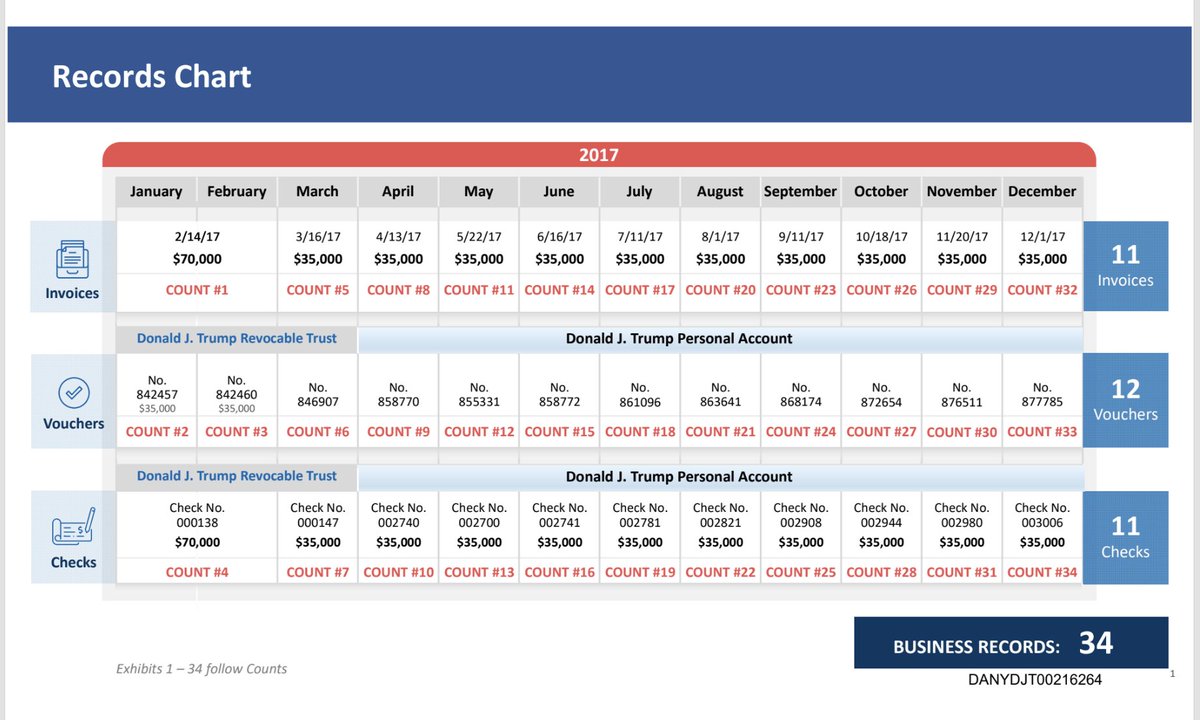
Hicks testimony: I think Trump's opinion was it was better to be dealing with it now, and that it would have been bad to have that story come out before the election.
That is devastating, Steinglass says, that was the last thing Hicks said on direct before bursting into tears.
That is devastating, Steinglass says, that was the last thing Hicks said on direct before bursting into tears.
This was about the election, Steinglass says returning to this point, not about Melania or about his family. Trump didn't express any concern at all about his family finding out. He didn't express any wish to silence Daniels until the election.
Over the past 5 minutes or so, Blanche has lodged a couple of objections—both overruled.
"Overruled, it's argument," Justice Merchan just said of the last one.
"Overruled, it's argument," Justice Merchan just said of the last one.
Steinglass shows Signal messages from Jay Sekulow, the purpose of which was to ask Cohen to fall on the sword, to protect the president, Steinglass says. This text shows what Cohen craved the most: recognition for his efforts on Trump's behalf.

Steinglass pauses to take a swig of water, as he continues to discuss the DJT personal account, which he calls a "clearinghouse" for other entities. It was the hub of a wheel with 500 spokes. In short, the DJT account was an enterprise.
New York is the business capital of the world, Steinglass says, and whether you're a private or public enterprise, you have an obligation to keep proper books and records. It's an obligation to the state. At its core, this case is really about cheating—objection, overruled.
After brief sidebar to discuss scheduling again, Steinglass returns to the podium.
You guys good to go a little bit longer? Steinglass asks the jury, getting some half-hearted nods.
Alriiiiiiight, he says cheerily.
We roll on.
You guys good to go a little bit longer? Steinglass asks the jury, getting some half-hearted nods.
Alriiiiiiight, he says cheerily.
We roll on.
Like all fixers, Steinglass resumes, Cohen knew where the bodies were buried, and it was essential to keep him loyal. Within days of the FBI raid, Trump reassured Cohen over the phone, then later via messages from surrogates.
Steinglass then pulls up a few Trump tweets to show his intention to send Cohen a message: stay in the fold. And it worked, at least at the time. Steinglass points out Trump used the more familiar "Michael."
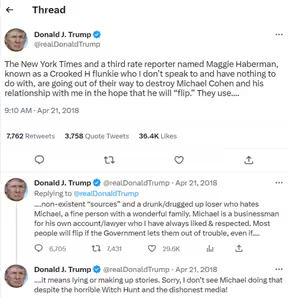
Steinglass retrieves the 4/21/18 "sleep well tonight" email from Costello to Cohen.
Costello told you under oath, Steinglass says, that his sole interests were to Cohen—that was just a bald-faced lie, says the prosecutor.
Costello told you under oath, Steinglass says, that his sole interests were to Cohen—that was just a bald-faced lie, says the prosecutor.
Costello's demeanor on the stand is something you can take into account, Steinglass says, referencing the witness's pugnacity—that's a factor you can use to assess his credibility.
Steinglass hauls out from evidence another Costello to Cohen email—the message is clear he says, stay loyal.
But then, realizing Costello was losing control, says Steinglass, Costello was desperate to serve his true master: the defendant.
But then, realizing Costello was losing control, says Steinglass, Costello was desperate to serve his true master: the defendant.

STEINGLASS: It's a little disingenuous for the defense to say you shouldn't trust Cohen bc he previously denied paying Daniels—those lies were told at the defendant's direction, and at his behest, and for his benefit. It's blaming the messenger for the defedant's own message.
Steinglass continues on a FECA-related line of argument (if I heard correctly), but Blanche quickly objects, and the parties approach—sidebar.
The jurors seem to be hanging in there—better than some of the press in the gallery at least.
Sidebar disbands, and Steinglass resumes with an excerpt of Cohen's testimony. Another objection—this one overruled.
Sidebar disbands, and Steinglass resumes with an excerpt of Cohen's testimony. Another objection—this one overruled.
Steinglass at last gets to the turning point in the Cohen-Trump relationship, when Cohen finally broke with Trump.
The defendant was furious, Steinglass says, his fixer had done the unthinkable, and Trump immediately went on the attack, which continues to this day.
The defendant was furious, Steinglass says, his fixer had done the unthinkable, and Trump immediately went on the attack, which continues to this day.
He displays one of these "attacks," a Trump tweet about Cohen, and Steinglass says the message, a warning, was clear: Cooperate and you will face the wrath of Donald Trump—objection, overruled.
To drive home the loyalty point, Steinglass pulls up another Trump book excerpt:
"This woman was very disloyal, and now I go out of my way to make her life miserable."
"This woman was very disloyal, and now I go out of my way to make her life miserable."
Now another Trump tweet "attack," this one aimed at Daniels as well (it's the "horseface" tweet, in which he denies seeing or speaking to her since the golf course photo)—why would he lie about this? Steinglass asks.
We now hear more examples of Trump's supposed wrath: e.g. bringing suit against Daniels, the defendant wanted everyone to see the cost of taking him on, says Steinglass.
We take our last brief recess of the day.
Blanche stands to elaborate on his objection he made just before the break, re: Steinglass' "prejudicial" claims linking Trump directly to Daniels' security.
We discussed this at great length in the motions in limine, says Steinglass.
Blanche stands to elaborate on his objection he made just before the break, re: Steinglass' "prejudicial" claims linking Trump directly to Daniels' security.
We discussed this at great length in the motions in limine, says Steinglass.
Steinglass continues, The defense opened the door to this—wide enough to drive a truck through—by arguing not only that they're generally incredible, but that they're somehow profiting from this case, that they're rolling in dough—but what they're really rolling in is fear.
Merchan says he agrees with his previous ruling, but says that Steinglass has gone far enough with this—noting that he's been at it now for four hours and counting (as if we all needed a reminder...)
Before he brings the jury back in, Merchan says that the jury has said all along they can go until 8pm, so he suggests that one of Steinglass's colleagues pass him a note if he begins to approach the 8pm deadline.
Alright, let's get the jury back in.
Alright, let's get the jury back in.
The press pool has noticeably thinned out, but this is my promise to you, dear reader: your faithful live tweeter will stay til the bitter end.
Onward.
Onward.
The jury now back, Merchan thanks the jury for their flexibility, mentioning that we're taking full advantage of it.
Thanks for sticking with me, Steinglass begins.
Thanks for sticking with me, Steinglass begins.
A new slide appears: Mr. Trump Involved Every Step of the Way.
You know it all began in the Trump Tower meeting, Steinglass says though he won't go into it. Cohen was the one Pecker would notify, but Trump was the one doing the asking. Cohen was the middle man.
You know it all began in the Trump Tower meeting, Steinglass says though he won't go into it. Cohen was the one Pecker would notify, but Trump was the one doing the asking. Cohen was the middle man.
A new header: 9/6/16 Trump Discusses AMI Reimbursement, from which Steinglass says the defense can't get away.
Steinglass continues to march through the timeline, highlighting all the points during which Trump was informed or updated.
Steinglass continues to march through the timeline, highlighting all the points during which Trump was informed or updated.
On break, the topic of conversation among the press I spoke to: what could be the benefit of Steinglass carrying on this long?
One theory: to put so much time between the end of his summation and the defense's that Blanche's closing argument seems like a distant memory.
One theory: to put so much time between the end of his summation and the defense's that Blanche's closing argument seems like a distant memory.
Steinglass continues to retrace our steps through the familiar timeline, but this time around, he's calling out each time Trump was aware of or continuing to direct the catch and kill schemes, NDA negotiations, etc.
I'm not tweeting much of this part of the summation because these are largely arguments and pieces of evidence we've heard before, just reorganized around the aforetweeted theme of Trump's direct knowledge.
Steinglass runs through some of these points, rapid fire: The defendant convened the Trump Tower meeting that hatched the conspiracy, called Pecker to discuss the McDougal story, called Cohen to greenlight hte catch and kill, reached out to Cohen via Melania Trump re: Daniels...
...story, spoke to Cohen about his frustration with the timing of the WSJ article.
He goes on, and on, and on, and...
He goes on, and on, and on, and...
Steinglass continues: Trump met with Cohen in the White House to finalize the reimbursement scheme, then signed 9 of 11 reimbursement checks by hand, sent a tweet admitting and reported on govt ethics form that they were reimbursements.
He goes on, and on, and...
He goes on, and on, and...
Another common sense argument surrounds Cohen about keeping the defendant in the loop: the defense wants you to believe Cohen went rogue, but there are three reasons you shouldn't believe that, says Steinglass: 1-Trump is a micromanager, detail-oriented...
...2-Cohen was and is a self-promoter. It defies all common sense to think that he would undertake these herculean efforts on Trump's behalf then keep it to himself—he may avoid a paper trail to protect the principal, but he sure as heck wants the principal to know...
...3-Because the defendant was the beneficiary of this entire scheme: he was the one trying to get elected. He stood to benefit the most to repay Cohen in a way not to make it obvious. Cohen just wanted his money back, he didn't care how.
The false business records benefited one person, and one person only, Steinglass says: and that's the defendant.
Steinglass then turns to the concept of beyond a reasonable doubt—he's careful not to explain the law, but says nothing is 100% certain, but you should be guided by common sense. Don't accept defense's invitation to look at each piece of evidence in the vacuum.
He then turns to accessorial liability, again careful to mention that the judge will instruct on this, but the point is Trump doesn't have to do certain acts himself to be held liable for them.
Steinglass slips a bit in his carefulness and begins to discuss the elements—but objection, sustained, and Merchan says he'll instruct on the law and the elements.
He acted in concert to create the false entries in the vouchers and invoices, and he acted in concert to create the Trust checks, the personally signed the rest of the checks from his personal account, Steinglass says, calling this a "no-brainer."
He clears his throat and continues: as to the intent to defraud, the judge will instruct you he adds, but jury's determine intent all the time.
Much of this echoes his speech during jury selection, if anyone remembers that long ago, faraway time.
Much of this echoes his speech during jury selection, if anyone remembers that long ago, faraway time.
There's ample evidence of the defendant's general intent to defraud, Steinglass says, again careful to mention the judge will instruct on the law, after having just asked to approach after yet another objection—a request which Merchan denied.
What crime are we alleging Trump intended to commit or conceal? Steinglass asks.
The answer is NY state election law, he answers himself simply. And again, the judge will instruct you on that.
The answer is NY state election law, he answers himself simply. And again, the judge will instruct you on that.
Not to beat a dead horse here, Steinglass says, and apparently someone laughed, because he says, That wasn't supposed to be funny, as he chuckles himself.
It's 7:43 p.m., and we're barely holding it together here.
It's 7:43 p.m., and we're barely holding it together here.
The co-conpirators in this case committed several FECA violations along the way—objection, overruled—incl payoffs to Sajudin, McDougal, and Daniels, Steinglass says. Purchasing life rights = illegal campaign contribution.
Pecker's acquisition of the McDougal story was not normal press function, so the press exemption doesn't apply here. Of course for Daniels that doesn't apply here—what does apply is a prohibition against excessive campaign contributions, Steinglass says.
A long pause from Steinglass, and the press hopes (falsely) that we have reached the end.
It's a tease.
...other options you can consider as unlawful means, Steinglass resumes, then rattles off a list of them: the 1099s issued to Cohen, Cohen's opening of a biz account, etc.
It's a tease.
...other options you can consider as unlawful means, Steinglass resumes, then rattles off a list of them: the 1099s issued to Cohen, Cohen's opening of a biz account, etc.
Trump's post-election steps to conceal a pre-election conspiracy is still part of the same conspiracy, Steinglass says. That's why he directed Cohen to continue to issue false denials in 2018—he still cared. He had every reason to continue to conceal his election fraud.
To be fair, this is a genuinely complicated case, from the fact pattern to the underlying legal theory, but at this point, Steinglass seems to be just repeating himself over and over, repackaging familiar evidence for familiar arguments in different ways.
Now I too, want to take a moment to thank you, Steinglass says to the jury, and you've really been remarkable. I know this has been a really long summation, and I apologize for trading brevity for thoroughness, but we only get one shot at this.
In this particular case, the evidence is literally overwhelming, Steinglass says. Trump got his trial—he's had his day in court. But the law is the law, and it applies to everyone equally. There's no special standard for this defendant.
Like any other case, he can be judge by a jury of his peers, based on the evidence, and nothing else, Steinglass says, the pace of his words slowing for emphasis and gravitas.
I ask you to find the defendant guilty, Steinglass says, at long, long last.
Merchan thanks Steinglass, then the jurors for the patience. What normally happens next is his instructions on the law—that will not happen tonight, he says, getting a "wooo!" from the press in overflow
Merchan thanks Steinglass, then the jurors for the patience. What normally happens next is his instructions on the law—that will not happen tonight, he says, getting a "wooo!" from the press in overflow
We've gone pretty late tonight, Merchan says (no kidding), so we'll begin tomorrow at 10am.
As he delivers his end-of-day pro forma instructions, allow me to thank you too, dear reader, for sticking with me during this marathon of a day.
I'll see you, as always, tomorrow.
As he delivers his end-of-day pro forma instructions, allow me to thank you too, dear reader, for sticking with me during this marathon of a day.
I'll see you, as always, tomorrow.
You thought Team No Sleep would go to sleep without a post court livestream? Think again. See you all at 9pm ET to debrief with @AnnaBower, @katherinepomps, Ben Wittes, and @rparloff
@AnnaBower @katherinepomps @rparloff But first: some fresh air.

Thanks as always for those who supported, and continue to support, these long days at 100 Centre St.
givebutter.com/c/trumptrials/…
givebutter.com/c/trumptrials/…
• • •
Missing some Tweet in this thread? You can try to
force a refresh