
A D-Day related 🧵on one of my father’s closest friends, Lt. William (“Bill”) Hamilton Shaw, USN. Born to Methodist missionaries in Pyongyang in 1922, Bill finished high school there and spoke native Korean. He was exactly two years older than my father. 
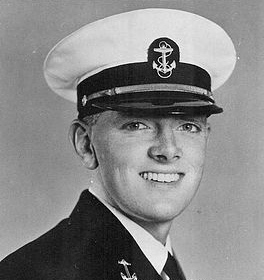
Bill enrolled at Ohio Wesleyan in 1939. When the U.S. entered the war, he enlisted in the Navy and was commissioned. He served as the XO of PT-518 in Operation Overlord. Two weeks after D-Day, Bill (at helm below) piloted Eisenhower on his first cross-Channel visit to Normandy.

After WWII ended, Bill went ‘home’ to Korea. There he met my father. In 1946-47, they served together as advisors helping to establish, more or less from scratch, what is now the ROK’s Naval Academy, at Jinhae-gu, Changwon, Korea.
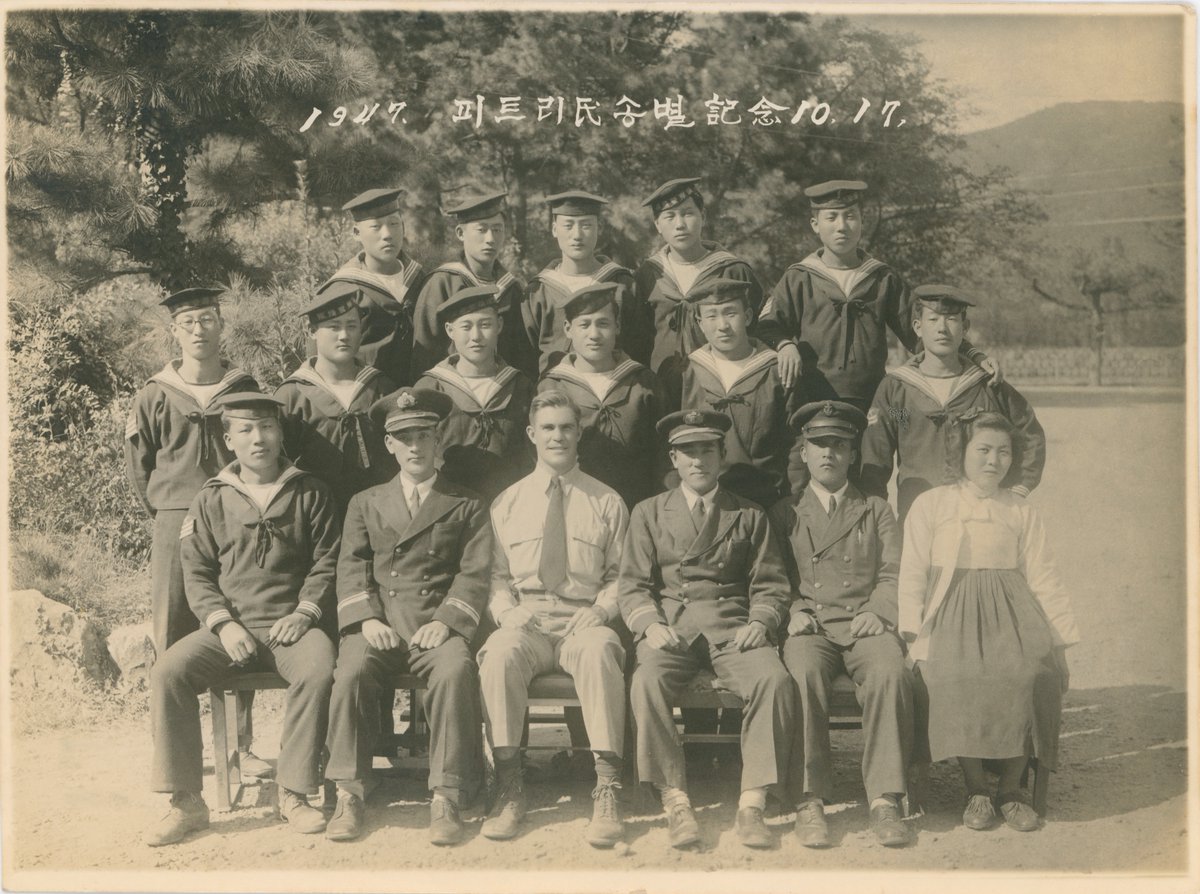
They did everything from admin (my 22 year old father called himself ‘chief personnel officer of the Korean Navy’) to navigation training and sailing lessons. Here's Dad with some of the Academy's midshipmen.
Bill Shaw and Dad became close friends. Here they are, headed to church one Sunday (each took the photo of the other).

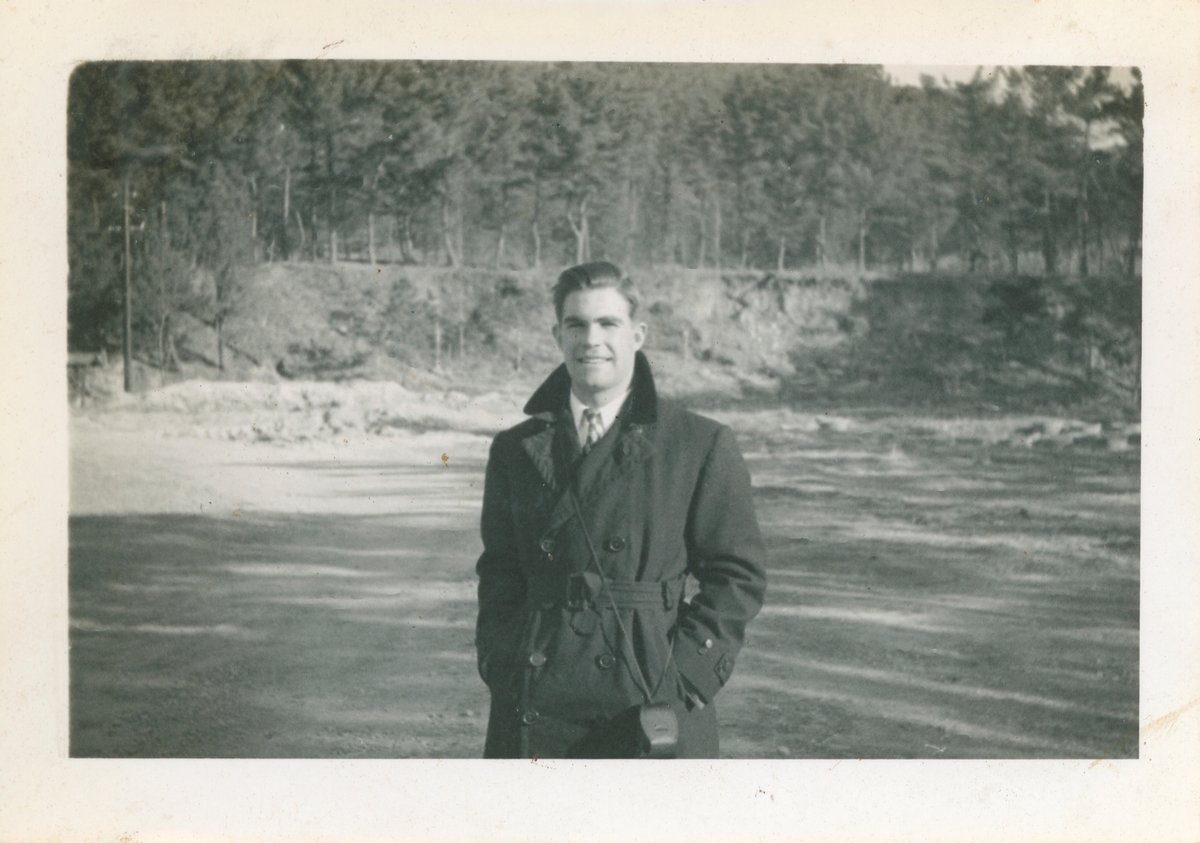
Photos of Bill by Dad, on a visit to Bill's missionary father (father 2nd from right in group photo), and on a visit to the HQ of a fabled Korean admiral of ancient times.


Dad left Korea in 1947 to finish his undergraduate degree (interrupted by the war) and then enrolled in post-graduate East Asian studies at Harvard.
After extensive correspondence between them (which I found after my father’s death), Bill decided to join Dad at Harvard, arriving in 1949. Bill and my father had both married in the interim (and Bill had two small children). In Cambridge, the couples were close.
Five months after Bill enrolled at Harvard, the Korean War started. Bill, who had been planning to follow in his father’s footsteps as a missionary in Korea, decided he had to return to Korea.
He said: “I cannot in good conscience return to Korea as a Christian missionary in peacetime if I am not first willing to be there to help the Koreans defend their freedom in time of war.” He rejoined the Navy, leaving wife and children.
In Korea, Bill became a trusted aide to Gen. MacArthur, and was involved in the planning of the Inchon Landing.
In Sept. 1950, allied forces were fighting to retake Seoul.
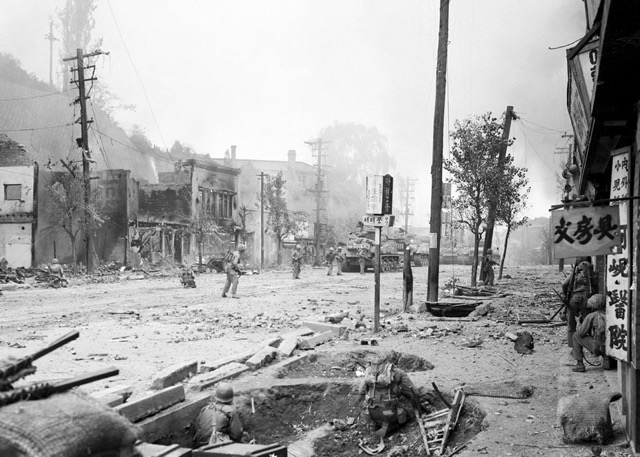
On Sept. 22, 1950, Bill volunteered to accompany a Marine unit reconnoitering an approach to the city over the Han river near the Nokpong-ri bridge. Bill was killed by a sniper while frantically shepherding civilians out of the way of an impending artillery attack.
Bill was awarded the Silver Star. The citation reads:
The President of the United States of America takes pride in presenting the Silver Star (Posthumously) to Lieutenant William Hamilton Shaw (NSN: 257303), United States Navy, for conspicuous gallantry and
The President of the United States of America takes pride in presenting the Silver Star (Posthumously) to Lieutenant William Hamilton Shaw (NSN: 257303), United States Navy, for conspicuous gallantry and
intrepidity in action against the enemy while serving as Special Interpreter and Liaison Officer attached to the Fifth Regiment, FIRST Marine Division (Reinforced), in action against enemy aggressor forces in Korea on 22 September 1950. Lieutenant Shaw courageously volunteered
to accompany a front line battalion in order to conduct on the spot interrogation of prisoners and civilians and to point out critical terrain features for the assault companies. Having been born and raised in Pyongyang, Korea, his services were of inestimable value and his
knowledge of the terrain was of material aid in planning the attack. When he learned that a combat patrol was assigned the mission of entering and clearing a native village he voluntarily accompanied the patrol and while leading the patrol through the village he was
mortally wounded and gallantly gave his life for his country. Lieutenant Shaw's display of initiative and heroic actions were in keeping with the highest traditions of the United States Naval Service.
This monument (one of several erected to Bill’s memory in Korea) stands in a public park near Nokpong-ri bridge over the Han river, where he fell.
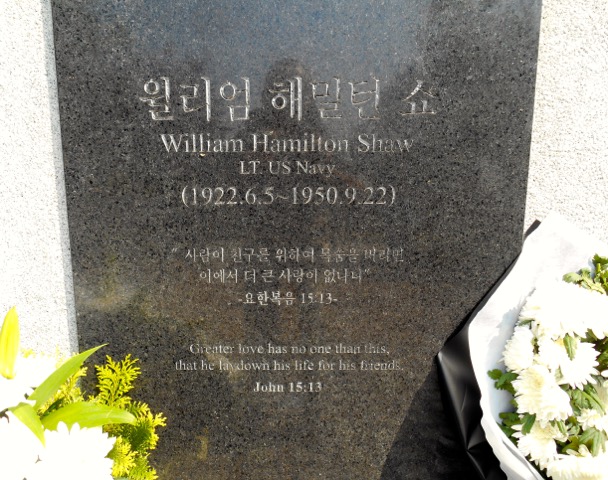
Bill is buried alongside his parents, in Seoul. For the rest of my father's life, this was the one death about which he could not speak without emotion.
I'm indebted to @NedForney for several of the photographs in this thread, and for the research and writing he's done on Bill Shaw.
• • •
Missing some Tweet in this thread? You can try to
force a refresh





