cephalopod Profile picture
Jun 27, 2024 9 tweets 3 min read Read on X
Correlation between your signal and future returns is an important metric in quant trading. But what is a “good” correlation? Here’s a simple way to think about it.
We’ll use a simple model where future returns y over some time period tau are normally distributed with a mean of beta * x and a daily volatility of sigma (here x is a signal with std deviation 1) Image
We can easily work out the correlation between signal and returns and use that to express beta as a function of correlation, volatility and forecast horizon. Image
The key insight is that it should be easy to find signals that are not profitable if you take trading costs into account, since you won’t be able to action them anyway.

If we require that even a three standard deviation signal is unprofitable then we can bound the correlation — Image
What does that tell us? Say that we are interested in a stock with 3% daily volatility, trading cost of 5 bps and a forecast horizon of one day. Then we expect to easily find signals with a correlation of 0.5% with future returns Image
If we use factor hedging to remove non-idiosyncratic risk, we might halve the volatility and double the cost to trade (since we need to trade the factor hedge as well) so we expect to be able to easily find signals with 2% correlation with future idiosyncratic return.
Alternatively if we are trying to predict a short term (1 minute) fx return which costs 0.2bps to trade and has a daily vol of 0.3% then we expect to easily find alphas with a much higher correlation of 8.5% Image
You can think of these as absolute minimum correlations, you need to exceed these to be able to trade profitably. As a rule of thumb, a correlation which is 1.5x the minimum would be ok (you will have a trade to do in about 5% of periods) and 2x the minimum is very good (you will be able to trade 20-30% of the time)
This is one of the many ways that you can extend the law of active management to be more relevant to real world trading, a topic for another time maybe.

• • •

Missing some Tweet in this thread? You can try to force a refresh

 

Keep Current with cephalopod

cephalopod Profile picture

Stay in touch and get notified when new unrolls are available from this author!

Read all threads

This Thread may be Removed Anytime!

PDF

Twitter may remove this content at anytime! Save it as PDF for later use!

Try unrolling a thread yourself!

how to unroll video
  1. Follow @ThreadReaderApp to mention us!

  2. From a Twitter thread mention us with a keyword "unroll"
@threadreaderapp unroll

Practice here first or read more on our help page!

More from @macrocephalopod

Jan 7
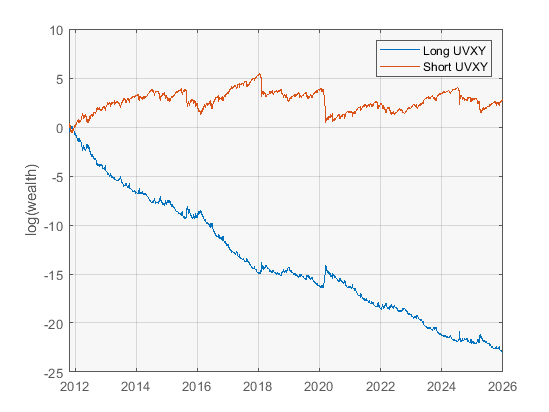
The dumbest thing about this is that it's trivially easy to simulate the performance of shorting UVXY and investing the cash into treasuries, and it's obviously much worse over the long term than going long SPX. Image
Image
You can make the trade look much better than it is by plotting the collapse in your log(wealth) from being long, but that doesn't mean shorting it is a good idea, as you can see from the red line in my chart. That's volatility drag baby!
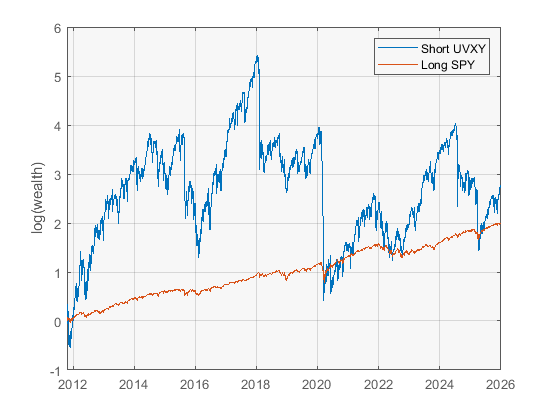
Compare shorting UVXY (daily rebalancing) vs just going long SPY and never rebalancing (because you don't need to)

Sharpe of geo. returns is 0.15 for UVXY vs 0.83 for SPX

Maximum drawdown is 33% for SPY, and 99% for shorting UVXY, since you get wrecked in 2018 and again in 2020 Image
Read 6 tweets
Dec 20, 2025
This is a good and balanced take and I broadly agree with it.
I do find it funny that the discussion gets framed as “retail vs quant” or sometimes “discretionary vs quant” which is not the framing I use at all.
I’ve never said quant trading is the only way to make money. There are many firms that reliably make money through discretionary/fundamental trading. Most multi manager hedge funds are primarily discretionary/fundamental. I respect them and I could never do what they do.
Read 7 tweets
Jan 30, 2025
Thursday morning quant interview question. A junior comes to you with a ML model trained using walk-forward validation, and shows the following backtest, created by stitching the out of sample periods. What are your comments? What might they have done wrong, if anything? Image
I think 4-5 people got this exactly right, and a few more had answers along the right lines but didn't mention some key detail. This is the first definitely correct answer that I saw -
This is the most succinct definitely correct answer -
Read 4 tweets
Jun 1, 2024
Interesting discussion, and follow the thread for further discussion of whether risk models cause crowding or not.

My view — they don’t really. Maybe a little on the margins, but the main drivers of crowding are alpha-driven rather than risk-driven.
In quant firms, proprietary signal research can uncover new, idiosyncratic alphas (which causes firms to decorrelate). But over time these ideas diffuse (researchers and PMs move between firms and take ideas with them) which causes them to correlate and crowd into the same names.
Use of the same “alternative” datasets also causes quant firms to converge, even more so now that many firms use data brokers to source new datasets (and the brokers will give little nudges like … “we’re seeing a lot of interest in this dataset, maybe you should take a look”)
Read 6 tweets
May 29, 2024
Does the profitability of vol selling strategies depend on starting volatility level?

A short story.
We start with front month VIX futures beginning in 2005, shortly after the contract was launched, so ~20 years of data.

For each day, calculate the P&L from shorting one futures contract. By working in price space we ignore any issues from from calculating VIX returns.
Every 21 days, sample the starting VIX level, and calculate the P&L from being short one near-term contract, assuming we roll over to the next contract at expiry.

This means that we have a dataset of non-overlapping sample P&Ls with ~1 month holding period.
Read 6 tweets
May 17, 2024
One more post about RenTech because it gives me an excuse to talk about Sharpe ratio, autocorrelation and scalability.

One thing that’s a bit surprising about RenTech returns is that their Sharpe ratio is “only” about 2.1 gross and 1.9 net.
With volatility of 30% on gross returns and 20% on net returns, that translates into 60% returns gross and 40% net.

These are great results by anyone’s standard, especially sustaining it for 30 years.
But top prop firms and multistrats have higher Sharpe ratios (eg 3ish for multistrats and much higher for top prop firms).

So what’s going on?
Read 11 tweets

Did Thread Reader help you today?

Support us! We are indie developers!


This site is made by just two indie developers on a laptop doing marketing, support and development! Read more about the story.

Become a Premium Member ($3/month or $30/year) and get exclusive features!

Become Premium

Don't want to be a Premium member but still want to support us?

Make a small donation by buying us coffee ($5) or help with server cost ($10)

Donate via Paypal

Or Donate anonymously using crypto!

Ethereum

0xfe58350B80634f60Fa6Dc149a72b4DFbc17D341E copy

Bitcoin

3ATGMxNzCUFzxpMCHL5sWSt4DVtS8UqXpi copy

Thank you for your support!

Follow Us!

:(