
The Legal Feminists have been reading this blog by Melanie Field,@EHRC's former Chief Strategy and Policy Officer linkedin.com/pulse/do-we-ne…
The blog starts with the usual expressions of regret about the "tone" of the debate — and the usual implication (often spelled out, though not here) that both sides are to blame.
Follow this link for a quick reminder of the truth on that: sex-matters.org/posts/updates/…
Follow this link for a quick reminder of the truth on that: sex-matters.org/posts/updates/…
If Field is right that the balance between trans rights and others' rights were carefully considered and also that sex in the EqA means "actual sex, except where modified by a GRC", the only possible inference is that those who framed the Act were intent on confusion and chaos. 

How, otherwise, can we understand absurdities like a definition of homosexuality as being attracted to members of your own sex, plus those members of the opposite sex who have been awarded a certificate?
Or the fact that single-sex services can be justified where "only persons of that sex have need of the service" — when there is no possibly imaginable service that could be said only to be needed by women plus men with certificates, or women plus men with certificates?
Or the Alice-in-Wonderland contortions that ensue when you try to work out whether a provision, criterion or practice puts "women" at a particular disadvantage if "women" means "women plus men with certificates"?
This is all very well, but the extreme example given in the EN creates an unfortunate impression that it is only in the most extreme circumstances, like rape crisis, that women are entitled to exclude men.
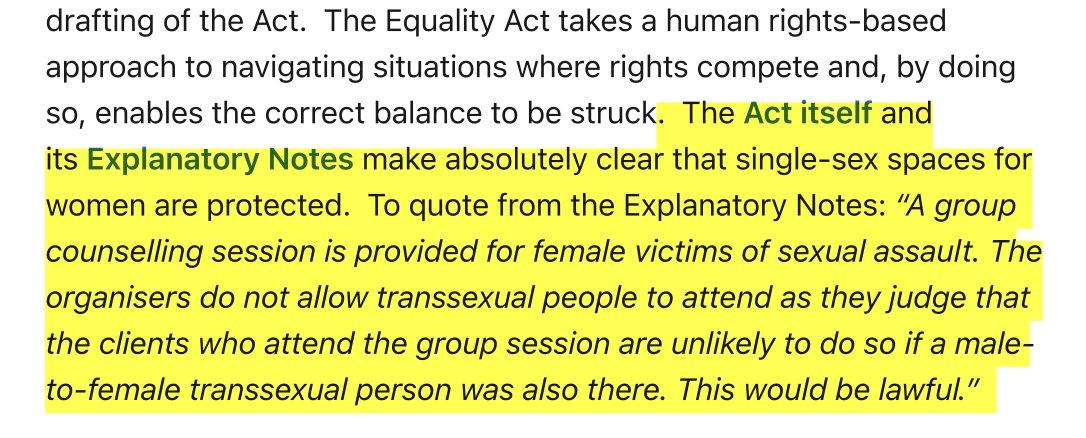
The reality is that there are many ordinary, everyday situations in which women need to be able to be confident that they will not encounter men, even men with certificates: toilets, changing rooms in the gym or or at work, the breast-feeding support group etc etc.
Why does Field drop in the @UKLabour mantra of "safe spaces" here? The EqA says nothing of safe spaces. Single-sex services are not just about safety, but also privacy, dignity, self-determination and freedom of association.
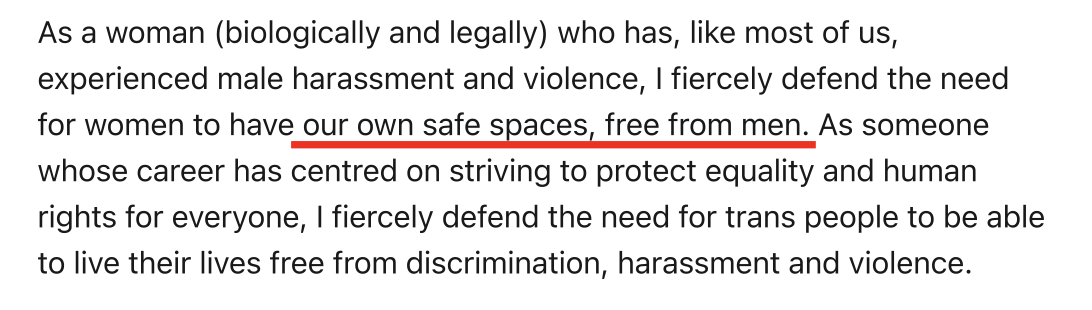
Field muses on what's gone wrong in the implementation of the law, which she believes is "in the right place" on paper, but she admits isn't being correctly applied.
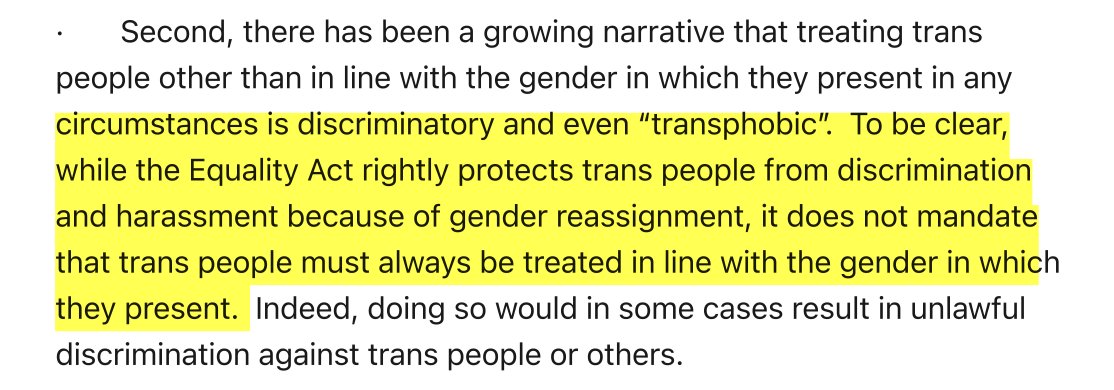
This, from the ERCC's 2011 Code of Practice on Services, Public Functions and Associations, seems likely to have been a contributing factor:

That was wrong, and obviously so. If "single-sex" services admit people of the opposite sex, they're not single-sex any more. (This should not be hard to spot, pace the judge at the permission stage in AEA v ERCC.)
This passage is interesting to read alongside the observation that Stonewall has recently deleted "cross-dresser" from its definition of what is covered by the "trans umbrella".

But more importantly, the acknowledgment of concerns that "predatory and violent men might seek to exploit laws designed to protect the rights of trans people by infiltrating women-only spaces" mostly misses the point.
It assumes there are two distinct categories: "predatory and violent men" on the one hand, and "trans people" on the other. The problem is that there is no way of telling whether a man who claims to be "trans" is "really" trans, because what would that mean?
So the category called "trans women" (ie men who assert a female gender identity, for whatever reason) can be expected to include some proportion of abusers, voyeurs, violent sex offenders, exhibitionists and other assorted wrong 'uns.
This is odd. Does Field think it would have been ok to appoint Mridul Wadhwa to head ERCC if he'd been "legally female" through the operation of a GRC? What difference would that make to the rape survivers bullied and gas-lit into pretending to think he was a woman?

It's not clear what provisions of the EqA these instances are said to breach, because the provisions about single-sex services are permissive, not mandatory.

That's why women wishing to challenge inclusion of men in supposedly single-sex spaces have had to fall back on complaints of indirect discrimination or harassment.
If they and their advisers have missed an express provision of the EqA giving them a right to single-sex, spaces, it would be good to know where to find it.
We don't know this yet: it is the question the Supreme Court will rule on after hearing the FWS appeal later this year.

It's not clear why amending the law pending this appeal would be unwise. These are simply two different routes to the same end: clarifying the law.

If Field is right that sex in EqA = "legal sex", then that has all kinds of bad consequences (eg the absurdities mentioned upthread) and needs amending. If she's wrong, the proposed amendment will simply clarify what the SC will presently tell us was already the law.
This can't be right. If sex in the EqA = "legal sex", a "trans man" with a GRC counts as male, and will be automatically excluded from any service that is for women only. That's because, on Field's hypothesis "women" doesn't include women who have GRCs declaring them to be men.

There's no "balance" to be struck between women's rights to privacy and dignity and the "rights of trans people not to be discriminated against". In any situation in which women's privacy and dignity justifies a women-only space, all men need to be excluded.
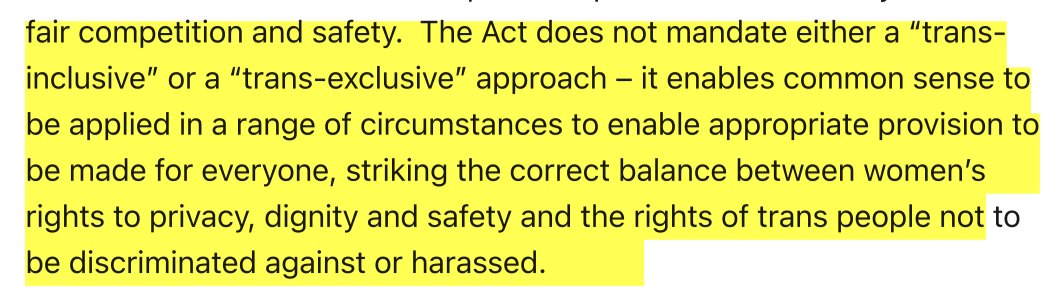
It's unhelpful that the EqA uses both terms, but it does seem to be tolerably clear that for the purposes of the Act, "gender" means the same thing as "sex".

But "gender-affected activity" is another context in which it should be obvious that the "legal sex" reading of the EqA makes no sense. There is no sport ever invented in which anyone's performance could be affected by whether or not they have a certificate from the government.
Eh? Why the sudden pivot to "forced to use"? The EqA doesn't force anyone to use anything.
What on earth is "fully... medically transitioned" supposed to mean? Surely Field doesn't think that anyone actually changes sex?
What on earth is "fully... medically transitioned" supposed to mean? Surely Field doesn't think that anyone actually changes sex?

In any case, the "sex means literal sex" reading of the EqA means nothing of the sort. Para. 28 of schedule 3 would permit exclusion of a "trans man" from women's services in which the presence of a woman who passed convincingly as male would cause justifiable dismay and upset.
A GRC doesn't need to have an effect in discrimination law. Protecting "trans people" from discrimination and harassment is what the protected characteristic of gender reassignment is for, and that is not restricted to people with a GRC.
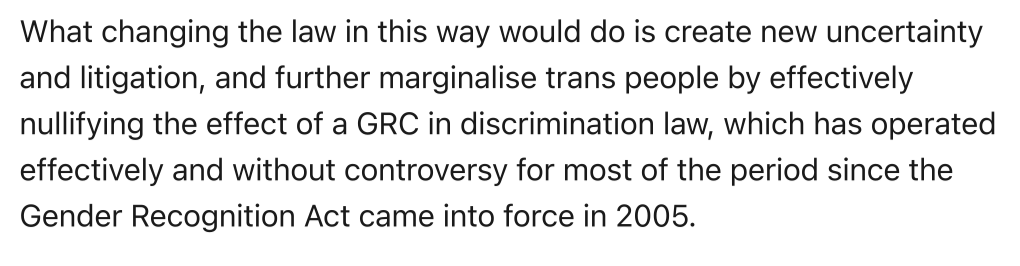
The only effect of GRCs in discrimination law is to put a spanner in the works of the EqA, creating all the absurdities mentioned above. Sex discrimination law (exceptions and all) worked fine before the GRA. The effect of the proposed amendment is to remove the spanner.
Field's reproach to David Tennant is well-taken, but it's unfortunate that she sees fit to repeat (by implication) the smear that defence of women's spaces entails thinking that all trans people are predators.
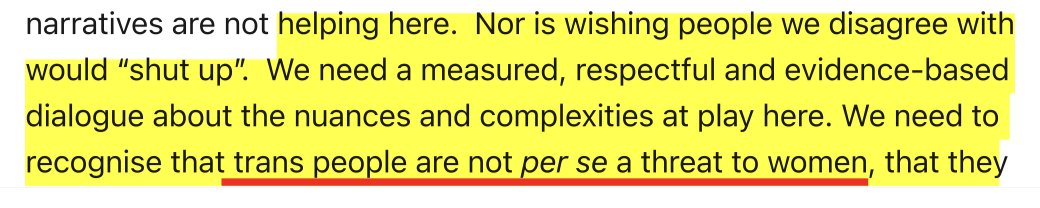
The point is not that men who say they are women are a particular danger to women; the point is that men who say they are women are still men, and women’s privacy and dignity (and sometimes safety too) are compromised if we pretend otherwise.
Why is it worrying that increased awareness of the reality of what official "gender recognition" means for women's privacy, dignity and safety is having the effect that support for those policies is waning?

We should recall at this moment that the Police and Criminal Evidence Act 1984 requires intimate searches of a suspect by police to be carried out by an officer of the same sex.
Many police forces (and until recently the @PoliceChiefs) operate policies under which any male police officer who says he is a woman may intimately search a female suspect whether or not he has a GRC.
That's clearly wrong, but unless "sex" in PACE means "real sex" not "legal sex", it's not clear what protects female suspects from being intimately searched by male police officers with GRCs — which @UKLabour is keen to make easier to get.
This being carefully listened to will be a novel experience for @RosieDuffield1, @polblonde, @K_IngalaSmith, @LabWomenDec and many others who have been shouting themselves hoarse for years on this issue, only to be dismissed as bigots.
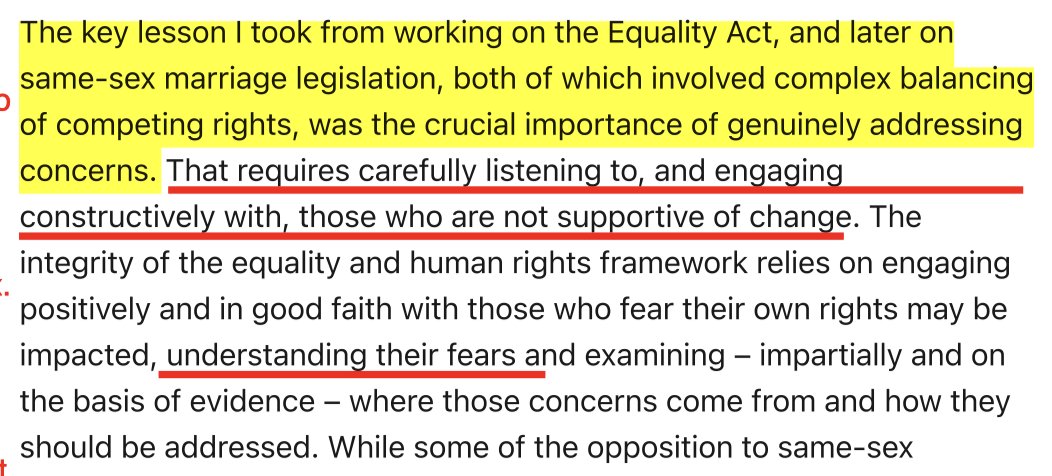
"Understanding their fears" grates. How many times do we have to repeat that this is not just about fear, or safety? It's about privacy, autonomy, freedom of association.
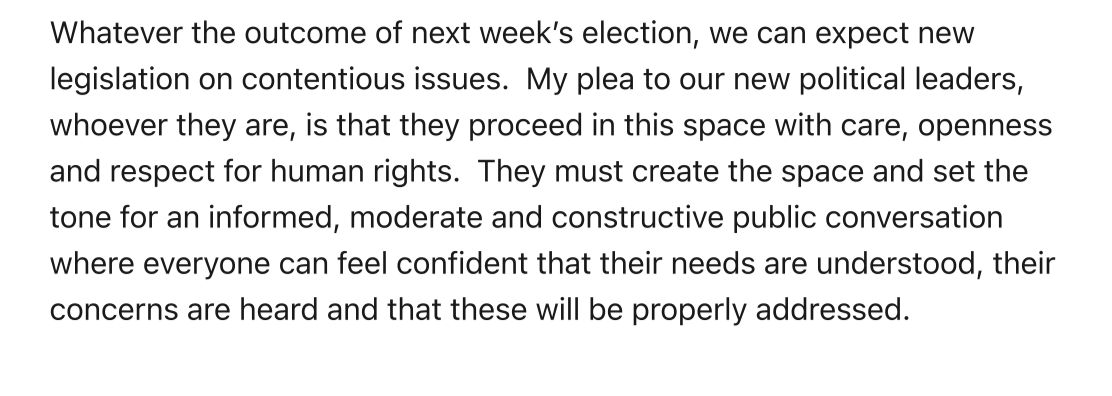
It's hard to disagree with Field's conclusion. But after years of being ignored, smeared as bigots, gaslit, bullied — and finally victim-blamed for the "tone" of the debate even as @Keir_Starmer performs a partial pivot — gender-critical women must be forgiven for scepticism.
End/
• • •
Missing some Tweet in this thread? You can try to
force a refresh




