Long COVID Risk Tables
You probably saw this week's NEJM article on #LongCOVID. We did a special section on it in this week's PMC COVID-19 Forecasting Report (pgs 6-8).
THREAD of tables. 🧵🔢
1/
Details:
Our model continues to provide estimates of Long COVID cases that will ultimately result from each day’s infections.
We provide a credible interval that 5-20% of infections will result in Long COVID.
This week, Al-Aly and colleagues reported in the New England Journal that in the more recent era of the pandemic, vaccinated individuals have a 3.5% chance of developing Long COVID from a particular infection.
They focused on medically documented new serious health conditions. We continue to view 5% as a useful lower bound for two reasons.
Long COVID chances were higher in unvaccinated individuals in their study, and there were no analyses based on time since last vaccination.
With many Americans still unvaccinated and many not vaccinated in the past year, the true estimate for a 2024 infection could well surpass 5% for a medically documented new serious health condition.
Moreover, Long COVID is a heterogeneous condition, and many cases are likely not medically documented, especially at the less debilitating end of the spectrum.
The following tables show the risk of ever developing Long COVID from an infection assuming 3.5%, 5.0%, and 20.0% rates.
These statistics document the seriousness of Long COVID with Americans getting infected nearly once a year (average of 12.5 months by our estimates).
However, it is also important to know that some effects are enduring, and others more likely to improve, so many with Long COVID will improve.
Many will also have repeated bouts of Long COVID, likely with different phenotypes.pmc19.com/data/
You probably saw this week's NEJM article on #LongCOVID. We did a special section on it in this week's PMC COVID-19 Forecasting Report (pgs 6-8).
THREAD of tables. 🧵🔢
1/
Details:
Our model continues to provide estimates of Long COVID cases that will ultimately result from each day’s infections.
We provide a credible interval that 5-20% of infections will result in Long COVID.
This week, Al-Aly and colleagues reported in the New England Journal that in the more recent era of the pandemic, vaccinated individuals have a 3.5% chance of developing Long COVID from a particular infection.
They focused on medically documented new serious health conditions. We continue to view 5% as a useful lower bound for two reasons.
Long COVID chances were higher in unvaccinated individuals in their study, and there were no analyses based on time since last vaccination.
With many Americans still unvaccinated and many not vaccinated in the past year, the true estimate for a 2024 infection could well surpass 5% for a medically documented new serious health condition.
Moreover, Long COVID is a heterogeneous condition, and many cases are likely not medically documented, especially at the less debilitating end of the spectrum.
The following tables show the risk of ever developing Long COVID from an infection assuming 3.5%, 5.0%, and 20.0% rates.
These statistics document the seriousness of Long COVID with Americans getting infected nearly once a year (average of 12.5 months by our estimates).
However, it is also important to know that some effects are enduring, and others more likely to improve, so many with Long COVID will improve.
Many will also have repeated bouts of Long COVID, likely with different phenotypes.pmc19.com/data/
If you assume 3.5% of people get Long COVID per infection, the risk grows sizably with reinfections, which are happening nearly once per year. Avg of 9 infections/American the next decade.
In the previous Tweet, we note how 3.5% is an obvious underestimate.
2/
In the previous Tweet, we note how 3.5% is an obvious underestimate.
2/

Based on that 3.5% estimate, a more realistic low-ball estimate of serious long COVID is 5-7%, given that not all serious new health conditions are documented in medical records & rates are higher among those unvaxxed or not recently vaxxed.
Bad decade (9 inf's) ahead.
3/
Bad decade (9 inf's) ahead.
3/

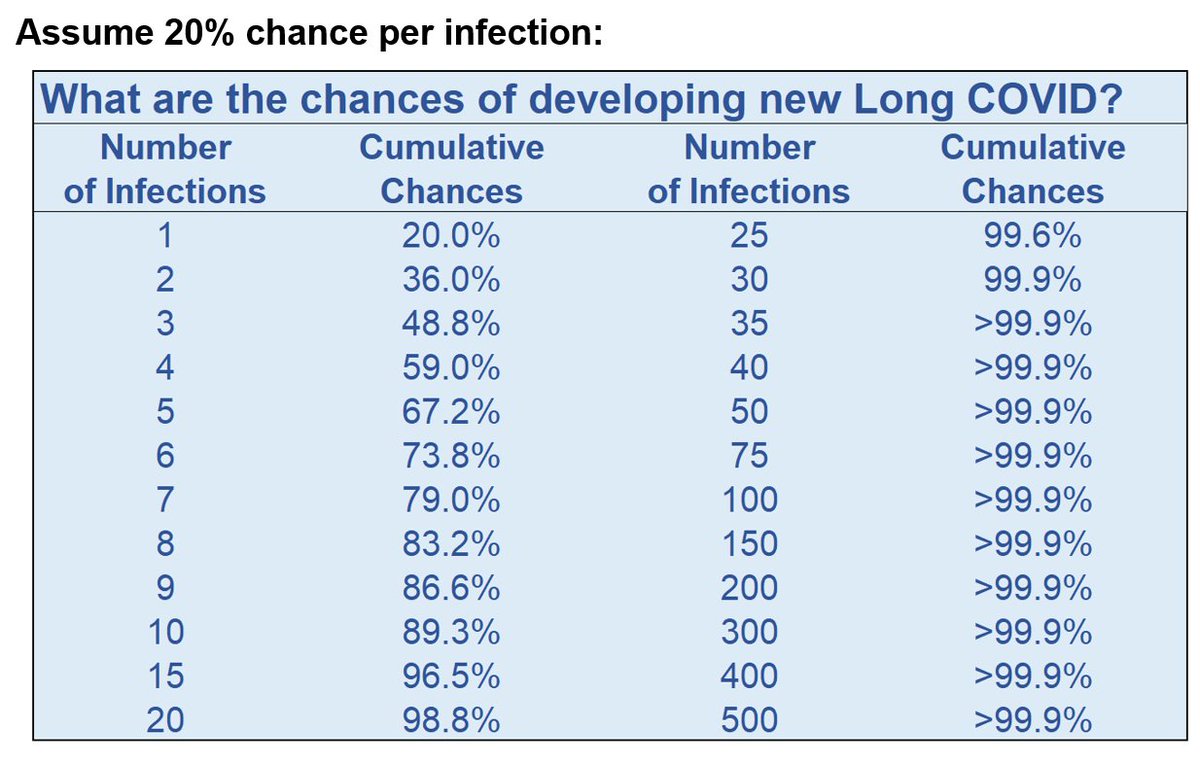
If LC translates into 3.5% more new serious health conditions documented in medical records, a reasonable estimate would be that 20% or more develop any #LongCOVID per infection.
Many do not go to a PCP for loss of smell or taste, fatigue, or "brain fog."
4/
Many do not go to a PCP for loss of smell or taste, fatigue, or "brain fog."
4/
However, even if assuming 3.5%. Let's consider a family of 4, where Covid burns through everyone each infection. In such cases, these are the number of "burn through" (unmitigated) household infections before someone gets #LongCOVID.
5/
5/
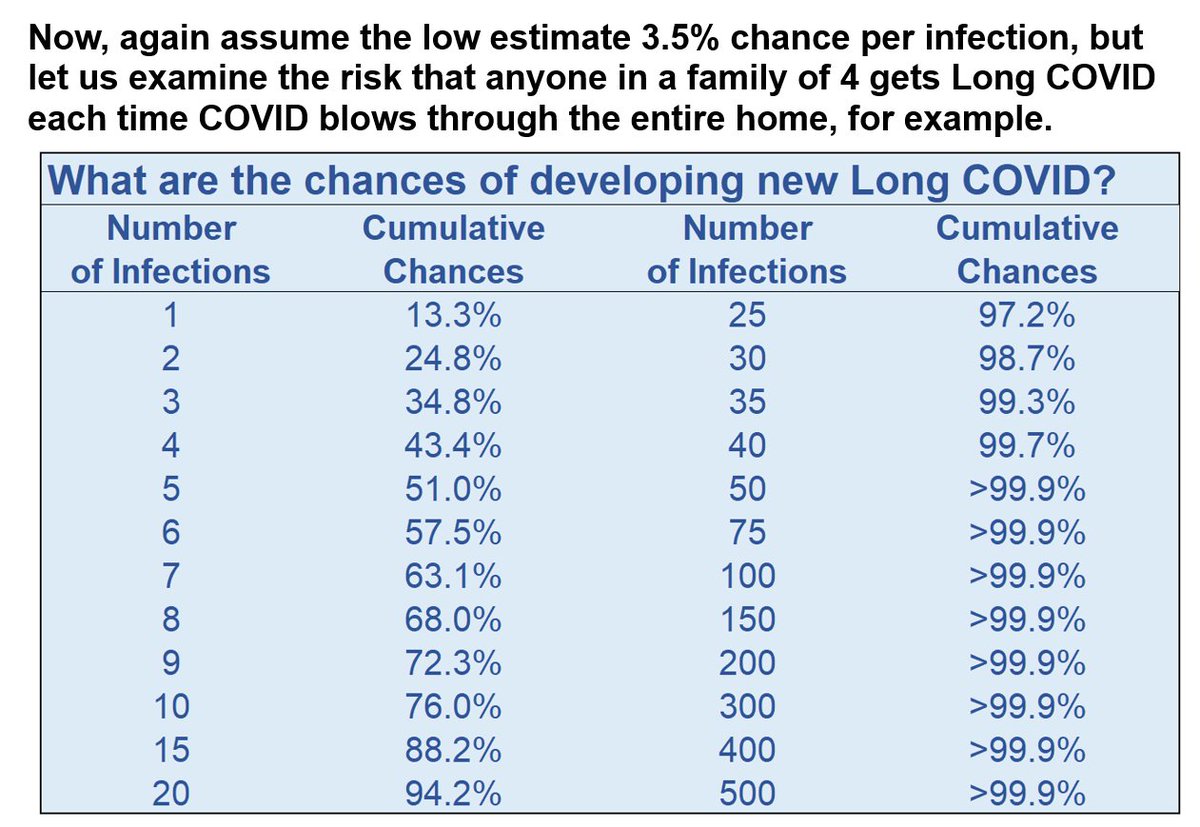
Americans are getting Covid nearly once a year on average (every 12.5 months). The 4-10 year scenarios, even w/low-ball estimates are terrible, especially when considering family impacts. More of us will get #LongCOVID, know others with LC, & know struggling families.
6/
6/
• • •
Missing some Tweet in this thread? You can try to
force a refresh