Let's talk about @KamalaHarris saying "to see what can be, unburdened by what has been." This phrase, which she repeats all the time, is not mysterious. It's esoteric. That is, it's occult. It's a Marxist and Luciferian incantation, and that's easily seen.
What "esoteric" means here is that it has a hidden meaning. It looks and sounds like goofy nonsense, but it isn't. People who know, know. That is, it's coded and Gnostic in its formulation and the principle she's articulating is ultimately Luciferian/Hermetic, a la Marx.
We can set aside the hand gesture she typically makes while uttering this incantation, although we shouldn't. It's blatantly up on the right (what can be, a worldly utopia) and down on the left (unburdened by, or liberated/emancipated from the mundane status quo).
Let's have a look at Karl Marx issuing the same idea. Here he is at the punchline of the Communist Manifesto explaining that when the proletariat organizes itself and executes a revolution, it can move forward into what can be (Communism) unburdened by class antagonisms.
Here's how Marx opens the Communist Manifesto, though: "The history of all hitherto existing society" [what has been] "is the history of class struggles." That's precisely what he says a Communist revolution would emancipate [unburden] Man from in the punchline, though.
In other words, Marxism itself, in its own manifest declaration, identifies it as being able to move into "what can be, unburdened by what has been," and socialist/Marxist consciousness is a Gnostic awakening to "see what can be, unburdened by what has been." Straight Communism.
A few years earlier in his Economic and Philosophic Manuscripts (1844), Marx expresses the same idea, comparing "crude Communism" to true, transcendent Communism. It's [becoming unburdened by] private property "as human self-estrangement" through "positive transcendence."
The general theory (theology) of Marxism is that Man is burdened by what has been, which is called his "historical conditions," but can awaken to his true (socio-spiritual) self, which is socialist, so that it can be transcended. "To see what can be, unburdened by what has been."
Here, earlier in EPM, Marx is explaining that awakening to a social(ist) consciousness (that is, man's true nature) has a transformative capacity to unburden/emancipate the senses to "see what can be, unburdened by what has been," rather literally. This is what it's really about.
Marx characterizes "what has been" as an "exoteric revelation of man's essential powers" to build a future for himself emancipated from his own historical conditions. That is, "to see what can be, unburdened by what has been" is an ESOTERIC incantation making this meaning visible
Exactly the same mentality appears in Queer Theory (Queer Marxism, so no surprise). "Queerness is not yet here. Queerness is an ideality." It's a "horizon imbued with potentiality." Being "Queer" means being able "to see what can be, unburdened by what has been."
How clearly does it have to be written to see it?
"Queerness is a structuring and educated mode of desiring that allows us to see and feel beyond the quagmire of the present. The here and now is a prison house."
The goal is to reach "what can be, unburdened by what has been."
Exactly the same sentiment is expressed in CRT through "antiracism." An "antiracist" society is one that can see or imagine "what can be, unburdened by what has been," meaning the history of racism and racial antagonism and injustice, which are our "historical conditions."
The sentiment Kamala Harris repeats endlessly, seemingly weirdly, is an esoteric incantation of societal and human rebirth (that is, a cult) that has manifested in such human paroxysms as the French Revolution, all Communist revolutions, and Lucifer's revolt against Heaven.
Lucifer sought "to see what can be, unburdened by what has been." God had created the perfect order in perfect Plenitude, but the angels had no free will beyond their first choice to accept or reject. Lucifer, in his pride, rejected, "to see what can be unburdened by" Heaven.
In the French Revolution, the goal was to establish a wholly new society that would have a new calendar, new government, new everything, starting at Year One. They were going to see what could be for the French people unburdened by what has been in French society. Disaster.
The French Revolution was actually modeled after Oliver Cromwell's Glorious Revolution in which the radical Puritan faction in England would aim "to see what can be, unburdened by" the chain of royal succession and divine right of kings in England. Murderous disaster.
It's worth knowing that Cromwell called his great experiment "The Great Protectorate," so that we can reflect on how much Kamala Harris's "what can be" is predicated on "safety" in our own day. Of course, the French called it the Committee for Public Safety too.
While every Communist revolution, like Marx indicates, is a revolt against what has been in the hopes of achieving a utopia only the cult can "see" (or "imagine"), is also a complete social rebirth, it's most obvious in Pol Pot's Cambodian Revolution with its "Year Zero."
Cromwell, the French, the Bolsheviks, Pol Pot, Mao, and the rest were all leading people to see "what 'can be,' unburdened by what has been." The death and rebirth of self and society is precisely the goal, and that's what Kamala Harris routinely channels (incants).
Today, we have the Great Reset. That is, a Great [What Can Be, Unburdened By What Has Been]. That's how a reset works. You unburden yourself from what "has been" and start over. It's the same exact program in essence, though not in mechanisms and details.
Though this thread is already very long, it's worth pointing out that Klaus Schwab's (WEF) most recent book is essentially a long manifesto of how we can move into a new world by "[seeing] what can be, unburdened by what has been" (here: shareholder capitalism and GDP growth).
The objective of the so-called New World Order is precisely that: a new circular economy focused on "wellbeing" that's managed by "enlightened" stakeholders (what can be) unburdened by shareholder fiduciary responsibility, profit, and individual achievement (what has been).
I'll sum up here, though so much more could be said. We're undergoing a global French (or Communist) Revolution, which will have disastrous results. Kamala Harris chants the Marxist/Luciferian incantation of that evil agenda: "to see what can be, unburdened by what has been."
• • •
Missing some Tweet in this thread? You can try to
force a refresh

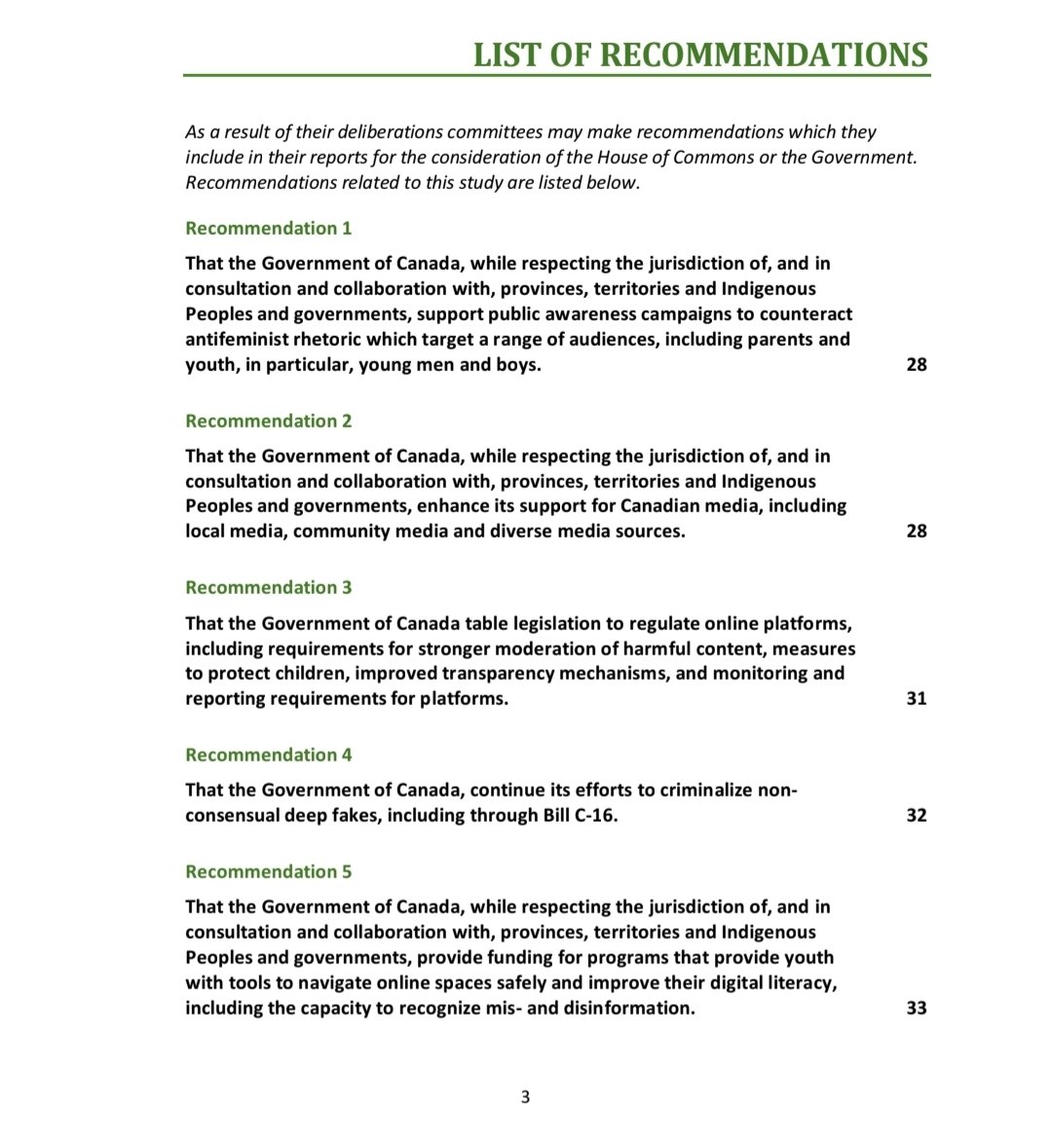
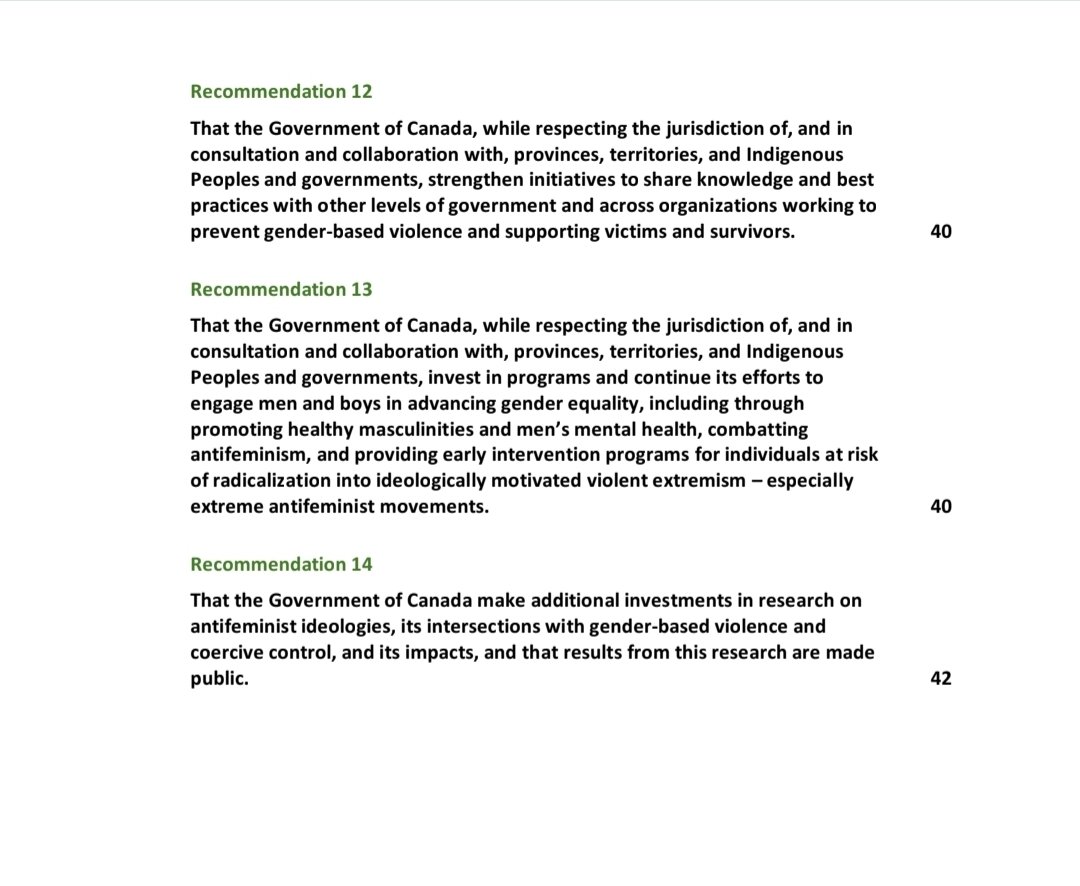
Canada seems to be trying to set some kind of record for being a completely self-unaware Woke retard country, and this official parliamentary report on combating antifeminism is a great unintentionally hilarious but terrifying new example.
You can tell from the summary that this is going to be grade-A retardation where the feminists and masculinity scholars (lol) who wrote it cannot begin to fathom that what they're on about is 100% predictable backlash to their own feminist abuses of men, boys, society, and women.
I'm not going to go through it all here, but these recommendations are so stereotypically Woke that it's funny except that they're actually going to implement it and aim to criminalize totally normal things because they can't figure out that people hate being abused by them.
Some more ramblings of Russian anti-West, anti-American, weirdo Aleksandr Dugin, darling of the Woke Right, sounding surprisingly like JD Vance's economic policy (which Grok will confirm if asked):
"The true "third way" in economics found its classic embodiment in the works of Friedrich List, who formulated the principles of "economic autarchy of large spaces."
"This theory proceeds from the fact that the economic development of capitalist societies is uneven and from the logical consequence of economic colonization by the "richer" countries of the poorer ones; moreover, for the "rich" in such conditions "free trade" is beneficial, and for the "poor" on the contrary.
"From this, List concluded that at certain stages of the economic development of society, it is necessary to resort to protectionism, dirigism and customs restrictions, i.e. to limit the principle of "freedom of trade" at the international level, in order to achieve the level of national and state independence and strategic power.
["Dirigism" refers to an economic system in opposition to laissez-faire in which the state takes an active and directive role in shaping and guiding the economy, rather than limiting itself to a purely regulatory or hands-off approach within a market economy.]
"In other words, it was obvious to List that the economy should be subordinated to national interests, and that any appeal to the "autonomous logic of the market" is only a cover for the economic (and subsequently political) expansion of rich states to the detriment of the poorer, and the subsequent enslavement of the latter.
"This approach immediately sets clear boundaries in which the "market" principle should operate, and in which the "socialist" one.
"It is interesting that Rathenau, the author of the German "economic miracle," and Witte, Lenin, and even Keynes formulated their economic principles on the basis of the doctrine of Friedrich List, although they used a language that was closer to or purely capitalist, or communist vocabulary, that the economy should be subordinated to national interests, and that any appeal to the "autonomous logic of the market" is only a cover for the economic (and subsequently political) expansion of rich states to the detriment of the poorer, and the subsequent enslavement of the latter."
CC: @PhilWMagness
After describing the theory a little, our behated weirdo continues, ominously given the context:
"It is very interesting that it was the Friedrich List model that was used by historically developed capitalist countries in times of crisis. Thus, even the United States, the radical defenders of the principle of "free trade", periodically resorted to protectionist measures and state subsidies to the industrial sector when periods of "economic depression" began.
"It was precisely such a period that was the stage of implementation of the New Deal, when the Americans almost literally reproduced the principles of List, although they submitted them in a relaxed version of Keynes, the author of the theory of "economic insulation", which, in general, is nothing but a new name for the theory of "economic autarky of large spaces ".
"By the way, List himself lived in the United States for a long time and observed the process of capitalist construction in the early phases. Based on these observations, he formulated the basic principles of his theory in relation to Germany. But, of course, the most ambitious results were given by the implementation of List's doctrine in National Socialist Germany, when his ideas were implemented totally and without any liberal or Marxist amendments."
Sounds very Woke Right overall, including the idea of a new New Deal, the favortism of FDR who implemented it, and all the rest. The Woke Right's rejection of Keynes here and a certain revisionist tendency that shows up in that last sentence in Dugin is blatantly concerning.
For further context, Dugin began this discussion (in The Foundations of Geopolitics) by criticizing the application of Hayek to the Russian context in the post-USSR period (which is what he's technically writing about here). All our favorite Woke Right weirdos also criticize Hayek rather strangely and specifically, claiming he is the falsely "conservative" wing of the same liberal (or neoliberal) project that gives us Woke and Communism.
Very interesting, indeed.
CC: @PhilWMagness
It gets a little worse. Remember, this is Dugin writing in 1997 for the Russian context, but our question is why is this the American post-liberal vision today in these United States of America:
"It is this version of the "third way" economy that is the only alternative in today's Russia, which is opposed at the same time to rampant liberalism and restorationist projects of neo-communists who do not want to seriously correct outdated and proved ineffective dogmas. If it were not for the instantly emerging associations with the Hitler regime, one could call this project "socialism of the national type.""
Rather than foregrounding identity politics, it will push:
1) Affordability (Marxist materialism); 2) Anti-corruption (ironic but an excuse to go after Trump); 3) Anti-Israel (pro-Palestine).
It will be warm to political violence.
The identity politics won't go away, but it won't be foregrounded any longer. It will definitely play supporting roles. They won't lead with it, though.
They'll find much superficial alignment with the Woke Right and Woke-ish "Libertarians" on their three key issues and violence
The agreement will only be superficial and occasionally strategic to block actual patriots. Like with every issue upon which they align, Woke Left (2.0) and Woke Right will come at the issues from different angles, e.g. pro-Palestine vs anti-Israel. Applies to all issues.
From my Woke Encyclopedia, an explanation of the "friend-enemy distinction" of Carl Schmitt, which is the Woke political logic. Link at the end!🧵
(1/13) The friend-enemy distinction refers to the cornerstone object of the political and judicial philosophy of a German theorist named Carl Schmitt, who wrote a number of works of right-wing political philosophy and thought before becoming such an enthusiastic Nazi in 1933, just after Adolf Hitler took power, that he earned the informal title “the Crown Jurist of the Third Reich.”
Though most of his significant political thinking was done both before and after he was a Nazi, during the years when he was a part of Hitler’s National Socialist movement and Party, he contributed strongly to the legal theory that justified the Nazi “total state,” including writing the 1933 piece that gets rendered in English as “The Legal Basis for the Total State,” which is significantly based upon the friend-enemy distinction.
Friend-enemy distinction:
(2/13) Schmitt’s thought is primarily of interest on the Woke Right, where he is a favored thinker and model political mind. He is vigorously forwarded for a handful of his political concepts, perhaps most visibly his “friend-enemy distinction” as the essential criterion of what makes politics political. This idea is first presented and developed in full detail in his 1927/32 book The Concept of the Political.
Friend-enemy distinction:
(3/13) For Schmitt, what makes the politics political is the distinction between (public) friend and (public) enemy, where enemies are defined as those who are interested in destroying one’s way of life and friends are defined as those who are willing to band together in its defense.
Schmitt specifically compares the essential nature of this distinction in politics to the distinction between good and evil in morality, beautiful and ugly in aesthetics, and profitable versus non-profitable in economics.
That is, politics is only political to the degree that it recognizes the possibility of factions that exist in mutual enmity underwritten by the potentially existential threat of violence. Of course, that means that Schmitt believes the essential criterion of politics is war, which he reveals also in part by making his point by completing the identity contained in von Clausewitz’s famous remark that “war is politics by other means.”
All radical movements find themselves in a pinch: they can only really advance when people don't know their true intentions, but they can only really advance by going public with what they're doing. It's an intrinsic dilemma that only rare figures in rare circumstances can win.
Mamdani is a good example of a rare figure (extremely good at presenting himself disingenuously while looking real) in rare circumstances (terrible primary opponent, then running against a terrible combination of Cuomo/Sliwa, then still not winning by huge margins).
The primary reason NYC got Mamdani isn't something to do with the electorate, the climate, or anything else. Mamdani, with tons of weird money, ran a very strong campaign (rare figure) in very weird circumstances, most of which were candidate-specific, not conditional.