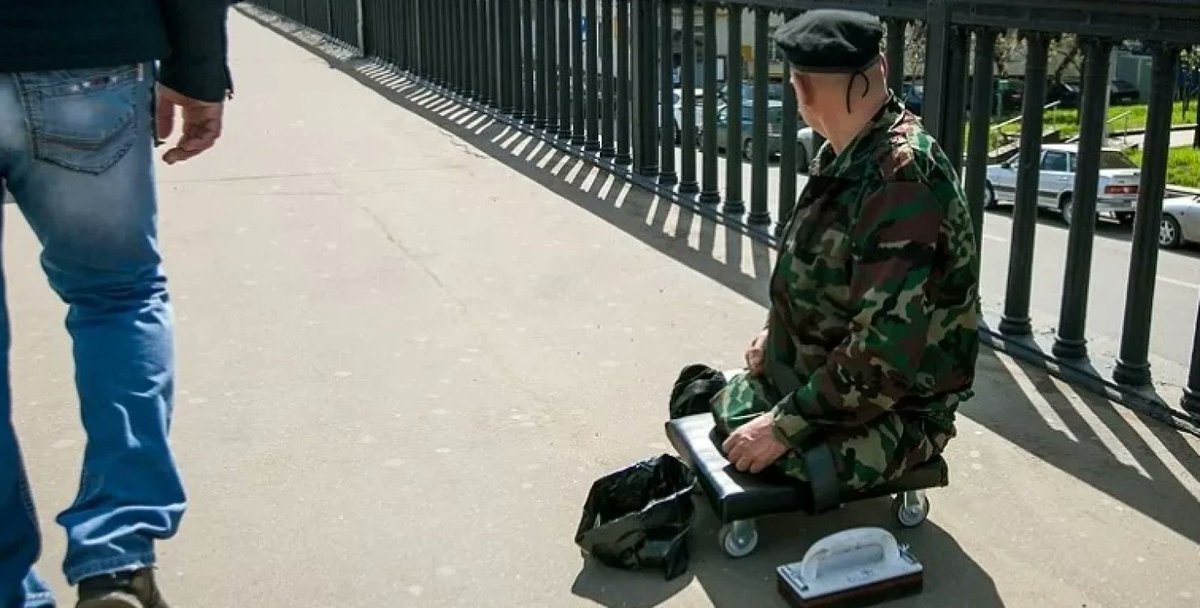
1/ Former Wagner mercenaries, their families, and ex-members of other Russian mercenary and volunteer units are reportedly being left "on the brink of poverty" without employment, assistance or prosthetics, despite Russia creating a fund to help ex-soldiers. ⬇️
2/ According to the pro-Kremlin Russian blogger Anastasia Kashevarova, the new Russian Defence Minister, Andrey Belousov, has said that ex-Wagner fighters are now being issued with the Veteran of Combat Operations Certificate (UVBD). This entitles them to state benefits.
3/ Former Wagnerites have been complaining for a long time that the Russian MOD was not issuing them with UVBDs, despite qualifying for them. However, as Kashevarova notes, being given a UVBD "is not a guarantee of rehabilitation, prosthetics and employment".
4/ She comments: "Many guys found themselves on the brink of poverty. They are amputees, they have no work, they have no payments, since the company [Wagner] no longer exists." Many ex-Wagnerites have had difficulty finding new jobs.
5/ In April 2023, Vladimir Putin established the Defenders of the Fatherland State Fund (FZO) to help ex-soldiers. However, Kashevarova says, "Despite the statements of the FZO, there is no help from them yet. In fact, the FZO with a colossal budget issues only crusts."
6/ The situation is worse for other groups. The families of dead Wagnerites are still not receiving posthumous UVBD certificates, which would provide a degree of compensation for their loss. Ex-members of other mercenary and volunteer units are also being denied help.
7/ Despite being full members of the Russian army, members of Storm V and Z assault units face the same situation. Kashevarova says they get "minimal payments and no insurance [for injuries or death]".
8/ Why, she asks, does the Defenders of the Fatherland Fund have "a huge staff, why a large number of premises, why purchase equipment and other things," if it is only for "luxury and posturing" and not for "real help"? /end
1/ Messages hacked from a Russian general's phone illustrate the sweeping scale of corruption at all levels of the Russian army. They highlight a top-to-bottom pyramid of extortion and bribery to obtain promotions and influence, plus scams and theft of military resources. ⬇️
2/ Last month, it emerged that gigabytes of messages spanning 2022-2024 had been obtained by Ukrainian sources from the phone of Major General Roman Demurchiev, most likely as the result of a successful hack.
3/ They have shed an unprecedentedly detailed look at the inner workings of the senior Russian officer corps, including Demurchiev's personal involvement in the torture, mutilation, and murder of Ukrainian POWs, as well as constant feuds between generals.
1/ Russia military policemen are engaged in another crackdown on privately owned vehicles operated by soldiers. Unfortunately for the soldiers, this is reported to be effectively lining them up for Ukrainian drone strikes. ⬇️
2/ The Military Automobile Inspectorate (VAI) and Military Police (VP) have made themselves hugely unpopular among Russian soldiers for their attempts to stop Russian soldiers using privately owned vehicles.
3/ According to Russian warbloggers, between 70-90% of vehicles used by the army in frontline areas are privately owned by soldiers, either purchased with their own money or provided as 'humanitarian aid' through donations from civilians and fundraisers.
1/ Iran's Kharg Island is reportedly under consideration as a target for capture by the Trump Administration. However, declassified US government documents show that the same thing was considered in 1979 but was rejected because it was too difficult and risky. ⬇️
2/ President Jimmy Carter and his National Security Council met in the afternoon of November 6, 1979 to discuss the ongoing Iranian hostage crisis. The discussion involved options for putting pressure on the Khomenei regime, including targeting Kharg Island.
3/ Kharg Island lies 25 km (16 miles) off the coast of Iran at the northern end of the Persian Gulf. It was built up as a deep water oil terminal in the 1960s, providing an ideal oil loading point for supertankers. 90% of Iran's oil exports pass through the island.
1/ The Russian government has dealt another body blow to Telegram by suddenly declaring all advertising on the app to have been illegal since 1 September 2025. Thousands of Russian bloggers and advertisers now face retroactive fines of up to 500,000 rubles ($6,308) per advert. ⬇️
2/ The Russian legal news outlet Pravo. ru reports that Russia's Federal Antimonopoly Service and the communications regulator Roskomnadzor have declared Telegram advertising to be illegal in a case involving beauty blogger Maria Loskutova.
3/ Loskutova's channel had included an advertisement for a fitness platform, posted on 28 January 2026. (Channel operators get a fee from advertisers, so both parties benefit.) It was declared illegal despite nothing being wrong with the contract or labelling.
1/ Civilian donations to the Russian army are said to have have collapsed ahead of the imminent ban on Telegram. It's a consequence, predicted by warbloggers, of the Russian government's apparent decision to ban the app. The impact on the front line is likely to be severe. ⬇️
2/ As the thread below highlights, the Russian army is dependent on volunteer donations for a huge amount of equipment, ranging from medicines, to generators, to vehicles. However, donations have been steadily dwindling as the economy has worsened.
3/ Telegram channels have been central venues for 'humanitarian aid' efforts, with their operators also raising money through shared revenue from adverts. The likely ban from 1 April has sent advertisers and subscribers fleeing. Russian soldier and warblogger 'Thirteenth' writes:
1/ A Russian army officer who briefed Vladimir Putin yesterday on the evils of Telegram has been exposed as being a premium Telegram user who doesn't even have an account on the state-approved messenger MAX. Russian warbloggers have erupted in outrage. ⬇️
2/ During the briefing, Lt Col Irina Godunova, a Russian army communications specialist, told Putin that Telegram was "considered a hostile means of communication" and that work was ongoing to "refine MAX" so that "everything will work well on the front line".
3/ Telegram plays a crucial part in frontline Russian military communications, as the thread below highlights. Russian warbloggers, many of them soldiers serving in Ukraine, have vociferously protested the Russian government's apparent plan to block it.