Mike Hoerger, PhD MSCR MBA Profile picture
Aug 1, 2024 26 tweets 7 min read Read on X
Slide Deck - Discussion of "Masking Policies at National Cancer Institute–Designated Cancer Centers During Winter 2023 to 2024 COVID-19 Surge"

x.com/i/spaces/1OdKr…
2/ “It takes 15 years to translate beneficial interventions into widespread practice. We need to improve understanding of the airborne transmission of COVID to accelerate that timeline. Patients cannot wait.”-Michael Hoerger, PhD, MSCR, MBAMedical Scientist
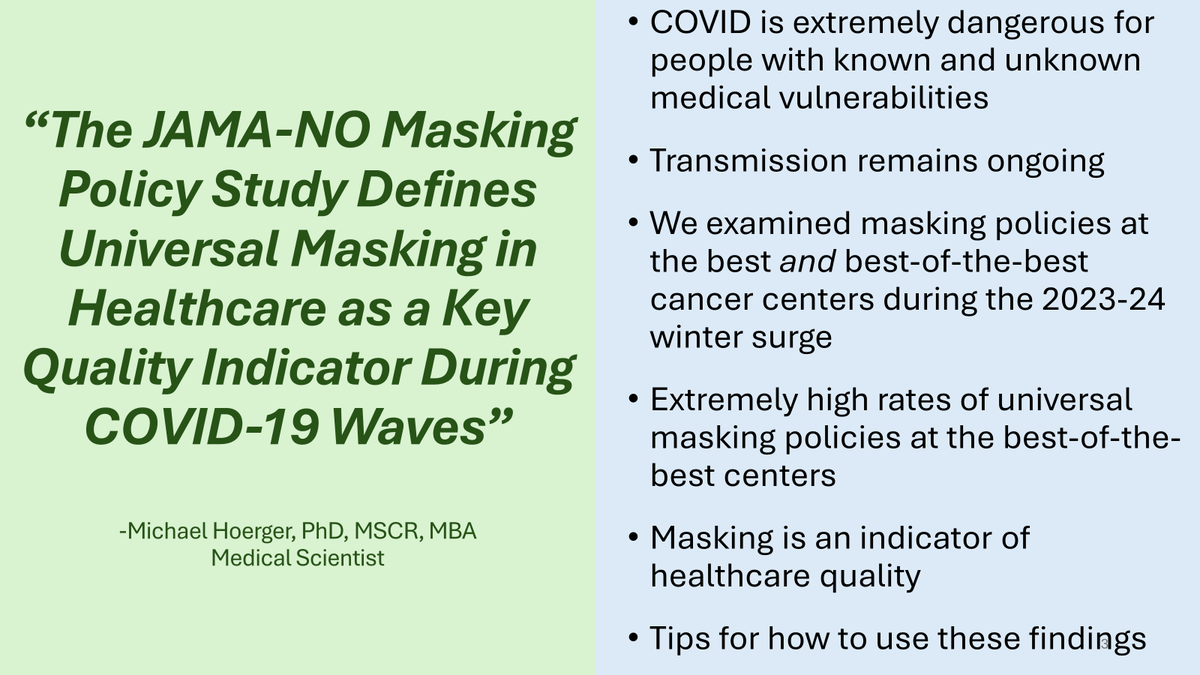
3/ “The JAMA-NO Masking Policy Study Defines Universal Masking in Healthcare as a Key Quality Indicator During COVID-19 Waves”-Michael Hoerger, PhD, MSCR, MBAMedical Scientist  COVID is extremely dangerous for people with known and unknown medical vulnerabilities Transmission remains ongoing We examined masking policies at the best and best-of-the-best cancer centers during the 2023-24 winter surge Extremely high rates of universal masking policies at the best-of-the-best centers Masking is an indicator of healthcare quality Tips for how to use these findings
5/
"Scenario planning: a framework for mitigating uncertainty in implementing strategic behavioral medicine initiatives during the COVID-19 pandemic"

ncbi.nlm.nih.gov/pmc/articles/P…
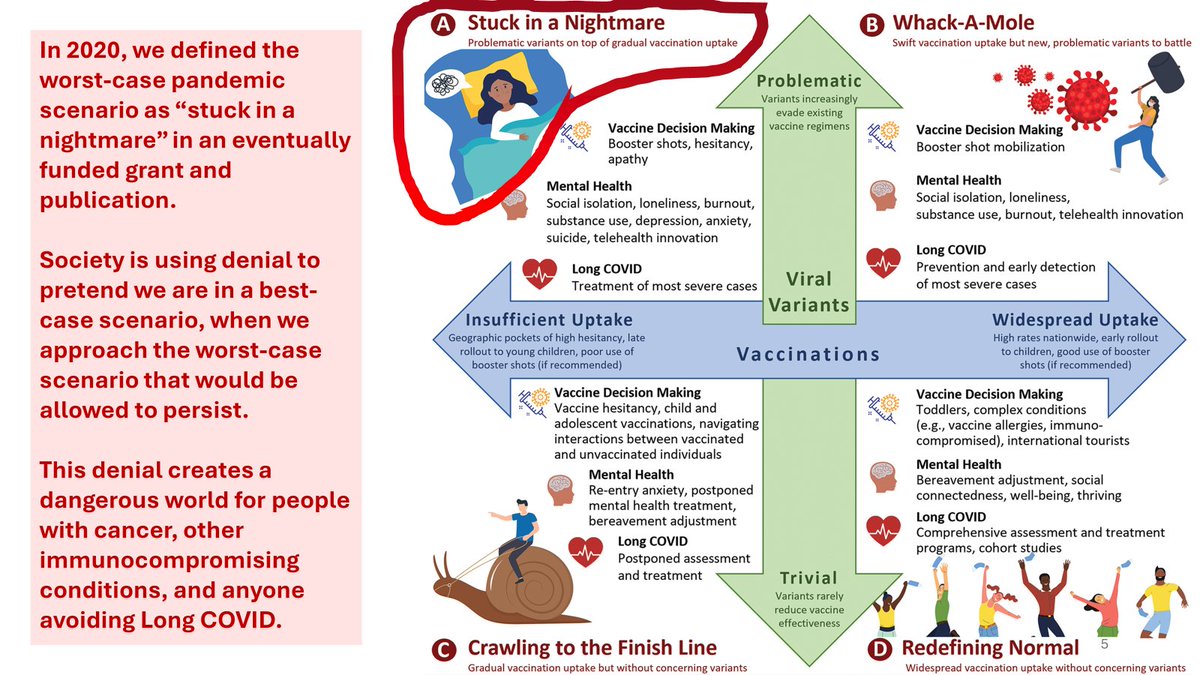
Figure from our COVID scenario planning paper, originally for a PCORI grant to study the pandemic impact on food service workers.  Caption: In 2020, we defined the worst-case pandemic scenario as “stuck in a nightmare” in an eventually funded grant and publication.  Society is using denial to pretend we are in a best-case scenario, when we approach the worst-case scenario that would be allowed to persist.   This denial creates a dangerous world for people with cancer, other immunocompromising conditions, and anyone avoiding Long COVID.
6/

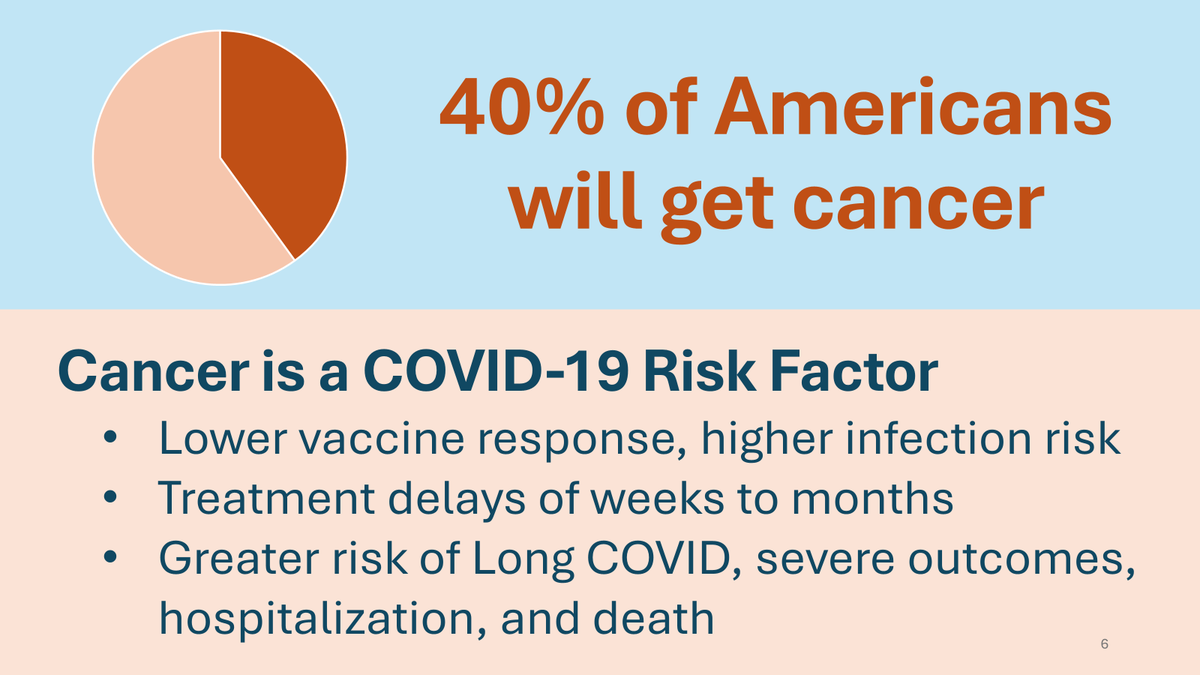
Cancer is a COVID-19 risk factor. 40% of Americans will get cancer  Cancer is a COVID-19 Risk Factor Lower vaccine response, higher infection risk Treatment delays of weeks to months Greater risk of Long COVID, severe outcomes, hospitalization, and death
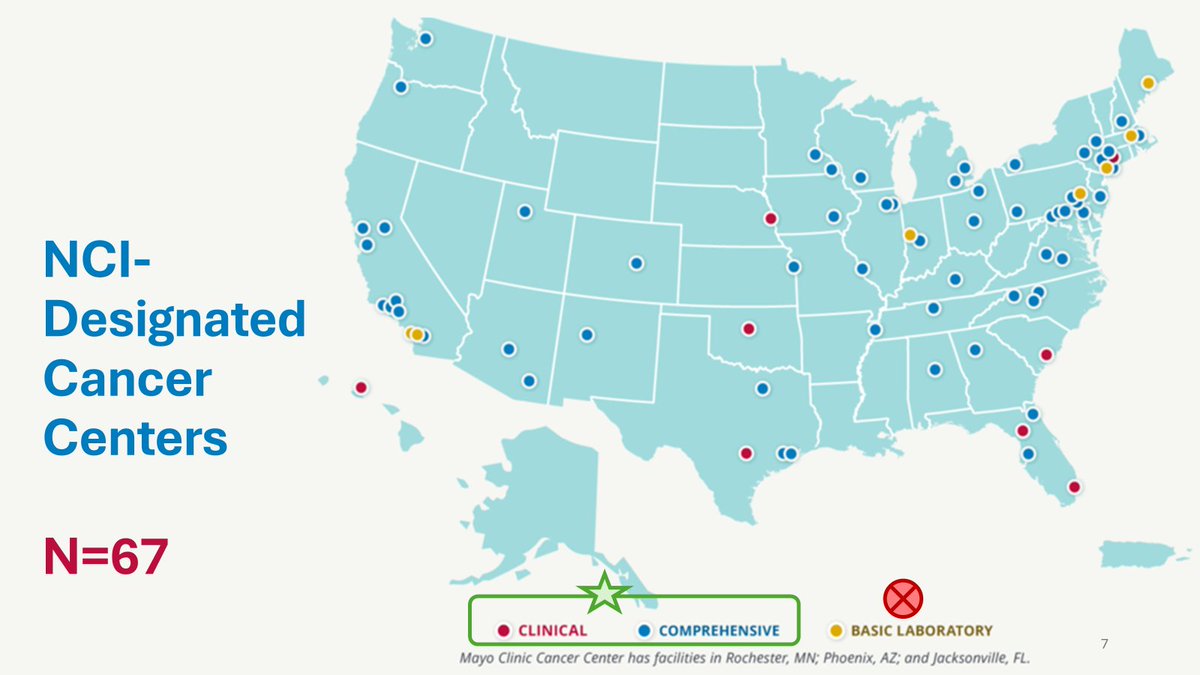
7/ Map of the U.S. showing NCI-designated cancer center locations
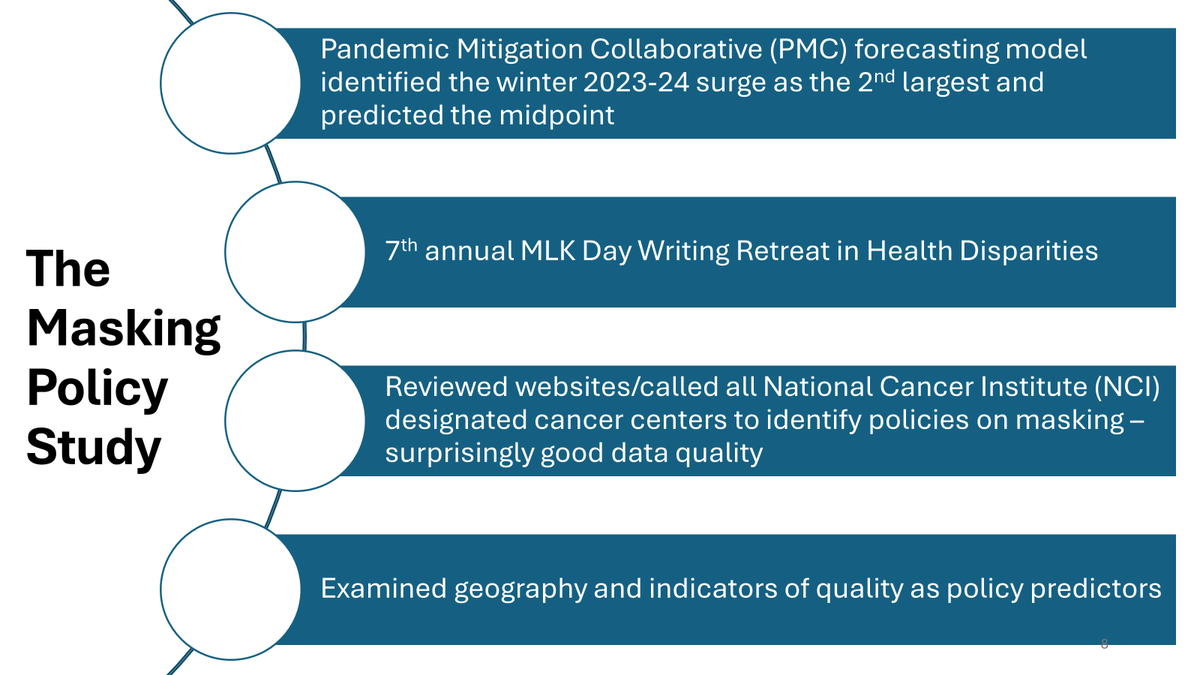
8/ The Masking Policy Study  Pandemic Mitigation Collaborative (PMC) forecasting model identified the winter 2023-24 surge as the 2nd largest and predicted the midpoint 7th annual MLK Day Writing Retreat in Health Disparities Reviewed websites/called all National Cancer Institute (NCI) designated cancer centers to identify policies on masking – surprisingly good data quality Examined geography and indicators of quality as policy predictors
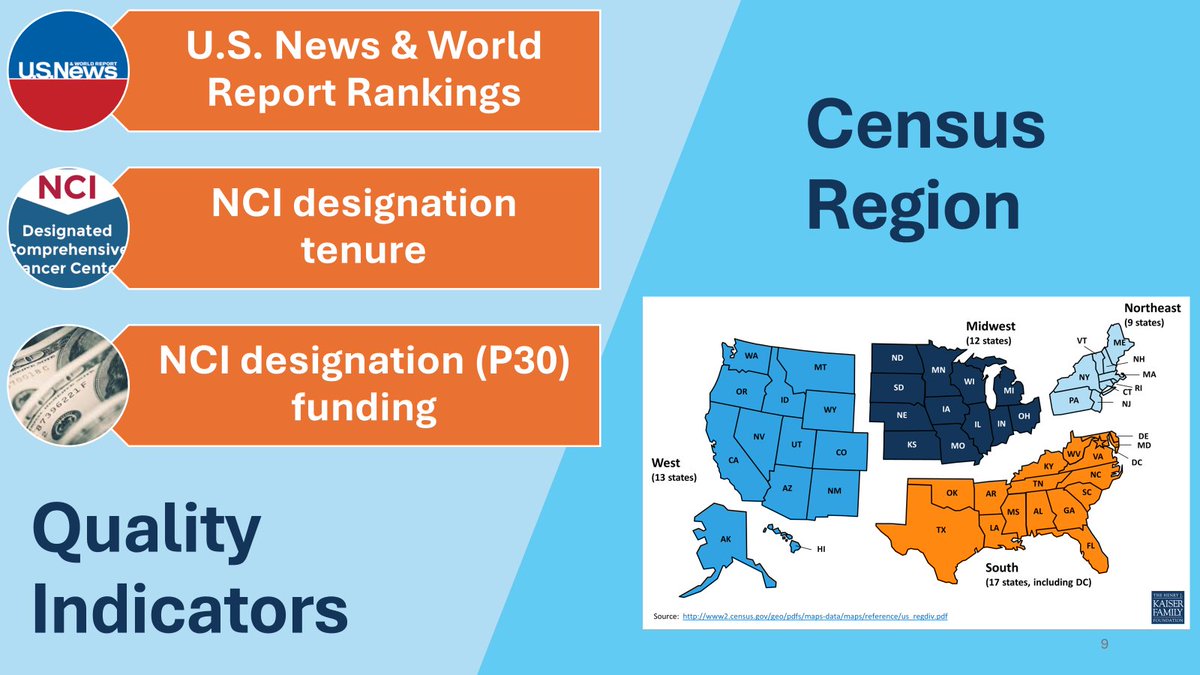
9/ study examined census region and quality indicators
10/
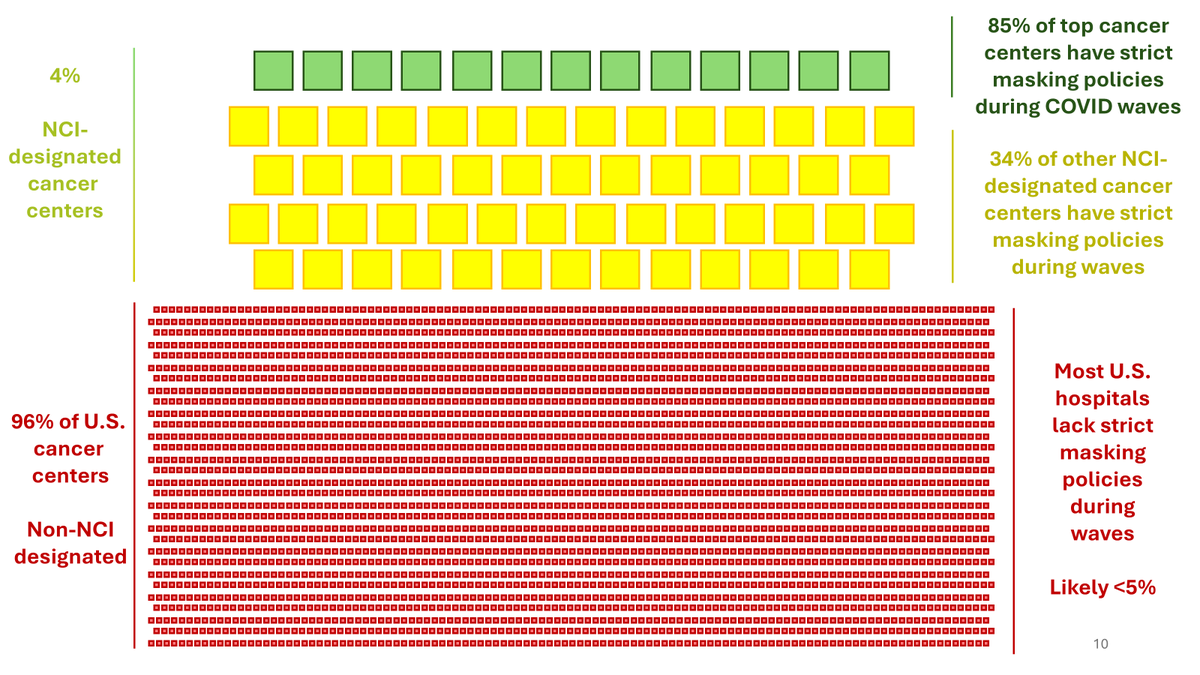
NCI-designated cancer centers comprise approximately 4% of U.S. cancer centers.

At the NCI-designated cancer centers, about 85% of those in the top quintile had universal masking policies in winter 2023-24, as did about 34% of other NCI-designated centers. Figure, summarized in tweet
11/
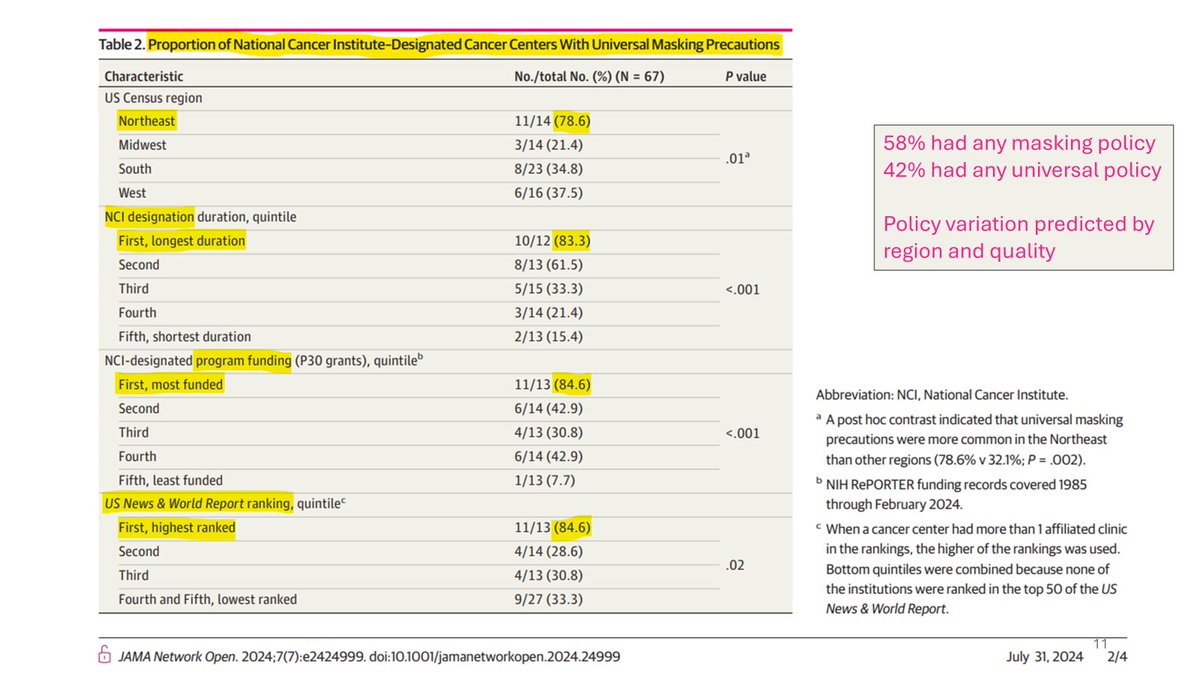
42% of NCI-designated cancer centers had universal masking policies during the winter 2023-24 surge, but numbers were significantly higher in the northeast and at centers with higher quality indicators. 58% had any masking policy, 42% had a universal masking policy. Table shows higher proportions in the NE and at centers with higher quality ratings.
12/
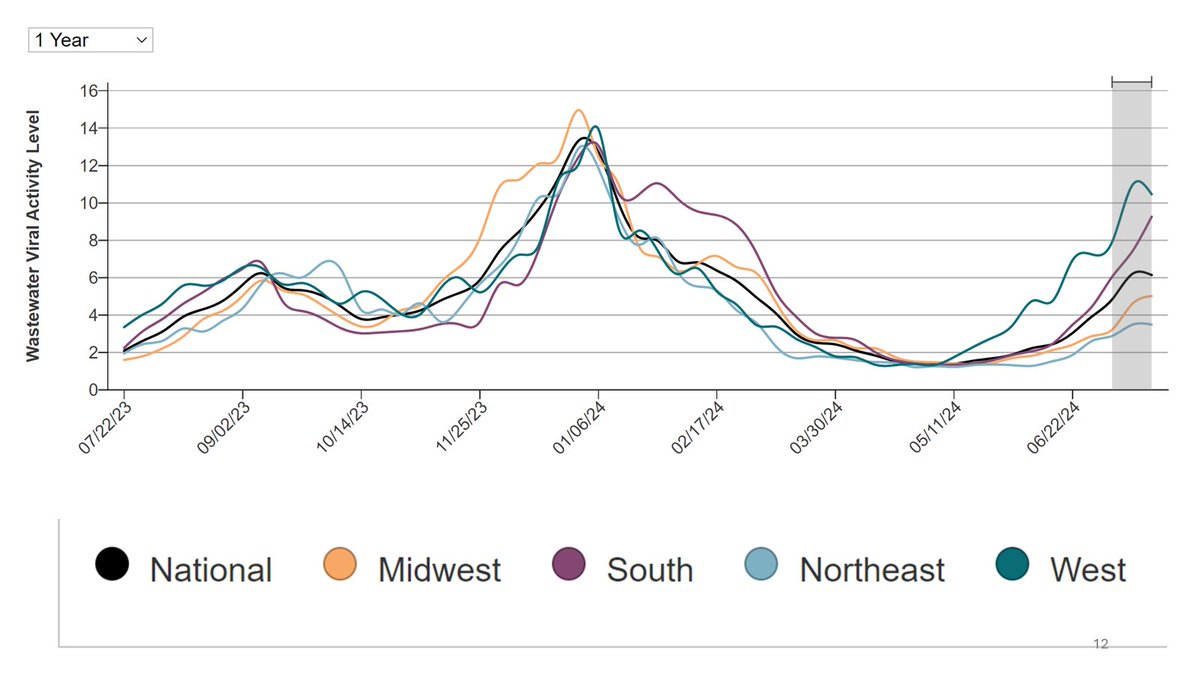
The Midwest and South lagged on masks in healthcare, despite higher overall transmission during the winter 2023-24 surge. CDC graph of regional C19 transmission the past year. Midwest had more transmission (early). South had more transmission (late).
13/
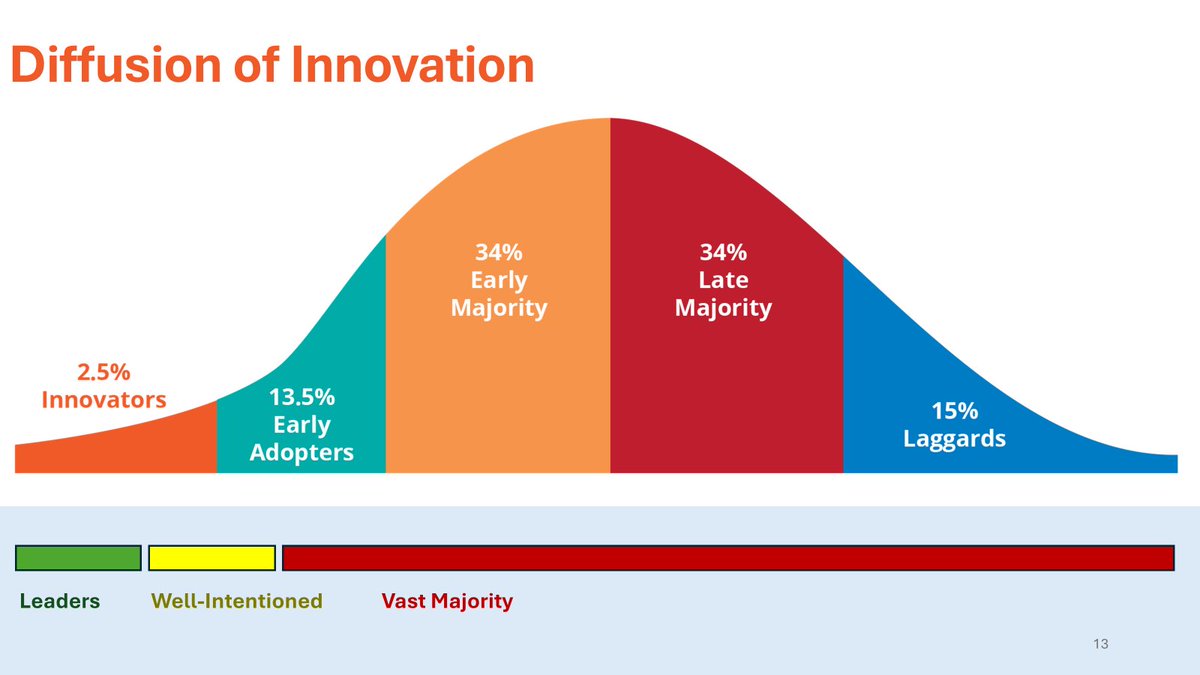
Apply the "Diffusion of Innovation" framework to organizational changes surrounding airborne illness transmission Bell curve showing the "Diffusion of Innovation" model  innovators, early adopters, early majority, late majority, laggards
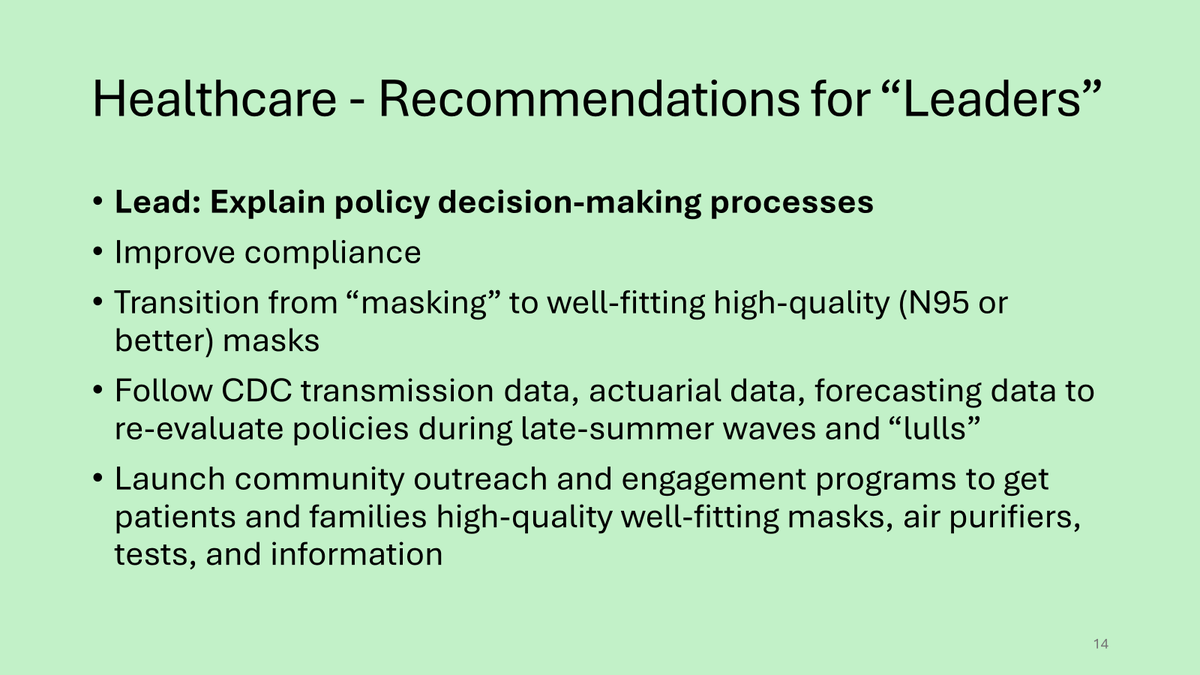
14/ Healthcare - Recommendations for “Leaders”  Lead: Explain policy decision-making processes Improve compliance Transition from “masking” to well-fitting high-quality (N95 or better) masks Follow CDC transmission data, actuarial data, forecasting data to re-evaluate policies during late-summer waves and “lulls” Launch community outreach and engagement programs to get patients and families high-quality well-fitting masks, air purifiers, tests, and information
15/

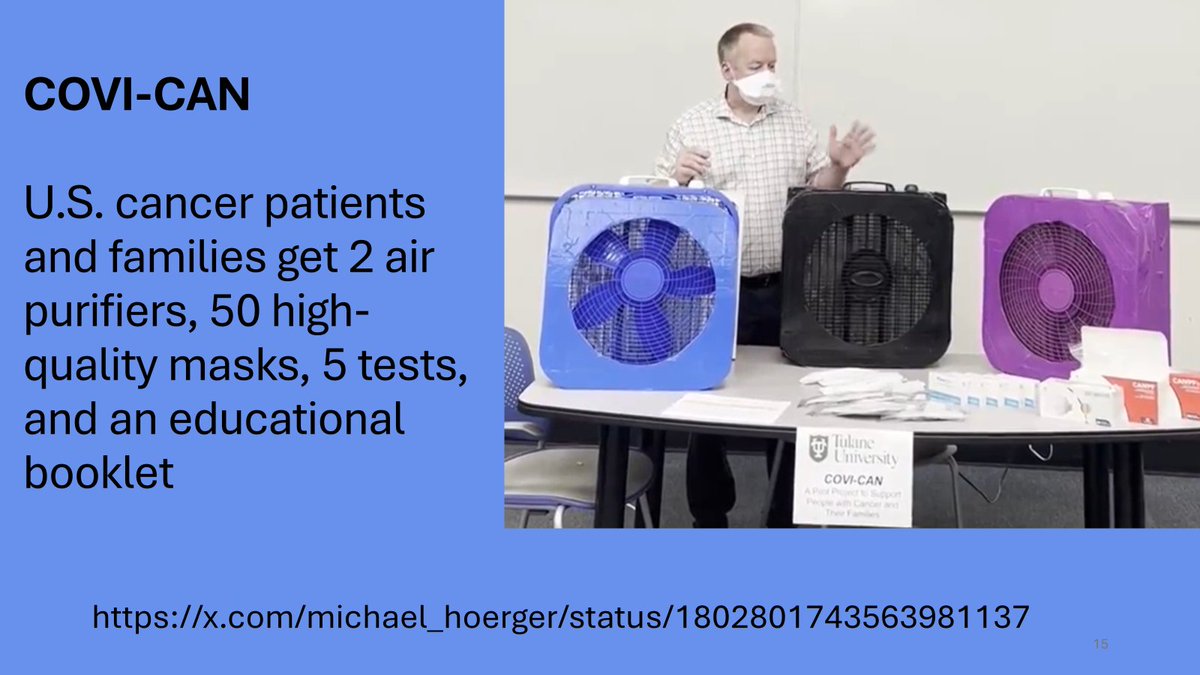
COVI-CAN
The Covid Defense Kit for patients undergoing cancer treatment and their families.


COVI-CAN  U.S. cancer patients and families get 2 air purifiers, 50 high-quality masks, 5 tests, and an educational booklet  Picture shows me demonstrating elements of the kit
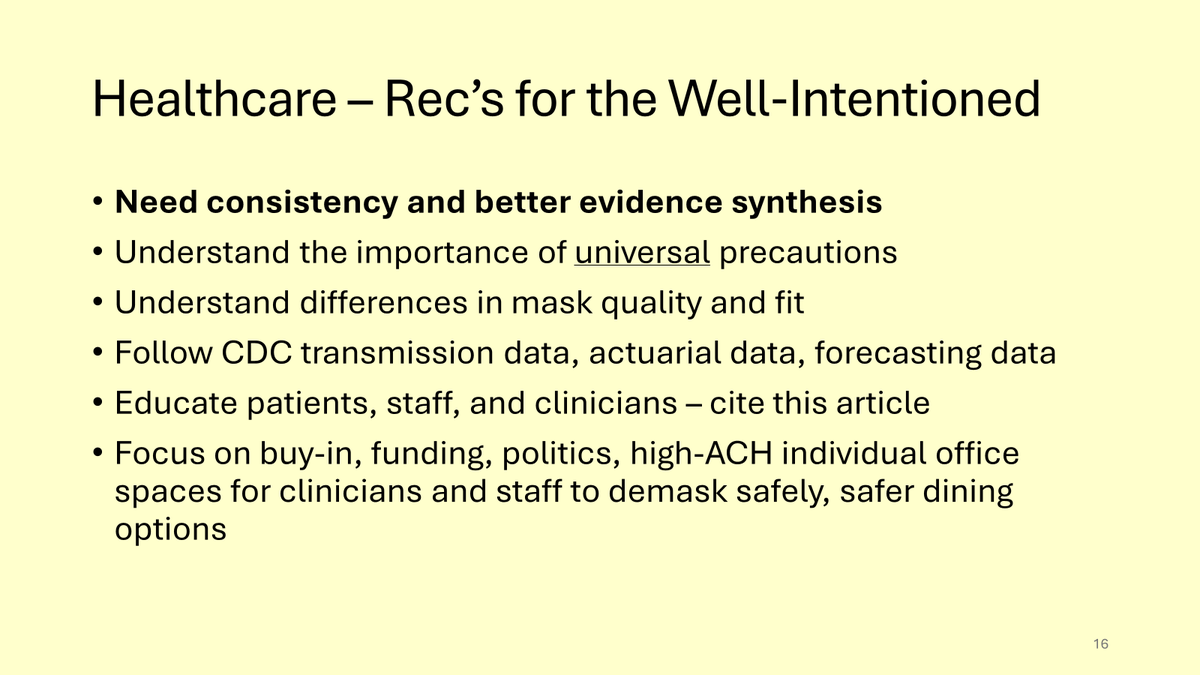
16/ Healthcare – Rec’s for the Well-Intentioned  Need consistency and better evidence synthesis Understand the importance of universal precautions Understand differences in mask quality and fit Follow CDC transmission data, actuarial data, forecasting data Educate patients, staff, and clinicians – cite this article Focus on buy-in, funding, politics, high-ACH individual office spaces for clinicians and staff to demask safely, safer dining options
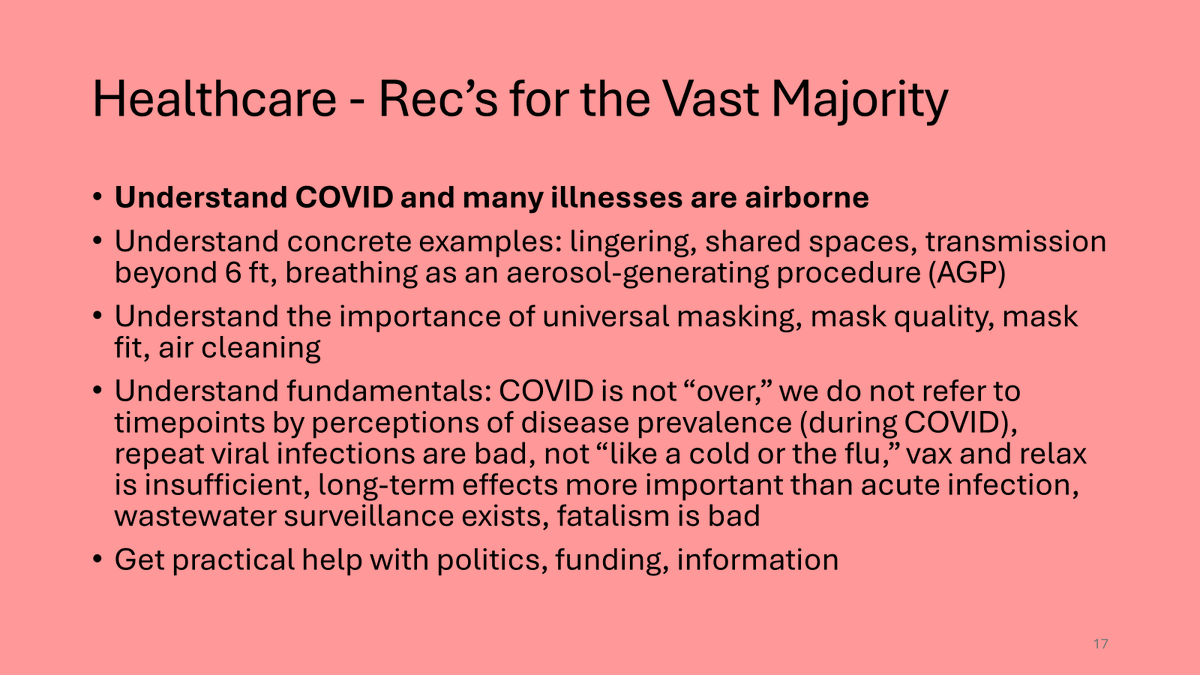
17/ Healthcare - Rec’s for the Vast Majority  Understand COVID and many illnesses are airborne Understand concrete examples: lingering, shared spaces, transmission beyond 6 ft, breathing as an aerosol-generating procedure (AGP) Understand the importance of universal masking, mask quality, mask fit, air cleaning  Understand fundamentals: COVID is not “over,” we do not refer to timepoints by perceptions of disease prevalence (during COVID), repeat viral infections are bad, not “like a cold or the flu,” vax and relax is insufficient, long-term effects more important than acute infection, wastewate...
18/
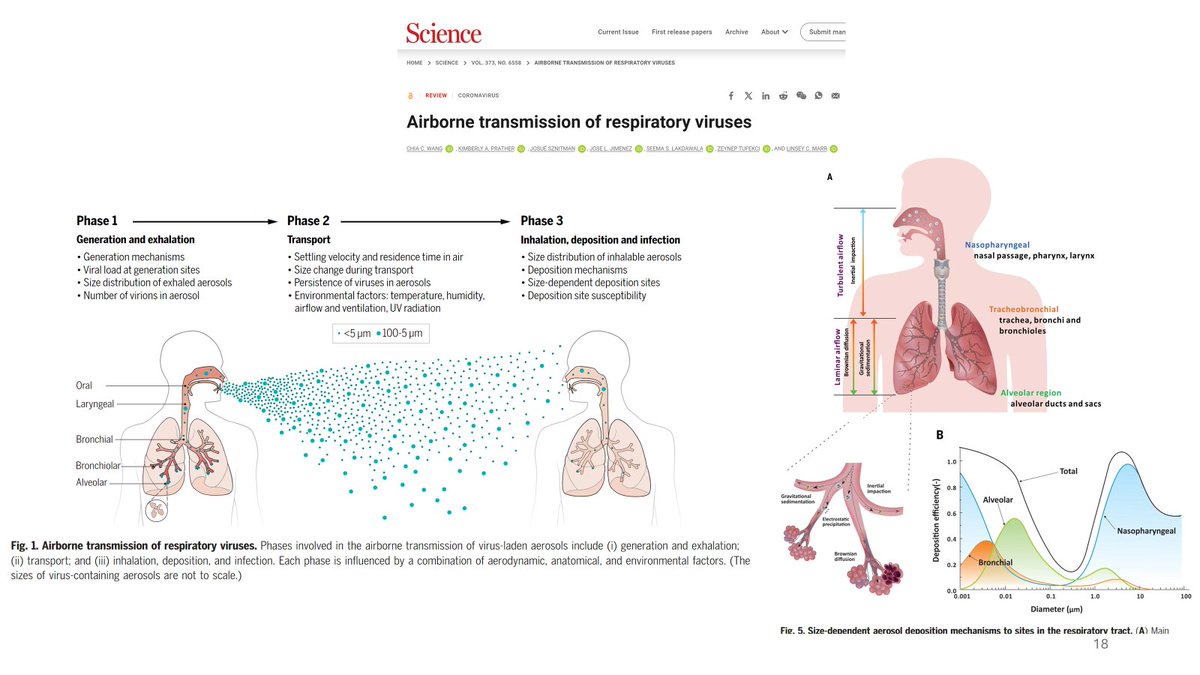
"Airborne transmission of respiratory viruses"

science.org/doi/10.1126/sc…
title and figures from "Airborne transmission of respiratory viruses"
19/
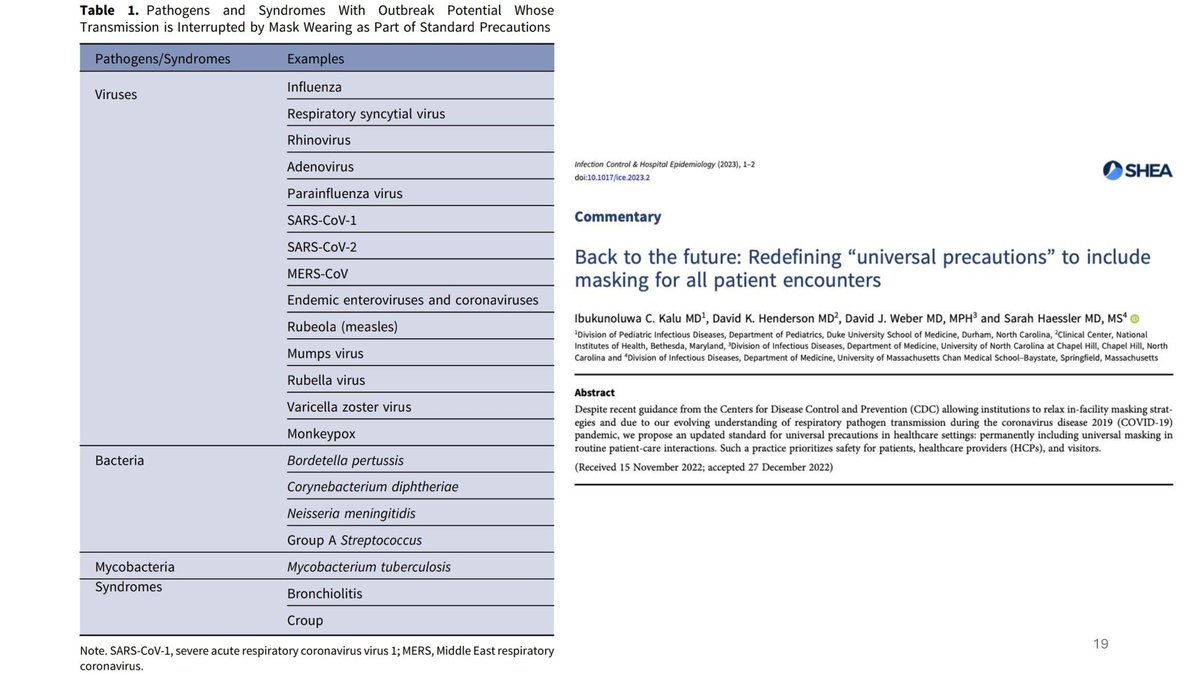
"Back to the future: Redefining 'universal precautions' to include masking for all patient encounters" title and table 1 from "Back to the future: Redefining 'universal precautions' to include masking for all patient encounters"  Table lists numerous illnesses transmitted by airborne. Article recommends masks. 2nd author is from NIH
20/

"Masks and respirators for prevention of respiratory infections: a state of the science review"
pubmed.ncbi.nlm.nih.gov/38775460/
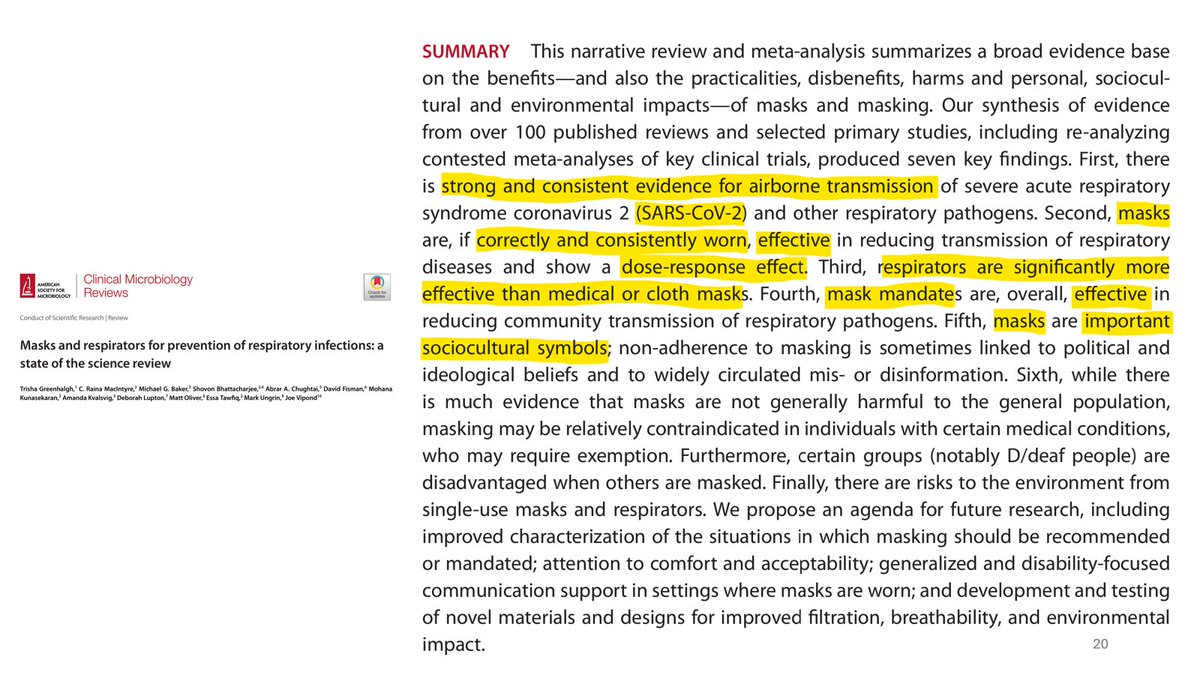
title and abstract from "Masks and respirators for prevention of respiratory infections: a state of the science review"  First, there is strong and consistent evidence for airborne transmission of severe acute respiratory syndrome coronavirus 2 (SARS-CoV-2) and other respiratory pathogens. Second, masks are, if correctly and consistently worn, effective in reducing transmission of respiratory diseases and show a dose-response effect. Third, respirators are significantly more effective than medical or cloth masks. Fourth, mask mandates are, overall, effective in reducing community ...
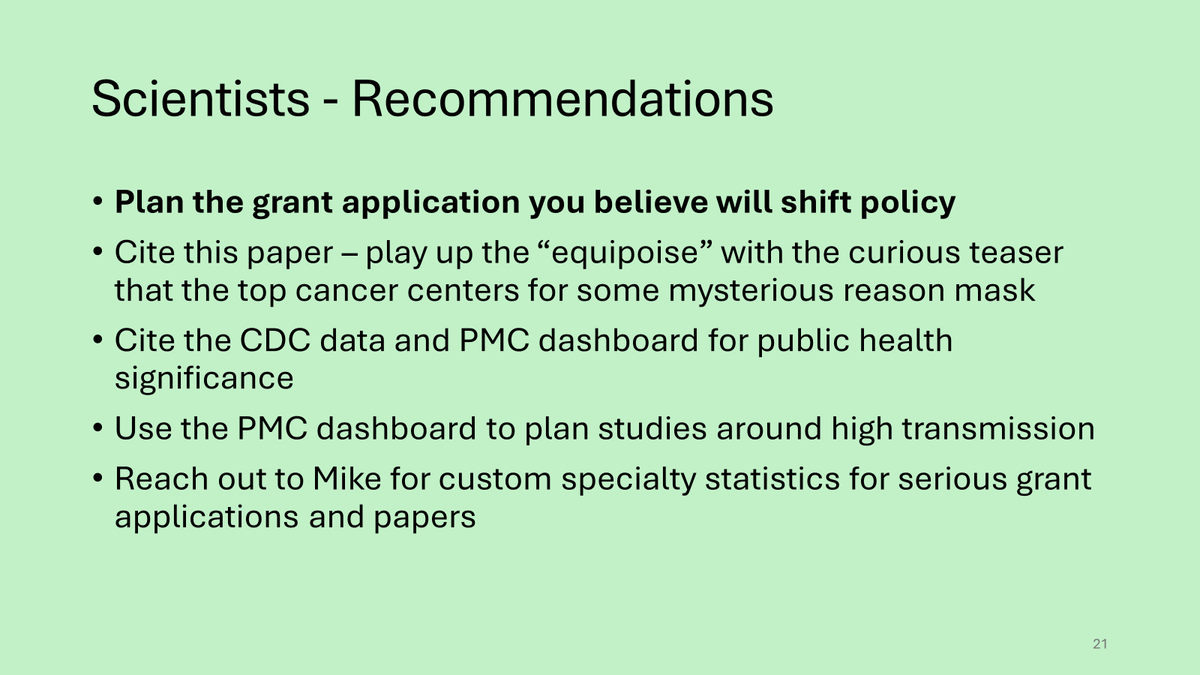
21/ Scientists - Recommendations  Plan the grant application you believe will shift policy Cite this paper – play up the “equipoise” with the curious teaser that the top cancer centers for some mysterious reason mask Cite the CDC data and PMC dashboard for public health significance Use the PMC dashboard to plan studies around high transmission Reach out to Mike for custom specialty statistics for serious grant applications and papers
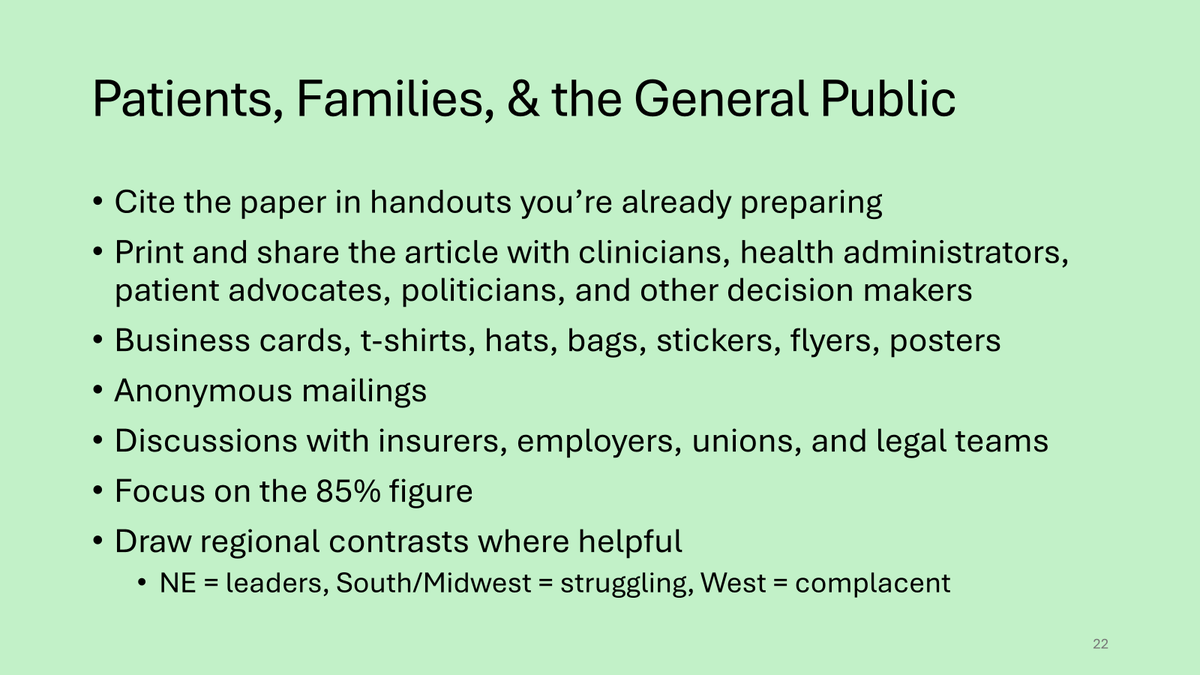
22/ Patients, Families, & the General Public  Cite the paper in handouts you’re already preparing Print and share the article with clinicians, health administrators, patient advocates, politicians, and other decision makers Business cards, t-shirts, hats, bags, stickers, flyers, posters Anonymous mailings Discussions with insurers, employers, unions, and legal teams Focus on the 85% figure Draw regional contrasts where helpful NE = leaders, South/Midwest = struggling, West = complacent
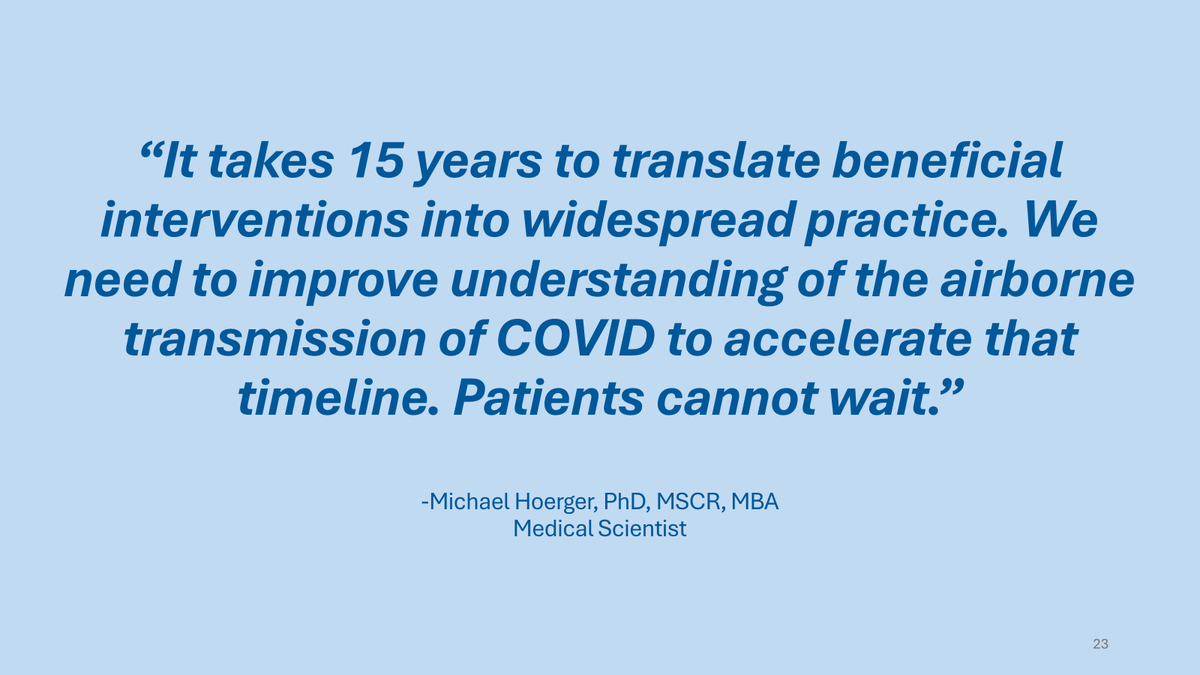
23/ “It takes 15 years to translate beneficial interventions into widespread practice. We need to improve understanding of the airborne transmission of COVID to accelerate that timeline. Patients cannot wait.”-Michael Hoerger, PhD, MSCR, MBAMedical Scientist
24/ Closing announcement: "Sunsetting" v1 of the PMC Dashboard soon
25/ Questions?  Post your questions as a comment on this final Tweet. We can focus on recurring themes if helpful.

• • •

Missing some Tweet in this thread? You can try to force a refresh

 

Keep Current with Mike Hoerger, PhD MSCR MBA

Mike Hoerger, PhD MSCR MBA Profile picture

Stay in touch and get notified when new unrolls are available from this author!

Read all threads

This Thread may be Removed Anytime!

PDF

Twitter may remove this content at anytime! Save it as PDF for later use!

Try unrolling a thread yourself!

how to unroll video
  1. Follow @ThreadReaderApp to mention us!

  2. From a Twitter thread mention us with a keyword "unroll"
@threadreaderapp unroll

Practice here first or read more on our help page!

More from @michael_hoerger

Jan 25
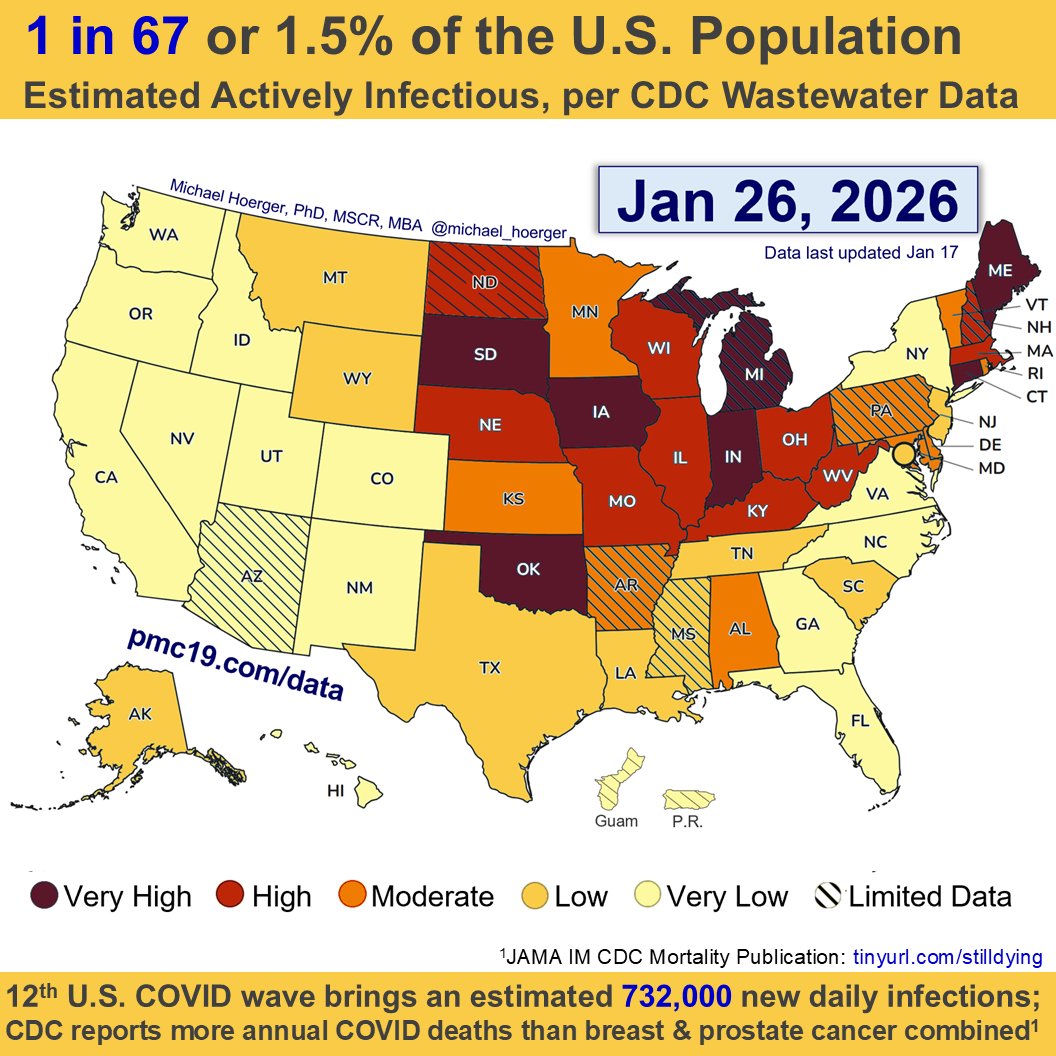
During this 12th COVlD wave, the CDC reports 1-in-3 states have "High" or "Very High" levels.

PMC estimates the proportion of residents actively infectious (prevalence):
◾️USA: 1 in 67
◾️IA: 1 in 27
◾️MI: 1 in 25
◾️IN & CT: 1 in 23
◾️ME: 1 in 21
◾️OK & SD: 1 in 17

🧵1/ Heat map using CDC data. National PMC prevalence estimate noted; estimated incidence of 732,000 new daily infections.
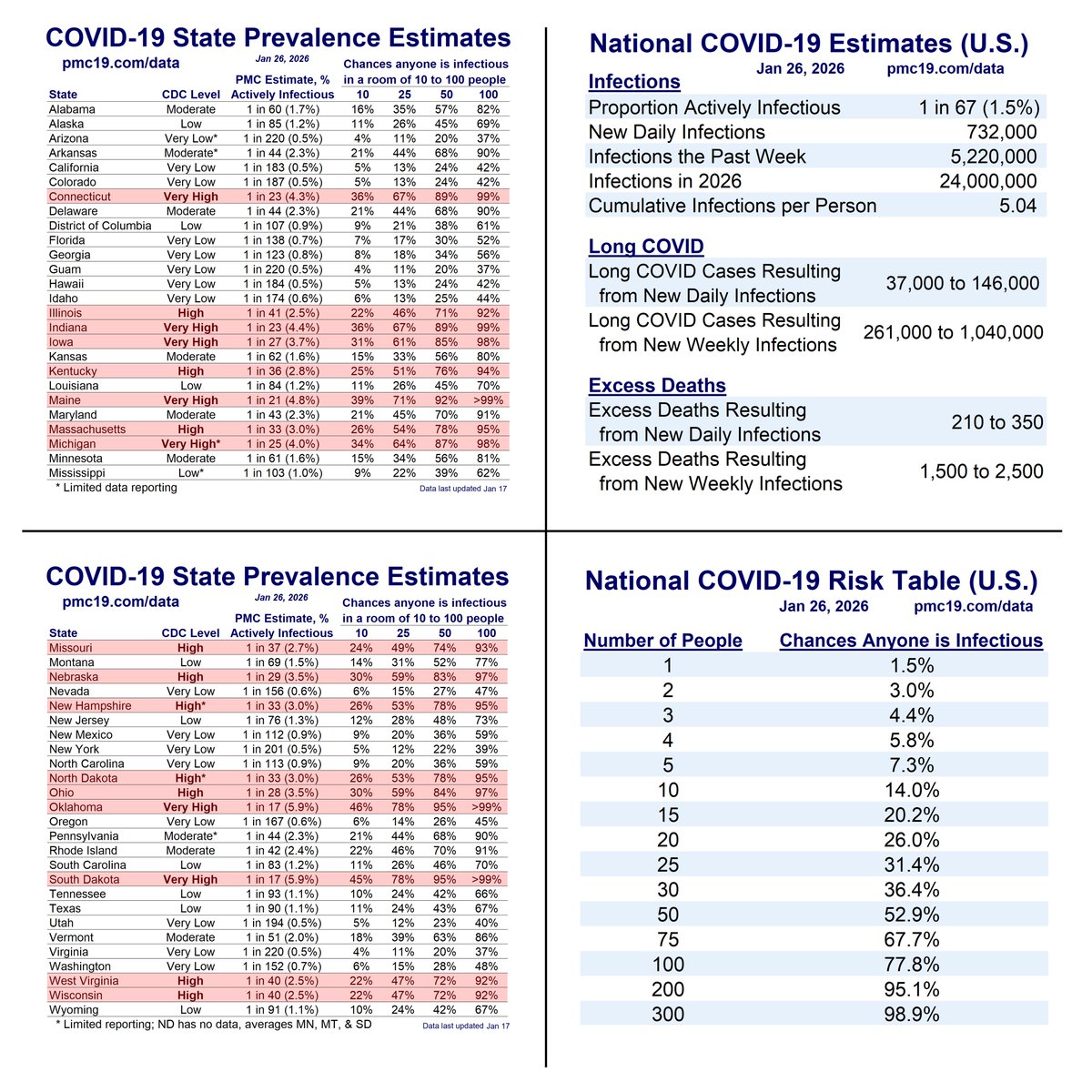
On average, Americans have have 5.0 cumulative SARS-CoV-2 infections.

This week's infections are expected to result in 1/4 to 1 million new #LongCOVID conditions and ≈2,000 excess deaths.
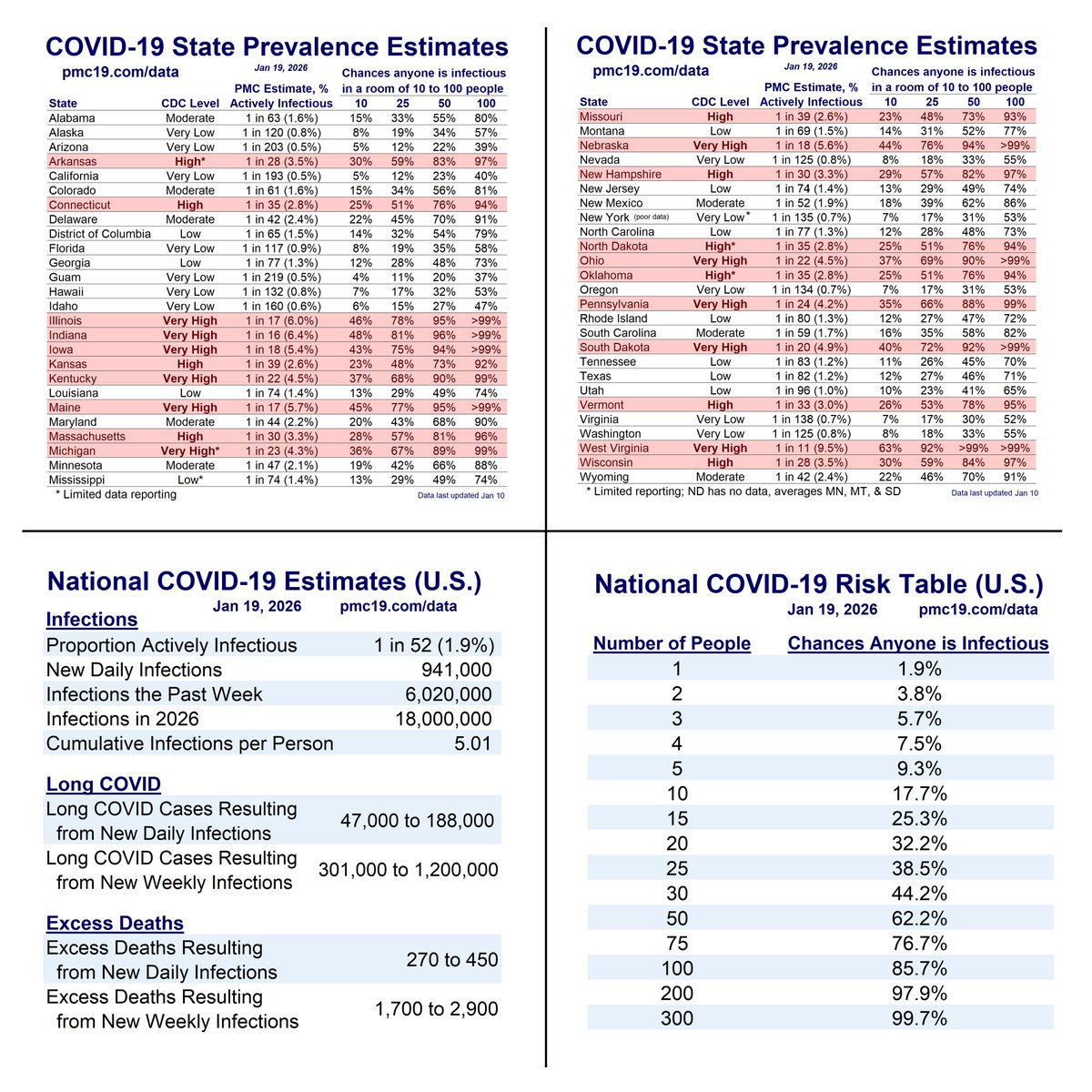
🧵2/ Column 1: Table of state-level prevalence estimates. Highest estimates noted in the thread text.  Column 2:  Proportion Actively Infectious										1 in 67 (1.5%) New Daily Infections										 732,000  Infections the Past Week										 5,220,000  Infections in 2026										 24,000,000  Cumulative Infections per Person										 5.04  										 Long COVID										 Long COVID Cases Resulting								37,000 to 146,000		   from New Daily Infections										 Long COVID Cases Resulting								261,000 to 1,040,000		   from New Weekly Infections										 										 Excess Deaths										 Ex...
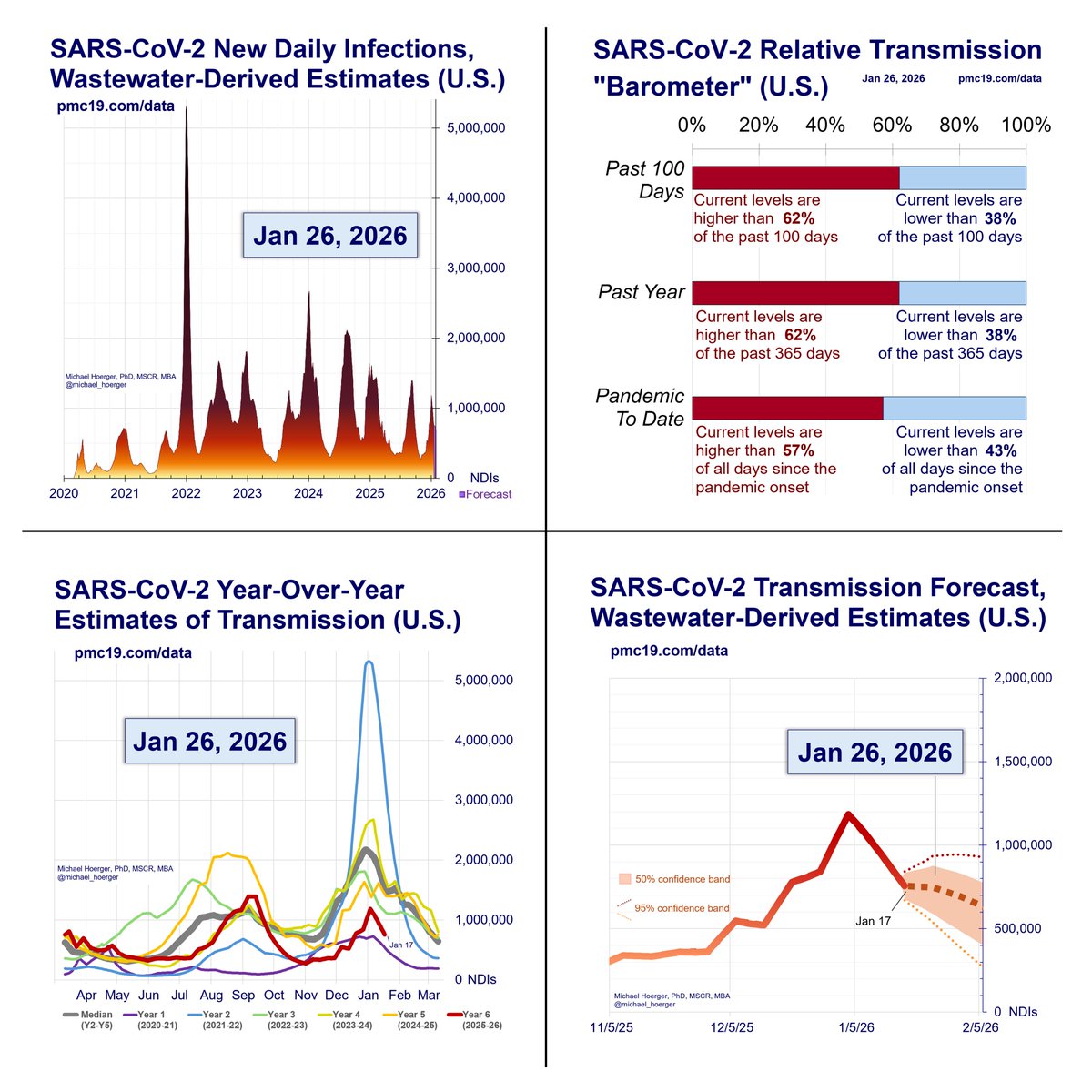
The wave peak is now estimated >10% higher than last week at 1.2 million new daily infections, nearly double the Delta wave.

We expect sustained high transmission (≈600,000 to 750,000 new daily infections) the next few weeks as COVlD circulates through schools/families.
🧵3/ Fig 1: Graph of 12 waves  Fig 2: "Barometer" showing above average transmission  Fig 3: Year-over-year graph, which informs the analytic forecast  Fig 4: Forecast described in post
Read 4 tweets
Jan 17
Based on today's CDC & Biobot data, we estimate the following for the week of Jan 19:

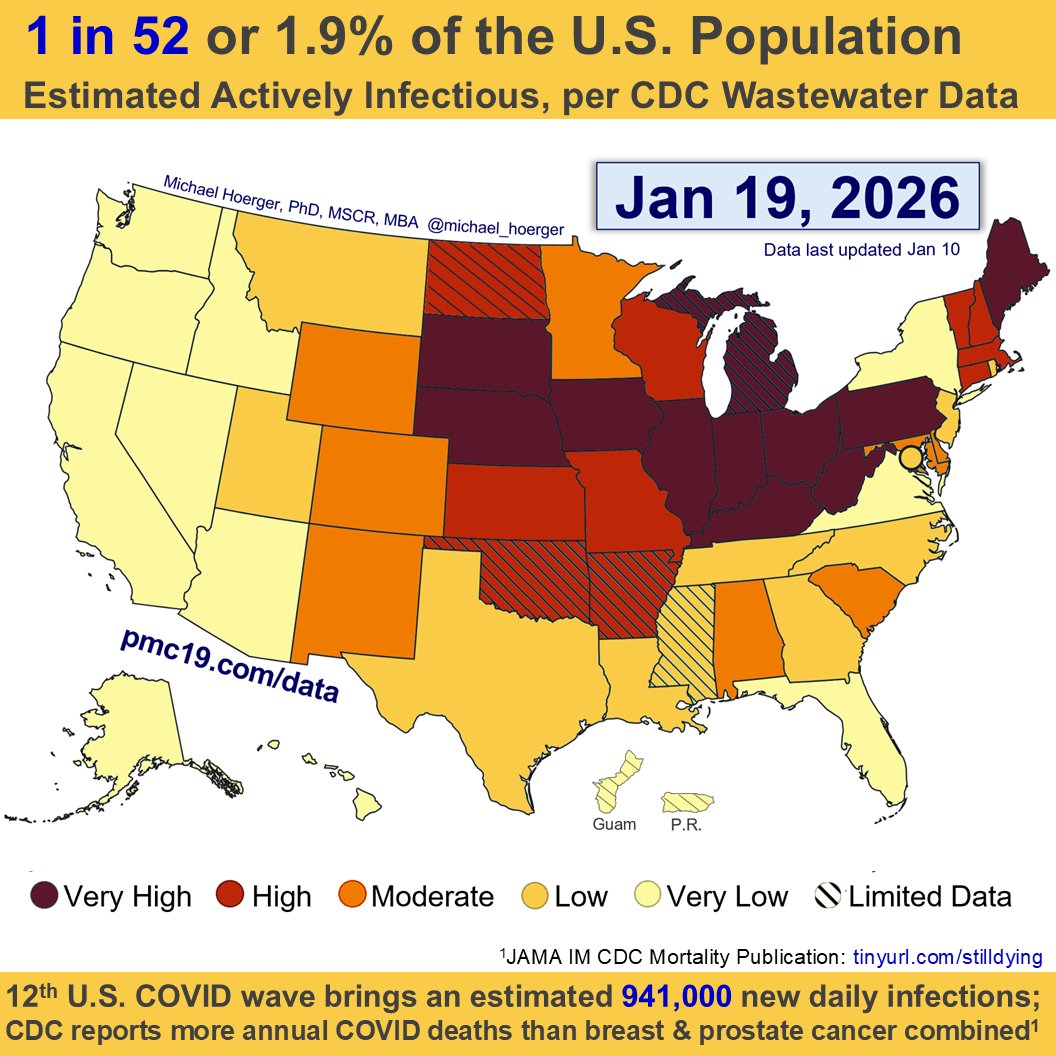
🔸1 in 52 people in the U.S. actively infectious
🔸25% chance of exposure in a room of 15 ppl
🔸Nearly 1 million new daily infections
🔸5 cumulative infections per person all-time (avg)
🧵1/5 Heat map from CDC data with PMC estimates. Description of "Very High" states in next post
Transmission estimates have been marginally corrected upward.

11 states have Very High COVlD levels:

🔸PA: 1 in 25 estimated actively infectious
🔸MI: 1 in 23
🔸OH & KY: 1 in 22
🔸SD: 1 in 20
🔸NE & IA: 1 in 18
🔸IL & ME: 1 in 17
🔸IN: 1 in 16
🔸WV: 1 in 11
🧵2/5 Proportion Actively Infectious										1 in 52 (1.9%) New Daily Infections										 941,000  Infections the Past Week										 6,020,000  Infections in 2026										 18,000,000  Cumulative Infections per Person										 5.01  										 Long COVID										 Long COVID Cases Resulting								47,000 to 188,000		   from New Daily Infections										 Long COVID Cases Resulting								301,000 to 1,200,000		   from New Weekly Infections										 										 Excess Deaths										 Excess Deaths Resulting 									270 to 450	   from New Daily Infections										 Excess Deaths Resulting 				...
We're in the middle of a 12th COVlD wave.

The peak has likely passed, but with students headed back to school, transmission is expected to remain high for at least the next several weeks.

🧵3/5 1) Graph of 12 waves 2) Barometer showing above-average transmission 3) Year over year graph 4) Forecast for transmission to decline and then percolate at high levels
Read 5 tweets
Jan 10
The size of the winter COVlD wave has been revised upward as post-holiday data come in.

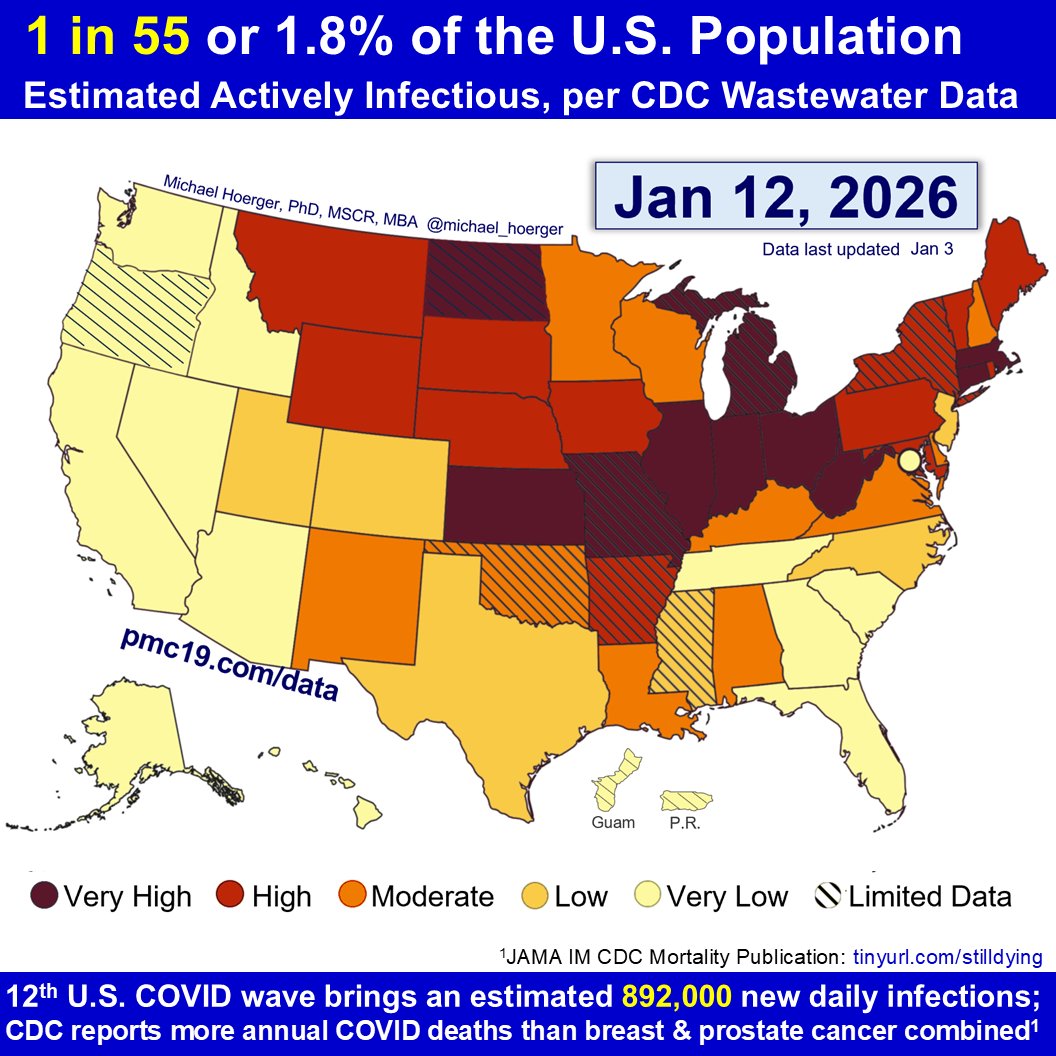
We estimated 1 in 55 people in the U.S. are actively infectious.

🔥WV: 1 in 14
🔥IN: 1 in 15
🔥MI & OH: 1 in 21
🔥MO: 1 in 22
🔥CT: 1 in 24
🔥KS: 1 in 25
🔥MA & IL: 1 in 27

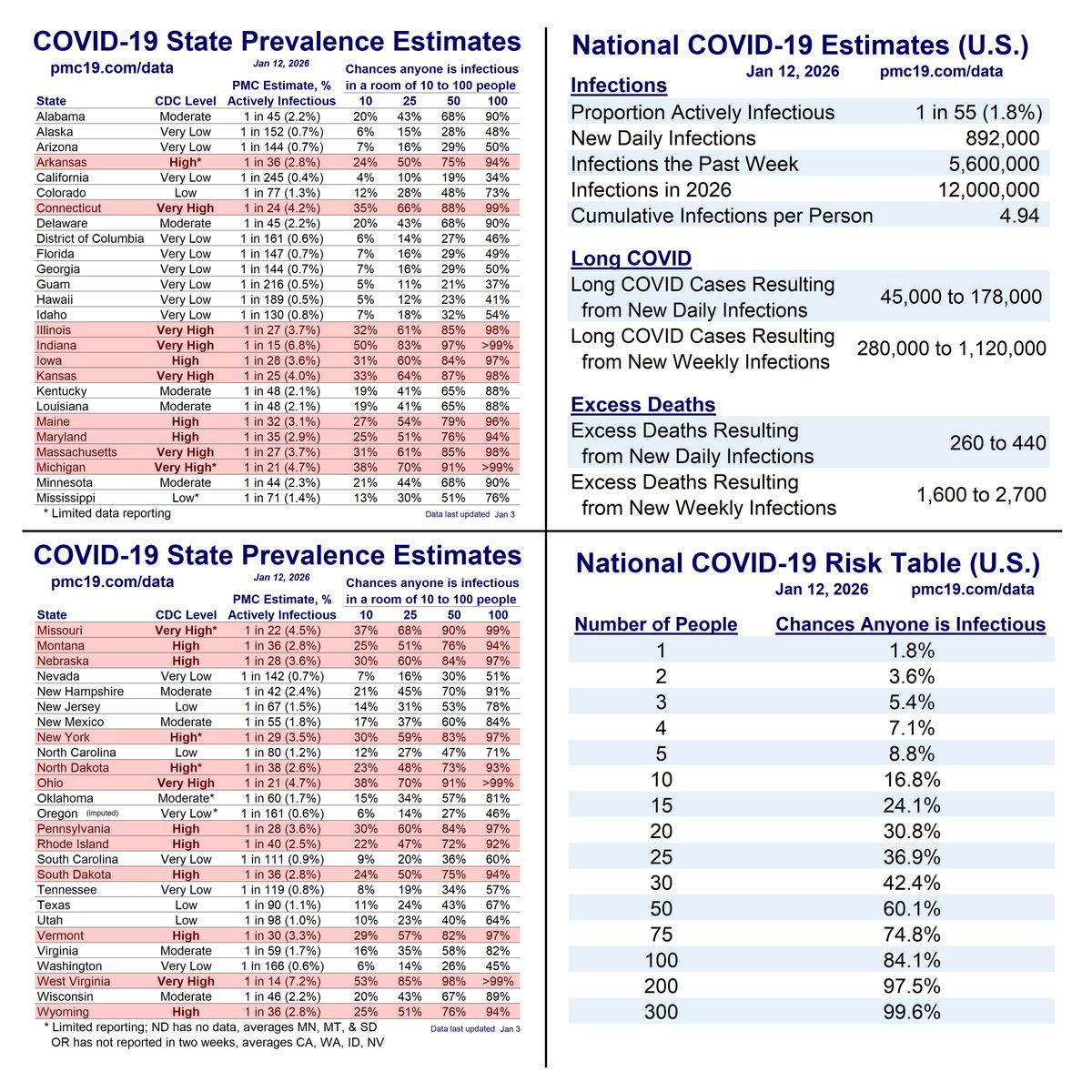
Quick 🧵 1/4 Heat map and PMC estimates, 1 in 55 infectious and 892,000 new daily infections for Jan 12.  We expedited the report to release it two days early.
Nationally, we are seeing an estimated 892,000 new daily SARS-CoV-2 infections, meaning a 1 in 4 chance of exposure in a room of 15 people. Risk varies considerably by state.

We are approaching an average of 5 infections per person since pandemic onset.
🧵 2/4 Alabama	Moderate Alaska	Very Low Arizona	Very Low Arkansas	High* California	Very Low Colorado	Low Connecticut	Very High Delaware	Moderate District of Columbia	Very Low Florida	Very Low Georgia	Very Low Guam	Very Low Hawaii	Very Low Idaho	Very Low Illinois	Very High Indiana	Very High Iowa	High Kansas	Very High Kentucky	Moderate Louisiana	Moderate Maine	High Maryland	High Massachusetts	Very High Michigan	Very High* Minnesota	Moderate Mississippi	Low* Missouri	Very High* Montana	High Nebraska	High Nevada	Very Low New Hampshire	Moderate New Jersey	Low New Mexico	Moderate New York	High* North Ca...
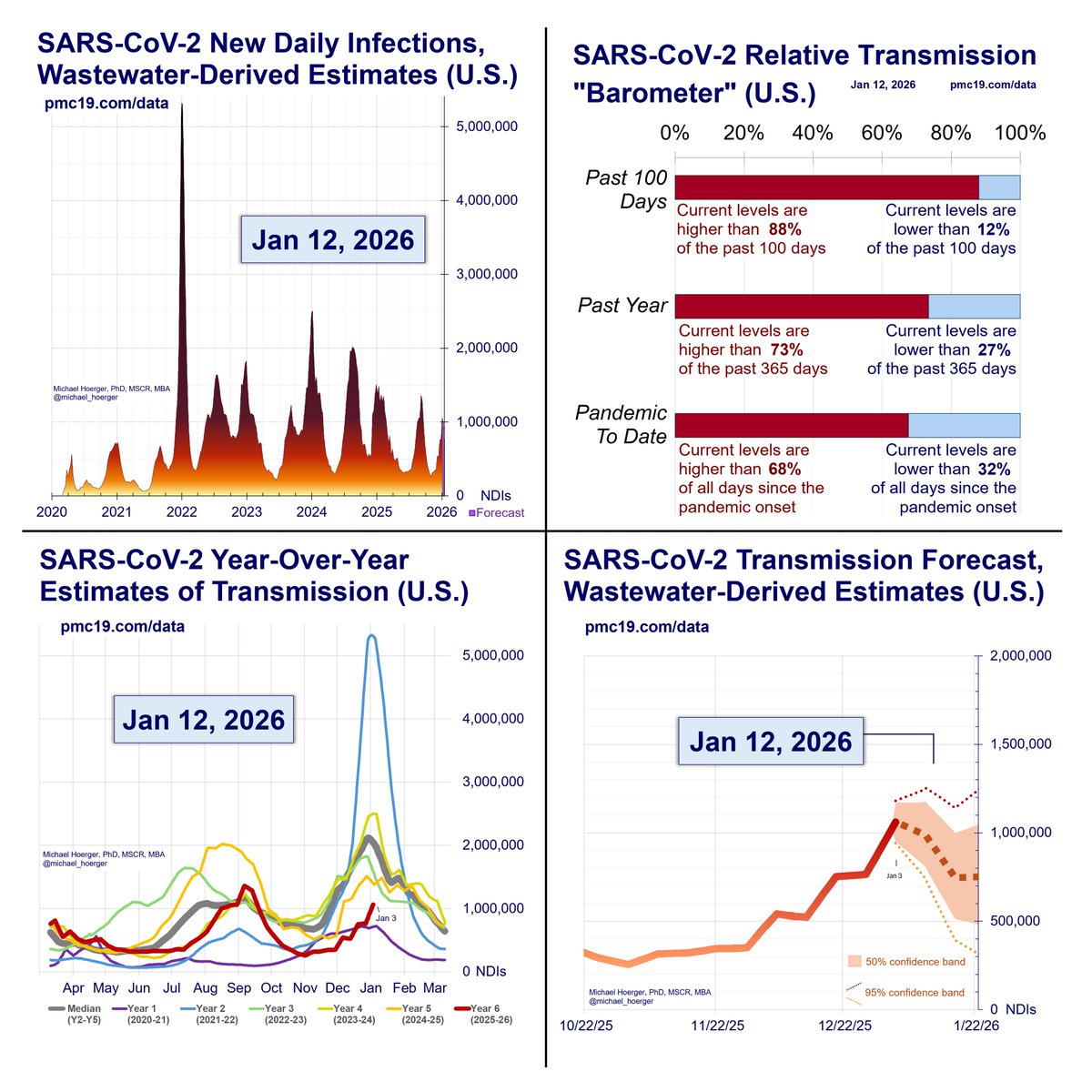
We are in the 12th COVlD wave of the U.S.

Current transmission is higher than 68% of all days since the pandemic onset in 2020.
🧵 3/4 12 waves of COVlD  Pandemic barometer: Higher than 88% of the past 100 days, 73% of the past year, 68% of the entire pandemic.  Year over year graph  Forecast of slowly declining transmission.
Read 4 tweets
Jan 8
You might not have heard, but the northeastern U.S. is in a COVlD surge.

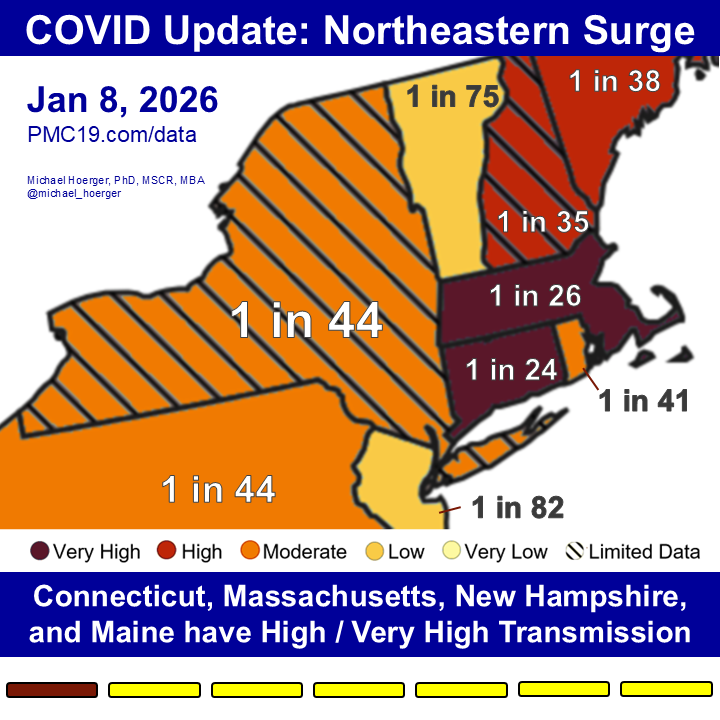
We use wastewater levels to derive estimates of the proportion of people actively infectious in each state (prevalence), e.g., 1 in 24 people in Connecticut.

Let me walk you through it...

🧵1/8 Colors show CDC levels PMC prevalence estimates noted: -Maine 1 in 38 actively infectious with COVlD -New Hampshire 1 in 35 (limited data) -Vermont 1 in 75 -New York 1 in 44 (limited data) -Pennsylvania 1 in 44 -Massachusetts 1 in 36 -Connecticut 1 in 24 -Rhode Island 1 in 41 -New Jersey 1 in 82
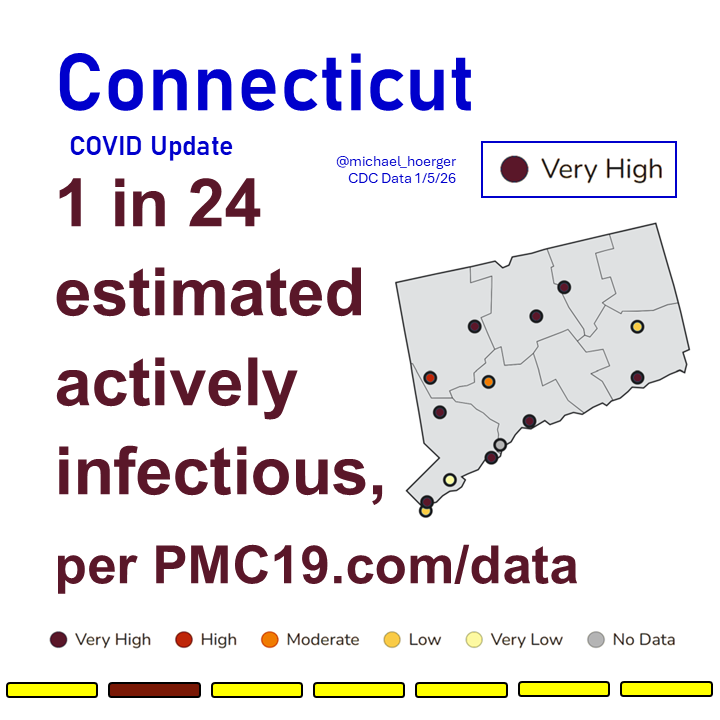
Notice that #Connecticut has excellent SARS-CoV-2 wastewater surveillance. It's "Very High" across much of the state, per CDC.

Based on wastewater levels, we estimate 1 in 24 residents are actively infectious w/COVlD. That's a 66% exposure risk in a room of 25 people.

🧵2/8 Colors show CDC levels PMC estimate of prevalence
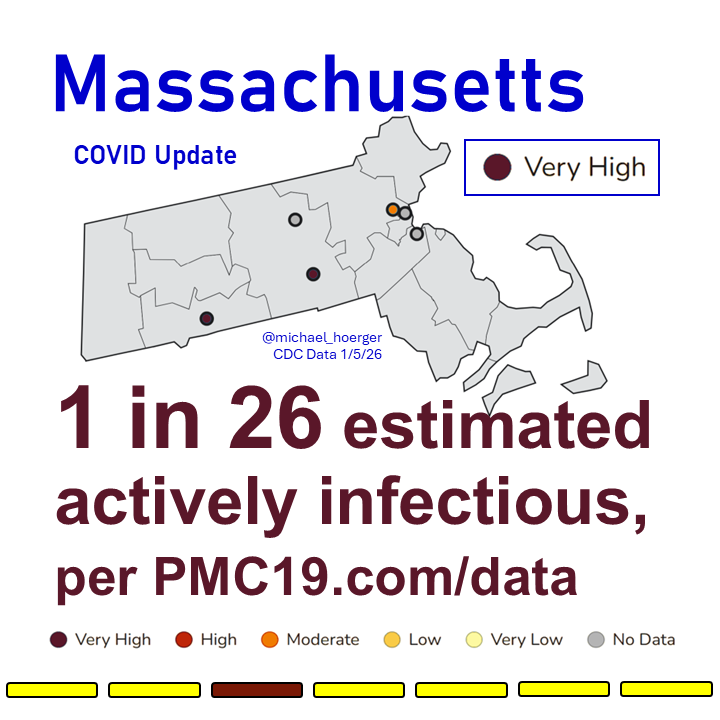
The CDC reports "Very High" levels in #Massachusetts.

The surveillance is less robust, but we estimate 1 in 26 residents are actively infectious, similar to our estimate in CT where coverage is better.

In a room of 25 people, that's a 62% chance of an exposure.

🧵3/8 Colors show CDC levels PMC prevalence estimates provided
Read 8 tweets
Jan 8
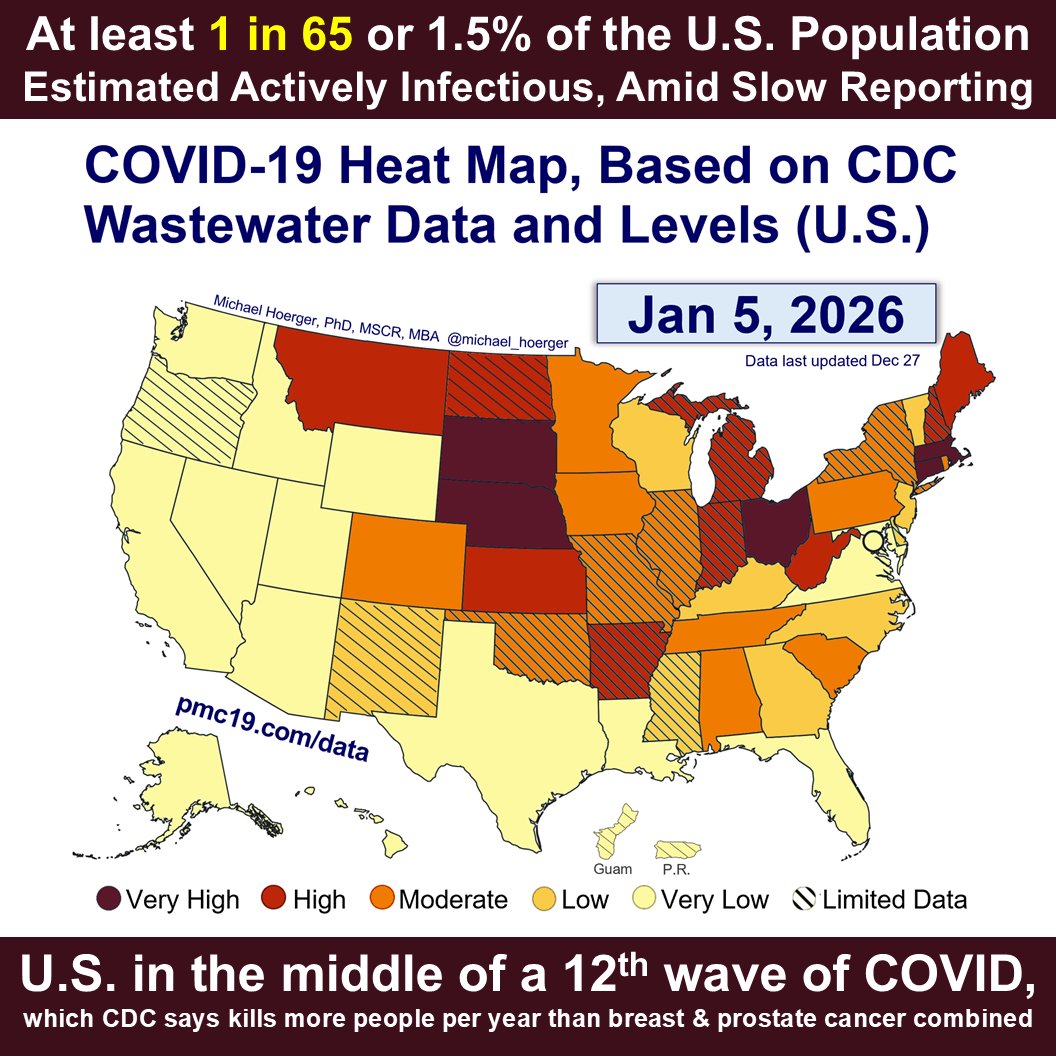
We're in the middle of a 12th COVlD wave in the U.S., with transmission particularly high in the Midwest and Northeast.

The CDC announced this week that COVlD continues to kill more Americans than breast and prostate cancer combined.

Get boosted & #MaskUp 💉💪😷
1/4🧵 Heat map of CDC data with PMC prevalence estimate
Levels are "Moderate" to "Very High" in 26 states.

However, data reporting is slow, and about 1/3 of states have low-quality data this week due to the holidays and illness.

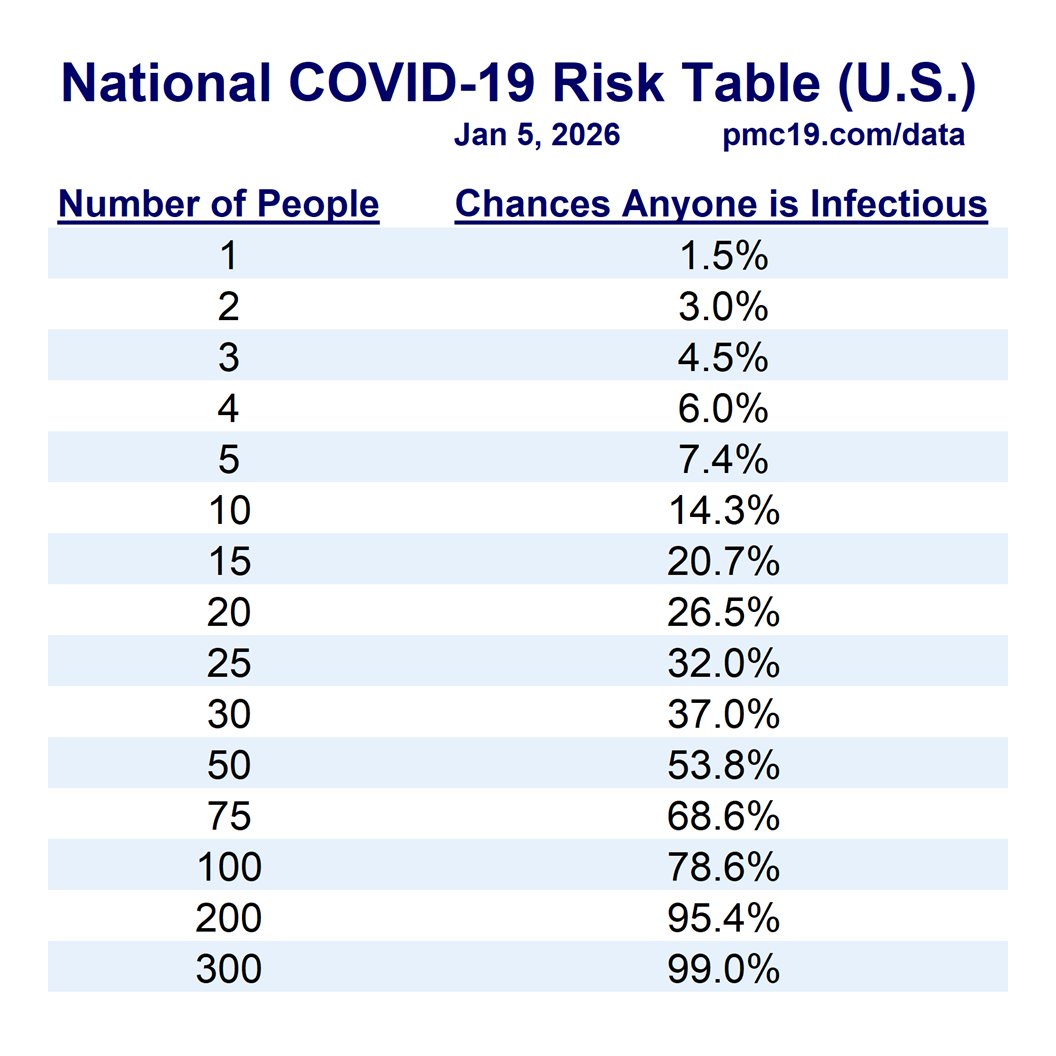
2/4🧵 National estimates: Number of People		Chances Anyone is Infectious			 1				1.5%	 2				3.0%	 3				4.5%	 4				6.0%	 5				7.4%	 10				14.3%	 15				20.7%	 20				26.5%	 25				32.0%	 30				37.0%	 50				53.8%	 75				68.6%	 100				78.6%	 200				95.4%	 300				99.0%
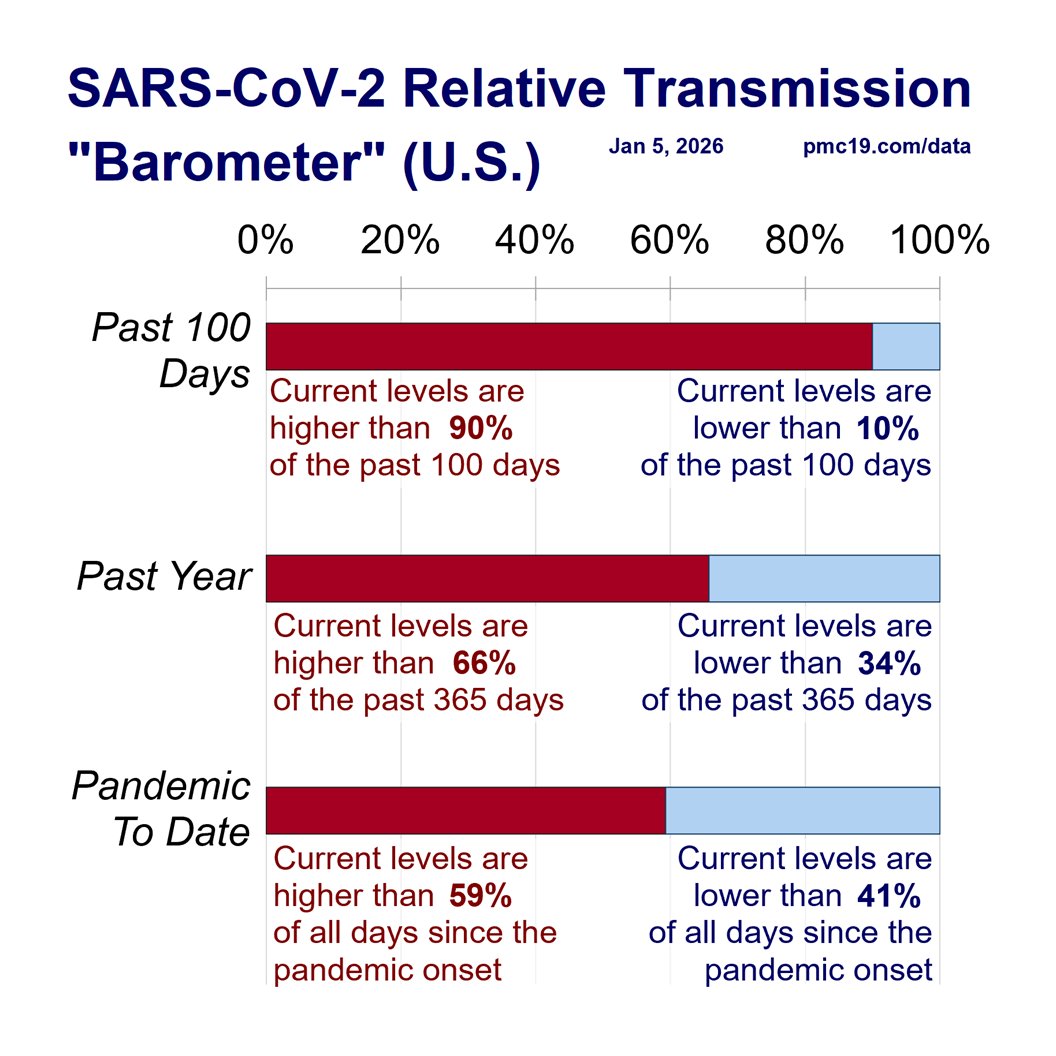
Barometer: Higher transmission than 90 of the past 100 days (perhaps higher still, due to low data reporting quality)
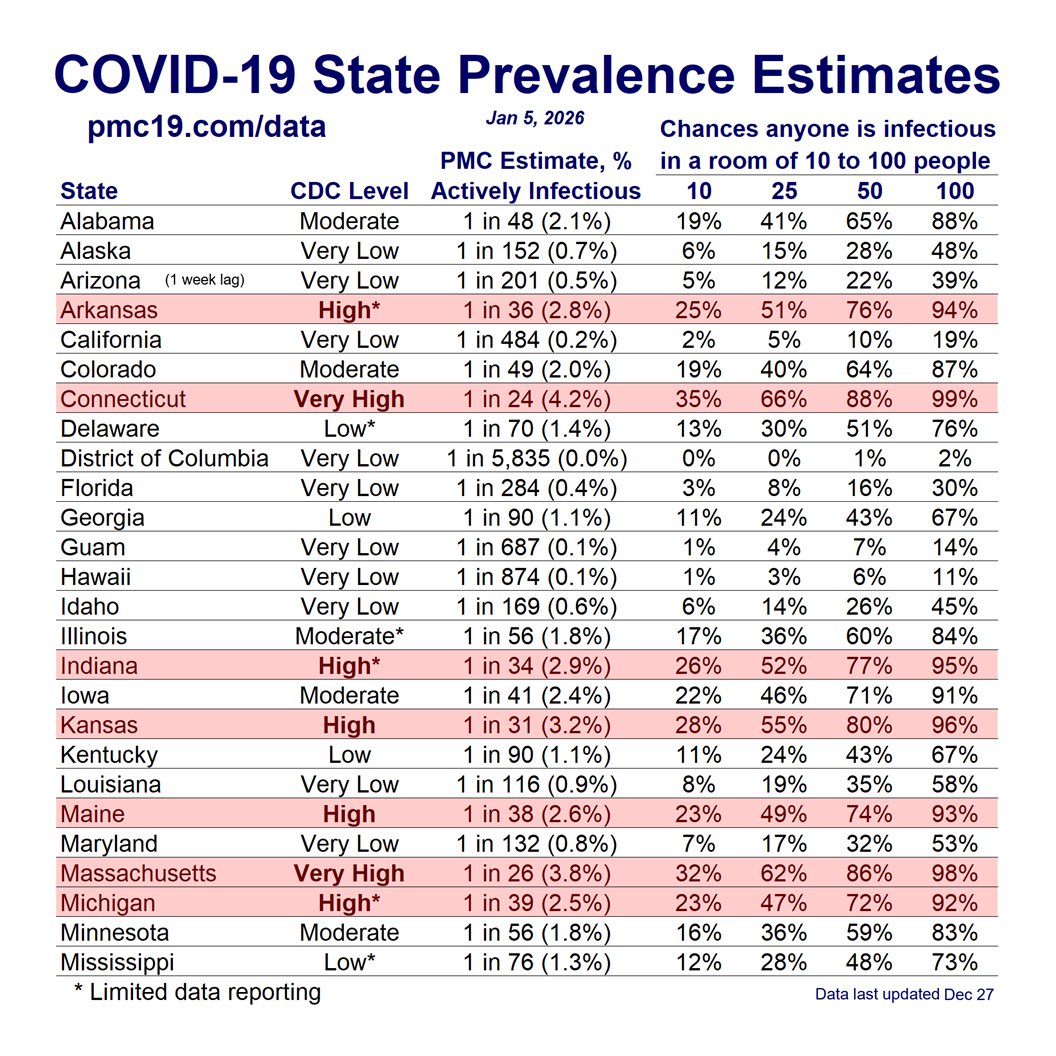
State	CDC Level	Actively Infectious Alabama	Moderate	1 in 48 (2.1%) Alaska	Very Low	1 in 152 (0.7%) Arizona	Very Low	1 in 201 (0.5%) Arkansas	High*	1 in 36 (2.8%) California	Very Low	1 in 484 (0.2%) Colorado	Moderate	1 in 49 (2.0%) Connecticut	Very High	1 in 24 (4.2%) Delaware	Low*	1 in 70 (1.4%) District of Columbia	Very Low	1 in 5,835 (0.0%) Florida	Very Low	1 in 284 (0.4%) Georgia	Low	1 in 90 (1.1%) Guam	Very Low	1 in 687 (0.1%) Hawaii	Very Low	1 in 874 (0.1%) Idaho	Very Low	1 in 169 (0.6%) Illinois	Moderate*	1 in 56 (1.8%) Indiana	High*	1 in 34 (2.9%) Iowa	Moderate	1 in 41 (2.4%) Kansas...
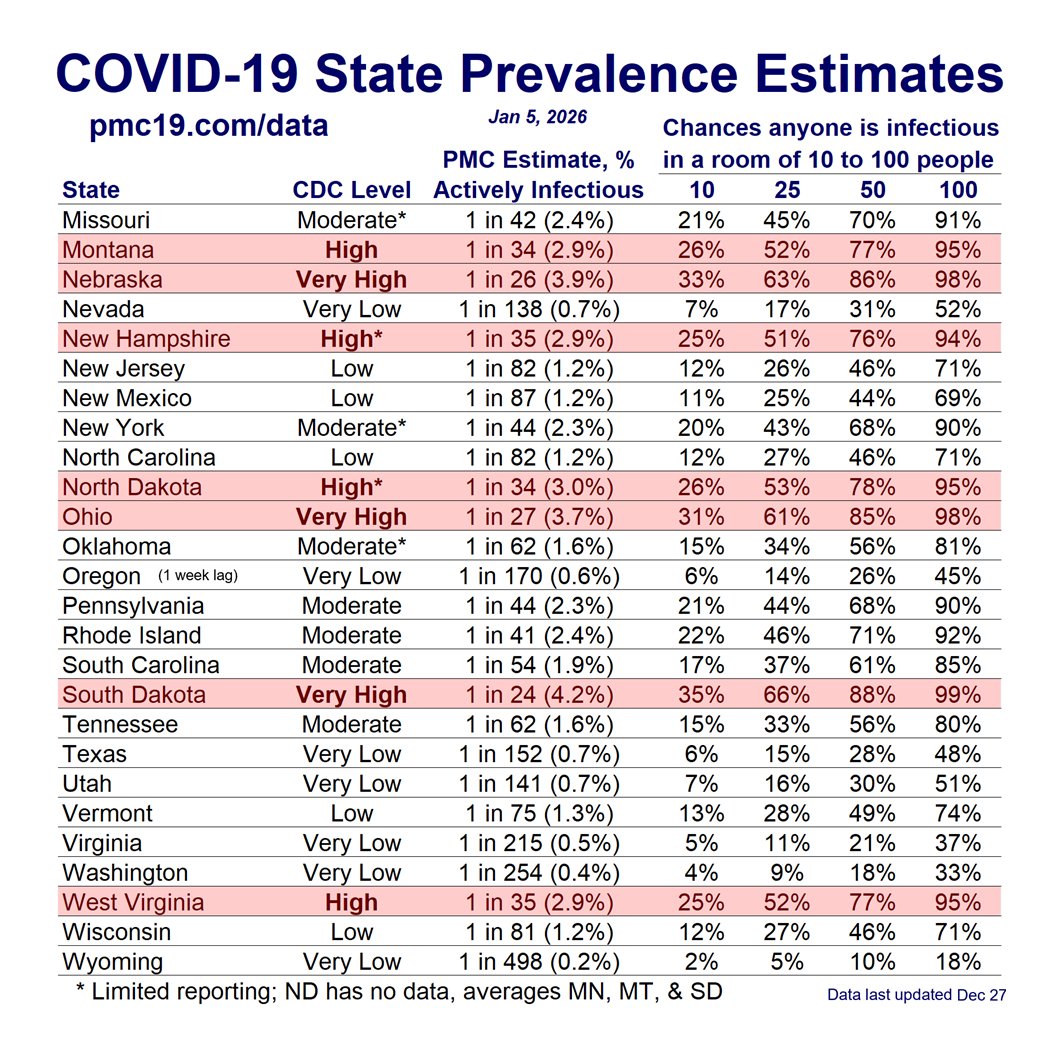
State	CDC Level	Actively Infectious Missouri	Moderate*	1 in 42 (2.4%) Montana	High	1 in 34 (2.9%) Nebraska	Very High	1 in 26 (3.9%) Nevada	Very Low	1 in 138 (0.7%) New Hampshire	High*	1 in 35 (2.9%) New Jersey	Low	1 in 82 (1.2%) New Mexico	Low	1 in 87 (1.2%) New York	Moderate*	1 in 44 (2.3%) North Carolina	Low	1 in 82 (1.2%) North Dakota	High*	1 in 34 (3.0%) Ohio	Very High	1 in 27 (3.7%) Oklahoma	Moderate*	1 in 62 (1.6%) Oregon	Very Low	1 in 170 (0.6%) Pennsylvania	Moderate	1 in 44 (2.3%) Rhode Island	Moderate	1 in 41 (2.4%) South Carolina	Moderate	1 in 54 (1.9%) South Dakota	Very High	1 in...
If like years 1-4 of the pandemic, the winter wave has peaked. If like last year, we could hover near peak levels for a month.

Forecasting quality is low with 1/3 of states having data issues. Hopefully, we'll know a lot more in a few days.

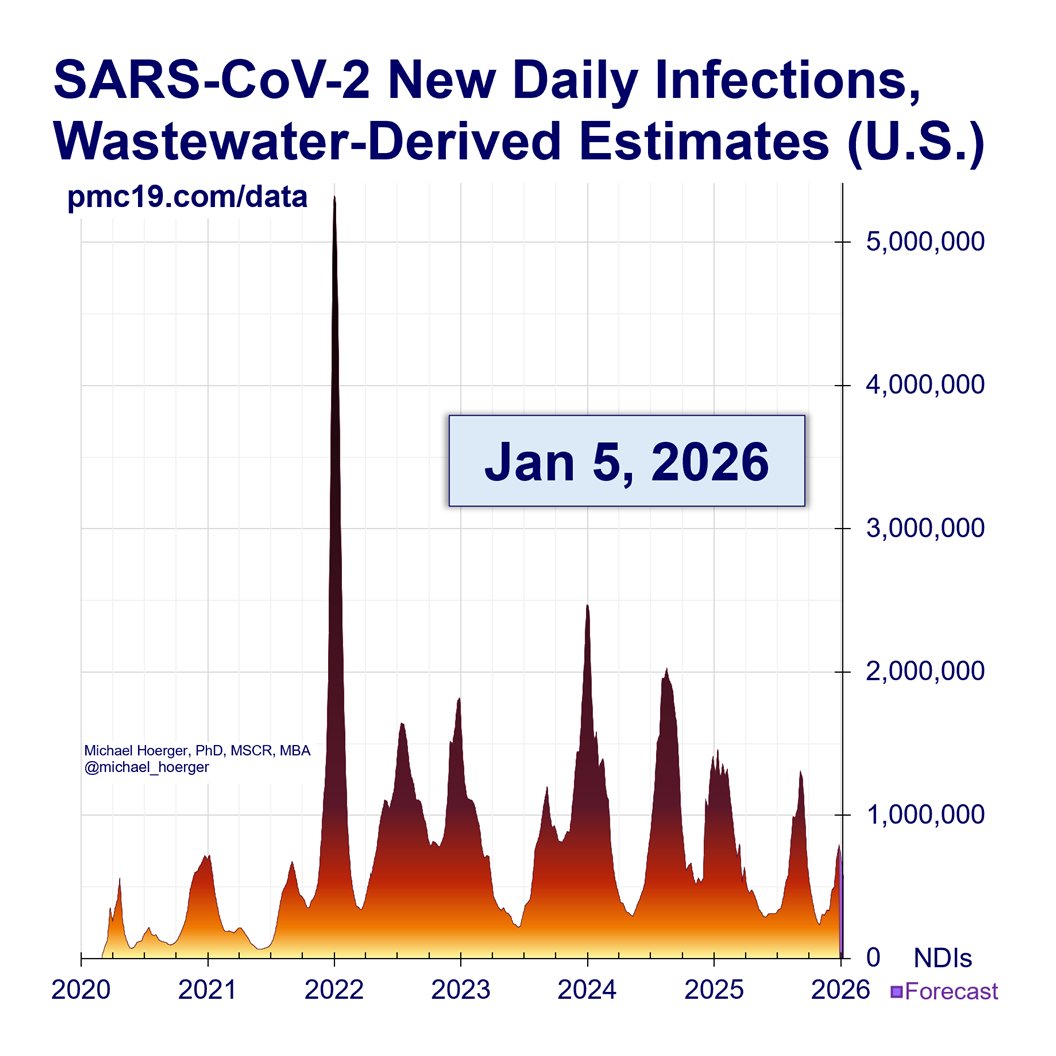
3/4🧵 12 waves
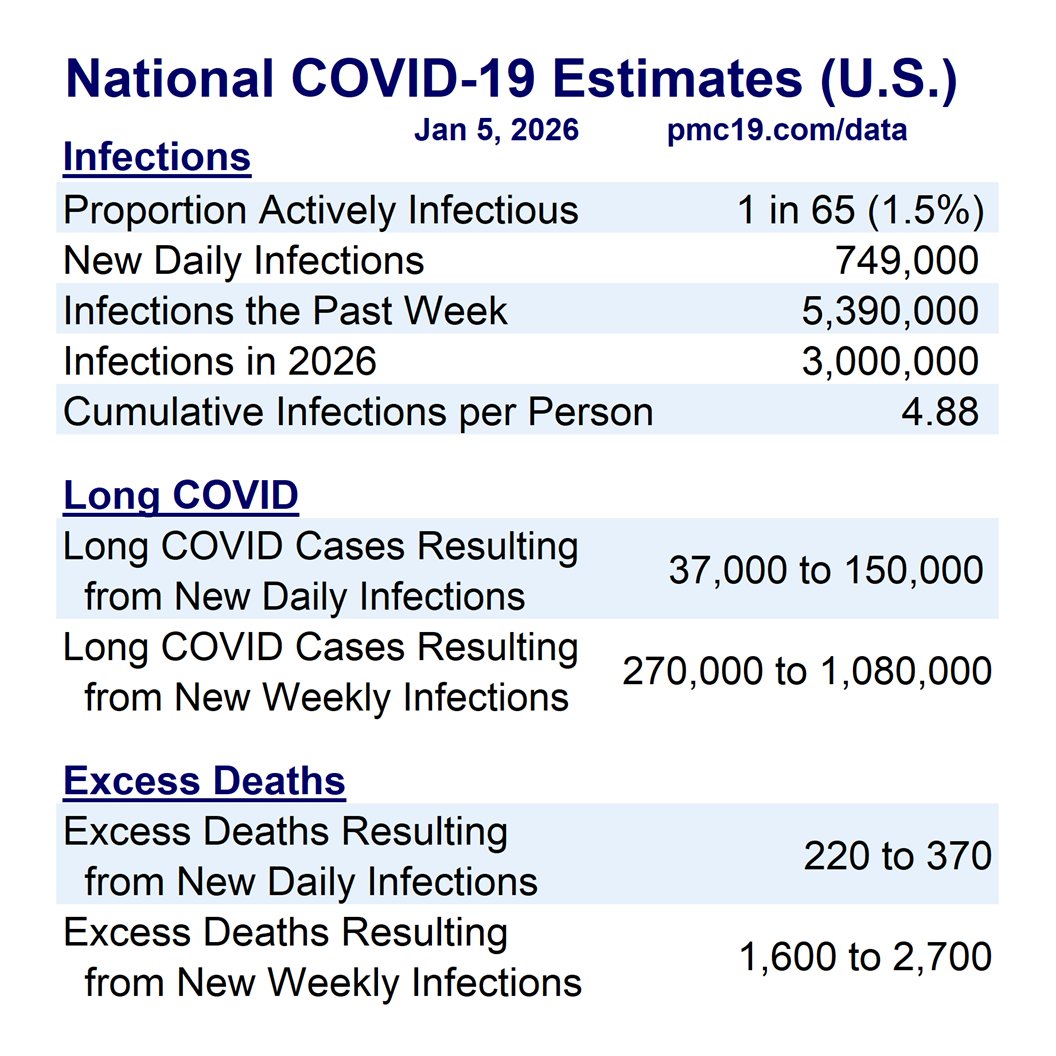
Proportion Actively Infectious										1 in 65 (1.5%) New Daily Infections										 749,000  Infections the Past Week										 5,390,000  Infections in 2026										 3,000,000  Cumulative Infections per Person										 4.88  										 Long COVID										 Long COVID Cases Resulting								37,000 to 150,000		   from New Daily Infections										 Long COVID Cases Resulting								270,000 to 1,080,000		   from New Weekly Infections										 										 Excess Deaths										 Excess Deaths Resulting 									220 to 370	   from New Daily Infections										 Excess Deaths Resulting 					...
year over year graph
forecast
Read 4 tweets
Jan 5
We told you that 109,000-175,000 Americans would died of COVID (excess deaths) in 2025.

Today, the CDC estimates 101,000 deaths/year (flat from Oct 2022 to Sep 2024), and likely higher when considering more nebulous non-acute excess deaths (heart attack 6 months later).
1/5
The CDC estimates are actually higher than I would have guessed, given their methodology, which models estimates based on easily countable factors in healthcare and expert input on multiplier values. It lends credence to the PMC upper bound of excess deaths of 175,000/yr.
2/5
What's troubling is the CDC has annual mortality flat. My expectation based on mortality displacement and Swiss Re data is that it should be declining. If is stays flat, we're running on something like breast+prostate cancer or lung cancer deaths per year in perpetuity.
3/5
Read 6 tweets

Did Thread Reader help you today?

Support us! We are indie developers!


This site is made by just two indie developers on a laptop doing marketing, support and development! Read more about the story.

Become a Premium Member ($3/month or $30/year) and get exclusive features!

Become Premium

Don't want to be a Premium member but still want to support us?

Make a small donation by buying us coffee ($5) or help with server cost ($10)

Donate via Paypal

Or Donate anonymously using crypto!

Ethereum

0xfe58350B80634f60Fa6Dc149a72b4DFbc17D341E copy

Bitcoin

3ATGMxNzCUFzxpMCHL5sWSt4DVtS8UqXpi copy

Thank you for your support!

Follow Us!

:(