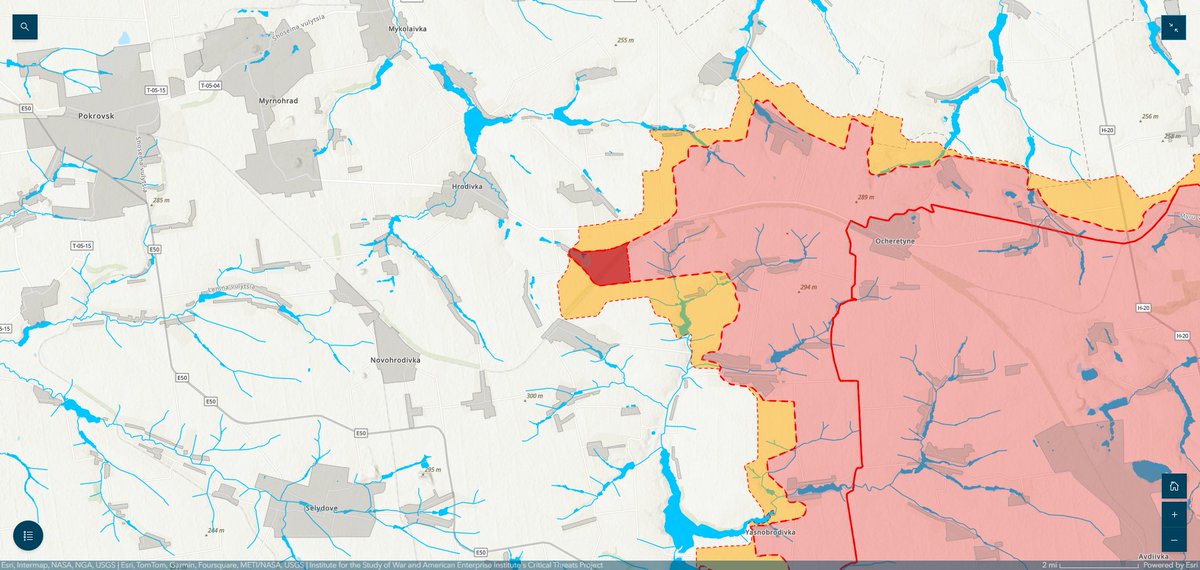
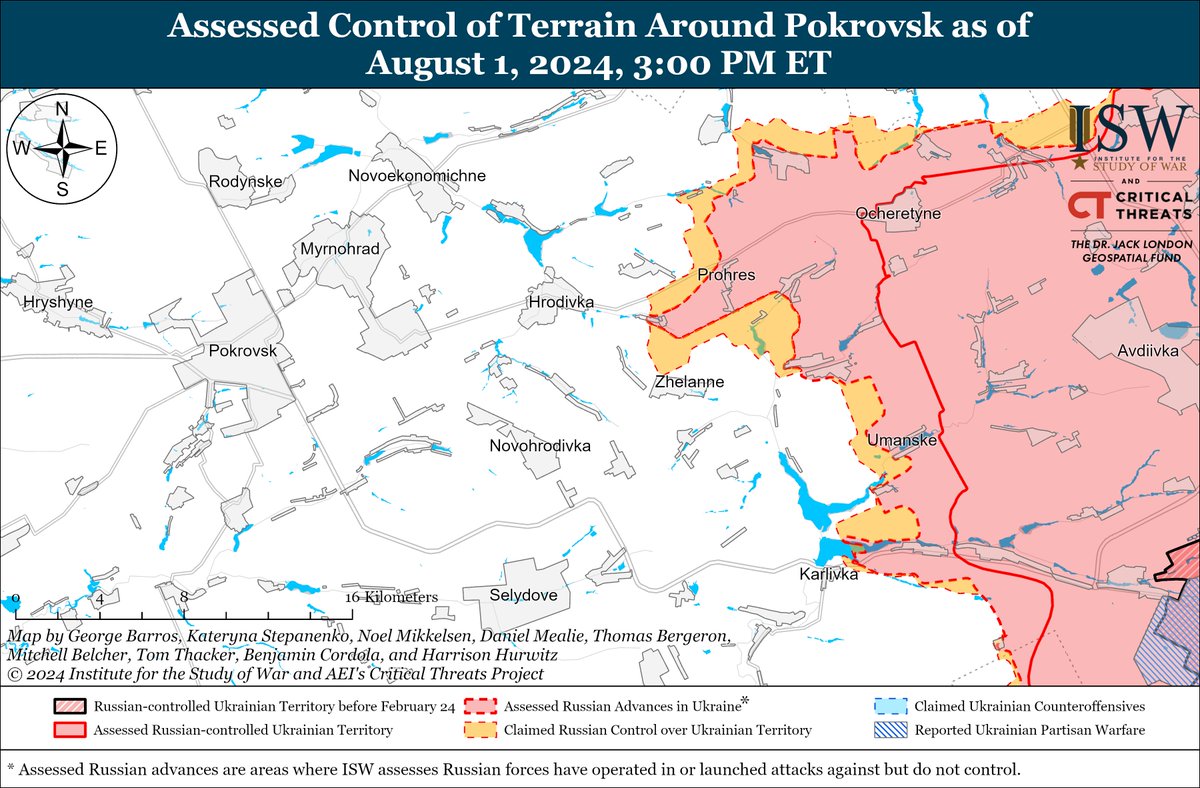
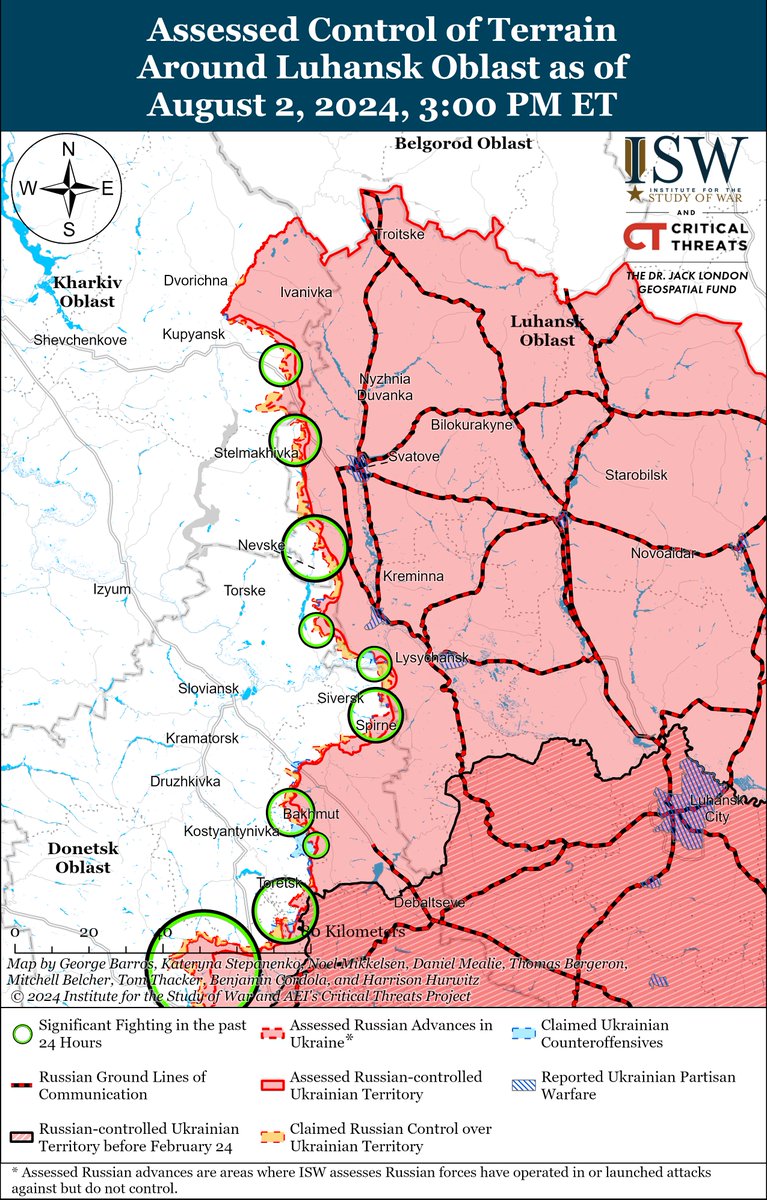
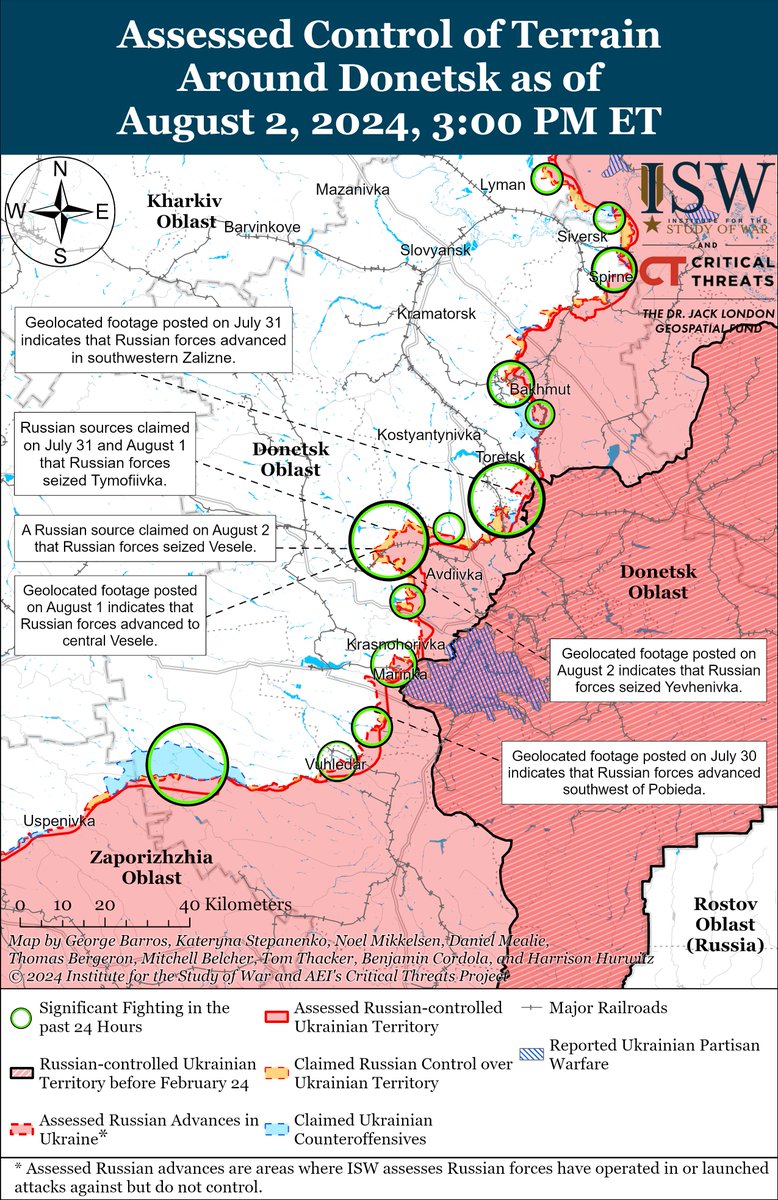
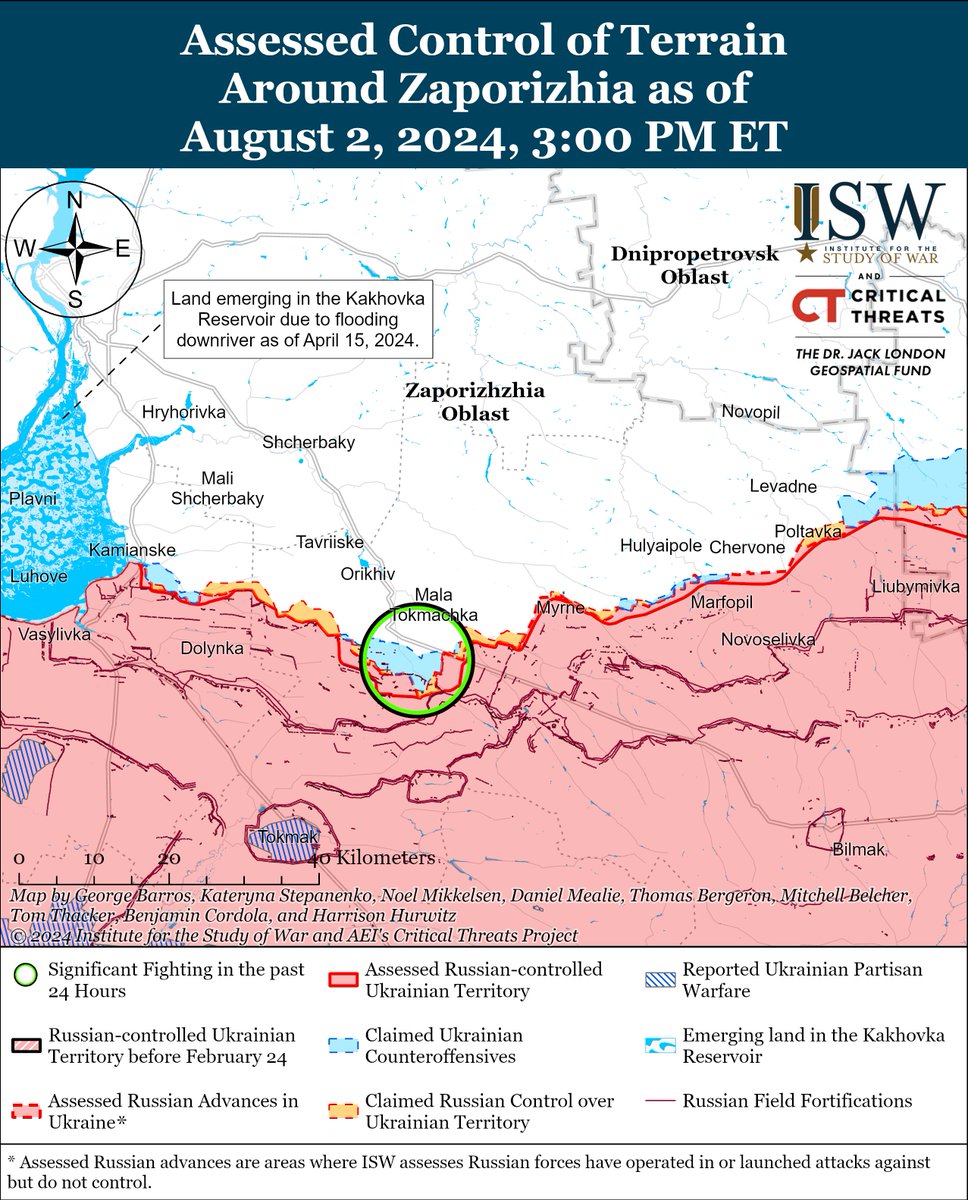
NEW: Russian forces continue to make slow, steady advances in the Pokrovsk direction (west of Avdiivka), largely enabled by Ukrainian manpower shortages and the terrain in the area immediately northwest of Avdiivka. Russian advances will likely slow further as Russian forces advance into a line of larger and more urban settlements. 🧵(1/12)
2/ Ukrainian President Volodymyr Zelensky identified the Pokrovsk direction as the Russian military's current priority on August 1 and noted that Russian forces are currently able to advance in certain areas of the front because Ukraine is still struggling with manpower shortages and challenges in properly staffing and equipping new brigades.
3/ Zelensky observed that some Ukrainian brigades are unable to conduct rotations because their replacement brigades are not yet staffed or equipped, which creates exploitable weaknesses that Russian forces can attack.
4/ Ukrainian military observer Kostyantyn Mashovets noted that Ukrainian defenders in the Pokrovsk direction have inferior equipment and defensive means and are therefore currently unable to slow Russian advances.
5/ Delays in the provision of Western and especially US military assistance have contributed to delays in equipping newly-raised Ukrainian units and re-equipping those that have been fighting.
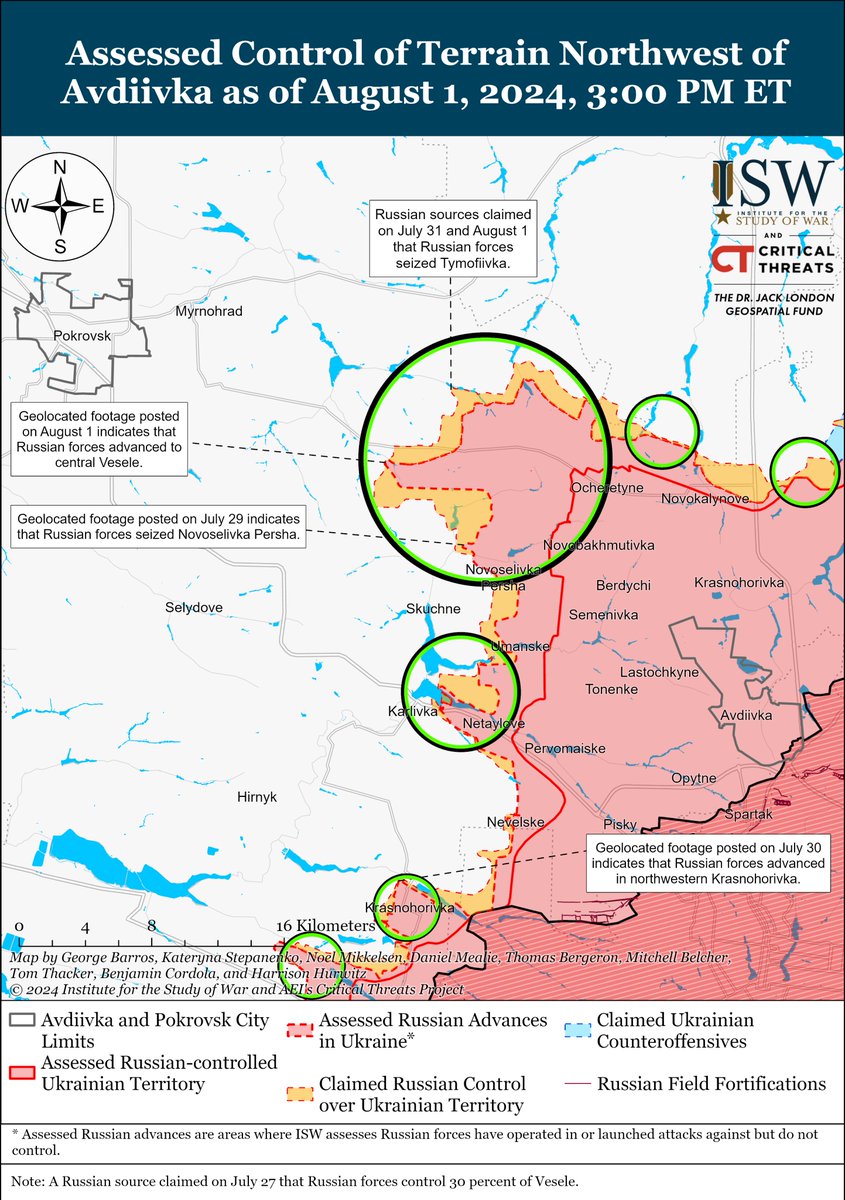
6/ Russian forces appear to be exploiting such weakness to make gradual tactical gains northwest of Avdiivka, where ISW recently assessed that Russian forces are attempting to achieve a limited tactical encirclement of Ukrainian forces east of the T0511 (O0544) Ocheretyne-Hrodivka-Myrnohrad highway, particularly on the left bank of the Vovcha River.
7/ Geolocated footage published on August 1 shows that Russian forces have advanced further within Vesele towards the T0511 road, placing the current furthest confirmed Russian advance about 3.5 kilometers from the outskirts of Hrodivka.
8/ Russian milbloggers claimed that Russian forces are attacking south of Vesele along the railway line and windbreaks towards Serhiivka and Zhelanne (just south of Vesele), which could further efforts to tactically encircle Ukrainian forces in this area if Russian forces properly exploit it.
9/ Ukrainian and Russian sources also reported that Russian forces seized Tymofiivka (north of the O0544 road and the Vesele area).
10/ Mashovets characterized recent Russian advances in the area southeast of the O0544 road as a tactical penetration of Ukrainian lines and stated that Russian forces have advanced 6.5 kilometers deep and 7.5 kilometers wide from Sokil to Serhiivka, crossing both the Vovcha and Kazennyi Torets rivers (running through Prohres-Vovche and Lozuvatske, respectively) in recent weeks.
11/ Mashovets warned that Russian forces are close to achieving an operationally significant breakthrough in the Pokrovsk direction by the end of August.
12/ Russia's current rate of tactical advance towards Pokrovsk will likely not continue indefinitely, however, as Russian forces are approaching a line of larger and more urban settlements.
MORE: Iran is likely considering its ability to maintain nuclear deterrence against Israel as it plans its retaliatory strike against Israel. (🧵 1/10)
2/ Iranian nuclear deterrence against Israel most likely requires that Iran demonstrate a reasonable ability to strike Israeli territory with a delivery device capable of carrying a nuclear warhead.
3/ Iran’s April 2024 attack on Israel demonstrated it is not capable of effectively penetrating Israeli air defenses. The Iranians may shape this attack deliberately to try to establish that they can, indeed, get a nuclear-capable missile to a target in Israel.
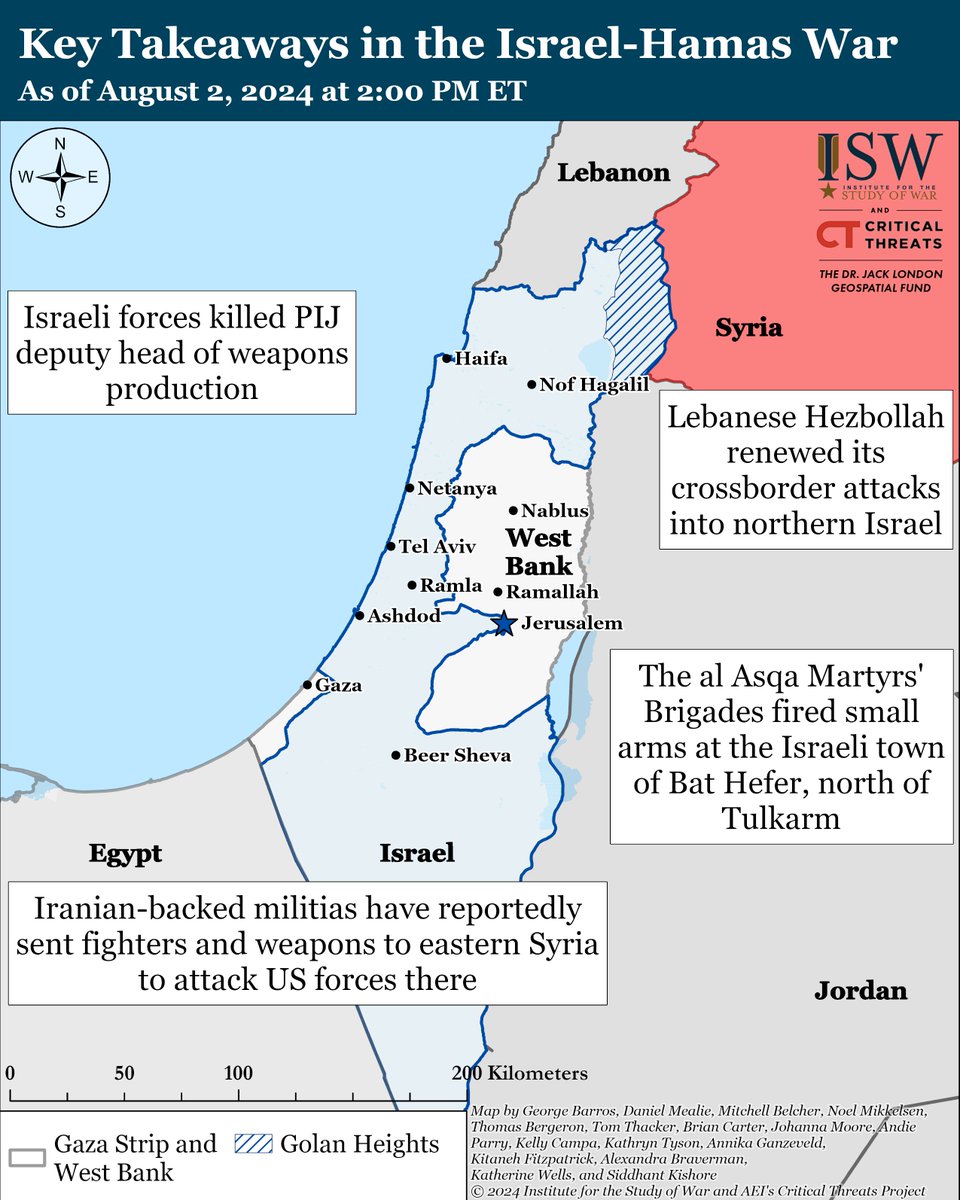
NEW: Iran and its Axis of Resistance may target US forces in Syria as part of a retaliatory strike for Israel killing several Axis of Resistance leaders, including Hamas Political Bureau Chairman Ismail Haniyeh. (🧵1/9)
2/ Iran is very likely taking into consideration US and allied support defending Israel as it considers how to cause greater damage than the April 2024 attack did. Iran designed its strike package of over 300 projectiles to inflict serious damage on Israel.
3/ The United States, Israel, and allied countries in the region collectively intercepted approximately 99% of all munitions launched by Iran during its April 2024 attack.
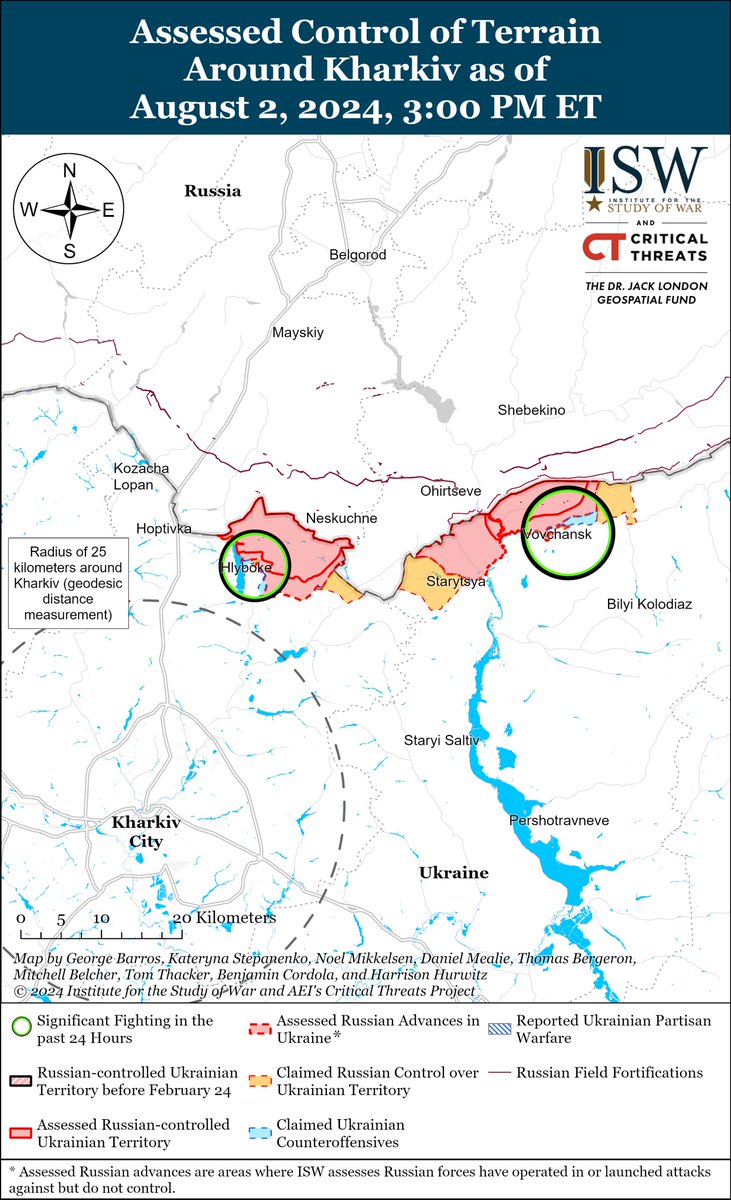
NEW: Ukrainian General Andriy Hnatov stressed that Russia is pursuing an effort to force Ukraine to commit its available manpower to ongoing defensive operations in order to prevent the accumulation of Ukrainian resources for future counteroffensive operations. (🧵1/6)
2/ Hnatov said the Russian military launched its offensive into Kharkiv Oblast in May because it was concerned that Ukraine's efforts to strengthen its force generation would allow UKR forces to leverage new manpower to stabilize the frontline and conduct a counteroffensive.
3/ Hnatov stated that Russian offensive operations in northern Kharkiv Oblast aimed to prevent Ukraine from building out reserves and addressing personnel shortages in already committed combat brigades by drawing Ukrainian forces to Kharkiv Oblast from elsewhere along the front, complicating rotations, and forcing Ukraine to commit newly generated forces to defensive operations in northern Kharkiv Oblast instead of offensive or defensive operations elsewhere in the theater.
Iran is likely now planning for its next attack in order to establish deterrence with Israel while still avoiding a large-scale war. 🧵(1/12)
1/ One of the most dangerous but increasingly likely scenarios is that Iran and the Axis of Resistance launch a combined, large-scale drone and missile attack that incorporates lessons from the April 2024 attack.
3/ Hezbollah, the Houthis, and Iranian-backed militias in Iraq and Syria could launch simultaneous attacks to further strain Israeli air defenses as well.
NEW: Iran and the Axis of Resistance are almost certainly considering how to cause greater damage to Israel than the April 2024 attack did since that attack failed to impose a serious cost on Israel and thus failed to deter. 🧵(1/8)
2/ Iran and its allies fired around 170 one-way attack drones, 30 cruise missiles, and 120 ballistic missiles at Israel in the April 2024 attack. Iran designed this strike package of over 300 projectiles to inflict serious damage on Israel.
3/ Iran specifically targeted two remote Israeli targets—an airbase in the southern Israeli desert and an intelligence center in the Golan Heights. Lebanese Hezbollah fired dozens of rockets, while the Houthis launched a few drones and missiles in the April 2024 attack.
1. The killing of Haniyeh reflects the degree to which Israel has infiltrated the Iranian security sector and is able to strike high-value targets within Iran.
2. Hamas responded to the killing by calling on Middle Eastern countries to “deter” and “rein in” Israel.
Iran is signaling that it will retaliate directly for Israel killing Haniyeh. ⬇️
3. One of the most dangerous courses of action would be Iran and other members of the Axis of Resistance conducting a large-scale, combined drone and missile attack into Israel. ⬇️