
INFALLIBILITY 101
If you have ever interacted with a Roman Catholic, you have no doubt run into the "You Don't Understand Infallibility" wall which the Roman Catholic erects to protect himself from the realization that he himself does not—and cannot—understand infallibility.🧵
If you have ever interacted with a Roman Catholic, you have no doubt run into the "You Don't Understand Infallibility" wall which the Roman Catholic erects to protect himself from the realization that he himself does not—and cannot—understand infallibility.🧵
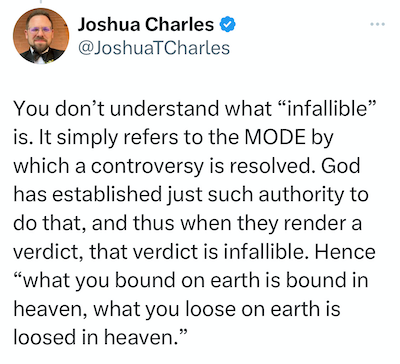
2. Every conversation on infallibility essentially reduces to this:
C: Jesus established an infallible teaching authority to protect His Church from teaching error.
P: Which church teachings are infallible?
C. You just don't understand infallibility.
See exhibits A & B, below.

C: Jesus established an infallible teaching authority to protect His Church from teaching error.
P: Which church teachings are infallible?
C. You just don't understand infallibility.
See exhibits A & B, below.

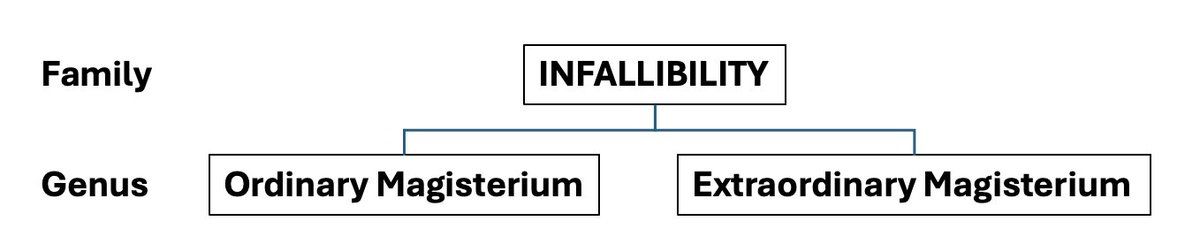
3. To edify the saints (and to walk Catholics to their first day of infallibility school), I provide at no charge this public service: an X class on Infallibility.
Within the family of infallibility, there exist two genera:
Ordinary and Extraordinary Magisterial Infallibility.
Within the family of infallibility, there exist two genera:
Ordinary and Extraordinary Magisterial Infallibility.
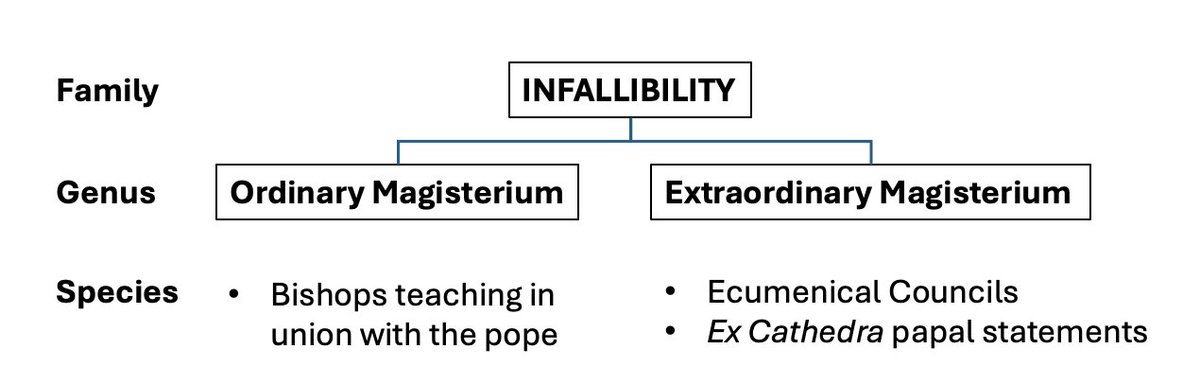
4. Within the genera of Magisterial Infallibility, there exist three species of infallibility:
Ordinary: bishops, in union with the pope, in their day-to-day instruction of the flock.
Extraordinary: Ecumenical Councils and Ex Cathedra
("from the chair") statements of the Pope.
Ordinary: bishops, in union with the pope, in their day-to-day instruction of the flock.
Extraordinary: Ecumenical Councils and Ex Cathedra
("from the chair") statements of the Pope.
5. So difficult is it to know if the Ordinary Magisterium has taught infallibly, the Catholic Encyclopedia dismisses it: It is "theoretically true" that the Ordinary Magisterium can be definitively infallible, but "in practice" it's impossible to prove. newadvent.org/cathen/07790a.…
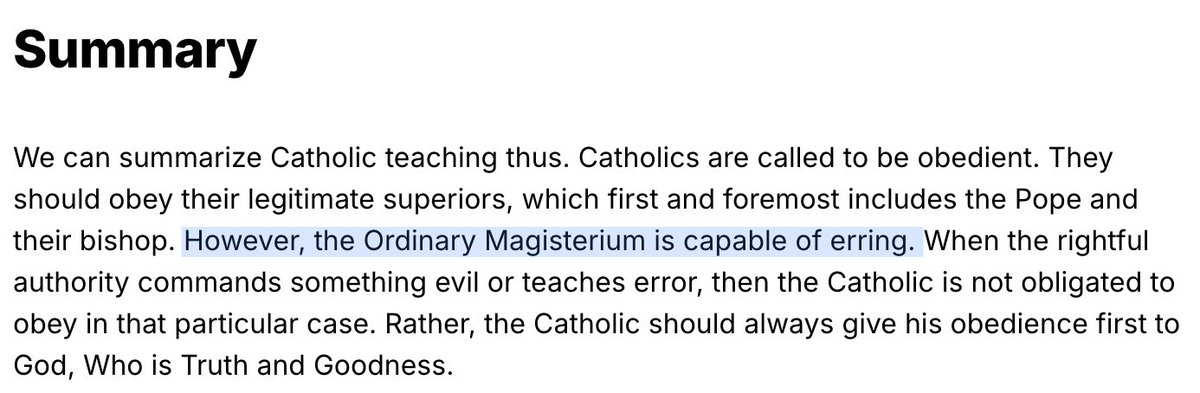
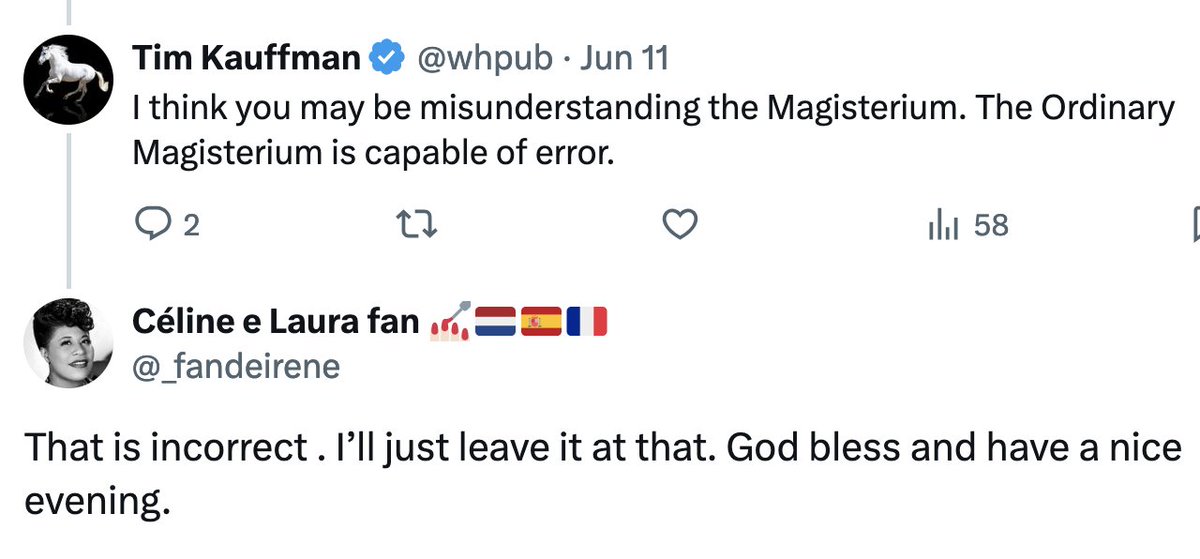
6. This is why both clergy & lay have such a difficult time agreeing on ordinary magisterial infallibility. An online article from The Fatima Organization says "the Ordinary Magisterium is capable of erring," and another here on twitter insists it is not (Exhibits B & C, below).
7. We can hardly blame exasperated RC philosopher Timothy Gordon (Exhibit D) who admits what every Protestant already knows: "No one really knows what's in the Magisterium. Did you know that? No one even knows what's officially in it." (23:00 minute mark) rumble.com/v2xg3ec-breaki…
8. Thus, the Catholic Encyclopedia demurs, focusing only on Extraordinary Magisterial infallibility: "Hence, for practical purposes ... we may neglect the so called magisterium ordinarium and confine our attention to ecumenical councils & the pope."
And thus, so shall we.
And thus, so shall we.
9. Catholics are obligated to believe the infallible teachings of Ecumenical Councils. But ... nobody is quite sure which ones are Ecumenical. Bellarmine didn't think Basle (AD 1431) was Ecumenical. Excommunicated Archbishop Viganò doesn't believe Vatican II was Ecumenical.
10. Fifty other clergy, scholars & journalists agreed with him on that (Exhibit E). RadTrads wonder as well.
Additionally, "Trullo (AD 692) is increasingly being recognized as belonging among the ecumenical councils" (Nedungatt, Trullo Revisited, 2010). lifesitenews.com/blogs/50-pries…
Additionally, "Trullo (AD 692) is increasingly being recognized as belonging among the ecumenical councils" (Nedungatt, Trullo Revisited, 2010). lifesitenews.com/blogs/50-pries…
11. The cause of this confusion? While Ecumenical Councils are allegedly "infallible," there is no infallible list of such Councils. According to Canon Lawyer Nedungatt, "no authoritative church magisterium [has] established" an authoritative list. Every RC must compile his own.
12. This leads to much confusion. E.g., provincial or regional councils are not infallible and thus do not publish infallible decrees. But that does not prevent some Catholics from imbuing their favorite provincial council with Ecumenical authority. newadvent.org/cathen/12515a.…
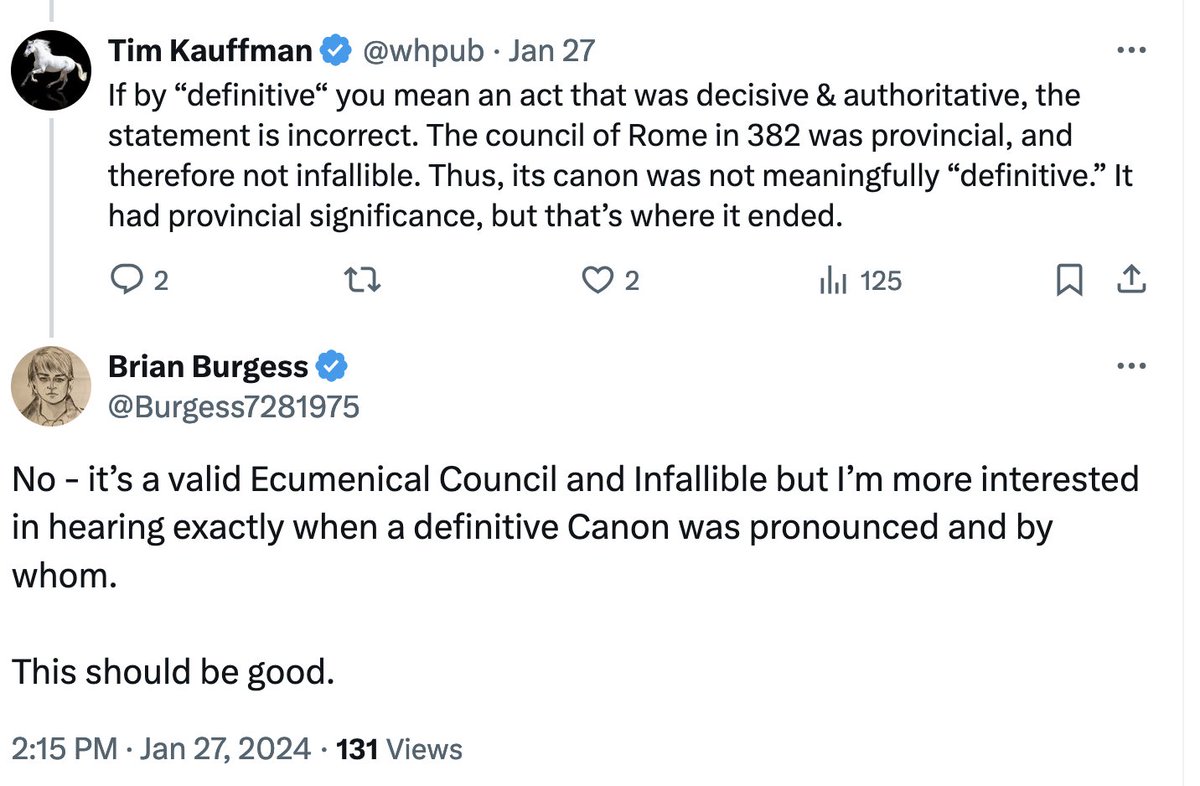
13. One RC on X recently claimed infallible knowledge of the canon of Scripture from the provincial Council of Rome (AD 382), claiming it was Ecumenical (Exhibit F). The Encyclopedia says otherwise: "The provincial council is not competent to deal directly with matters of faith."
14. Well, if the Ordinary Magisterium is only "theoretically" infallible, and the Extraordinary Magisterium hasn't given a definitive list of Ecumenical Councils—leaving Roman Catholics to come up with their own—the only remaining organ of Extraordinary infallibility is the Pope.
15. But that is problematic because nobody seems to know when, why or how a pope speaks infallibly. Karl Keating says the pope teaches infallibly "only when some doctrine has been called into question" (Papal Infallibility). But Scott Hahn's opinion is the exact opposite:
16. "Many people think that this ex cathedra … is sort of like the ultimate way in which the pope resolves doctrinal controversies. That is the opposite of the truth" (A Biblical Understanding of Mary). Whom shall we believe? Hahn or Keating?
17. And how do we know if the Pope has spoken ex cathedra? Scott Butler says it's easy: "when [1] as the supreme shepherd and teacher of all the faithful ..., [2] by a definitive act [3] he proclaims a doctrine of faith or morals" (Jesus, Peter and the Keys). But others disagree.
18. The Catholic Encyclopedia says there are 4 criteria, but Fr. William Most says there are only two: "[1] the intent to make an item definitive, plus [2] writing in such a way as to make that intent clear" (Most, Infallibility). Is it any wonder there is no infallible list?
19. As I demonstrated in my response to @RealCandaceO, nobody knows how many times the pope has spoken ex cathedra, which is why there are so many divergent & fallible opinions from Catholics on a definitive number ex cathedra papal statements (Exhibit G).
https://x.com/whpub/status/1782539911738036697
20. This led to a hilarious interaction with Catholic Answers' Al Fr. Justin who said: "The Church officially recognizes only 2 instances of a Pope speaking ex cathedra." Then upon reflection: "The Catholic Church doesn't provide a comprehensive list of ex cathedra statements."
21. Small wonder that Catholic apologist Robert Sungenis, unable to figure out ex cathedra, threw up his hands: "This is why I said earlier that when the Church makes something infallible, I wish they would just do it plainly & clearly, as Canon 749.3 requires." (August 5, 2008)
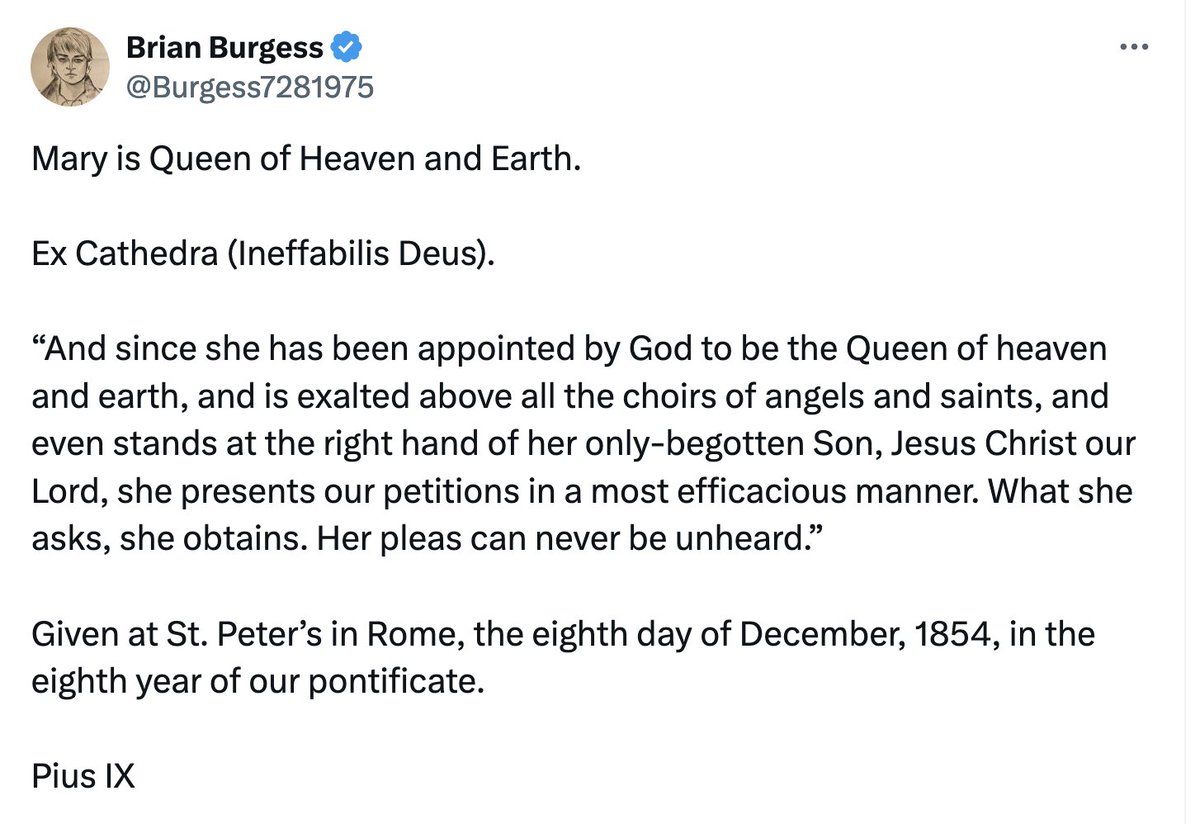
22. Such confusion is exacerbated by the fact that Catholics don't realize that in an ex cathedra statement, only the dogmatic definition is infallible, leading to @Burgess7281975's mistake of thinking that Pius IX had declared "ex cathedra" that Mary is Titular queen of heaven!
23. But the Catholic Encyclopedia says otherwise: "It should be noted that not everything contained in a definition is infallibly defined. ... Incidental statements, called obiter dicta, are also examples of non-definitive utterances." newadvent.org/cathen/04675b.…
24. So here is "Infallibility" in a nutshell: The Ordinary Magisterium is theoretically infallible but no one even knows what's in it. The Extraordinary Magisterium has provided neither an infallible list of Ecumenical Councils nor such a list of ex cathedra papal statements.
25. Catholics on X will confidently pontificate about this teaching or that, one council or another, one allegedly ex cathedra statement or another, never realizing that their own confusion is because it's they, not Protestants, who "don't understand infallibility"! Now you know.
• • •
Missing some Tweet in this thread? You can try to
force a refresh





