Tim Kauffman Profile picture
I monitor transmillennial patterns of apostasy. Beware the migration of the epiclesis.
2 subscribers

Oct 9, 2024 25 tweets 6 min read
An entertaining & informative response from a Romanist who thinks I claim to have discovered something "EVERYONE HAS MISSED." Funny thing is, I don't claim that at all. Scholars, historians, liturgists and translators of all stripes already know the evidence I provide is valid.🧵 2. There is much more to this story, but much of it revolves around Irenæus, because his alleged writings provide the foundation of the belief in the "real presence of Christ" in the Eucharist. So I'll focus on him. And I use "alleged" advisedly. Irenæus believed no such thing.
Aug 11, 2024 13 tweets 6 min read
This reader took the time to rebut the class notes from Infallibility 101, and in doing so essentially reaffirmed our conclusions on infallibility—that nobody can know with certainty what has been infallibly taught, and therefore each Catholic is on his own. Let's take a look.🧵 2. On items 5-8 he says I "misrepresented" the Catholic Encyclopedia because it just says it's hard to know which teachings are part of the Ordinary Magisterium. But that's exactly the problem I raised, and exactly what the Encyclopedia insists: "in practice it may be impossible to prove conclusively that such unanimity as may exist has a strictly definitive value in any particular case." And because it's so hard to know, the Encyclopedia preferred rather to address the other organs of infallibility, and so did I. Readers may consult the Encyclopedia themselves and judge for themselves: newadvent.org/cathen/07790a.…
Aug 10, 2024 25 tweets 7 min read
INFALLIBILITY 101

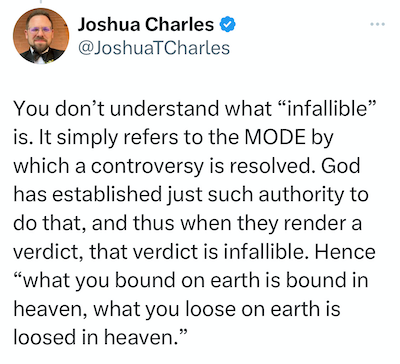
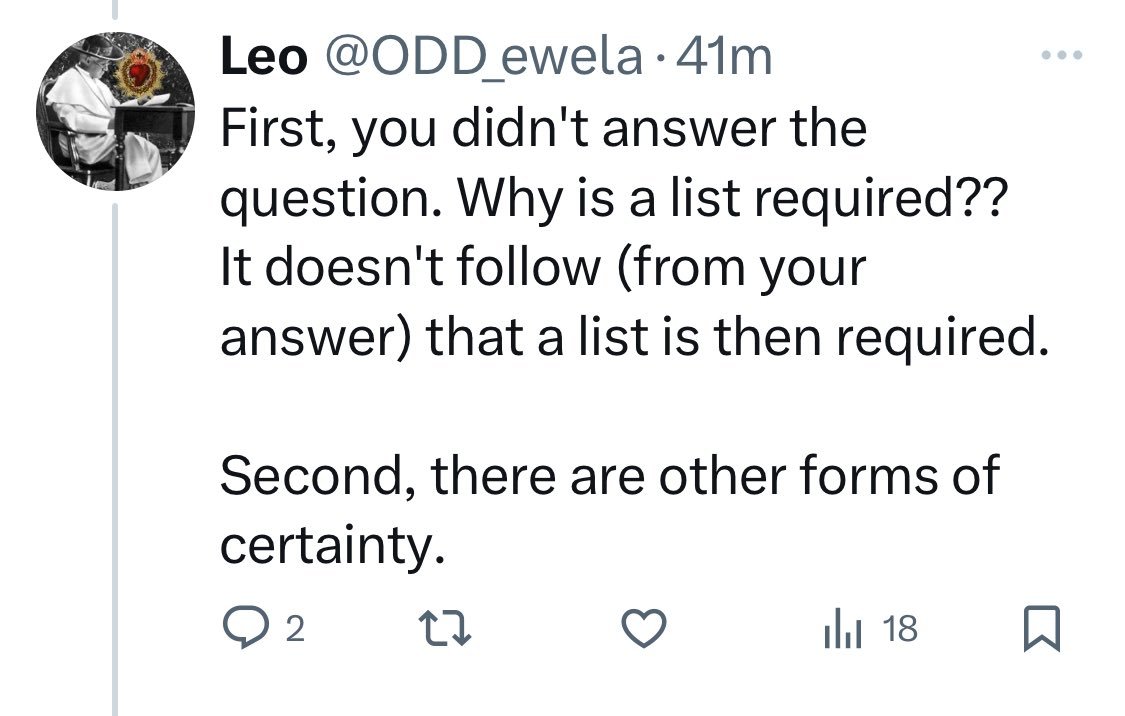
If you have ever interacted with a Roman Catholic, you have no doubt run into the "You Don't Understand Infallibility" wall which the Roman Catholic erects to protect himself from the realization that he himself does not—and cannot—understand infallibility.🧵 2. Every conversation on infallibility essentially reduces to this:

C: Jesus established an infallible teaching authority to protect His Church from teaching error.
P: Which church teachings are infallible?
C. You just don't understand infallibility.

See exhibits A & B, below.
Image
Image
Aug 2, 2024 11 tweets 5 min read
It's August, and that means it's that time of year when Roman Catholics claim that the church has believed in Mary's bodily assumption for 2000 years, and the only reason they didn't mention anything about until—wait for it—the late 4th century, is because nobody questioned it!🧵 Image 2. Yesterday, Catholic Answers, sent out an email reminding Catholics that Mary's Assumption has "been believed in the Church for 2,000 years." But last year's email said there's no evidence for the dogma in the first three centuries "Because the doctrine wasn’t being attacked."

Jul 19, 2024 12 tweets 3 min read
In these trying times, it is easy to be distracted by the cares of this world and forget the important things: like, that nobody thought Peter was the first bishop of Rome until ... the late 4th century! Fortunately😇, I'm here to help everyone stay focused on what matters.🧵 2. Irenæus (AD 189) thought that Peter and Paul together "having founded" the church in Rome made Linus its first bishop. He said Peter & Paul "committed into the hands of Linus the office of the episcopate," then to Anacletus, then to Clement. (Against Heresies 3.3.3)
Jul 3, 2024 16 tweets 4 min read
The 5 Marian Dogmas reveal as much about Rome's departure from the early church as they do about its reliance on Marian Apparitions for revelation. The 5 Dogmas are "Mother of God," perpetual virgin, sinless, assumed into heaven, and intercessor of all Christians. Let's see.🧵 2. The 1st certain literary use of theotokos was by Alexander of Alexandria—324 AD—to distinguish between Jesus' divine generation by His Father (theogonias) & his human generation by His mother (theotokos) (to Alexander of Constantinople 12). Thus, theotokos ≠ Mother of God.
Jun 29, 2024 13 tweets 4 min read
As fascinating as Viganò's trial is, what must not be overlooked is first, that he thinks he is simply saying what the Apparitions of Mary revealed, and second, how common that is in Roman Catholicism. It is truly the religion of Marian Apparitions, not the religion of Christ.🧵 2. In the Lifesite article, Viganò says the sorry condition of Rome today "makes us understand how terrible are the words of the Virgin Mary at La Salette—'Rome will lose the faith and become the seat of the Antichrist.'" He cites authoritatively an apparition of Mary from 1846.
May 1, 2024 15 tweets 4 min read
It seems that I have frustrated another Roman Catholic by asking him to prove that he can measure up to the same standard by which he measures me. The classic "gotcha" question for Protestants is to prove the canon of Scripture FROM the Scripture. My answer: I will if you will.🧵 2. The Catholic immediately produces the canons of Trent in 1546 (or if he is more ambitious, the canons of Florence in 1449 or the alleged synod of Rome in 382 AD)—because for the Roman Catholic, the "word of God" is not limited to Scripture but is also conveyed via Tradition.
Mar 15, 2024 15 tweets 3 min read
The below is a Catholic response to my insistence that bind/loose be interpreted thru Isaiah 61 & Ezekiel 34 rather than rabbinical legal theory. Asking a Protestant to "Now do The Canon" is intended (so far as I can tell) to cut Protestant epistemology off at the knees. Ok.🧵 2. The Bible itself does not list the Canon of Scripture, so any "Bible alone" argument implicitly contains within it an appeal to its table of contents, defeating the Sola of Sola Scriptura. The Catholic does not have this problem because an infallible council defined the canon.
Feb 7, 2024 13 tweets 3 min read
My dear Protestant brethren have been recoiling in horror at this devotion with accusations of paganism at best and more likely idolatry. But as a former Roman Catholic, I'm here to tell you that you're all very wrong. It's much, much worse than you think.🧵 2. It is not a statue of Mary. It is a statue of something that claimed to be Mary in a vision to Catherine Labouré in Paris (1830). The thing appearing to Catherine said that she must have a medal struck, and those who wore it would receive graces. She even designed it for her:
Jan 25, 2024 9 tweets 2 min read
This is a fascinating journey into the mind of the Roman Catholic apologist. Responding to his claim that Luke 10:16 proves apostolic succession, I pointed out that Jesus said "whoever rejects you rejects me" (Lk 10:16) to the Seventy not to the Apostles. It's a common mistake.🧵 2. He dug in, insisting that the Seventy must have enjoyed some level of apostolic authority, and therefore we can infer authoritative apostolic episcopal succession from Jesus' commission of the Seventy. To which I responded, "But was Luke 10:16 addressed to the Apostles?"