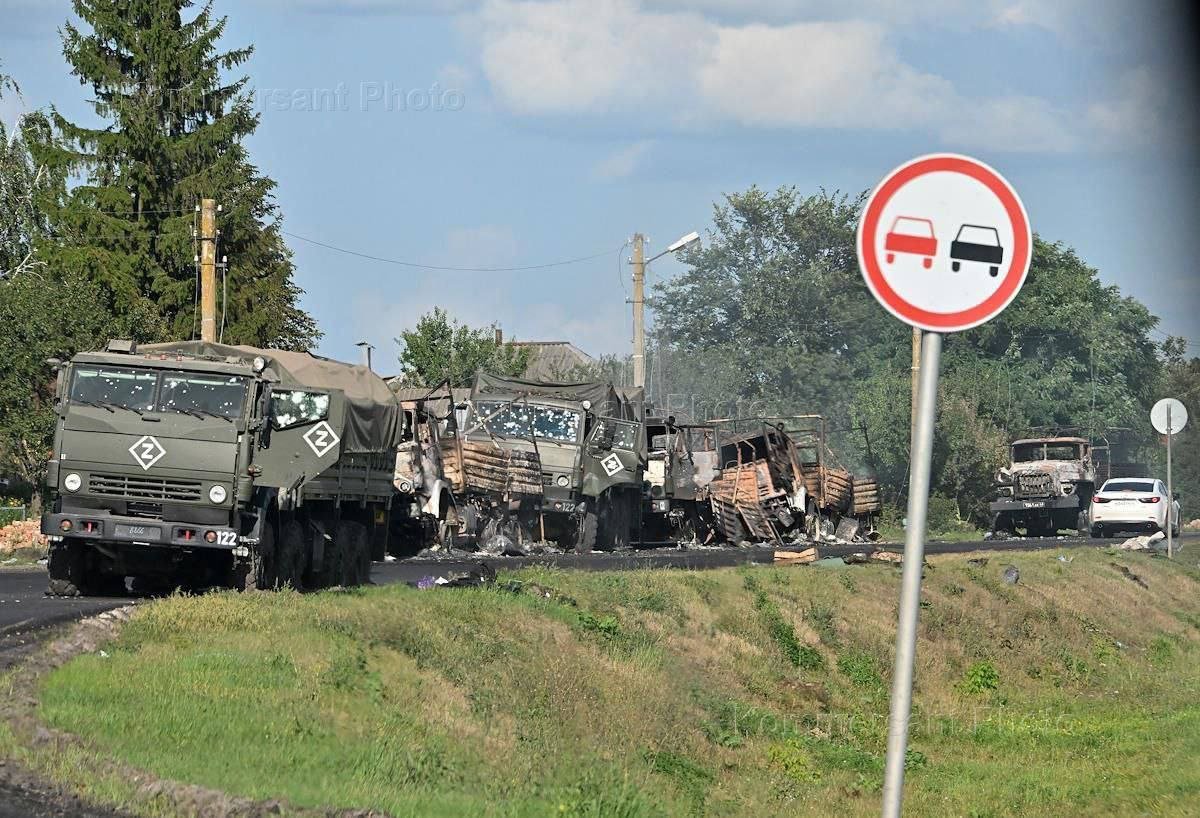
Russia has declared a counter-terrorist operation in the Kursk, Belgorod and Bryansk regions. The decision was made by the Director of the Federal Security Service of Russia, Alexander Bortnikov. By calling it a "counter-terrorist operation," Russia is once again trying to
1/17
1/17

downplay the seriousness of the situation. On the other hand, under a counter-terrorist operation, the FSB is handling the situation, not the Defense Ministry, which Vladimir Putin has long since lost confidence in. A breakthrough in the Kursk region will most likely provoke
2/17
2/17

Putin to finally purge last from Shoigu's team. Gerasimov made decisions regarding the defense of these regions, and even seeing the concentration of Ukrainian troops in the Sumy region over the past 2 months, he did not consider them a threat. Perhaps, there will be quick
3/17
3/17
resignations. They will look for those to blame. Ukraine has learned its lessons from its last attempt at a massive offensive and this time tried to determine the most vulnerable parts of the front. They turned out to be Russia's border territories. Previous sabotage and
4/17
4/17

reconnaissance groups have scouted out how easy it is to penetrate the defenses in these areas, and this offensive was prepared with these factors in mind. Also today there were reports of Ukrainian troops appearing in the Belgorod region. Soldiers posted a video from
5/17
5/17

the village of Poroz. Whether this is the site of another major breakthrough or rather a diversionary maneuver will become clear later. It is also possible that the offensive in the Kursk region is also a diversionary maneuver. There are many theories now. There are some
6/17
6/17

about capturing the nuclear power plant and exchanging it for Zaporizhzhya, there are some about exchanging the Kursk region for the withdrawal of Russian troops from Ukraine and the return of the 1991 border. Possibly. But it seems that Ukraine is not very inclined to
7/17
7/17
bargain with Russia, and its main goal is to completely overthrow the Russian Army. Perhaps Ukraine will be able to issue an ultimatum in some point. Ukrainian special forces are supplying weapons to local resistance movements, stirring up the heat for a civil war. Russia
8/17
8/17

entered Ukraine under the pretext of a popular uprising in Donetsk and Lugansk, and in response it will receive its own civil war. Something interesting is happening on the Internet. Apparently, there is also a massive information operation going on there. Firstly, before
9/17
9/17

the operation, many information platforms covering the war received a warning to maintain complete silence. There is almost no information from the Ukrainian side. Rare videos and photos, which are most likely carefully selected and play a role in the overall strategy of
10/17
10/17

the information part of this war. Secondly, Russian channels are littered with messages that greatly fuel panic. There are reports of sabotage and reconnaissance groups working or military equipment stolen by Ukrainians. In some messages, Russian soldiers were called upon
11/17
11/17

to shoot to kill. In the confusion, the Russians could have started shooting at their own. In general, at the moment, Z-channels are in a fever and in the morning they write that the offensive has been stopped, and by the evening they write in panic that everything is
12/17
12/17

lost. And so on in a circle. Also, a video has spread across the Internet that created the impression that the Ukrainians have access to surveillance cameras in the Kursk region. Russian publics have spread the news, apparently the cameras have been turned off. It turned
13/17
13/17

out later that the video is old. The Ukrainians also faced a problem in the Kursk region - they lack transport to transport those who surrendered. However, Russia has also made progress, these are the same Toretsk and Pokrovsk. However, the progress is minimal and the
14/17
14/17

intensity is falling. On the other hand, columns of equipment have already been noticed not only from the Kharkiv region, but also from the Donbas and other parts of the front, sent to reinforce the Kursk region. How long Russia will have enough resources to continue the
15/17
15/17

offensive, which has already been going on for three months in the Avdiivka direction, is an open question. Ukraine expected the exhaustion of Russian resources to begin its offensive. Russia wore them down in the Donetsk region. The offensive on Kursk has greatly raised
16/17
16/17

the morale of Ukrainian soldiers, and it has also restored faith in Ukraine in the West. Ukraine can advance, Ukraine can win. The success of this operation remains to be determined in the future, until there is objective data on what is happening and what the scale is.
17/17
17/17

• • •
Missing some Tweet in this thread? You can try to
force a refresh