Neurodivergent_lou Profile picture
Aug 11 17 tweets 4 min read Read on X
Autism Diagnosis Criteria Explained: The Full Criteria in Easy to Understand and Neurodiversity Affirming Language
#Autism #Neurodivergent #Disability #ActuallyAutistic All slides have my username @neurodivergent_lou in the bottom left hand corner. Slide 1: text reads - Autism Diagnosis Criteria Explained The Full Criteria in Easy to Understand and Neurodiversity Affirming Language.
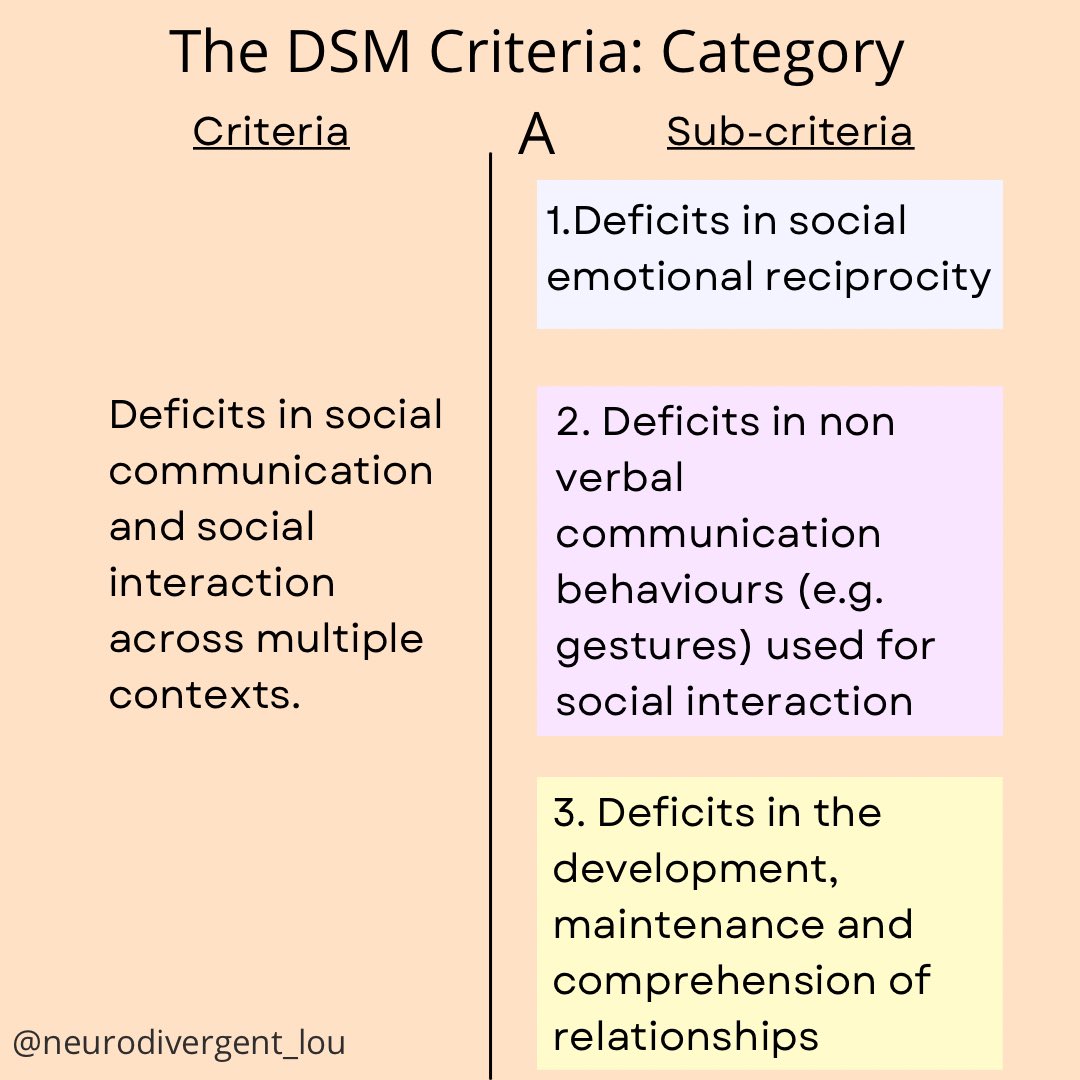
Slide 2: text reads- The DSM Criteria: Category A Deficits in social communication and social interaction across multiple contexts. 1.Deficits in social emotional reciprocity 2. Deficits in non verbal communication behaviours (e.g. gestures) used for social interaction 3. Deficits in the development, maintenance and comprehension of relationships
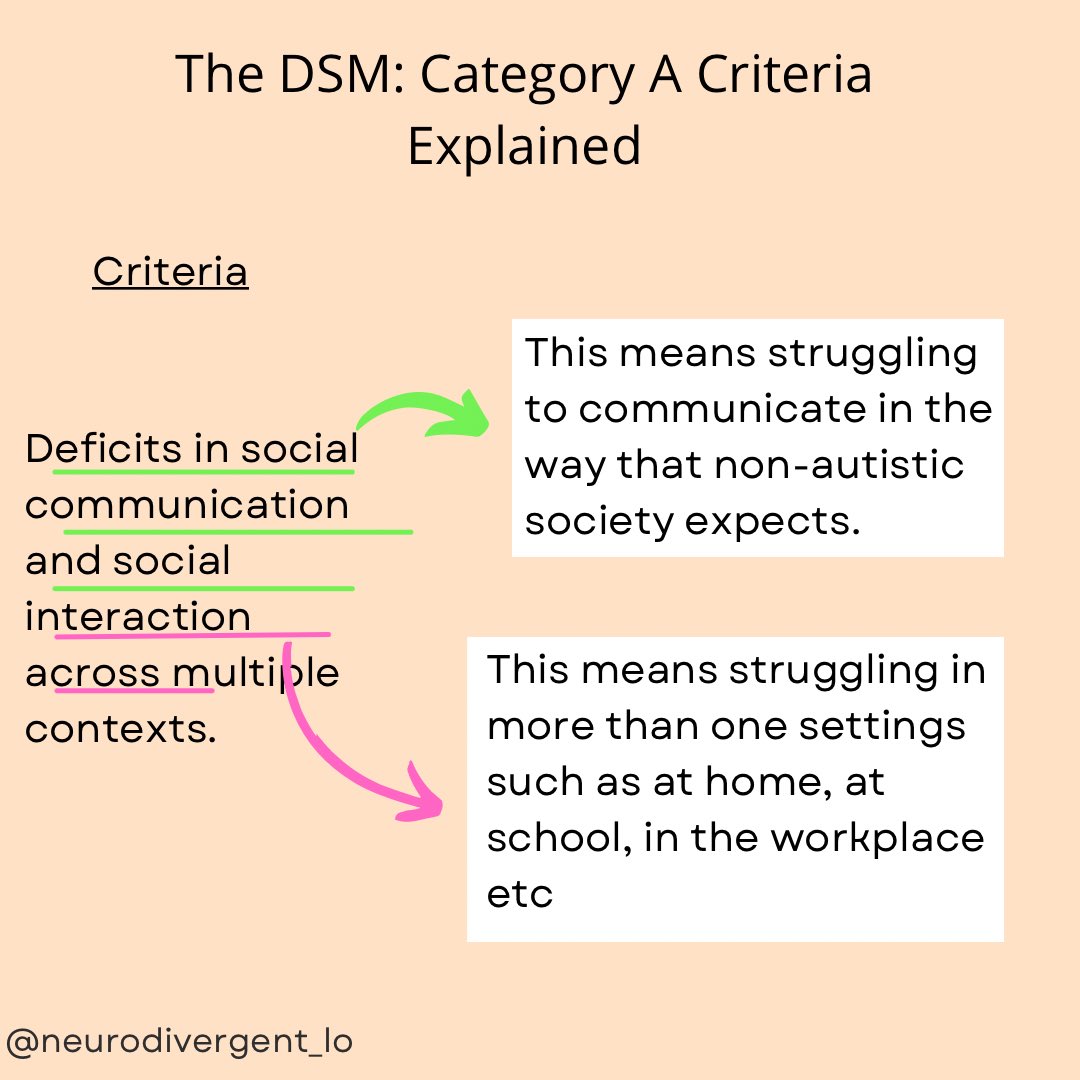
The DSM: Category A Criteria Explained Criteria Deficits in social communication and social interaction across multiple contexts. This means struggling in more than one settings such as at home, at school, in the workplace etc This means struggling to communicate in the way that non-autistic society expects.
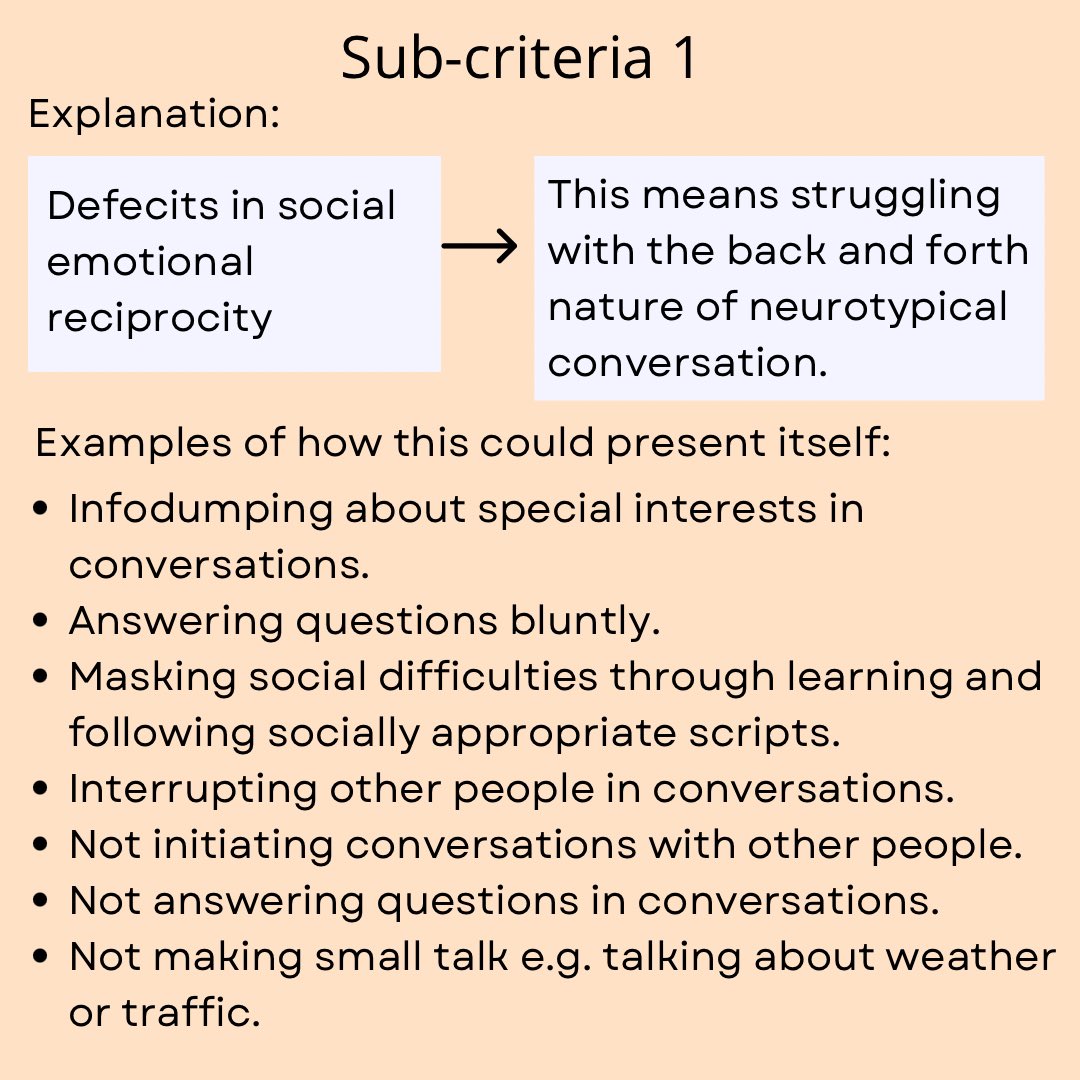
Sub-criteria 1  Defecits in social emotional reciprocity This means struggling with the back and forth nature of neurotypical conversation. Examples of how this could present itself: Explanation: Infodumping about special interests in conversations. Answering questions bluntly. Masking social difficulties through learning and following socially appropriate scripts. Interrupting other people in conversations. Not initiating conversations with other people. Not answering questions in conversations. Not making small talk e.g. talking about weather or traffic.
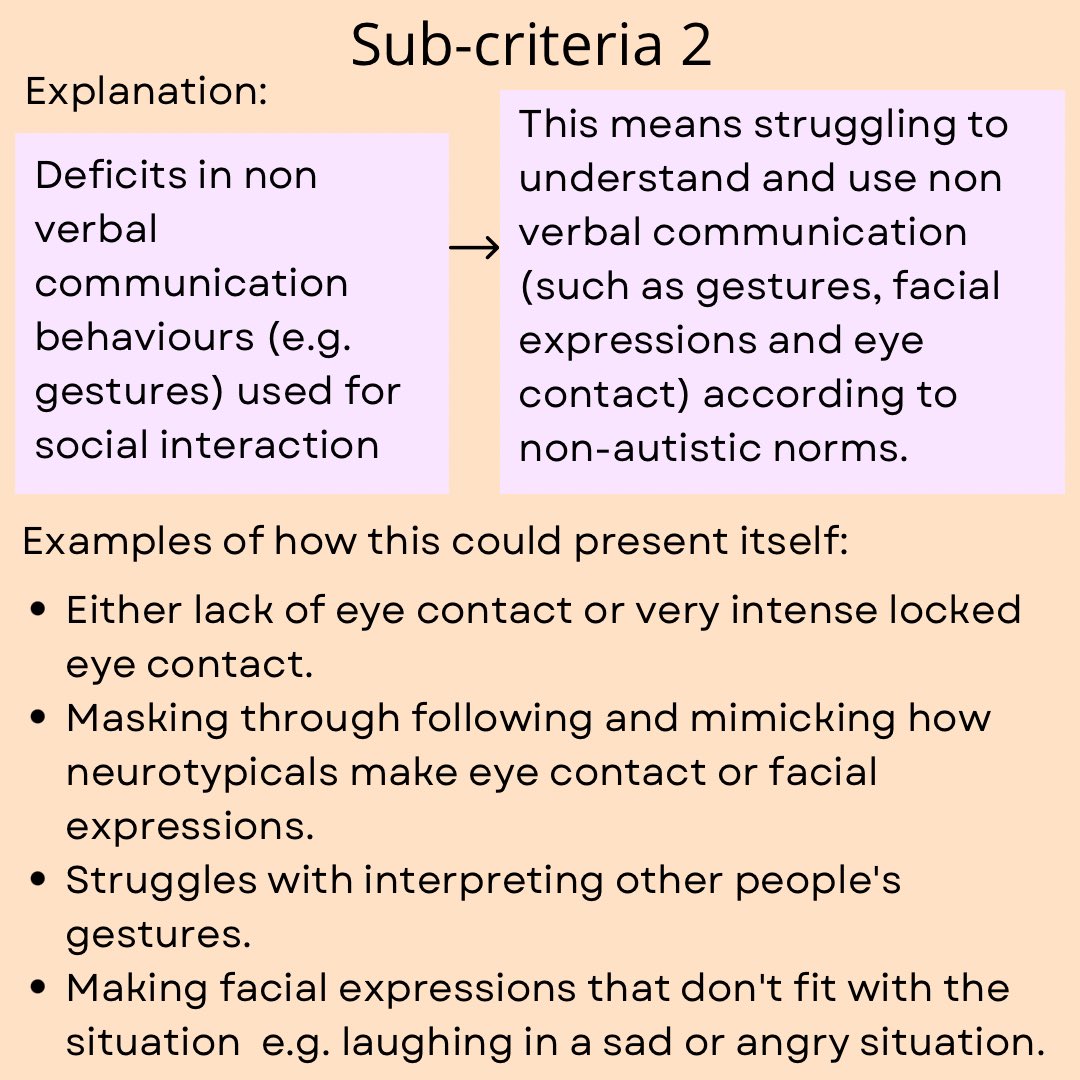
Sub-criteria 2 Deficits in non verbal communication behaviours (e.g. gestures) used for social interaction This means struggling to understand and use non verbal communication (such as gestures, facial expressions and eye contact) according to non-autistic norms. Examples of how this could present itself: Explanation: Either lack of eye contact or very intense locked eye contact. Masking through following and mimicking how neurotypicals make eye contact or facial expressions. Struggles with interpreting other people's gestures. Making facial expressions that don't fit with the situation  e....
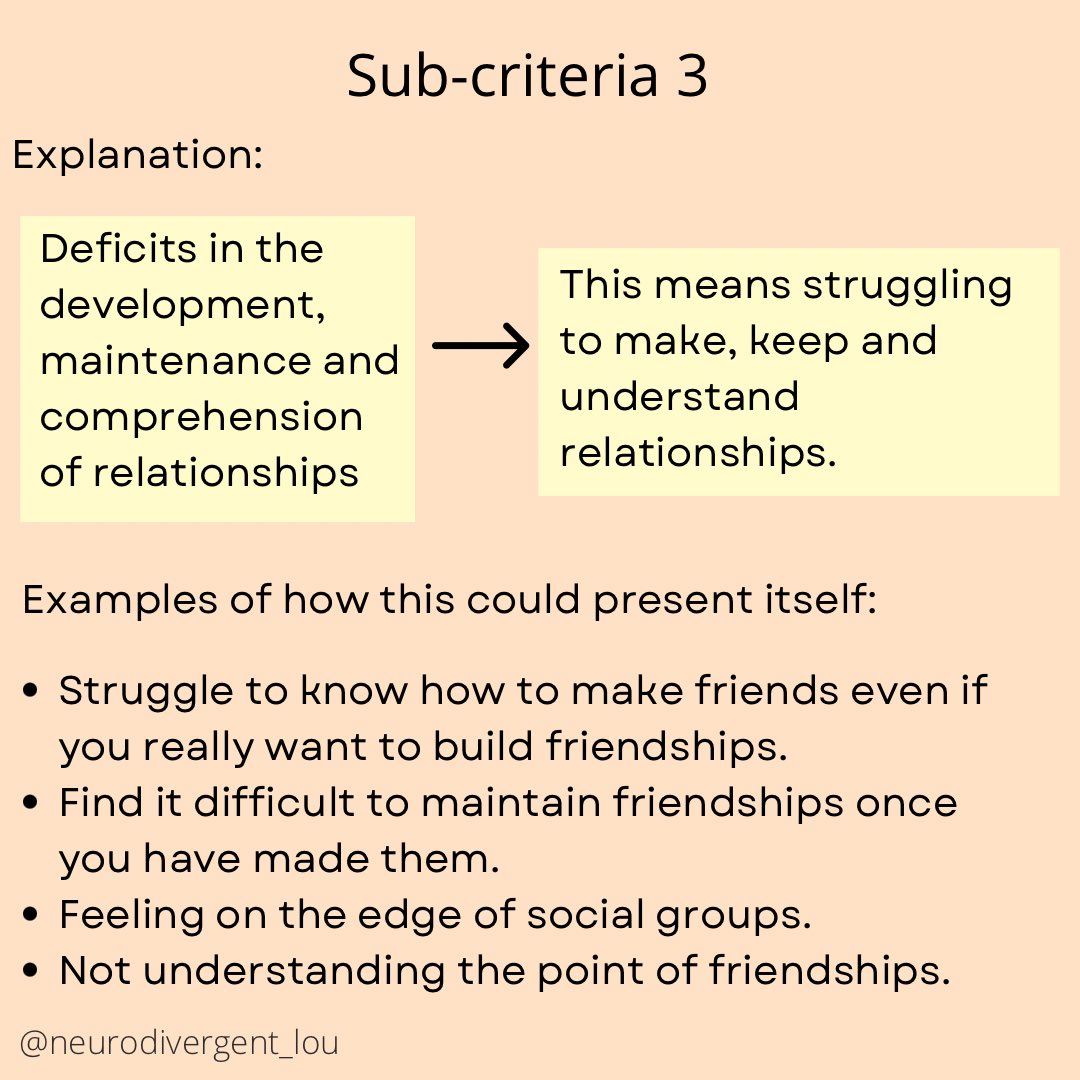
Sub-criteria 3 Deficits in the development, maintenance and comprehension of relationships This means struggling to make, keep and understand relationships. Explanation: Examples of how this could present itself: Struggle to know how to make friends even if you really want to build friendships. Find it difficult to maintain friendships once you have made them. Feeling on the edge of social groups. Not understanding the point of friendships.
Restricted, repetitive patterns of behaviour, interests or activities as manifested by at least two of the following. Stereotyped or repetitive speech, motor movements or use of objects. 2. Excessive adherence to routines, ritualized patterns of verbal or non verbal behaviour, or excessive resistance to change. 3. Highly restricted, fixated interests that are abnormal in intensity or focus. The DSM Criteria: Category B Criteria Sub-criteria 4. Hyper or hypo reactivity to sensory input or unusual interest in sensory aspects of the environment.
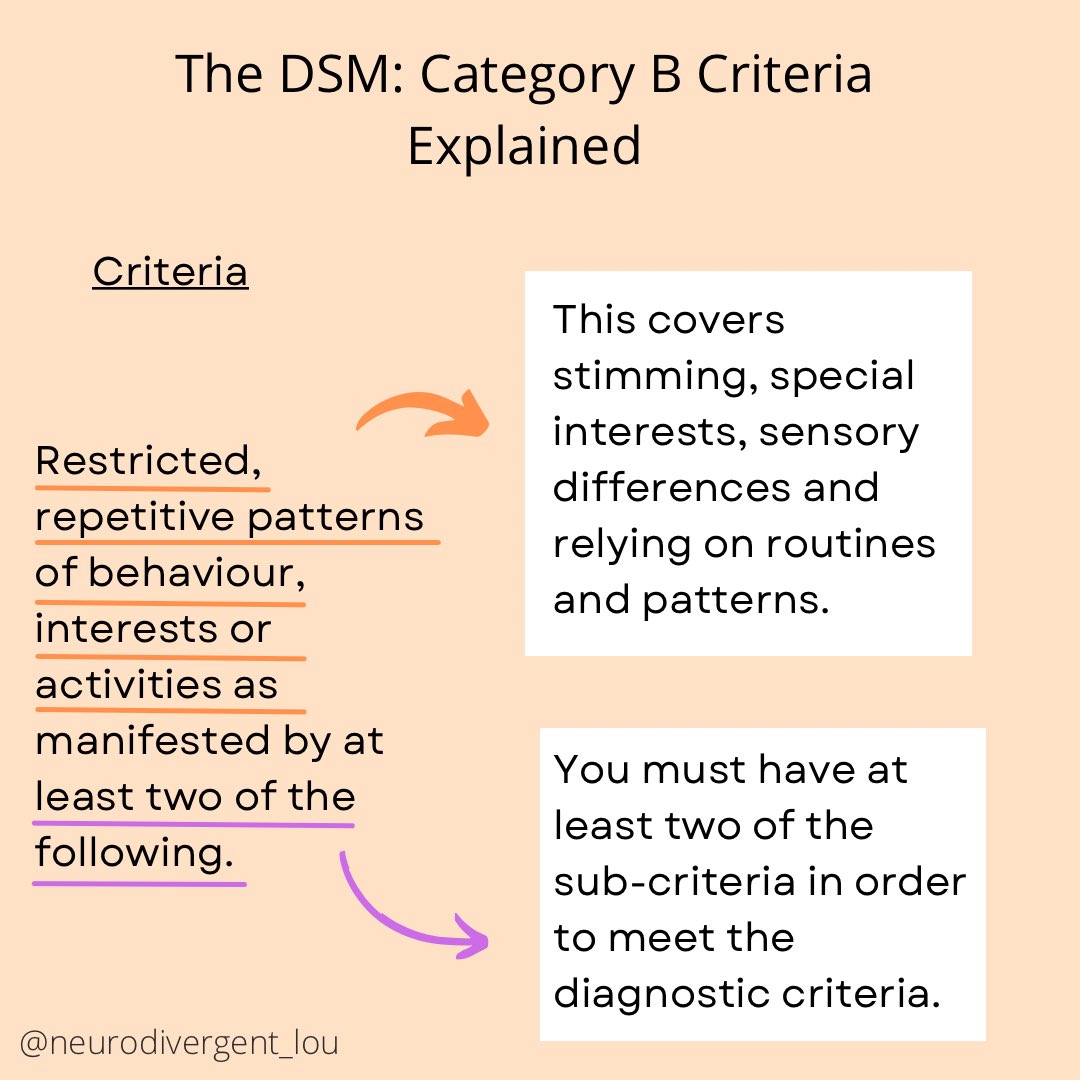
The DSM: Category B Criteria Explained Criteria Restricted, repetitive patterns of behaviour, interests or activities as manifested by at least two of the following. You must have at least two of the sub-criteria in order to meet the diagnostic criteria. This covers stimming, special interests, sensory differences and relying on routines and patterns.
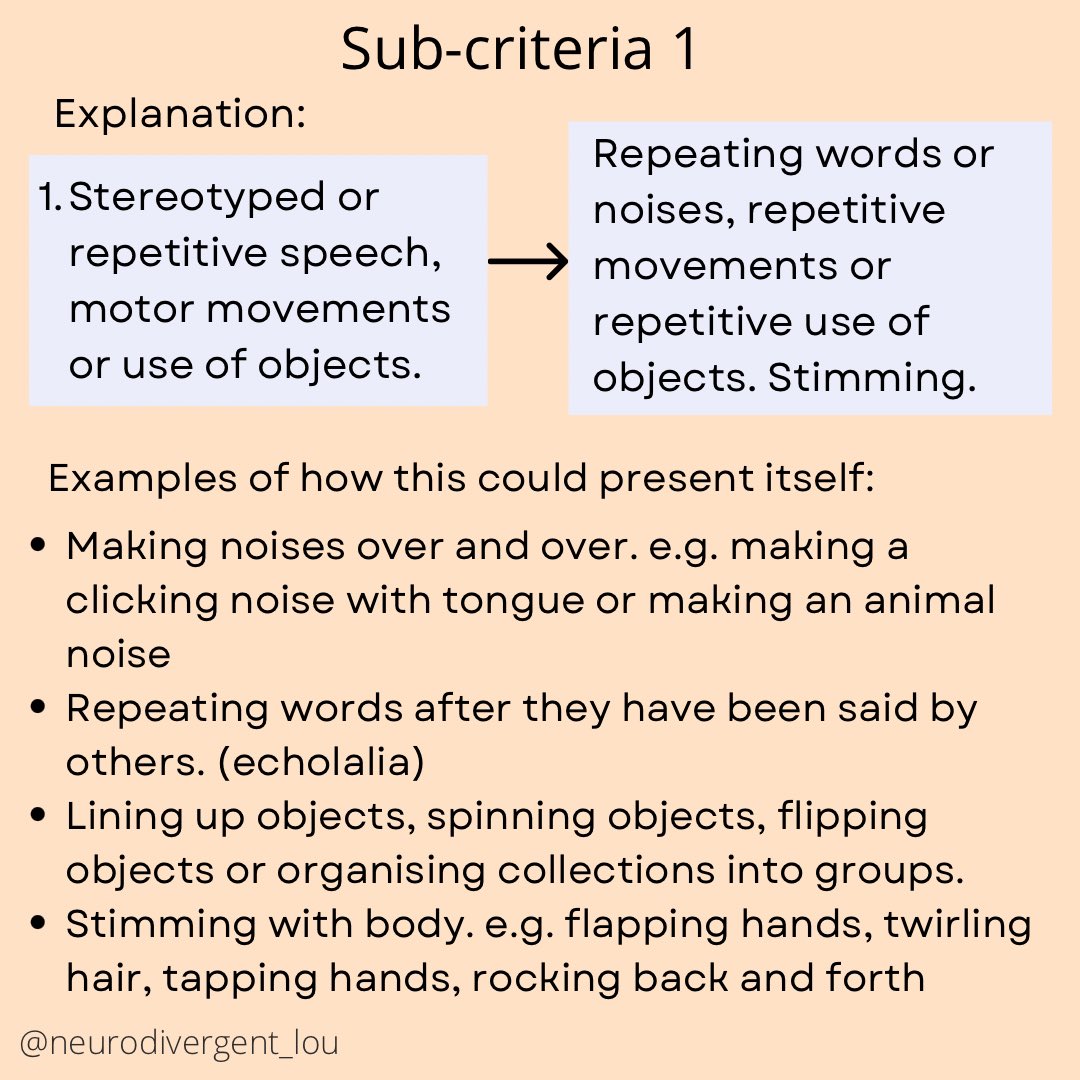
Sub-criteria 1  Repeating words or noises, repetitive movements or repetitive use of objects. Stimming. Examples of how this could present itself: Explanation: Making noises over and over. e.g. making a clicking noise with tongue or making an animal noise Repeating words after they have been said by others. (echolalia) Lining up objects, spinning objects, flipping objects or organising collections into groups. Stimming with body. e.g. flapping hands, twirling hair, tapping hands, rocking back and forth Stereotyped or repetitive speech, motor movements or use of objects.
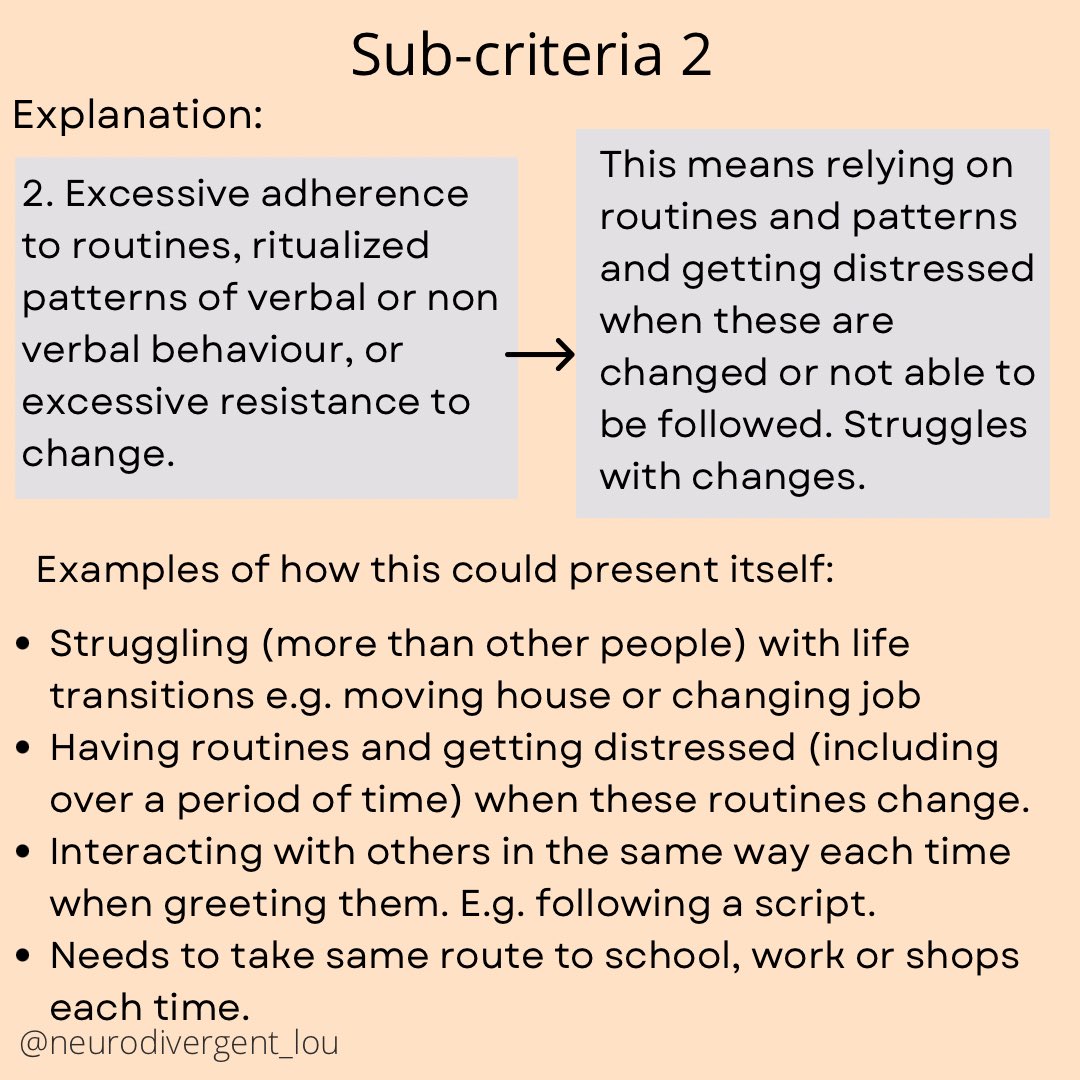
Sub-criteria 2 This means relying on routines and patterns and getting distressed when these are changed or not able to be followed. Struggles with changes. Examples of how this could present itself: Explanation: Struggling (more than other people) with life transitions e.g. moving house or changing job Having routines and getting distressed (including over a period of time) when these routines change.  Interacting with others in the same way each time when greeting them. E.g. following a script. Needs to take same route to school, work or shops each time. 2. Excessive adherence to routines...
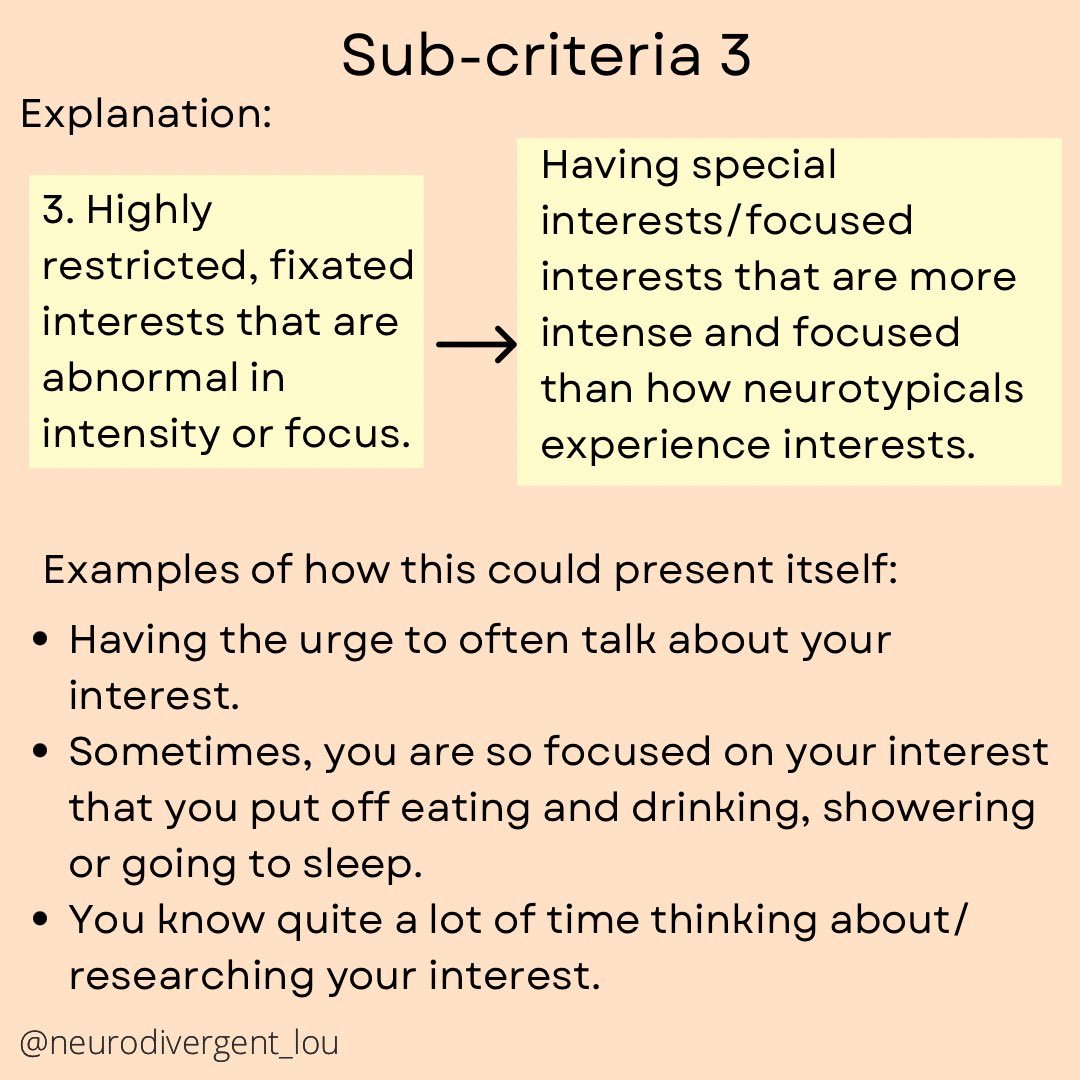
Sub-criteria 3 Having special interests/focused interests that are more intense and focused than how neurotypicals experience interests. Explanation: Examples of how this could present itself: Having the urge to often talk about your interest. Sometimes, you are so focused on your interest that you put off eating and drinking, showering or going to sleep. You know quite a lot of time thinking about/ researching your interest. 3. Highly restricted, fixated interests that are abnormal in intensity or focus.
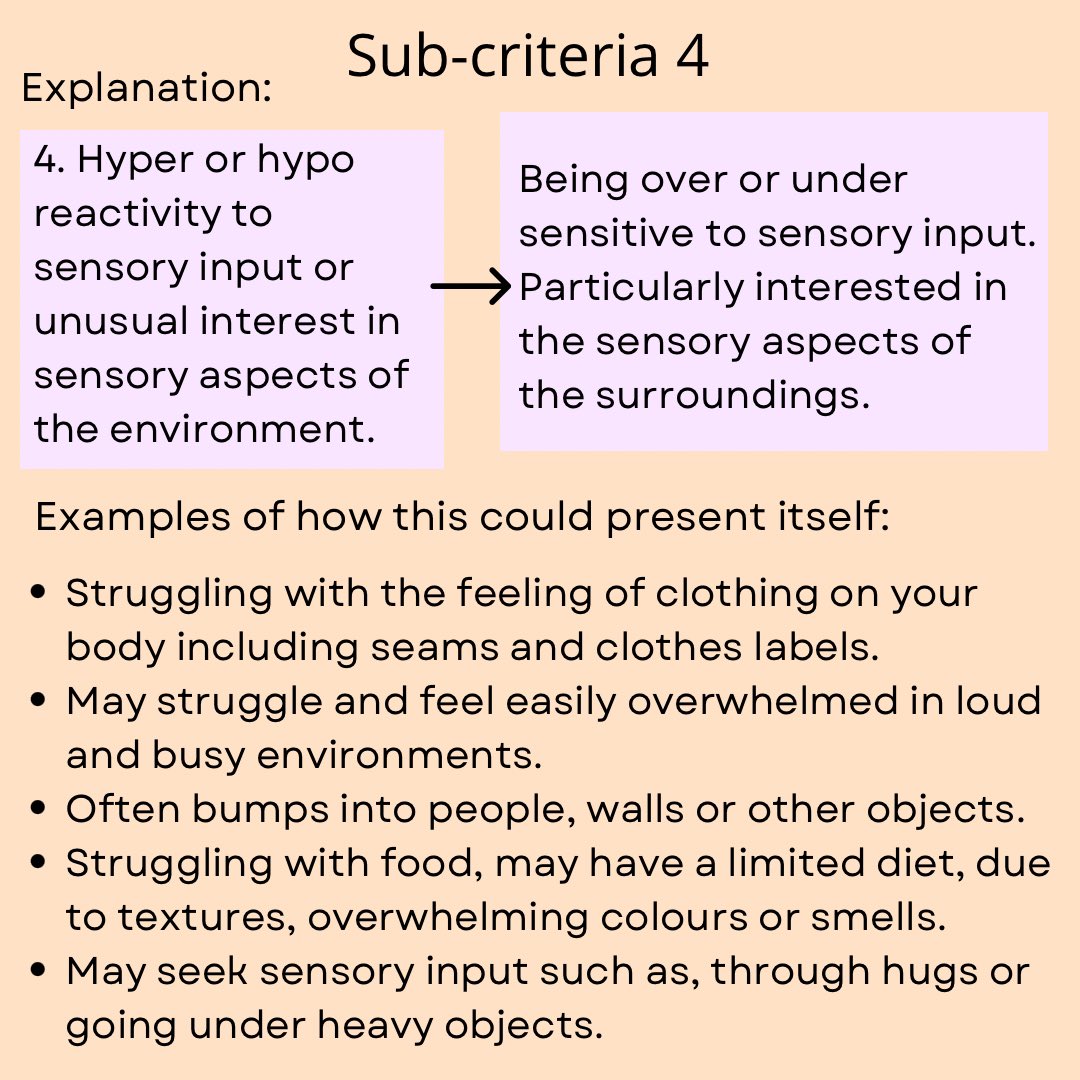
Sub-criteria 4 Being over or under sensitive to sensory input. Particularly interested in the sensory aspects of the surroundings. Explanation: Examples of how this could present itself: Struggling with the feeling of clothing on your body including seams and clothes labels. May struggle and feel easily overwhelmed in loud and busy environments. Often bumps into people, walls or other objects. Struggling with food, may have a limited diet, due to textures, overwhelming colours or smells. May seek sensory input such as, through hugs or going under heavy objects. 4. Hyper or hypo reactivity t...
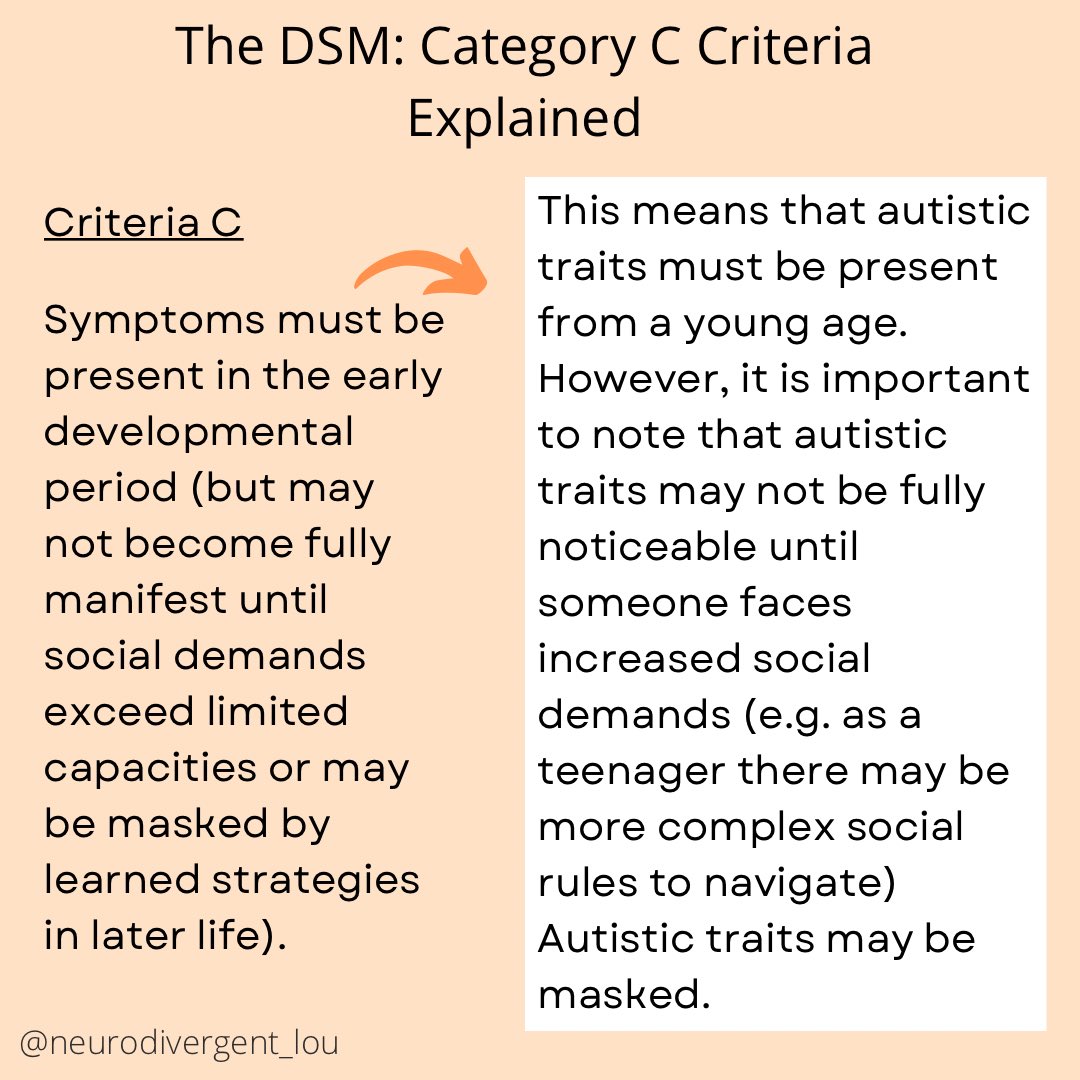
The DSM: Category C Criteria Explained Criteria C Symptoms must be present in the early developmental period (but may not become fully manifest until social demands exceed limited capacities or may be masked by learned strategies in later life). This means that autistic traits must be present from a young age. However, it is important to note that autistic traits may not be fully noticeable until someone faces increased social demands (e.g. as a teenager there may be more complex social rules to navigate) Autistic traits may be masked.
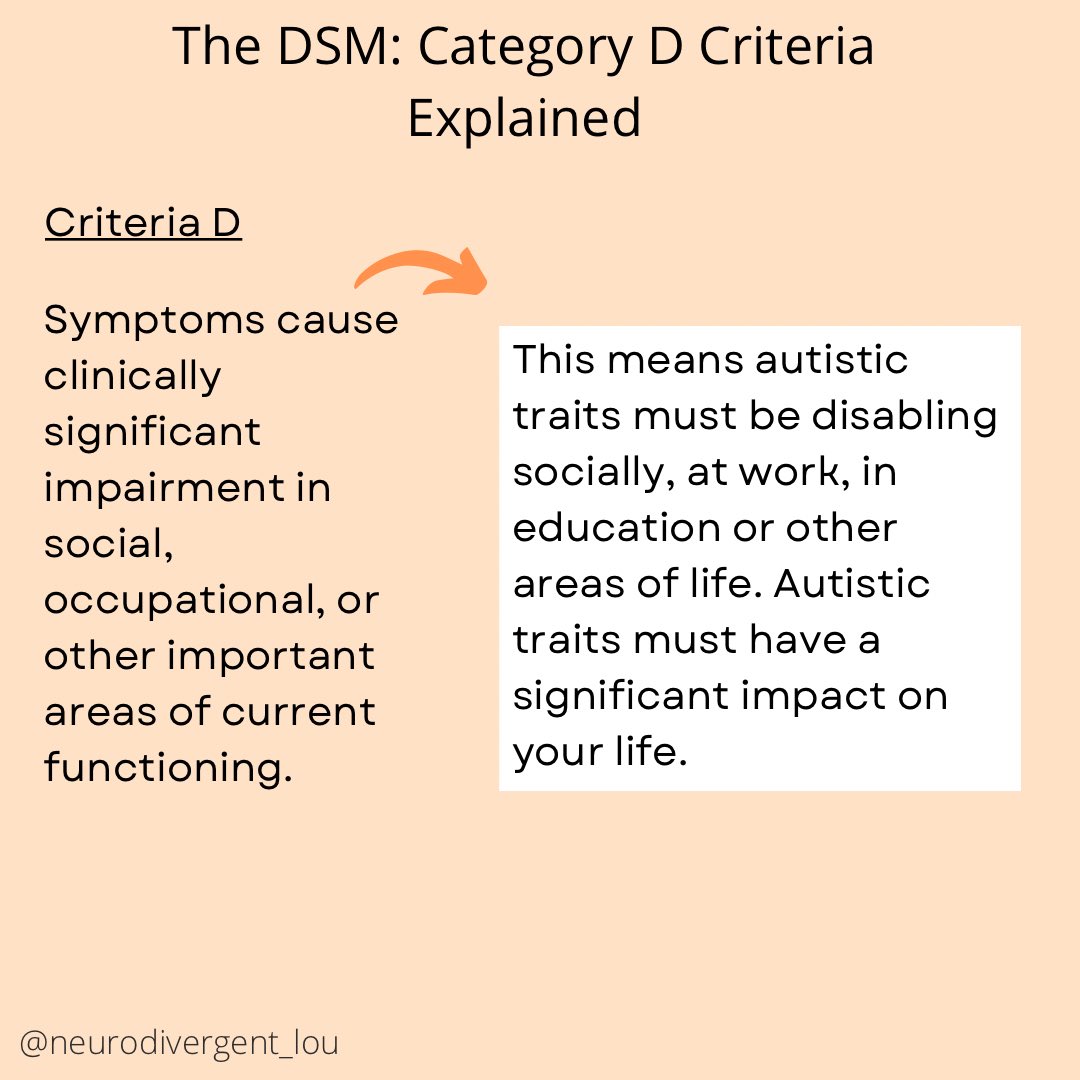
The DSM: Category D Criteria Explained Criteria D Symptoms cause clinically significant impairment in social, occupational, or other important areas of current functioning. This means autistic traits must be disabling socially, at work, in education or other areas of life. Autistic traits must have a significant impact on your life.
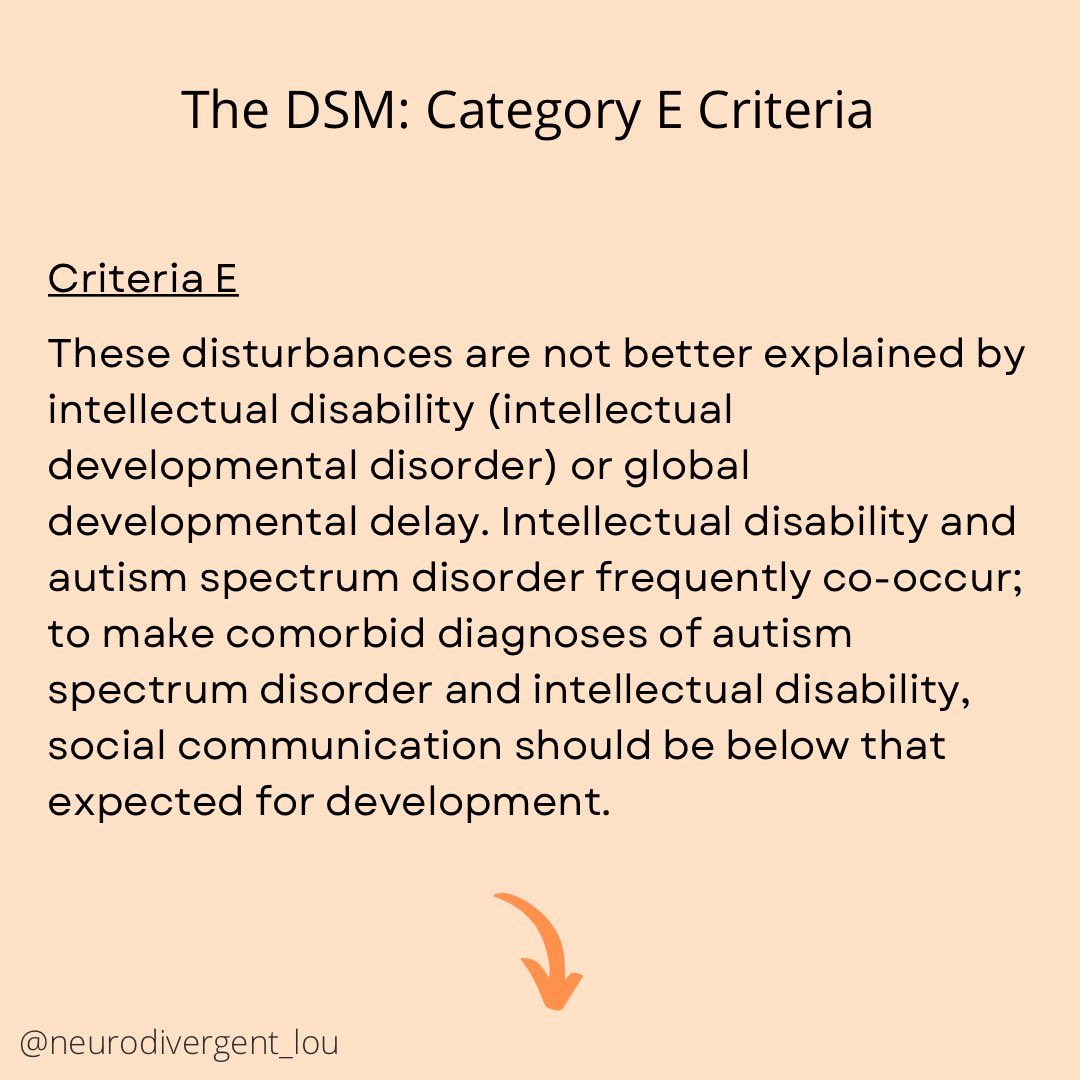
The DSM: Category E Criteria Criteria E These disturbances are not better explained by intellectual disability (intellectual developmental disorder) or global developmental delay. Intellectual disability and autism spectrum disorder frequently co-occur; to make comorbid diagnoses of autism spectrum disorder and intellectual disability, social communication should be below that expected for development.
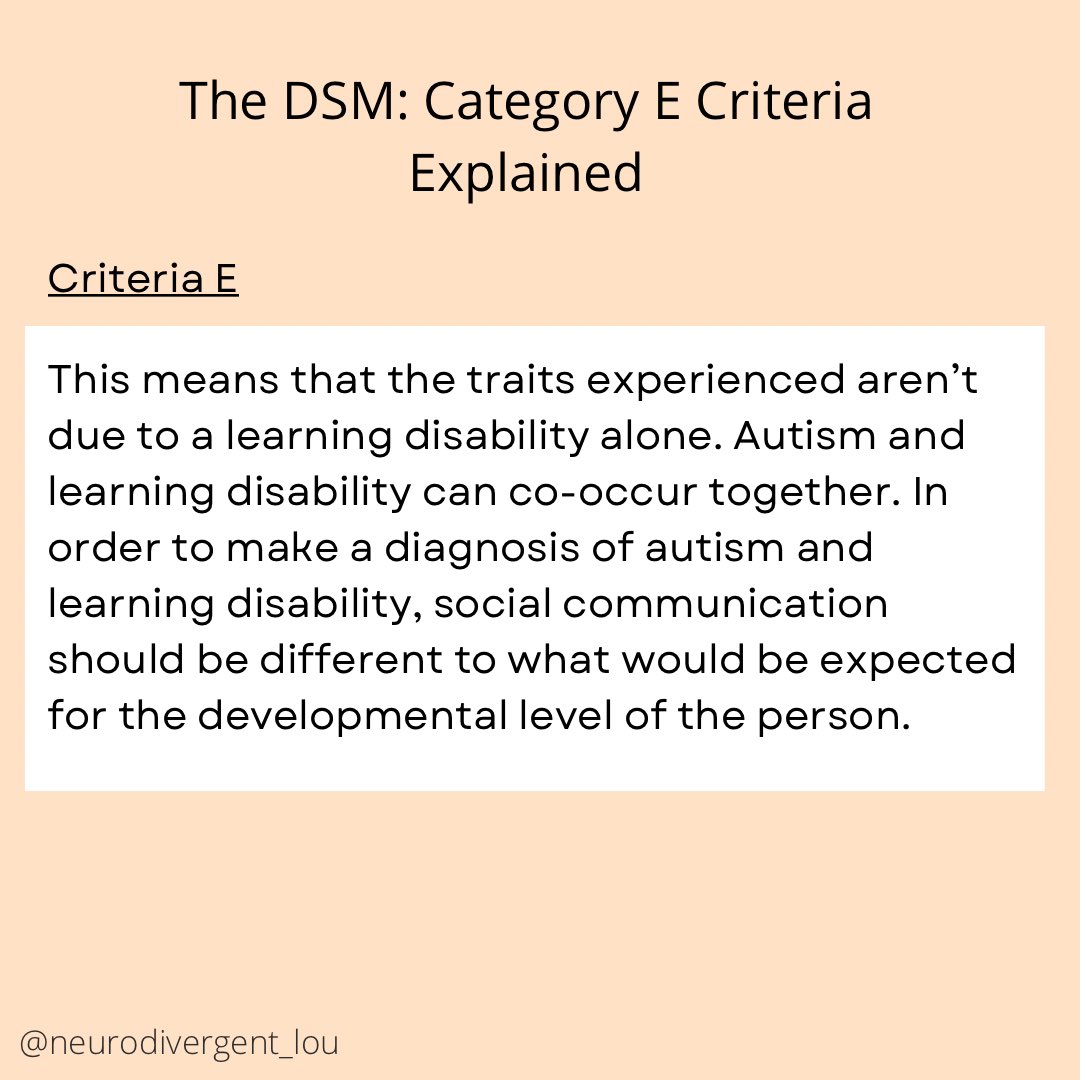
The DSM: Category E Criteria Explained Criteria E This means that the traits experienced aren’t due to a learning disability alone. Autism and learning disability can co-occur together. In order to make a diagnosis of autism and learning disability, social communication should be different to what would be expected for the developmental level of the person.
Image

• • •

Missing some Tweet in this thread? You can try to force a refresh
 

Keep Current with Neurodivergent_lou

Neurodivergent_lou Profile picture

Stay in touch and get notified when new unrolls are available from this author!

Read all threads

This Thread may be Removed Anytime!

PDF

Twitter may remove this content at anytime! Save it as PDF for later use!

Try unrolling a thread yourself!

how to unroll video
  1. Follow @ThreadReaderApp to mention us!

  2. From a Twitter thread mention us with a keyword "unroll"
@threadreaderapp unroll

Practice here first or read more on our help page!

More from @neuro_lou

Aug 10
5 Reasons Why I Rely On Music as an Autistic Person
#Autism #Neurodivergent #Disability #ActuallyAutistic All slides have a blue background with black text. All slides have my username @neurodivergent_lou in the bottom left hand corner. Slide 1: text reads - 5 Reasons Why I Rely On Music as an Autistic Person...
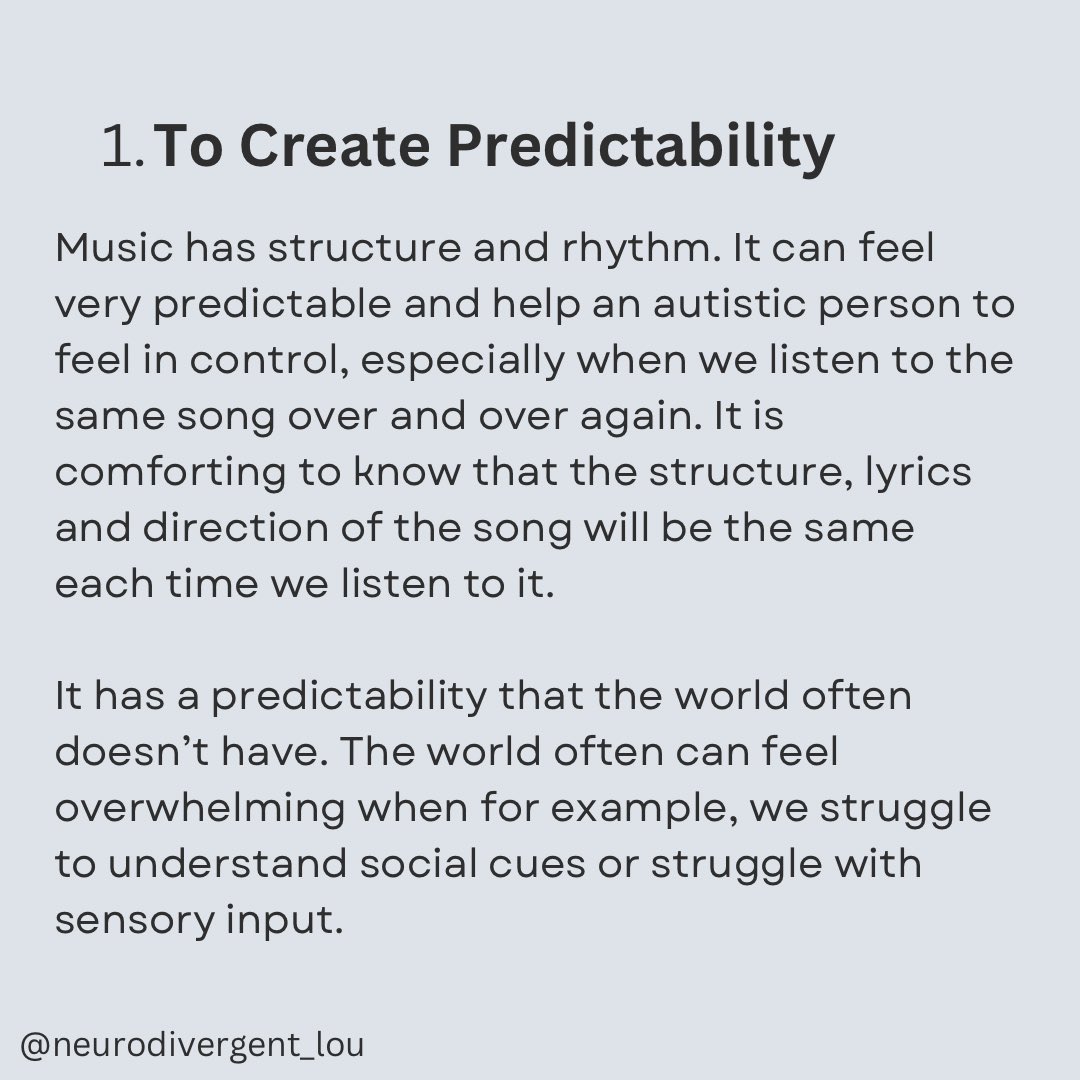
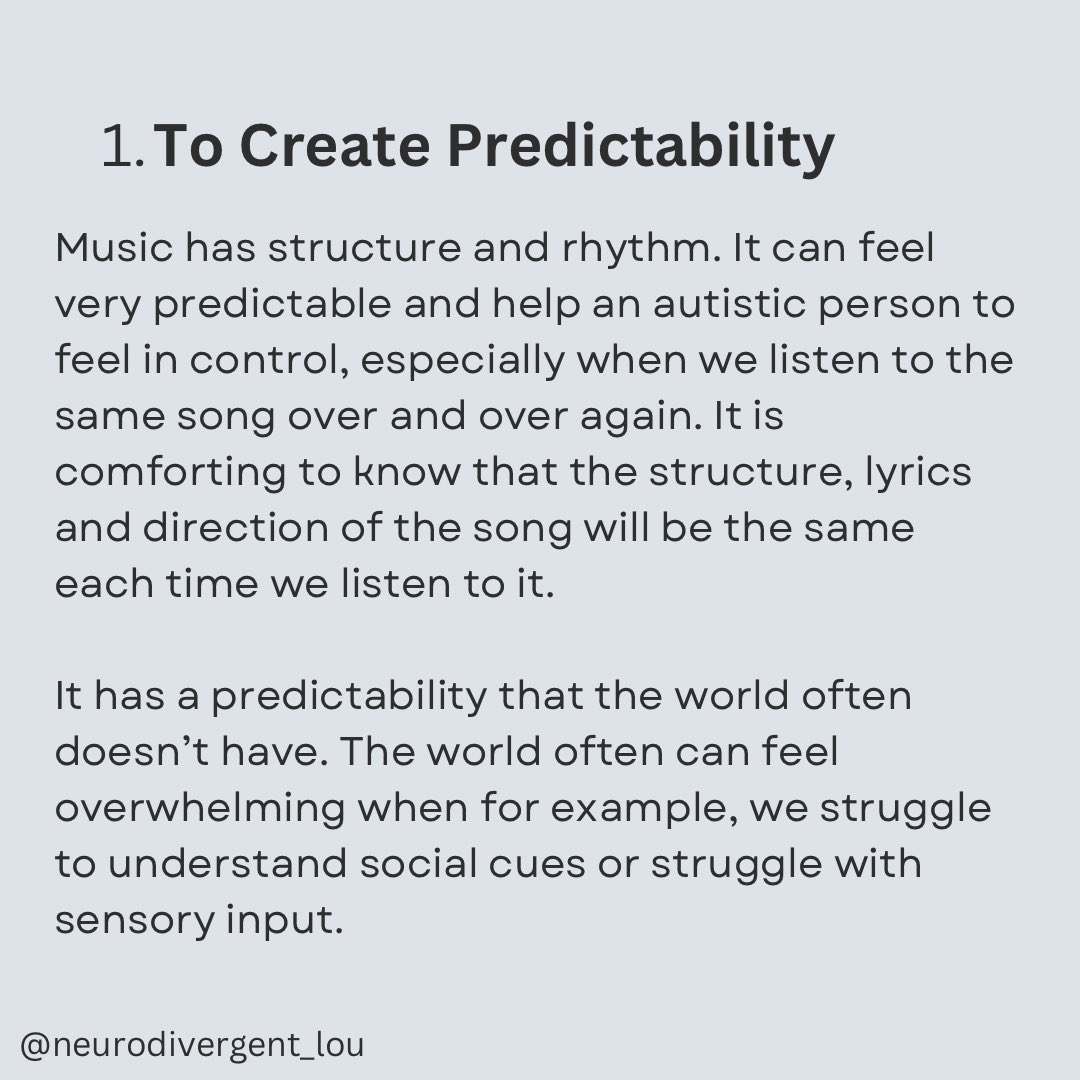
Slide 2: text reads- To Create Predictability Music has structure and rhythm. It can feel very predictable and help an autistic person to feel in control, especially when we listen to the same song over and over again. It is comforting to know that the structure, lyrics and direction of the song will be the same each time we listen to it.   It has a predictability that the world often doesn’t have. The world often can feel overwhelming when for example, we struggle to understand social cues or struggle with sensory input.
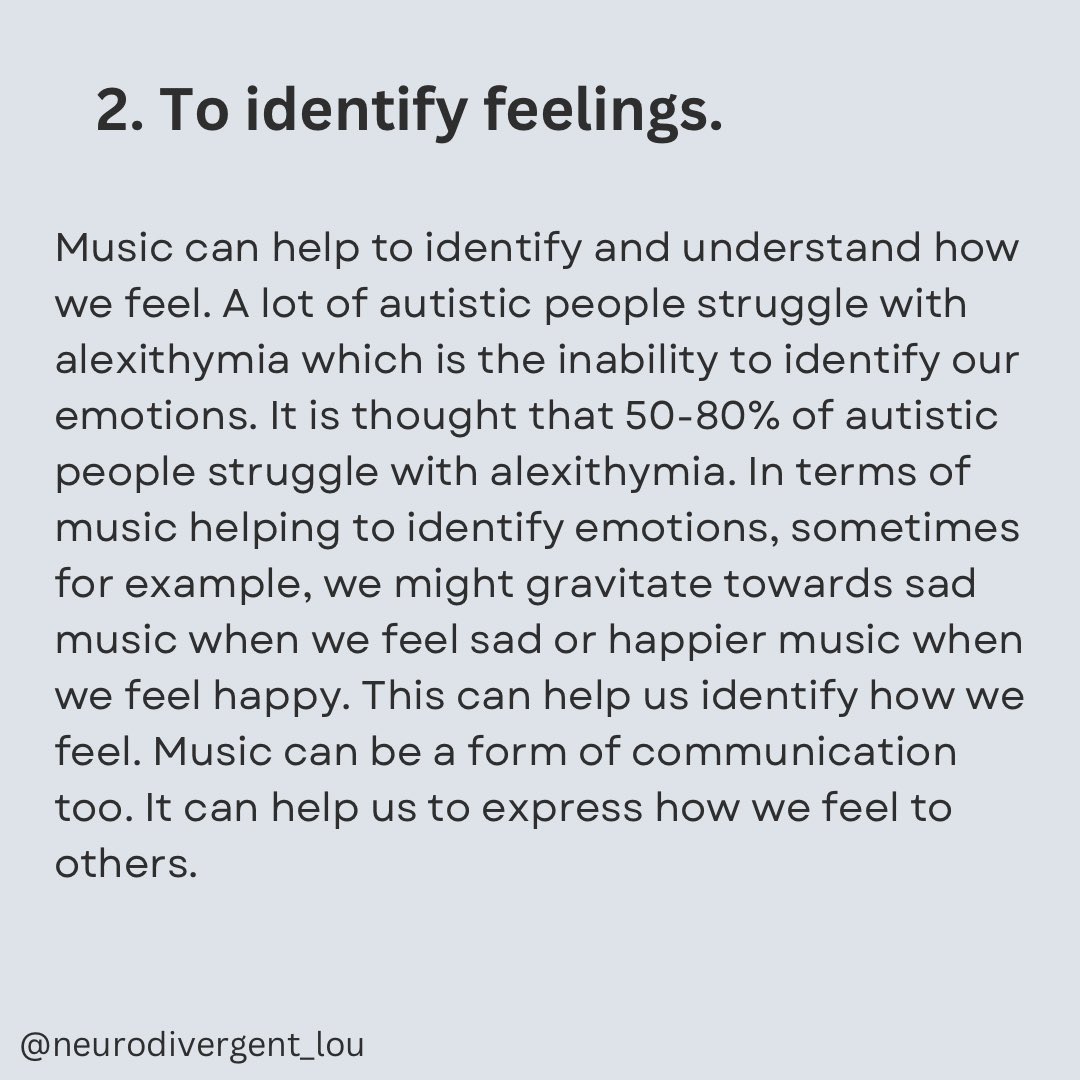
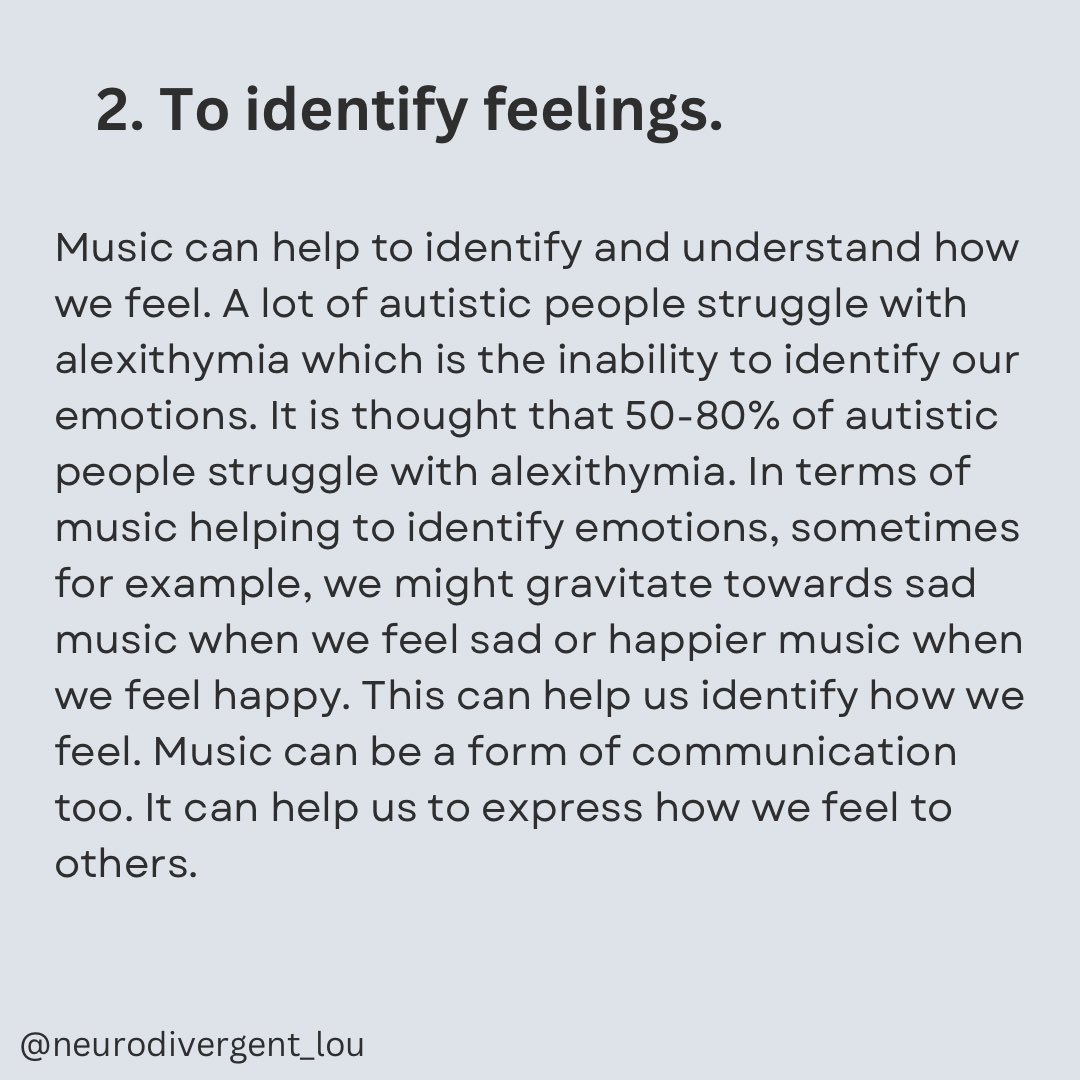
Slide 3: text reads- 2. To identify feelings. Music can help to identify and understand how we feel. A lot of autistic people struggle with alexithymia which is the inability to identify our emotions. It is thought that 50-80% of autistic people struggle with alexithymia. In terms of music helping to identify emotions, sometimes for example, we might gravitate towards sad music when we feel sad or happier music when we feel happy. This can help us identify how we feel. Music can be a form of communication too. It can help us to express how we feel to others.
Read 7 tweets
Aug 5
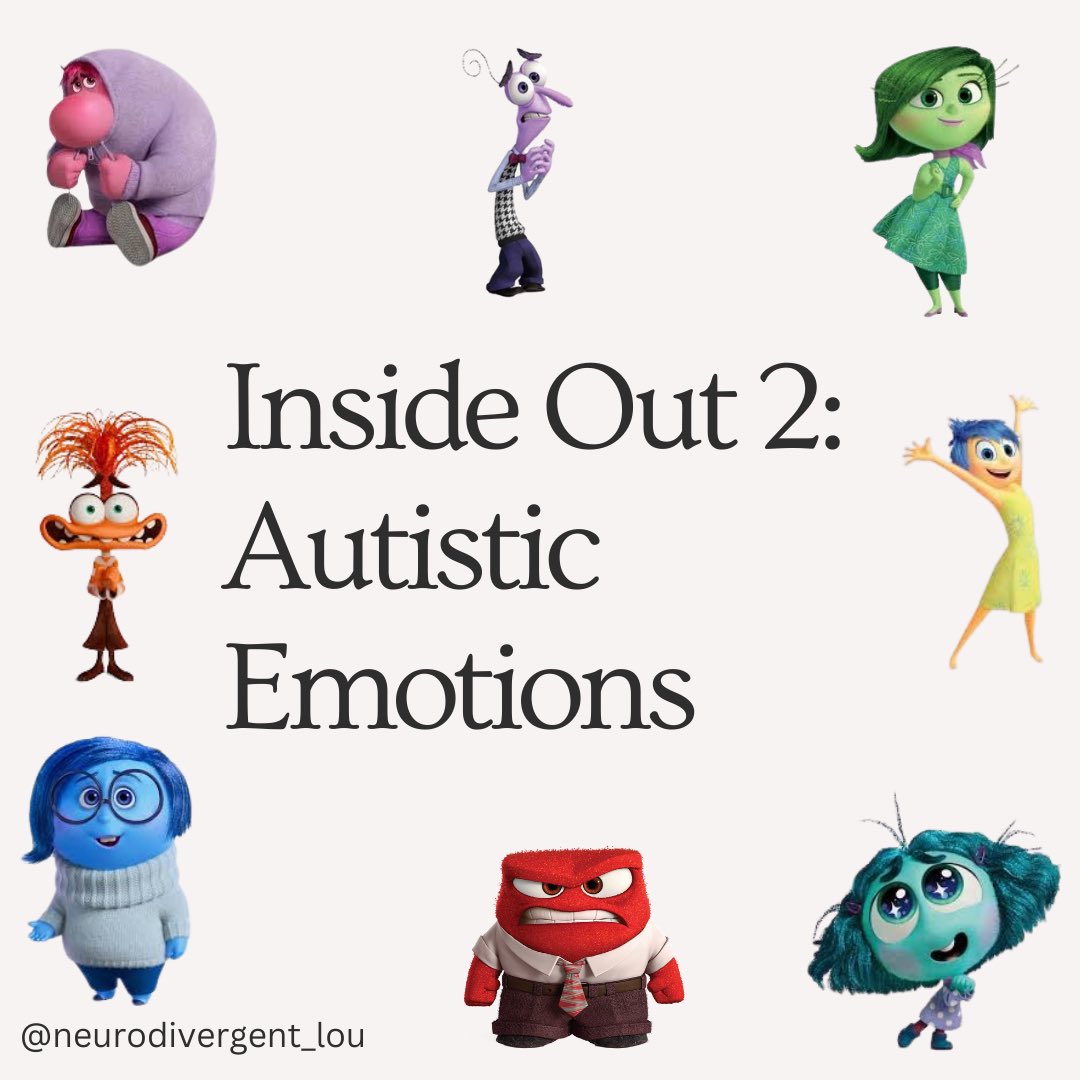
Inside Out 2: Autistic Emotions
#Autism #Neurodivergent #Disability #ActuallyAutistic All slides have a light background with black text. All slides have my username @neurodivergent_lou in the bottom left hand corner. Slide 1: text reads - Inside Out 2: Autistic Emotions. (Image - emotions from Inside Out)
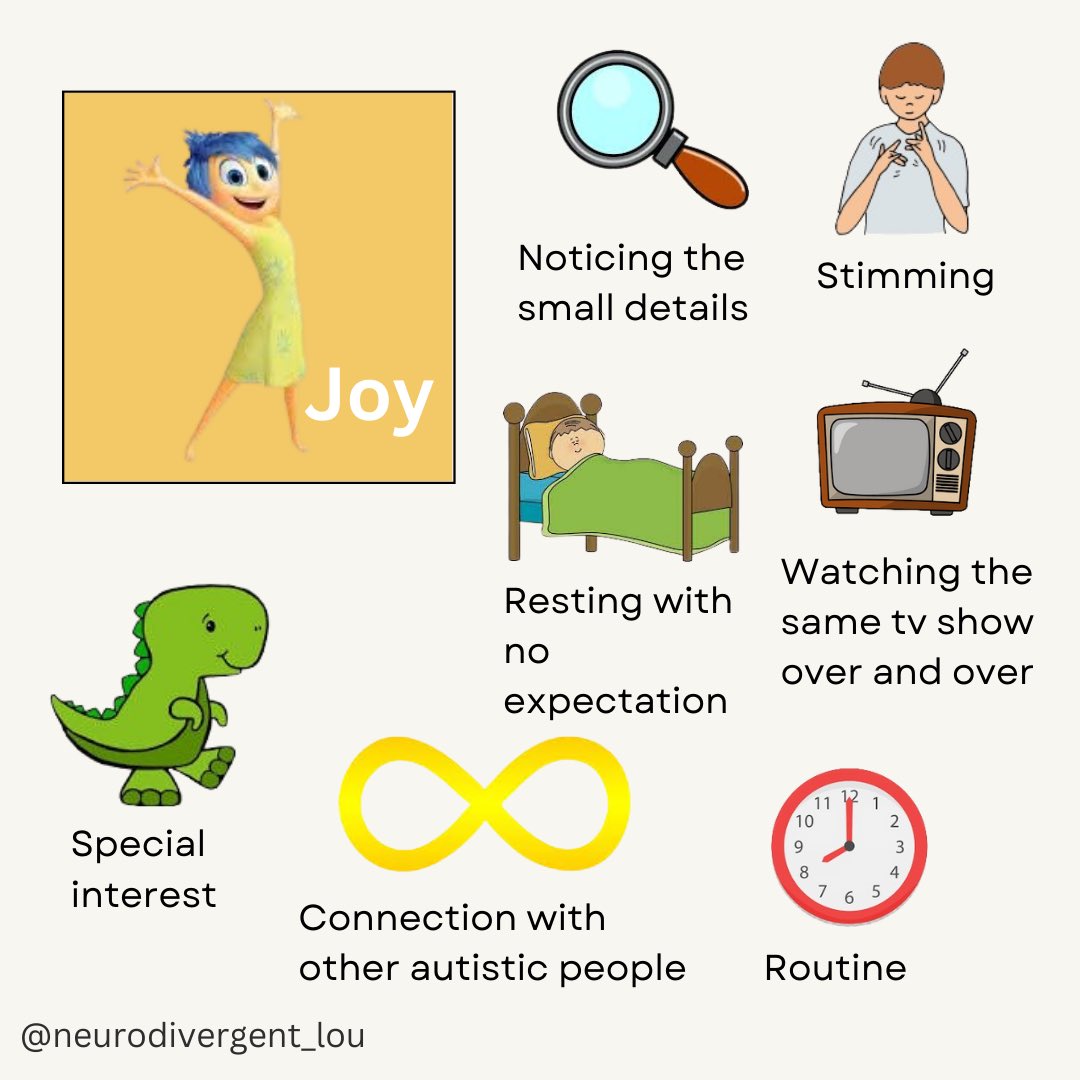
Character joy from inside out. Special interest Connection with other autistic people Noticing the small details Stimming Resting with no expectation Routine Watching the same tv show over and over
Slide 3: text reads- You hear ‘well we didn’t have autism back in my day’ for the third time that week The sudden irritability when all the sensory input builds up and becomes unbearable. The frustration of meticulously choosing your words to be clear and literal, yet still are misinterpreted.
Read 10 tweets
Aug 4
5 Reasons Why I Rely On Music as an Autistic Person
#Autism #ActuallyAutistic #Neurodivergent #Disabled #Disability #Autistic All slides have a blue background with black text. All slides have my username @neurodivergent_lou in the bottom left hand corner. Slide 1: text reads - 5 Reasons Why I rely on music as  an autistic person?
Slide 2: text reads - To Create Predictability Music has structure and rhythm. It can feel very predictable and help an autistic person to feel in control, especially when we listen to the same song over and over again. It is comforting to know that the structure, lyrics and direction of the song will be the same each time we listen to it.   It has a predictability that the world often doesn’t have. The world often can feel overwhelming when for example, we struggle to understand social cues or struggle with sensory input.
Slide 3: text reads- 2. To identify feelings. Music can help to identify and understand how we feel. A lot of autistic people struggle with alexithymia which is the inability to identify our emotions. It is thought that 50-80% of autistic people struggle with alexithymia. In terms of music helping to identify emotions, sometimes for example, we might gravitate towards sad music when we feel sad or happier music when we feel happy. This can help us identify how we feel. Music can be a form of communication too. It can help us to express how we feel to others.
Read 7 tweets
Jul 16
Things I’ve learnt about the world since realising I’m autistic
#Autism #Neurodivergent #Disability #ActuallyAutistic All slides have a light purple background with black text. All slides have my username @neurodivergent_lou in the bottom left hand corner. Slide 1: text reads - things I’ve learnt about the world since realising I’m autistic.
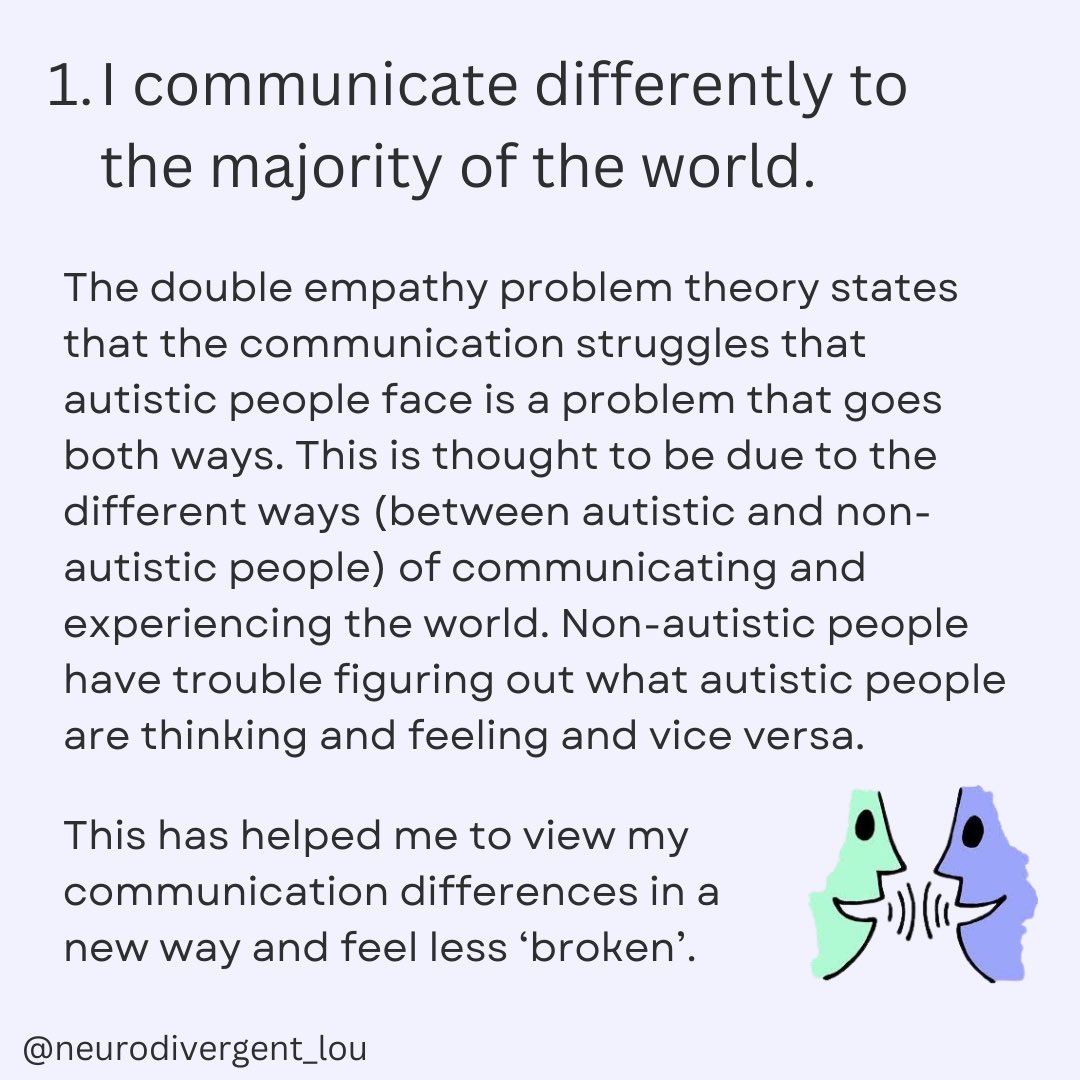
I communicate differently to the majority of the world. The double empathy problem theory states that the communication struggles that autistic people face is a problem that goes both ways. This is thought to be due to the different ways (between autistic and non-autistic people) of communicating and experiencing the world. Non-autistic people have trouble figuring out what autistic people are thinking and feeling and vice versa. This has helped me to view my communication differences in a new way and feel less ‘broken’.
2. A lot of what we learn about autism is based on the deficit narrative. Some of it is based in misconception. The more I learn about autism, the more I realise that a lot of what I learnt about autism was described from a deficit narrative, from the lens that autistic people are broken and need fixing. Some of the information was also based on misconception. There is still a lot to do to change the narrative around autism.
Read 8 tweets
Jul 14
Autism and Fawning #Autism #Neurodivergent #Disability All slides have my username @neurodivergent_lou in the bottom left hand corner. Slide 1: text reads - autism and fawning.
Slide 2: Fawning is a trauma response which involves suppressing our own needs, feelings and sense of self, to appease and take care of others. It is sometimes seen as part of the flight/fight or freeze response.  Sometimes, for example, an autistic child, may be seen as ‘perfect’ or ‘absolutely fine’ at school, when in fact they are fawning in response to distress.
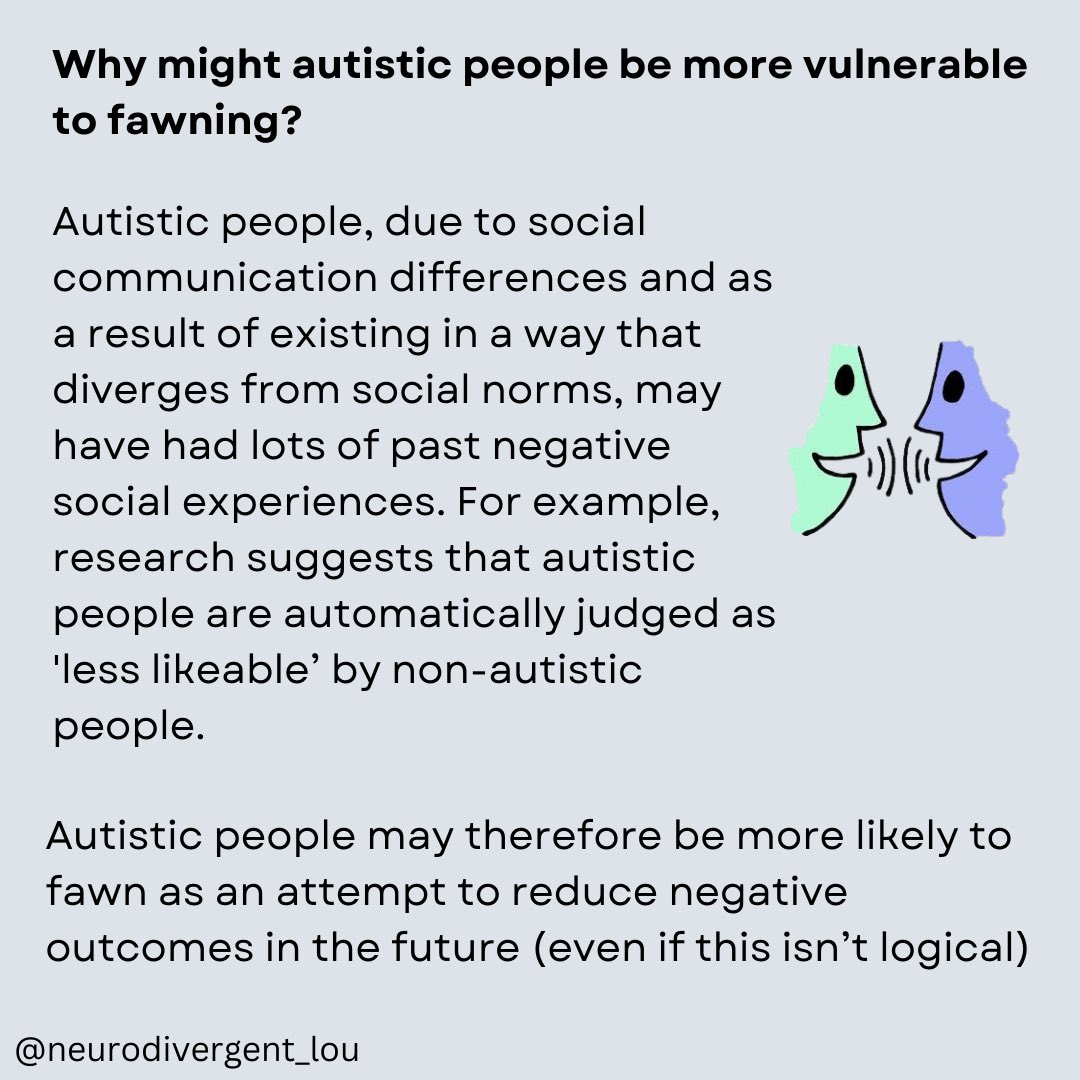
Slide 3: text reads- Why might autistic people be more vulnerable to fawning? Autistic people, due to social communication differences and as a result of existing in a way that diverges from social norms, may have had lots of past negative social experiences. For example, research suggests that autistic people are automatically judged as 'less likeable’ by non-autistic people. Autistic people may therefore be more likely to fawn as an attempt to reduce negative outcomes in the future (even if this isn’t logical)
Read 10 tweets

Did Thread Reader help you today?

Support us! We are indie developers!


This site is made by just two indie developers on a laptop doing marketing, support and development! Read more about the story.

Become a Premium Member ($3/month or $30/year) and get exclusive features!

Become Premium

Don't want to be a Premium member but still want to support us?

Make a small donation by buying us coffee ($5) or help with server cost ($10)

Donate via Paypal

Or Donate anonymously using crypto!

Ethereum

0xfe58350B80634f60Fa6Dc149a72b4DFbc17D341E copy

Bitcoin

3ATGMxNzCUFzxpMCHL5sWSt4DVtS8UqXpi copy

Thank you for your support!

Follow Us!

:(