It's been some time since my last missile thread.
With the AGM-158A JASSM now emerging as a viable option for Ukraine, it's a good opportunity to explore the basic capability profile and main advantages of JASSM compared to ATACMS, Storm Shadow/SCALP-EG, and Taurus. 🧵👇
1/15
With the AGM-158A JASSM now emerging as a viable option for Ukraine, it's a good opportunity to explore the basic capability profile and main advantages of JASSM compared to ATACMS, Storm Shadow/SCALP-EG, and Taurus. 🧵👇
1/15

The AGM-158A JASSM is, broadly speaking, the American counterpart to the German-Swedish Taurus KEPD-350 & the British-French Storm Shadow/SCALP-EG.
Due to its significant export success, it's increasingly becoming the standard land-attack cruise missile in Western arsenals. 2/15
Due to its significant export success, it's increasingly becoming the standard land-attack cruise missile in Western arsenals. 2/15


The AGM-158A JASSM entered service in 2003. It has an unclassified range of 370 km and carries a 450 kg (1,000 lb) penetrator warhead.
JASSM stands out for its low-observability fuselage, providing a smaller radar cross-section than other cruise missiles in its class.
3/15
JASSM stands out for its low-observability fuselage, providing a smaller radar cross-section than other cruise missiles in its class.
3/15

The WDU-42/B penetrator warhead inside JASSM is relatively similar in shape and function to the penetrator warheads found inside Taurus and Storm Shadow/SCALP-EG.
However, JASSM's payload differs by not including a precursor shaped charge.
4/15
However, JASSM's payload differs by not including a precursor shaped charge.
4/15

This somewhat limits the effectiveness against heavily hardened targets, especially compared to Taurus, which also has the most shape-optimized penetrator in NATO arsenals.
However, there are likely no Russian targets in Ukraine where this would be relevant.
5/15
However, there are likely no Russian targets in Ukraine where this would be relevant.
5/15

Besides the baseline AGM-158A JASSM, other variants have been developed, most notably the AGM-158B JASSM-ER.
The JASSM-ER more than doubles the unclassified range of the baseline variant to 1,000 km. However, it is highly unlikely that Ukraine will receive the JASSM-ER.
6/15
The JASSM-ER more than doubles the unclassified range of the baseline variant to 1,000 km. However, it is highly unlikely that Ukraine will receive the JASSM-ER.
6/15

This is because of the critical importance the JASSM-ER would play in a US-China warfighting scenario.
Given the expected effectiveness of China's air & missile defense, JASSM-ER's range advantage is needed to credibly threaten Chinese targets located at strategic depth.
7/15
Given the expected effectiveness of China's air & missile defense, JASSM-ER's range advantage is needed to credibly threaten Chinese targets located at strategic depth.
7/15

Due to the limited range and utility of the baseline variant in a conflict with China, officials may be more willing to part with their inventory of AGM-158A JASSMs.
Additionally, early-production JASSM AURs are nearing their expiration dates, further justifying delivery.
8/15
Additionally, early-production JASSM AURs are nearing their expiration dates, further justifying delivery.
8/15
Assuming my accounting is accurate, the U.S. Air Force acquired just over 2,000 AGM-158A JASSMs between 2003 and 2021.
The final production lot for the AGM-158A JASSM was awarded in FY2016.
While some JASSMs have been used, a substantial stockpile should be available.
9/15
The final production lot for the AGM-158A JASSM was awarded in FY2016.
While some JASSMs have been used, a substantial stockpile should be available.
9/15
If Ukraine receives the AGM-158A JASSM, it will be the first time the AFU has access to two types of Western long-range strike weapons in substantial numbers.
Keep in mind that ATACMS deliveries began when Ukraine's Storm Shadow/SCALP-EG arsenal was virtually exhausted.
10/15
Keep in mind that ATACMS deliveries began when Ukraine's Storm Shadow/SCALP-EG arsenal was virtually exhausted.
10/15
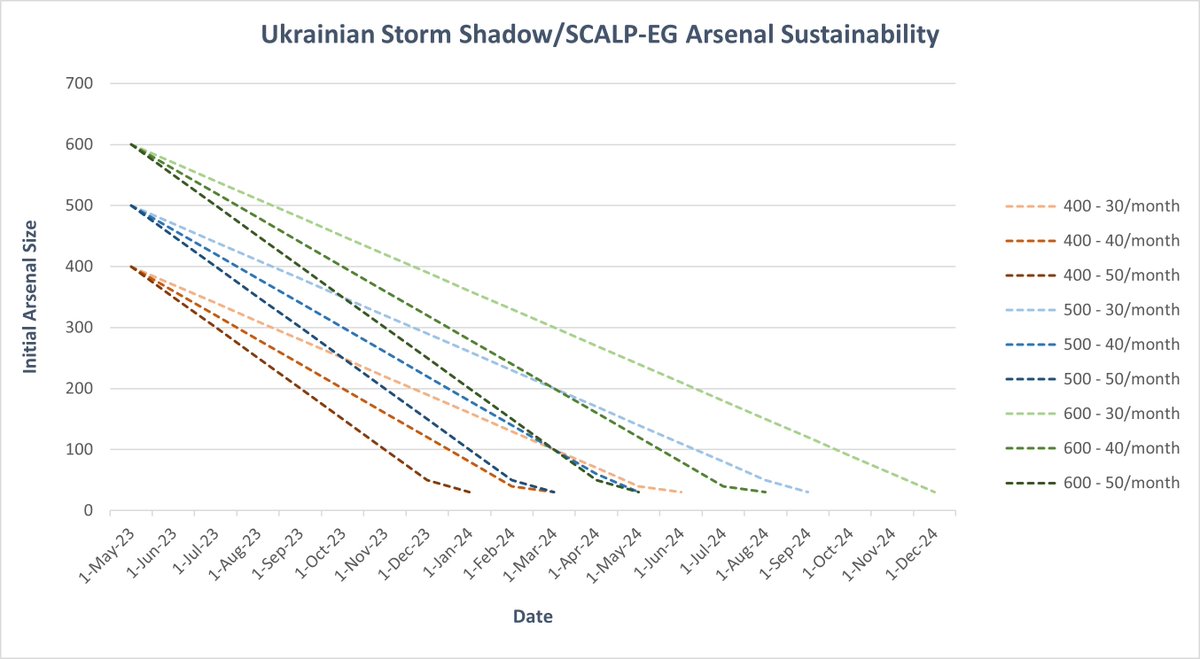
Being able to strike critical targets from ballistic (ATACMS) and ground-skimming (JASSM) attack vectors will significantly complicate Russian missile defense efforts, and facilitate Ukrainian efforts at overwhelming Russian integrated air and missile defense.
11/15
11/15
This is important because current ATACMS usage is high. Although this may not be unsustainable in the short term, relying on salvo attacks to penetrate Russian missile defense reduces the efficiency of Ukrainian long-range strikes using ATACMS.
JASSM can help with that.
12/15
JASSM can help with that.
12/15

It will force Russia to position missile defense systems for air-breathing, low-flying threats alongside those for high-altitude ballistic missile targets.
In any case, if JASSM is delivered, I expect to see an increase in reported S-300/S-400 attrition events.
12/15
In any case, if JASSM is delivered, I expect to see an increase in reported S-300/S-400 attrition events.
12/15

JASSM would, of course, also be useful to take out a range of operational-level targets inside Ukraine, such as supply depots and logistics facilities.
The expected utility of JASSM would strongly increase if Ukraine were permitted to use them within Russia.
13/15
The expected utility of JASSM would strongly increase if Ukraine were permitted to use them within Russia.
13/15
Considering the demonstrated challenges the Russians faced in countering Storm Shadow/SCALP-EG and the highly survivable design of JASSM, I anticipate high initial effectiveness.
But in part, this will also depend on the extent of Ukraine's access to U.S. targeting data.
14/15
But in part, this will also depend on the extent of Ukraine's access to U.S. targeting data.
14/15
Receiving the AGM-158A JASSM would enhance Ukraine's long-range strike capabilities.
As for Germany, I don't anticipate delivery of JASSM to influence their stance on delivering Taurus. As long as the current government remains in power, Taurus will remain in Germany.
15/15
As for Germany, I don't anticipate delivery of JASSM to influence their stance on delivering Taurus. As long as the current government remains in power, Taurus will remain in Germany.
15/15
This thread was fairly surface level. I highly encourage you to follow @John_A_Ridge, @ColbyBadhwar, and @ThrustWR who I'm sure will post more detailed analysis in the future, especially if and when JASSM is confirmed.
• • •
Missing some Tweet in this thread? You can try to
force a refresh