🥩Steaking a Claim: Is Haem Iron the Hidden Culprit in Diabetes?
🧵1/5) A new study asserts “Here we show that haem iron intake but not non-haem iron is associated with a higher T2D risk.”
It concludes, “These findings have important public health implications in shaping guidelines to prevent diabetes by limiting the daily consumption of foods rich in haem iron, particularly red meat.”
Methods
The primary analysis was conducted on 204,615 participants from the Nurses’ Health Study (NHS), Nurses’ Health Study II (NHS2) and the Health Professionals Follow-up Study (HPFS).
The researchers quantified associations between total, haem, and non-haem iron and T2D risk & between iron intake and established metabolic biomarkers.
High-level Questions to Consider
👉 Are there confounders? What are they?
👉 What are the metabolic associations and how can we use these to filter these data for relevance at the individual level?
👉 Is the AI cover image for this 🧵 fun or garish? 😂
🧵1/5) A new study asserts “Here we show that haem iron intake but not non-haem iron is associated with a higher T2D risk.”
It concludes, “These findings have important public health implications in shaping guidelines to prevent diabetes by limiting the daily consumption of foods rich in haem iron, particularly red meat.”
Methods
The primary analysis was conducted on 204,615 participants from the Nurses’ Health Study (NHS), Nurses’ Health Study II (NHS2) and the Health Professionals Follow-up Study (HPFS).
The researchers quantified associations between total, haem, and non-haem iron and T2D risk & between iron intake and established metabolic biomarkers.
High-level Questions to Consider
👉 Are there confounders? What are they?
👉 What are the metabolic associations and how can we use these to filter these data for relevance at the individual level?
👉 Is the AI cover image for this 🧵 fun or garish? 😂

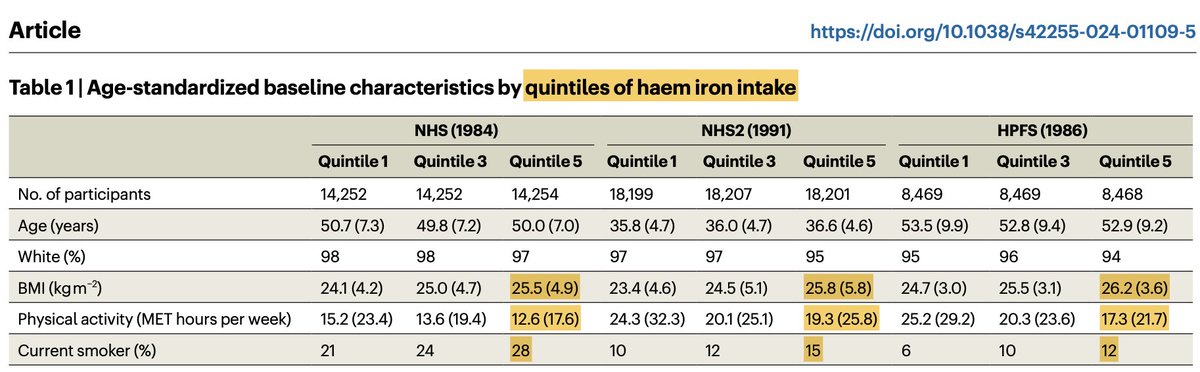
2/5) Basic Confounders
Participants with greater haem iron intake were generally less physically active, more likely to smoke and had at least trending higher BMI.
Furthermore, haem iron intake was positively correlated with a Western style-diet, which includes more “sweets and desserts, french fries, and refined grains,” here quoting from reference 31 where Western diet score is characterized.
To their credit, the authors of the current paper note that the association between dietary patterns and T2D risk could “also be partly due to… high added sugar in the Western diet…” seems plausible...
Participants with greater haem iron intake were generally less physically active, more likely to smoke and had at least trending higher BMI.
Furthermore, haem iron intake was positively correlated with a Western style-diet, which includes more “sweets and desserts, french fries, and refined grains,” here quoting from reference 31 where Western diet score is characterized.
To their credit, the authors of the current paper note that the association between dietary patterns and T2D risk could “also be partly due to… high added sugar in the Western diet…” seems plausible...
3/5) Metabolomics
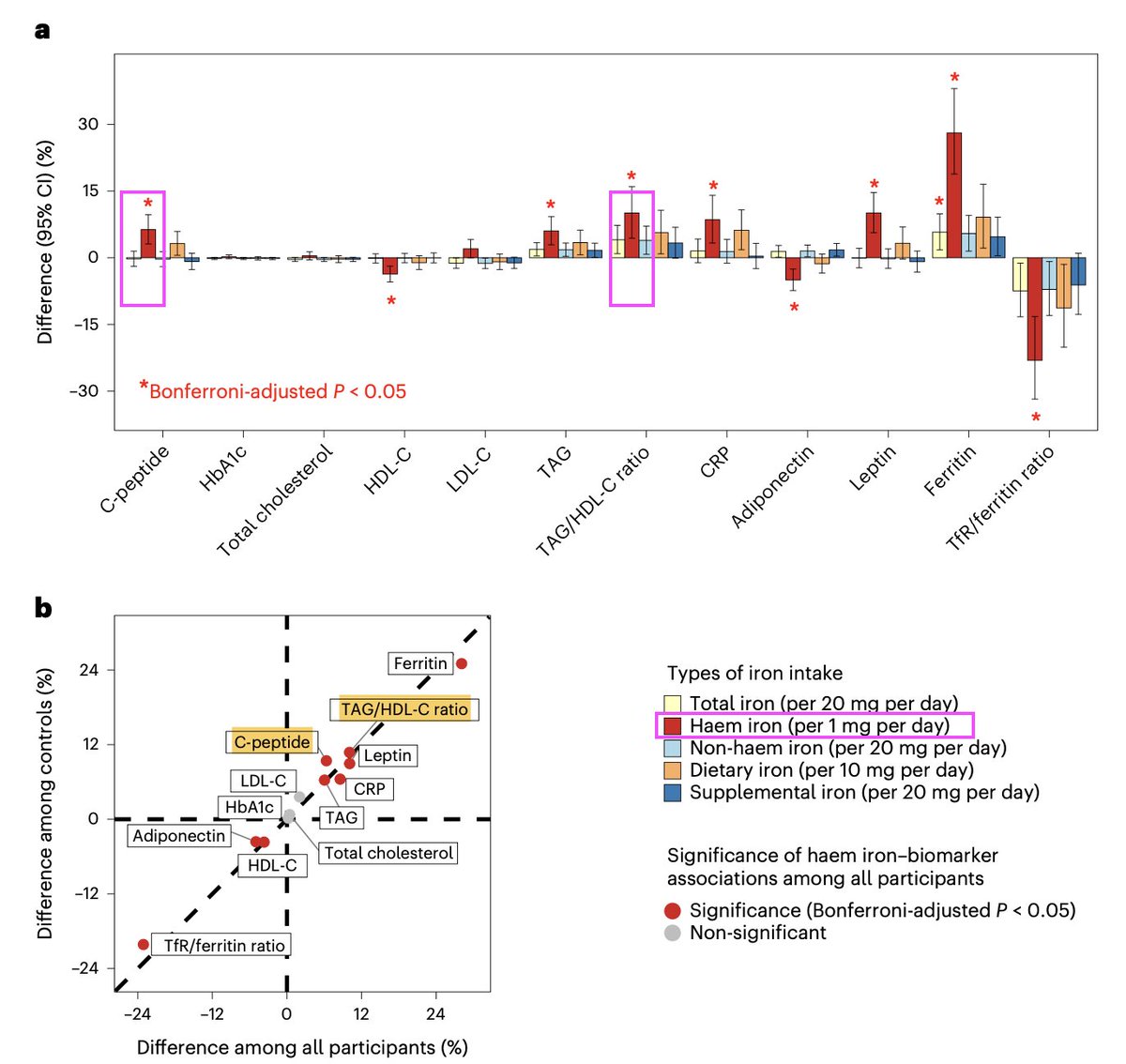
Among the most prominent metabolomic findings were that C-peptide (a marker of insulin release), and TG/HDL-C ratio were higher with more haem iron intake.
Given this correlation, and the fact that whatever underlying metabolic dysfunction contributes to T2D risk also likely manifests in worse markers of metabolic health (e.g. high C-peptide/insulin/insulin resistance, high TG and low HDL-C), I’d suggest that if one’s metabolic markers are ‘optimized’ these data have little relevance on the individual level.
🚨The beautiful thing about metabolic health science is that the proof is in the pudding (the markers, both metabolomic and functional).
So, if a study says X-containing food is associated with Y “bad” markers and Z “bad” outcome, but you eat a lot of X-containing food, and your markers are excellent… well… the conclusion should be obvious.
No a double standard please... Of course, this cuts both ways, and I’d never criticize someone for abstaining from red meat or eggs or any food if they are themselves doing well. To each their own. Humans are heterogenous.
Among the most prominent metabolomic findings were that C-peptide (a marker of insulin release), and TG/HDL-C ratio were higher with more haem iron intake.
Given this correlation, and the fact that whatever underlying metabolic dysfunction contributes to T2D risk also likely manifests in worse markers of metabolic health (e.g. high C-peptide/insulin/insulin resistance, high TG and low HDL-C), I’d suggest that if one’s metabolic markers are ‘optimized’ these data have little relevance on the individual level.
🚨The beautiful thing about metabolic health science is that the proof is in the pudding (the markers, both metabolomic and functional).
So, if a study says X-containing food is associated with Y “bad” markers and Z “bad” outcome, but you eat a lot of X-containing food, and your markers are excellent… well… the conclusion should be obvious.
No a double standard please... Of course, this cuts both ways, and I’d never criticize someone for abstaining from red meat or eggs or any food if they are themselves doing well. To each their own. Humans are heterogenous.
4/5) Biological Plausibility
For these associational studies, I always go looking for biological plausibility arguments.
The steelman case made in the discussion was “haem iron, acting as a potent pro-oxidant, could exacerbate the accumulation of reactive oxygen species, promoting oxidative damage and inflammation—key factors in the diabetes pathophysiology” and that “[Our data] suggest the involvement of insulin resistance [and] inflammation.”
I don’t discount this and, in general, have an open mind to the possibility that high levels of haem iron intake, particularly in a Western diet context, could increase risk of T2D by promoting oxidative stress and inflammation.
That’s certainly possible.
However, given the humble size of the association in this study (OR 1.26) and significant confounders noted above, I’m inclined to be less concerned about the steak than I am about the “sweets and desserts, french fries, and refined grains” and smoking.
For these associational studies, I always go looking for biological plausibility arguments.
The steelman case made in the discussion was “haem iron, acting as a potent pro-oxidant, could exacerbate the accumulation of reactive oxygen species, promoting oxidative damage and inflammation—key factors in the diabetes pathophysiology” and that “[Our data] suggest the involvement of insulin resistance [and] inflammation.”
I don’t discount this and, in general, have an open mind to the possibility that high levels of haem iron intake, particularly in a Western diet context, could increase risk of T2D by promoting oxidative stress and inflammation.
That’s certainly possible.
However, given the humble size of the association in this study (OR 1.26) and significant confounders noted above, I’m inclined to be less concerned about the steak than I am about the “sweets and desserts, french fries, and refined grains” and smoking.
5/5) Concluding thoughts
These associational data are interesting and fine for hypothesis generation.
However, there are confounders and “statical adjustments and modeling” may not be sufficient to account for these entirely.
One can choose to limit haem iron containing foods if they so choose. However, high sugar intake, obesity, a Western-style diet rich in refined carbohydrates, and a sedentary lifestyle are all much larger risk factors than eating steak.
I'd also be interested in the opinions of Professor @AdrianSotoMota, particularly where statistical adjustments are concerned. Typically, I take these with a grain (or shaker) of salt when the confounders have a potentially large impact and the reported "statistically significant" effect is small.
Wang et al. Integration of epidemiological and blood biomarker analysis links haem iron intake to increased type 2 diabetes risk. Nature Metabolism. 2024.
And I couldn't drop this thread without a Ron Swanson GIF... so here you go :)
These associational data are interesting and fine for hypothesis generation.
However, there are confounders and “statical adjustments and modeling” may not be sufficient to account for these entirely.
One can choose to limit haem iron containing foods if they so choose. However, high sugar intake, obesity, a Western-style diet rich in refined carbohydrates, and a sedentary lifestyle are all much larger risk factors than eating steak.
I'd also be interested in the opinions of Professor @AdrianSotoMota, particularly where statistical adjustments are concerned. Typically, I take these with a grain (or shaker) of salt when the confounders have a potentially large impact and the reported "statistically significant" effect is small.
Wang et al. Integration of epidemiological and blood biomarker analysis links haem iron intake to increased type 2 diabetes risk. Nature Metabolism. 2024.
And I couldn't drop this thread without a Ron Swanson GIF... so here you go :)
• • •
Missing some Tweet in this thread? You can try to
force a refresh