Ryan Hisner Profile picture
Sep 1 6 tweets 2 min read Read on X
Lots of talk about the XEC variant lately. It's a fast variant, but I want to emphasize two things.

First, I don't think XEC is much faster than the dominant KP.3.1.1. Germany is the only country w/enough seqs for a reliable growth estimate & it's pretty modest & uncertain. 1/6 Image
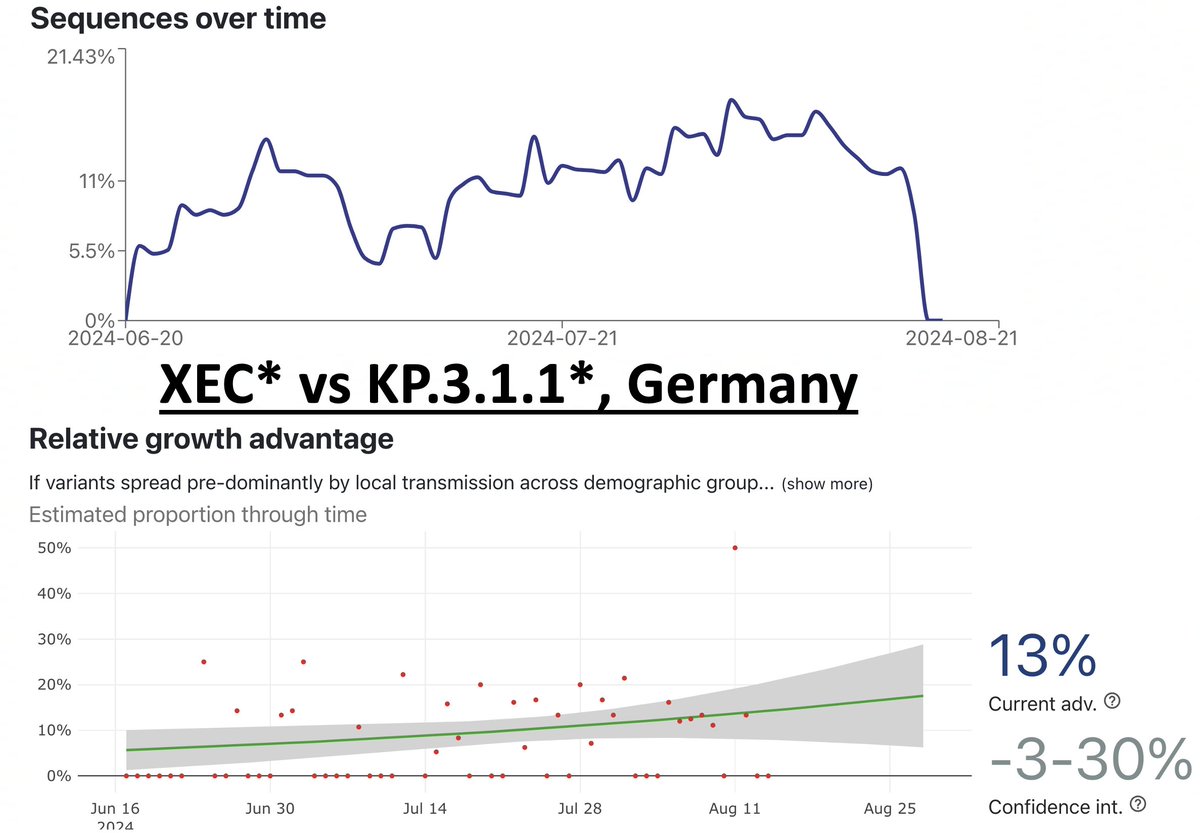
A variant w/such a small growth advantage (assuming it's accurate) takes months to grow to dominance. And such modest advantages do not result in any noticeable change in case levels, so I don't expect XEC to have any real impact. By the time it would become dominant... 2/6
...it's almost certain that some other, more dramatic evolutionary event will have taken place, whether that be another chronic-infection-derived saltation variant or simply further stepwise spike mutations on top of current variants. 3/6
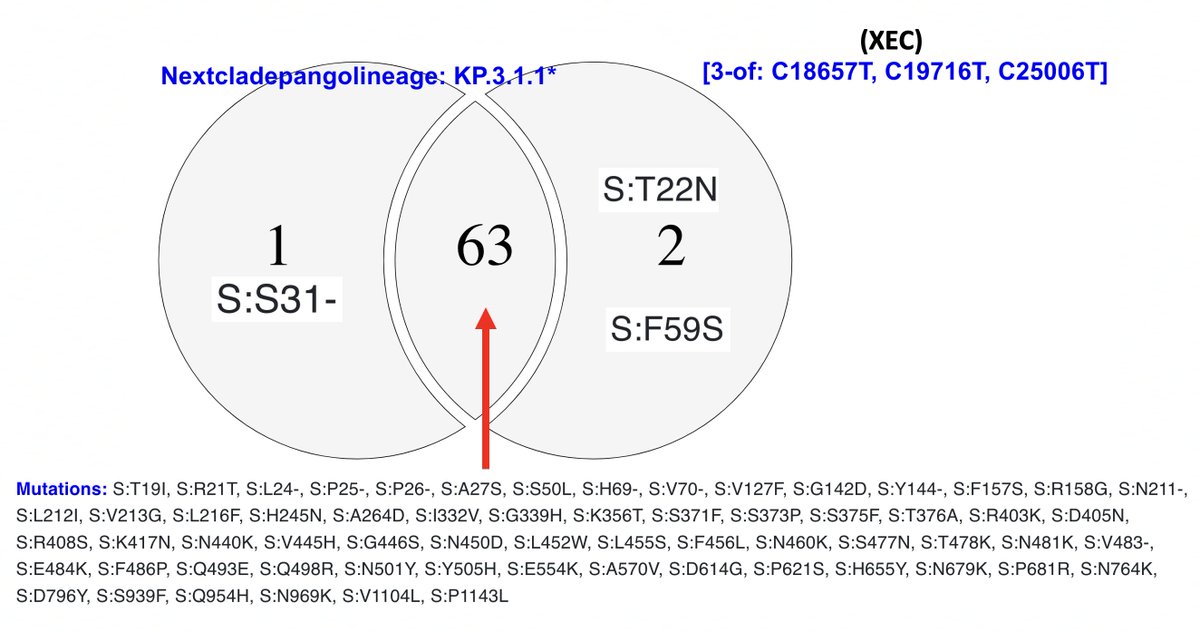
2nd important point: XEC's spike is nearly identical to KP.3.1.1's spike, so there's no real concern about immune escape here.
There are only 2 differences:
#1. KP.3.1.1 has ∆S31 & XEC has T22N. But both introduce glycans & have near identical effects on growth. 4/6 Image
#2. XEC has F59S, which KP.3.1.1 lacks. This is the most likely source of XEC's slight growth advantage over KP.3.1.1, but it's not in an antigenically important region & has never been a major factor in any previous variant.

Meanwhile, they share 63 AA spike mutations.
5/6 Image
In summary, I see XEC as a notable and important variant but not one likely to have a major real-world impact. Others feel differently, and I could be wrong. We probably won't know for several weeks yet. 6/6

• • •

Missing some Tweet in this thread? You can try to force a refresh

 

Keep Current with Ryan Hisner

Ryan Hisner Profile picture

Stay in touch and get notified when new unrolls are available from this author!

Read all threads

This Thread may be Removed Anytime!

PDF

Twitter may remove this content at anytime! Save it as PDF for later use!

Try unrolling a thread yourself!

how to unroll video
  1. Follow @ThreadReaderApp to mention us!

  2. From a Twitter thread mention us with a keyword "unroll"
@threadreaderapp unroll

Practice here first or read more on our help page!

More from @LongDesertTrain

Jul 17
KP.3, w/the unusual Q493E mutation, now dominant globally. To me, it's the first major spike change—involving real structural/epistatic change as opposed to treadmilling, stepwise antibody-evasion mutations merely keeping pace w/population immunity—since JN.1 emerged. 1/23
Most spike mutations affect ACE2 binding similarly in BA.2, XBB.1.5, & JN.1—e.g., Y453F confers a large incr in ACE2 affinity in all—so the XBB.1.5 deep mutational scanning info from @bdadonaite & @jbloom_lab is still invaluable. But Q493E is different. 2/
In both XBB.1.5 and BA.2 spike backgrounds, Q493E imposes a devastating hit to ACE2 affinity—so large that no variant with it could survive & circulate.
Data below from:
Bloom Lab XBB.1.5 DMS -
BA.2 RBD heat map - 3/ dms-vep.org/SARS-CoV-2_XBB…
jbloomlab.github.io/SARS-CoV-2-RBD…
Image
Read 25 tweets
Jul 3
AI is a disaster for journalism. Here are a two examples of AI hallucinations on the FLiRT variants of JN.1, which are named after spike mutations F456L & R346T.

This one from @NewstalkFM says FLiRT stands for "F-Type Recombinant Lineage," a term invented from whole cloth. 1/3
When I Googled that name, a clear AI hallucination dutifully copied & pasted by "journalists," I accidentally stumbled on another.

This one, from the Manchester Evening News via Yahoo News, says FLiRT stands for "Fresh Lineage of Rapid Transmission." 2/3 Image
How many other things that we read from such "news organizations"—better described as transcribers of ChatGPT word vomit—are AI hallucinations?

We need publicly funded journalism, yesterday. See one proposal from @DeanBaker13 described below. 3/3 thenation.com/article/societ…
Read 4 tweets
Jun 29
@suprion_verlag @dfocosi @yunlong_cao @RajlabN @BenjMurrell @SystemsVirology @SimonLoriereLab @EricTopol @TRyanGregory @tylernstarr @JPWeiland @siamosolocani @CorneliusRoemer The basic pattern has been that we occasionally see huge evolutionary jumps with no intermediate sequences (BA.1, BA.2, BA.5, BJ.1/XBB, BA.2.3.20, BA.2.86, & many others), which in reality evolved stepwise within a single, chronically infected individual.
@suprion_verlag @dfocosi @yunlong_cao @RajlabN @BenjMurrell @SystemsVirology @SimonLoriereLab @EricTopol @TRyanGregory @tylernstarr @JPWeiland @siamosolocani @CorneliusRoemer Then, after such a variant begins circulating, it begins to pick up mutations, primarily in the spike protein, which evade antibodies that are widespread in the population. The specific mutations vary somewhat with each new variant, but there's a lot of common ground as well...
@suprion_verlag @dfocosi @yunlong_cao @RajlabN @BenjMurrell @SystemsVirology @SimonLoriereLab @EricTopol @TRyanGregory @tylernstarr @JPWeiland @siamosolocani @CorneliusRoemer R346T, for example, has been acquired again and again. Various mutations at E484 and F486 have been common as well, and there are many others that could be mentioned. In some cases, these mutations seem to have arrived at a quasi-endpoint (for now)—∆Y144 or F486P, for example.
Read 5 tweets
Jun 18
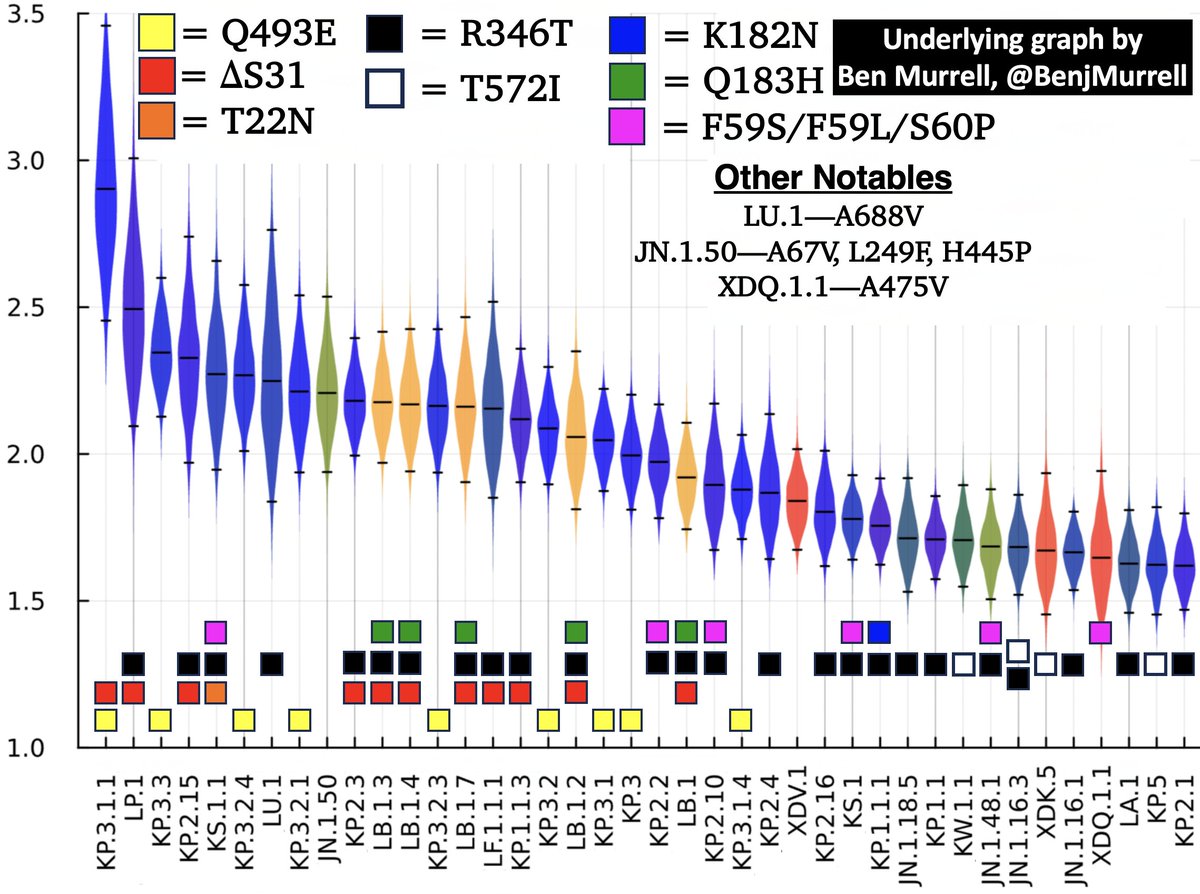
. @BenjMurrell is doing the best variant growth modeling in the world, & his latest results confirm most of what we've thought: KP.3 is the fastest large variant, & its sublineage KP.3.1.1—w/the highly advantageous, glycan-creating S:∆S31—is easily the fastest in the world. 1/15
It can be a difficult to decipher the meaning of these graphs if you don't have an encyclopedic knowledge of the latest variants—which I think only @siamosolocani possesses—so I tried to add some context to Ben's graph, which I'll explain below. 2/15 Image
I divide key mutations into 4 categories, from most to least impactful, IMO.

#1. Q493E (KP.3 exclusive), F456L (~universal)
#2. T22N, ∆S31 (glycan-adding)
#3. R346T, T572I
#4. F59S/L, S60P, K182N, Q183H

Lowest row of boxes on the graph is group #1, above it #2, & so on. 3/15 Image
Read 16 tweets
May 8
KP.3 (w/the rare Q493E) has been my pick since I first noticed it emerging from numerous travel seqs from India. F456L & R346T are the typical stepwise immune-evasion mutations that, as @shay_fleishon noted, very likely impose a fitness cost. Q493E may be different. 1/
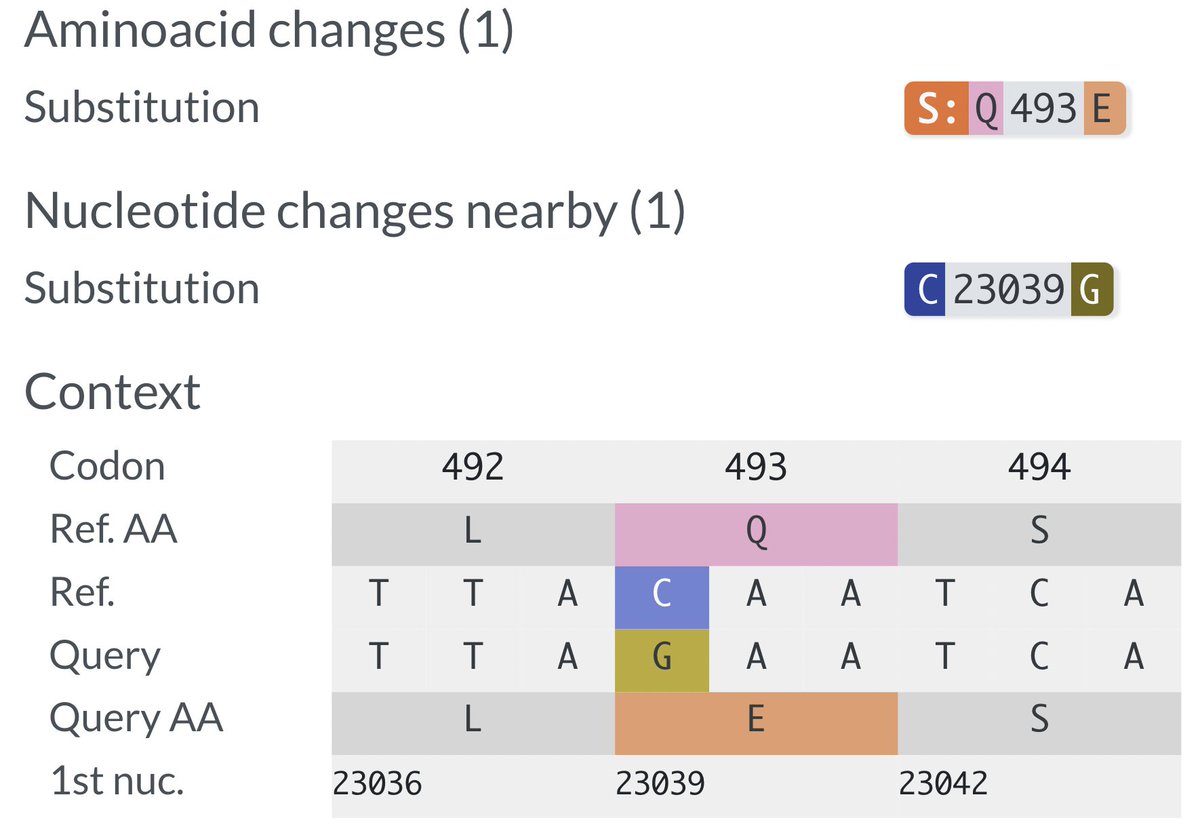
Q493E involves the rarest of all nucleotide mutations, C->G, and occurs at a key residue that we've seen very little action from of late. 493 mutations, however, are common in the Cryptics, usually Q493K I believe. (@SolidEvidence can correct me if I'm wrong on that). 2/8 Image
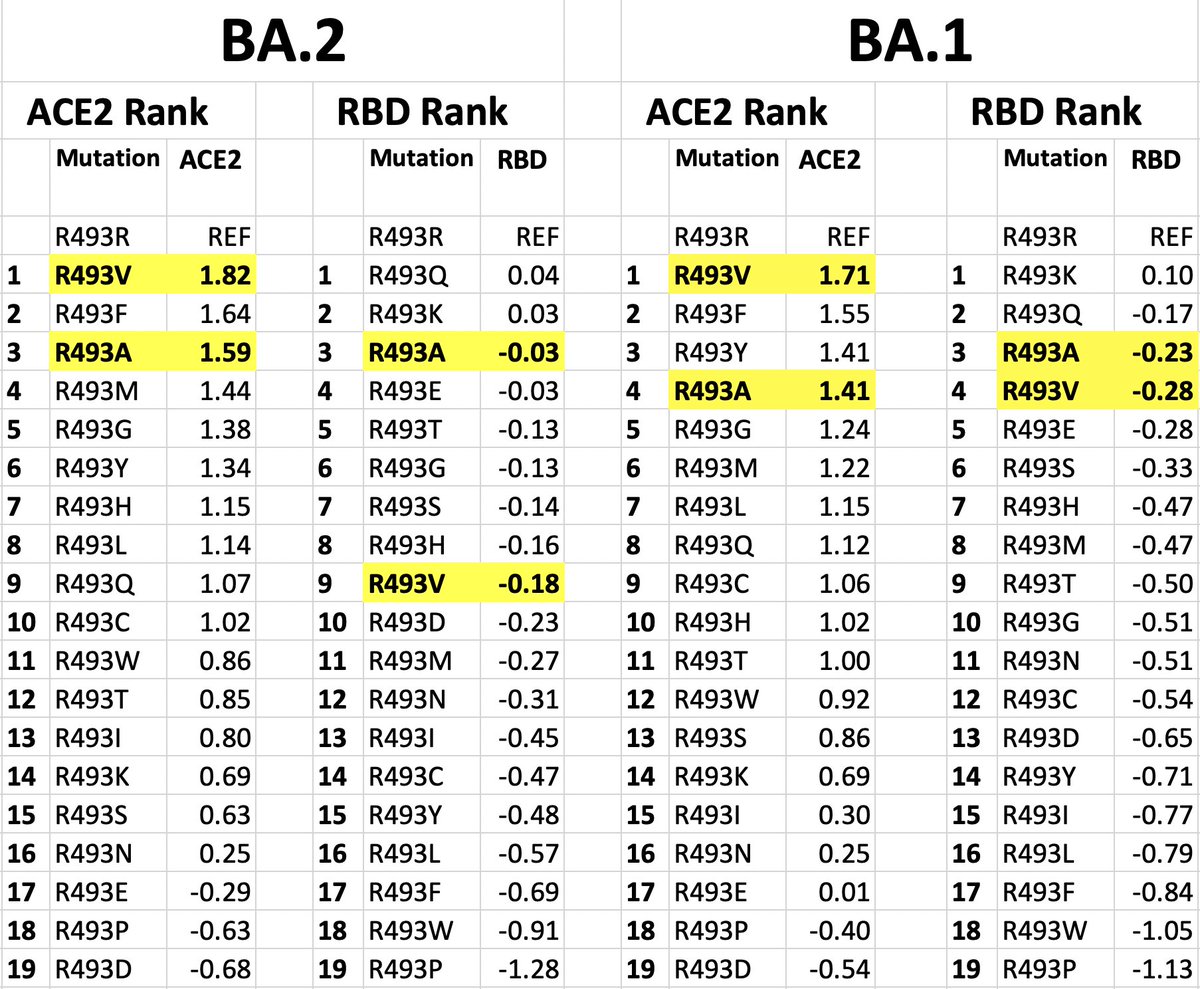
493 is also one of the few residues where mutations—on BA.1/BA.2 backgrounds—can confer large increases in ACE2 affinity—see @jbloom_lab data below. The 2-nuc Q493A & Q493V appeared in a handful of remarkable chronic-infection seqs, for example. 3/8 Image
Read 8 tweets
May 1
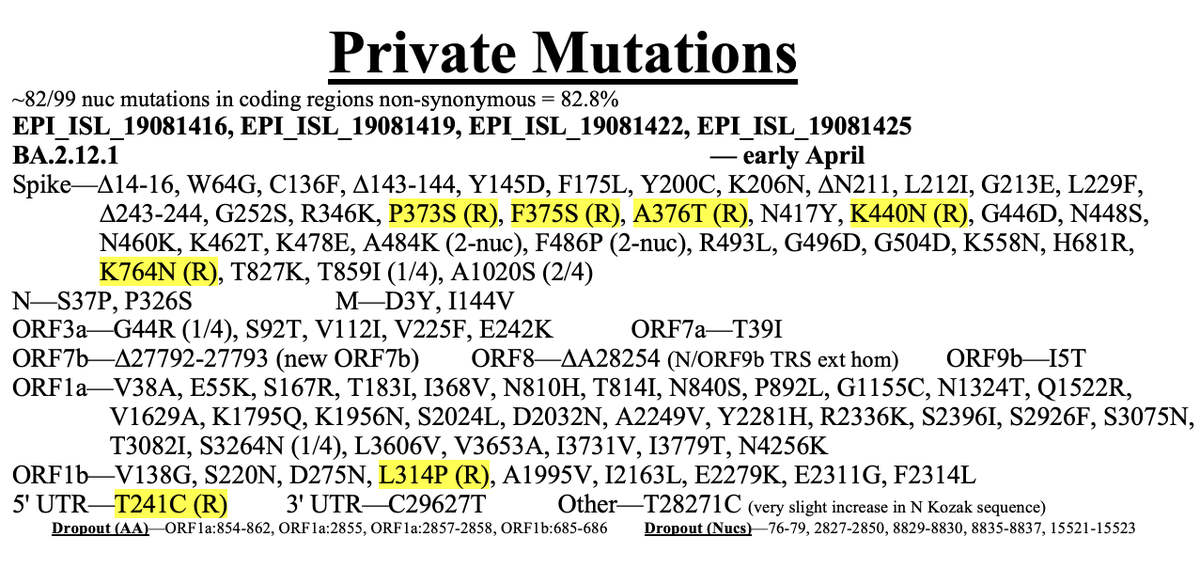
We have a new record for mutations in a non-molnupiravir sequence. It's a BA.2.12.1 with >100 private mutations. There are 4 seqs from early April, all from the same patient. I'll discuss four interesting features it has in this 🧵. 1/23 Image
#1) Reversions
Reversions are extremely rare. They almost never appear in circulating lineages. There are, however, a large number of reversions that are convergent in chronic-infection sequences. This one has more than usual. 2/23 Image
Let's start with my favorite.
• ORF1b:L314P (NSP12_L323P)
The extraordinarily rare yet hugely significant ORF1b:L314P reversion is an enigma. ORF1b:P314L was one of the very first SARS-CoV-2 mutations. It quickly dominated & has been universal ever since. 3/23
Read 23 tweets

Did Thread Reader help you today?

Support us! We are indie developers!


This site is made by just two indie developers on a laptop doing marketing, support and development! Read more about the story.

Become a Premium Member ($3/month or $30/year) and get exclusive features!

Become Premium

Don't want to be a Premium member but still want to support us?

Make a small donation by buying us coffee ($5) or help with server cost ($10)

Donate via Paypal

Or Donate anonymously using crypto!

Ethereum

0xfe58350B80634f60Fa6Dc149a72b4DFbc17D341E copy

Bitcoin

3ATGMxNzCUFzxpMCHL5sWSt4DVtS8UqXpi copy

Thank you for your support!

Follow Us!

:(