Dangerous garbage being presented “science writing”. Two *actual* facts surrounding #COVID infection: 1. Your risk of #LongCOVID, a currently incurable chronic illness, after surviving an acute COVID infection currently sits conservatively at ~6-7% 2. Your risk of LC increases 1/
Now, in the face of this information, there are really five (or so) types of reactions: 1. Disbelief and denial 2. Being unaware or uninformed of the risk 3. Believing appropriate caution is necessary to avoid Long COVID 4. Believing it is worth the risk 2/
to yourself AND OTHERS to live your best pre-COVID life 5. Not having the financial freedom to not risk yourself and others by not taking precautions
Regardless of which of these 5 lanes you live in, won’t change the first two FACTS. So, as a person of questionable influence, 3/
let me remind you: #LongCOVID is life-changing and incurable. LongCOVID is caused by #COVID. We still have no way of predicting who will emerge unscathed from a COVID infection. The only way to avoid getting LongCOVID is to not get COVID. Let me also remind you that while 4/
@ClareWilsonMed ridicules people “putting sticks up their nose” if you should, god forbid, get #LongCOVID and you don’t have evidence of infection, things get harder for you to access good care. They shouldn’t, but they do. So since the “science writer” who penned this opinion 5/
didn’t lay it all out honestly in favor of publishing a bit of clickbait that hurts public health, next time you hear drivel like this, think about the 5 lanes of people and which lane you want to be in. Think about the fact that those minimizing COVID have been minimizing it 6/
since 2020 and have been consistently wrong since 2020. Magical thinking doesn’t make you safe and speaking realistically and quantitatively about risk stratification doesn’t make you a fearmonger. Writing junk like this DOES make you dangerous. Grow up, Clare.
/end
• • •
Missing some Tweet in this thread? You can try to
force a refresh

A thread today about Immunoglobulin G (IgG) antibodies to various pathogens and why they seem to be elevated a lot in people with #LongCOVID, #MECFS, chronic #lyme/tick- and vector-borne illnesses and other complex chronic illnesses. First, let's start basic: what is IgG?
1/
A good way to think of it is that when your body encounters a virus or bacteria, it learns how to fight it and then writes down the instructions and stores it. Those stored written instructions are IgG antibodies. They stick around in your bloodstream for years, sometimes
2/
for life, so that if the same invader shows up again, your immune system can recognize the pathogen and mount a highly targeted attack that takes out the pathogen much faster than the first time. Pretty cool. So, all of us have IgG antibodies for various viruses and pathogens
3/
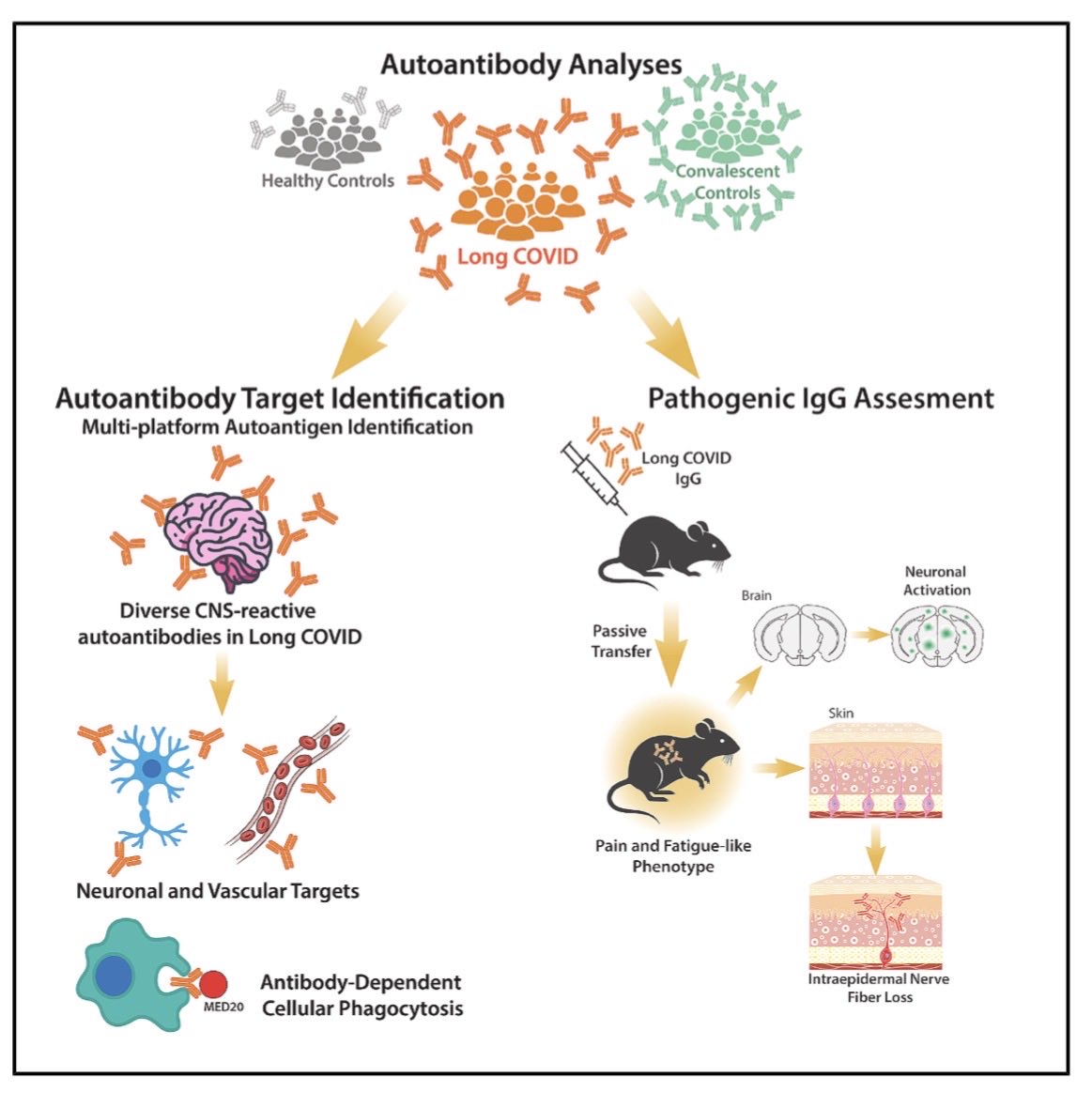
Wonderful day for a new #LongCOVID paper! Thanks to an incredible collaboration with @VirusesImmunity and brilliant work done by @keylas3, we studied the effects of injecting antibodies taken from people with LC into mice compared with what happened
when we injected antibodies taken from people who had fully recovered from COVID or never had COVID. This sort of experiment is called a “passive transfer” experiment and the results we saw were extremely interesting. First, when the antibodies were exposed to tissue samples 2/
in a dish, the LC antibodies frequently created reactivity in the tissue that was not seen in the control samples. Second, when the animals were transferred autoantibodies from people with #LongCOVID, they got sick! The most prominent effect was seeing pain behaviors emerge in
3/
We have known for a while that #LongCOVID pathobiology for many involves reactivation of various herpesviruses. As we continue to validate this it is great to see this work coming out in collaboration with @VirusesImmunity’s incredible team. Here we
show that DNA levels of HHV6, a very common form of herpesvirus that infects most people in early childhood, were found in the saliva of people with #LongCOVID. Furthermore, we saw that these DNA levels were positively associated with overall LC symptom burden. Meaning, the
2/
worse the #LongCOVID symptoms in a trial participant, the more HHV6 DNA we found in their saliva. There’s a lot to be thoughtful about on this paper: is HHV6 reactivating and causing symptoms? Or is salivary HHV6 DNA the “canary in the coal mine” for immune deregulation caused
3/
Excited to work with @Invivyd to get this out. One of the most common questions I get from people in the #LongCOVID community are about vaccination alternatives. People still want to protect themselves from SARS-CoV-2 infection but many experience
1/medrxiv.org/content/10.648…
systemic adverse effects from vaccination. This is an inconvenient fact of vaccination that leads to many feeling gaslit and unable to protect themselves. Our goal is always to provide people with as many tools as possible so that they always have an array of choices when
2/
it comes to managing their own healthcare. That's why this pre-print is particularly important to me: it shows that monoclonal antibodies designed to prevent SARS-CoV-2 infection demonstrated a SIGNIFICANT (>40x) lower numbers of systemic, treatment-emergent adverse events
3/
Excited to finally get this one out in @Nature_NPJ! In the largest study of its kind to date, we used data from the @visible_health platform to answer a simple question: can we predict symptom fluctuations and crashes from both the physiological and
patient-reported data? The answer to this question is yes. Not perfectly, but actually quite well. A few important takeaways: 1) Just as we have seen previously in people living with chronic pain, the ability to predict symptom flares and crashes in ppl with #LongCOVID,
2/
#MECFS and other complex chronic illnesses can represent a massive life upgrade. The ability to prepare for or expect a crash or a bad symptom day is preferable to many than these things just seemingly randomly appearing with no warning. 2) The fact that physiological signal
3/
I want to thank everyone for the interest in this work that we completed in a #LongCOVID cohort with this novel device. I always appreciate feedback and want to thank folks for holding me accountable to a high standard of communication. To that end, I want to re-clarify this 1/
thread: this was a safety/feasibility trial which means that our primary endpoints were related to safety and feasibility. In the paper, we state clearly that we hit those endpoints: no device-related adverse events and 100% adherence to the protocol in all participants. That
2/
is great for a safety/feasibility trial. I then went on to express excitement that some cognitive scores moved. I understand that folks have (rightly) pointed out that without a larger sample size and correcting for multiple comparisons we can’t make definitive statements
3/