We're releasing a preview of OpenAI o1—a new series of AI models designed to spend more time thinking before they respond.
These models can reason through complex tasks and solve harder problems than previous models in science, coding, and math. openai.com/index/introduc…
Rolling out today in ChatGPT to all Plus and Team users, and in the API for developers on tier 5.
OpenAI o1 solves a complex logic puzzle.
OpenAI o1 thinks before it answers and can produce a long internal chain-of-thought before responding to the user.
o1 ranks in the 89th percentile on competitive programming questions, places among the top 500 students in the US in a qualifier for the USA Math Olympiad, and exceeds human PhD-level accuracy on a benchmark of physics, biology, and chemistry problems.
We’re starting to roll out advanced Voice Mode to a small group of ChatGPT Plus users. Advanced Voice Mode offers more natural, real-time conversations, allows you to interrupt anytime, and senses and responds to your emotions.
Users in this alpha will receive an email with instructions and a message in their mobile app. We'll continue to add more people on a rolling basis and plan for everyone on Plus to have access in the fall. As previously mentioned, video and screen sharing capabilities will launch at a later date.
Since we first demoed advanced Voice Mode, we’ve been working to reinforce the safety and quality of voice conversations as we prepare to bring this frontier technology to millions of people.
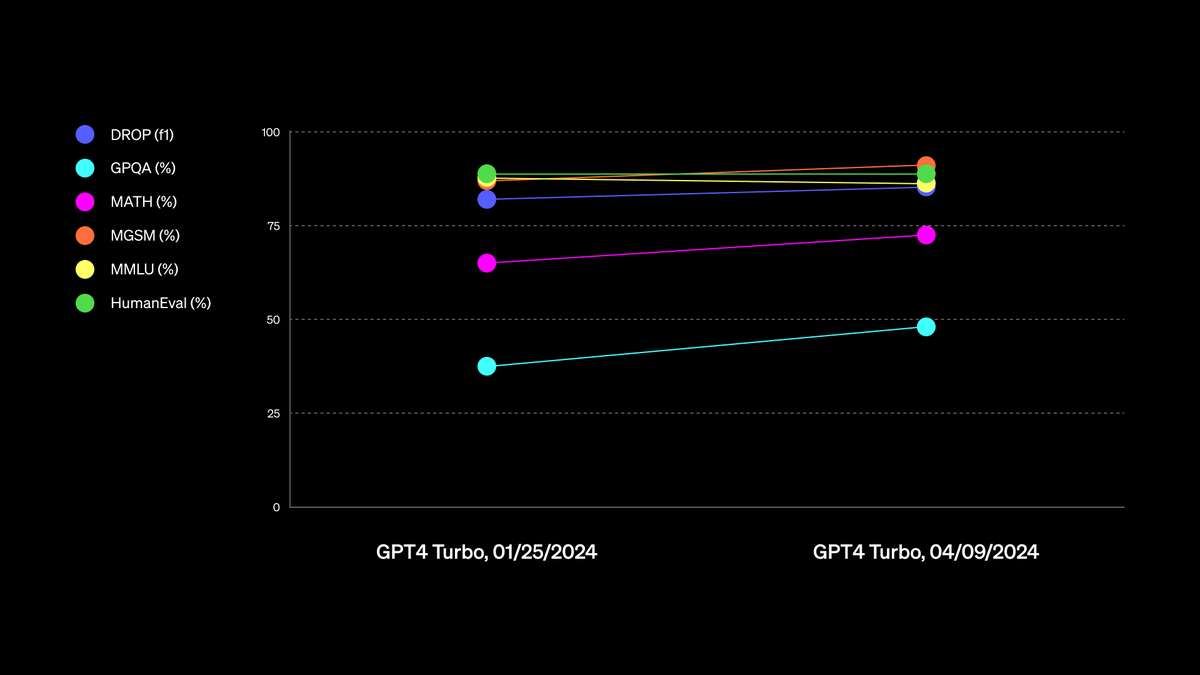
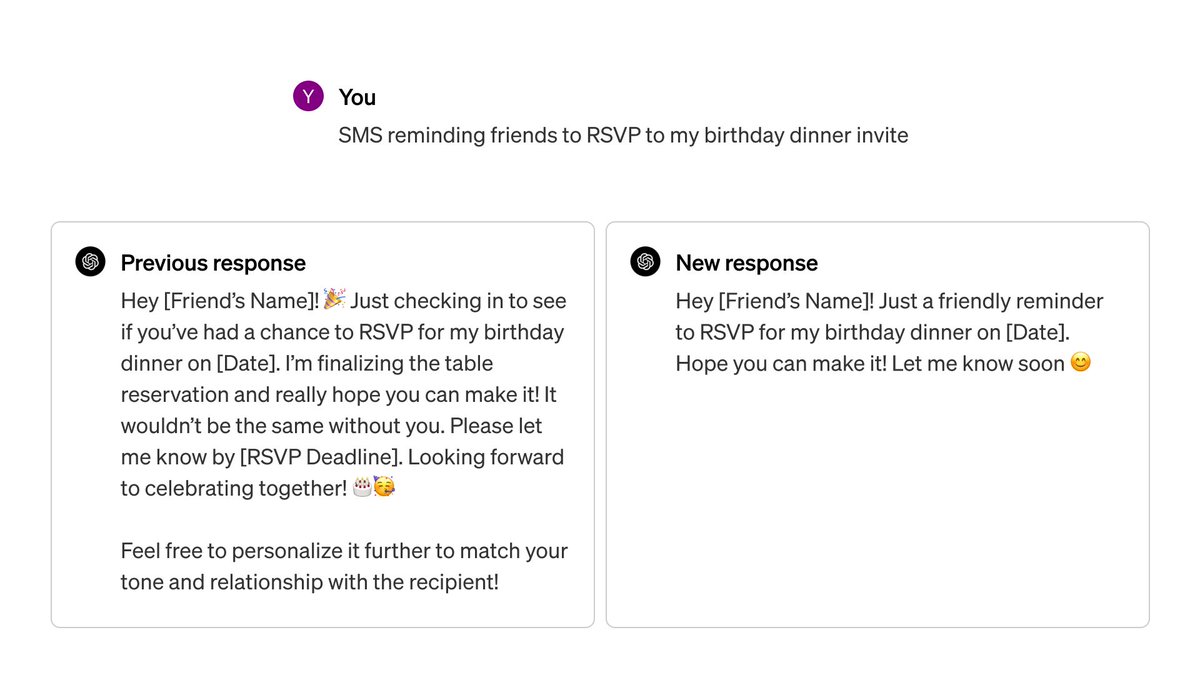
Our new GPT-4 Turbo is now available to paid ChatGPT users. We’ve improved capabilities in writing, math, logical reasoning, and coding.
Source: github.com/openai/simple-…
For example, when writing with ChatGPT, responses will be more direct, less verbose, and use more conversational language.
We continue to invest in making our models better and look forward to seeing what you do. If you haven’t tried it yet, GPT-4 Turbo is available in ChatGPT Plus, Team, Enterprise, and the API.
Sora can create videos of up to 60 seconds featuring highly detailed scenes, complex camera motion, and multiple characters with vibrant emotions.
Prompt: “Beautiful, snowy Tokyo city is bustling. The camera moves through the bustling city street, following several people enjoying the beautiful snowy weather and shopping at nearby stalls. Gorgeous sakura petals are flying through the wind along with snowflakes.”openai.com/sora
We’ll be taking several important safety steps ahead of making Sora available in OpenAI’s products.
We are working with red teamers — domain experts in areas like misinformation, hateful content, and bias — who are adversarially testing the model.
Prompt: “Several giant wooly mammoths approach treading through a snowy meadow, their long wooly fur lightly blows in the wind as they walk, snow covered trees and dramatic snow capped mountains in the distance, mid afternoon light with wispy clouds and a sun high in the distance creates a warm glow, the low camera view is stunning capturing the large furry mammal with beautiful photography, depth of field.”
We are systemizing our safety thinking with our Preparedness Framework, a living document (currently in beta) which details the technical and operational investments we are adopting to guide the safety of our frontier model development. openai.com/safety/prepare…
Our Preparedness Team will drive technical work, pushing the limits of our cutting edge models to run evaluations and closely monitor risks, including during training runs. Results will be synthesized in scorecards that track model risk.
Our new safety baselines and governance process will turn these technical findings into safety decisions for model development and deployment. This involves establishing a cross-functional Safety Advisory Group to make safety recommendations.
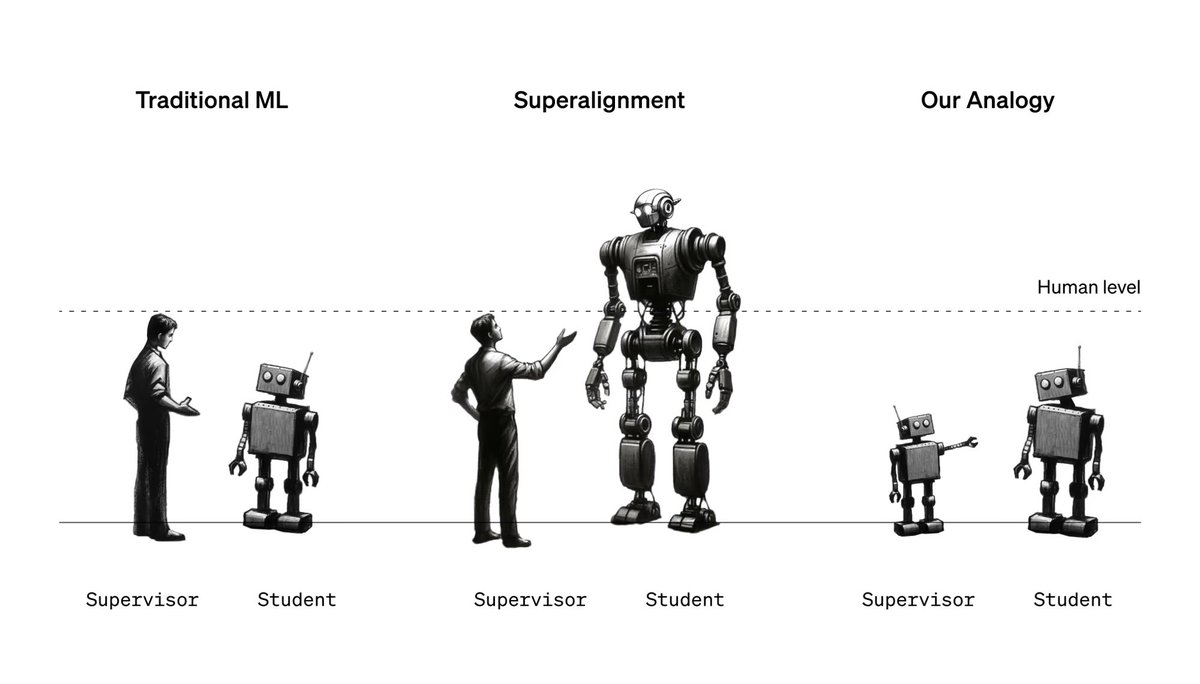
In the future, humans will need to supervise AI systems much smarter than them.
We study an analogy: small models supervising large models.
Read the Superalignment team's first paper showing progress on a new approach, weak-to-strong generalization: openai.com/research/weak-…
Large pretrained models have excellent raw capabilities—but can we elicit these fully with only weak supervision?
GPT-4 supervised by ~GPT-2 recovers performance close to GPT-3.5 supervised by humans—generalizing to solve even hard problems where the weak supervisor failed!
Naive weak supervision isn't enough—current techniques, like RLHF, won't be sufficient for future superhuman models.
But we also show that it's feasible to drastically improve weak-to-strong generalization—making iterative empirical progress on a core challenge of superalignment