Four days ago, a new PCPSR poll came out about Palestinian public opinion about the war and some surrounding questions. The results are dramatic; I'll touch some of the highlights here and will draw some conclusions. Here's the poll itself. /1 pcpsr.org/sites/default/…
Almost a year into the war, support for the Oct 7 attack is at a record low in the Gaza Strip: a mere 39%. Down from 59% in Dec and 71% in March. Recall that diplomatic pressure on Israel peaked around March-April. West Bankers are also sobering up, although much more slowly. /2
Perhaps needless to emphasize, but doesn't hurt to, that no moral reckoning took place in the Gazan population. 89% still believe that Hamas members didn't commit atrocities against Israeli civilians. Their enthusiasm for the massacre dropped because it backfired *at them*. /3
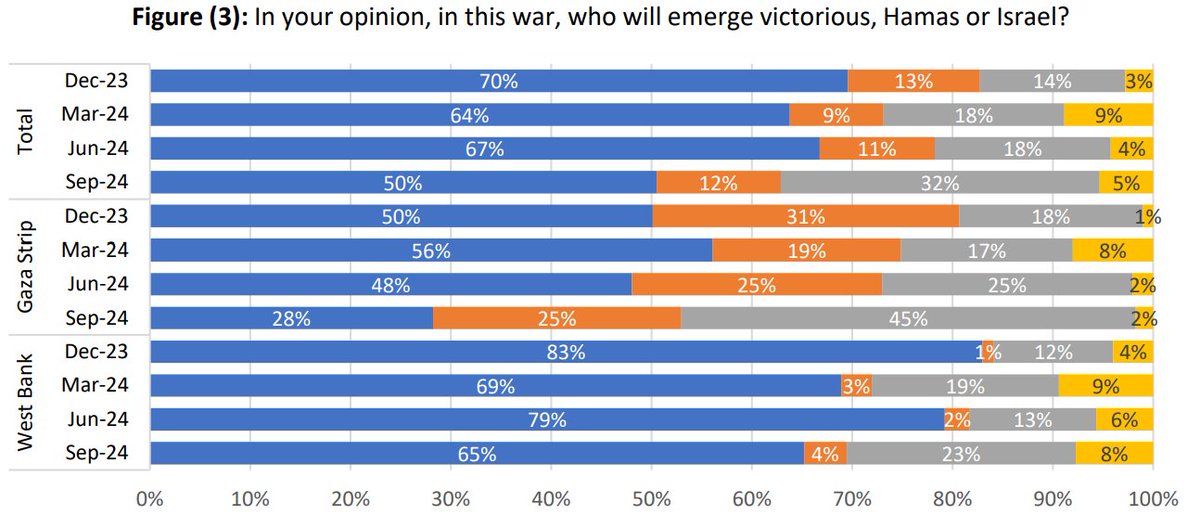
A record low share of Gazans, only 28%, believe now that Hamas will win the war (down from 56% in March and 48 in June). Almost the same share, 25%, believe that Israel will win the war. West Bankers are still optimistic (65%), though not as much as in the past. /4
Only 37% of Gazans believe that Hamas will be in power in the Gaza Strip after the war, down from 46% three months ago. An almost identical 36% said they'd prefer Hamas to rule the Strip (also down from 46%). Perhaps for the first time in history, Hamas is genuinely unpopular. /5
As we can see from the quoted passage, Hamas remains popular in the West Bank, where 73% want to see it stay in power and 70% expect it to after the war. Gazans have intense buyers' regret, while their brethren in the West keep cheering for the people who destroy their lives. /6
Sinwar is even less popular in the Gaza Strip: only 29% of Gazans have a positive view of him, although 70% of West Bankers do. I must say, the chasm between the West Bank and the Gaza Strip never ceases to amaze me. West Bankers show the attitudes of unempathetic diasporoids. /7
Interestingly, Iran and Hezbollah also dropped in popularity. They peaked in June, I presume after Iran's large drone and rocket attack on Israel, and it dropped again by September, probably due to Iran's lack of response to Haniye's assassination. Yemen is the most popular. /8
Election polls show similar results. The Sinwar/Haniye slate (I guess this was asked before the latter was assassinated) gets a record low of 26% in the Gaza Strip; a record high, 33%, say they wouldn't vote. However, in the West Bank Sinwar/Haniye are at a record *high*. /9
Support for the two-state solution rose modestly in both the Gaza Strip and the West Bank. In the Gaza Strip it's shown as higher only in March. I said when I wrote about this and I repeat it now: I think the March result of 62% was a polling error back then. /10
Support for armed struggle is at a record low in the Gaza Strip since the beginning of the war (36%), while support for negotiations is at a record high (40%). In the West Bank, public support for neither has changed much since the beginning of the war. /11
We can draw a few conclusions.
First: while Gazans displayed more dovish views than West Bankers since the outbreak of the war, the gap widened over the past few months and by now became dramatic. Not only materially, but mentally too, they now live in parallel realities. /12
There's something deeply ironic about this, since one of Hamas's goals was to unite the Palestinian people, including Israeli Arabs. This attempt utterly failed, especially when we also take Israeli Arabs into consideration (on which I touched here). /13
Second: I said this previously, but I think these polls are a great way to test rival hypotheses about Palestinian psychology. Does military pressure curb the appetite for violence, or does it just radicalize them? For each terrorist eliminated, do we create three more? /14
The answer is pretty clear: Israel's willingness to enter a long war, and its refusal to cave to diplomatic pressure, curbed rather than inflamed Palestinians' appetite for terrorism - *but only in the Gaza Strip, where they were directly affected by the military response*. /15
Palestinians in the West Bank are unfazed, as extreme as ever, and somewhat amazingly, the suffering of their close relatives in the Strip causes zero reflection in them. You would expect they are able to learn from the mistakes of Gazans, but apparently this is not the case. /16
To my mind, this means that an Intifada in the West Bank is almost unavoidable. West Bankers have been watching this war from the sidelines, saw what Gazans brought on themselves by bringing Hamas to power, and they thought: "this is great, we want to try the same thing". /17
I'll close by answering the rhetorical question so often posed by Western leftists: for each terrorist you kill, how many new ones do you create?
We can now give an empirically informed answer.
In the Gaza Strip, less than one.
In the West Bank, it makes no difference. /18-end
• • •
Missing some Tweet in this thread? You can try to
force a refresh

1./ Common fallacies in IR thought, or: how to avoid geopolitical gibberish.
Some thought patterns became so prevalent in geopolitics commentary that they bled into ordinary discourse. Yet these ideas are manifestly and obviously absurd, and they should seem absurd to anyone who wasn’t indoctrinated with geopolitics gibberish. In this thread, I’ll list a few common fallacies.
2./ The homeopathic fallacy (“the weaker, the stronger”; credit to @aryehazan): the more of your enemies you kill, and the more you destroy their fighting abilities, the stronger they become. This only applies to *them*, mind you; if *your* people die and your infrastructure is destroyed, you just get weaker. Homeopathy works only on third-world countries and terrorists, not on Israel and the West.
3./ The “no upper bound” fallacy: your enemies cannot be discouraged or demoralized. Any action whatsoever that you take against them will only make them more radical, more determined, more full of hate. Don’t count on this to help you, though: *your* morale absolutely can be broken. Only your enemy’s cannot. In fact, your enemy is incapable of sadness, desperation and hopelessness, and is only capable of rage, hate and ever greater resolve. No matter how much your enemy hates you, he can hate you even more. You think the Palestinians murdering 1200 people was bad? Just wait for how much they’ll hate you now, they won’t show such restraint the next time!
I agree with this post of Tamritz, but I'd like to elaborate on it. The war between US/Israel and Iran has a dynamic very similar to the dynamic of the war between Israel and Hamas between 2023 and 2025. I will go over this dynamic and will then also stick out my neck and make a cautious prediction about what I think we can expect over the coming weeks / months. (Long thread; maybe get a coffee before continuing.)
Tl;dr: my prediction is that Trump will either succeed at securing Hormuz by force, or we are facing a prolonged war in which Iran eventually agrees to a nuclear deal that is closer to Trump's original red lines than to Iran's. Most likely is some combination of the two. (I'm assuming there won't be regime change.) Below I'll explain why. /1
Hormuz is Iran's version of the hostages. In the Gaza War, Hamas had something very precious for Israel: the hostages. The hostages were Hamas's only card, so Hamas felt it couldn't let go of them without substantial guarantees that the war wouldn't be renewed. Hamas demanded a "capitulation deal" from Israel, which would have included full withdrawal with Hamas in power on the entire Gaza Strip. A majority of the Israeli public (including a substantial minority of Bibi's voters) felt that the hostages were a top priority and were willing to pay any price for them.
Hormuz is similar. It's Iran's only serious card, so Iran feels it can't let go of it without a guarantees that the war wouldn't be renewed and a favorable nuclear deal. The closure of Hormuz is felt in the oil price, and it will be even more felt by the American public as time goes on. Americans are currently divided over the war, but the MAGA base is largely behind it. As the oil price will start shooting up, more and more of them will sour on the war and prioritize cheap oil over ending the war on the US's terms. /2
Bibi, unlike much of the Israeli public, was willing to pay *almost* any price for the hostages, but not just any price: he couldn't agree to a capitulation deal that forces the IDF to fully withdraw from the Gaza Strip with Hamas in power. There were many reasons for this: his own personal convictions, coalition partners to his right, and his desire to build a legacy toward the end of his political career. But paradoxically, the hostages also made the Gaza War longer and bloodier: Israel couldn't agree to the terms dictated by Hamas, but also couldn't just declare victory and leave. As a result, Bibi slowly siphoned out the hostages in partial deals, while he kept pounding Hamas with varying levels of intensity. In the process, the long, grueling war devastated the Gaza Strip. It's pretty clear that without the hostages, the war would have ended much sooner, and the IDF wouldn't currently control any part of the Strip. In this sense, Hamas's only card proved extremely ruinous for the Gaza Strip.
Things are similar with Iran. Trump either has to open Hormuz by force, or he needs to reach some kind of deal with Iran that ends the war, but he won't be able to agree to the conditions that Iran is demanding. He cannot simply declare victory and leave, because Iran sees Hormuz as the only means to guarantee that the US and/or Israel won't attack it again. However, this fact - that neither Iran nor Trump can let go - will make the war longer. Iran will need to be completely wrecked until its leadership will agree to a deal on terms that are also acceptable to Trump. Thus, Iran's biggest card will lead to much more devastation than if it held no card at all. /3
There is no need to annex the West Banks. Annexation would serve two legitimate goals, and both can be achieved by other means: to make a future withdrawal harder, to arrange the legal environment (property law, land ownership, taxes etc.) of settlers. /1
The first goal can be achieved by the passing a law that conditions any further withdrawal from the West Bank I’m getting the support of at least 80 MKs we majority in a public referendum - the same conditions as giving up sovereign Israeli territory. /2
The second goal can also be achieved through similar techniques. For example, a law can be passed that states that on certain matters, in the absence of contradictory COGAT directives, the same legal consequences follow *as if* Israeli property law was in effect. /3
I wanted to wait at least until the living hostages are really, truly back in Israel, scribbling down my thoughts about about the two-year long Gaza War. Thread. /1
The Gaza War ended in the same way as the war's other fronts, with Hezbollah and with Iran: with a victory, although not "total victory". The war wasn't "total" victory in the colloquial sense. Hamas still exists and the Gazan population still defiantly supports its ideology. /2
It is still, however, a victory in two very important senses. First, and most importantly: it's victory in the sense that as the war ends, Israel is in a much better strategic position against Hamas than it was on Oct 6, 2023, while Hamas is in a significantly worse position. /3
Ironically, Trump, who is often described as cynical and a man with no principles, is one of the last true peaceniks in the US. The progressives obviously don't believe in peace, they just want to punish Israel. /1
The more centrist Democrats who demand a two-state solution, I don't think they really believe this will solve the I/P conflict either. Some of them are principled liberals and they think the Palestinians have the "right" to a state no matter what they will do with it. /2
Others are just grifters, parts of the DC establishment, "peace processors" who thrive on perpetuating the I/P conflict and the entire institutonal structure that sustains it. They are utterly cynical and don't believe in peace, only in the "peace process". /3
In an interesting and surprising way, the groups in Israel who behave most consistently on the Israeli normalcy vs. Jewish exceptionalism dilemma, the most consistent ones are on the fringes of the right with little representation in its elite: soft Bibists and galuti Haredim. /1
On most cultural matters, as well in matters of war and peace, the Israeli center-left tends to advocate for "Israeli normalcy": Israel should be a normal state just like any Western liberal democracy, with state and synagogue more or less separated, with humanistic principles /2
applied both to its own minorities and, as much as possible, even to its hostile neighbors.
The Israeli right largely rejects that: Israel, they point out, is not and was never meant to be a "normal country". It's the eternal people's vehicle of self-determation. Unique. /3



