🧵/ link in the last post. With @Maja_Zivanovic & @MilosKatic, we spoke to a Serbian mercenary who fought for Russia in Ukraine from Nov '22 to June '23. He revealed poor training, tensions with Russian commanders, and shell companies behind recruiting Serbs for the war. 

Serbs fighting for Russia since 2014 (via 'Wagner' then) isn’t new, but we seem to be the first Western media journalists to interview one. Of course, we didn’t take his words (and photos he provided) at face value; we corroborated them with other sources, including OSINT.
Dragan (name changed for security reasons) fought for the 'Volki' ('Wolves') unit, led by Bosnian Serb Davor Savicic (on the left). Our guy was recruited by the infamous Dejan Beric (on the right), who has stayed abroad since joining Russian forces in Ukraine in 2014.


For context, here’s one of previous RFE/RL investigations on 'Redut' PMC, used by the GRU (Russian military intel) to hire mercenaries for the war in Ukraine worldwide after 'Wagner' effectively ceased to exist.
rferl.org/a/redut-fake-r…
rferl.org/a/redut-fake-r…
Dragan arrived in Russia in November ‘22, drawn by the idea of 'helping the brotherly Russian people' and the promise of a Russian passport (which Beric promised, but never delivered). He believed he’d settle in Russia after the war because 'life is better there than in Serbia.'
Beric failed to fulfill yet another promise: reimbursing Dragan’s (and other mercenaries') airfare for the flight from Belgrade to Moscow via Ankara, Turkey.

Upon arrival, Dragan was met at Moscow's Vnukovo airport by a man who introduced himself as Dima, whom Dragan understood to be a GRU officer. Dima escorted him to a snowy parking lot and into a white van with tinted windows for a 45-minute drive.

"We got off the highway in some populated areas. And at one point, military boom gates started to appear," Dragan said. "Everything around us was military. [The guards] just stood still and saluted and opened [the gates] without saying anything."
We were able to confirm from Dragan's account of the trip and images he provided that he was taken to the Alabino military training ground just west of Moscow (55.542528, 36.956778). Satellite image of the camp by @planet, taken on May 17th, 2023.
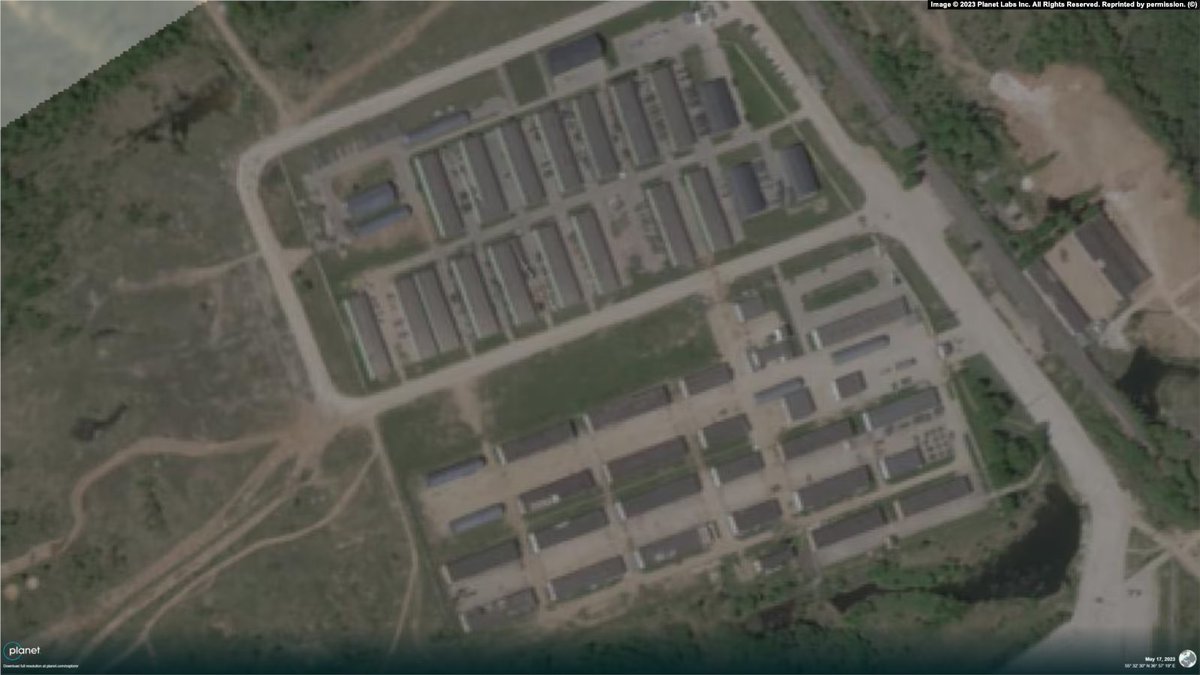
According to Dragan, Russian conscripts were training there too, which can be collaborated by the social media photos (, ). archive.is/wTChD
archive.is/x6TQJ
archive.is/x6TQJ
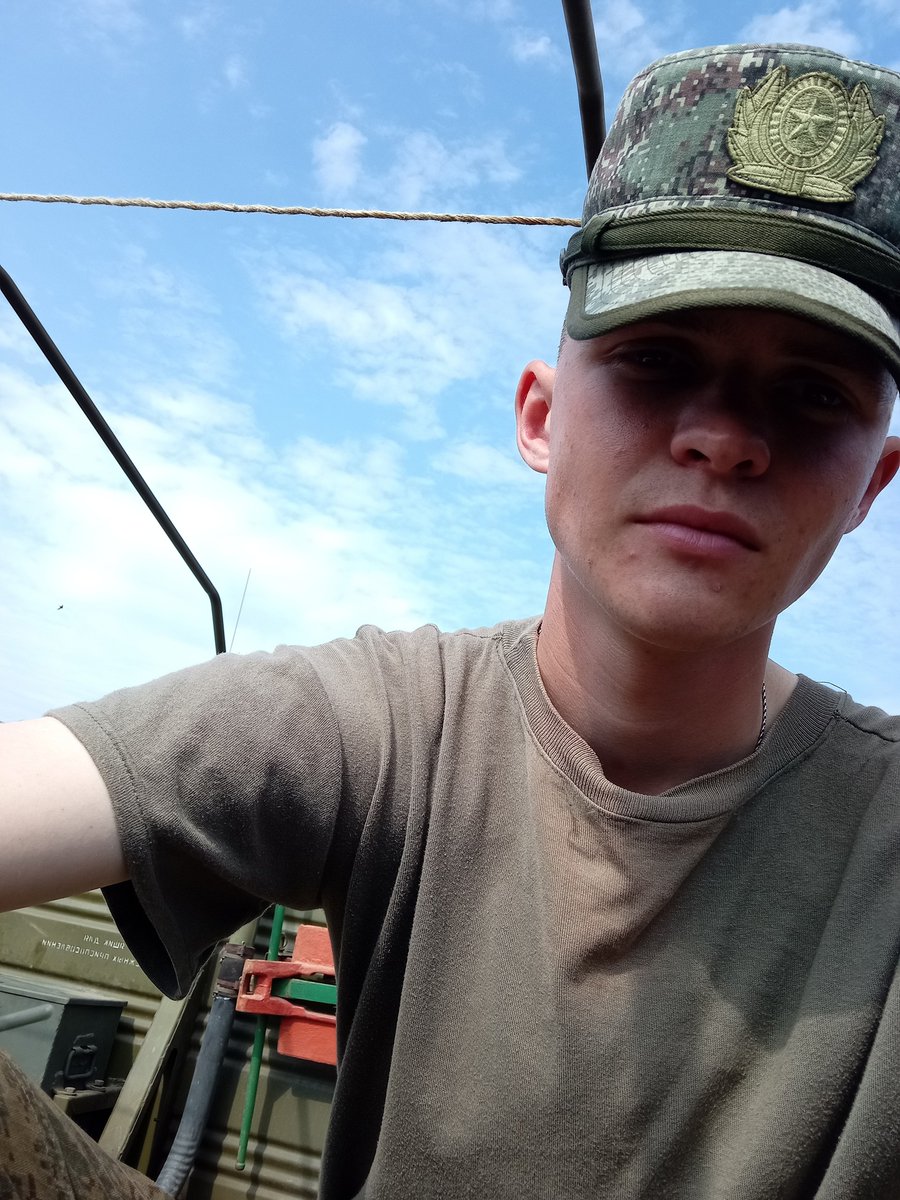
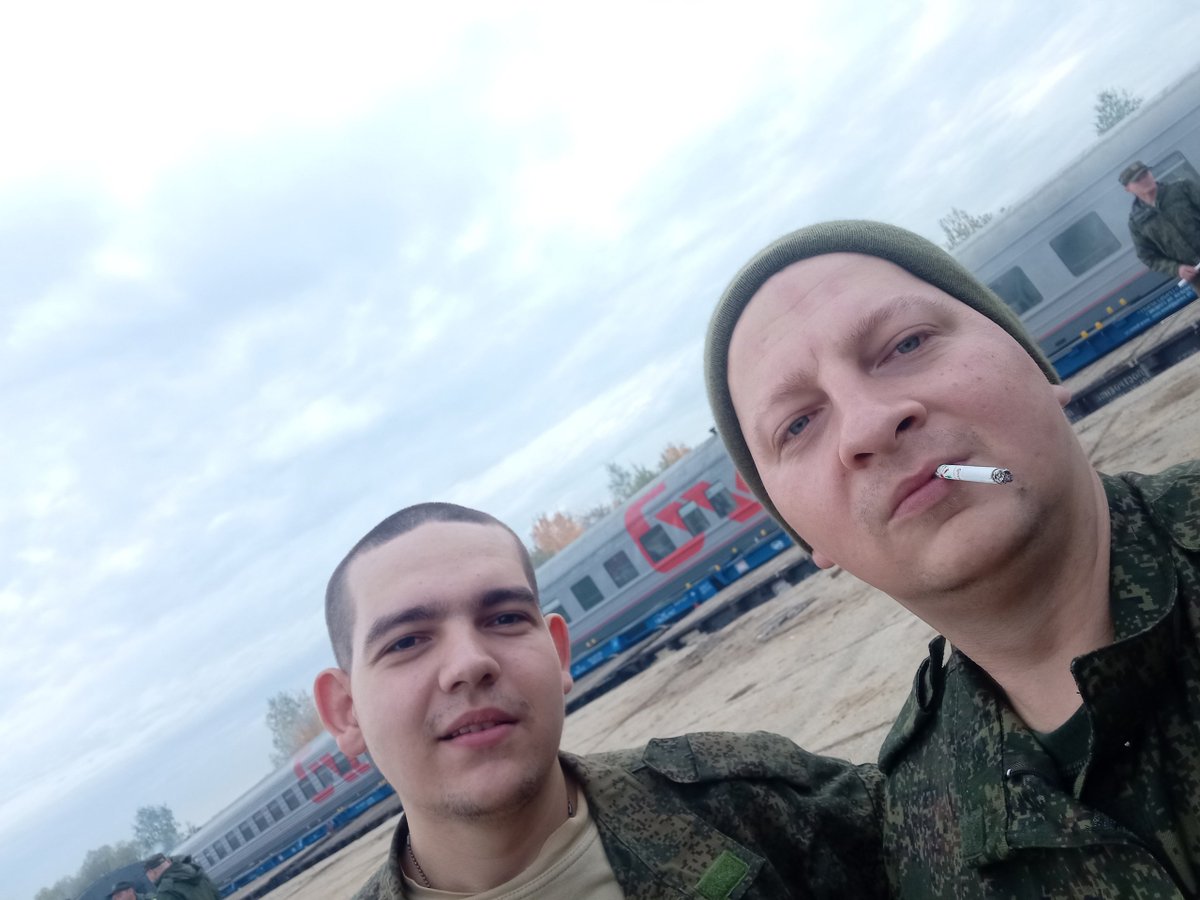
We also compared details from Dragan's photos (top) with images from a Beric video (, bottom) from Alabino and confirmed they were taken at the same location. Different tents, but identical interiors, furniture, and even TVs provided to the mercenaries.

Dragan estimated there were around 25 Serbs with him at Alabino over the next weeks; 5 quit before completion of training. There were Serbs from Serbia, but also from Republika Srpska in Bosnia-Herzegovina, Montenegro, North Macedonia, and even an ethnic Serb from France.

Asked about the financial terms of the deal, Dragan said he received 110,000 rubles (about $1,215) in cash for each of the two months of training, and about twice that figure for each of the six months he was fighting in Ukraine.
Dragan said monthly cash payments were delivered by 'Amur.' RFE/RL confirmed Amur's ties to Redut, identifying him as a commander of mercenary forces in occupied Ukraine. He ordered those forces to round up individuals for interrogation and torture. rferl.org/a/russia-gru-f…
Dragan was assigned to a unit called the 1st Diversionary-Reconnaissance Assault Brigade 'Wolves' (1-я ДРШБр "Волки") and said the group was trained for 2 months by 4 instructors who he understood to be members of the Russian military's Special Operations Forces.

Dragan says his training, which lasted for approx. 2 months, was ok. What he is complaining about is the fact that those Serbs who arrived later didn’t receive two months of training; it was limited to several weeks or even days (we will return to this later in the thread).
After the New Year celebrations ended, in January ’23, Dragan was sent to Ukraine, but first he and his friends spent a few days at the training facility of the GRU’s 16th Special Forces Brigade in the Tambov oblast (read more about this facility here: ).svoboda.org/a/laboratorii-…
Dragan expected that Serbs would be led by Savicic or Beric themselves; instead, their commanders were Ukrainians from Luhansk Oblast who sided with Russia in the war back in 2014-2015.
First they were lodged in the public school №4 in Yasynuvata, occupied part of the Donetsk oblast, then moved to an abandoned private house in Makiivka near Donetsk. We were able to geoconfirm one of his photos taken there 48.049639, 37.855417 @GeoConfirmed

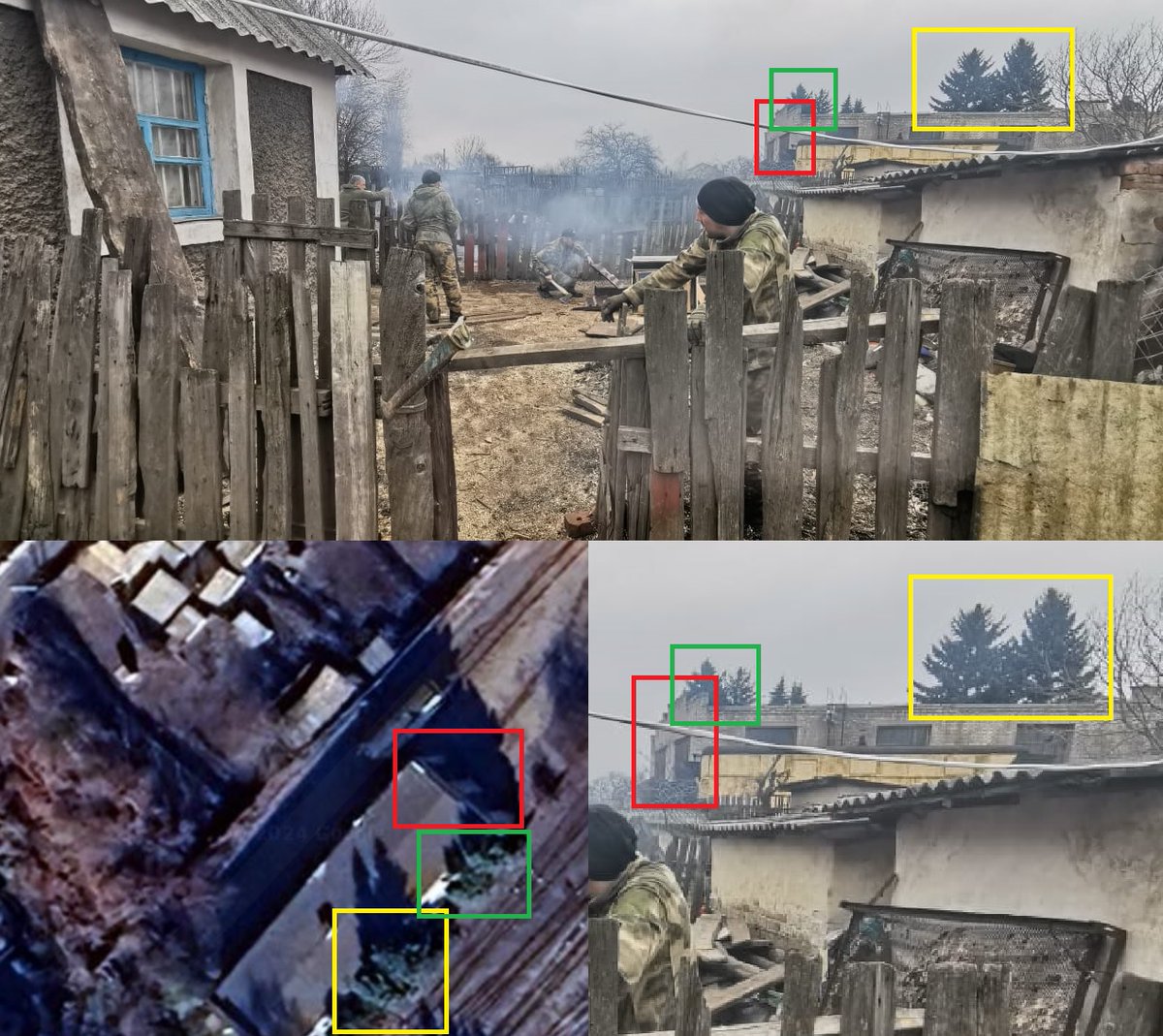
Another base of the 'Wolves', according to Dragan, was located at the Stakhanov (Kadiivka) Railway Car Plant in Luhansk Oblast. It’s a well-known Russian base that also hosted Russian conscripts and was struck by HIMARS several times by Ukraine.

"Conscripts were paid half as much as us. They were forbidden from leaving the factory, but there was a store nearby, and some still tried to go there. We would then shoot into the air. If they didn't stop after that, we could kill them," Dragan recounts.
https://x.com/AmamNgc/status/1646131082532716544
Dragan and other Serbs from the 'Volwes' fought battles near Lysychansk in the Luhansk oblast, near Avdiyivka in the Donetsk oblast, they were also sent to Soledar.

"We were the only ones who received proper training. For others, it lasted from five to 14 days," Dragan says. When asked how many Serbs were killed during the six months he spent in Ukraine, Dragan gives an approximate number of 15 people.
We can’t confirm this number, but as proof of his claims, he sent a voice message in which one of the mercenaries lists the call signs of the deceased. Dragan says he knows of about 70 Serbs recruited for the war.
The story of one of them is particularly interesting. Acc. to Serbian and Bosnian media Emrah Zornic, from Novi Pazar in southwestern Serbia, had mysteriously turned up in Ukraine before he was killed trying to 'provide aid to the wounded and civilians.'
sandzakpress.net/novopazarac-em…
sandzakpress.net/novopazarac-em…
Back then, @RFERL journalists went to Novi Pazar and confirmed that he was a Muslim from a typical Bosniak family.
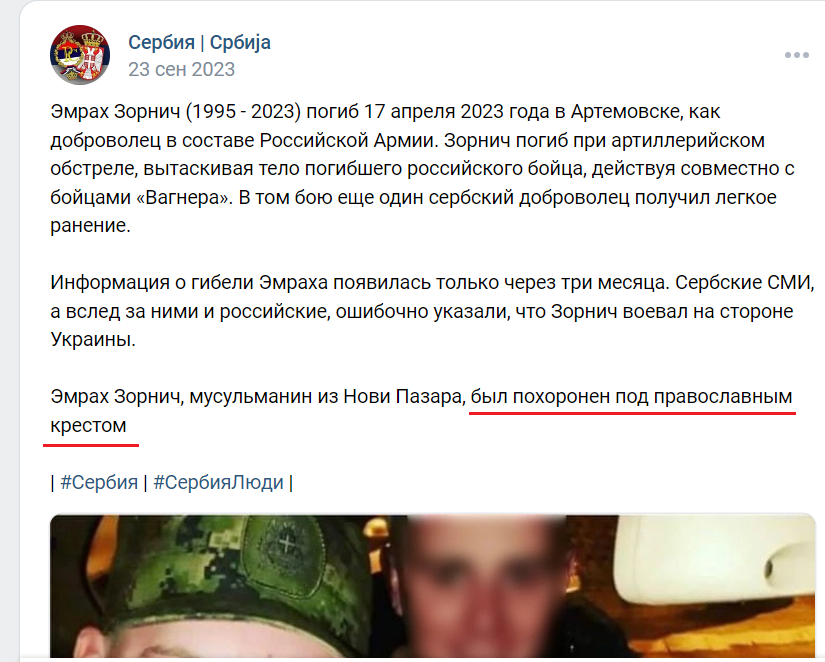
Dragan says that despite this, Dejan Beric ordered Zorniz to be buried under an Orthodox cross, following the Orthodox ritual. Everyone in his unit was outraged by such ignorance on Beric’s part.
Beric himself mentioned in one of his videos that 'the only Serb killed in Ukraine was actually a Muslim,' without naming Zornic.
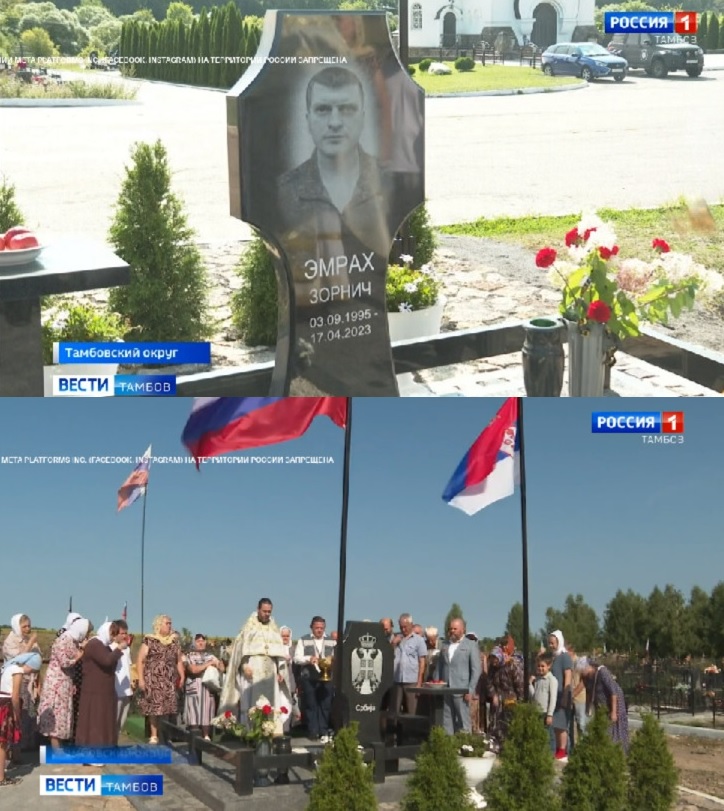
I found Zornic’s grave on a video, recently broadcasted by Russian state TV in Tambov oblast. He was buried 12 kms from the SOF base in Trigulay, used by GRU to send mercenaries to Ukraine. smotrim.ru/video/2855600
Recently, at the end of August, a new memorial was constructed above his grave, and an Orthodox priest held a memorial service on that occasion.
I also found a VK post stating that Zorniz was buried 'under an Orthodox cross.' When we were preparing this publication and reached out to Beric with our questions (including those about Zorniz’s funeral), the post was deleted (saved copy: ). archive.is/iXYq2
One of the local businessmen in a Russian state TV video about the new monument at Zornic's grave says he died just a few days after arriving in Ukraine (not surprising, given that Zornic received only a few days of training).
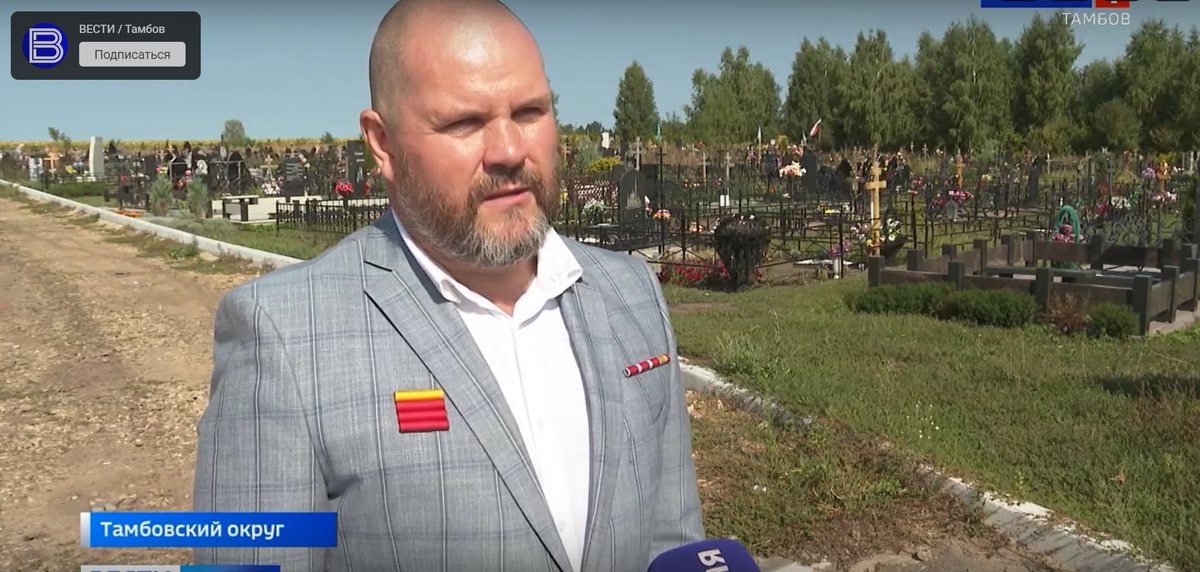
This TV fragment portrays Zornic as just a 'Serb'. "He stood up to defend our state. There are countless nationalities in the world, but there is one nationality - that of a warrior against darkness." – the person in the video says vk.com/video-46909186…
Now some documents. From earlier investigations into Redut PMC and Serbian fighters in Russia, we knew they had a cover story for the media, pretending to work for a 'construction company.' Even Davor Savicic himself used this legend back in 2016. fontanka.ru/2016/03/28/171/
Dragan provided us with a photo of the document he was given in Russia to avoid any problems in Serbia, where he faces up to eight years in prison for that. It says he had been practicing for a Moscow-based construction company called Monte Gradnja.

The head of Monte Gradnja is a man named Rajko Backovic. According to the Russian companies register, Backovic also owns part of 'Wolf Group' alongside the 'Wolf' himself, Davor Savicic. rusprofile.ru/id/12350001673…
Another company associated with Savicic is 'Virlin LLC,' which specializes in trading apples from Serbia to Russia. msk.hullabaloo.ru/news/ovoshnie-…
Back in 2015, it was a big deal: Serbia illegally exported Polish apples to Russia after Russia imposed a ban on importing fruits from EU countries. reuters.com/article/world/…
Back to our guy, Dragan. He says he’s not coming back to Russia, because ‘Human life is as valuable to Russians as it was in [Josef] Stalin's time’. – ‘It’s just one massive business, in which ordinary people are killed – mobilized or paid, whatever.’
Back to our guy, Dragan. He says he’s not coming back to Russia, because 'Human life is as valuable to Russians as it was in [Josef] Stalin's time'. – 'It’s just one massive business, in which ordinary people are killed – mobilized or paid, whatever.'
Beric says he hasn't published a video in a while 'due to restrictions imposed by YT' 'I was told that I am no longer respected because I am not a soldier. I respond to those people: yes, I am no longer a soldier; now I am a video blogger. I’ve served my time; now I’m retired.'
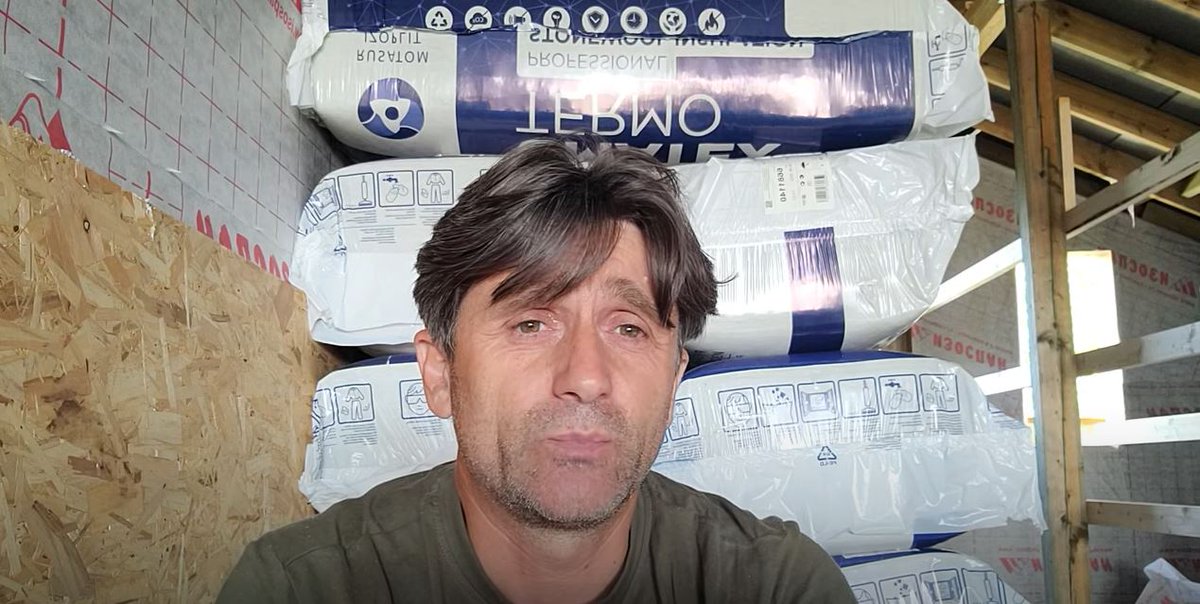
An exhaustive examination of Serbian court records since 2014 shows that, despite official confirmation of hundreds of Serbs fighting in Ukraine, there have been only 37 convictions for participating in the war and one for organizing such participation. themoscowtimes.com/2023/01/17/ser…
Despite Vučić being vocal on the issue, only six cases resulted in prison sentences, and just one involved activities after the 2022 escalation. Currently, there are no criminal prosecutions of alleged fighters.
Read the full story here (thank you @Andy_Heil for translating and editing it!). rferl.org/a/ukraine-war-…
The Russian version with slightly more details (Google Translate for your language please): svoboda.org/a/zhiznj-dlya-…
Finally, the version of this investigation in Serbian: slobodnaevropa.org/a/srbi-ratovan…
• • •
Missing some Tweet in this thread? You can try to
force a refresh