Maxar collected a trove of new high-resolution satellite imagery showing the damage to Russian ammunition depots in western southern Russia. 📷@Maxar
Thread with much imagery.
Starting off with the before / after shots of the ammo storage buildings at the Oktyabrski depot.
Imagery of the destruction of probable missile cannisters at the Oktyabrski ammo depot.
At one location in the Toropets depot, a large crater nearly 82-meters wide is visible where there used to be a storage building and bunker. Additionally, train rail cars that were likely used to transport ammunition to the depots were damaged or destroyed at each location.
More images collected from Toropets.
Damage to material being offloaded from railcars at Toropets. Before vs after.
Destroyed railcars observed in the vicinity of the Toropets ammo depot.
Tikhoretsk*
This is in Krasnodar.
Tikhoretsk*
This is in Krasnodar.
• • •
Missing some Tweet in this thread? You can try to
force a refresh

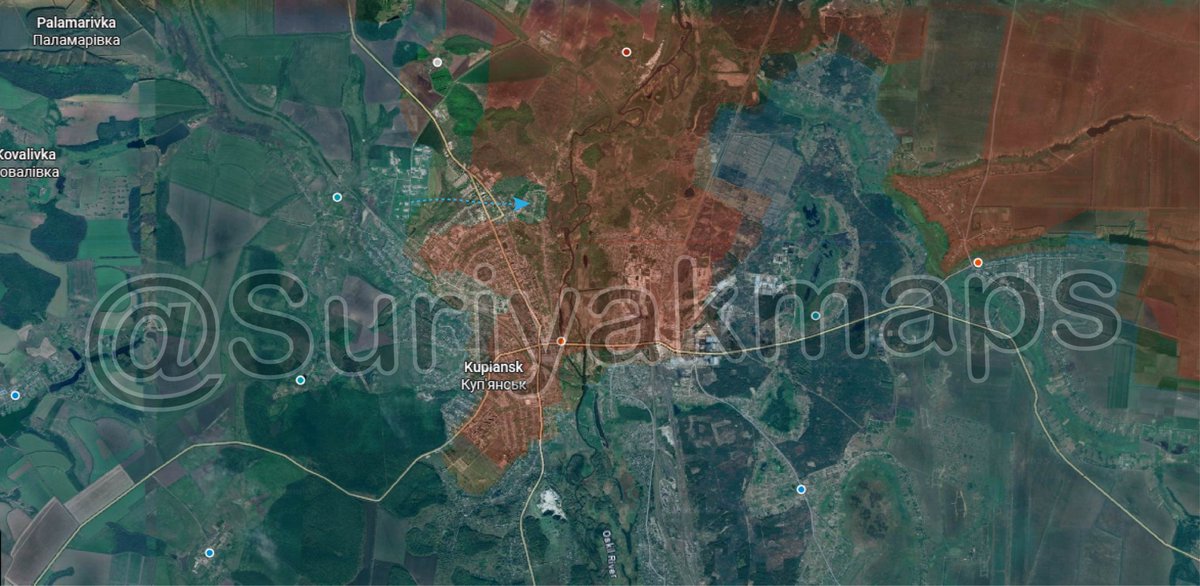
Ukraine's counterattack in Kupyansk is interesting for many reasons, including surfacing apparent problems and analytical challenges with assessing control of terrain in open-source war maps.
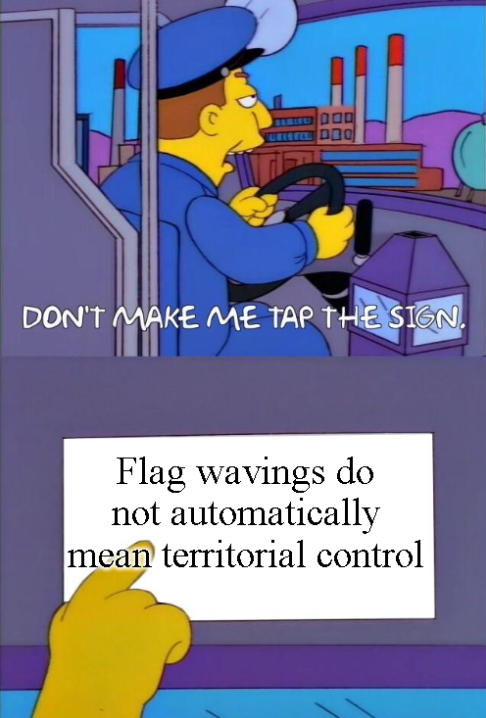
It inspired me to make the following meme and a short thread.🧵
Mapmakers now face a challenge when making maps based off geolocations. The methodology that many cartographers have is that a geolocated ground presence means control.
The problem is that the Russians caught on and began metagaming this methodology.
It’s well established that Russian forces use 2- or 3-man infiltration teams to push far beyond the Russian frontline into Ukrainian held territory. Their mission is to wait for more forces to consolidate a strong point that can be used to continue pushing forward. Infiltrators also sometimes wave a flag ostentatiously at a designated landmark in order to claim that Russian forces control a particular area. Russian forces did exactly this in Kupyansk, resulted with many maps showing that Russian forces exercised the same level of control in Kupyansk as they do in Mariupol.
The Russian geolocated presence in both locations is qualitatively different, of course. But many maps don't make that distinction and show both locations under the same shade of red.
Ukrainian forces have resumed offensive operations in Kursk and are confirmed to have made tactical advances within at least 300 meters of Berdin.
Quick thread on tracking tactical Ukrainian advances:
Fresh snowfall makes identifying tracks easier. Russian sources posted video on January 5 showing how Ukrainian mechanized vehicles are making distinctive dark marks on snowy white backdrops as they push forward across fields: t.me/RVvoenkor/83914
These vehicle tracks are visible from space. Satellite imagery collected on January 5 shows distinctive vehicle tracks in the snow on the way from Ukrainian forces’ previous positions near Cherkasskoe Porechnoe heading in the direction of Berdin.
We created a tool to illustrate the extent to which US restrictions on Ukraine’s use of ATACMS constrain Ukraine’s ability to strike important military infrastructure in Russia.
We made this tool to help visualize the extent to which US policy is protecting a vast number of objects in Russia's rear and how many legacy installations and known military landuse protected by US policy is supporting Russia's war effort.
225 unique military and paramilitary objects are available here for exploration.
Clicking on pins on the map allows the user to lean more details about that object.
Current US policy prohibiting Ukraine from using US-provided weapons in the territory of the Russian Federation is severely compromising Ukraine's ability to defend itself.
Whatever the merits of this US policy before the Russian assault on Kharkiv Oblast began, it should be modified immediately to reflect the urgent realities of the current situation.
Defeating Russia’s operation in Kharkiv Oblast requires defeating Russia’s glide bomb threat. Russian forces are using glide bombs launched from Russian airspace to enable Russian ground maneuver in Kharkiv Oblast.
Russian sources report that Ukrainian forces entered Verbove on September 22 & continued attacking the settlement with armored vehicles as of September 24.
Russian sources also indicate that Ukrainian forces are operating north of Verbove.
Tactical report thread w/ sources.🧵
A Russian Airborne Forces (VDV) -affiliated source reported that Ukrainian forces entered Verbove for the first time on September 22 and continued pushing east.
In our newest special edition for @TheStudyofWar, our team assesses that Ukraine's defensive and counteroffensive operations in the Bakhmut area since summer 2022 are an operationally sound undertaking.
Ukraine's sustained operations in Bakhmut have fixed a large amount of Russian combat power that would otherwise have been available to reinforce Russian defenses in southern Ukraine.
This significant Ukrainian achievement has helped prevent Russia from creating a large mobile VDV operational reserve that could have been used to stop the main Ukrainian counteroffensive effort in Zaporizhia Oblast.