This time, we developed a nasal booster vaccine for influenza viruses. In this preprint, @MiyuMoriyama et al. show that nasal boosters with unadjuvanted hemagglutinin protein induce sterilizing immunity in mice against flu. (1/) biorxiv.org/content/10.110…
This work builds on the Prime and Spike vaccine strategy by @tianyangmao @BenIsraelow et al. against COVID where mRNA vaccine followed by nasal booster with recombinant spike protein established local immunity, ⬇️ infection & transmission in rodents. (2/) science.org/doi/10.1126/sc…
For Prime and HA against flu, @MiyuMoriyama tested several different mRNA IM prime and nasal HA booster doses, followed by a homologous influenza virus challenge. Like Prime and Spike, no adjuvant is needed for the nasal booster due to preexisting immunity from Prime. (3/)
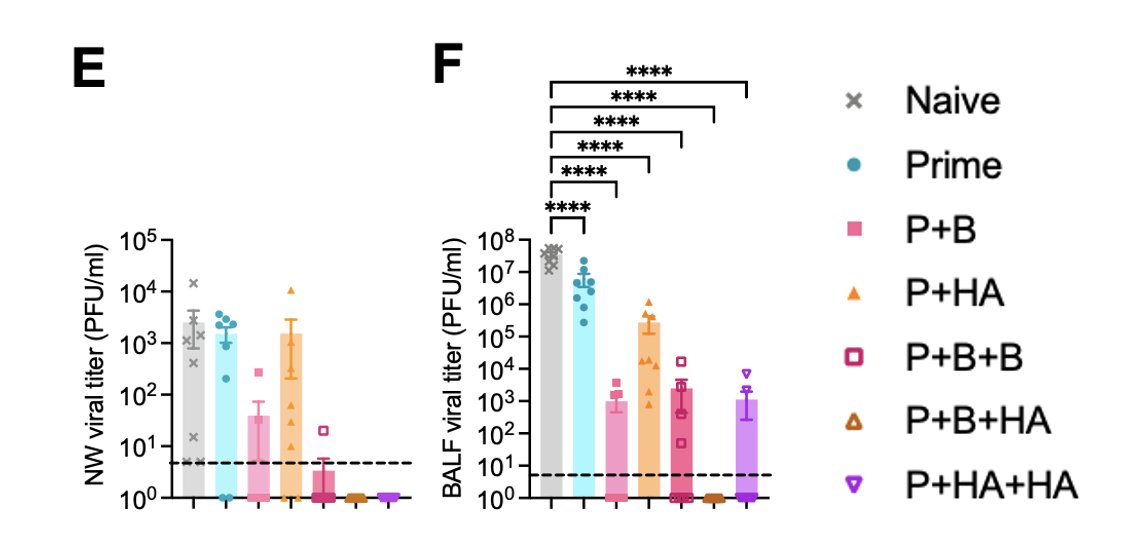
Intramuscular HA mRNA (2 doses) followed by a recombinant HA nasal booster induced sterilizing immunity against homologous viral challenge in the nose and lung leading to no weight loss or pathology from infection (4/)
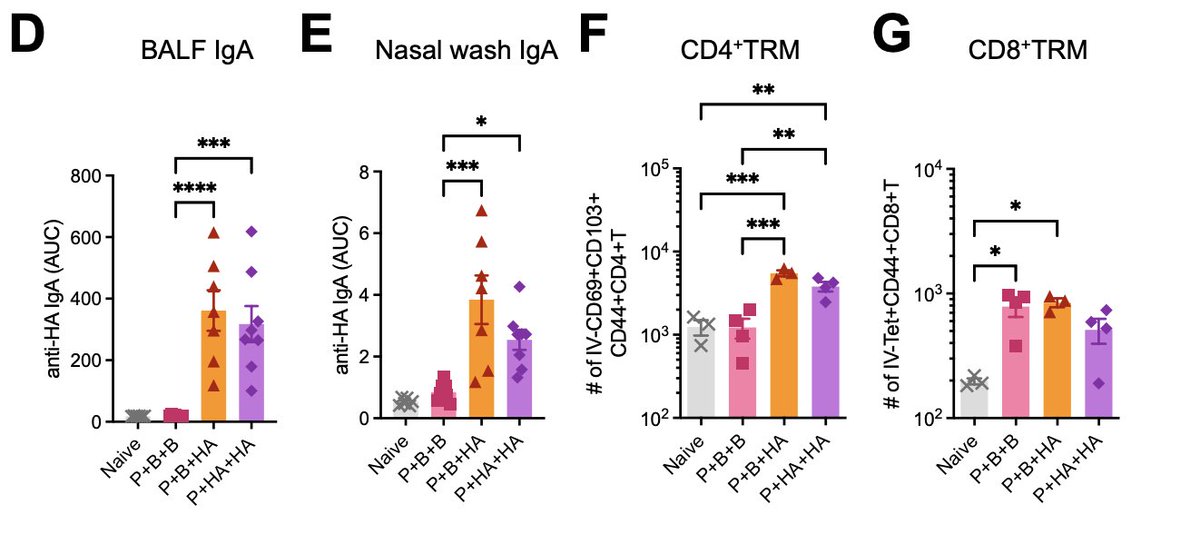
How does this happen? Prime and HA (P+B+HA or P+HA+HA), but not IM mRNA vaccines alone (P+B+B), induce robust nasal and lung IgA production, and tissue-resident memory CD4 T cells. (5/)
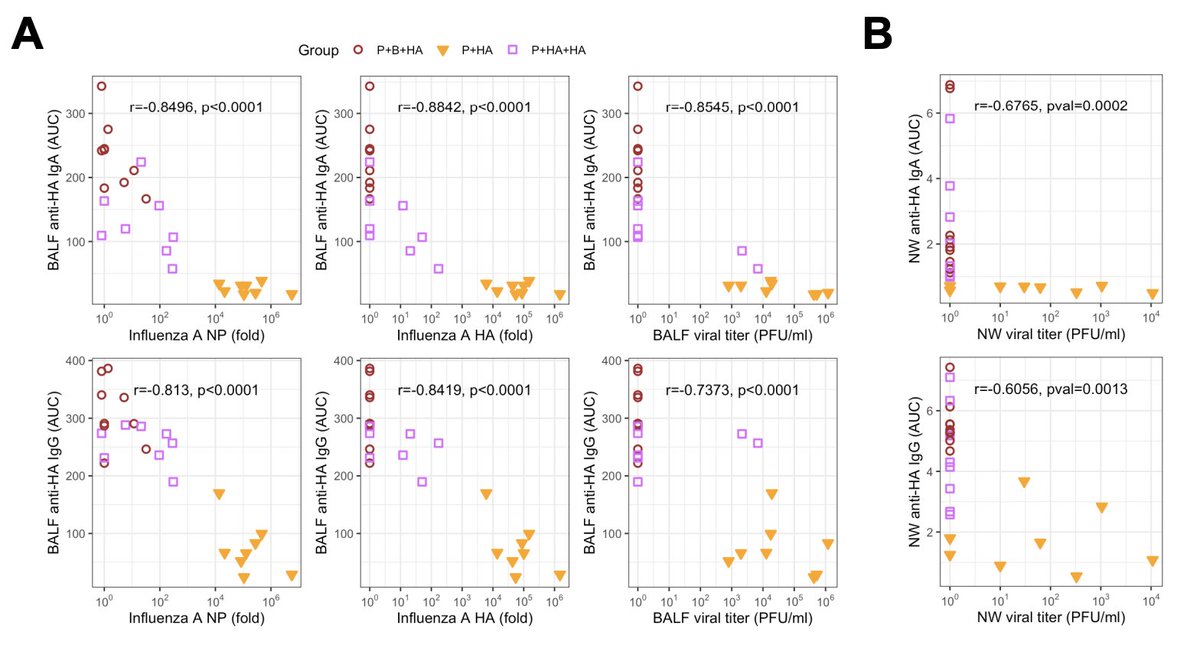
Mucosa IgA and IgG inversely correlated with viral burden in the respiratory tract. Note the interesting results for mucosal IgA and viral load. There appears to be a threshold of IgA above which virus replication is shut down 🤯 (6/)
Older adults above age 65 years are at higher risk of developing severe and lethal influenza infections. @MiyuMoriyama next tested the Prime and HA vaccine approaches in older mice and showed that they can be protected from disease. (7/)
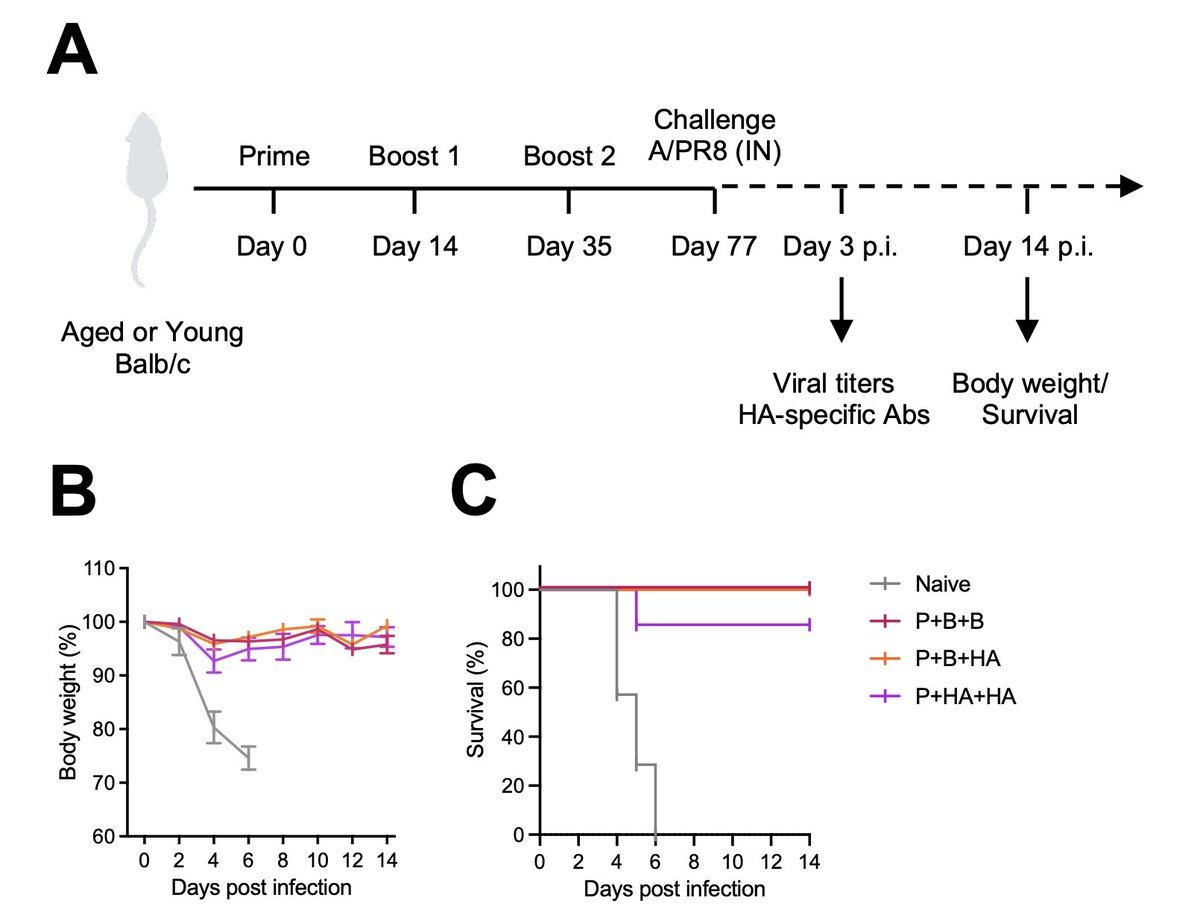
However, unlike younger mice, sterilizing immunity was not achieved in older mice in the lung (BALF) or nose (NW). Yet, 2 doses of HA mRNA vaccine followed by nasal HA booster (P+B+HA) did reduce viral load in the lung better than 3 doses of IM mRNA (P+B+B) in older mice. (8/)
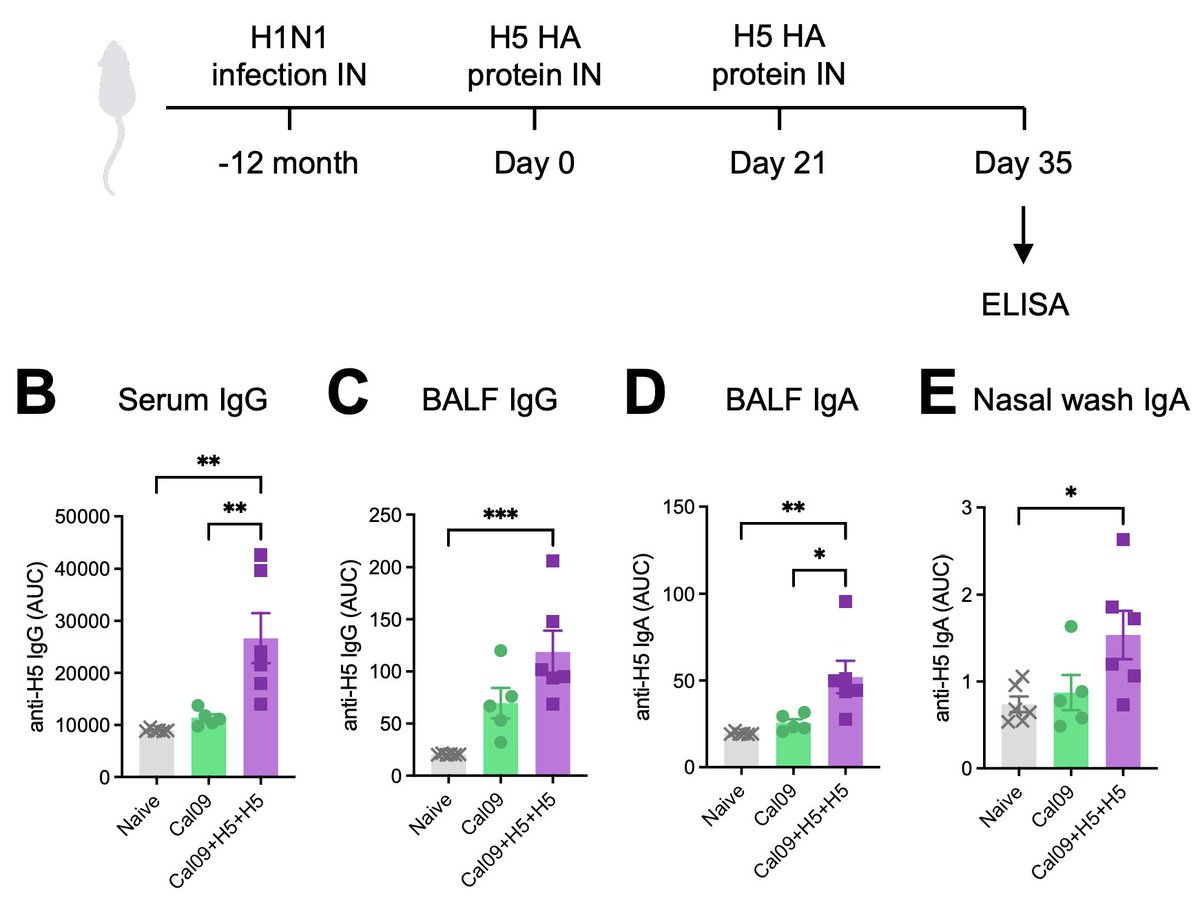
Can we adapt Prime and HA for avian flu? Yes! When two doses of nasal boosters of H5 HA protein were given to mice that recovered from an H1N1 infection a year ago (thus mimicking immunity in people), mice developed robust anti-H5 antibody responses. (9/)
Finally, we show that nasal boosters with a mixture of HA from homologous (same HA as the Prime) and a heterologous influenza A virus (P+HAm+HAm) can confer sterilizing immunity against a heterologous viral challenge 💥 (10/)
I wish to highlight the incredible work of the amazing team led by @MiyuMoriyama. We continue to strive to develop safe and effective vaccines against mucosal pathogens that can prevent infection and transmission. Grateful to @niaidcivics for the support 🙏 (end)
• • •
Missing some Tweet in this thread? You can try to
force a refresh

A groundbreaking paper by @younis_sh1 et al. @stanfordimmuno provides an answer to the long-standing question about how EBV infections are linked to lupus. A short thread to explain the key findings. (1/) science.org/doi/10.1126/sc…
The authors developed a new method called EBV-seq, enabling them to overcome the barrier of studying rare cells (~25 per 10,000 B cells in lupus patients) that are infected by EBV. Note that in healthy people, only 1/10,000 B cells are EBV-infected. (2/)
First, the authors found that EBV infects autoreactive B cells that express anti-nuclear antibodies in lupus patients, but not in healthy people or in patients with multiple sclerosis. (3/)
Introducing BEACON (Bioactive Enhanced Adjuvant Chemokine Oligonucleotide Nanoparticles) to stimulate mucosal immune responses against genital #HSV infection. Awesome work led by @sachinbhag, who designed and developed BEACON to guide T and B cells (1/) biorxiv.org/content/10.110…
The BEACON nanoparticle is composed of CpG ODN (TLR9 agonist) and CXCL9 (chemokine). When applied to the vaginal mucosa, the recruitment of antiviral T cells is achieved with minimal local inflammation - much more potent than CpG or CXCL9 separately. (2/)
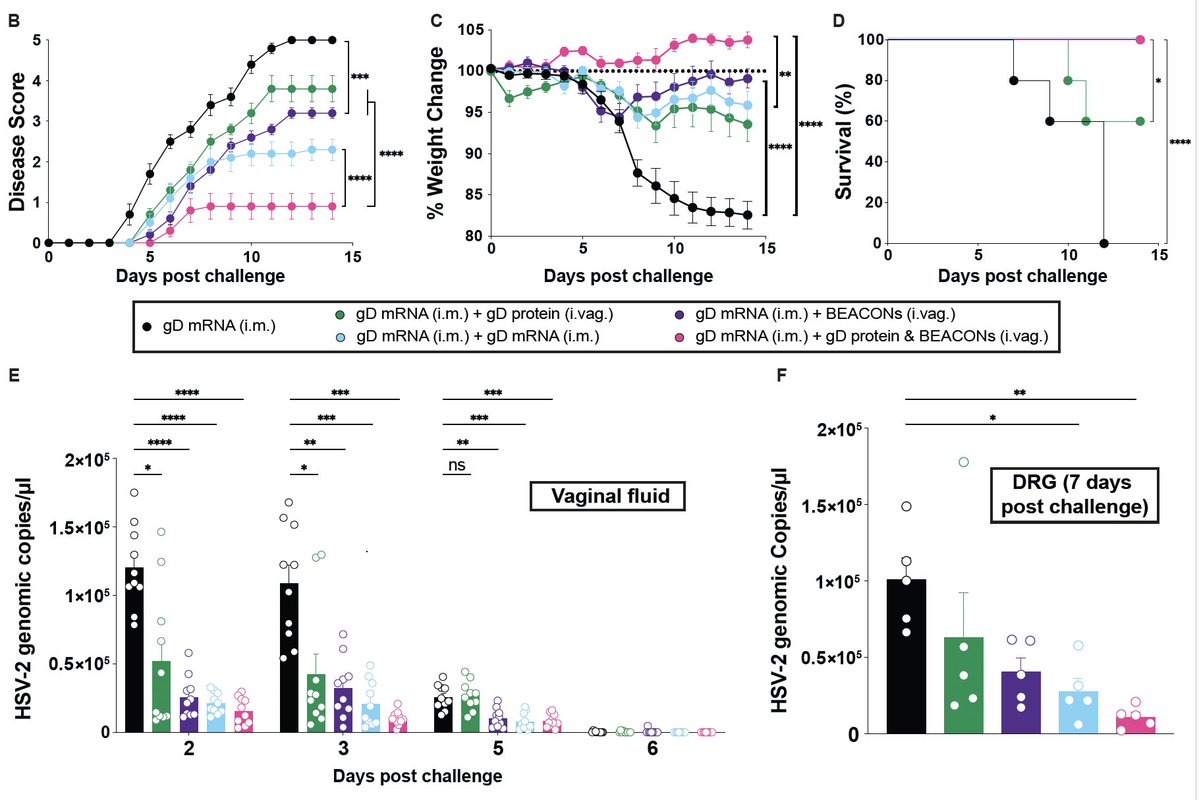
Intramuscular vaccines do not promote mucosal immunity. BEACON can be used as a local adjuvant to boost HSV-2 gD- or gB-specific T and B cells, preventing not only disease/death but also blocking viral load in both vaginal tissue and dorsal root ganglia (🚫latency)(3/)👇🏼
A fascinating new study by Vishnu Shankar et al. @stanfordimmuno shows that oxidative stress is a shared characteristic of ME/CFS and Long COVID in lymphocytes due to inability to clear reactive oxygen species. This happens in sex-specific manner. (1/) pnas.org/doi/abs/10.107…
Females show higher mtROS levels and insufficient antioxidant levels, while males show mitochondrial lipid oxidative damage. While the reason for this is unclear, it may explain the sex differences in lymphocyte dysfunction we see in PAIS in general. (2/) science.org/doi/10.1126/sc…
ROS-targeting therapies were tested. Metformin treatment in vitro showed some impact on CD4 T cell proliferation. I suspect that other therapies to induce autophagy/mitophagy might also benefit restoration of T cell phenotype. #LowDoseRapamycin 👇🏼 (3/) polybio.org/projects/long-…
Published today! Victoria Bastos, @KerrieGreene_ et al found two distinct immunotypes of ME/CFS based on the cerebrospinal fluid analysis. Great collaboration with @MBVanElzakker @microbeminded2 and the Bragée clinic in Sweden. (1/) academic.oup.com/jimmunol/artic…
This is perfect timing as Victoria will present these data at the @polybioRF symposium today. (2/)
Based on cerebrospinal fluid cytokines, we identified two clusters of ME/CFS patients. Cluster 1 had elevated matrix metalloproteinases & many cytokines compared to cluster 2. Other than older age (Cluster 1), clinical presentation of these clusters was similar. (3/)
Published today📣
Our nasal booster in the "Prime & Spike" vaccine works without adjuvants (which are needed to induce adaptive immunity but also cause inflammation). @Kwon_Dongil @tianyangmao @BenIsraelow et al. asked how this is possible. (1/) nature.com/articles/s4159…
Prime & Spike is a vaccine strategy that leverages preexisting immunity primed by conventional vaccines to elicit mucosal IgA and T cell responses that prevent COVID infection and transmission in rodents. The nasal booster is simply the spike protein (2/) science.org/doi/10.1126/sc…
Our new study shows that the nasal spike protein booster converts lymph node memory B cells into IgA-secreting cells in the lung with the help of memory CD4 T cells. Ag-specific CD4 T cells replace all the necessary functions of adjuvants without nonspecific inflammation! (3/)
This prospective observational study led by @connorbgrady @bornali_27 @SilvaJ_C @hmkyale examined the impact of the primary COVID-19 vaccination on the symptoms and immune signatures of 16 people with #longCOVID. Here is what we found 👇🏼 (1/)
This study asked: Does COVID vaccination improve symptoms of long COVID? If so, is the improvement due to robust T and B cell responses leading to the clearance of the viral reservoir? If not, is there an immune feature that predicts worsening of LC? (2/)
The self-reported impact of vaccination was variable. Of the 16 long COVID patients, 10 felt better, 3 had no change, and 3 had worse health (1 hospitalized) 12 weeks after vaccination. Both physical and social effects of symptom burden appeared to decrease after vaccination. (3/)