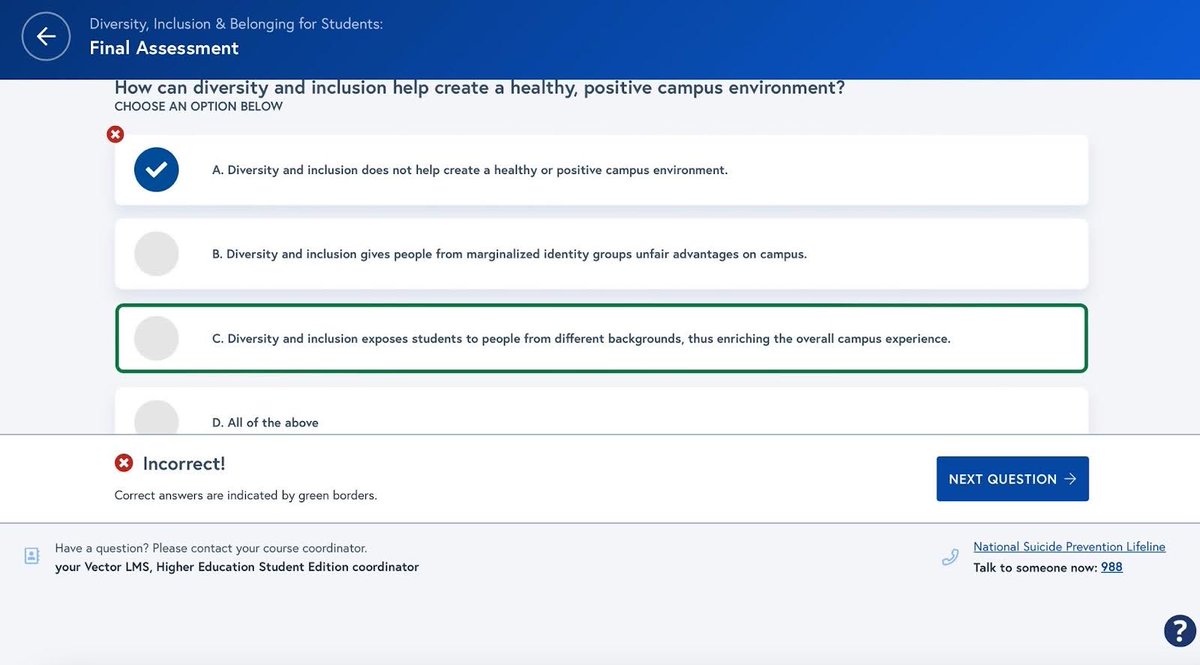
NEW: Harvard punished a Taiwanese student, Cosette Wu, who disrupted a talk by China's ambassador.
But it declined to punish a Chinese student who forcibly dragged Wu from the event.
After video of the assault went viral, Harvard even gave that student a letter of apology .🧵
But it declined to punish a Chinese student who forcibly dragged Wu from the event.
After video of the assault went viral, Harvard even gave that student a letter of apology .🧵

Wu got in all of 20 seconds of heckling before a student from China grabbed Wu and, in an incident that the university's police department logged as an assault, ejected her from the event.
The student was Hongji Zou, a master's candidate in Harvard's Graduate School of Education and an officer in Harvard's chapter of the Chinese Students and Scholars Association—a group overseen by the Chinese Communist Party.
Twisting Wu's arm and pulling her into the aisle, Zou, who had helped to organize Xie's talk, shoved the struggling protester past the stage and out of the room. There, he was stopped by a security guard who pried the younger female student from his grip.
The case sparked outrage on social media and led to an investigation by the House Select Committee on the CCP, which demanded to know what sanctions, if any, Harvard had imposed on the students involved.
It would be hard to imagine a simpler case for a fair-minded disciplinary board. Wu's protest had technically violated Harvard's rules on free speech, which prohibit conduct that drowns out speakers or inhibits their ability to speak. BUT...
But those rules have often gone unenforced at Harvard, particularly after the Oct. 7 attacks, including against disruptions that were more serious than Wu's.
Just last week, the university told students that they would be allowed to disrupt a talk by Mosab Youssef—a former Hamas member who defected to Israel and became an outspoken critic of the terror group—for 10 minutes before being removed by security.
https://x.com/KassyAkiva/status/1844508395203854630
By comparison, Wu's heckling of the ambassador lasted just 20 seconds.
Zou, on the other hand, had roughed up a student for protesting the CCP. If Harvard were going to bring the hammer down on anyone, surely it would be Zou and not the woman he manhandled.
Zou, on the other hand, had roughed up a student for protesting the CCP. If Harvard were going to bring the hammer down on anyone, surely it would be Zou and not the woman he manhandled.
But when the House Select Committee finally obtained the documents it had requested—police reports, disciplinary records, and emails between senior university officials, among others—it turned out Harvard had done the opposite.
The university placed Wu on disciplinary probation in May over her "inappropriate social behavior." And it gave Zou, who had been identified and disparaged on social media, a letter of apology.
Zou had violated Harvard's "Policy on Physical Violence," Harvard told him in an email. But the academic dean of the education school, Martin West, had decided "not to impose any sanctions in response to this violation"—in part because of the blowback Zou had received online.
"I understand that your intentions were to prevent the event from being further disrupted," West wrote. "I also acknowledge that you and your family have experienced significant harm as a result of the event, which I deeply regret."
Wu, meanwhile, would have a permanent note in her file. Probations become part of a student's "official record," according to the Harvard College Handbook, and must be mentioned in all recommendations provided by the school.
"This is yet another example of Harvard's appallingly unequal treatment of protestors based on the speech they support," said Rep. John Moolenaar (R., Mich.), the chairman of the House Select Committee on the CCP.
"Harvard is punishing brave students who spoke out against the CCP's human rights abuses while not only letting the student who assaulted them off scot-free but also handing him an apology."
This story is based on documents that the House committee shared with the Beacon. They suggest that Harvard is more inclined to tolerate protests of a democratic ally than those of an authoritarian adversary—one with a long record of targeting its critics on American campuses.
Students from China have been known to harass, intimidate, and even spy on fellow expats who criticize the CCP, flagging speech critical of the regime for the authorities in Beijing.
Some have even been convicted of making physical threats: In April, a Chinese national at the Berklee College of Music was sentenced to 9 months in prison for stalking a fellow Chinese student who had posted pro-democracy fliers around campus and promising to chop off his hands.
Such incidents were top of mind for the House committee when it began investigating Harvard in June. In a letter to the university, Moolenaar wrote that Wu's assault was consistent with a pattern of Chinese students harassing their peers who speak out against the CCP.
He also noted the Chinese Students and Scholars Association (CSSA)—the student group to which Zou belonged—has played a role in that repression, with over 150 chapters on American campuses alone.
According to the State Department, CSSA chapters across the country "monitor Chinese students and mobilize them against views that dissent from the CCP's stance."
They have become more influential in recent years as U.S. universities have cracked down on Confucius Institutes, other CCP front groups, citing their ties to the Chinese regime.
Wu's assault "raises serious questions" about "the involvement of international students from China at Harvard in acts of harassment and intimidation condoned by the Chinese government," Moolenaar's committee wrote in its letter.
As such, the committee wanted to know whether Zou, the student captured on video manhandling his classmate, had been a member of Harvard's CSSA.
The university said that he was, though it declined to identify the student and redacted his name from the documents it provided to the committee.
The Free Beacon was nonetheless able to confirm Zou's identity by cross-referencing videos of the incident—in which his face is clearly visible—with a picture of Zou on Harvard's CSSA website, where he is listed as a co-chair of alumni relations.
Further corroboration of Zou's identity comes in the emails Harvard officials exchanged as they debated whether to take disciplinary action against him.
Those messages allude to posts on X and LinkedIn that identified Zou, disclosed information about his brother, and even claimed he was the son of CCP officials.
Though the Free Beacon could not independently confirm the claims about Zou's parents, Kevin Boehm, the assistant dean for student affairs at Harvard Graduate School of Education, indicated that Zou was distraught, telling West in an email that the "doxxing" had taken its toll.

West replied the next day that he had decided not to sanction Zou because of the social media firestorm the student had endured. "My view," he wrote, "is that the internet has probably punished [him] enough at this point."
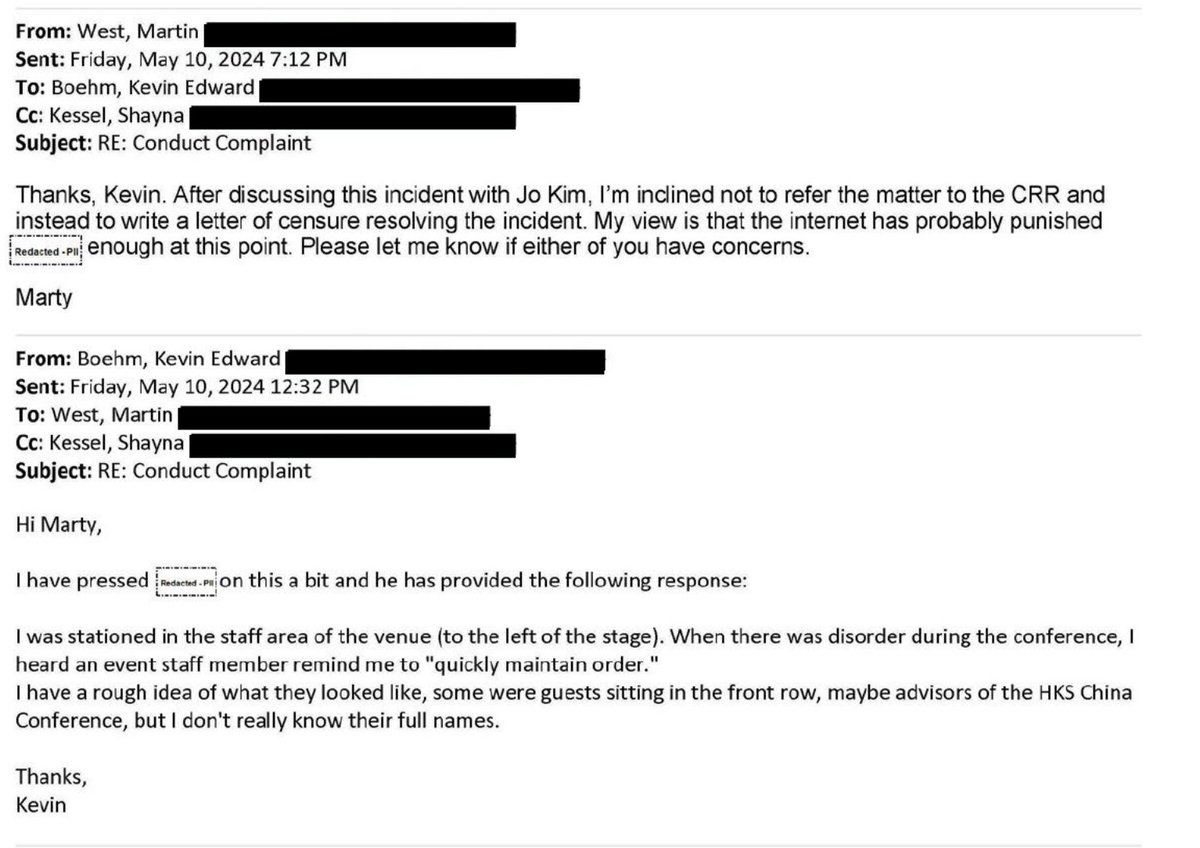
The exchanges also indicate that Zou told Boehm that he had been instructed to "maintain order" by an "event staff member," whom West and Boehm could not identify, and that Zou "accompanied" Wu "to meet nearby campus security personnel."
Those answers appear to have satisfied West, who on May 22 informed Zou that he would be allowed to graduate the next day.
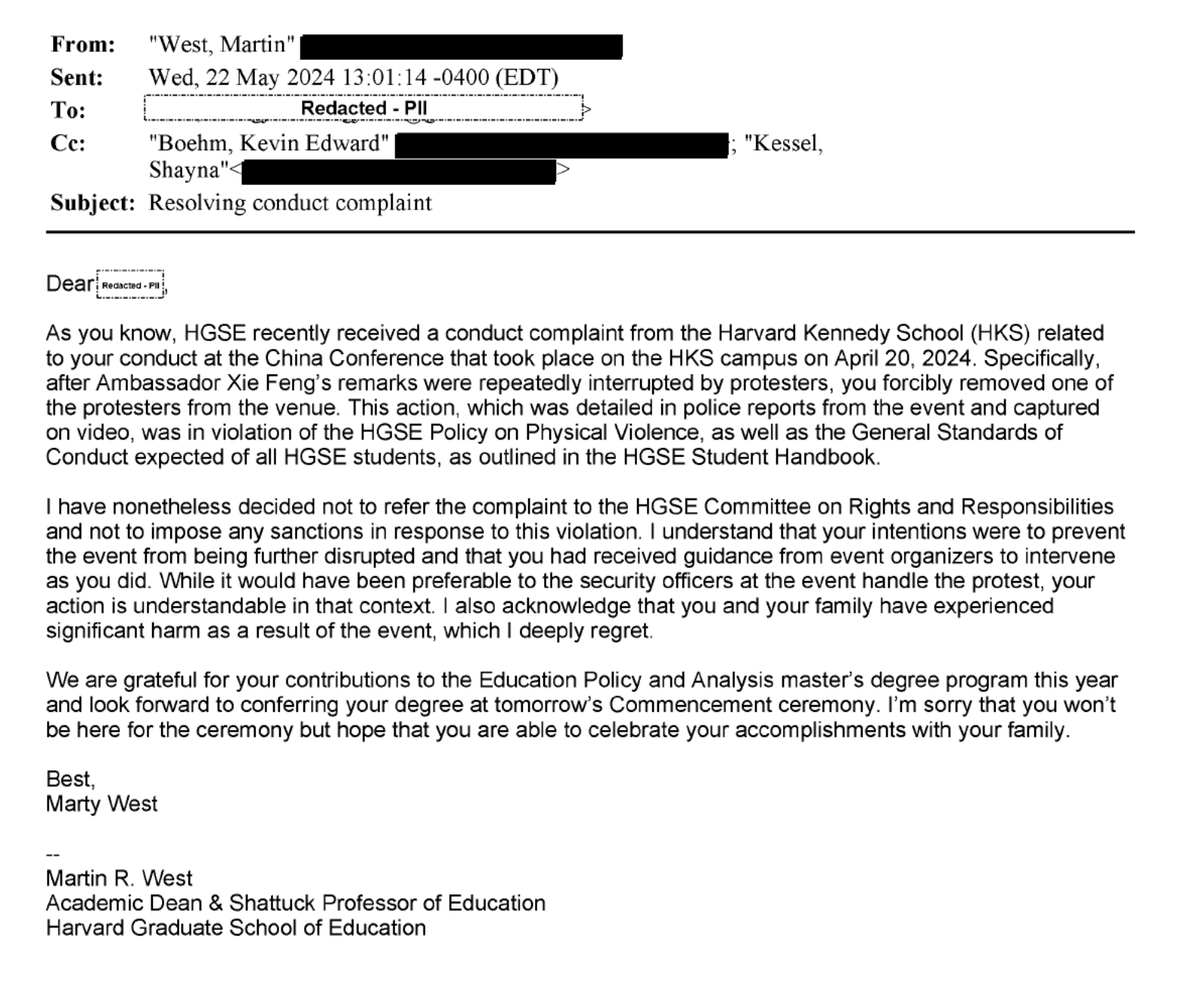
"We are grateful for your contributions to the Education Policy and Analysis master's degree program this year and look forward to conferring your degree at tomorrow's Commencement ceremony," West wrote.
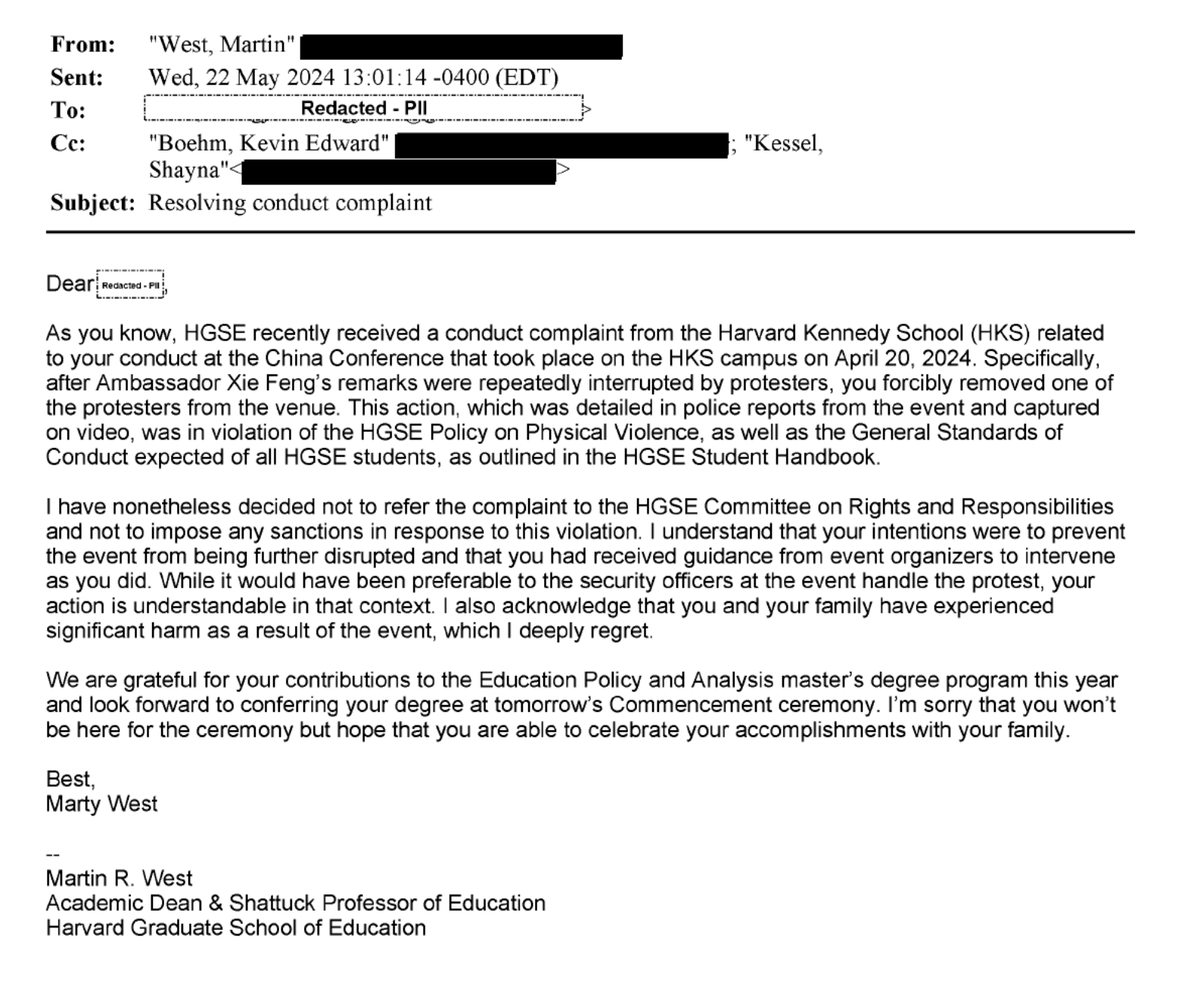
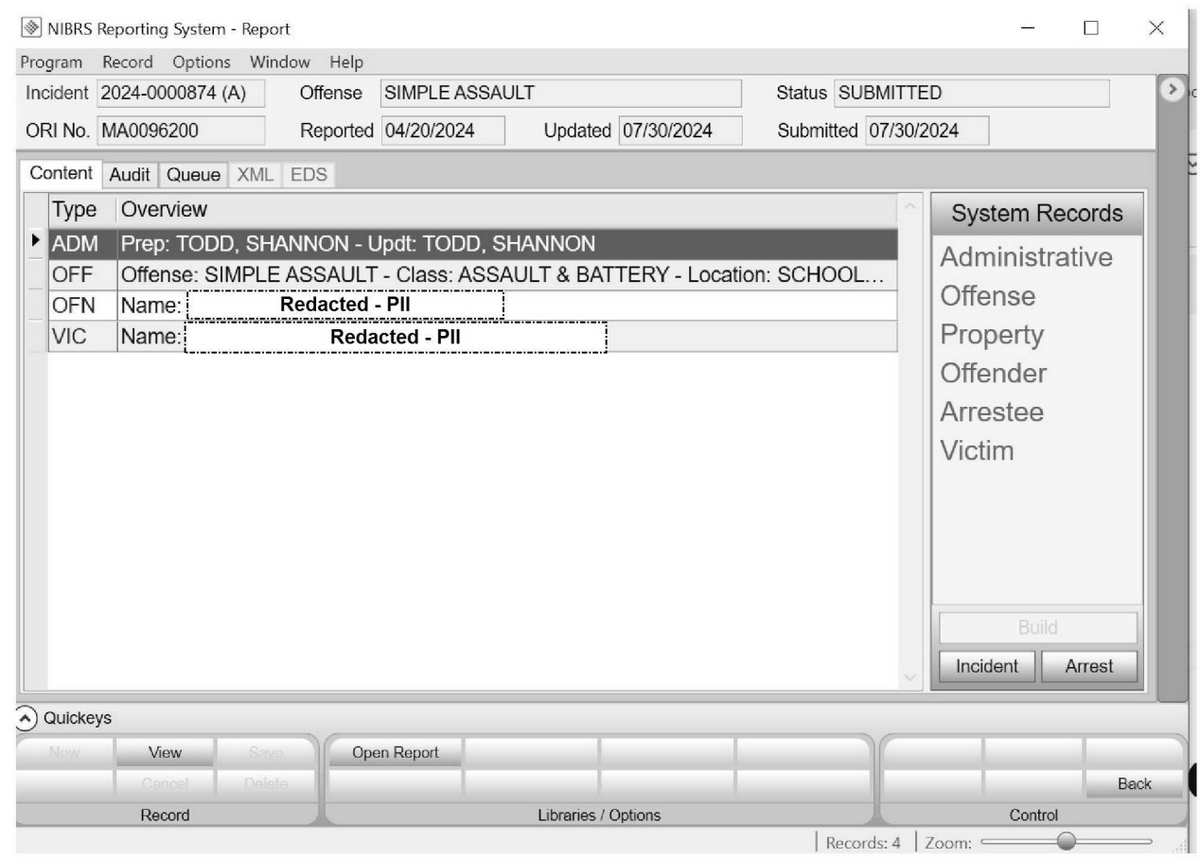
Though the email acknowledged that Zou had violated Harvard's Policy on Physical Violence, it did not mention that his conduct had been classified as assault and battery in an April 20 incident report submitted to Massachusetts State Police.
It is less clear how Harvard officials decided that Wu should be disciplined for her disruption. A subcommittee of Harvard's Administrative Board, which oversees undergraduate student discipline, initially recommended that Wu be "admonished" rather than formally sanctioned.

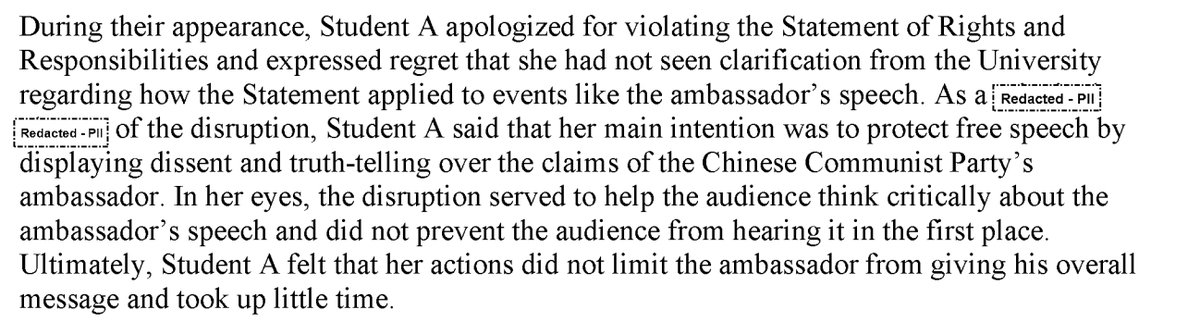
The committee noted noted in a May 17 report that she had apologized in a meeting with the board for disrupting the Chinese ambassador.
It also stated that Wu, who in 2023 cofounded the Coalition of Students Resisting the CCP, had not realized her protest violated any rules.
It also stated that Wu, who in 2023 cofounded the Coalition of Students Resisting the CCP, had not realized her protest violated any rules.
But later that day, the full board voted to place Wu on disciplinary probation against the advice of its subcommittee. "The Board felt this incident warranted a formal disciplinary response," it told her in an email.
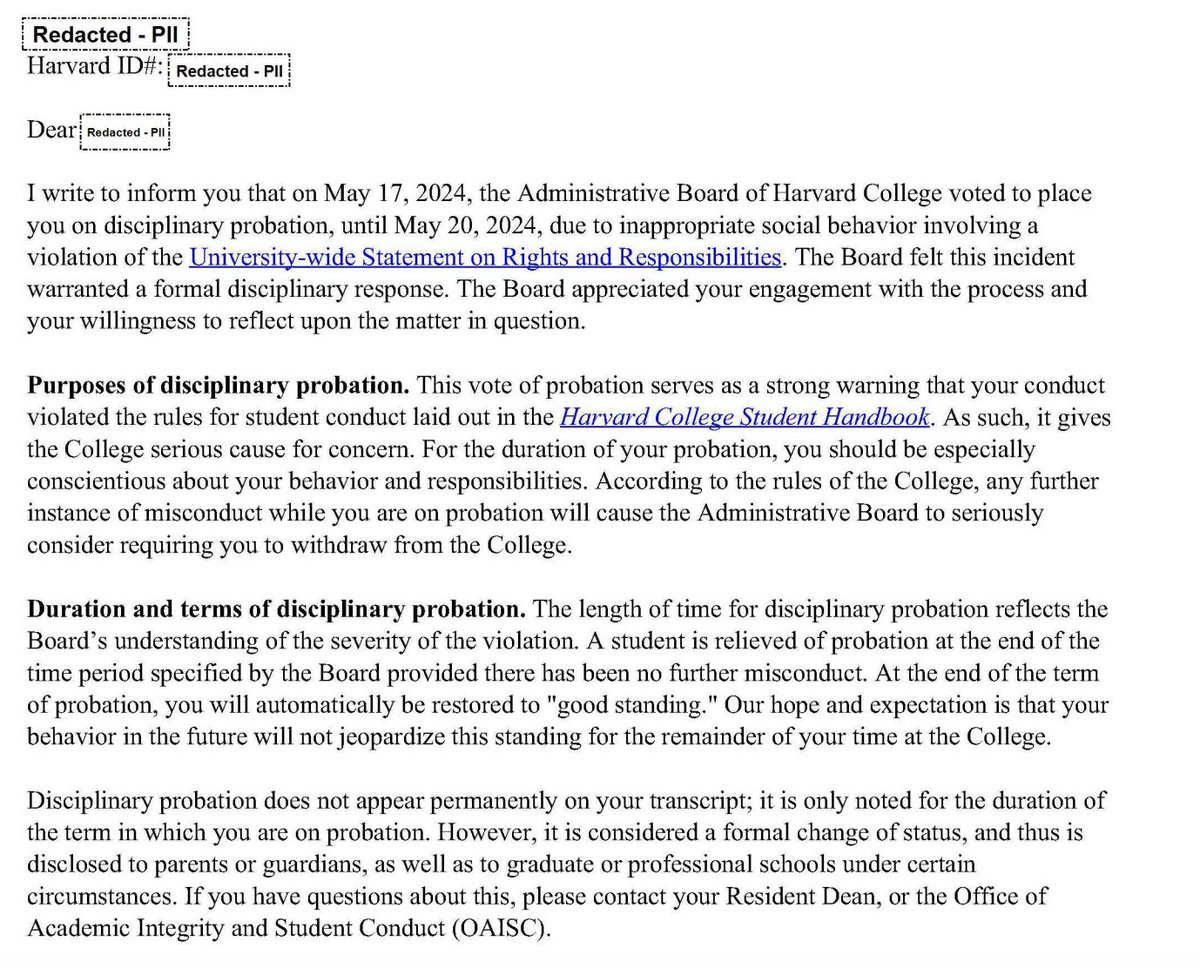
Though the probation would only last a few days, from May 17-20, and would not "appear permanently" on Wu's transcript, the board stated that the punishment would be disclosed to "graduate or professional schools under circumstances," without specifying what those were.
The line likely refers to letters of recommendation, which, per the Harvard College Handbook, "must always" mention "probation for disciplinary reasons."
It is not clear how much West knew about the Administrative Board proceedings taking place at the undergraduate level or vice versa. At Harvard, the university acknowledged in July, "each School is responsible for determining discipline for its own students."
Harvard also placed on probation two other students who had disrupted Xie's talk, including Tsering Yangchen, the co-president of Boston's chapter of Students for a Free Tibet. Both individuals had been escorted out, promptly and peacefully, by security.
"I wish I could say I was surprised, but this is par for the course for Harvard," said Virginia Foxx, the chairwoman of the House Committee on Education and the Workforce, which is conducting a separate investigation of the university over its handling of anti-Semitism.
"The only consistent part of the university's disciplinary standards is that they're always applied selectively to the benefit of favored groups."
Those groups, she continued, include "pro-CCP agitators" as well as anti-Israel students.
Those groups, she continued, include "pro-CCP agitators" as well as anti-Israel students.
News of the disparate disciplinary actions comes as Jewish students are suing Harvard for the school's uneven enforcement of school rules after Oct. 7, when anti-Israel protesters took over public spaces, used megaphones inside campus buildings, and disrupted classes and events.
The lawsuit, which was filed in January before the Chinese ambassador's appearance at the Kennedy School, describes several cases in which Harvard tolerated those disruptions or canceled programming to avoid them.
Many of the protests appeared to violate Harvard's Statement on Rights and Responsibilities—the policy against disrupting events that the university used to punish Wu.
The contrast could strengthen the argument, made at length in the 77-page complaint, that Harvard's willingness to tolerate certain disruptions but not others amounts to anti-Semitic discrimination.
The university "selectively enforces its own rules, deeming Jewish victims unworthy of the protections it readily affords non-Jewish ones," the complaint reads.
"Harvard's clearly unreasonable response to antisemitic discrimination and harassment reflects an egregious double standard, as it is at odds with Harvard's aggressive enforcement of its policies concerning alleged misconduct not involving antisemitism."
Xie is not the first foreign diplomat to be disrupted at Harvard: Protesters interrupted Michael Herzog, Israel's ambassador to the United States, when he came to the Kennedy School in 2022. It is not clear whether those students faced any consequences for the disruption.
Tldr: Harvard spent months tolerating disruptive anti-Israel protests. Then it brought the hammer down on a Taiwanese girl who was peacefully protesting a CCP apparatchik—while letting the Chinese national who assaulted her off the hook.
freebeacon.com/campus/harvard…
freebeacon.com/campus/harvard…
• • •
Missing some Tweet in this thread? You can try to
force a refresh