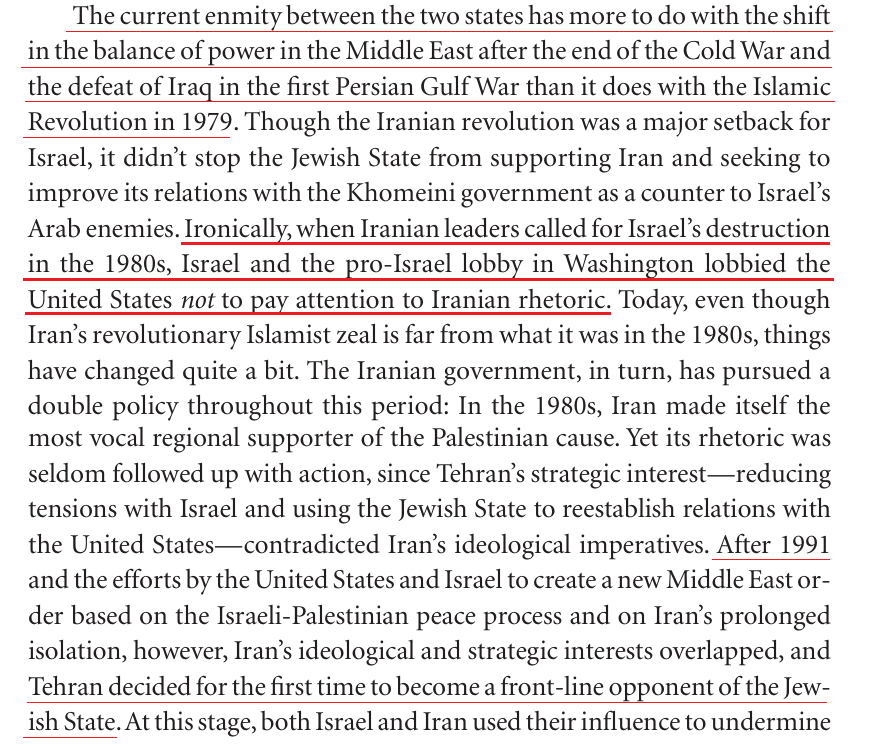
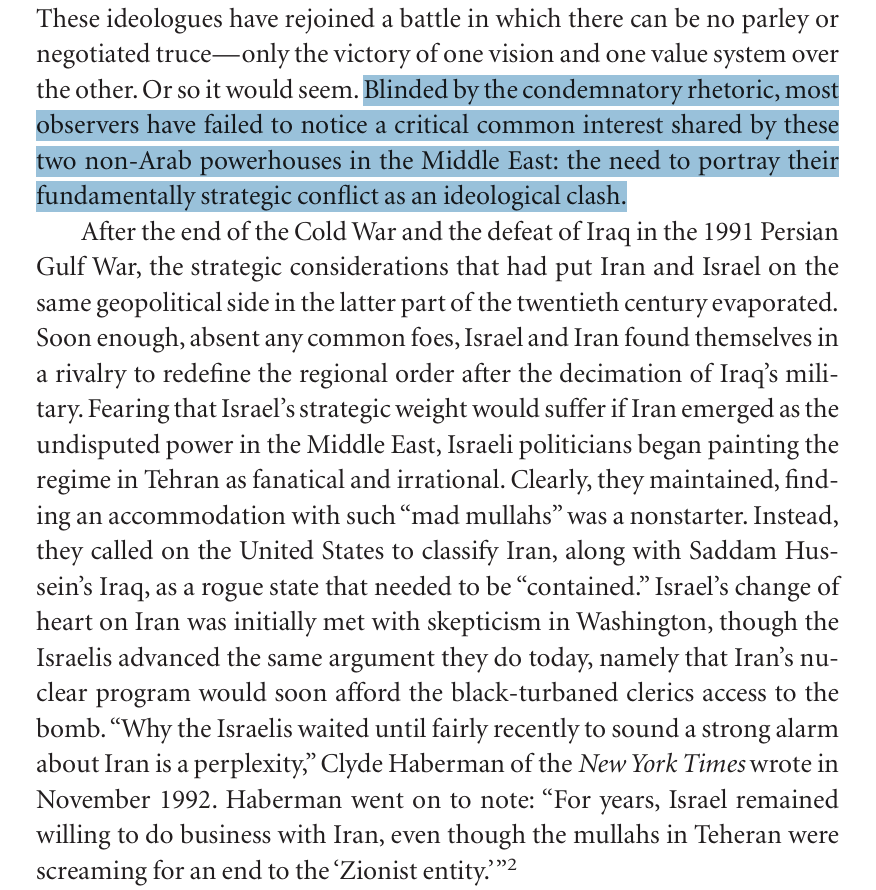
Thread w/excerpts of How Long Will South Africa Survive (1982).
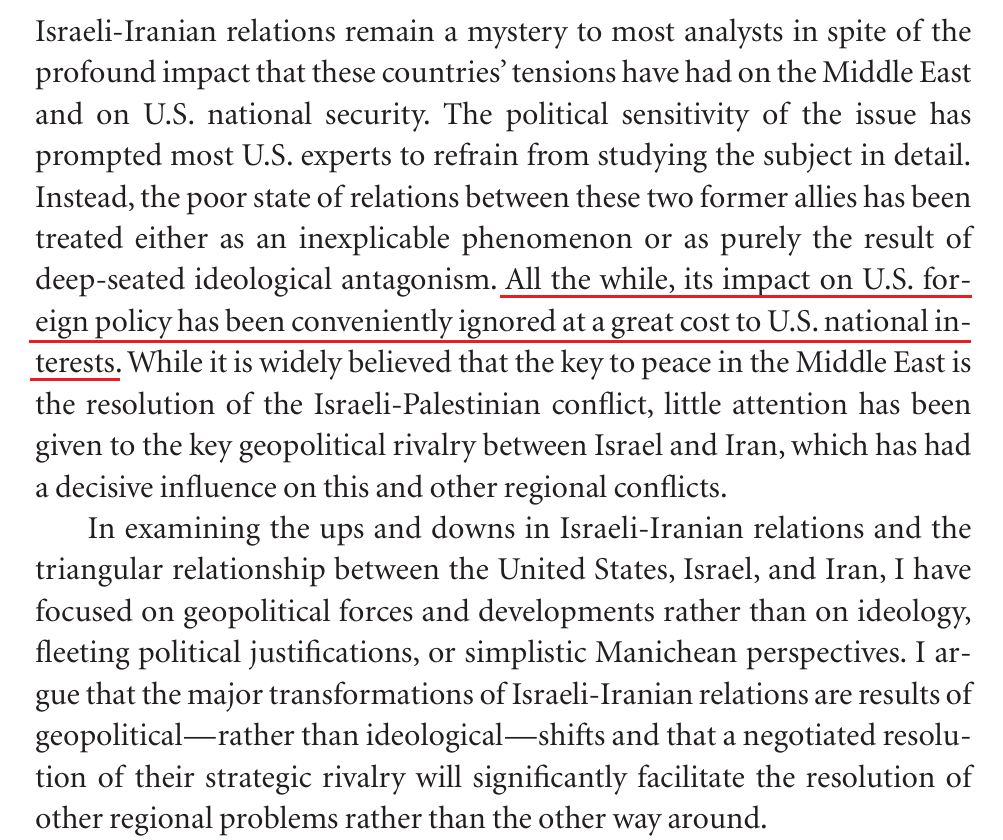
Much new info here to me; as a millennial, how apartheid SA worked as a state is a blank. Parallels with🇮🇱 are constant, though author never draws them. SA however, couldn't rely on a powerful lobby or diaspora.
Much new info here to me; as a millennial, how apartheid SA worked as a state is a blank. Parallels with🇮🇱 are constant, though author never draws them. SA however, couldn't rely on a powerful lobby or diaspora.
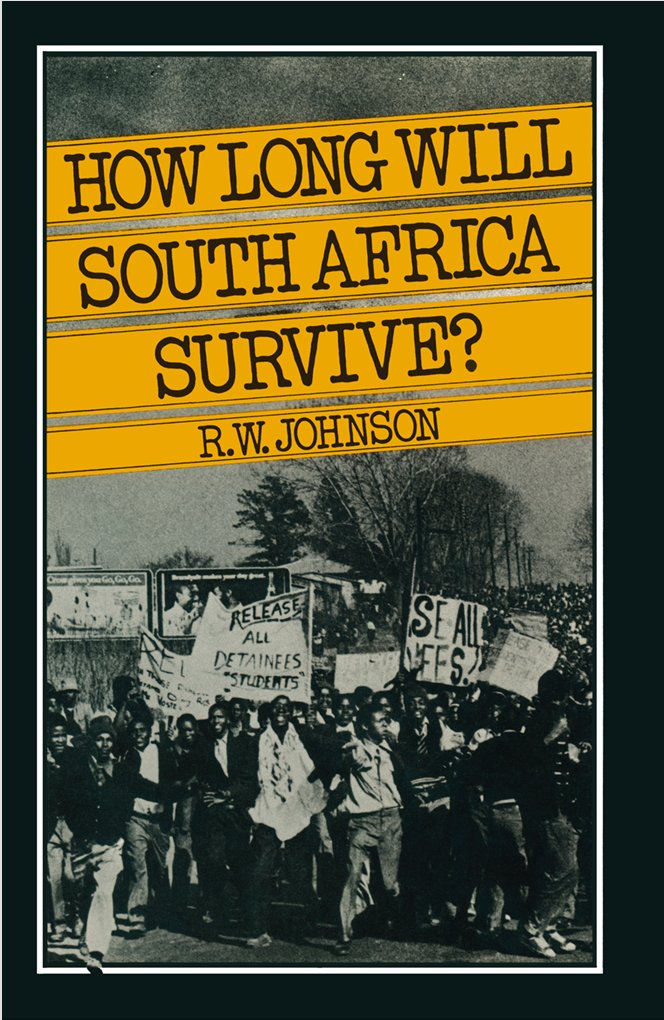
Author opens with the 1960 Sharpeville massacre, contends SA government very narrowly missed a violent overthrow, just as the Tsarist Russia barely dodged the abortive 1905 Revolution.
Both states had experienced breakneck economic growth alongside boiling social tension.
Both states had experienced breakneck economic growth alongside boiling social tension.


Worth noting that <100 casualties suffered at the hands of SA police were quite minor in comparison to massacres associated with the transition to black rule (Zanzibar, Congo etc) elsewhere in 60s Africa.
Sharpeville's aftermath marked SA's turn to a security state.
Sharpeville's aftermath marked SA's turn to a security state.
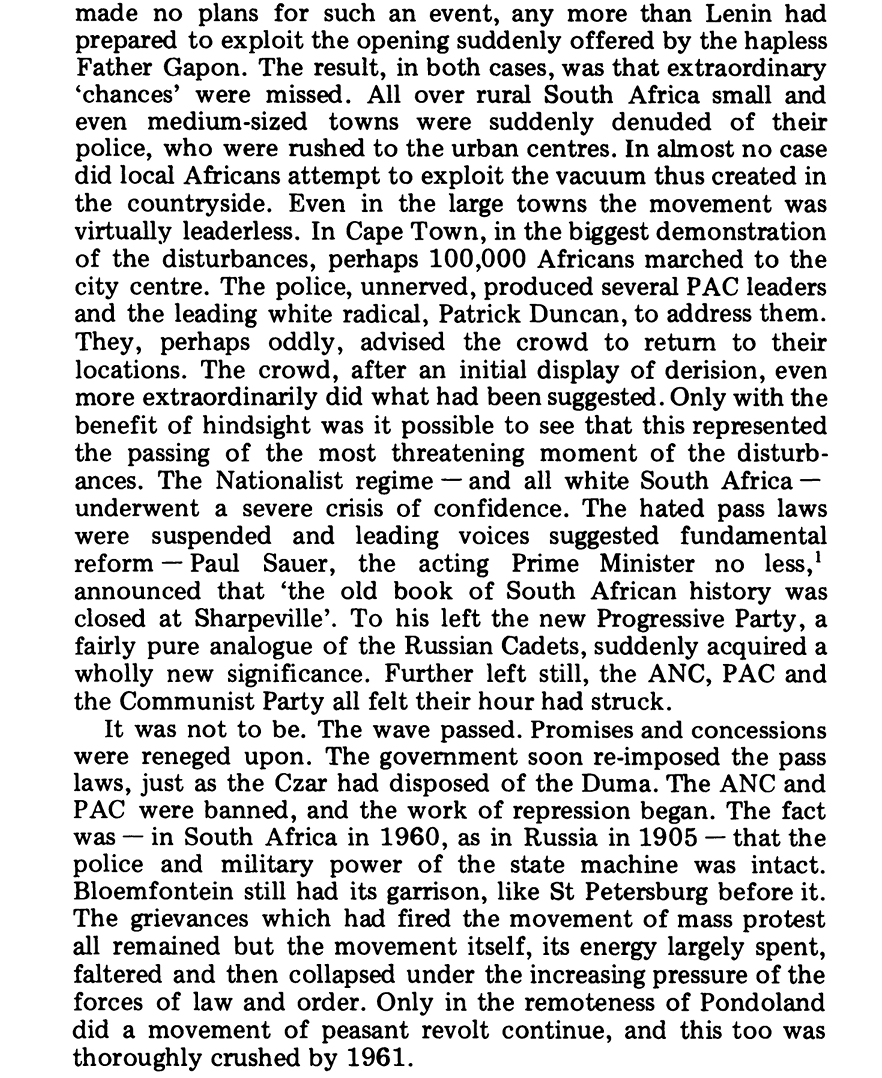
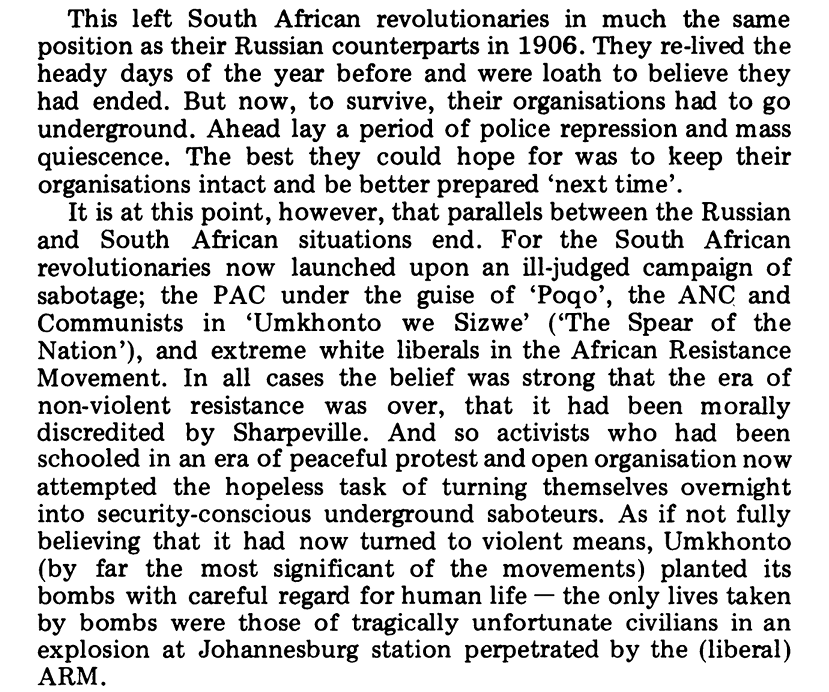
In the purges after Sharpeville, whites supporting violent anti-apartheid organisations practically disappeared. Organisations like the ANC or the CPSA (Communists) became nearly entirely black, with a few senior exceptions like the✡️Joe Slovo. Failed operations led to exile.
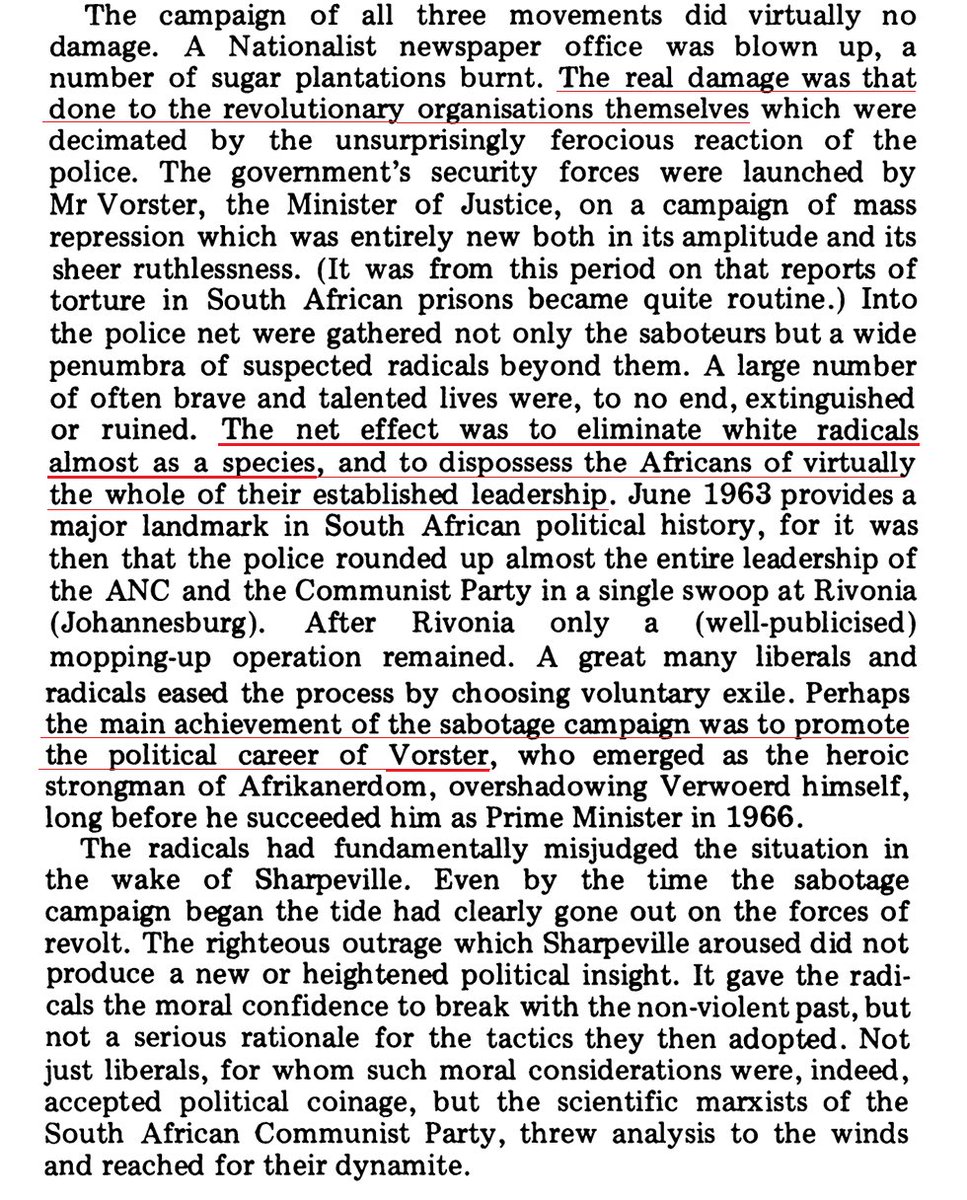
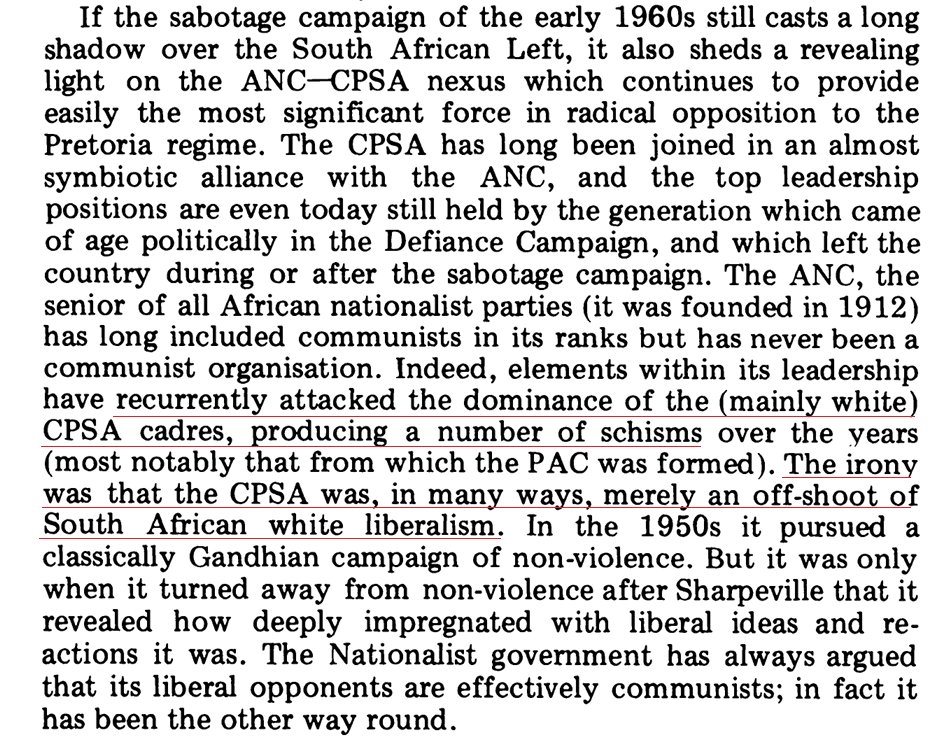
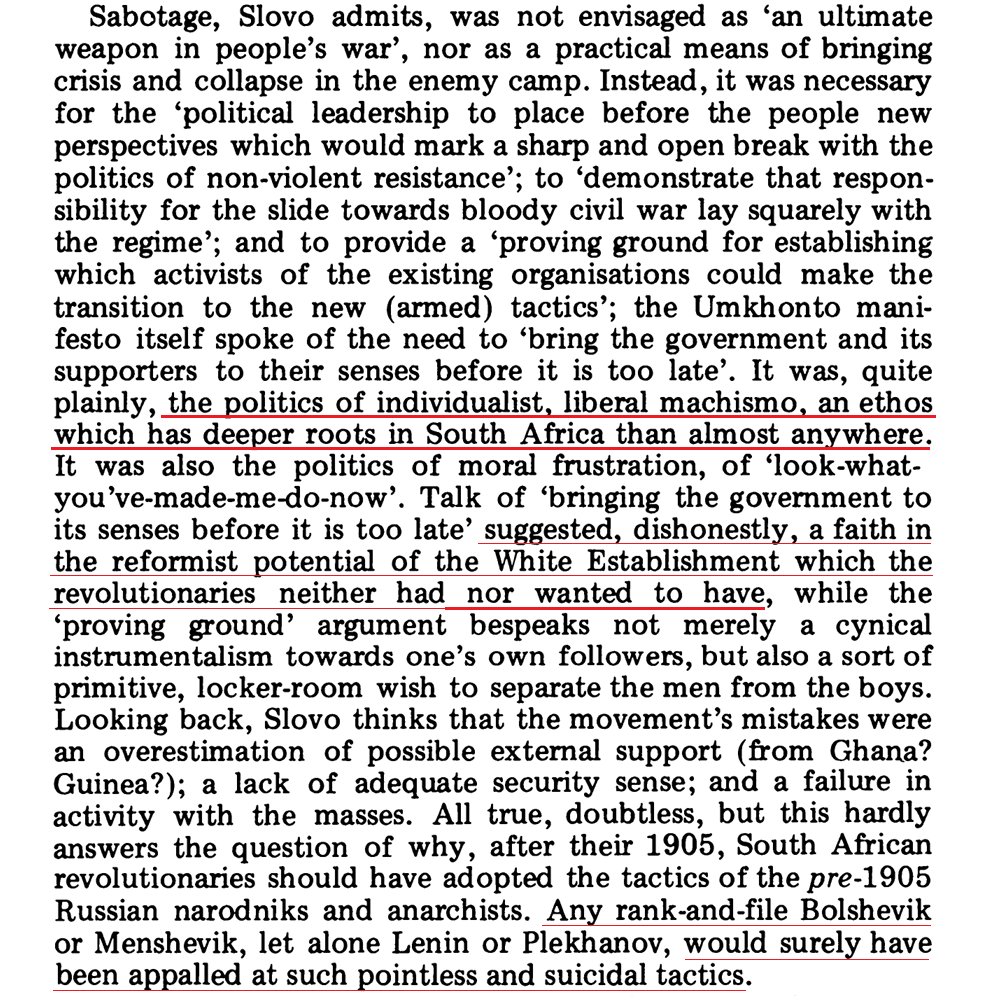
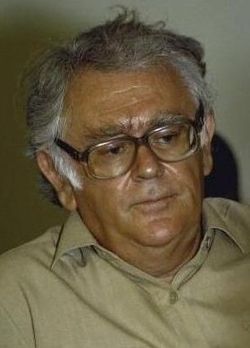
SA anti-apartheid orgs suffered from the usual positive delusions of exiled activists, despite repeated failures. Aside from the USSR, much of their support came from Anglican & Scandi churches. The CPSA was particularly useless & fractured.
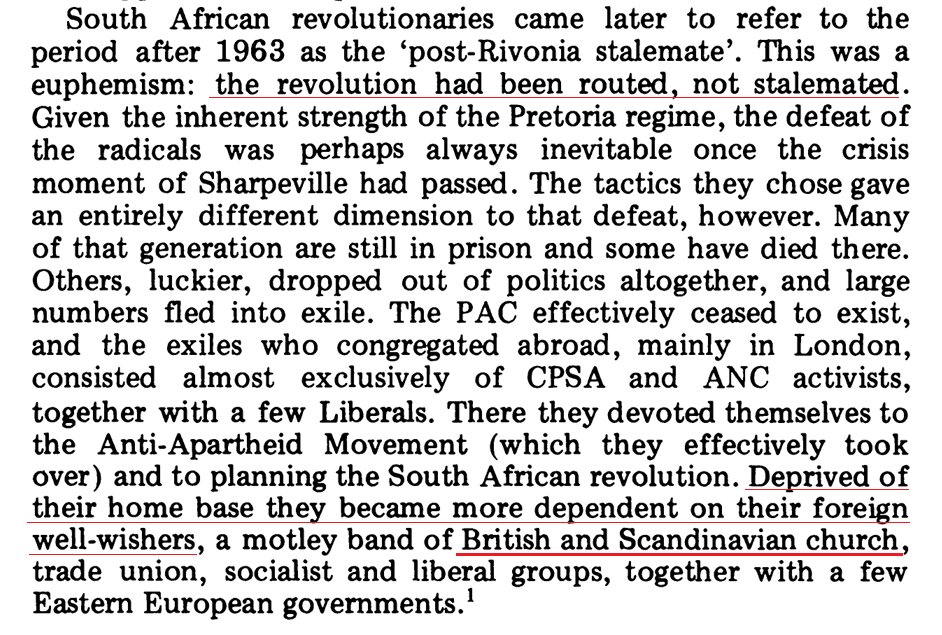


Despite the impotence of anti-apartheid orgs, Sharpeville had serious economic impact. Foreign investment fled, a rude shock to a population that had so far experienced nothing but growth. Many Anglo whites emigrated, seeing their future in SA as either kill-or-be-killed.

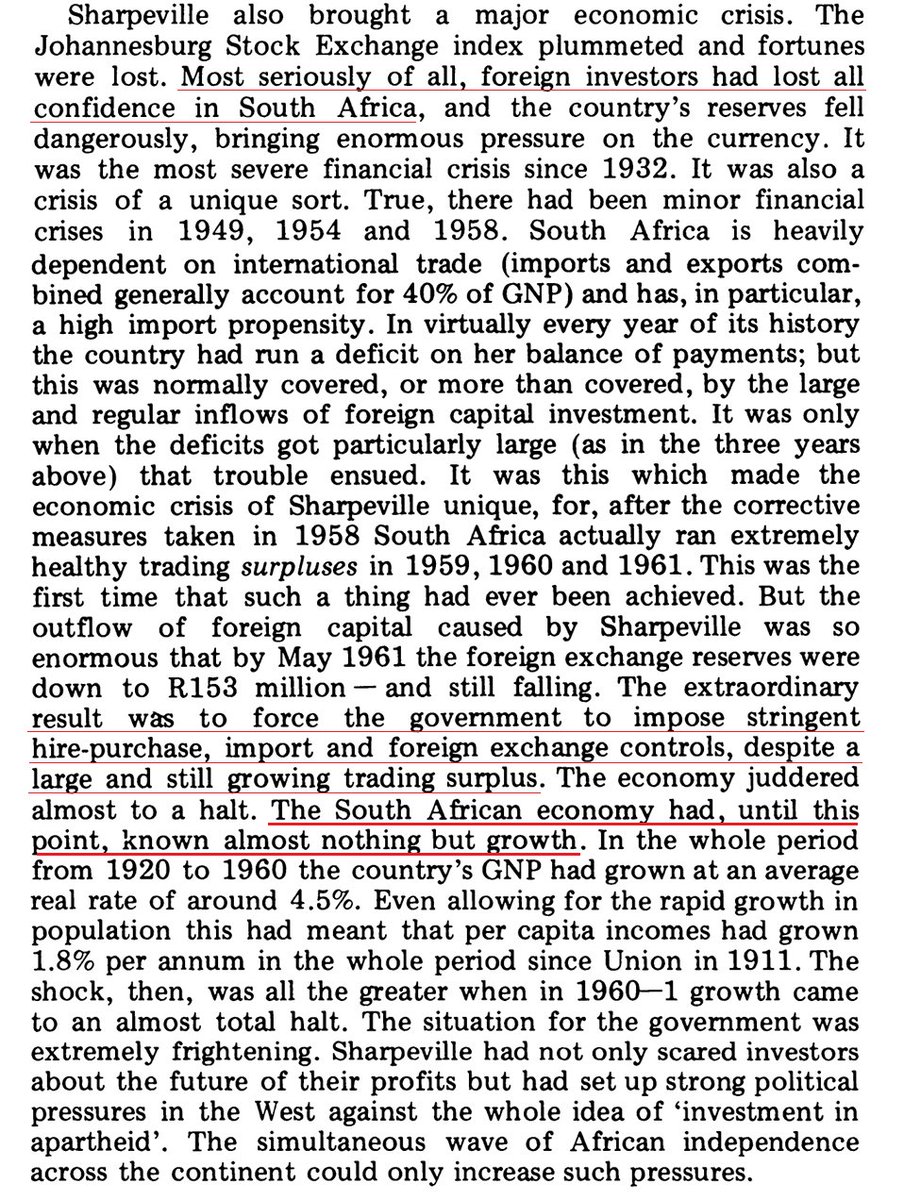
The downturn was surprisingly brief. The economy rapidly recovered & black dissent was crushed. Emigres to 🇦🇺returned complaining of its lack of servants.
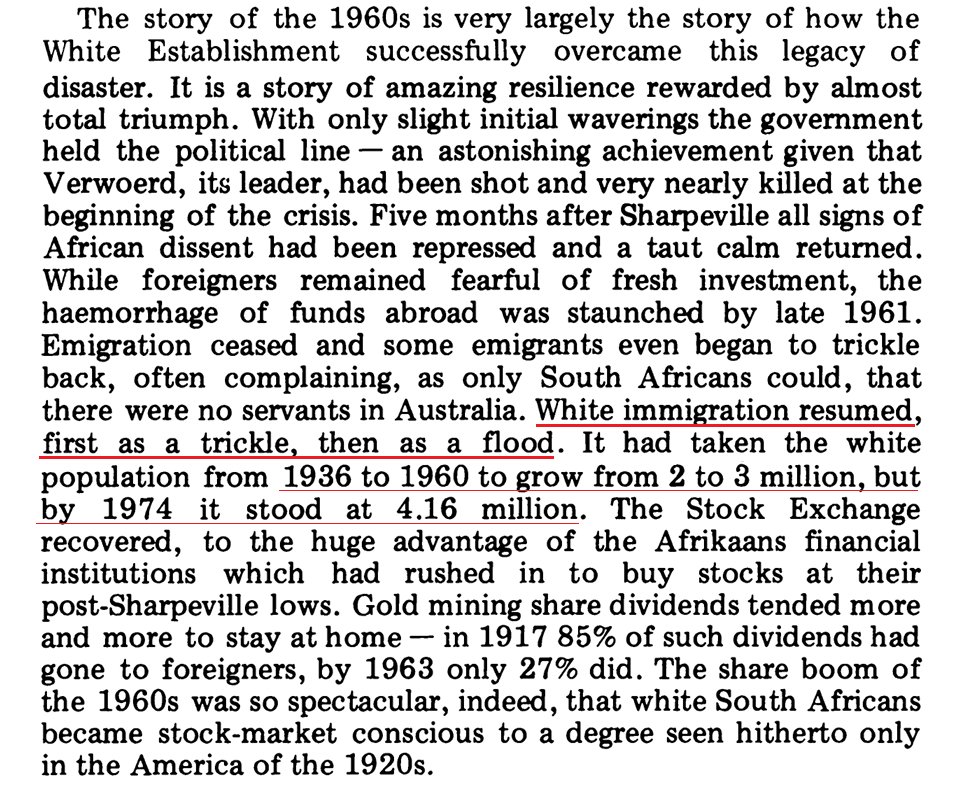
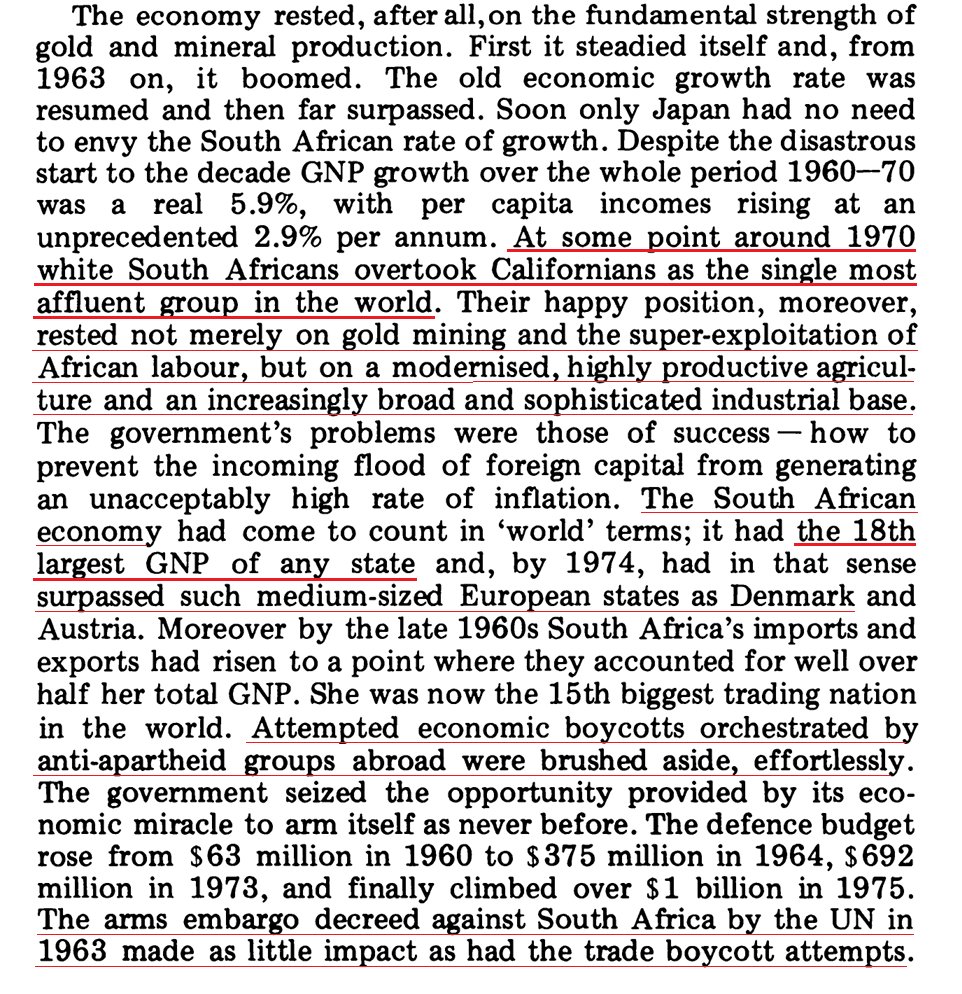
There was mass-immigration to SA, growing the white pop 25% in 15 years. By 1970, SA whites were richer than Californians.
There was mass-immigration to SA, growing the white pop 25% in 15 years. By 1970, SA whites were richer than Californians.
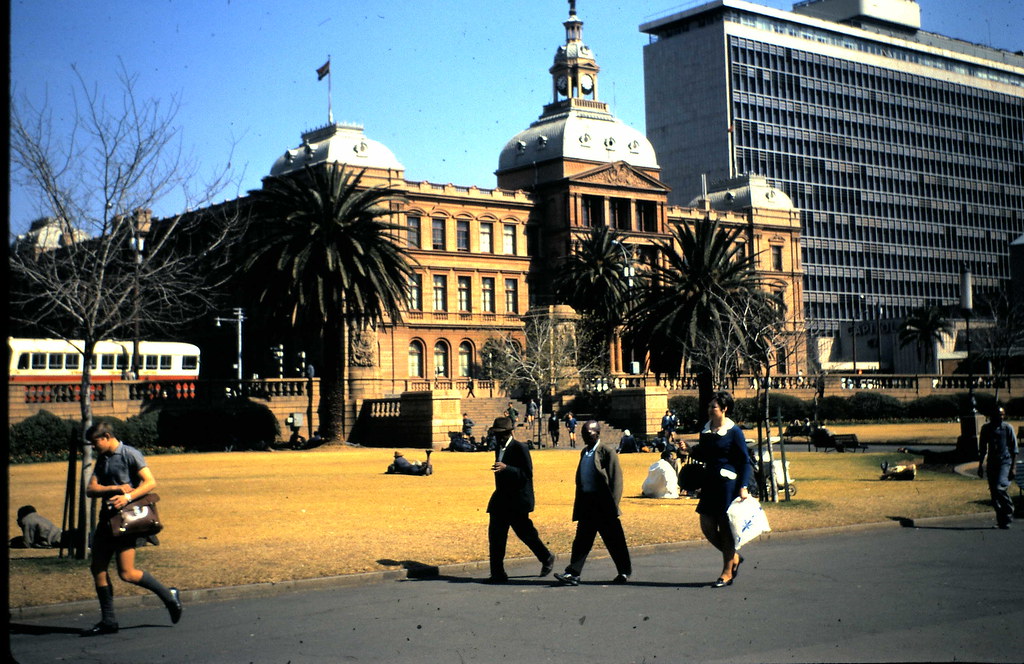
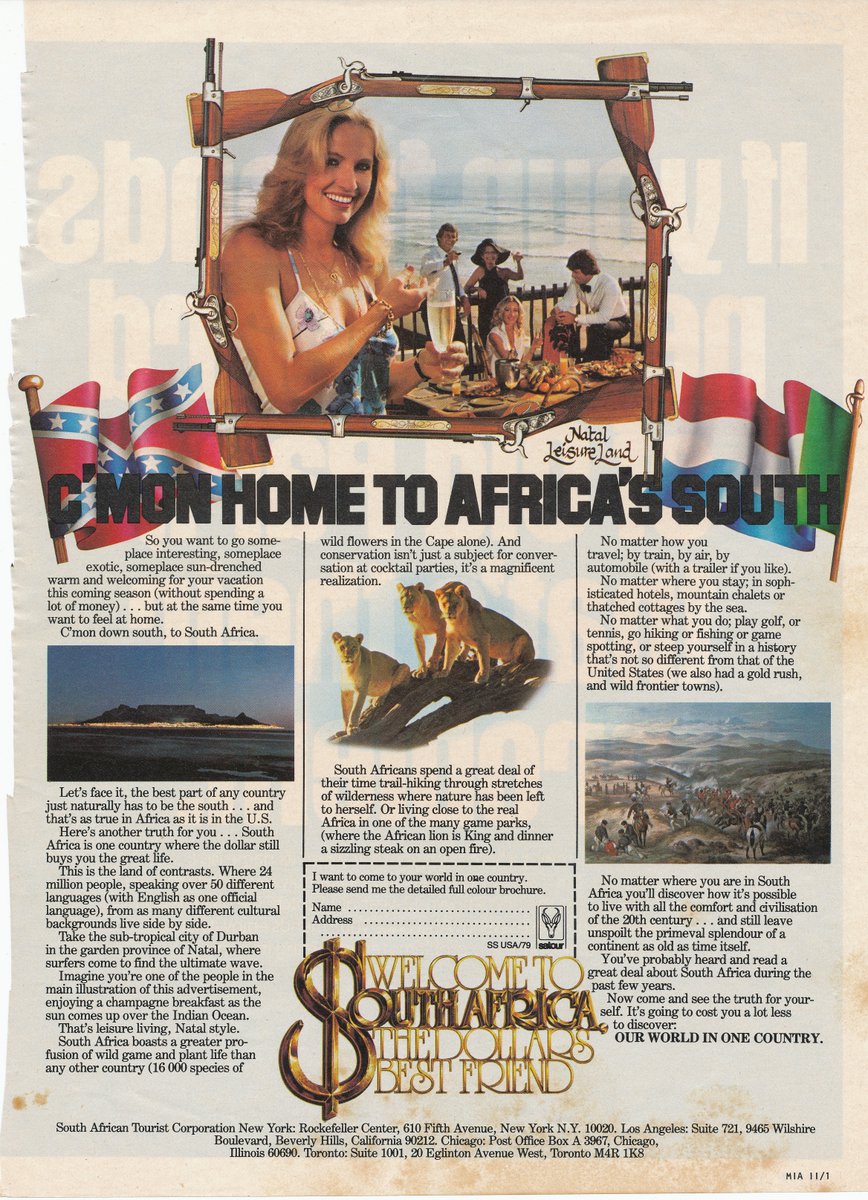
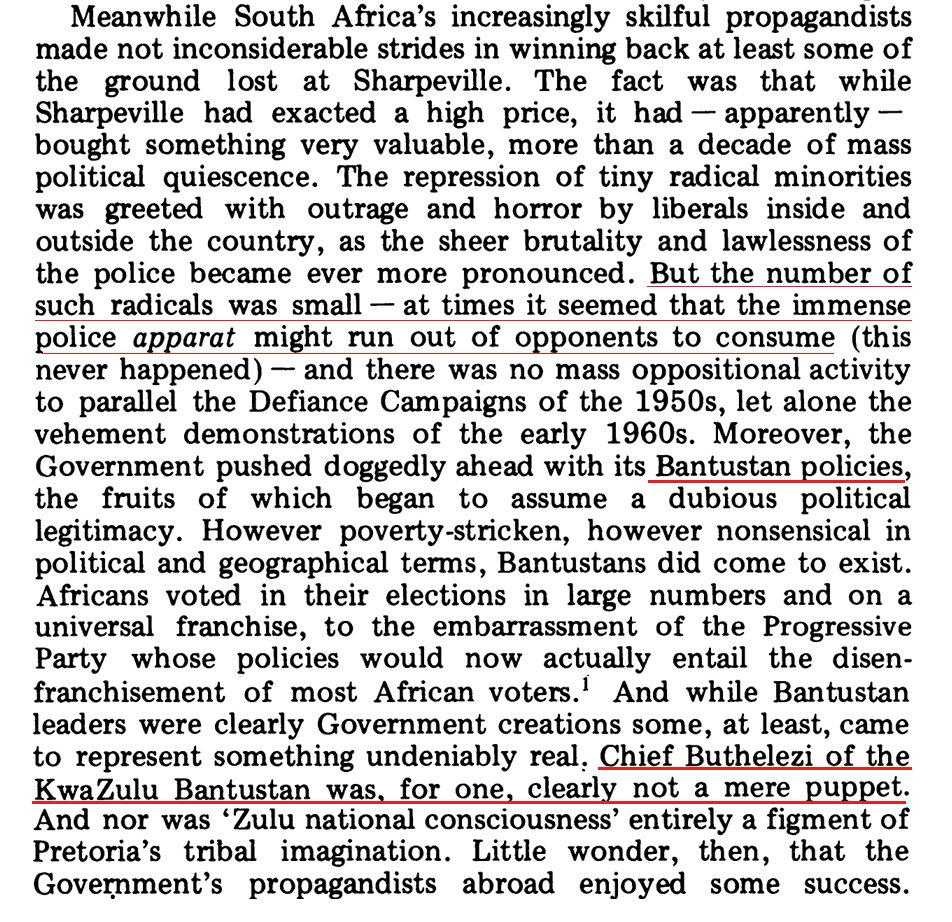
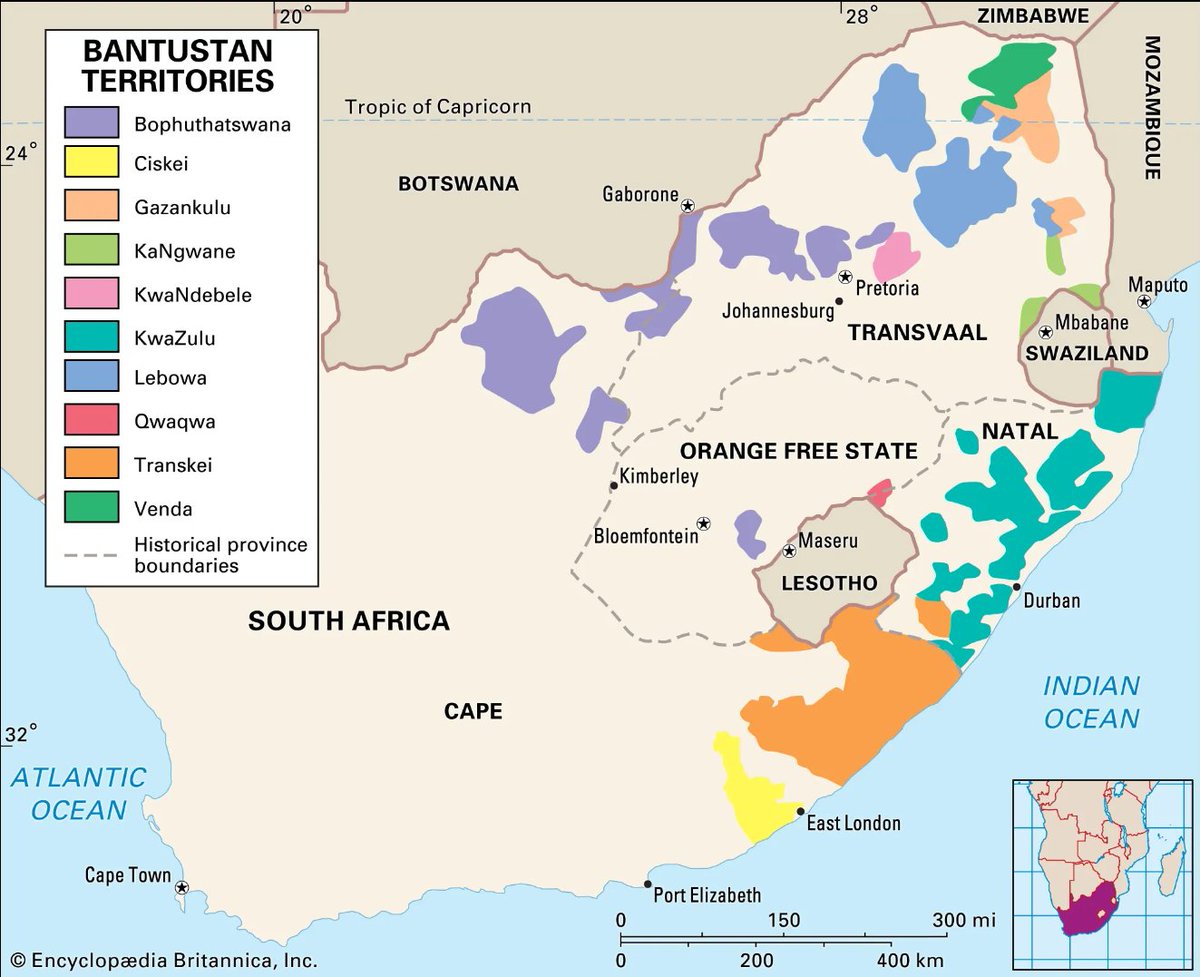
SA & its now forgotten Bantustan policies - parcels of disconnected land which SA granted a ghostly independence, with their own flags & local governance (saving SA costs). Parallels to Palestinian enclaves in Judea & Samaria so obvious I wonder if they were a direct inspiration.
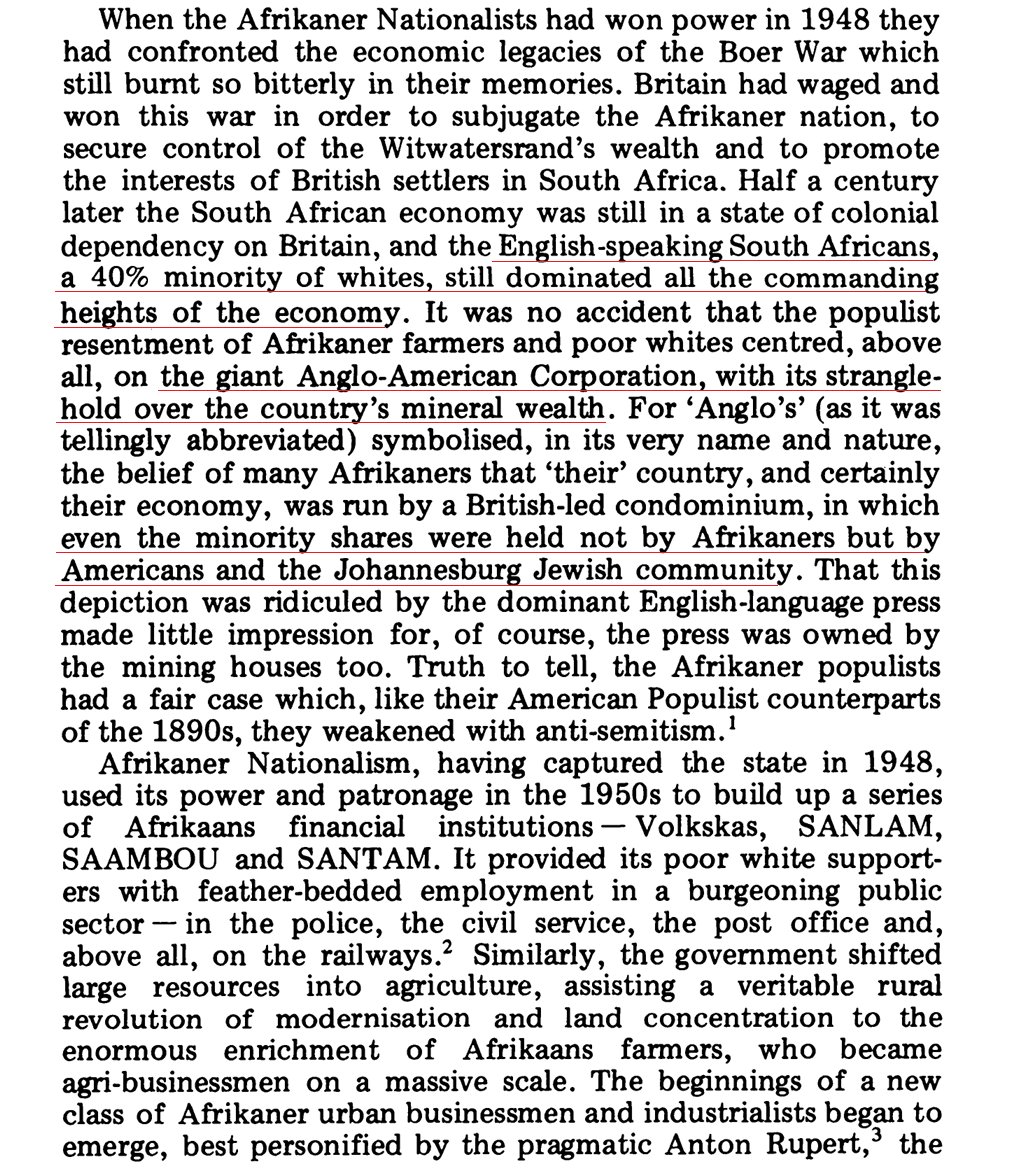
Never wanting to repeat its 1960 divestment shock, SA made strenuous efforts to modernise its economy & build an its own industrial base. Mineral wealth let SA reward states willing to impart their technological expertise handsomely. Similarly endowed, 🇦🇺 has lacked such vision.

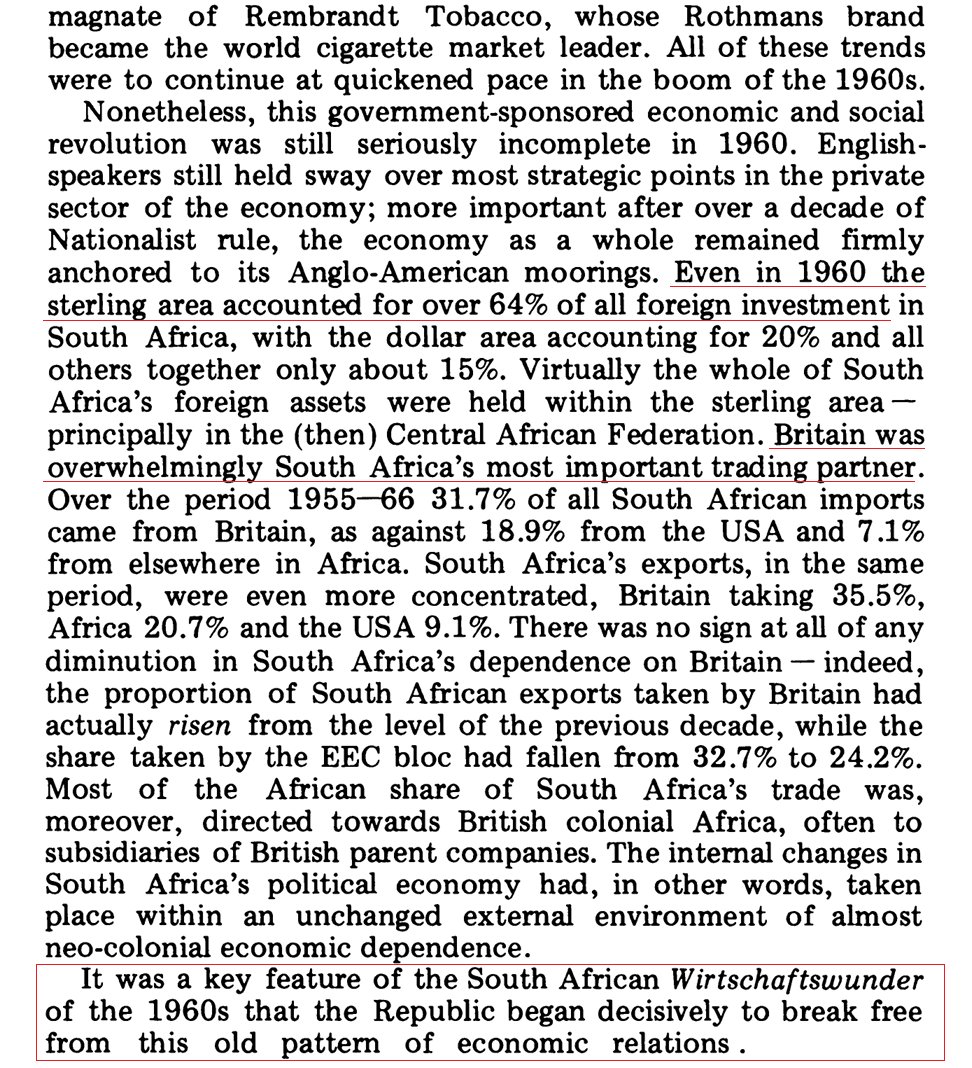
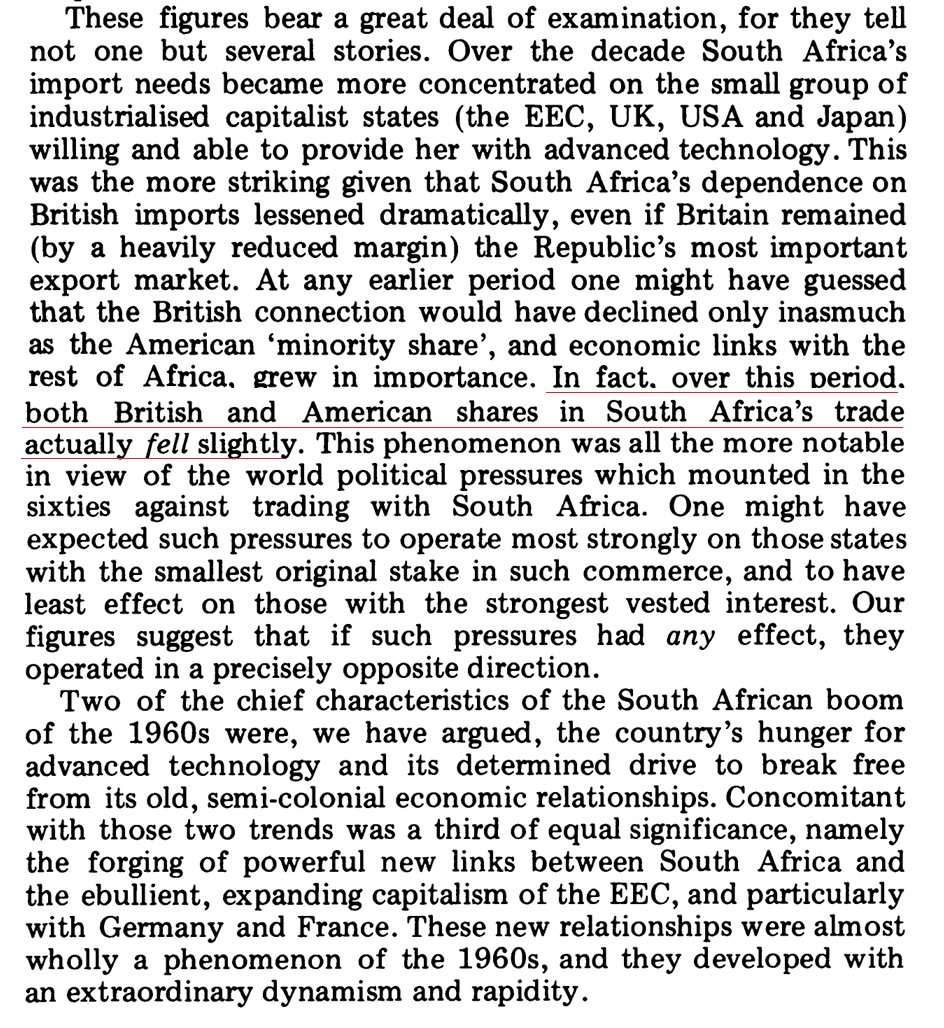
SA-Japan relations limited to trade only: 🇯🇵 didn't even maintain an embassy.
In discussions preparing for black rule in Rhodesia, 🇯🇵opposed Kissinger's plan to have white farmers etc compensated for expropriation, deriding them as "beneficaries of racism". Amazing hypocrisy.
In discussions preparing for black rule in Rhodesia, 🇯🇵opposed Kissinger's plan to have white farmers etc compensated for expropriation, deriding them as "beneficaries of racism". Amazing hypocrisy.

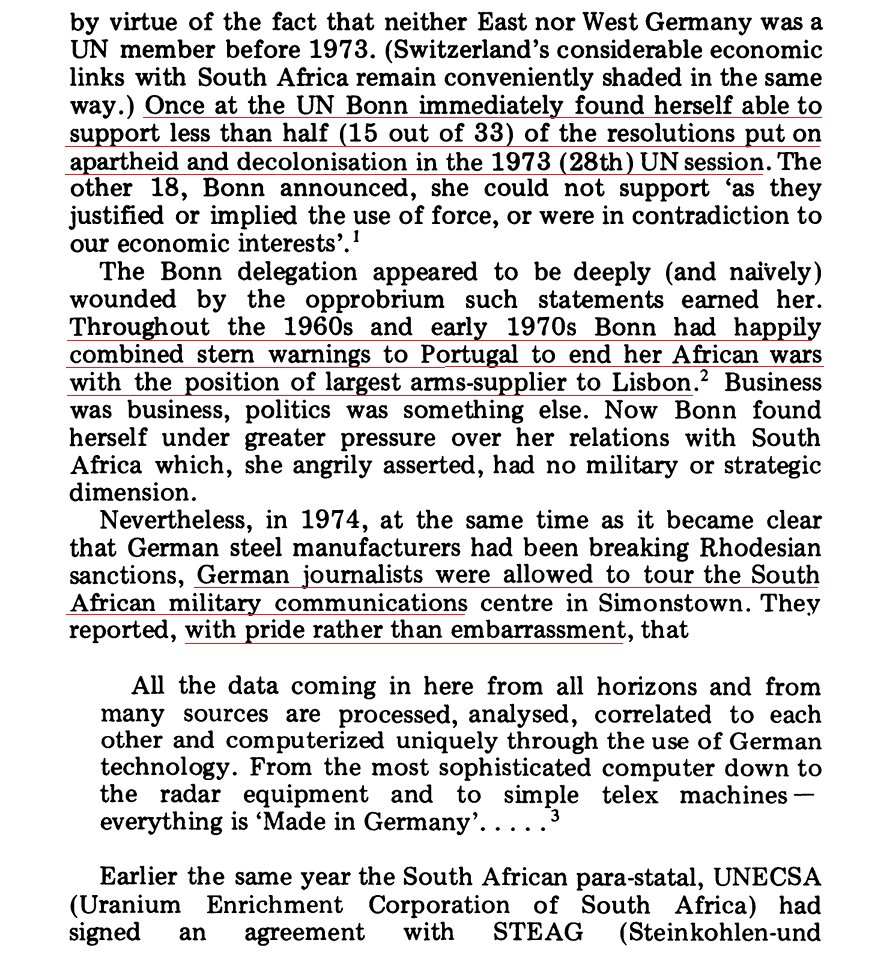
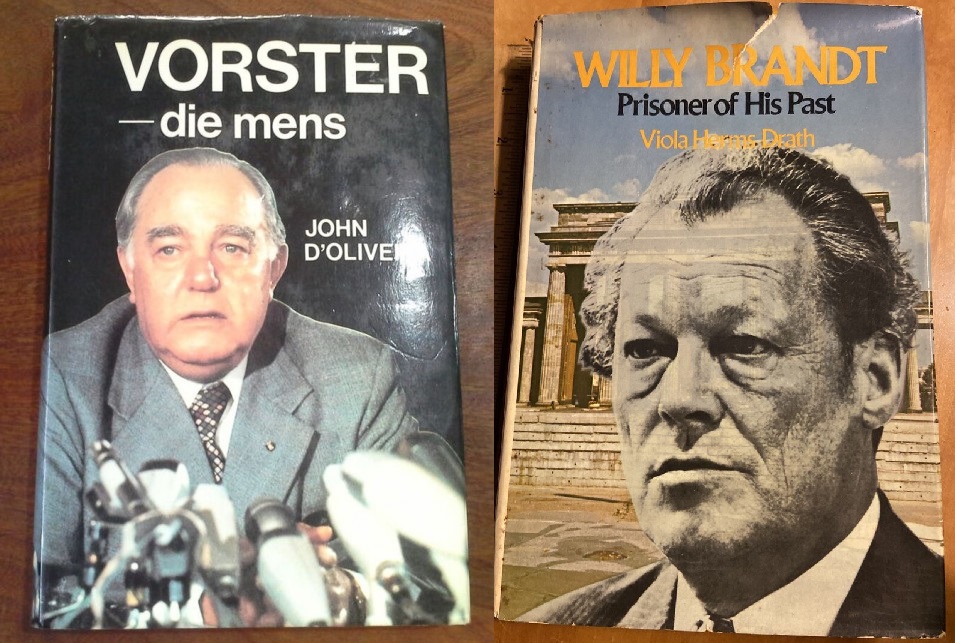
During W.German's "economic miracle", its ties to SA became very close. Culture & trade ties transcended politics, with Nazi sympathiser Vorster & once-exiled anti-Nazi activist Brandt enjoying a warm personal relationship. W.🇩🇪 was also 🇵🇹's main arms supplier, rhetoric aside.
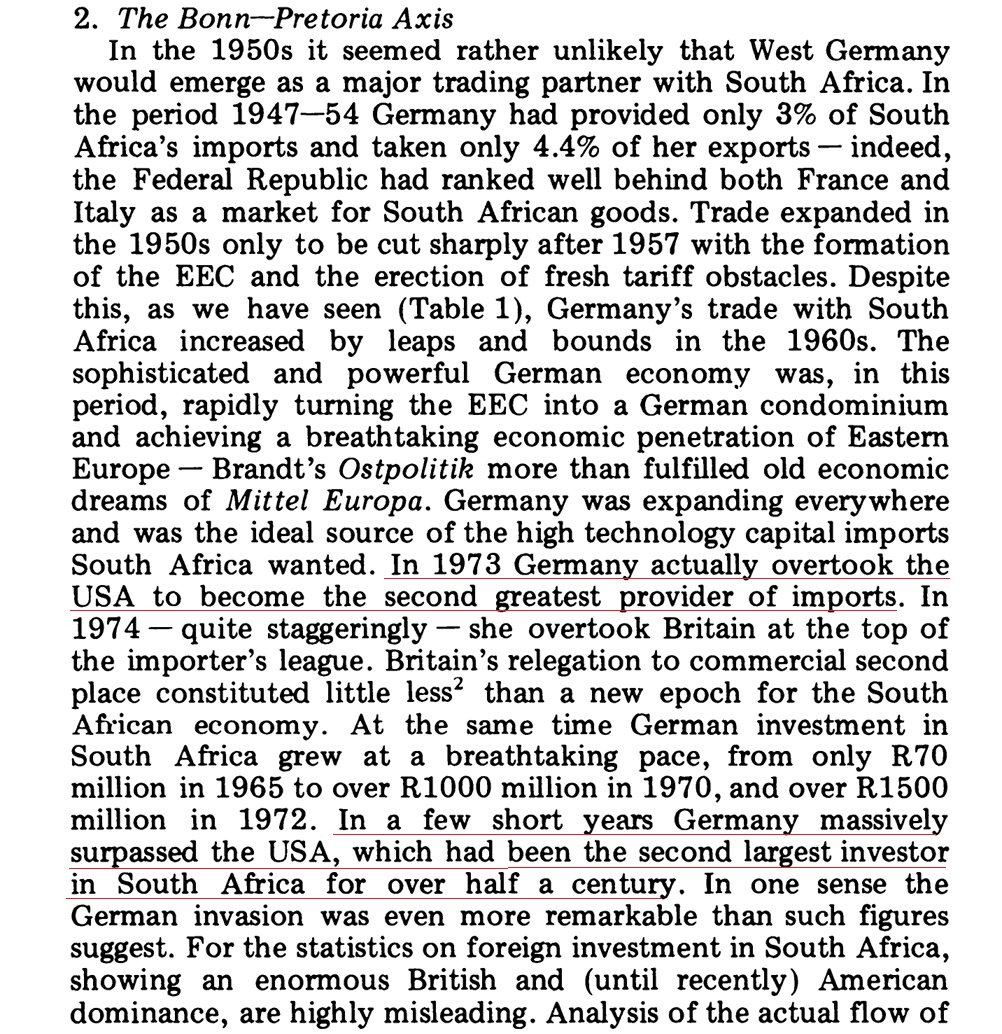
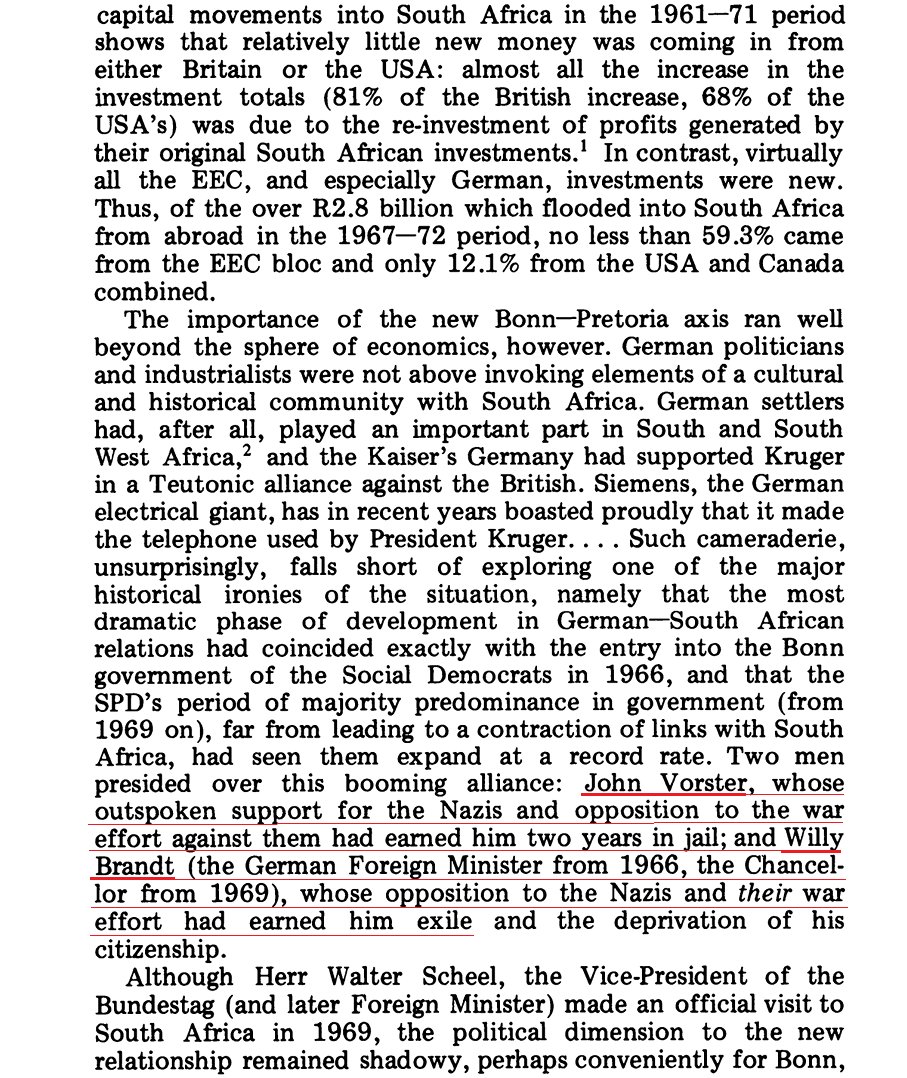
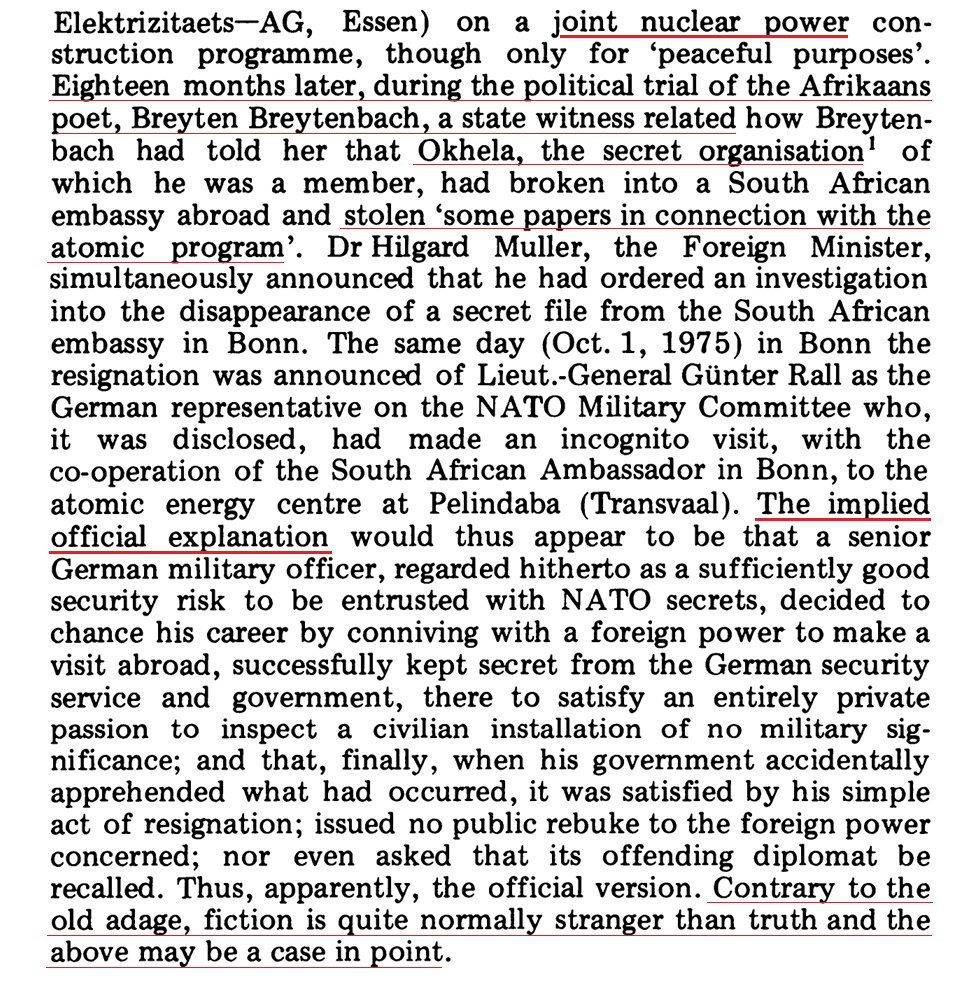
SA also acquired its nuclear technology from W.Germany, quite clearly with official blessing, despite the utterly ridiculous cover-story that was provided to the media when it was inadvertently discovered by the press. Recently, many such cases.
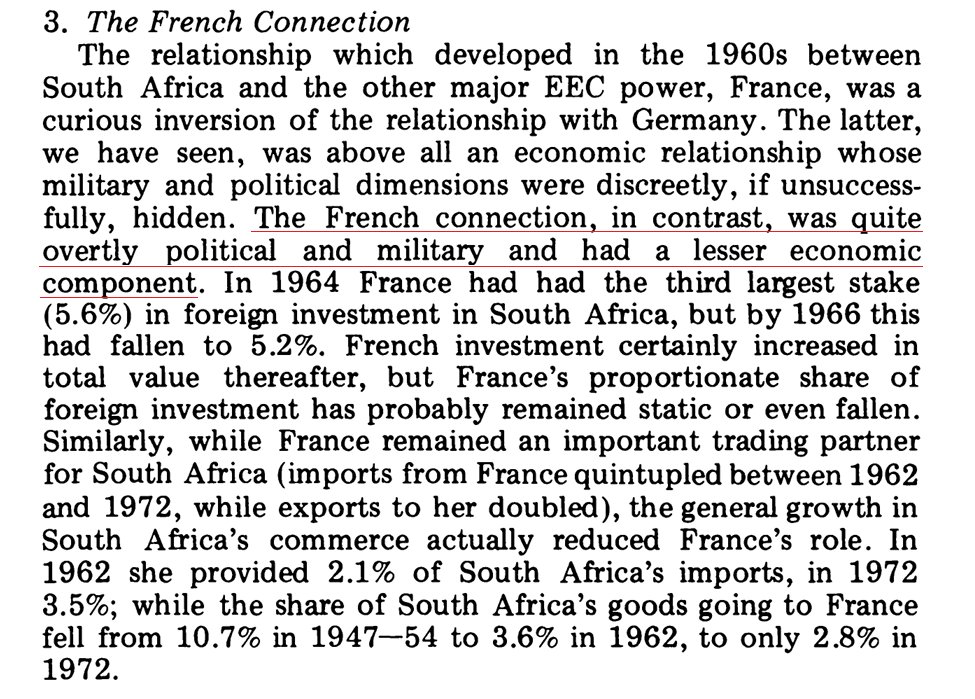
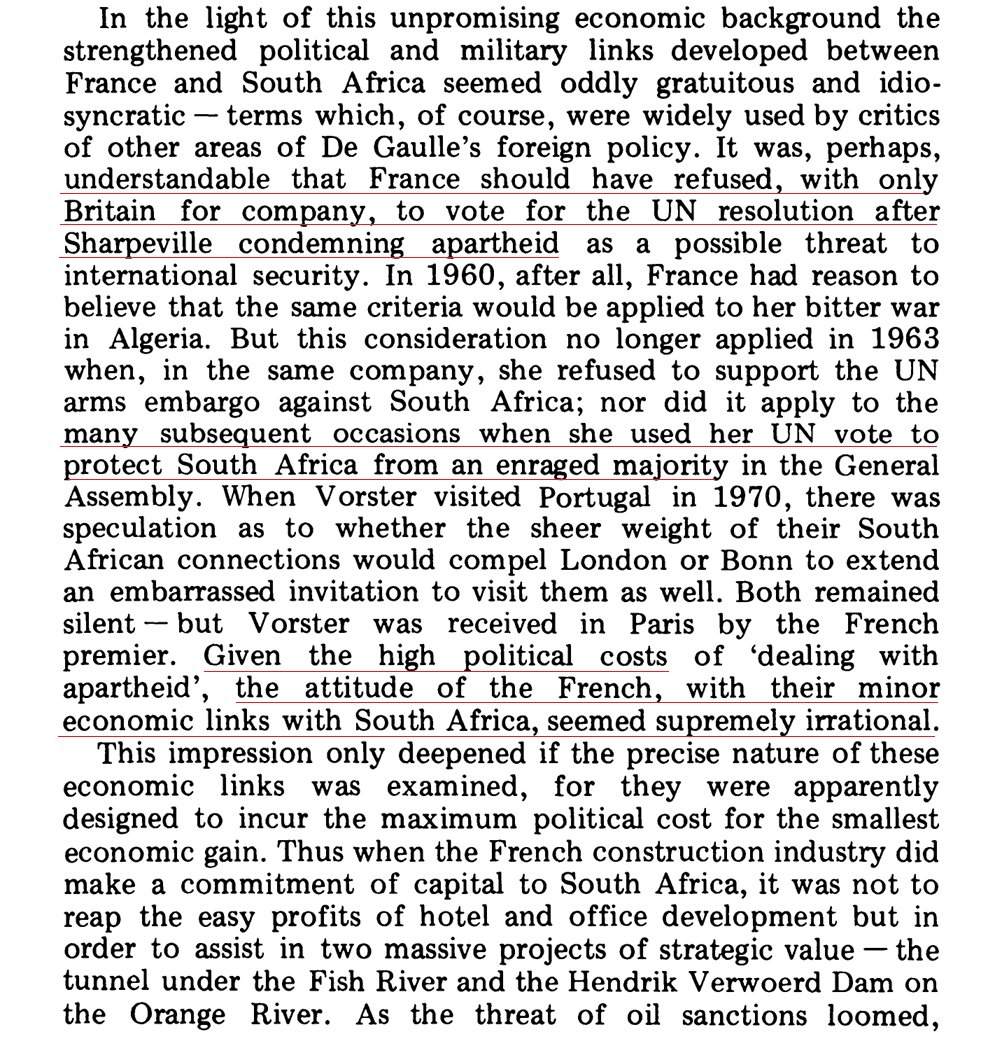
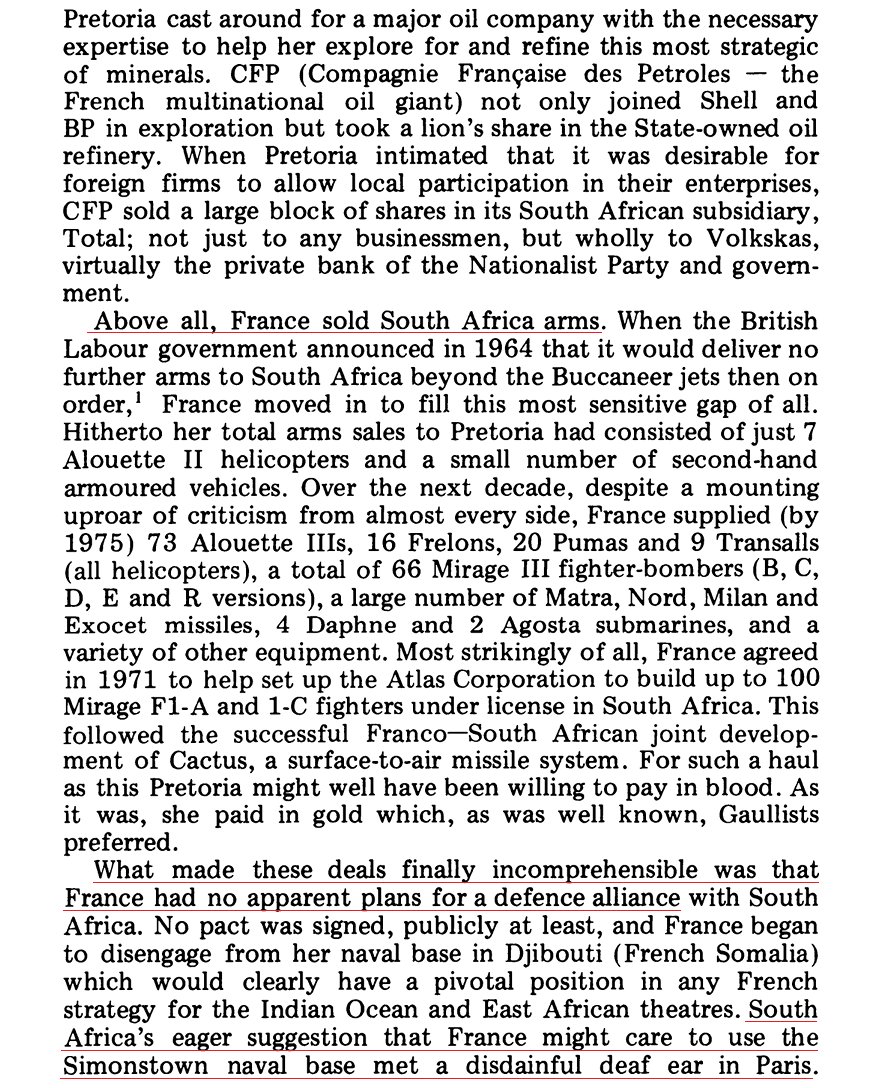
At the UN, 🇫🇷 used its veto power to shield SA from 3rd-World condemnation, even in opposition to both superpowers. It sold SA vast quantities of arms but otherwise kept it at arms length, not wanting to owe SA a thing, & be free to cut ties at anytime, as it did to 🇮🇱 post-1967.

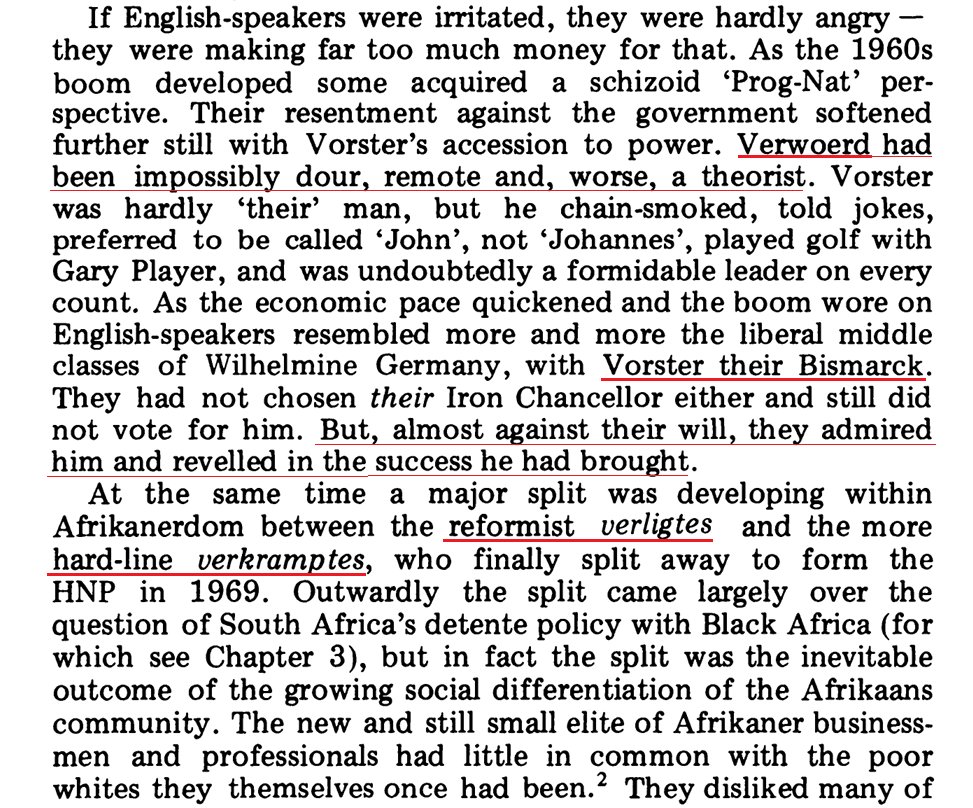
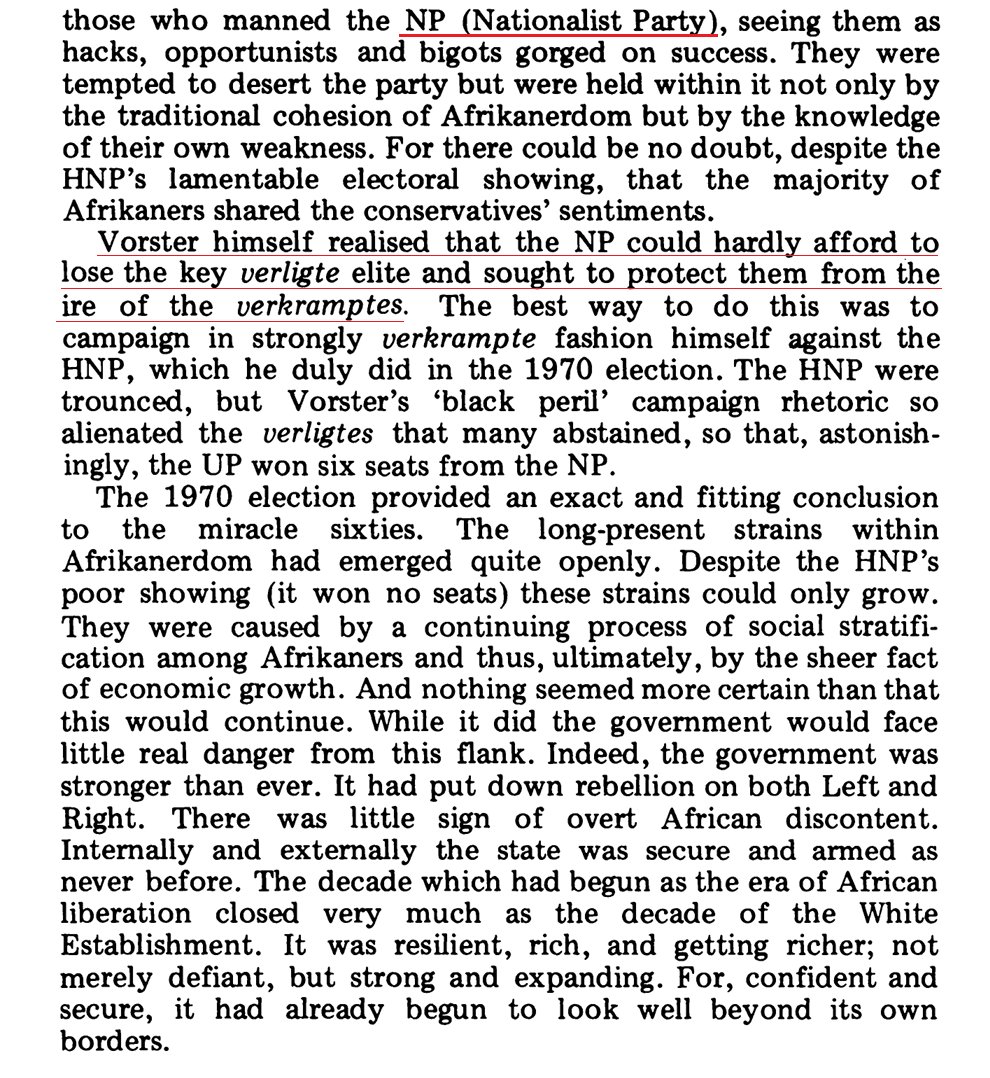
Factions within SA whites. The Anglos mostly voted for the liberal United Party. Afrikaaner voters were split between verligte reformers (NA) & the verkrampte hardliners (HNP).
Though the latter were divided, Vorster's skillful leadership ensured continued Afrikaaner dominance.
Though the latter were divided, Vorster's skillful leadership ensured continued Afrikaaner dominance.

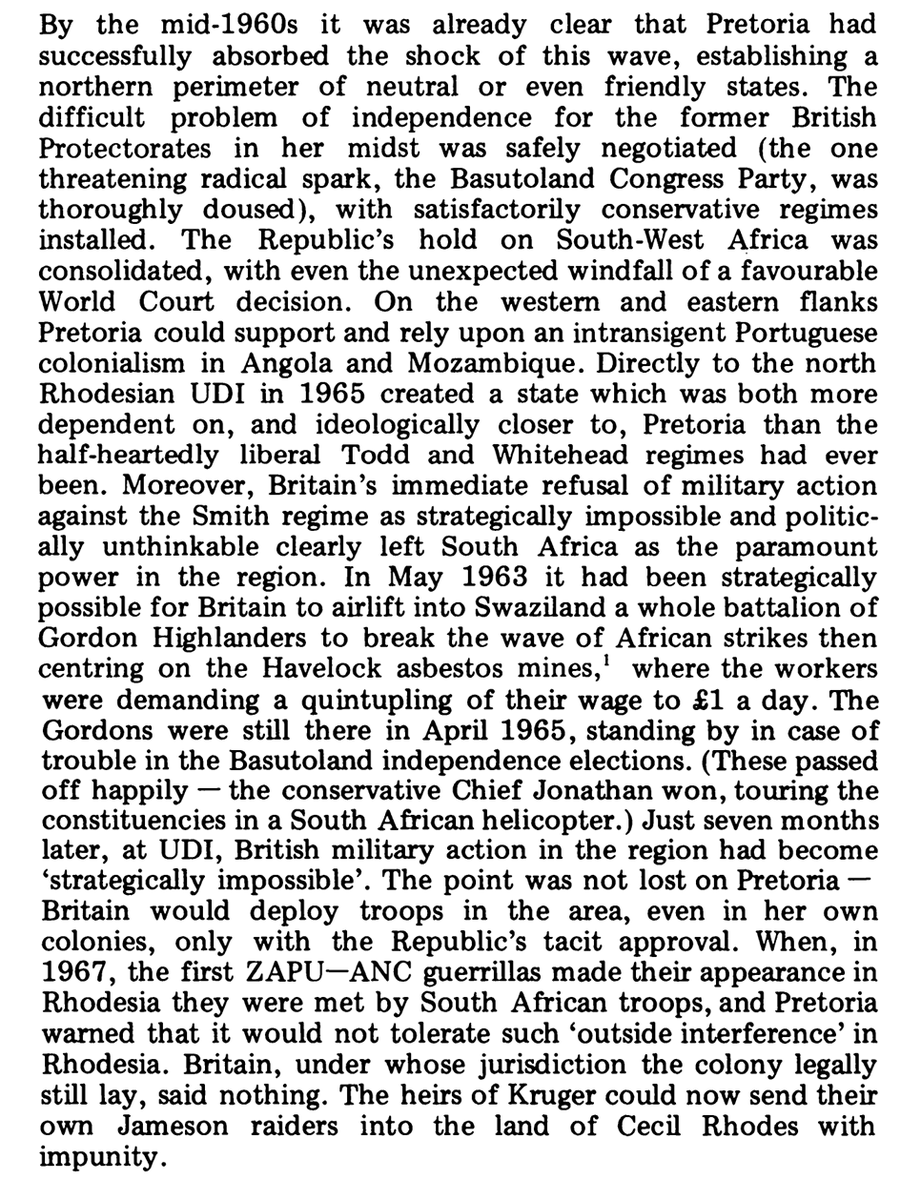
SA buffer states. Botswana neutral. Unexpected UN mandate of Namibia to SA. Rhodesian "Unilateral Declaration of Independence (UDI). Zambia & Malawi secretly friendly despite rhetoric, much like Jordan & Israel today. With 🇵🇹-run Mozambique & Angola, 60s SA dominated its region.
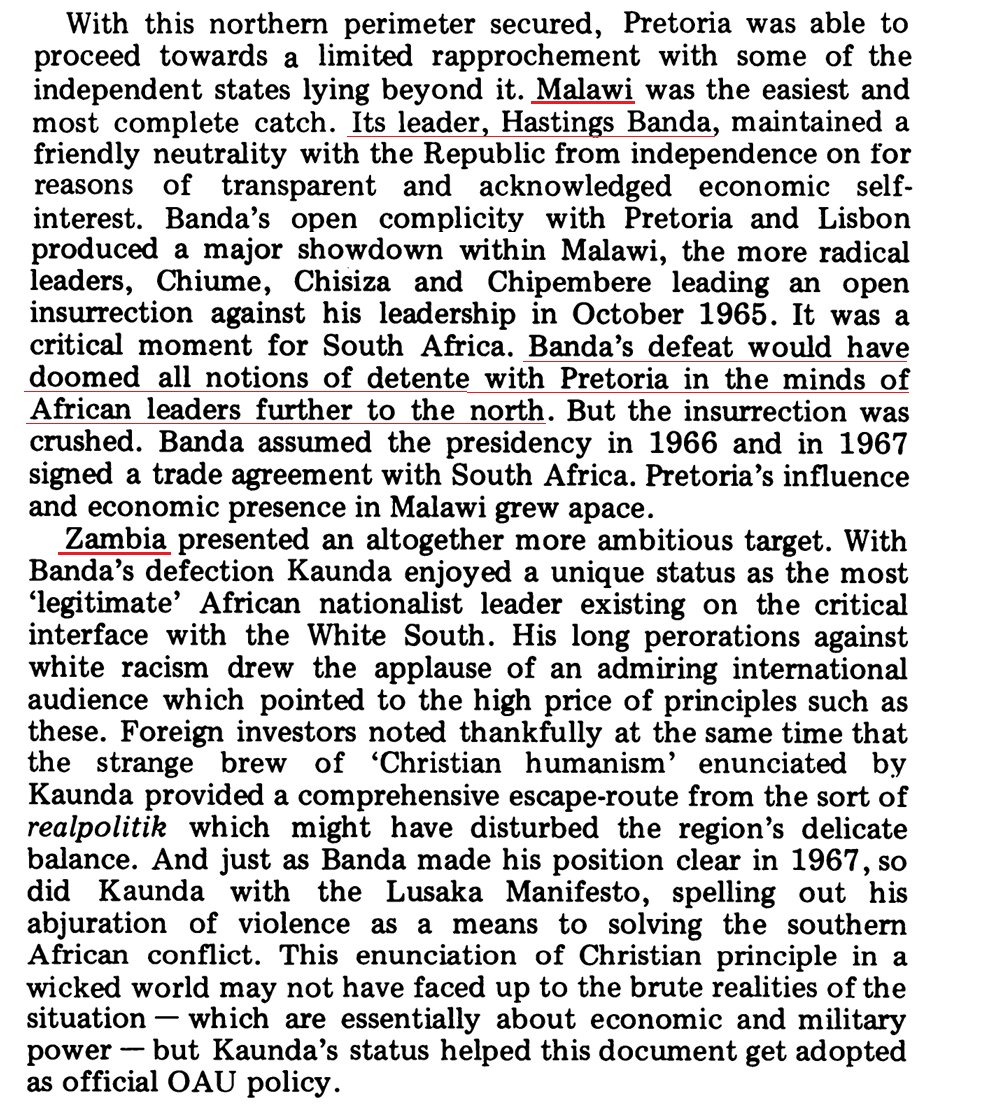
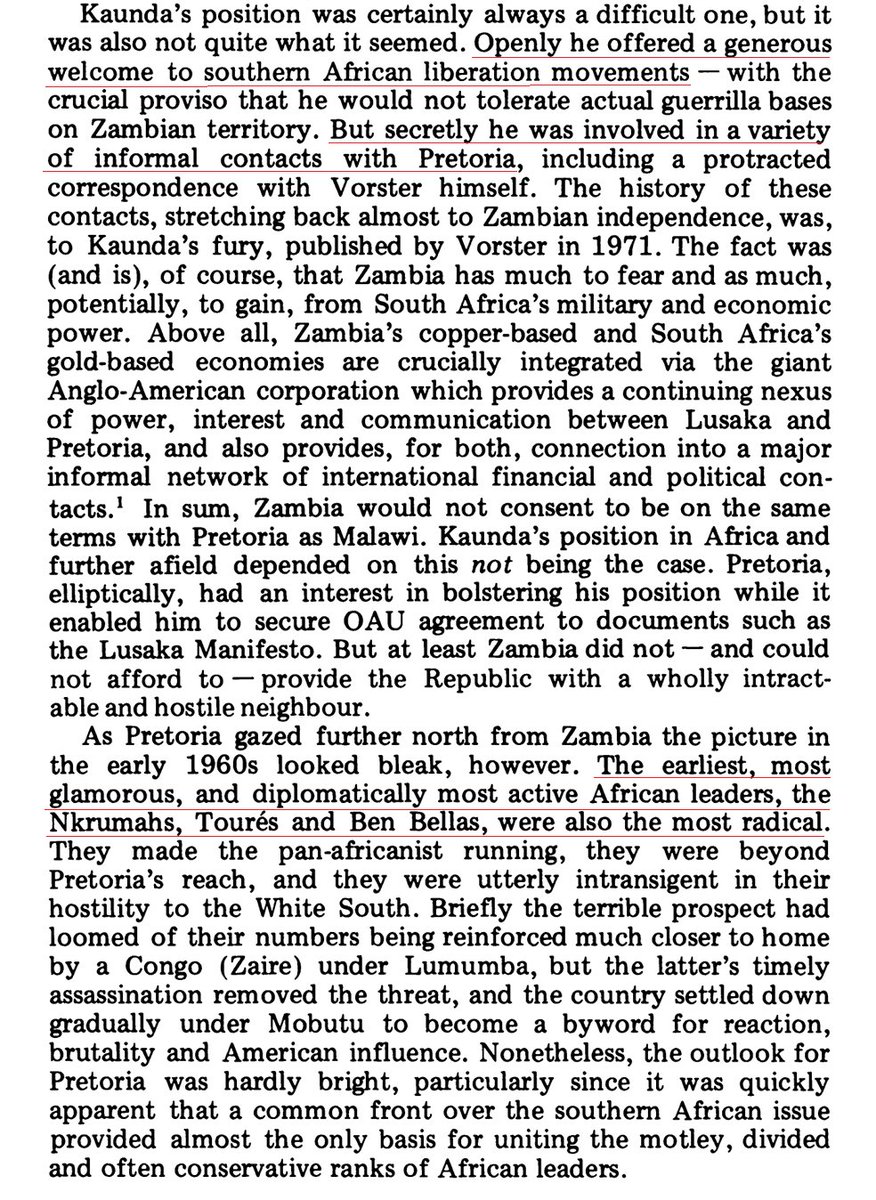
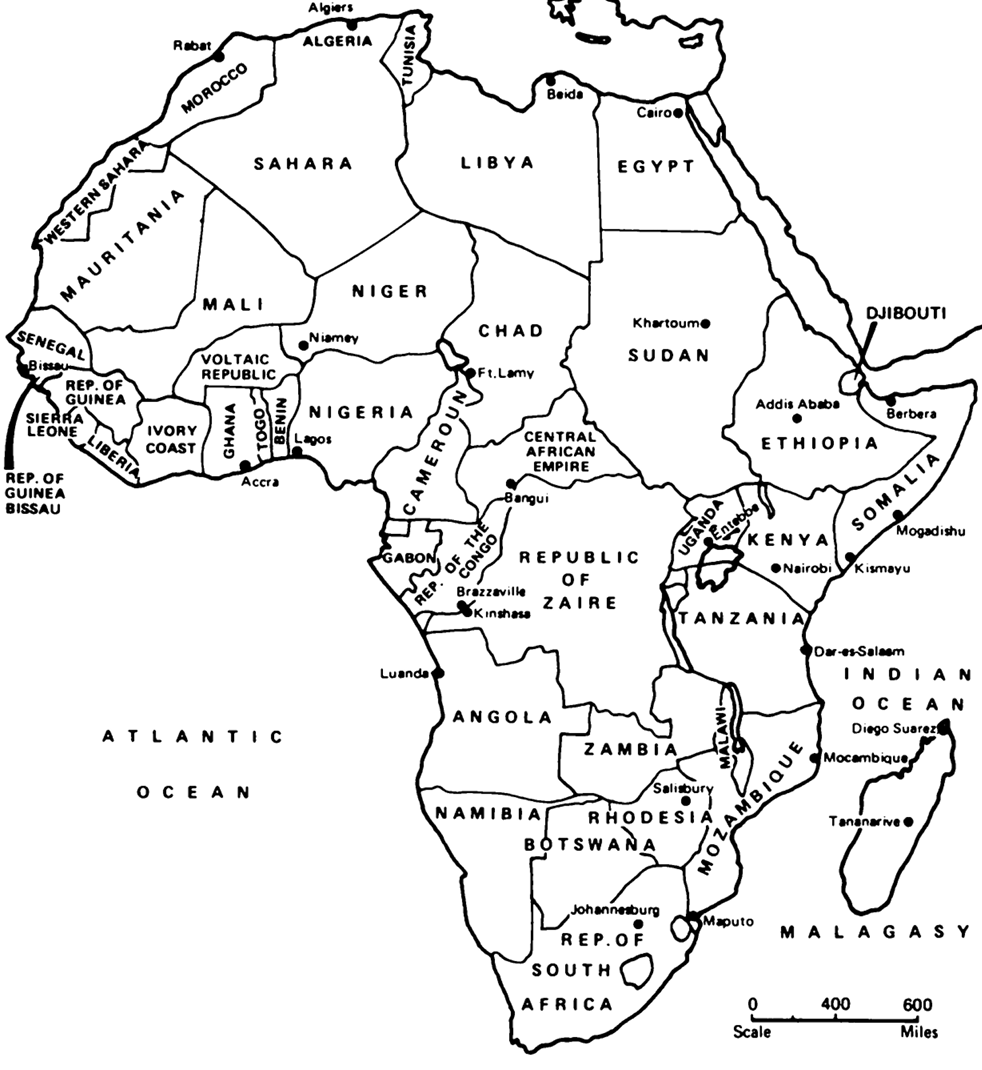
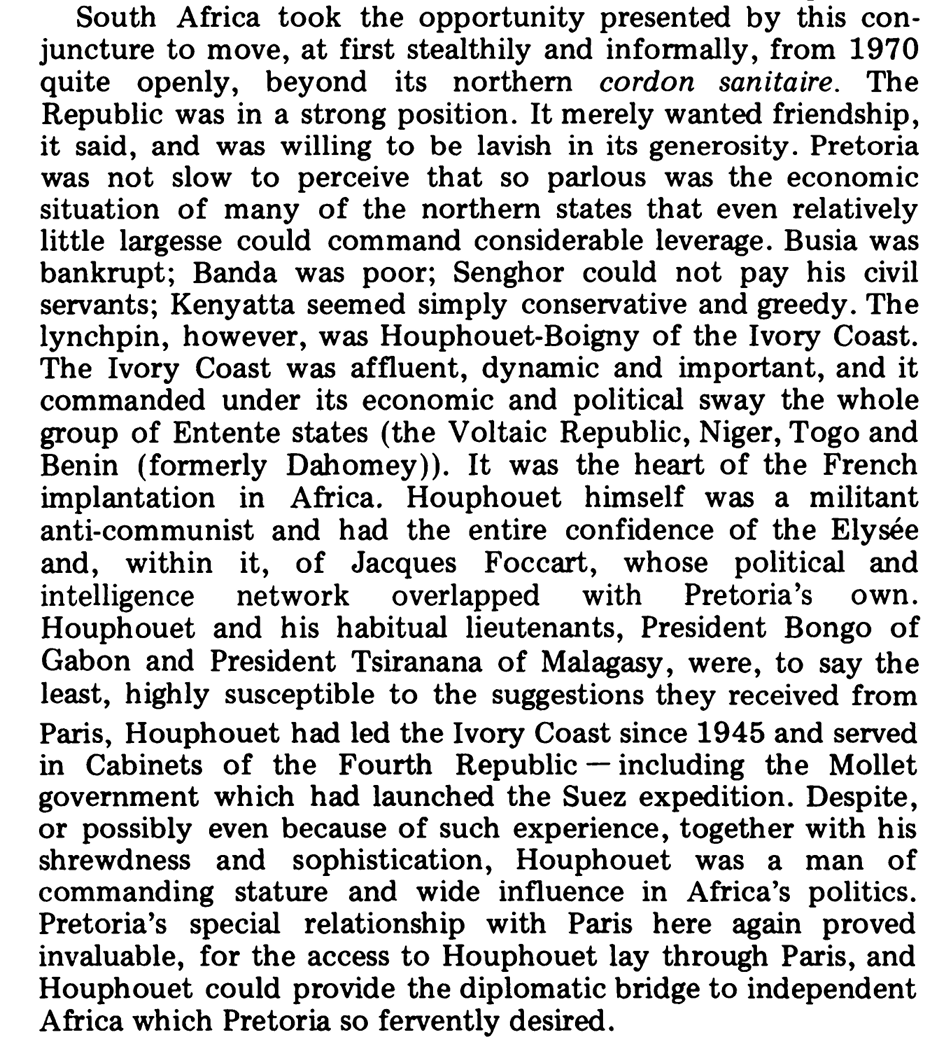
SA attempts at West African ties. Pre-73 oil crisis, Ivory Coast (IC) & Nigeria were on equal footing. IC's leader Houphouet remained close to France & SA sought to lose its pariah-status among independent black Africa through him.
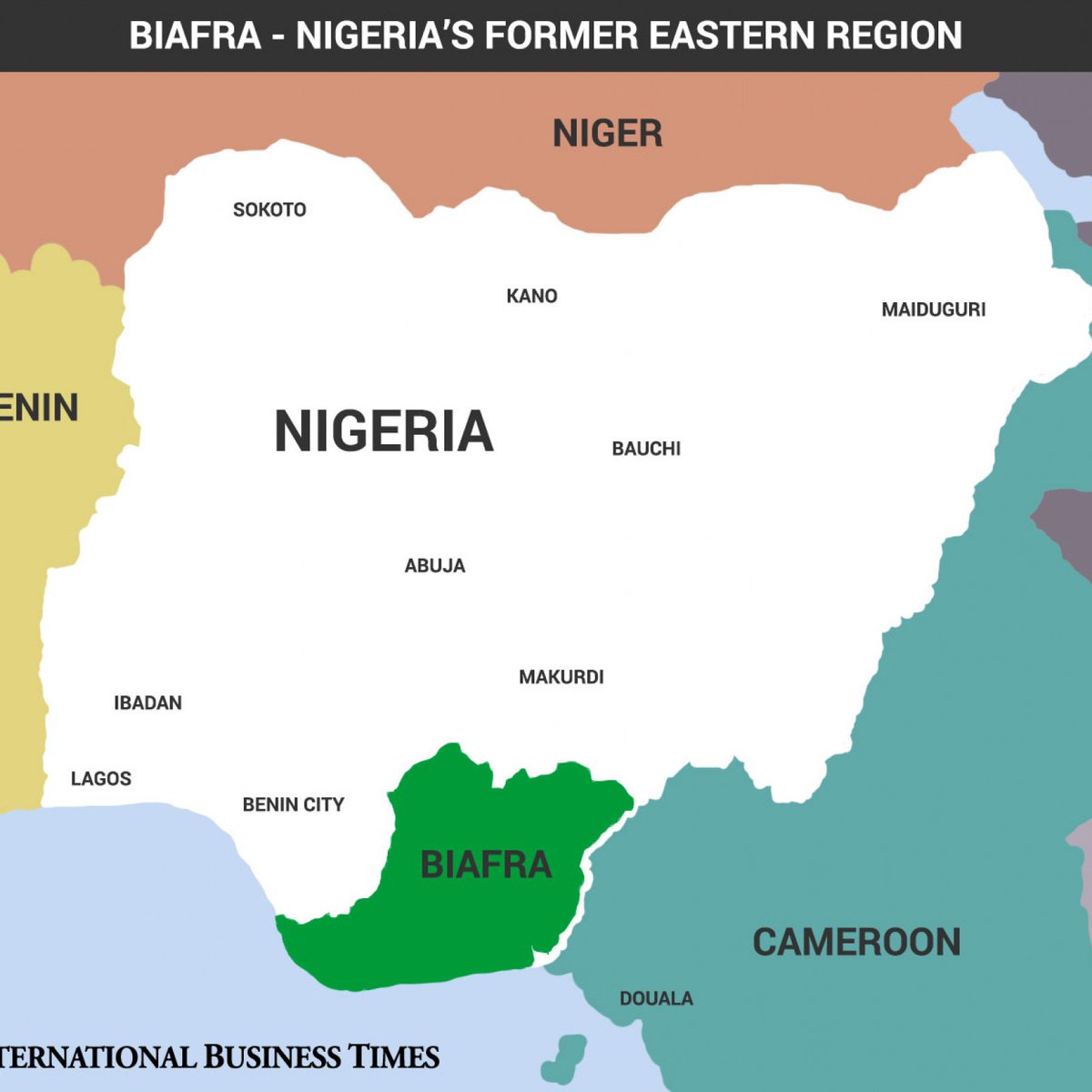
IC, 🇫🇷& SA supported Biafran secession vs 🇳🇬.
IC, 🇫🇷& SA supported Biafran secession vs 🇳🇬.

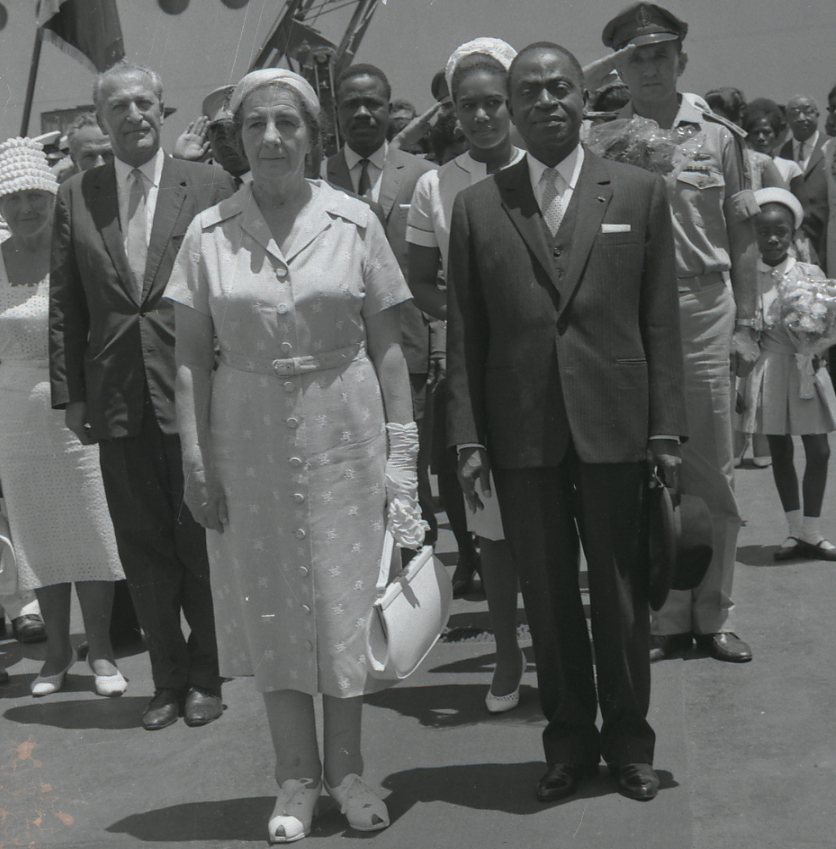
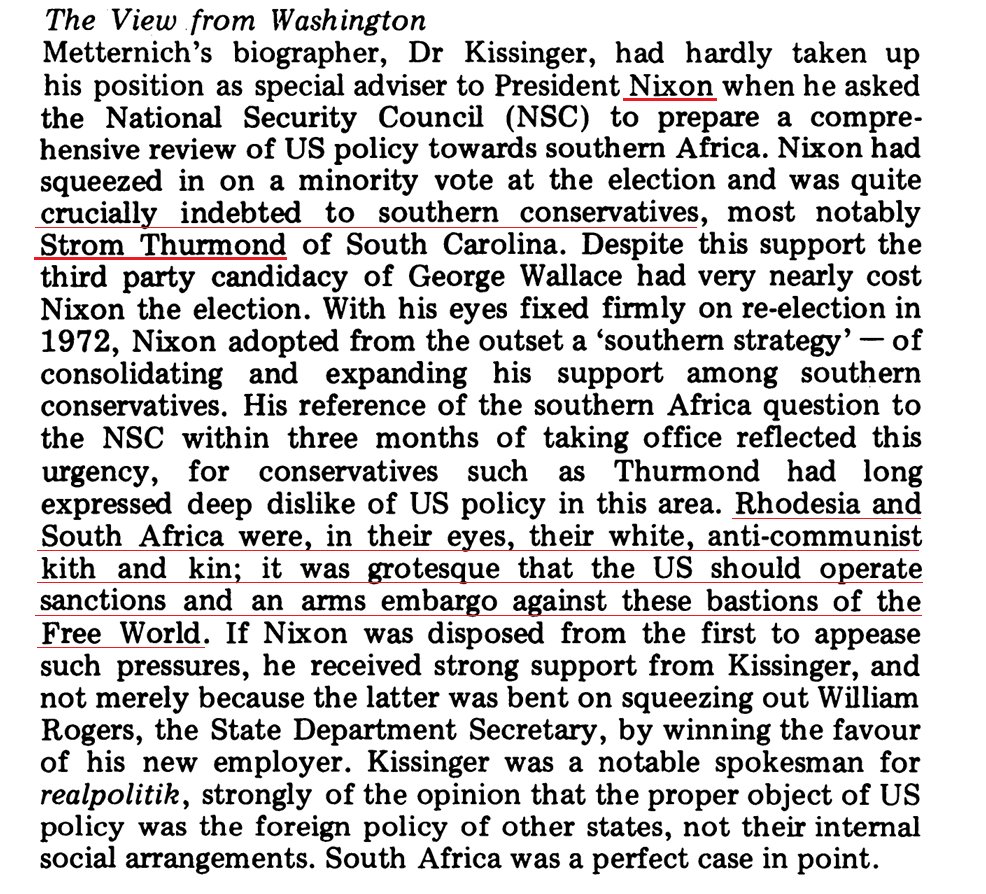
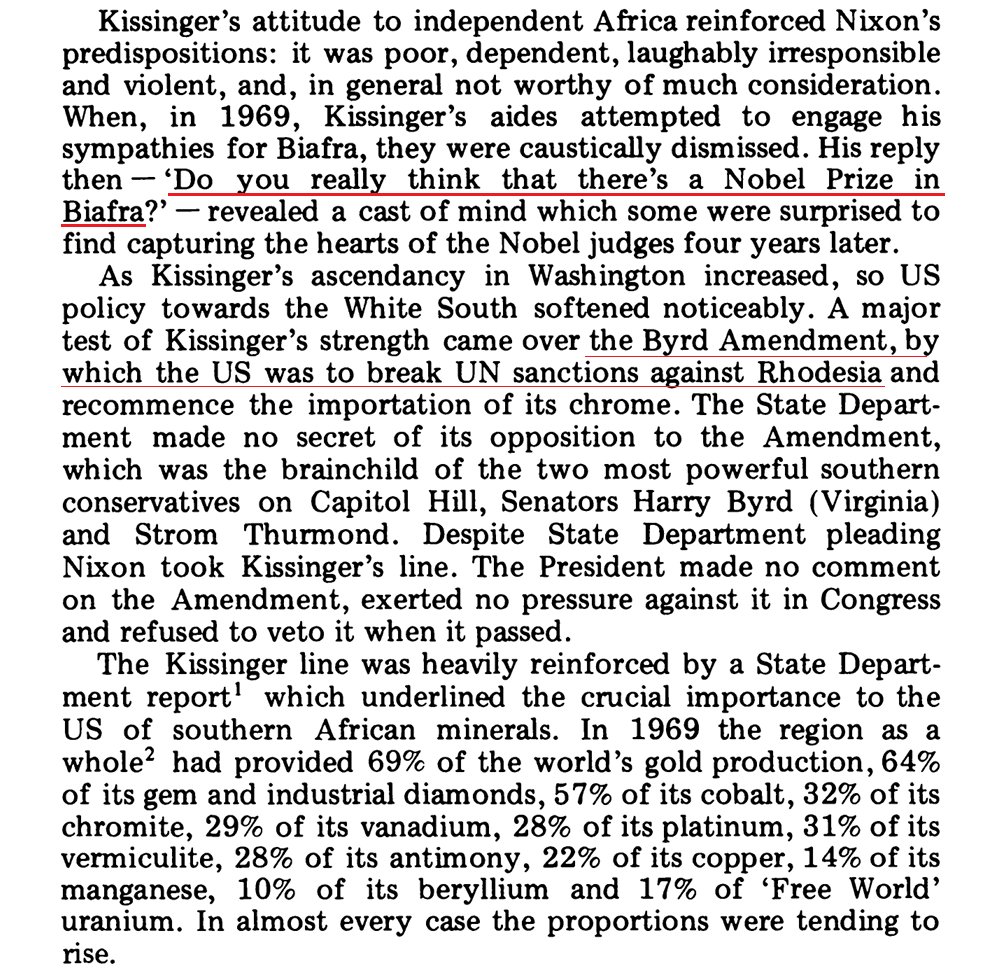
Nixon owed favours to Southern segregationists, who found Western sanctions on brotherly SA appalling. US policy on Portuguese-Africa softened for same reasons.
SA & 🇵🇹concessions to blacks could be limited to symbolic gestures.
"Commission soulful enquiries into negritude"👟🍉
SA & 🇵🇹concessions to blacks could be limited to symbolic gestures.
"Commission soulful enquiries into negritude"👟🍉


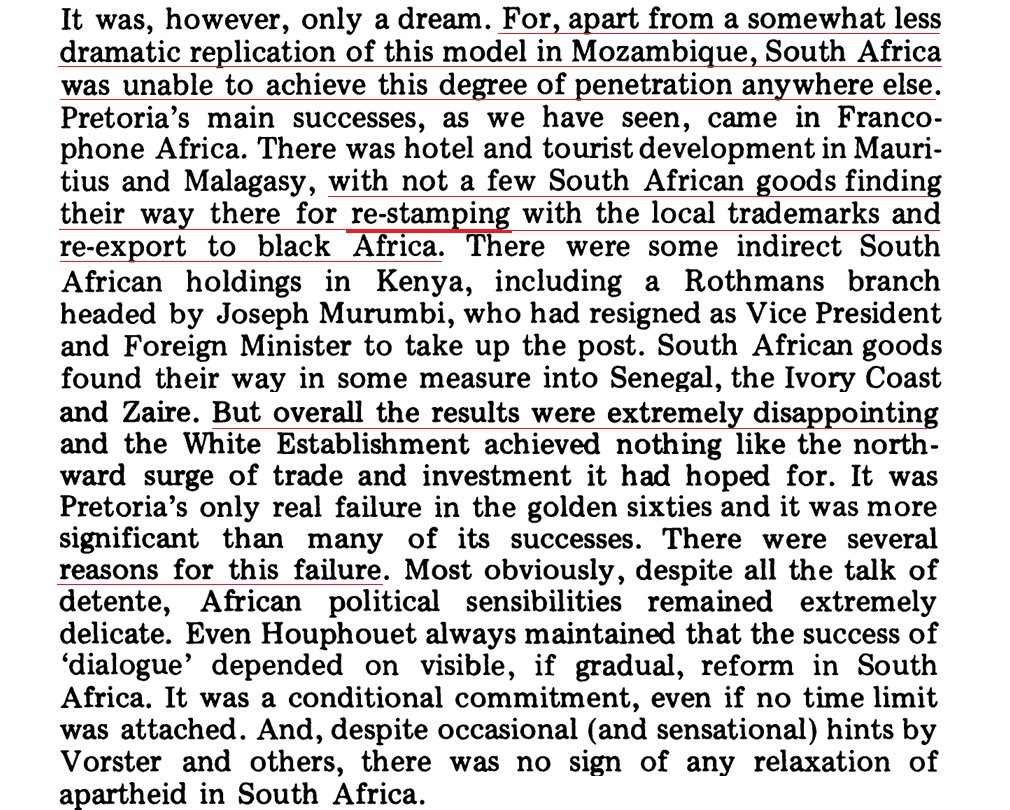
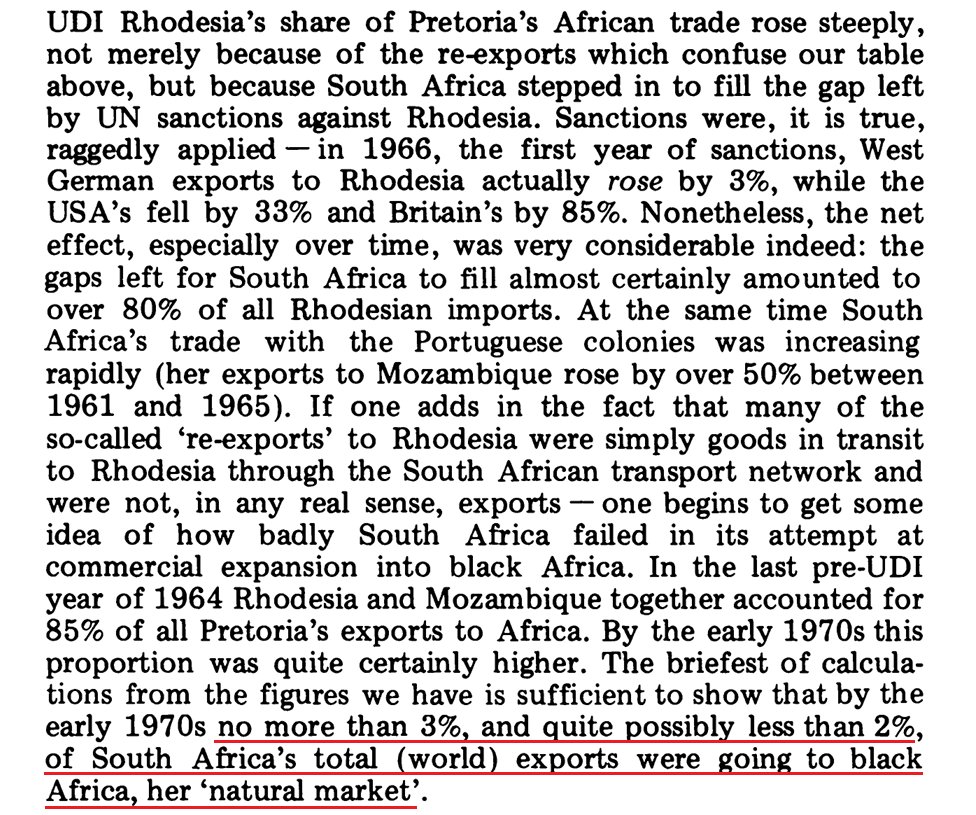
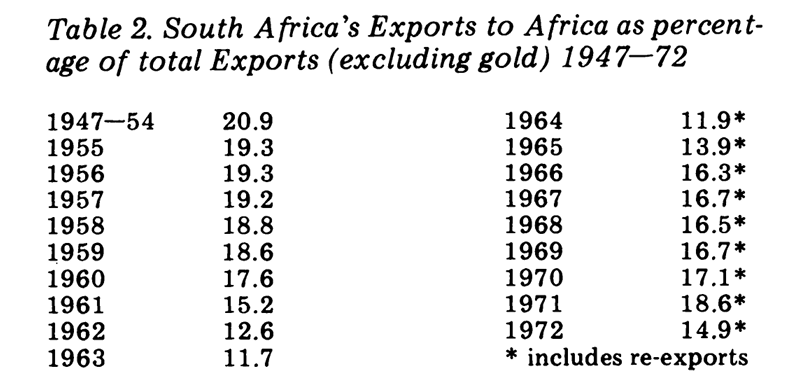
Despite high hopes, SA failed to economically penetrate any African state north of Zambia.
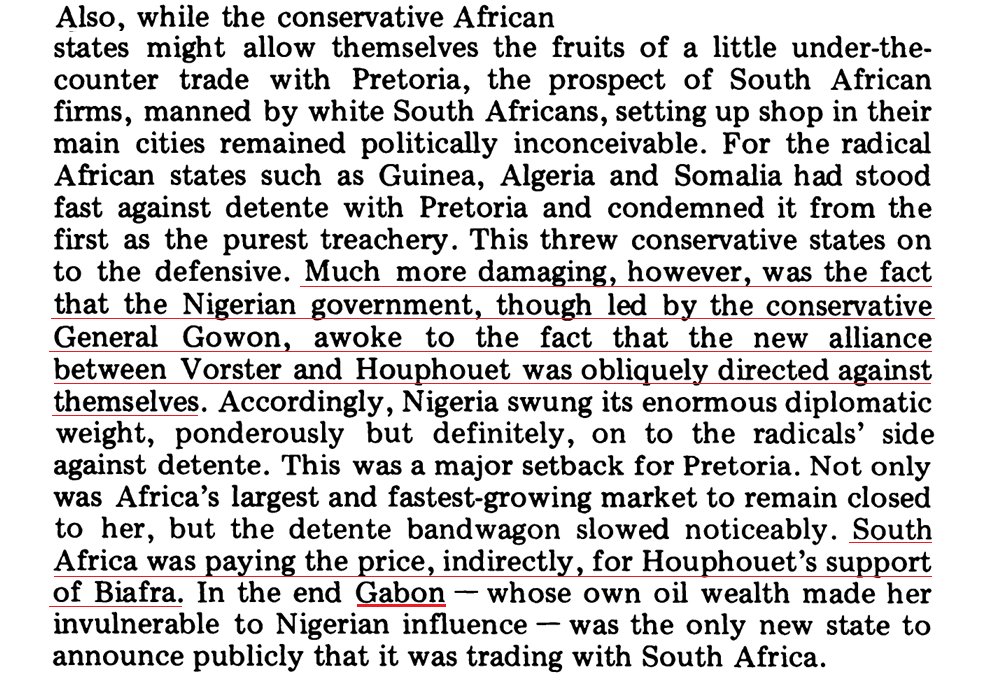
Recourse to restamping SA goods (also a common 🇮🇱ploy) as coming from Malagasay (Madagascar) was the best they could do. Previously neutral 🇳🇬 figured out SA was backing Ibgo separatists.
Recourse to restamping SA goods (also a common 🇮🇱ploy) as coming from Malagasay (Madagascar) was the best they could do. Previously neutral 🇳🇬 figured out SA was backing Ibgo separatists.
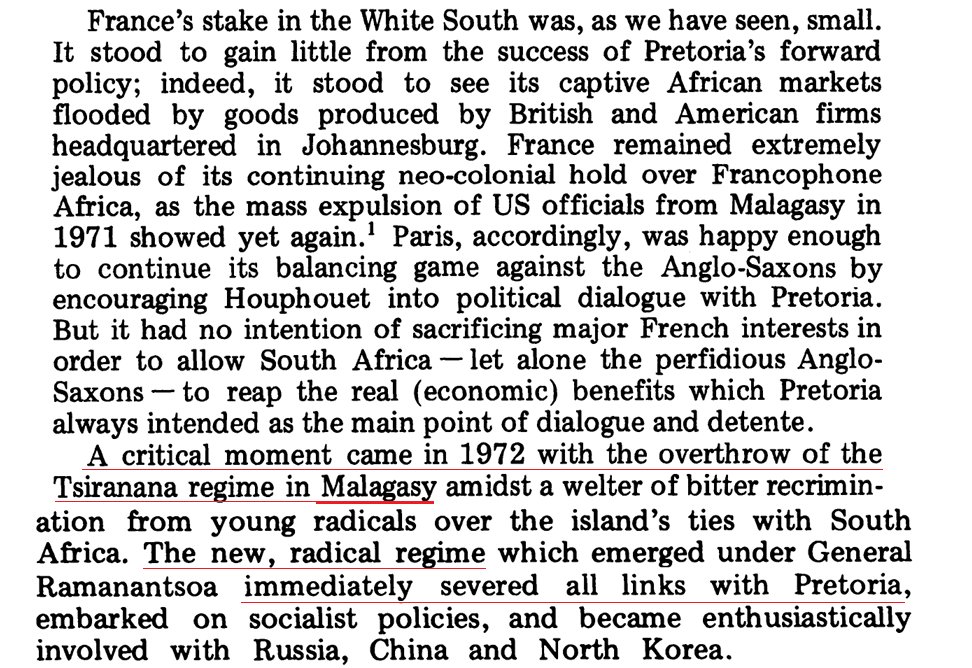
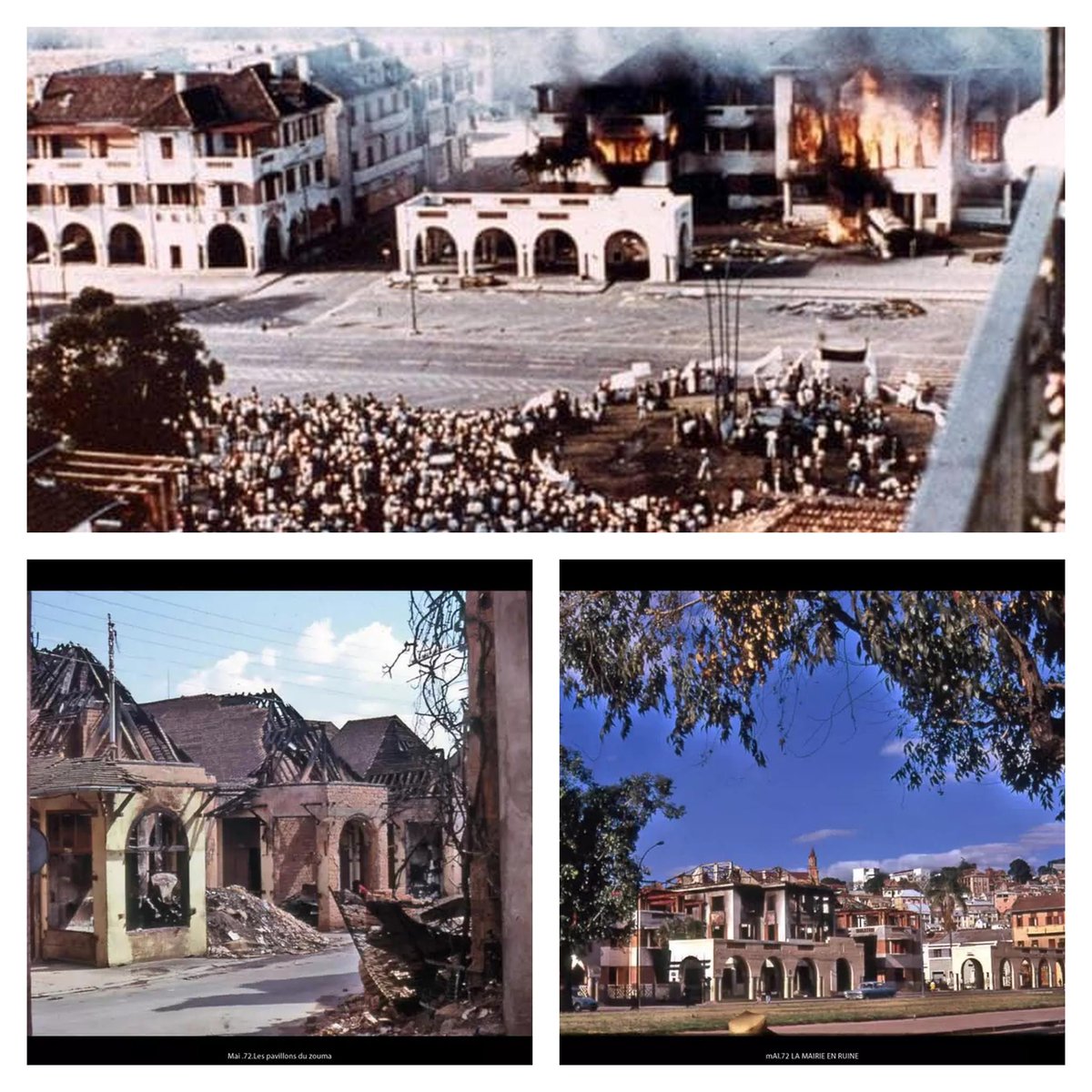
Radical Communist coup in Malagasay/Madagascar, instantly severing all its ties to SA & 🇫🇷. In 2 years 7k Frenchmen left the island.
Europe & conservative African leaders saw the old 🇲🇬regime's SA connections as the reason for its overthrow & distanced themselves accordingly.
Europe & conservative African leaders saw the old 🇲🇬regime's SA connections as the reason for its overthrow & distanced themselves accordingly.

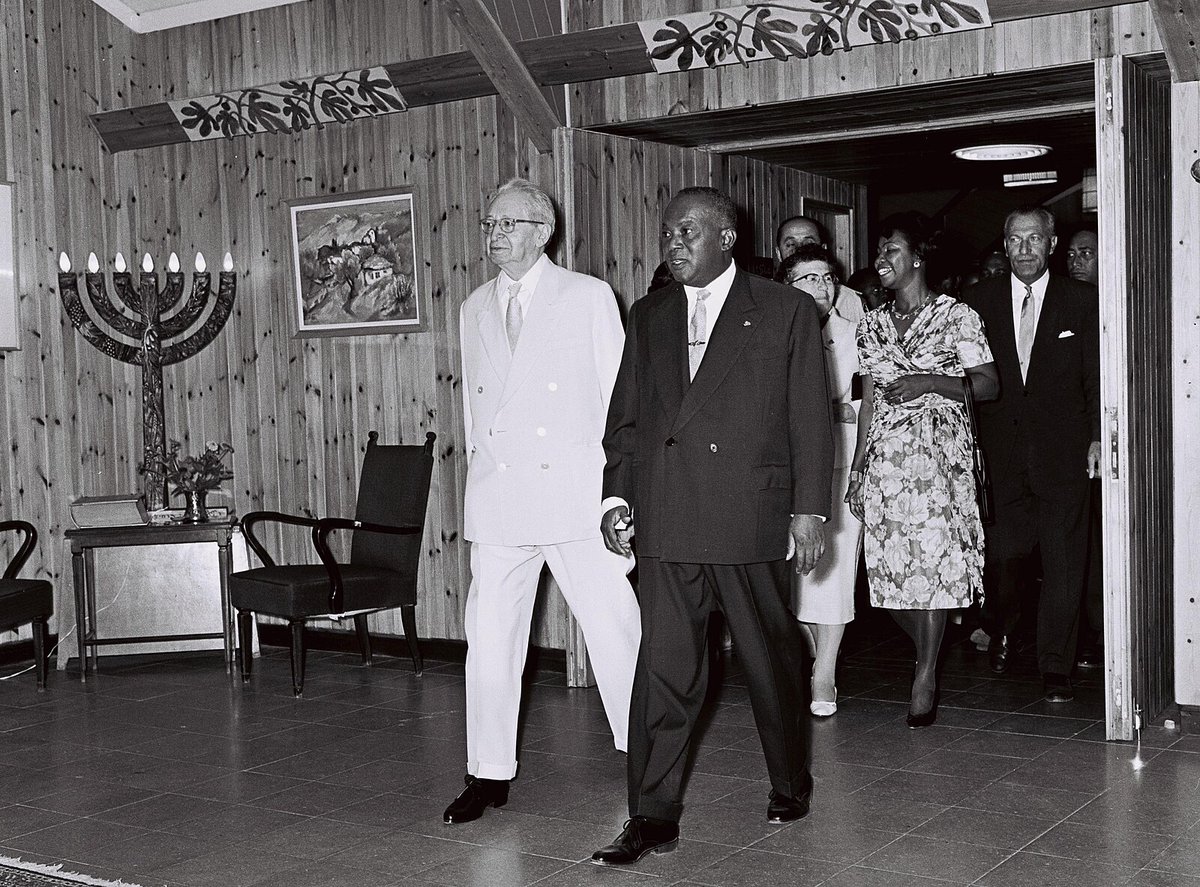
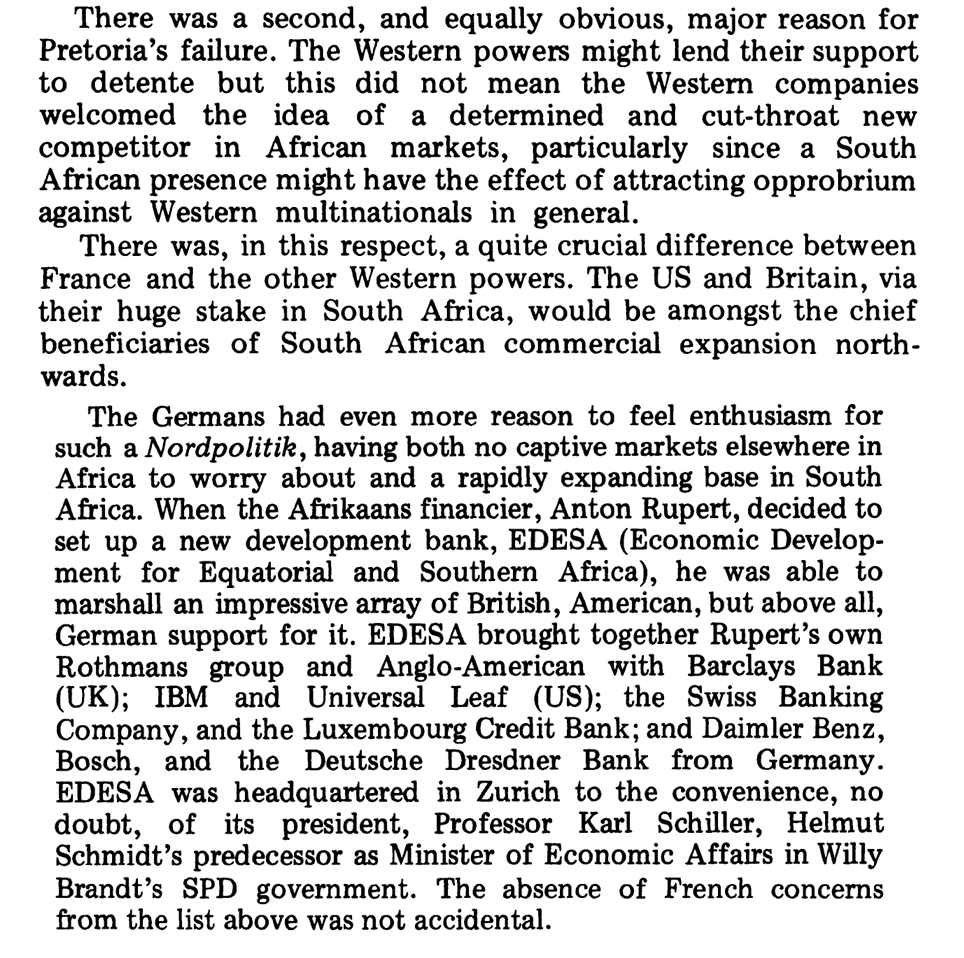
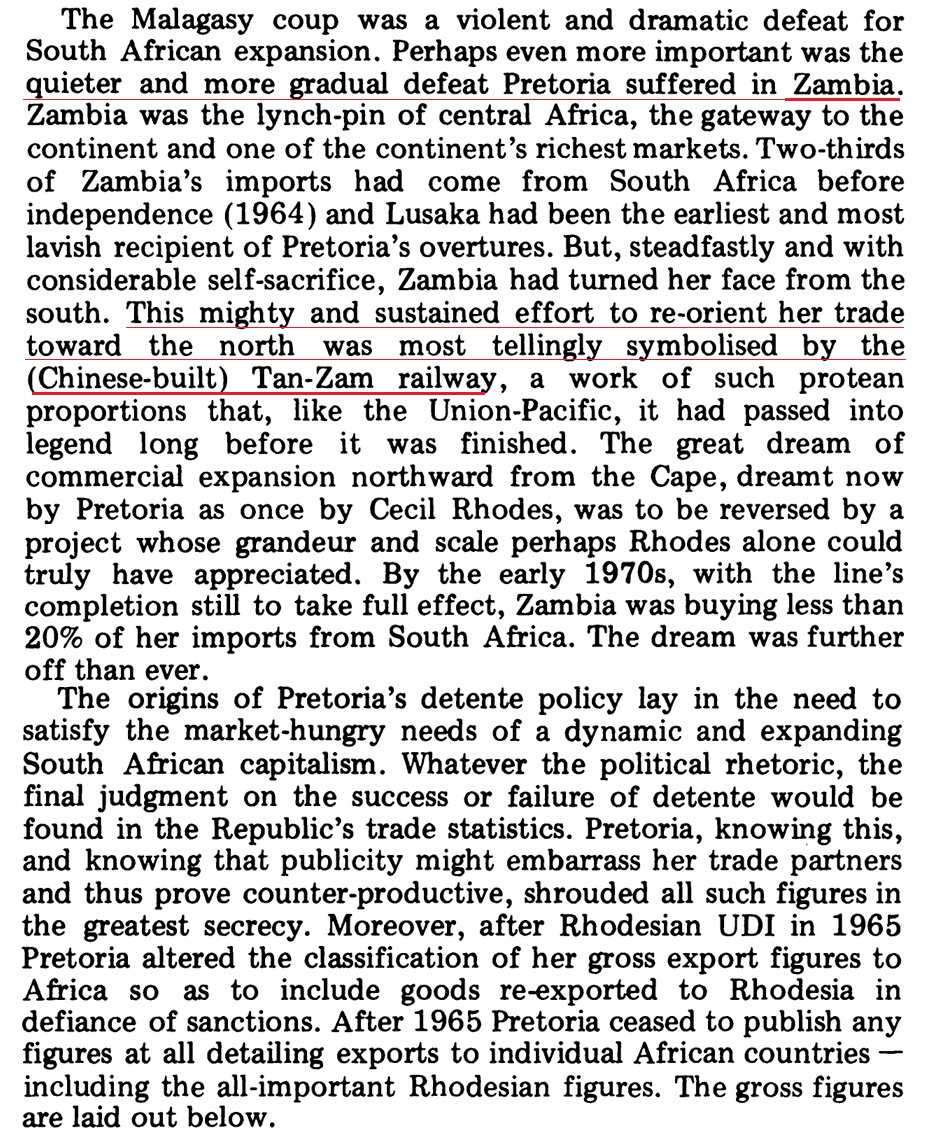
As SA's economy grew, other Western states began to see it as a competitor for African markets. Zambia, SA's gateway to the north, began severing its SA ties, at significant cost. A Chinese built railway was commissioned to faciliate its reorientation. Failure of SA's trade push.
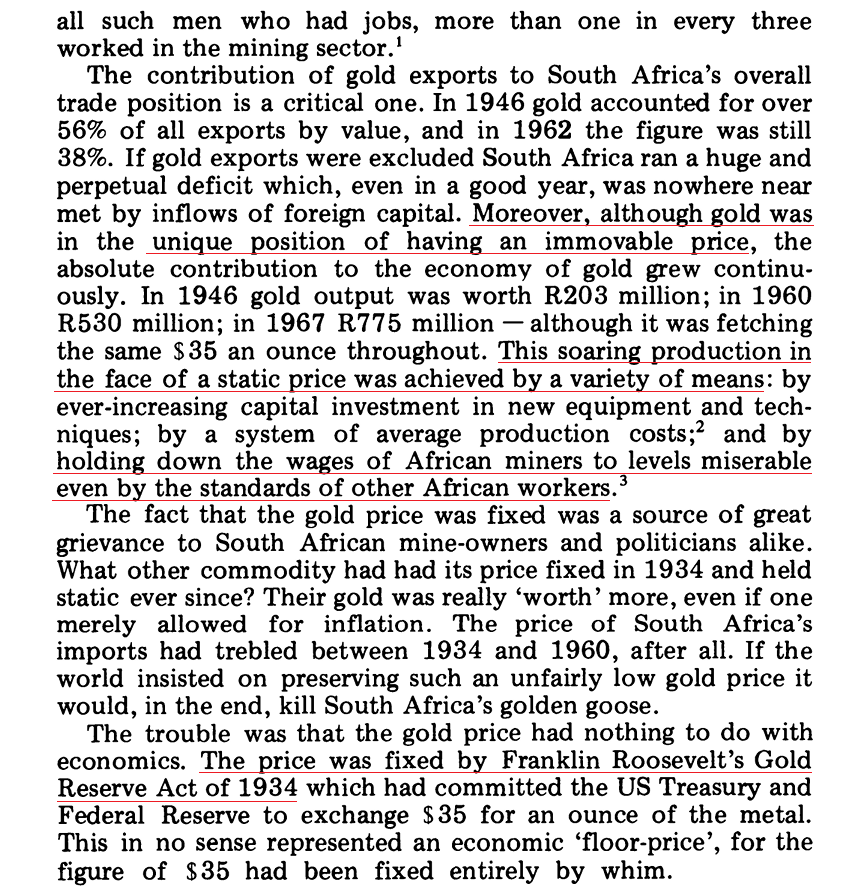
Chapter on the gold-dollar exchange standard. SA centrality in the 60s & 70s global economy, due to mining 75% of the world's gold. USSR only other significant exporter. Fixed $35 price of gold source of frustration for SA, who saw the US as forcing it to be unnaturally cheap.


The "artificially" strong USD$ allowed 🇺🇸 to buy out or otherwise outcompete European companies.
Under De Gaulle, France began attacking dollar hegemony by converting its $ into gold. Italy & soon other states began copying 🇫🇷. These machinations couldn't help involving SA.
Under De Gaulle, France began attacking dollar hegemony by converting its $ into gold. Italy & soon other states began copying 🇫🇷. These machinations couldn't help involving SA.
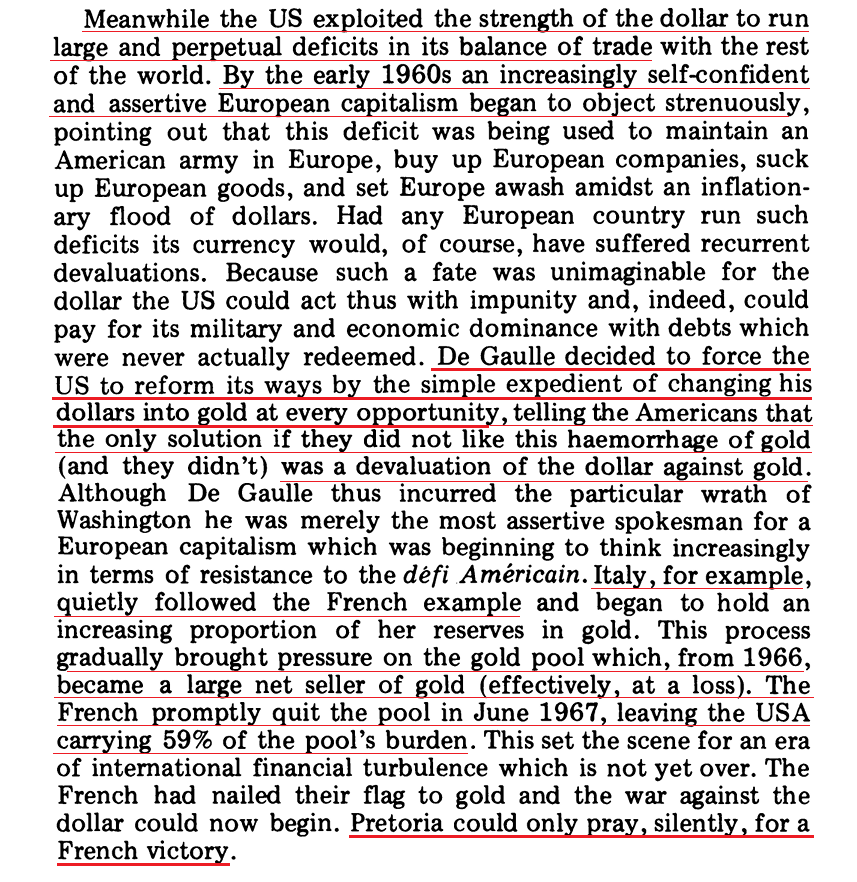
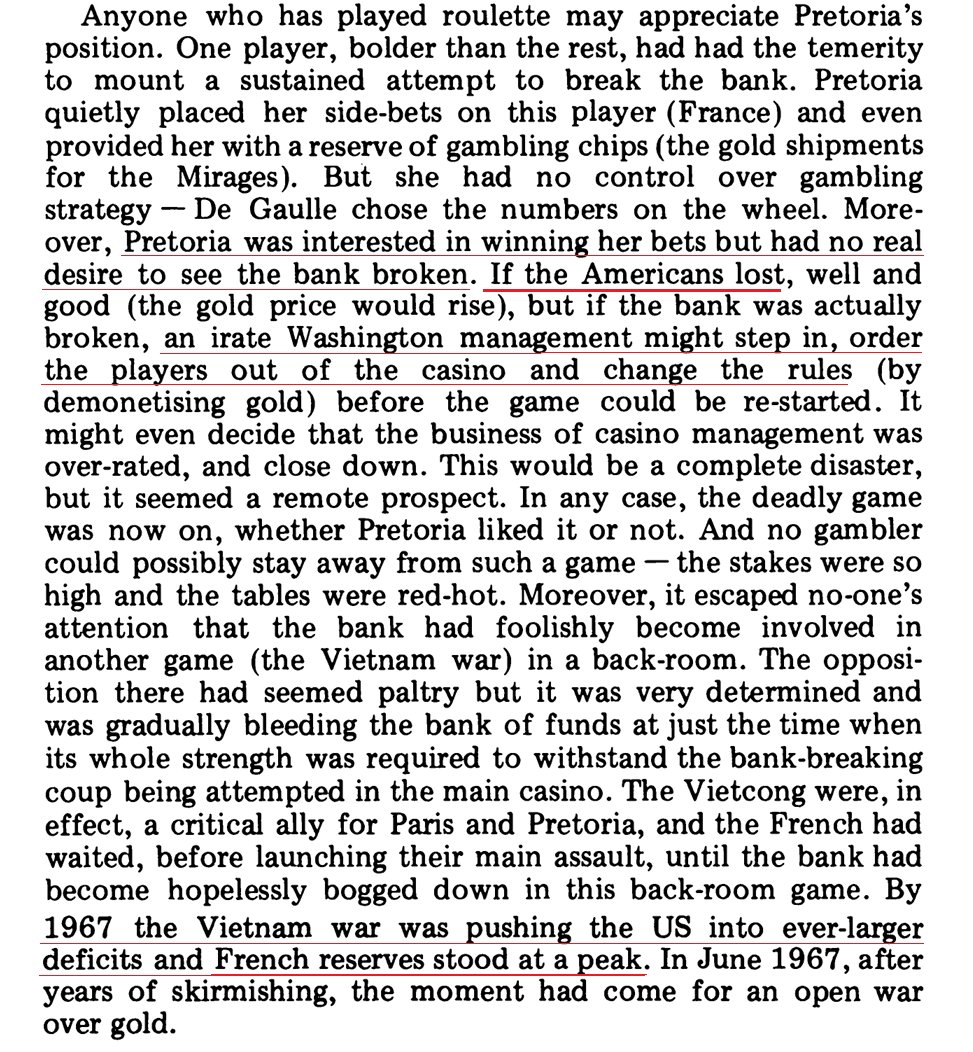

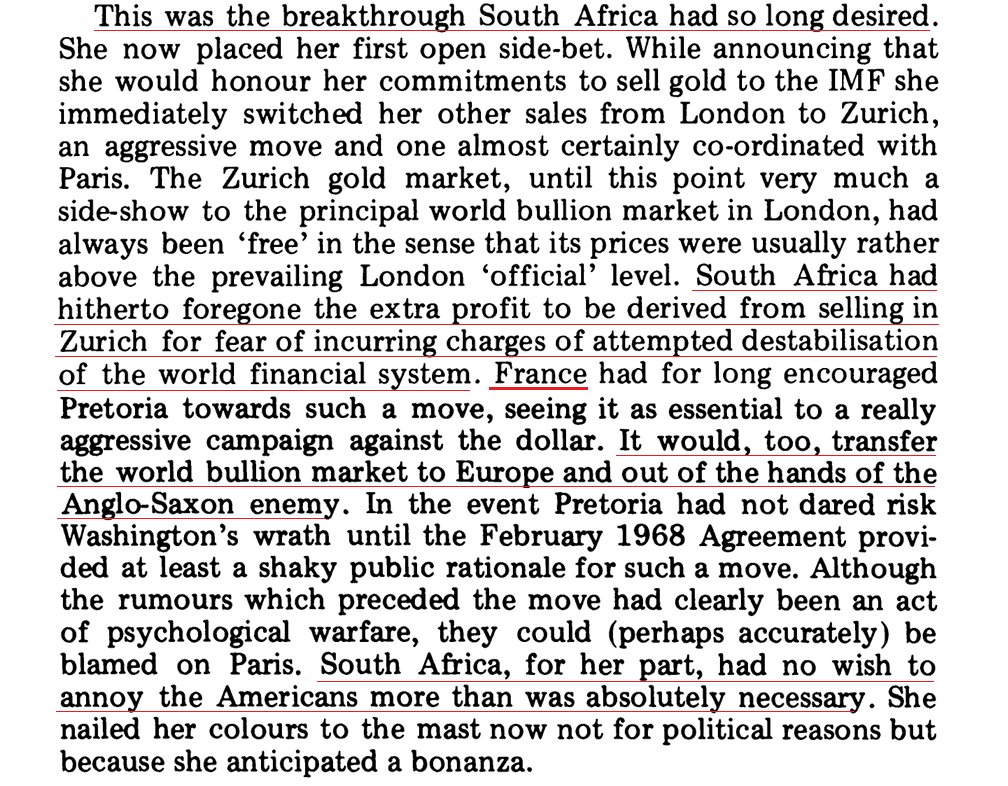
After a few years of frantic gold buying & massive US deficit in Vietnam, both the dollar & gold's artificially low price came under intense pressure. SA saw a potential bonanza if gold's $ price were allowed to be decoupled, but was wary of angering 🇺🇸. Pompidou elected in 🇫🇷.

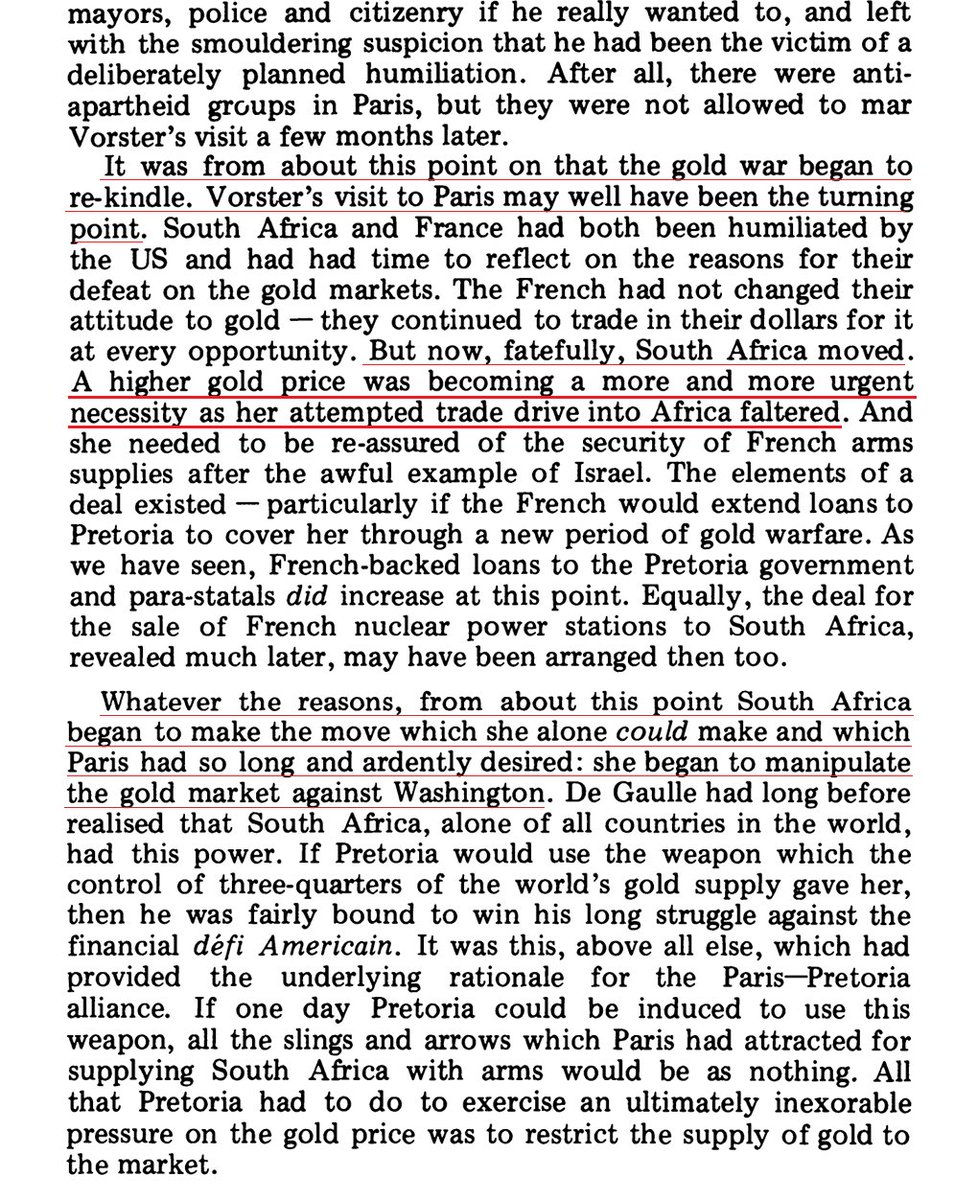

SA finally relented to French browbeating & agreed to use its position as world's leading gold supplier to forcibly manipulate its price, by restricting its supply. The ultimate market coup of "cornering gold".
A huge gamble, given 🇺🇸 wouldn't stand for such effrontery for long.
A huge gamble, given 🇺🇸 wouldn't stand for such effrontery for long.

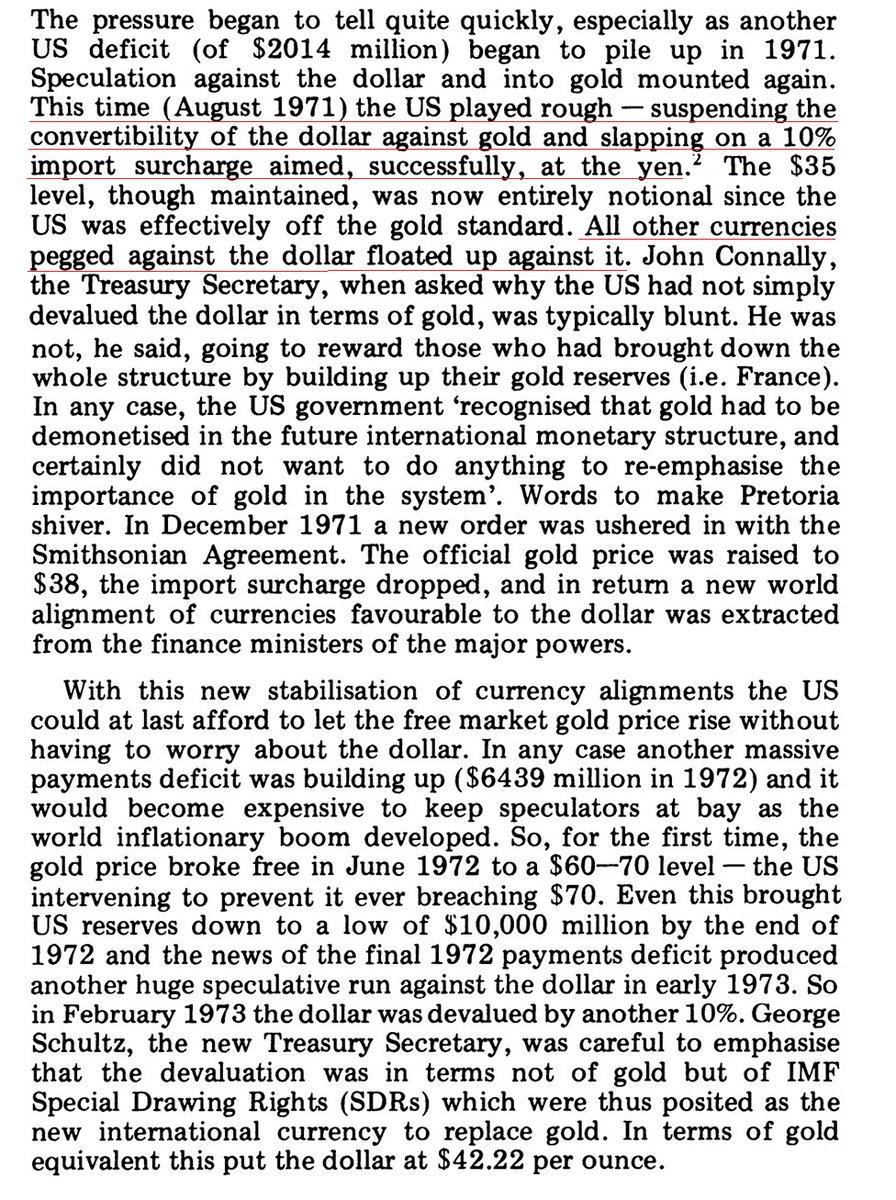
US finally bowed to French financial attacks & allowed gold's price to explode (35>95 $). France in its bold defiance of US, with SA tagging along, ended up destabilising the entire world financial system. Currencies around the world chased gold & brought on global inflation.

This coincided with 🇮🇱's Yom Kippur War & the subsequent Arab oil boycott. Western economies went into depression. After so much effort, 🇫🇷 now lost a 3rd of its gold reserves in 7 months.
SA now enjoyed gold price of $197. This windfall was spent on arms, a 40% rise in 1974.
SA now enjoyed gold price of $197. This windfall was spent on arms, a 40% rise in 1974.
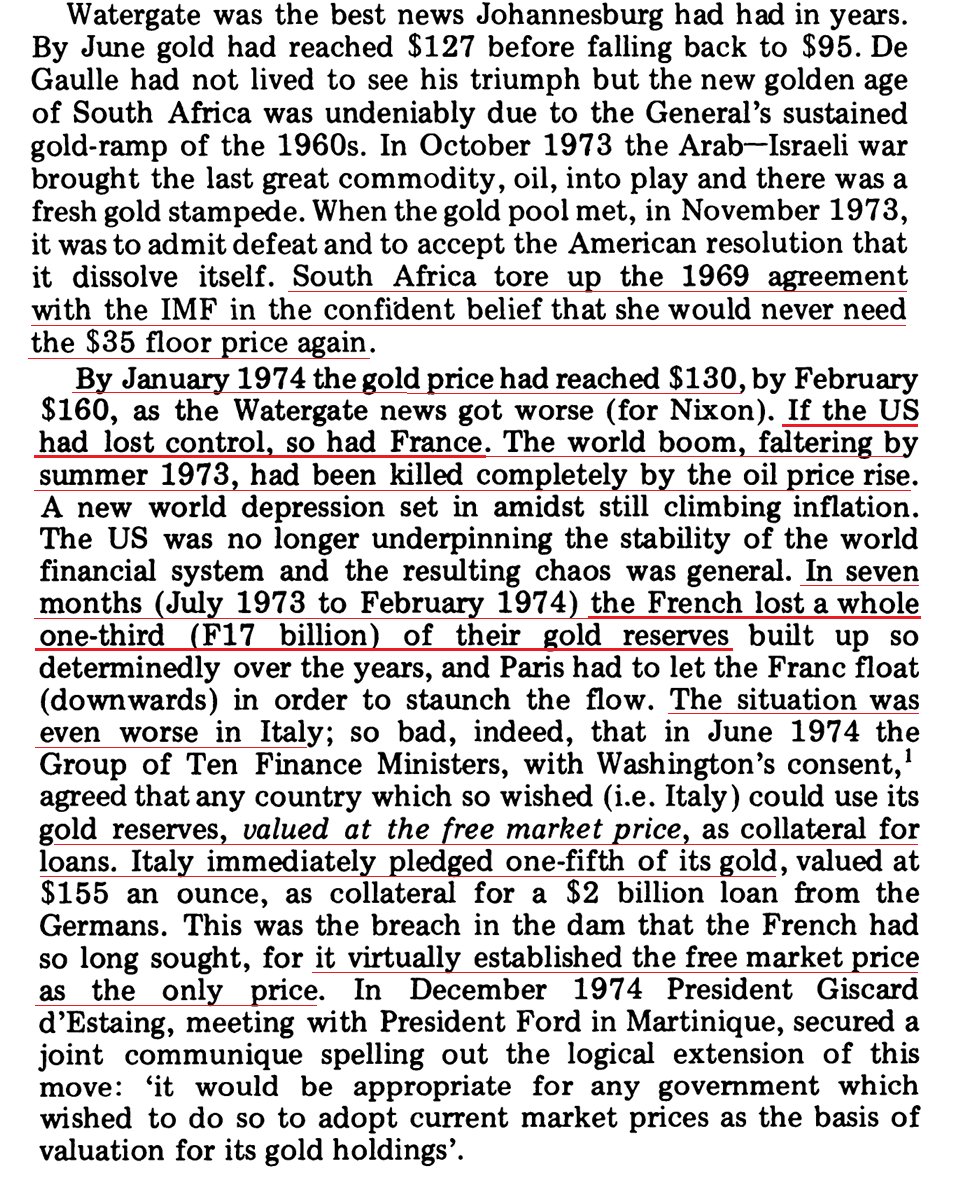

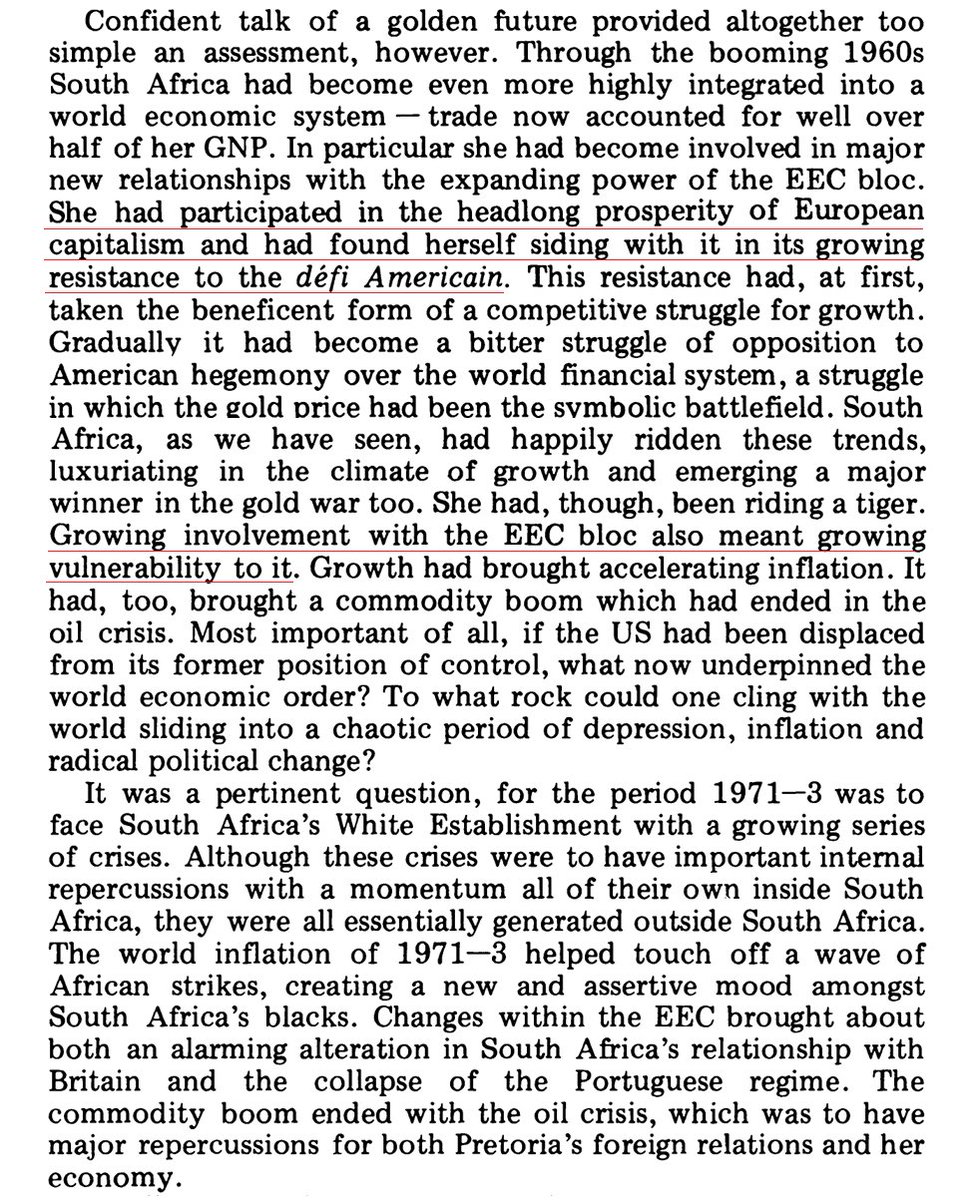
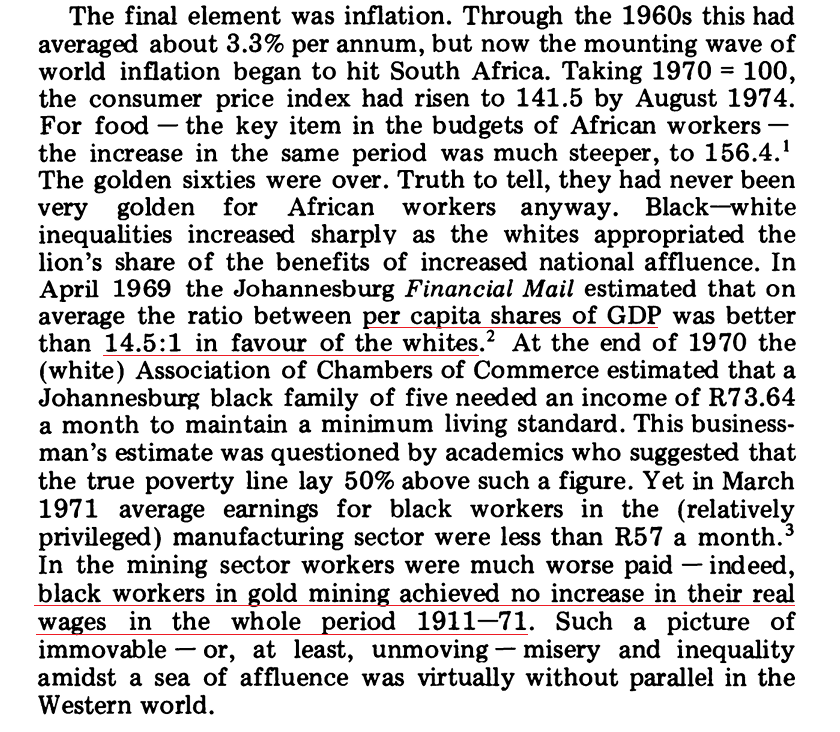
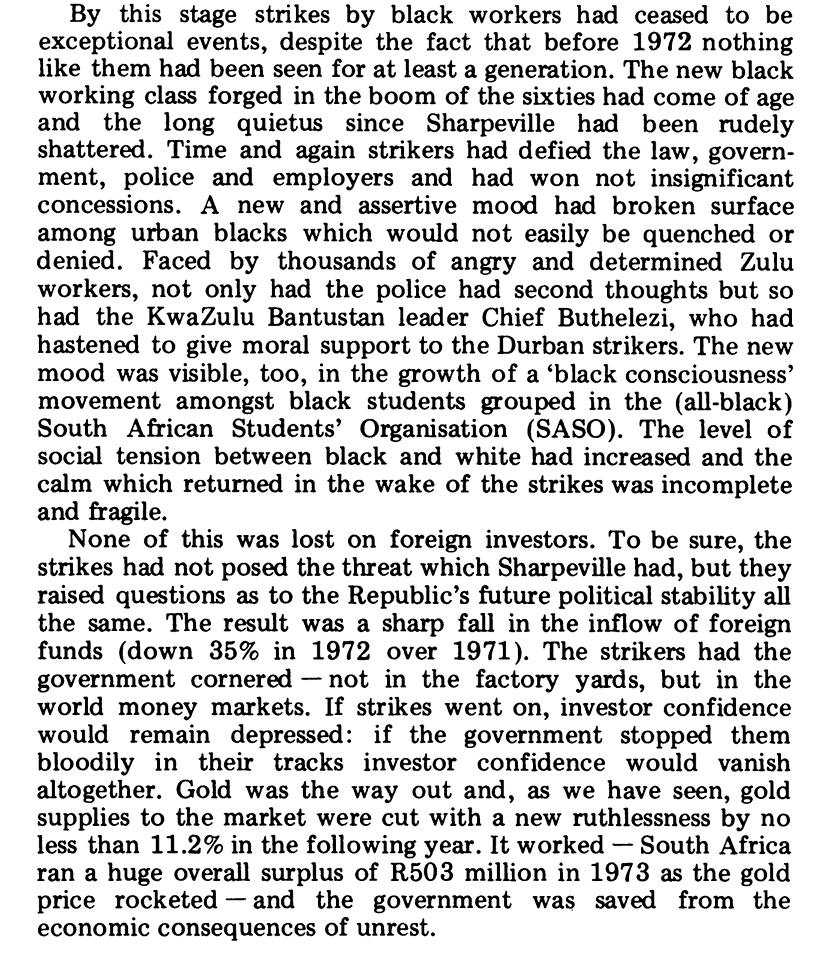
The gold bonanza for SA however masked growing problems, internally & abroad. It had allowed SA to ignore its failure to establish trade or diplo ties with broader Africa. Depression hit 🇵🇹. Inflation finally made conditions intolerable for SA's blacks, with mass unrest looming.
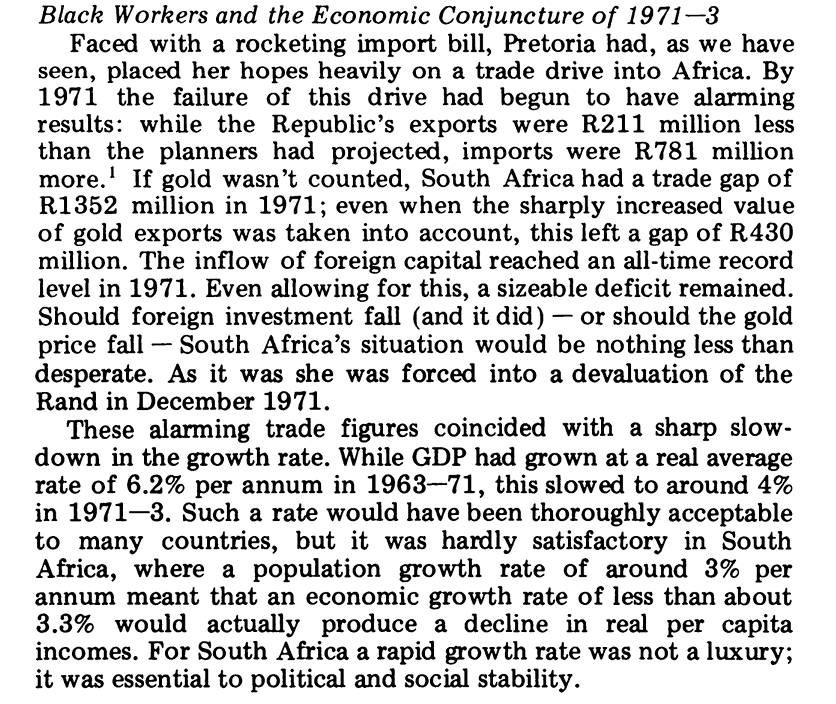
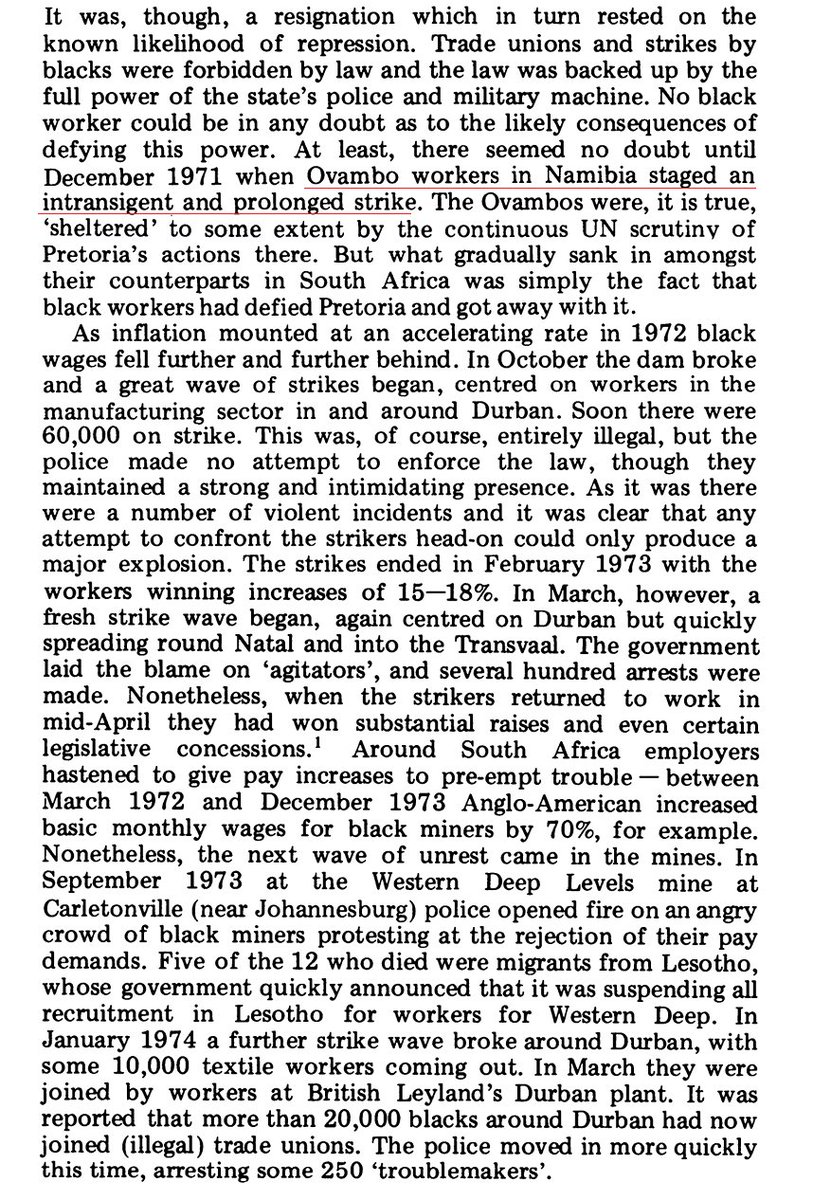
SA's robust GDP growth of 4-6% was offset by its rapidly increasing population. Black workers in key sectors like mining had seen no wage increase since 1911. Strikes in neighboring Namibia, inspired the same in SA. They were too large to put down, & foreign investors pulled out.
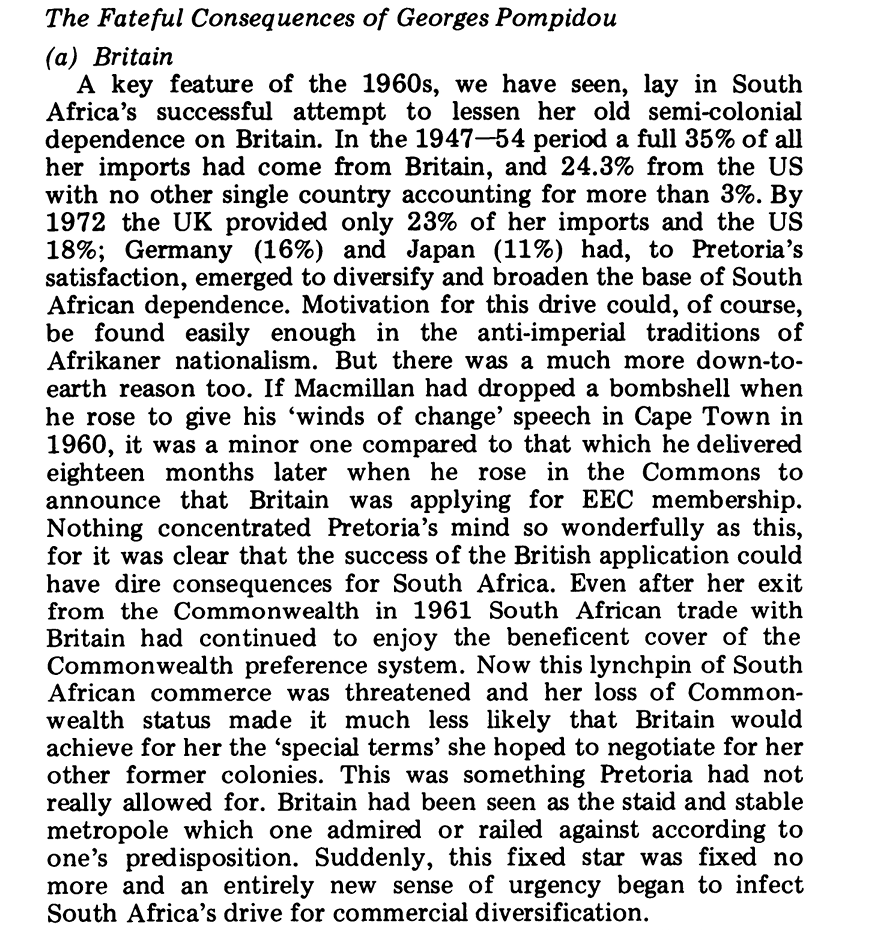
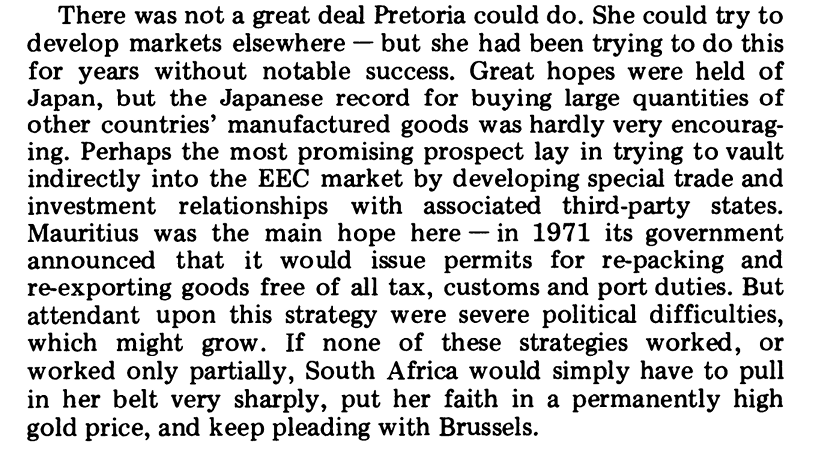
France's new leader Pompidou unintentionally dealt SA a severe blow in allowing 🇬🇧 to join the EU (then the EEC). The new tariffs meant UK & African Commonwealth trade with SA plummeted. Strange Bri'ish culinary proclivities for items like tinned fruit could not easily replaced.
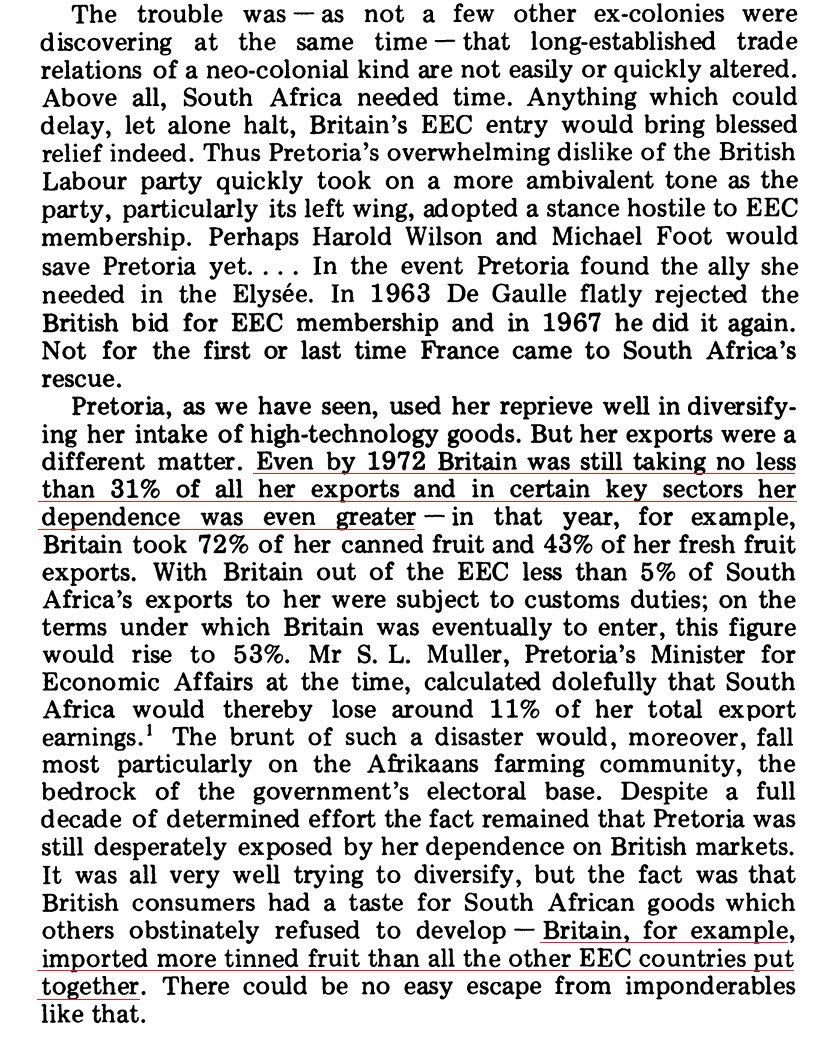

The EEC's effect on Portugal's African Empire. Salazar's 🇵🇹 wanted nothing to do with Europe & spat on 🇺🇸 dictat. This it could afford to do with the world's most stable currency & huge gold reserves. Emigration to colonies continued, with some 650K Portuguese in Africa by 1974.
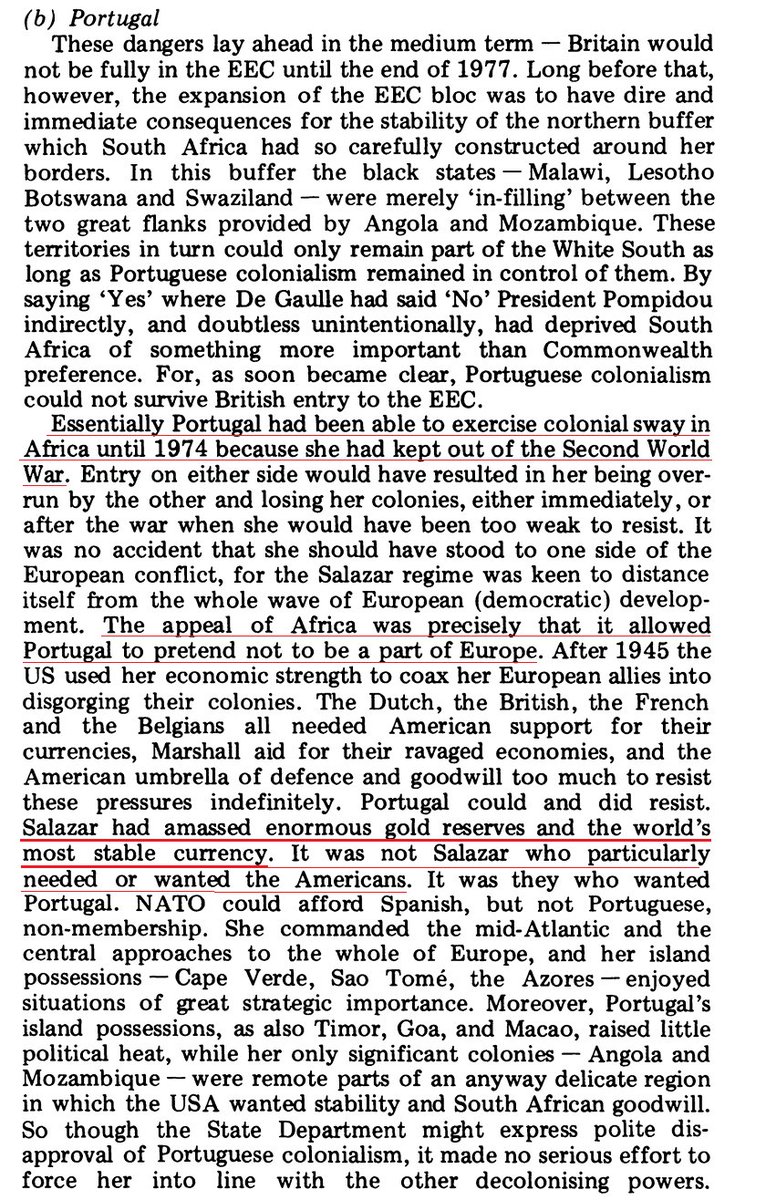
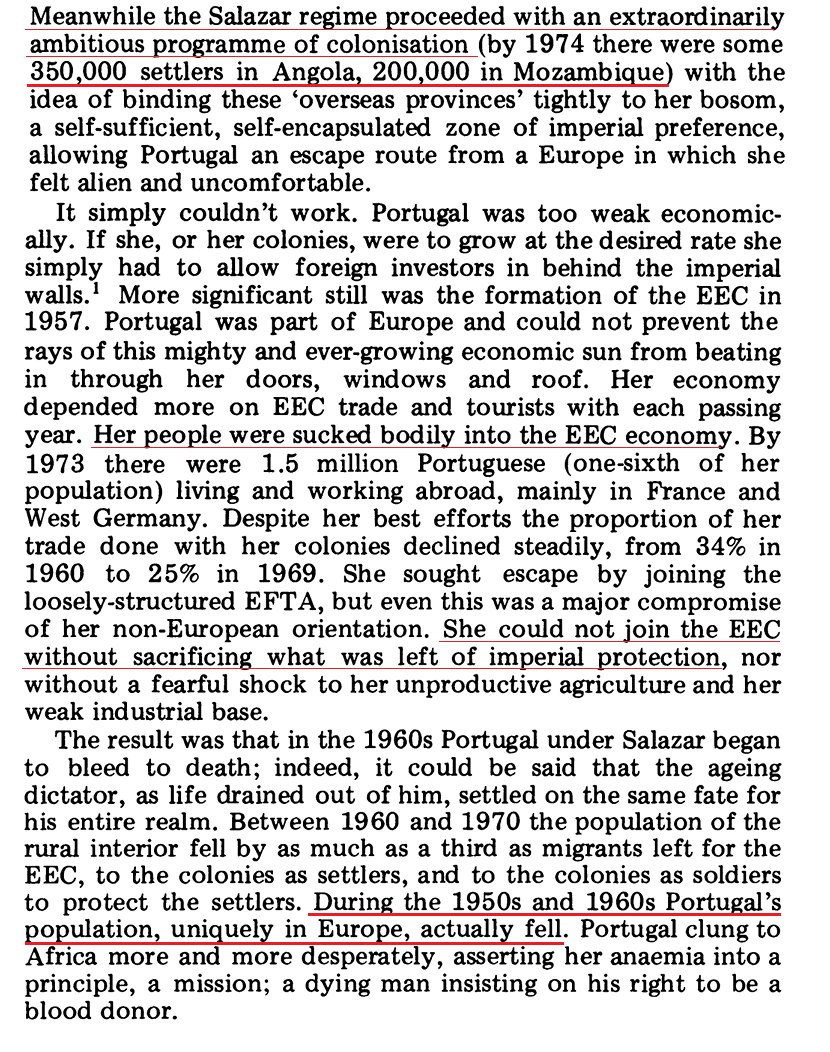
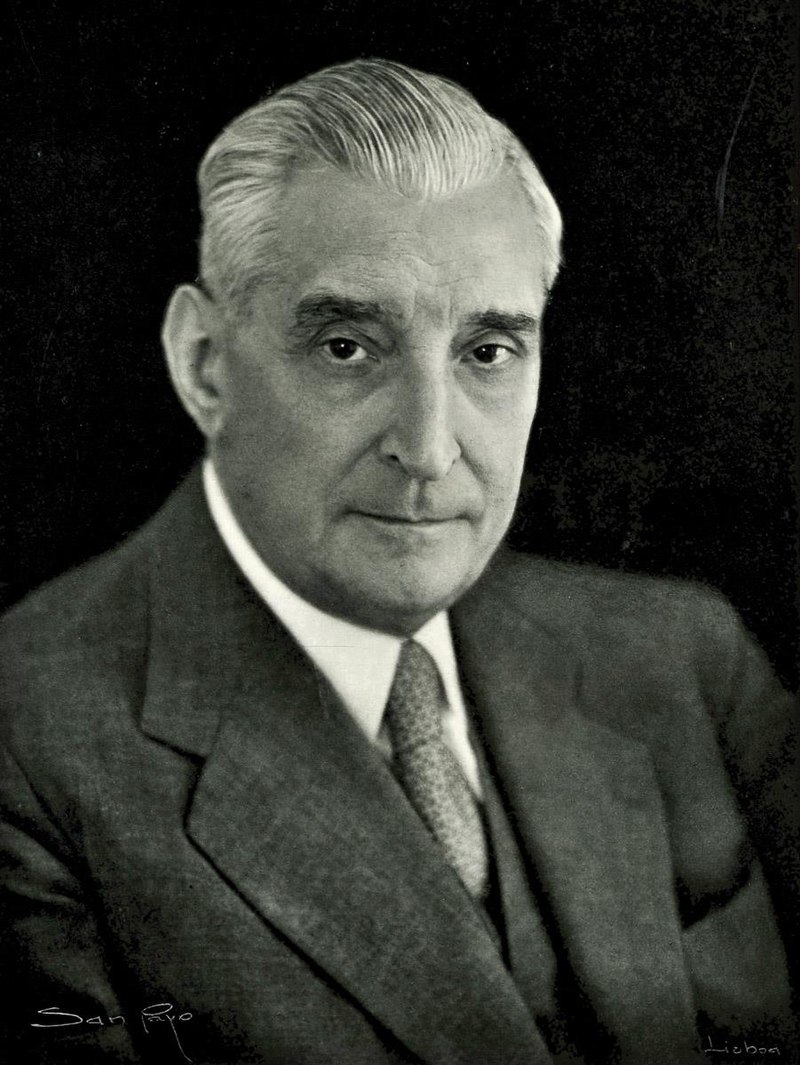
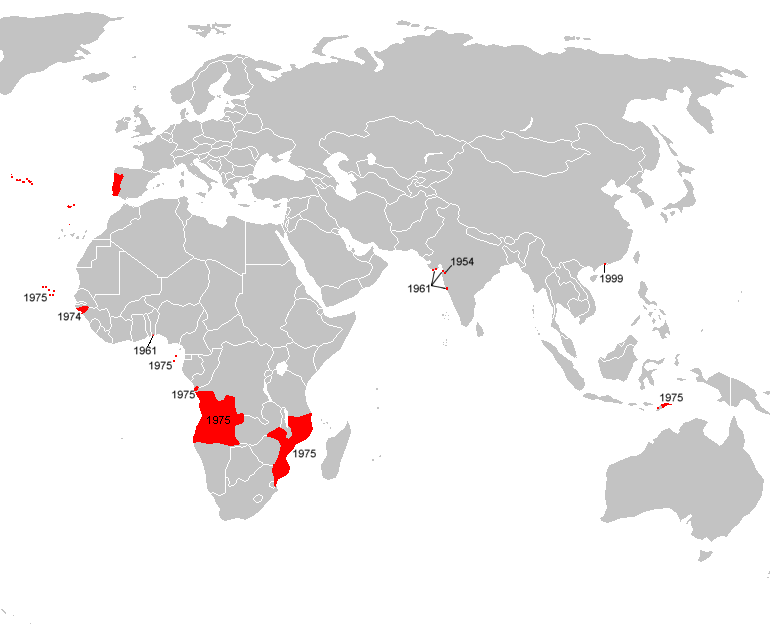
🇬🇧 entry into the EEC shocked the Portuguese economy. Against its will, 🇵🇹 was sucked into Europe's orbit. On top of 70s inflation, its African colonial insurgencies, backed by the USSR, were more than a small state could bear. In 74, 🇵🇹 threw in the towel.
A catastrophe for SA.
A catastrophe for SA.
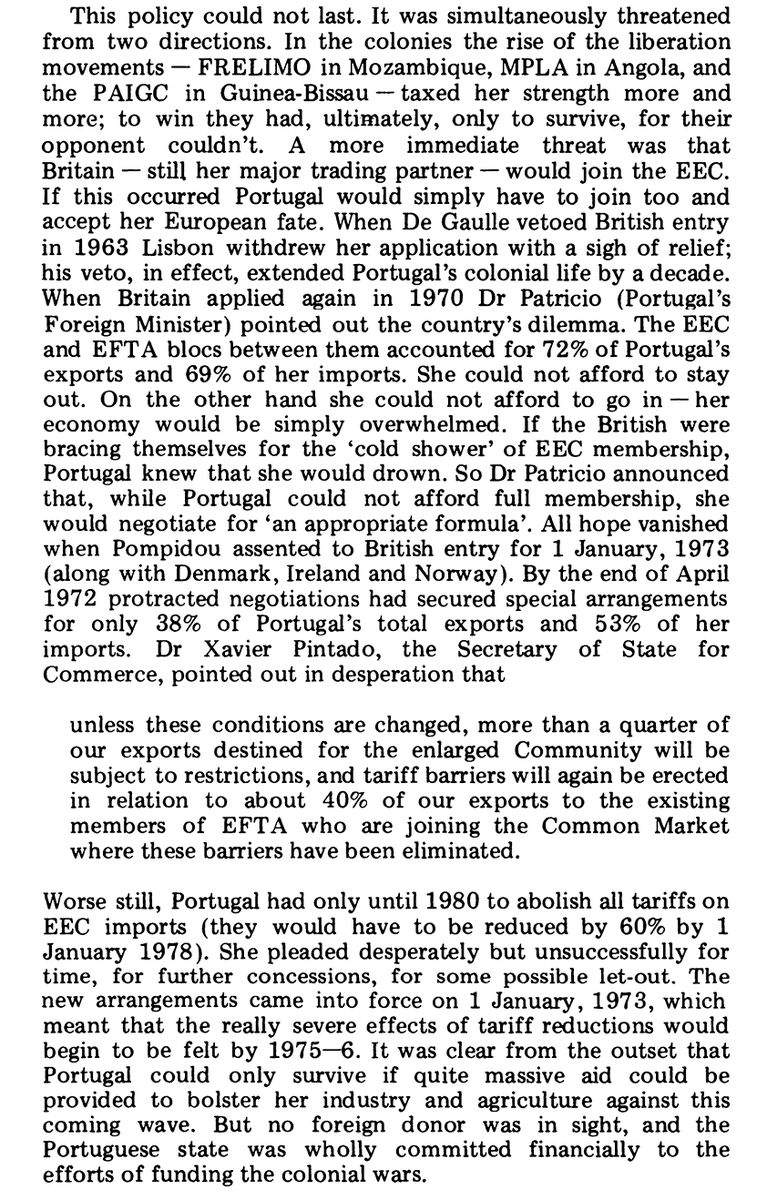
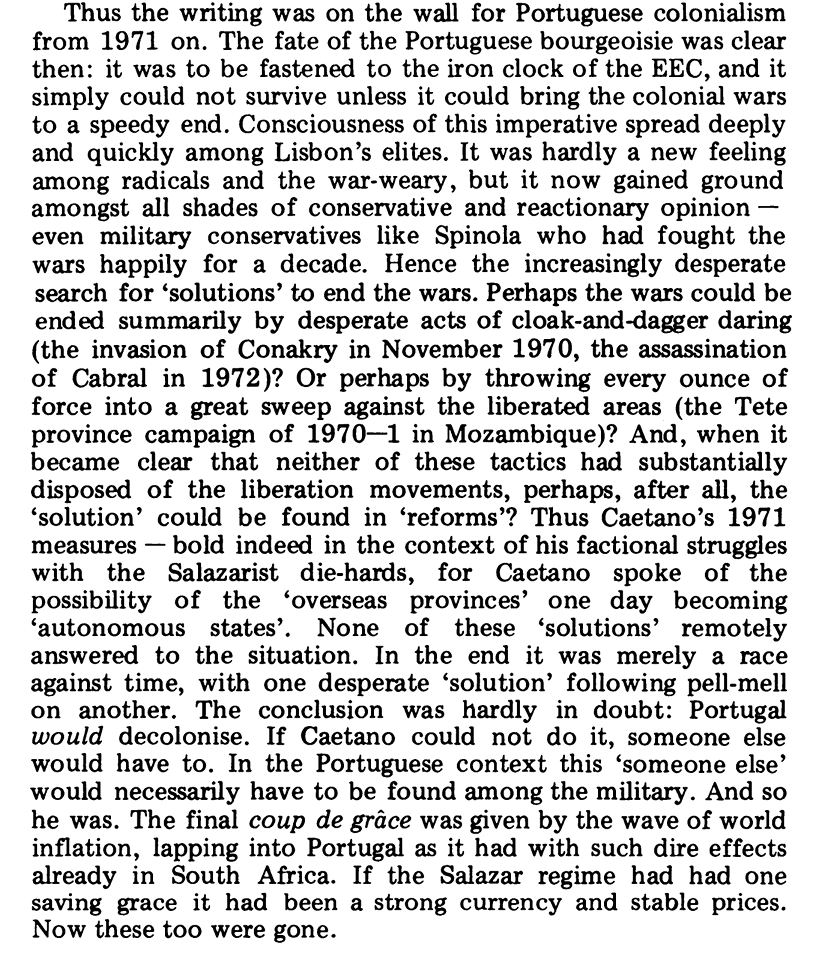
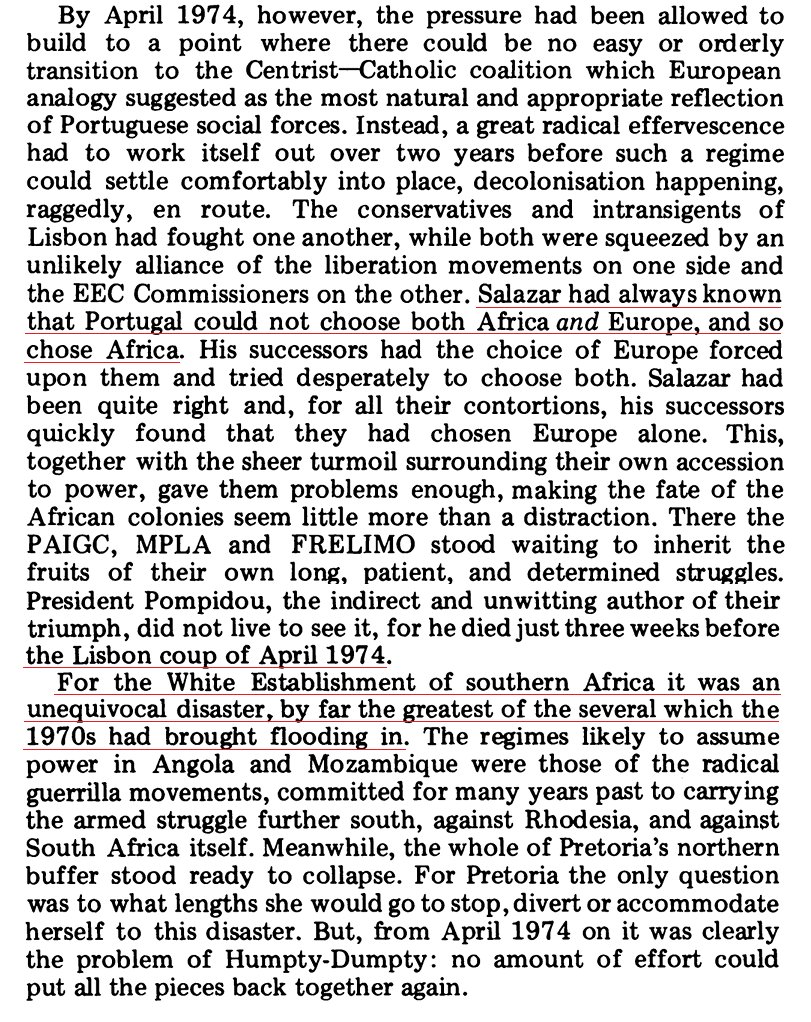

Effects of the 73 Oil Shock on SA.
Uniquely, the rocketing price of oil was the least of its problems - SA had long stockpiled oil in old goldmines for exactly such an emergency. Its was rather the Arab world's new assertiveness, & its novel UN cooperation with African states.
Uniquely, the rocketing price of oil was the least of its problems - SA had long stockpiled oil in old goldmines for exactly such an emergency. Its was rather the Arab world's new assertiveness, & its novel UN cooperation with African states.
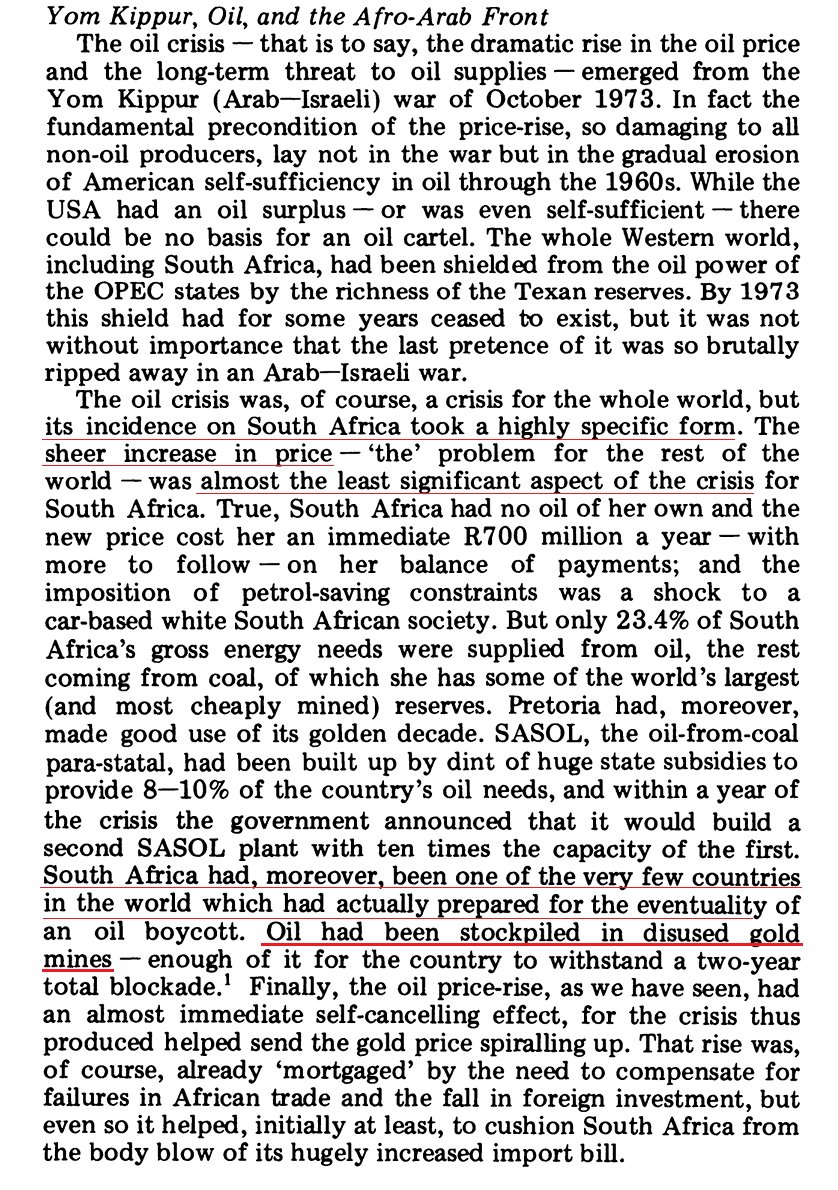
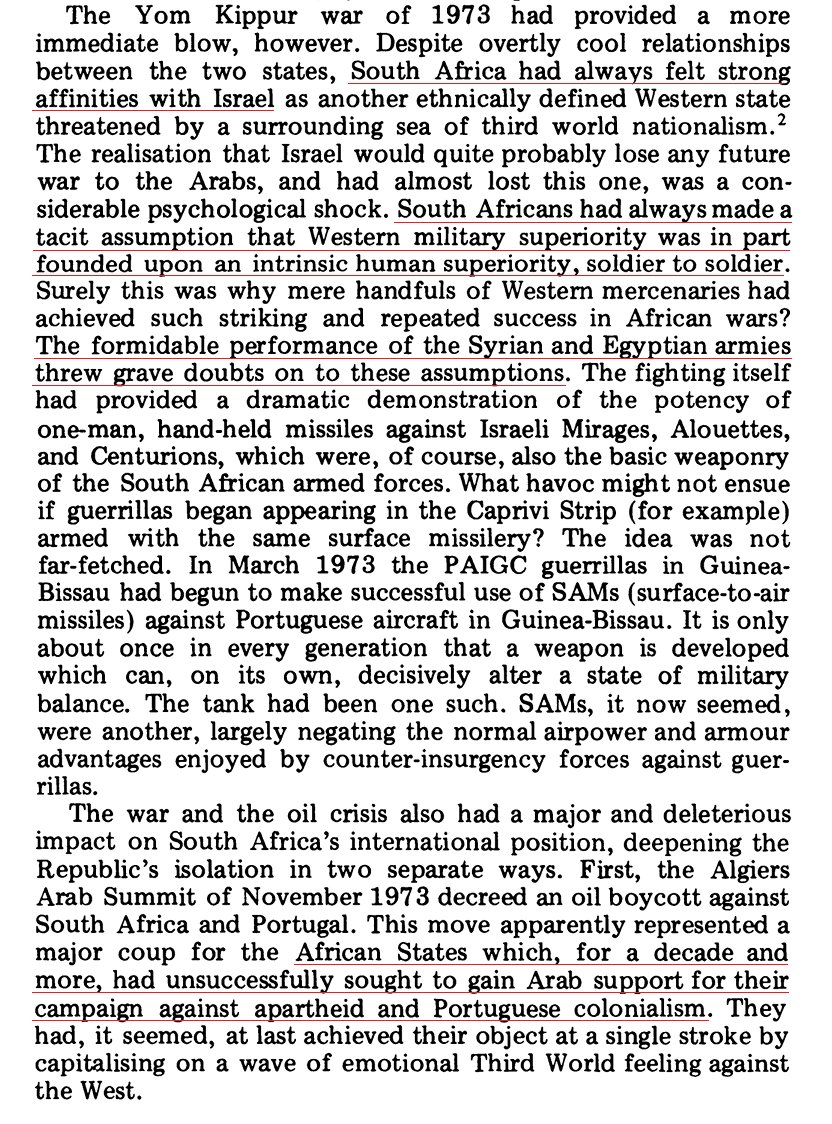
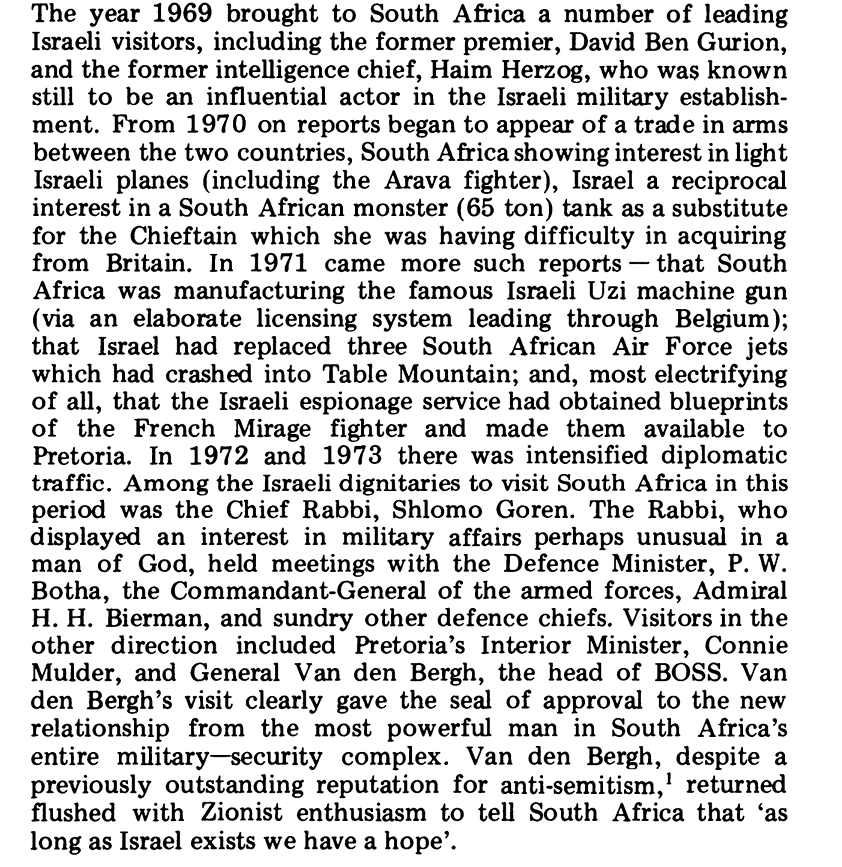
SA-🇮🇱 relations. Despite the "outstandingly anti-semitic reputations" of Afrikaaner leaders, trade & military ties deepened throughout the 60s. After '73, most moderate African states ended relations with 🇮🇱, following the lead of African "radicals" who had broken ties after '67.
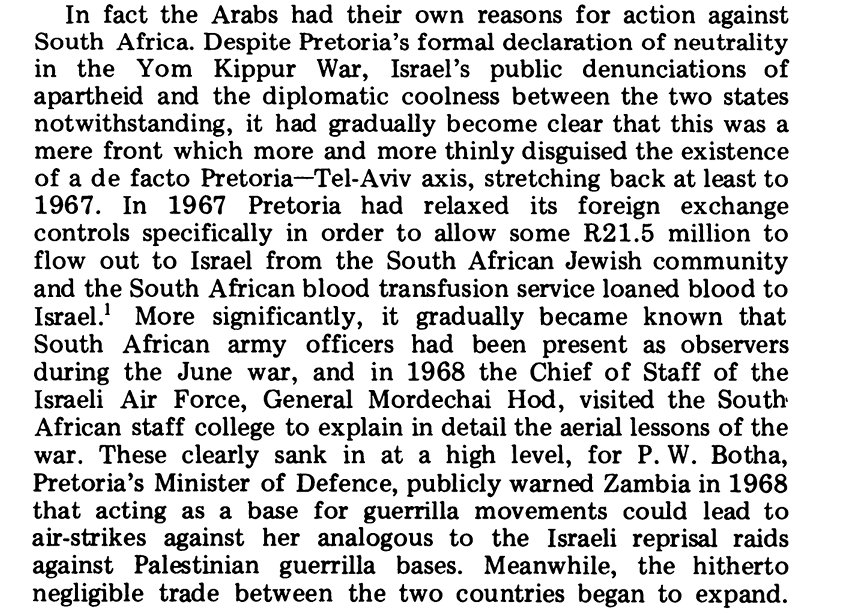
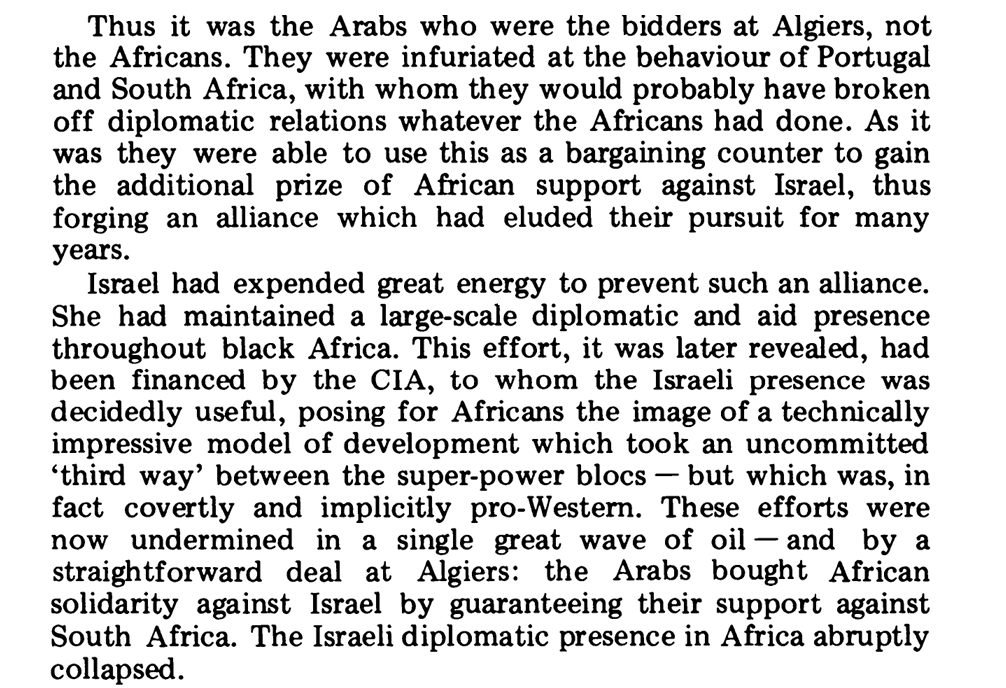
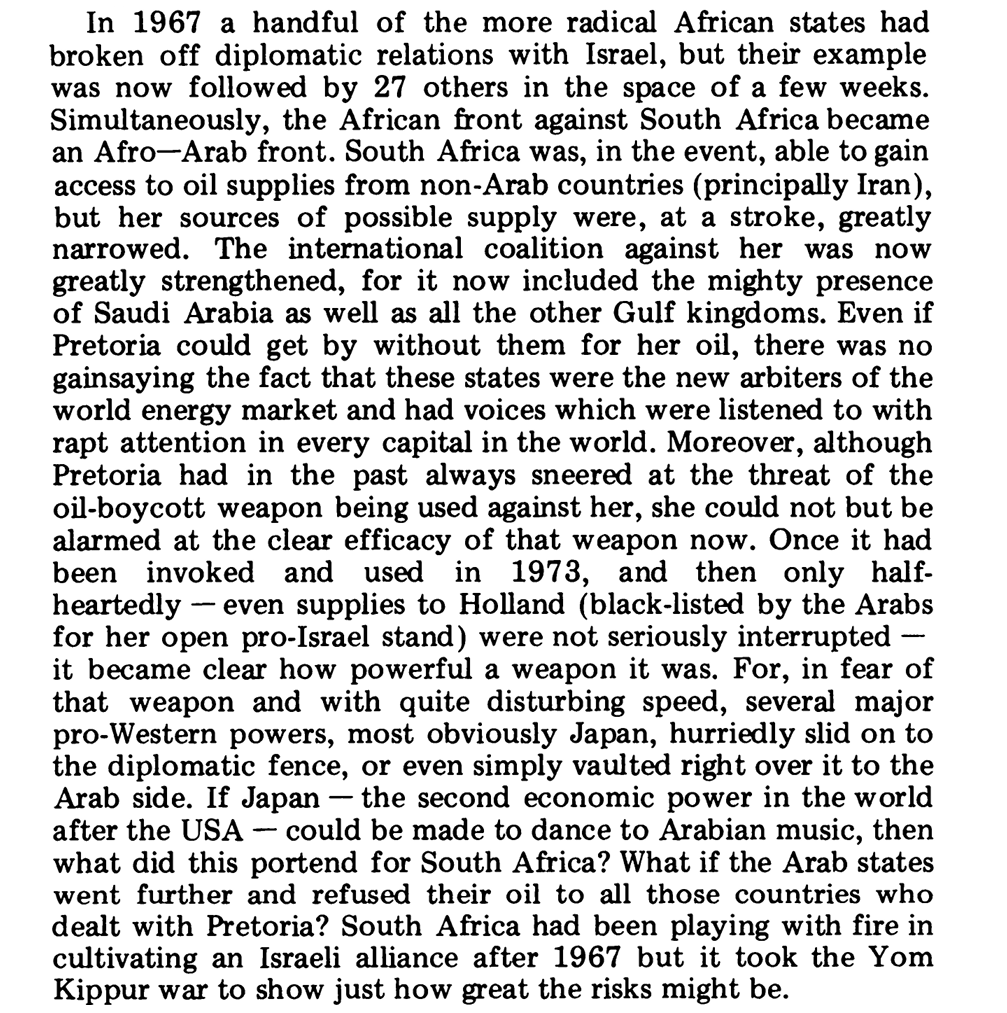
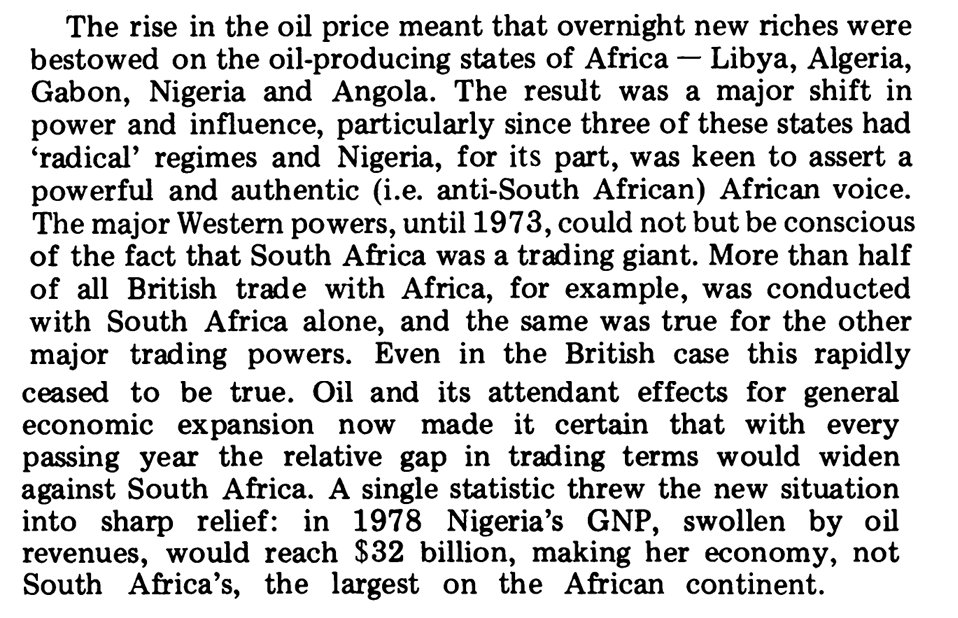
Rising oil prices gave anti-apartheid African states new influence. SA's economy was even overtaken by 🇳🇬 in 78, though this boon was soon negated by an exploding population & ethnic strife.
For purely mercenary reasons, states like 🇬🇧 abandoned their few remaining ties to SA.
For purely mercenary reasons, states like 🇬🇧 abandoned their few remaining ties to SA.
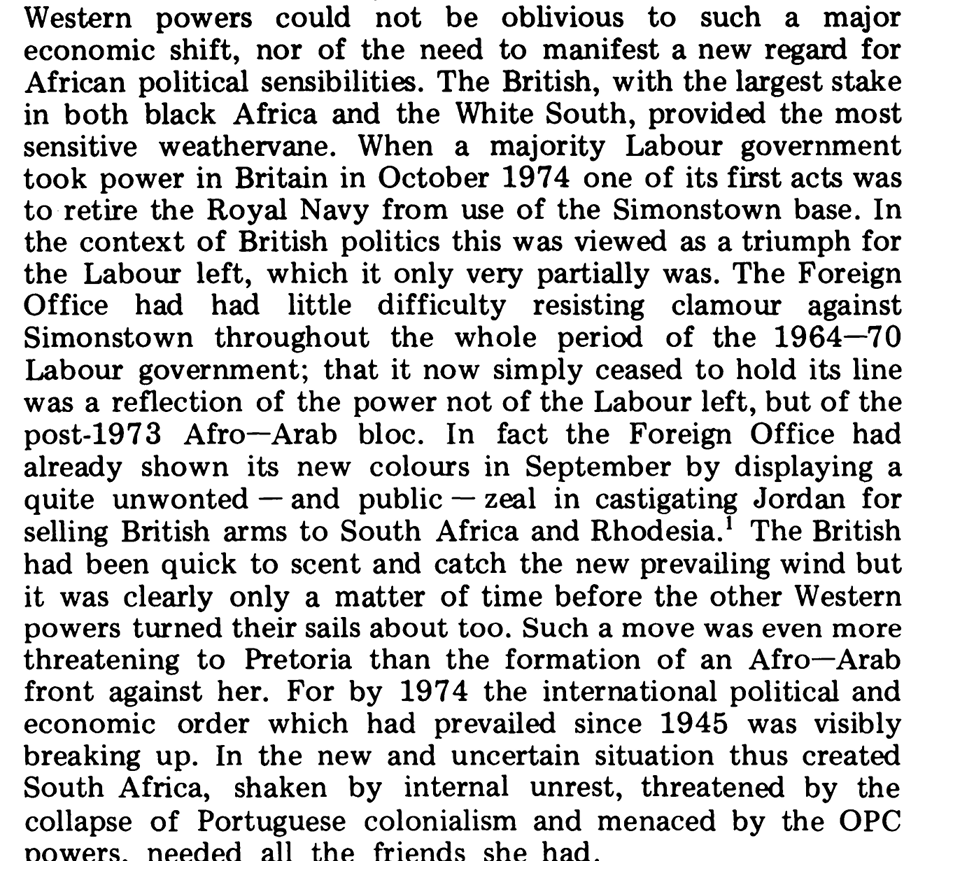
SA's foreign policy was based on 2 principles:
Prevent rise of any leftist government in a adjacent state that would shelter 🇿🇦 activists/guerillas. Achieve this without deploying SA troops abroad.
Collapse of 🇵🇹Empire & Rhodesia's escalating Bush War forced a choice of just 1.
Prevent rise of any leftist government in a adjacent state that would shelter 🇿🇦 activists/guerillas. Achieve this without deploying SA troops abroad.
Collapse of 🇵🇹Empire & Rhodesia's escalating Bush War forced a choice of just 1.

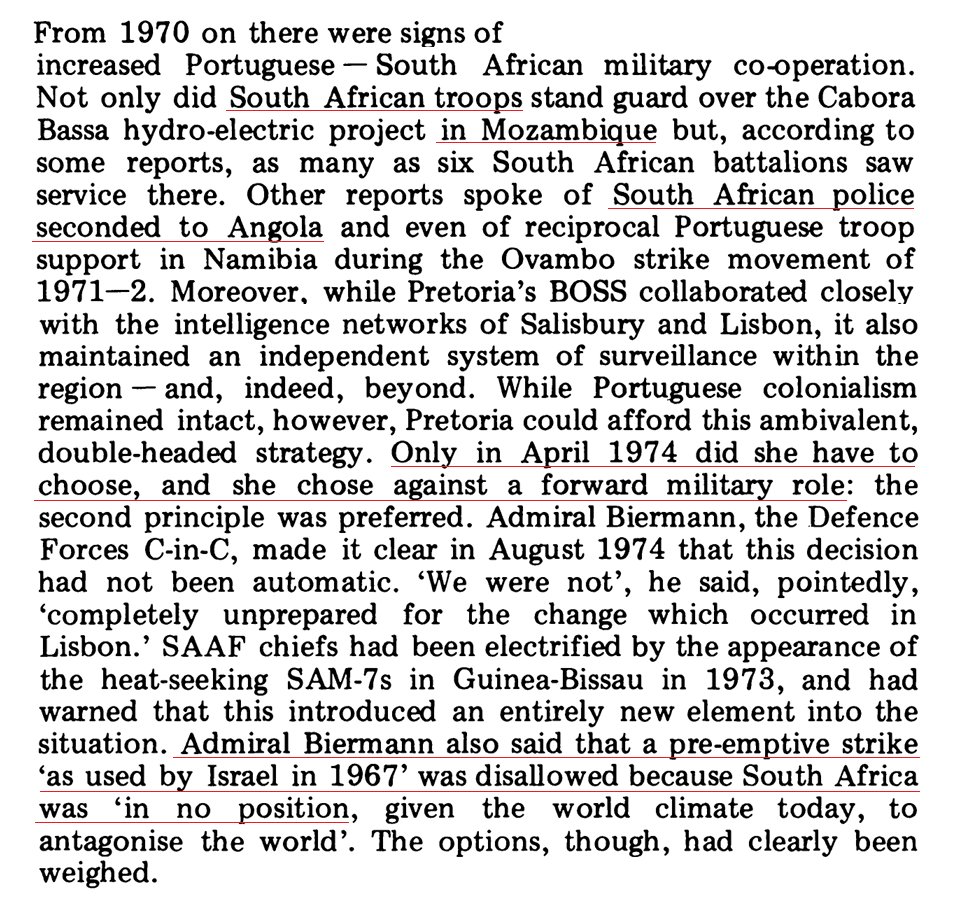
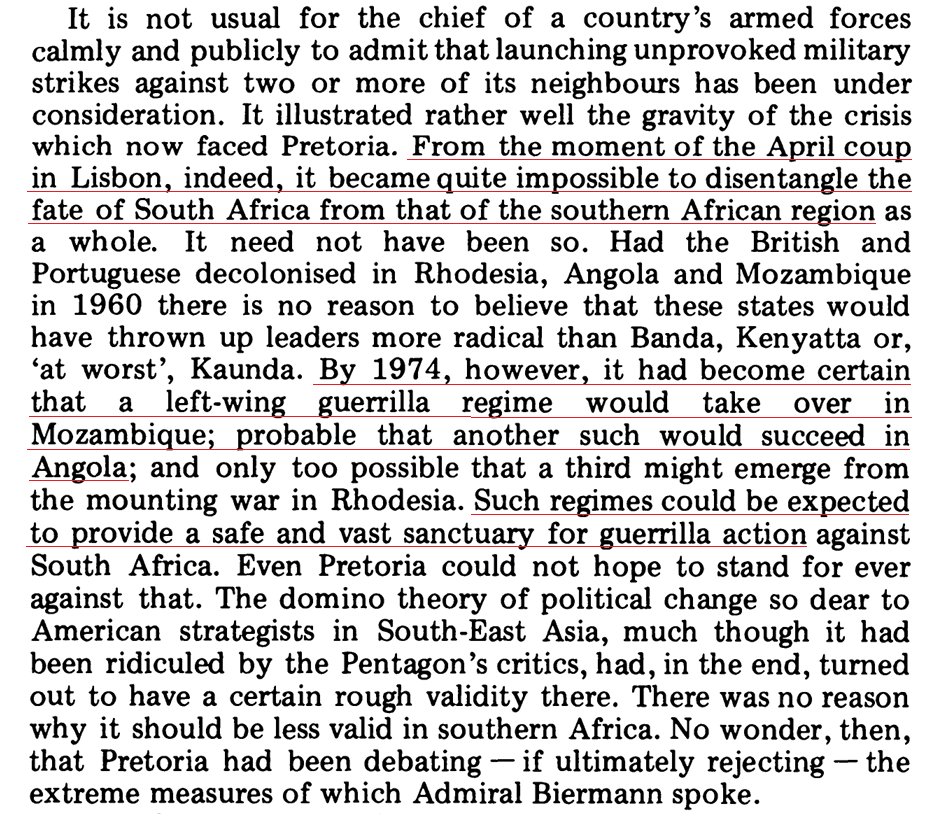
SA picked the 2nd option, pusillanimously rejecting requests for help from whites in Mozambique & Angola, despite them holding relatively compact & defensible positions. SA delusionally believed if it assisted "decolonisation" elsewhere, it would lead to broad African acceptance.
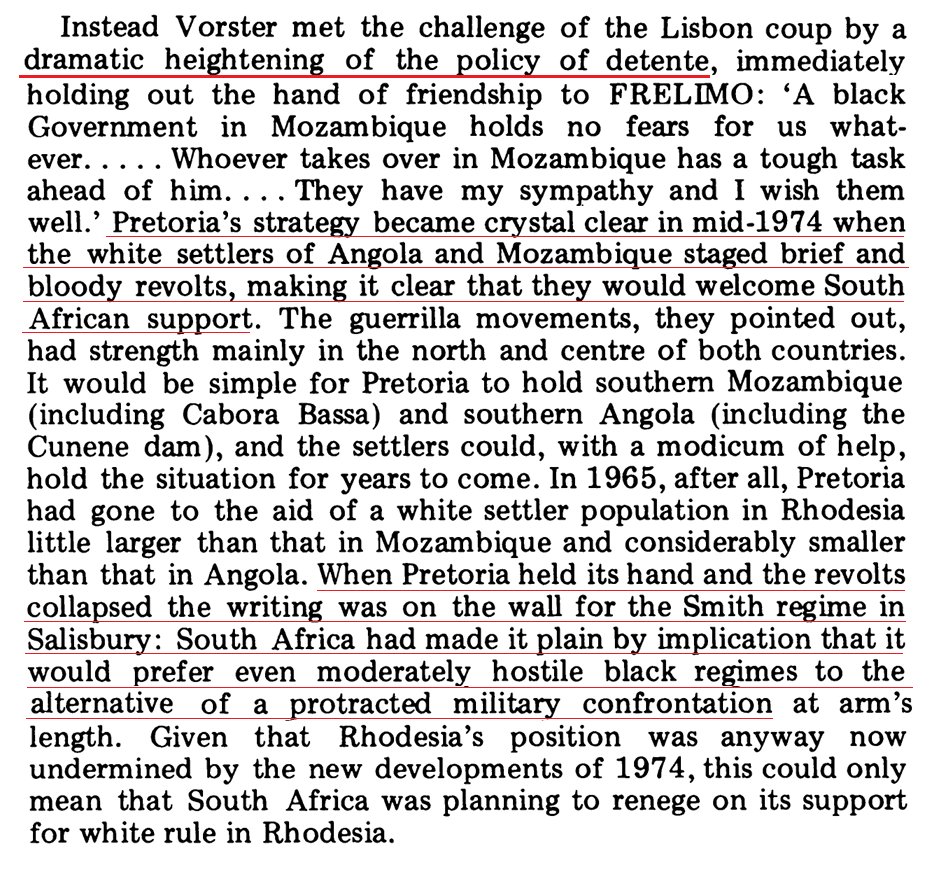
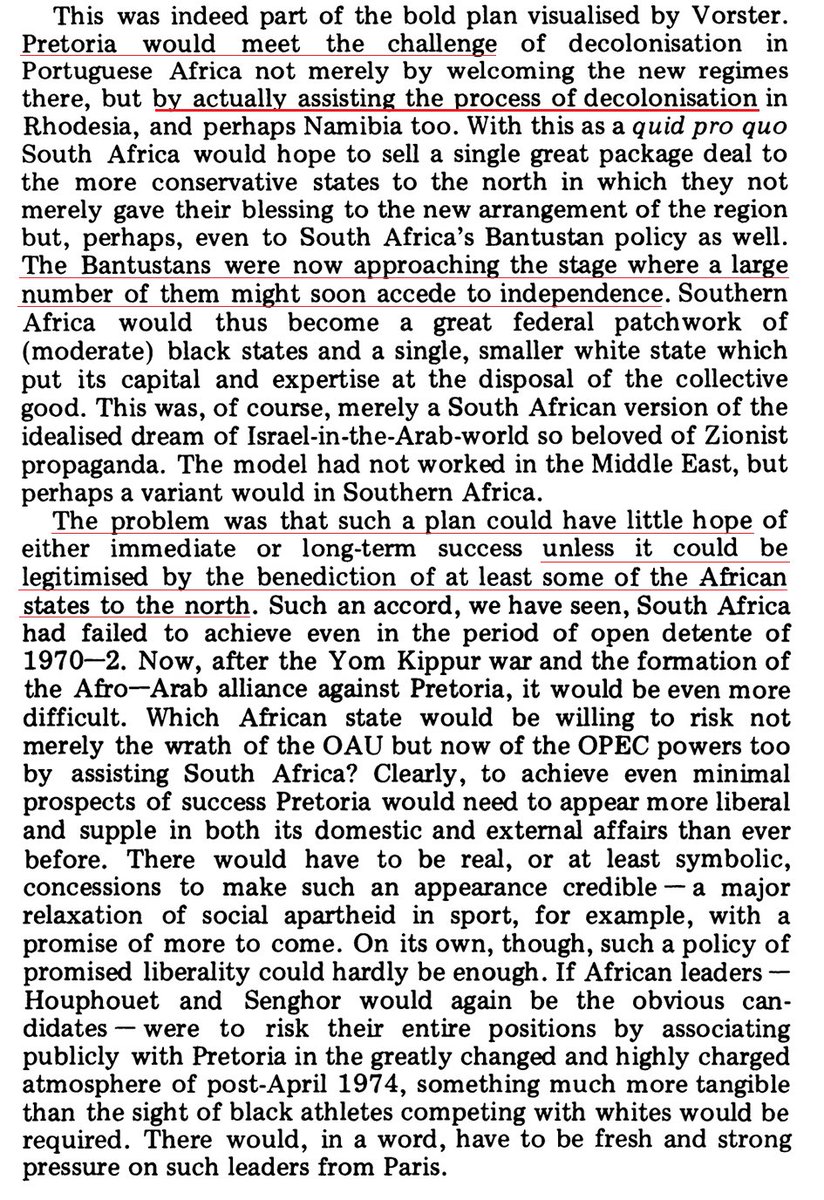
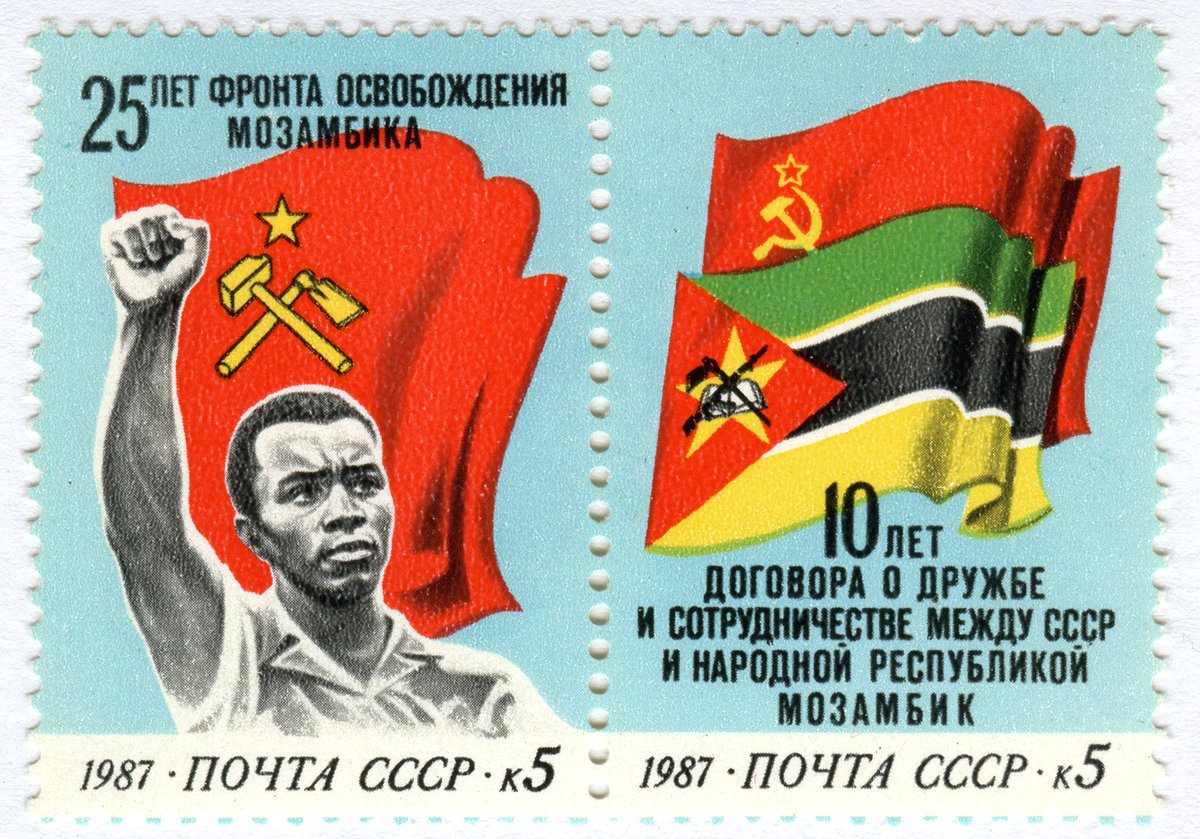
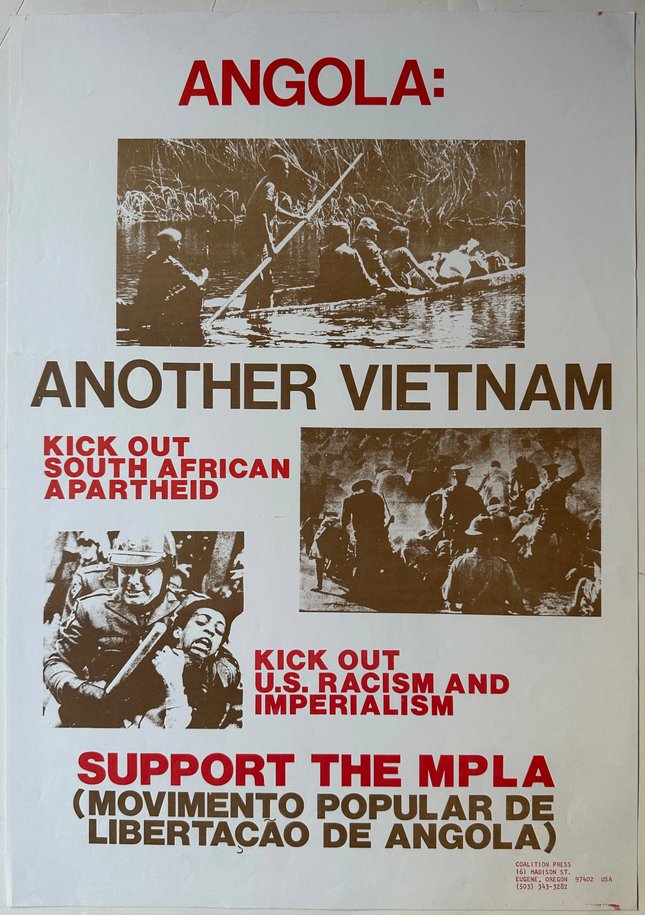
France urged SA to take a more pro-active policy abroad, supporting secessionist movements in Angola etc., whilst being the only state to protect SA at the UN. But as seen above, SA rejected 🇮🇱-style preemptive strikes, thinking it still had any reputation to lose with Africans.
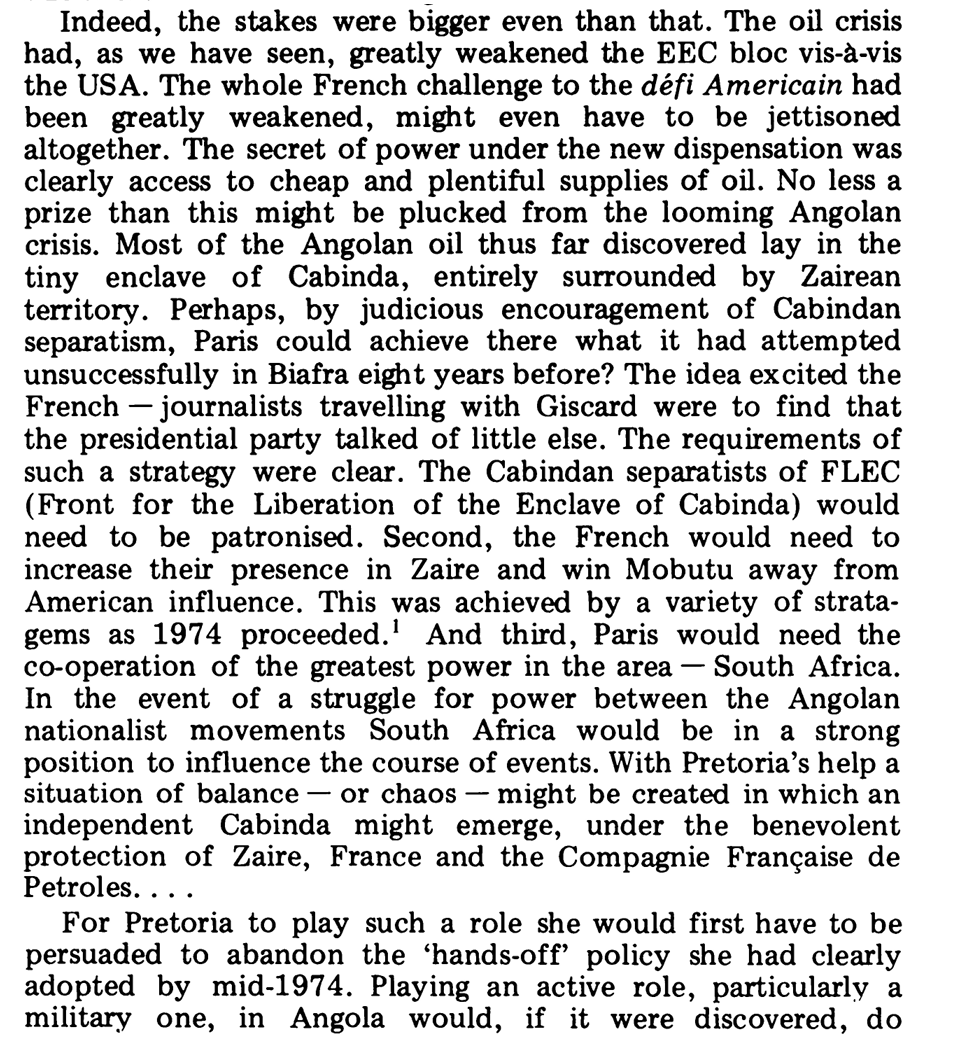
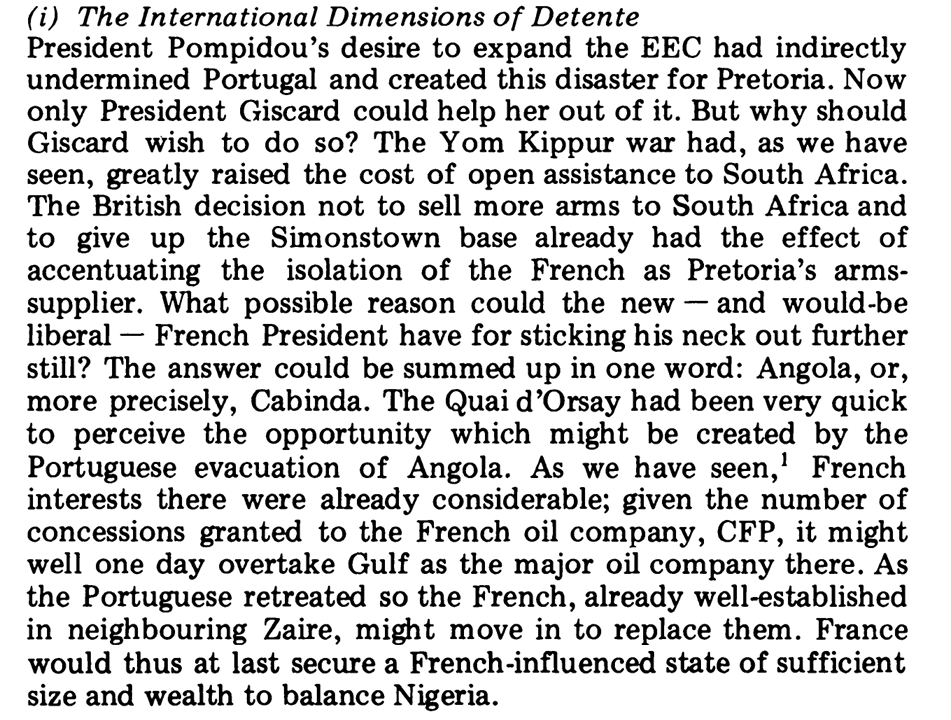
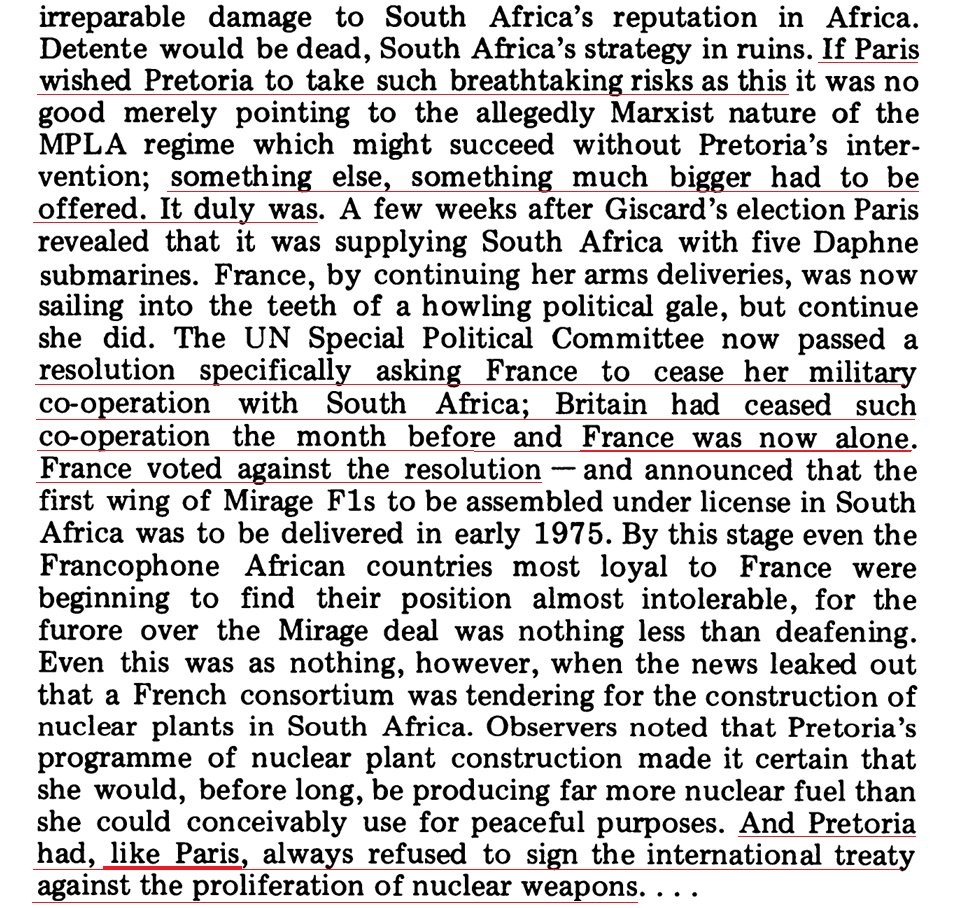

SA abandonment of Rhodesia, trying to avoid provoking the already hostile new government of Mozambique. In '74 SA's leader Vorster even made public statements hinting at dismantling apartheid. Without action taken, did nothing to win favour abroad & infuriated Boer conservatives.
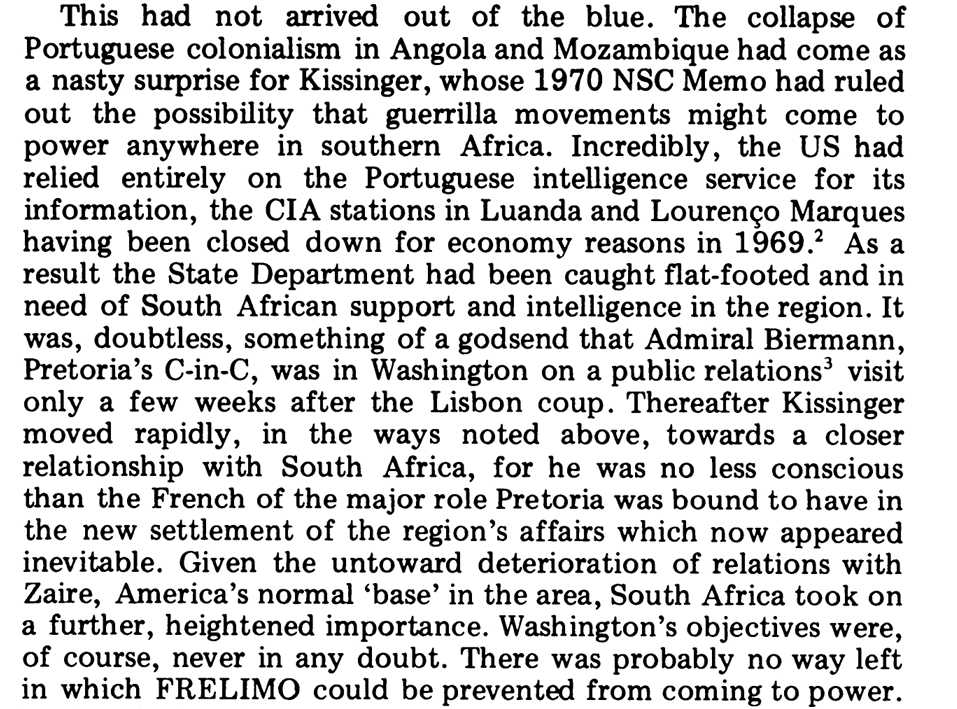
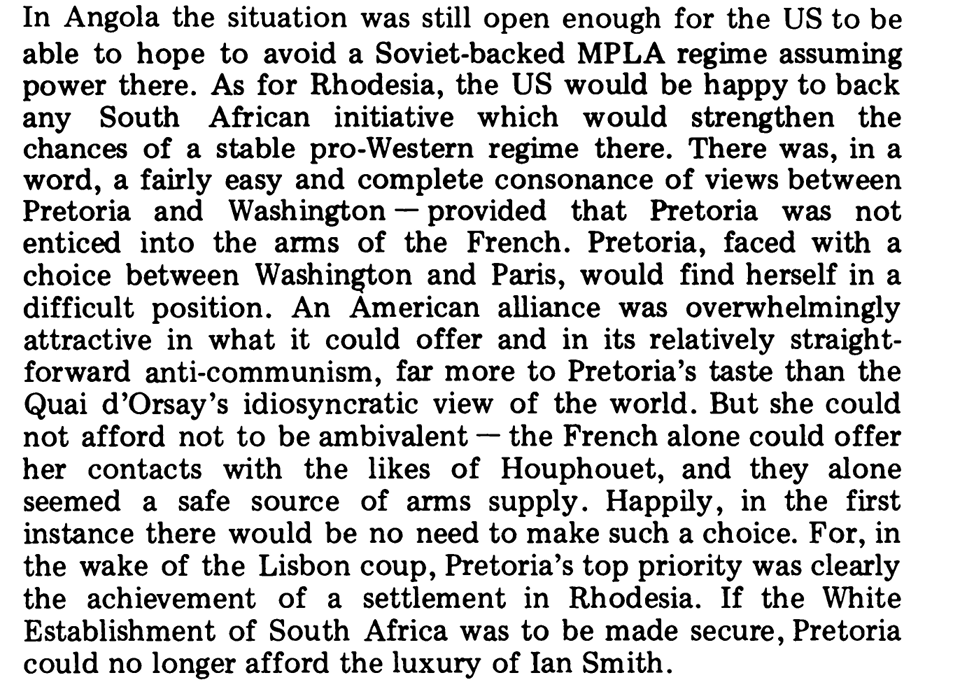
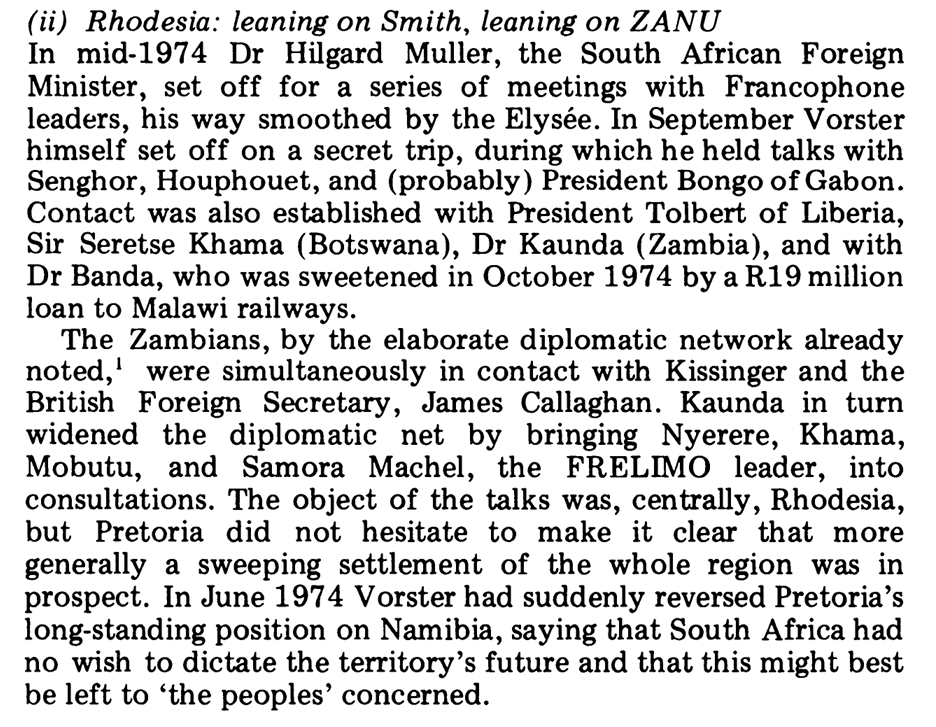
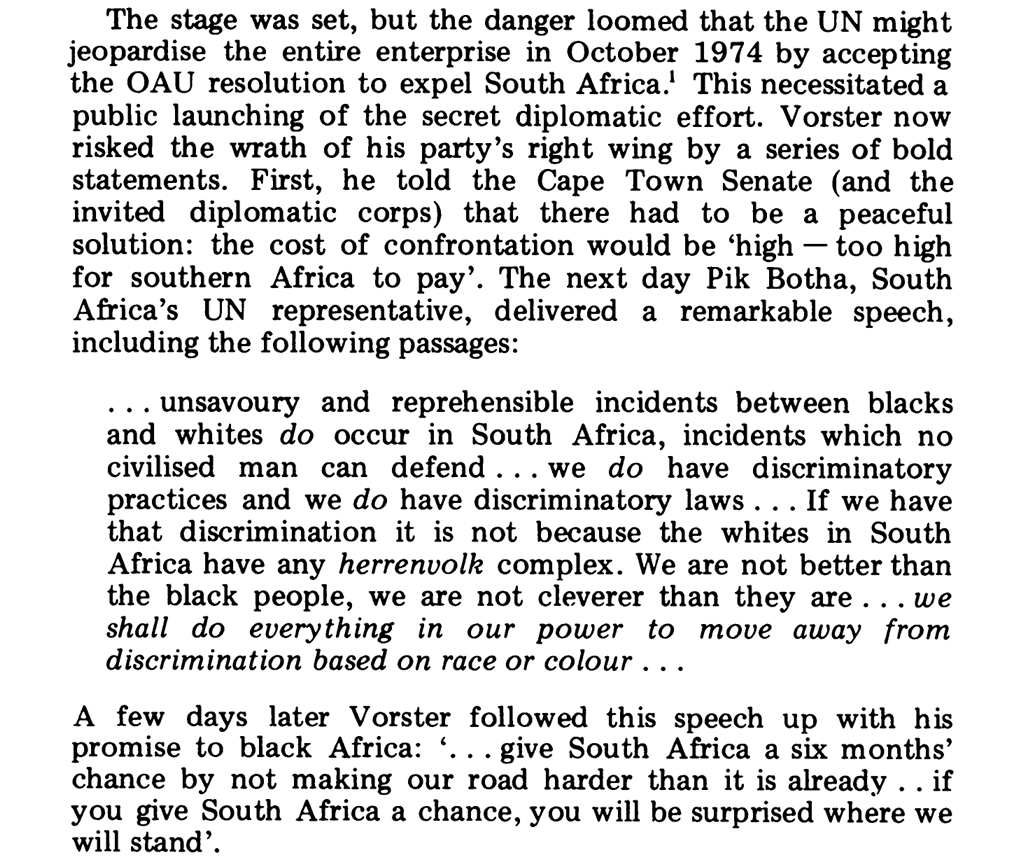
SA pressured Smith to give up the fight in Rhodesia & began dealing his guerilla enemy, Mugabe.
The new situation in now-Zimbabwe made the position of Zambia's moderate leader Kaunda, very difficult. Under radical pressure, he turned to single-party government.
The new situation in now-Zimbabwe made the position of Zambia's moderate leader Kaunda, very difficult. Under radical pressure, he turned to single-party government.
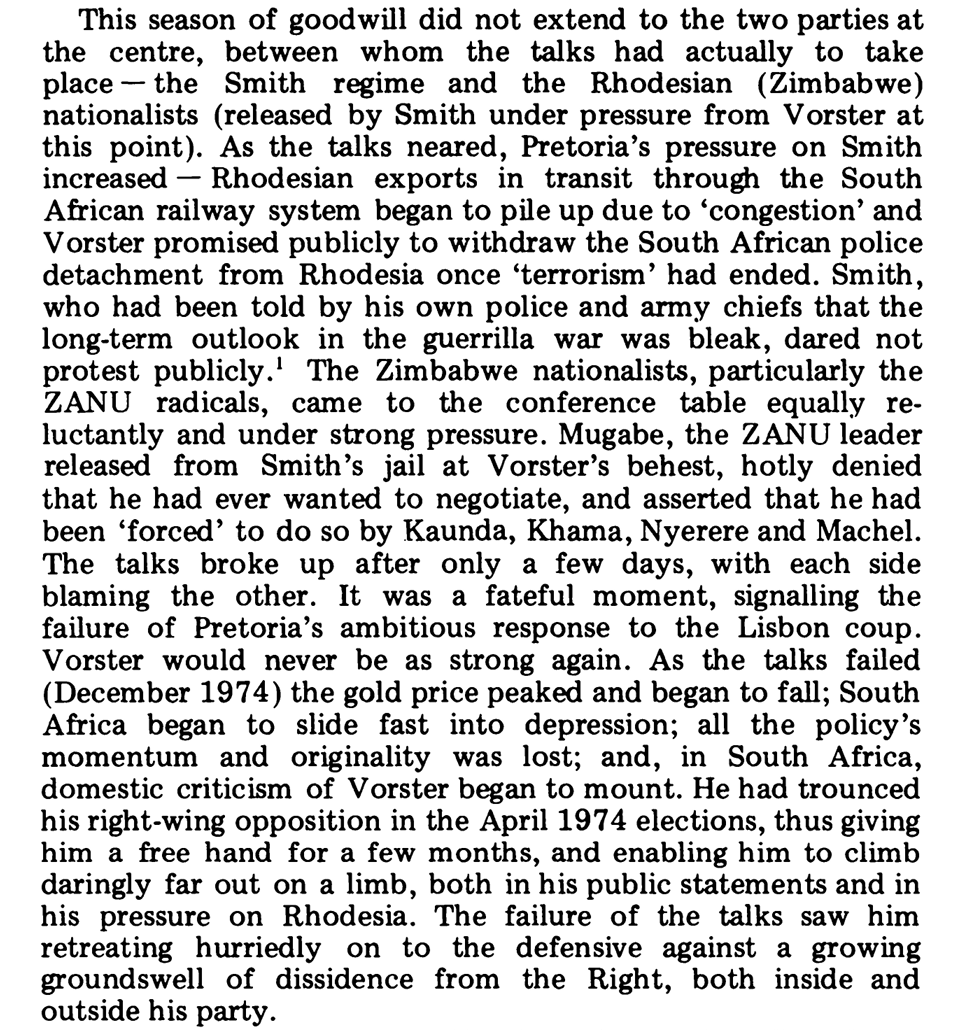
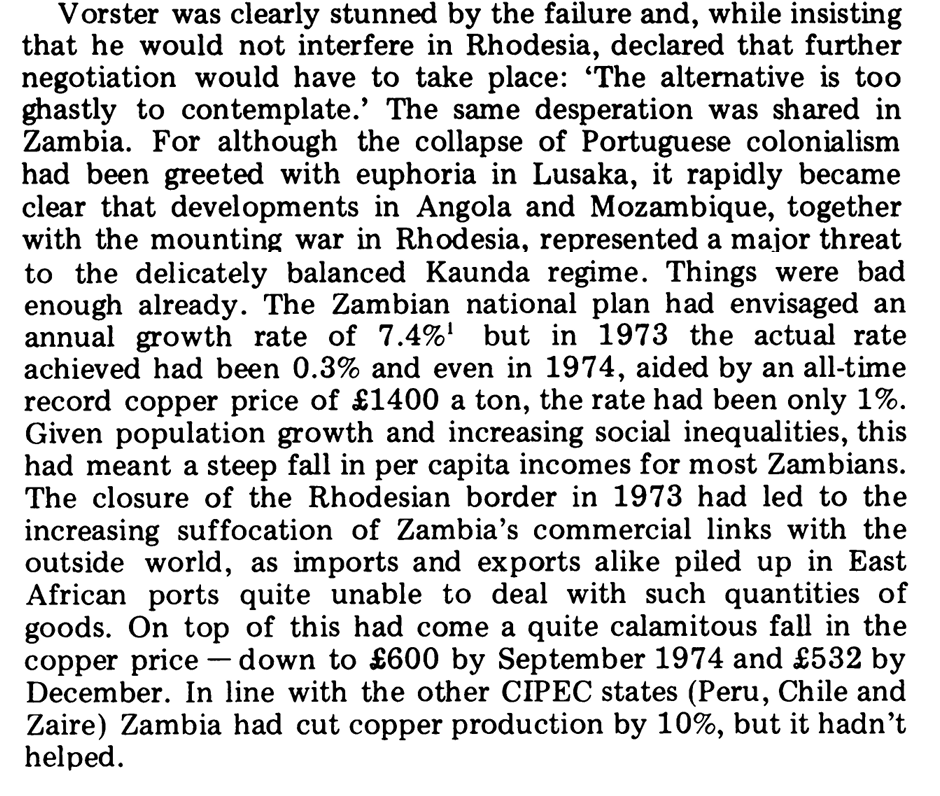
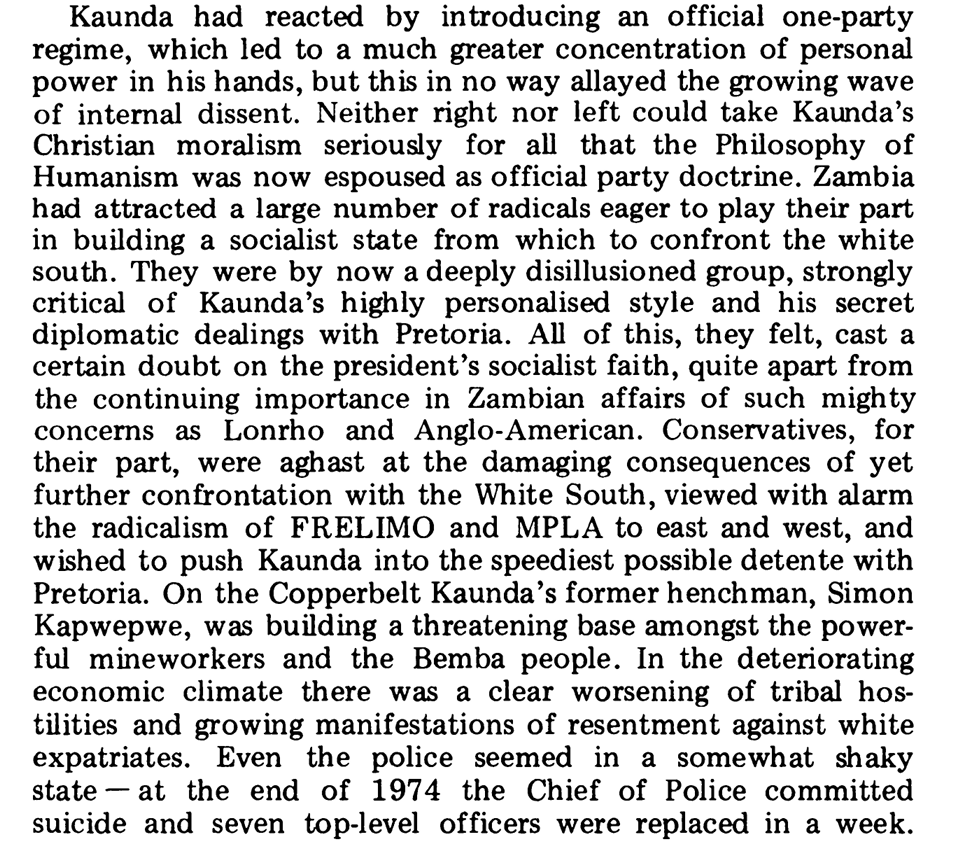
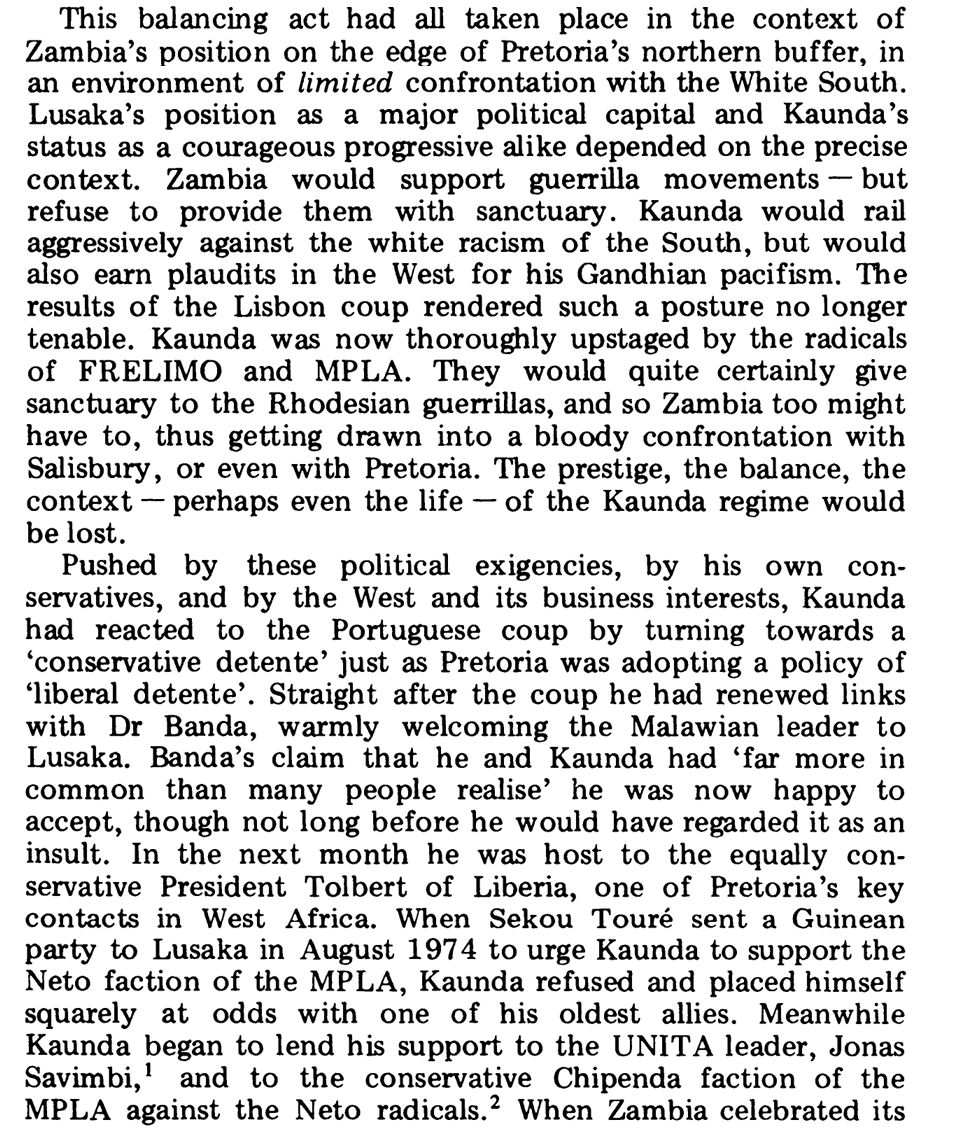
Both SA & Zambia wanted to end Rhodesia's Bush War in a compromise.
Each state urged Ian Smith or black nationalists to respectively "moderate" their positions, but Vorster's weak hand due to internal opposition & factional war within ZANU itself scuttled the talks.
Each state urged Ian Smith or black nationalists to respectively "moderate" their positions, but Vorster's weak hand due to internal opposition & factional war within ZANU itself scuttled the talks.


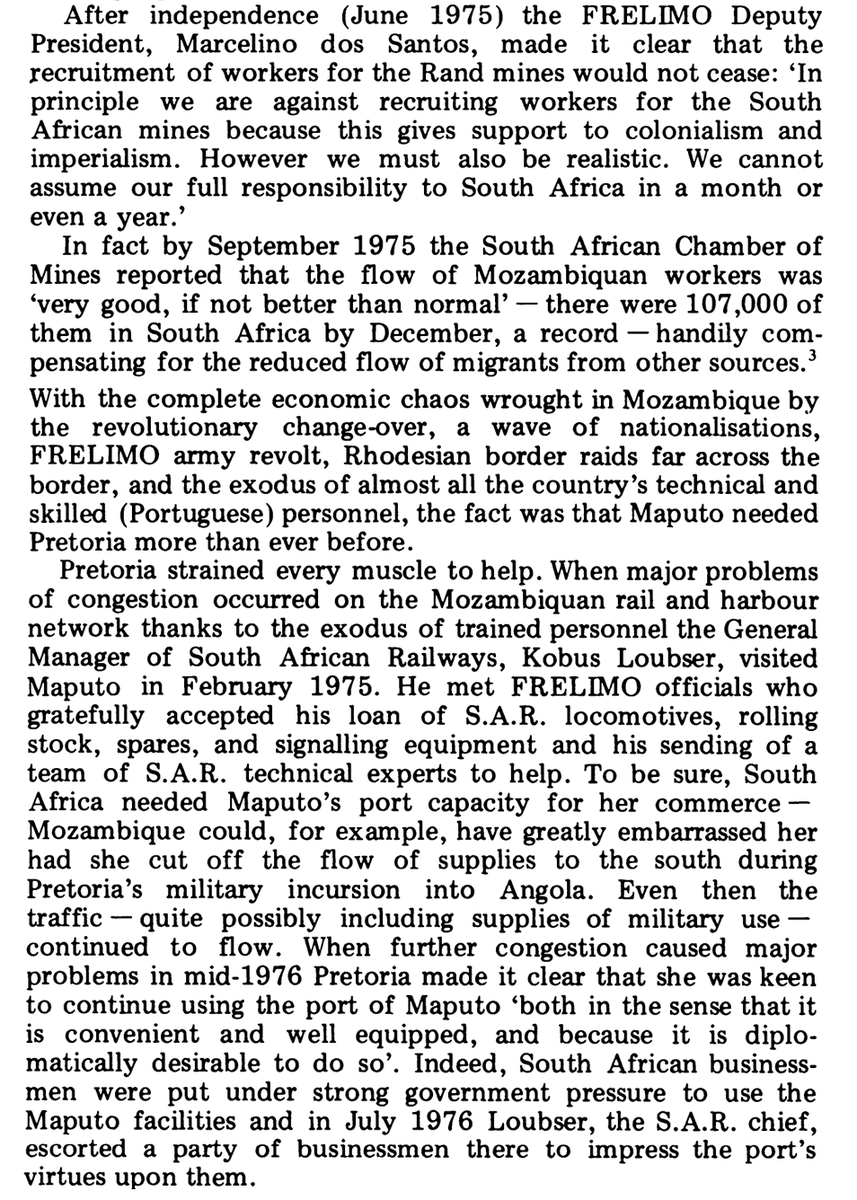
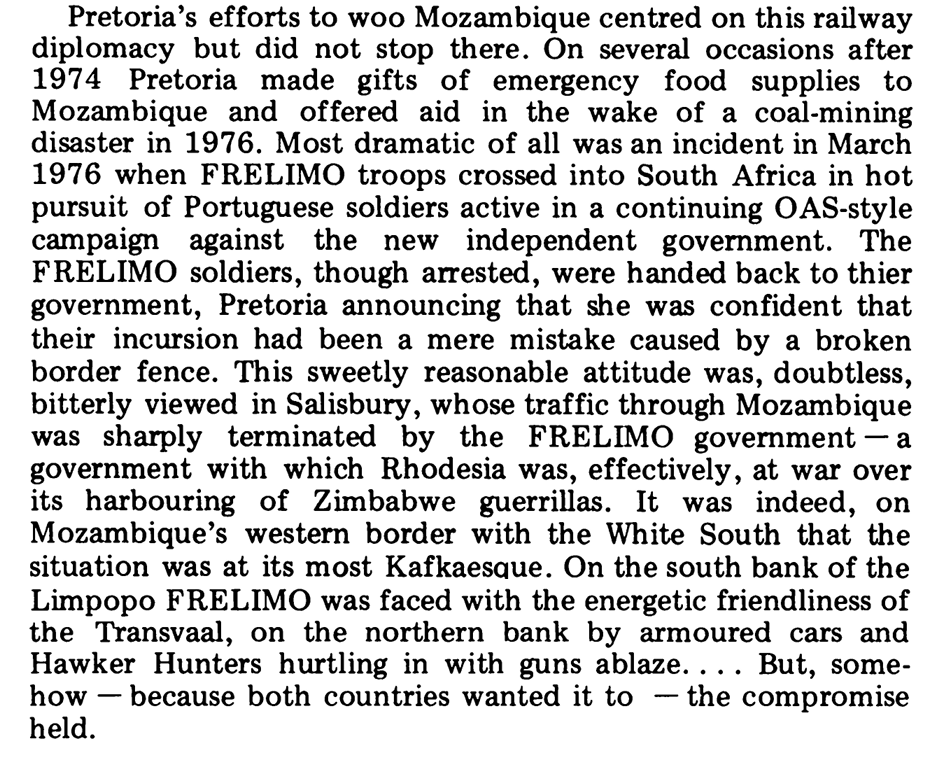
SA's relations with newly independent Mozambique. Despite its revolutionary origins, 🇲🇿's FRELIMO adopted a detente with SA, not least due to its hopeless economic situation. SA even assisted 🇲🇿 economically, fearing anarchy if its USSR-aligned government fell.

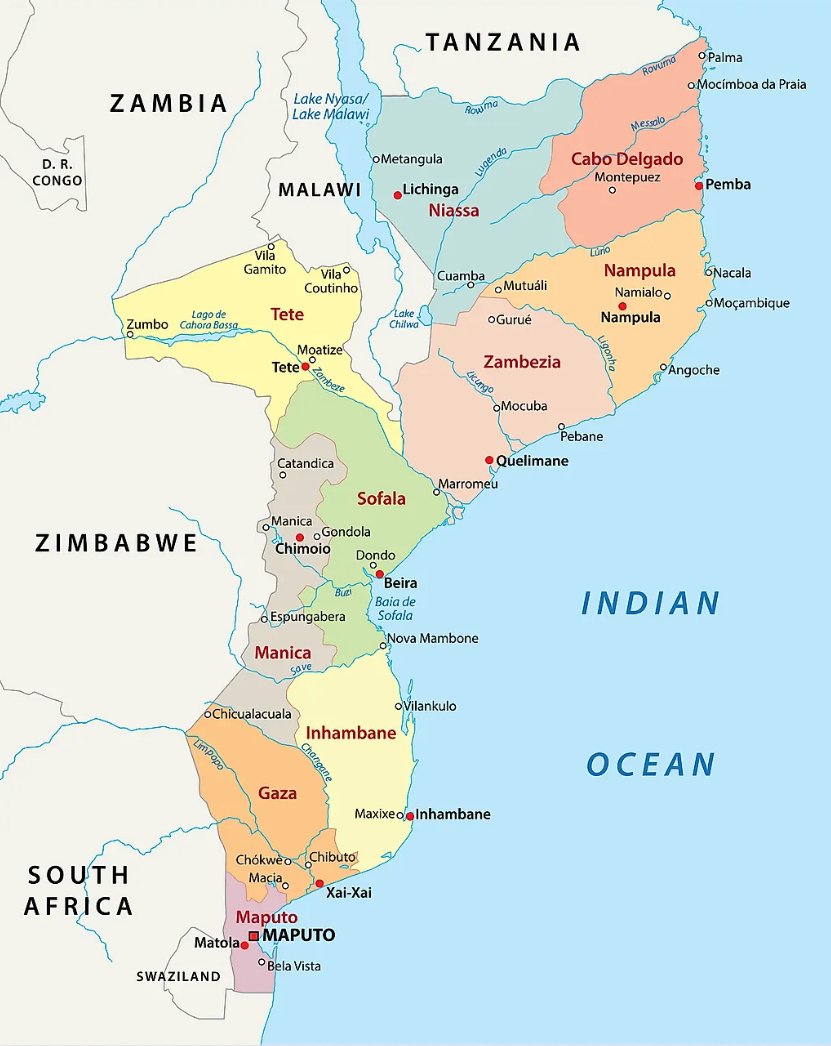
The 🇵🇹 withdrawal left Angola in chaos, contested between a dozen factions, variously backed by the US, France (alone), USSR or African neighbors like Zaire.
The alphabet soup of warring acronyms & international intrigues are very complicated & I'll pass over most of them.
The alphabet soup of warring acronyms & international intrigues are very complicated & I'll pass over most of them.
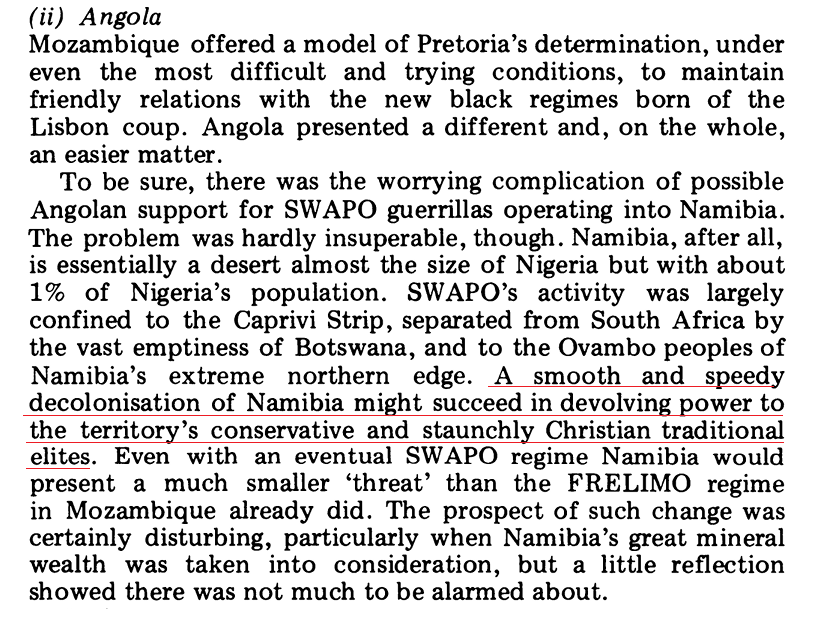
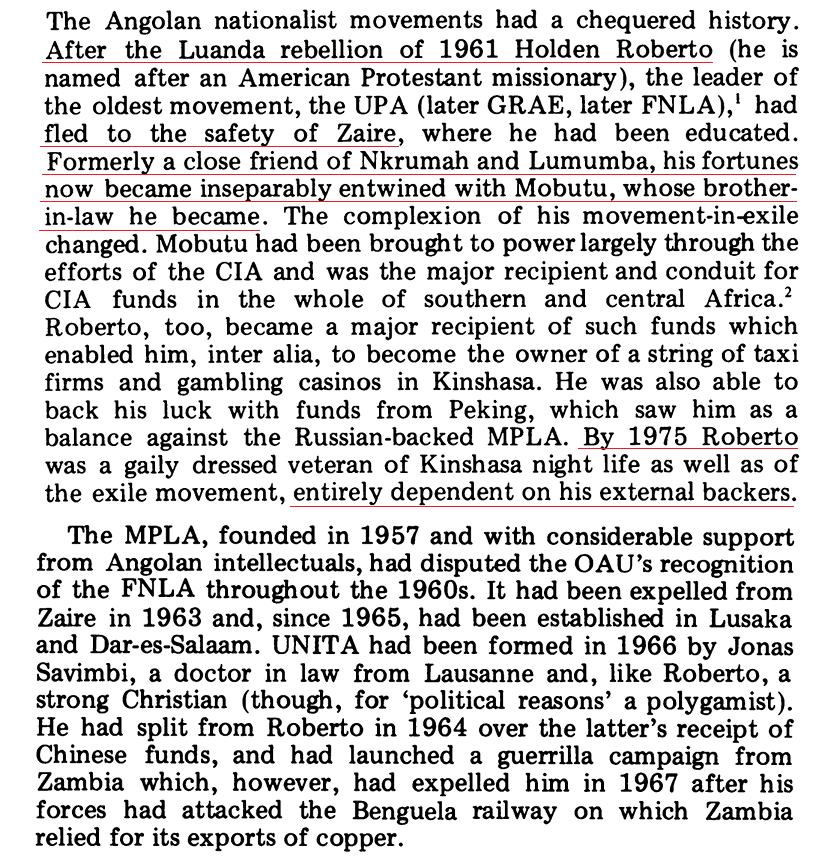
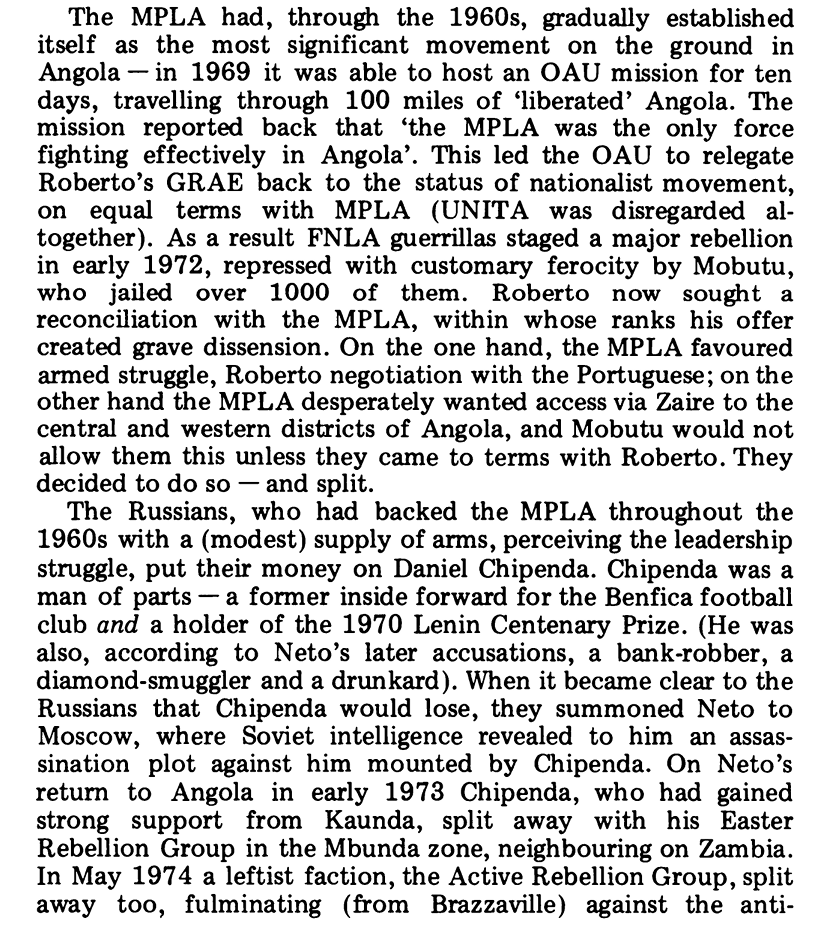
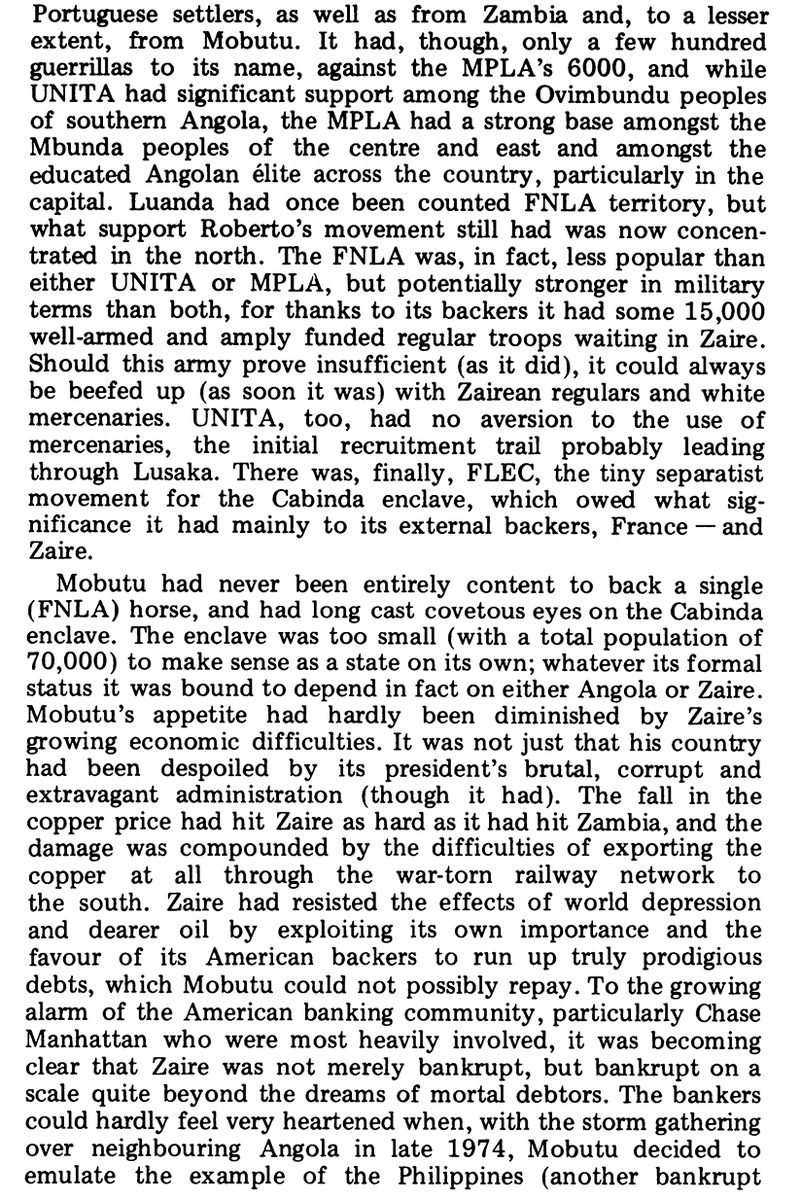
SA was cajoled into fighting in Angola by the US (or rather, Kissinger acting outside his mandate) against its better judgement.
Once SA troops were in 🇦🇴, SA was reluctant to commit further, thus incurring global condemnation without much effecting the war's outcome. Cubans.
Once SA troops were in 🇦🇴, SA was reluctant to commit further, thus incurring global condemnation without much effecting the war's outcome. Cubans.

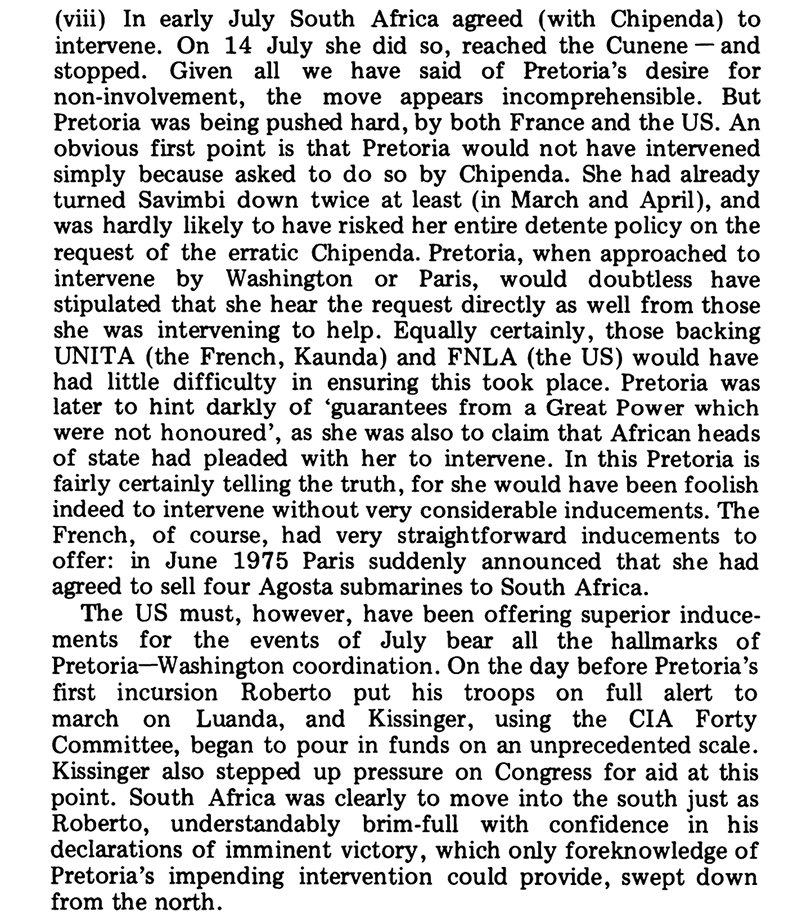
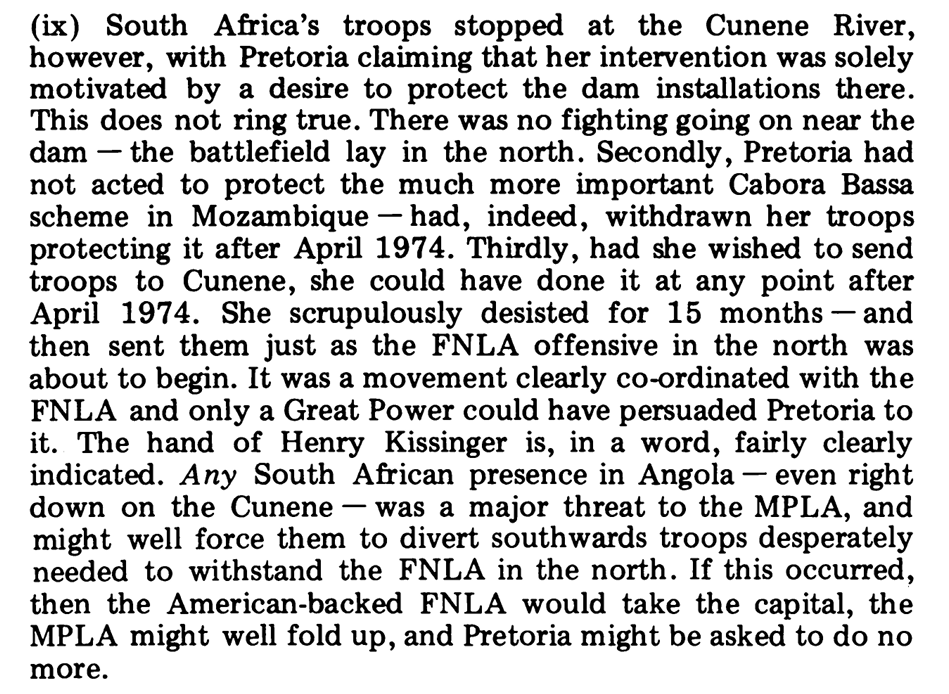
Not only Communist Bloc, but France & the US were backing proxy🇦🇴militias against one another.
🇫🇷 was so incensed on discovering the SA-🇺🇸 alignment in the war that it ceased selling SA weapons overnight. France had ignored "Afro-Arab wrath" over its SA ties only months earlier.
🇫🇷 was so incensed on discovering the SA-🇺🇸 alignment in the war that it ceased selling SA weapons overnight. France had ignored "Afro-Arab wrath" over its SA ties only months earlier.

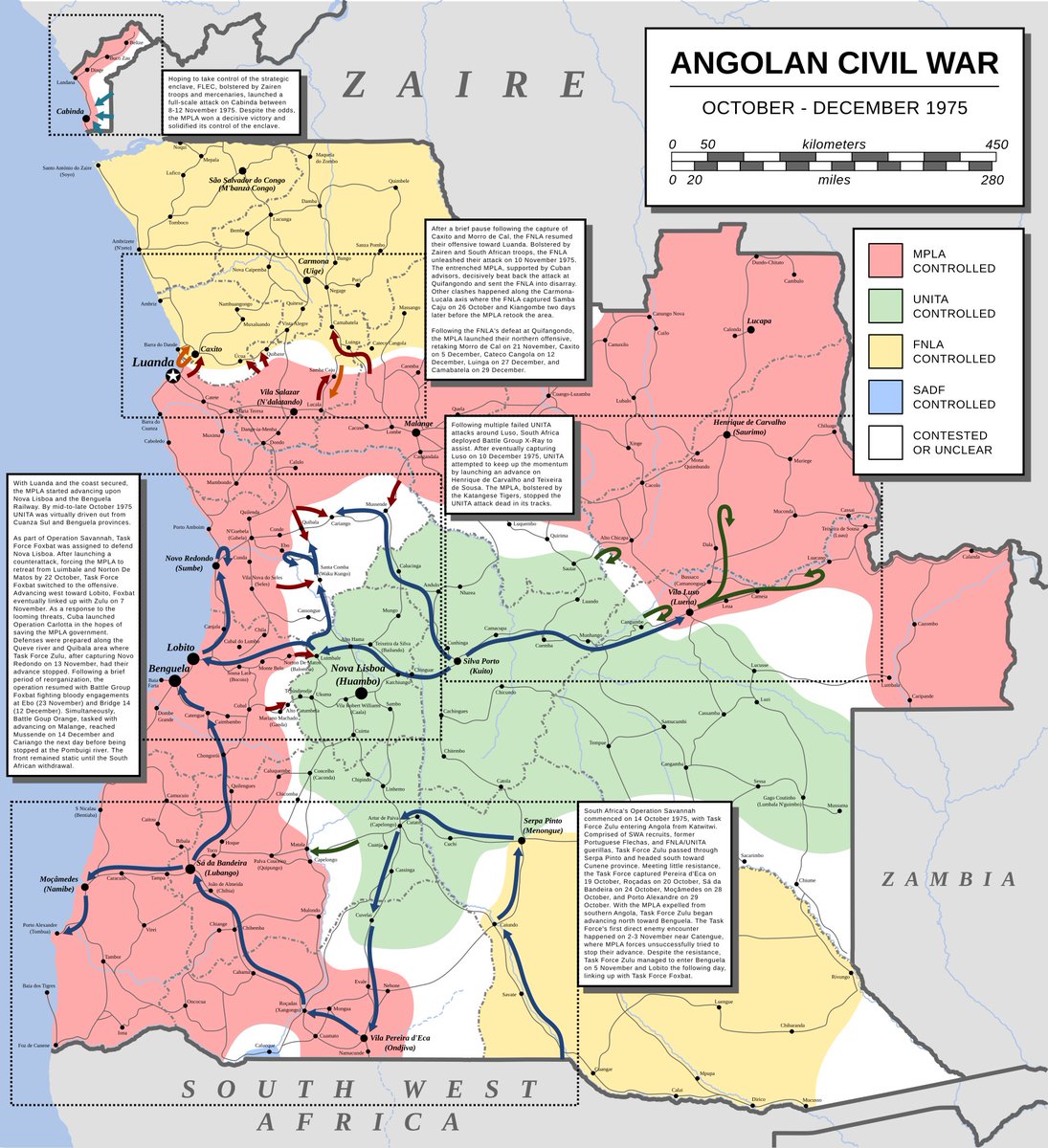
Author's harsh words on Henry Kissinger's bungling as a lone-wolf in Africa, which had catastrophic consequences for SA.
Easy to dismiss with the benefit of hindsight, how strong the Communist Bloc appeared in the early 70s. They seemed be advancing everywhere in the 3rd World.
Easy to dismiss with the benefit of hindsight, how strong the Communist Bloc appeared in the early 70s. They seemed be advancing everywhere in the 3rd World.
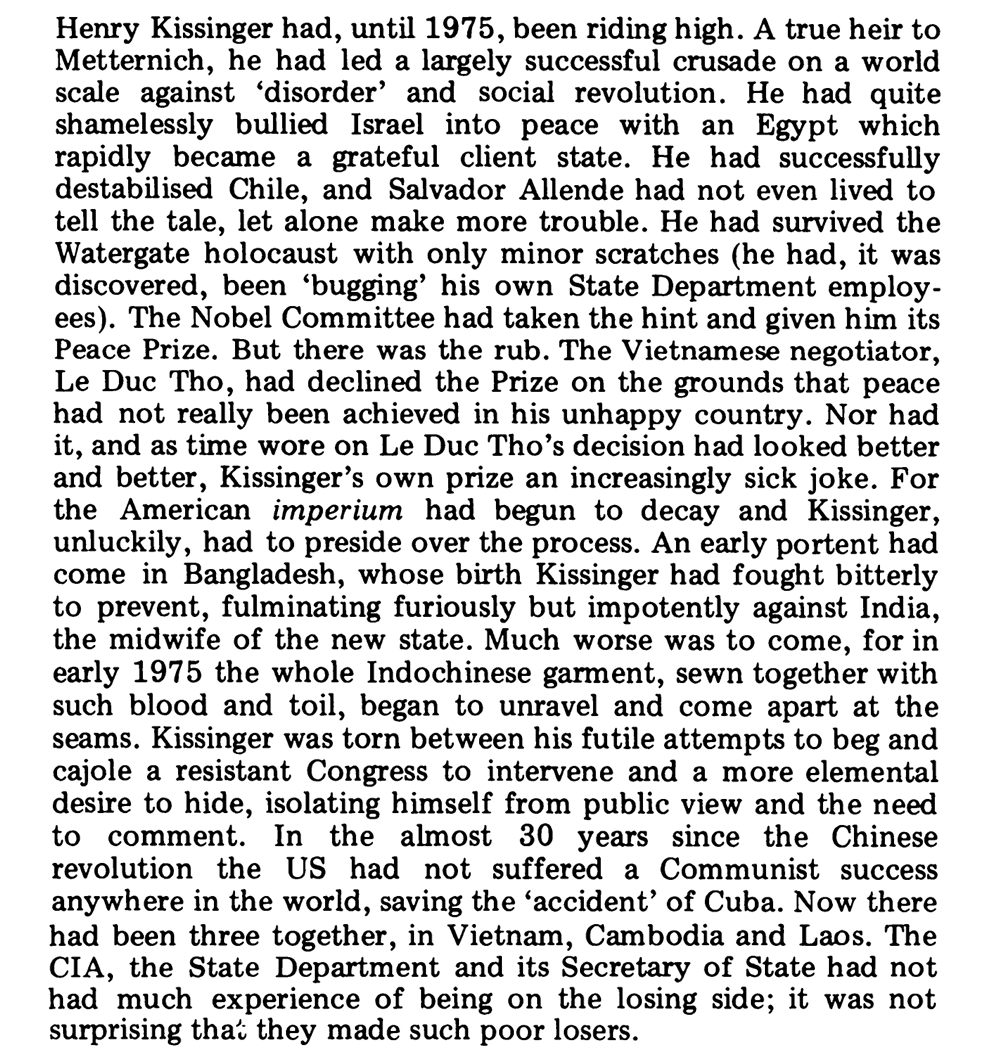
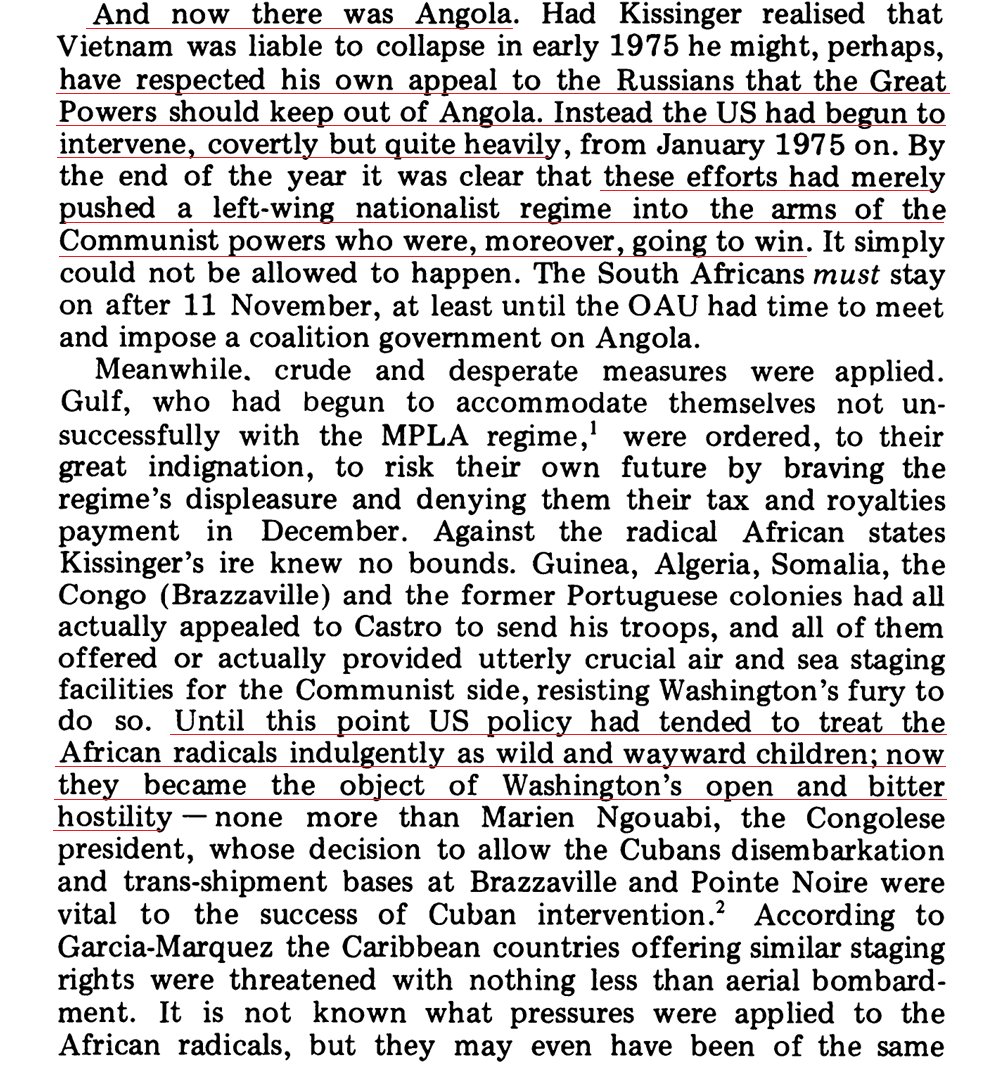
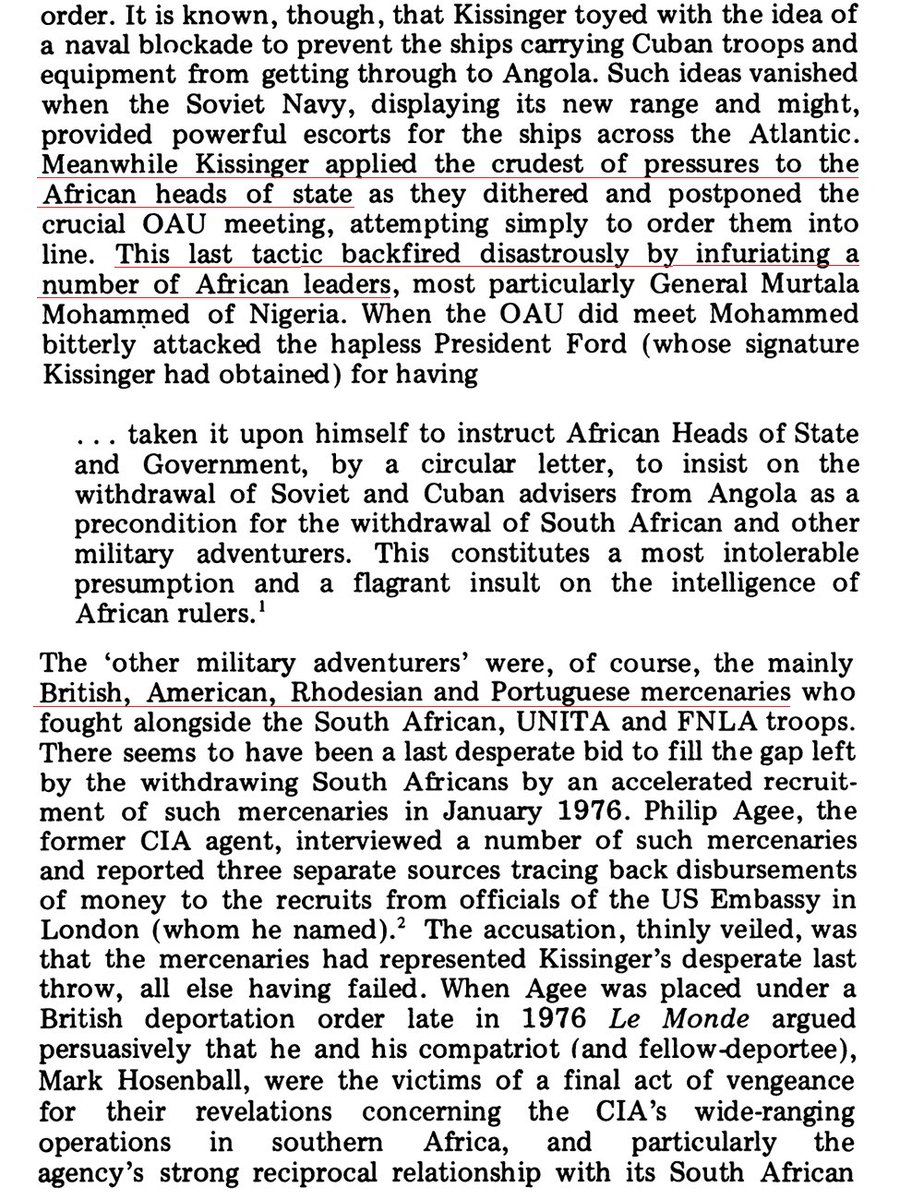

Despite only committing 2K troops, SA's Angola adventure had huge negative effects. Despite its reluctance, SA's 🇦🇴involvement gave it the impression of a defeated aggressor.
Images of white POWs captured by blacks were a PR disaster. Many more African states cut ties with SA.
Images of white POWs captured by blacks were a PR disaster. Many more African states cut ties with SA.
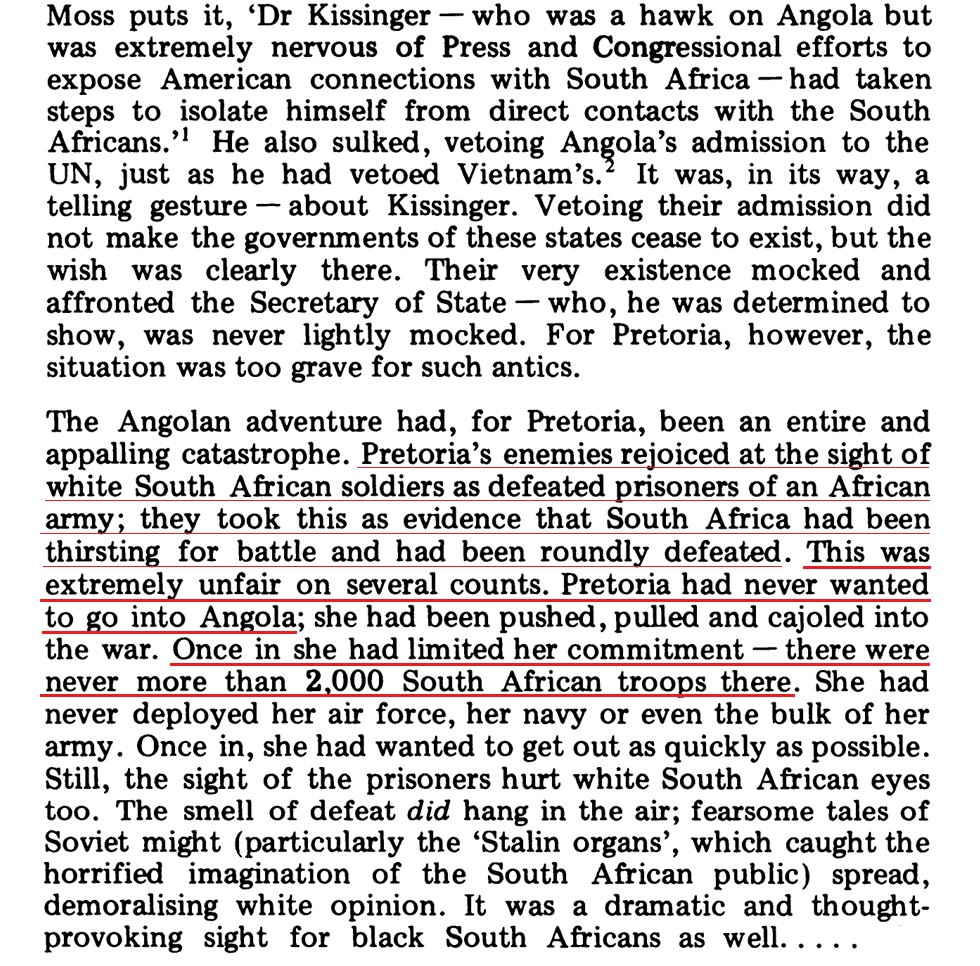
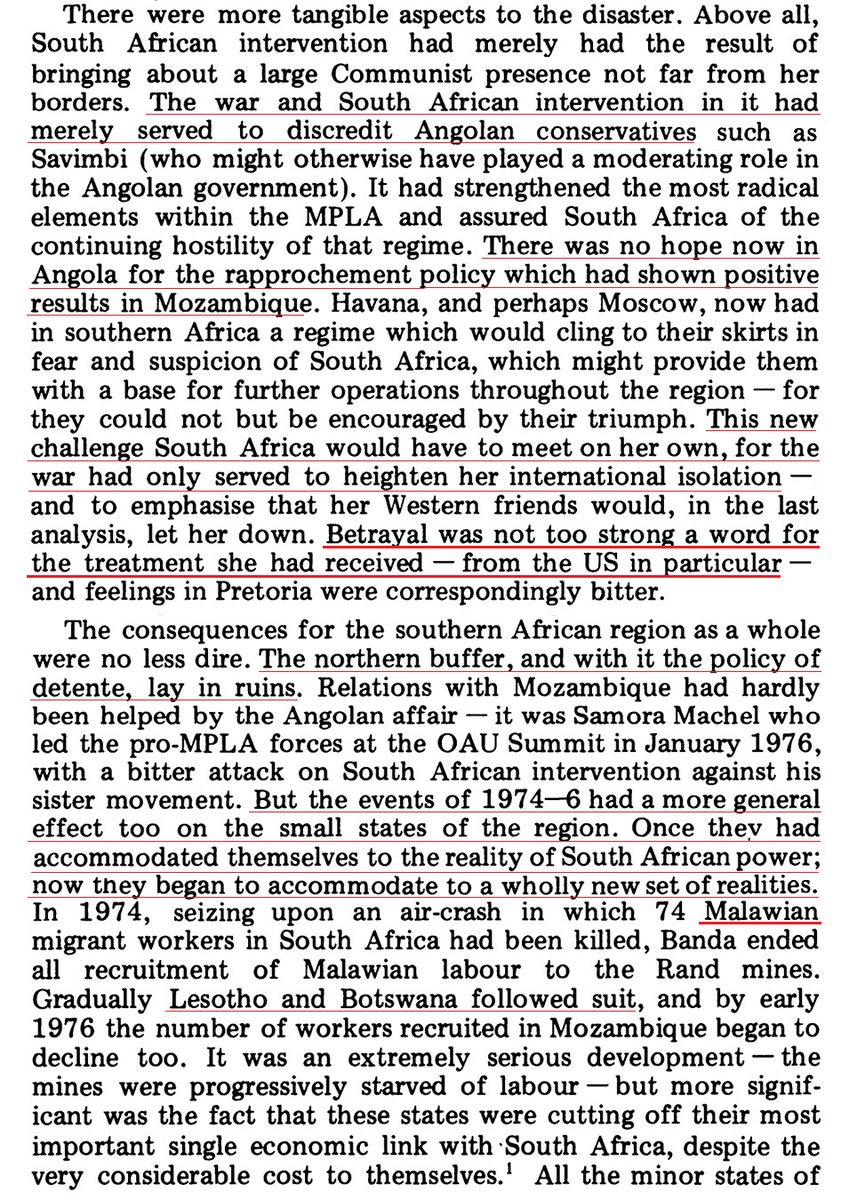

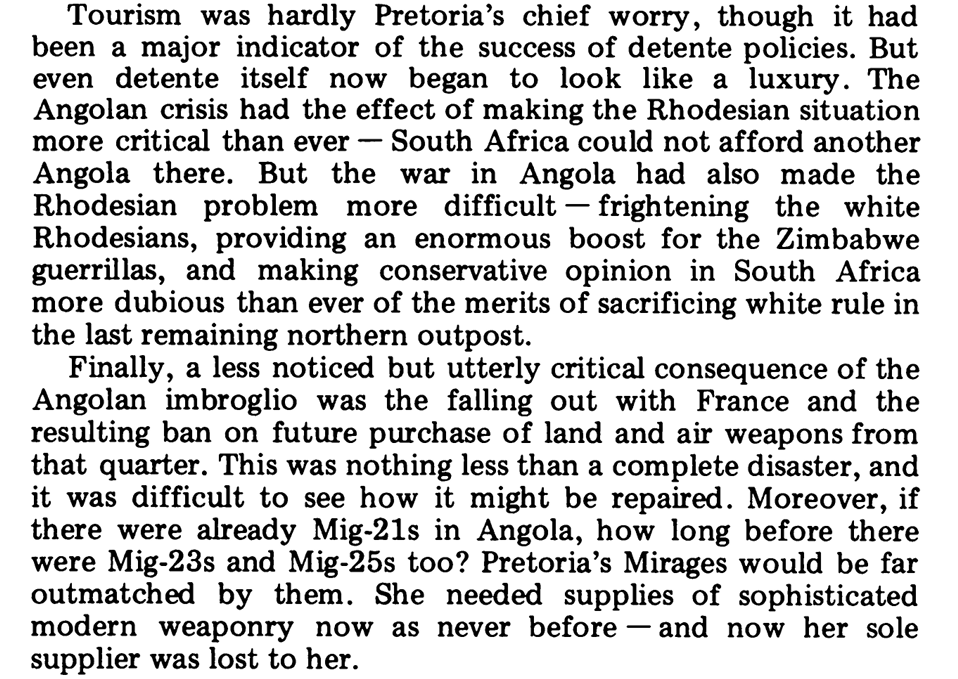
Even the one potential silver-lining to SA's 🇦🇴 debacle, its cooperation there with African states, came to nothing. French outrage at SA's rejection of their vision for🇦🇴 led to SA's ostracism from Francophone Africa as well. Other states like Zambia accomodated to Soviet power.
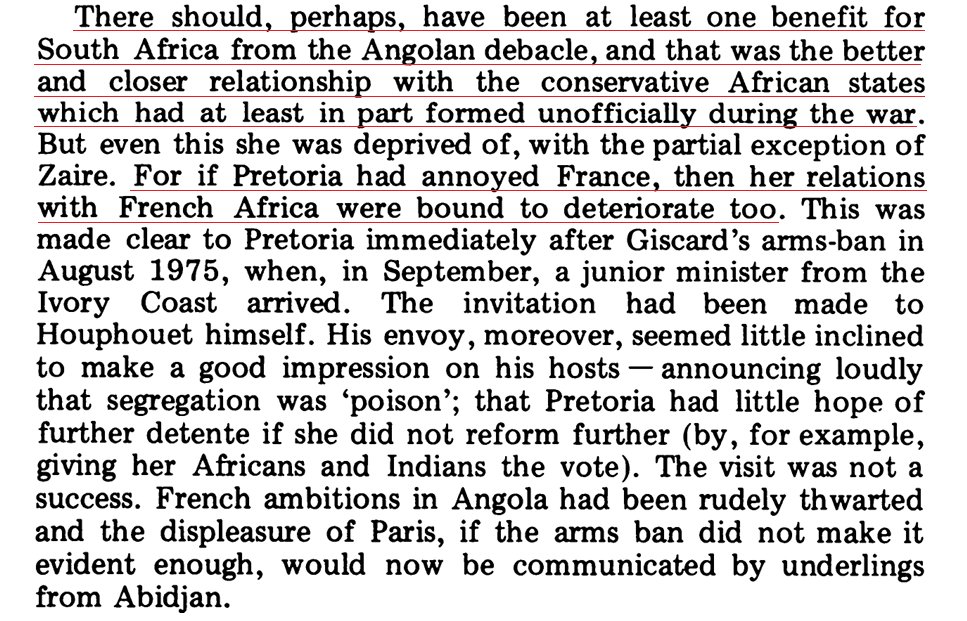

No longer feared by black Africa, ditched by Europe & badly burnt by 🇺🇸, SA sought new allies.
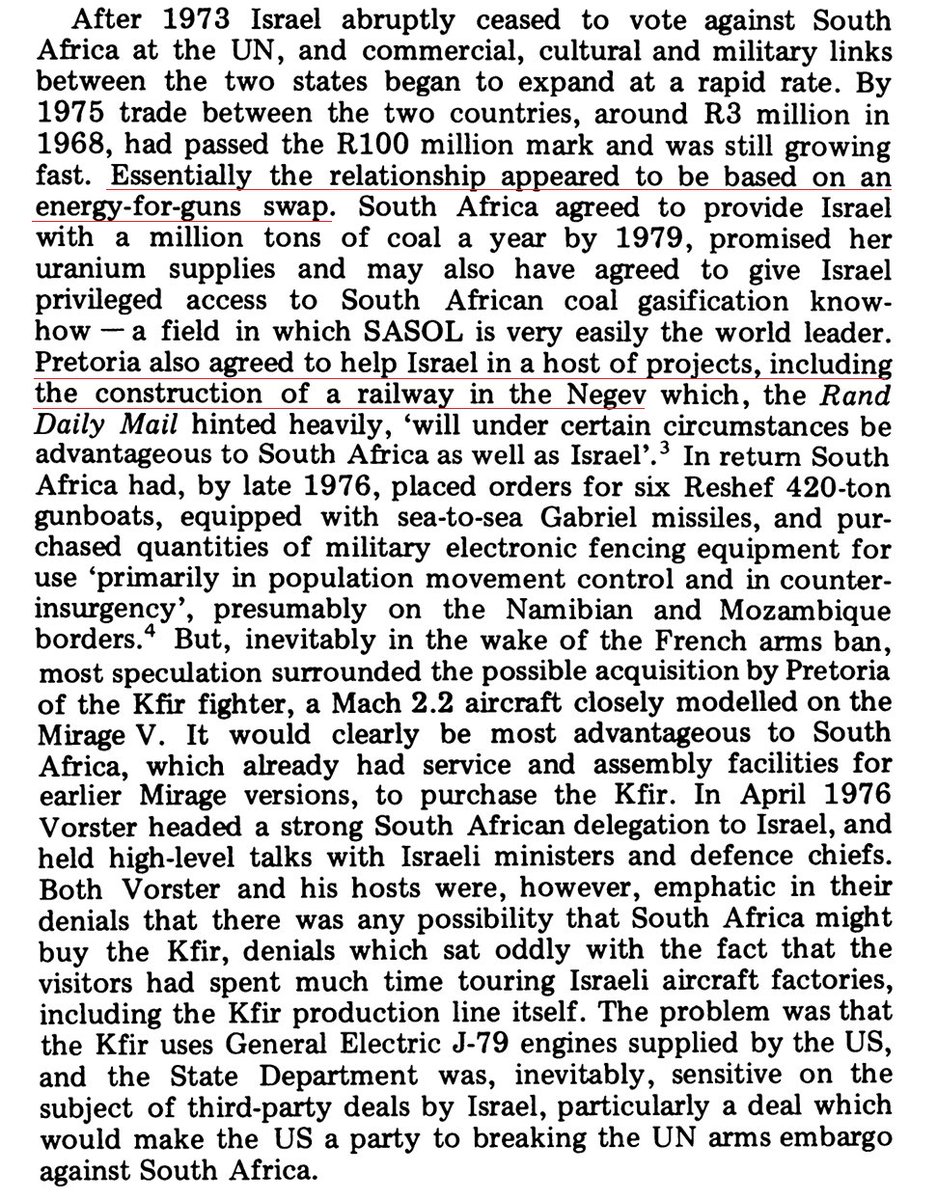
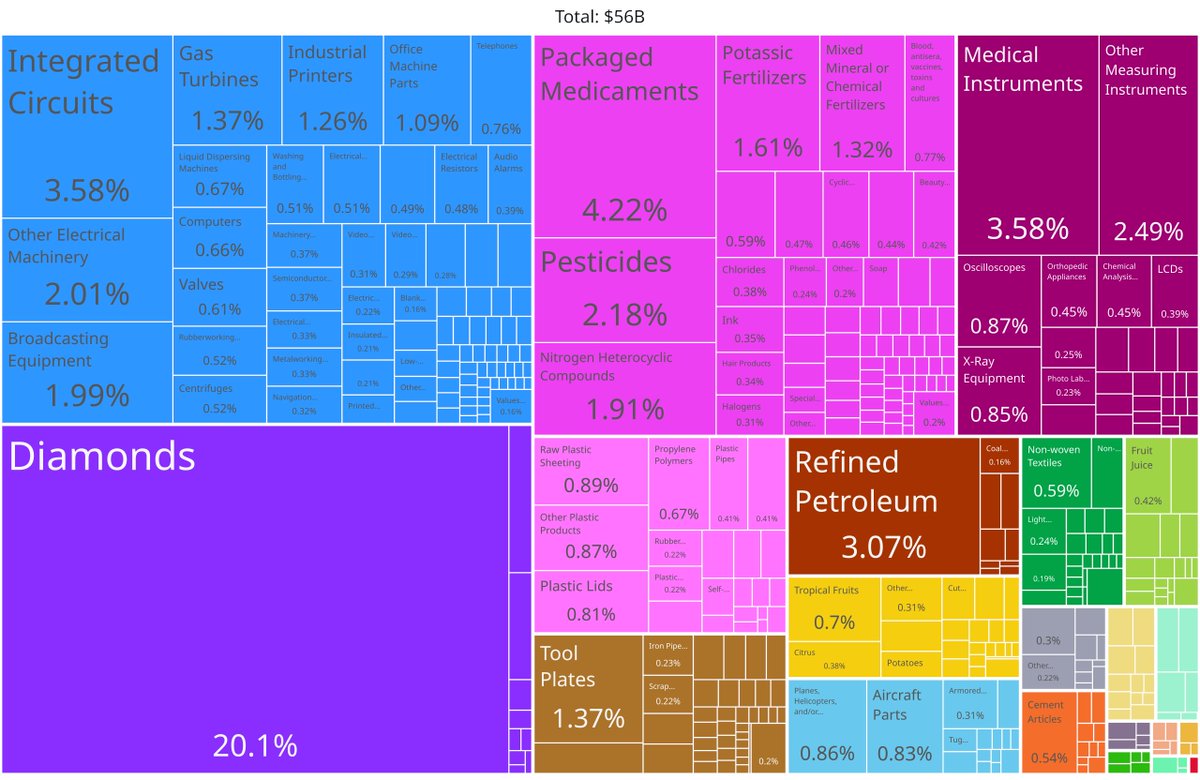
The clear first move was to deepen 🇮🇱 ties, already co-dependent due to Israel being the world's largest polished💎exporter.
Surprised 🇮🇱ever voted against SA at the UN to begin with.
The clear first move was to deepen 🇮🇱 ties, already co-dependent due to Israel being the world's largest polished💎exporter.
Surprised 🇮🇱ever voted against SA at the UN to begin with.

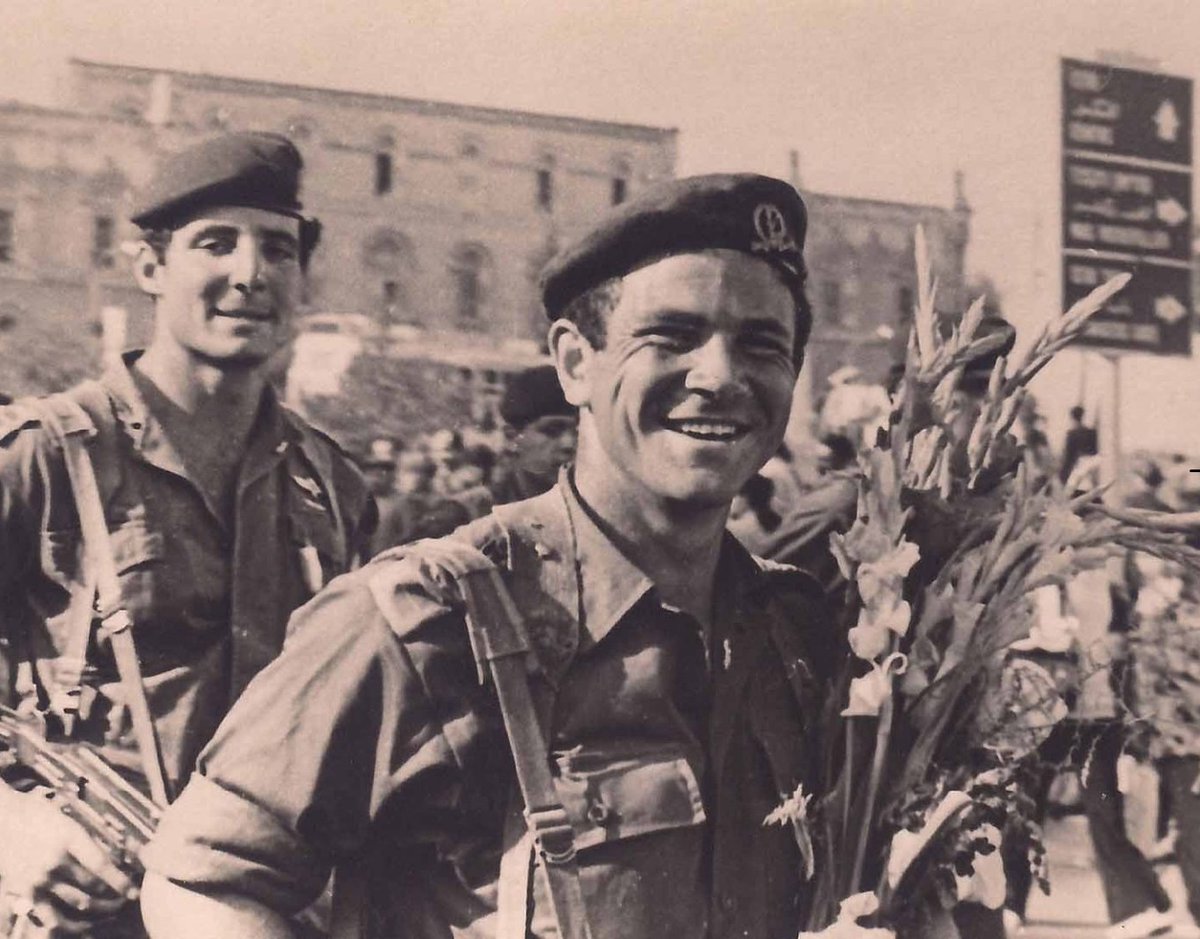
SA/🇮🇱/Kenya axis. The last non-leftist state in E. Africa enabled the spectacular Entebbe air-raid into 🇺🇬. All hostages were saved, the 1 casualty being the operation leader, Bibi Netanyahu's older brother.
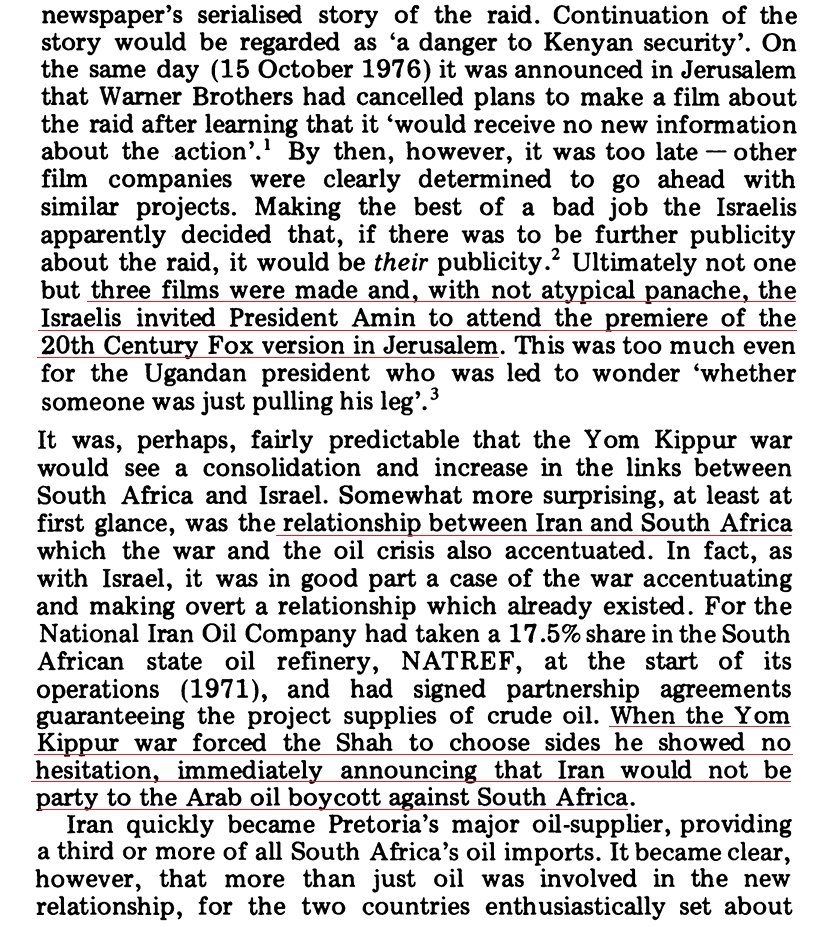
🇮🇱 invited Idi Amin to Jerusalem to see its film adaptation (1 of 3).
🇮🇱 invited Idi Amin to Jerusalem to see its film adaptation (1 of 3).


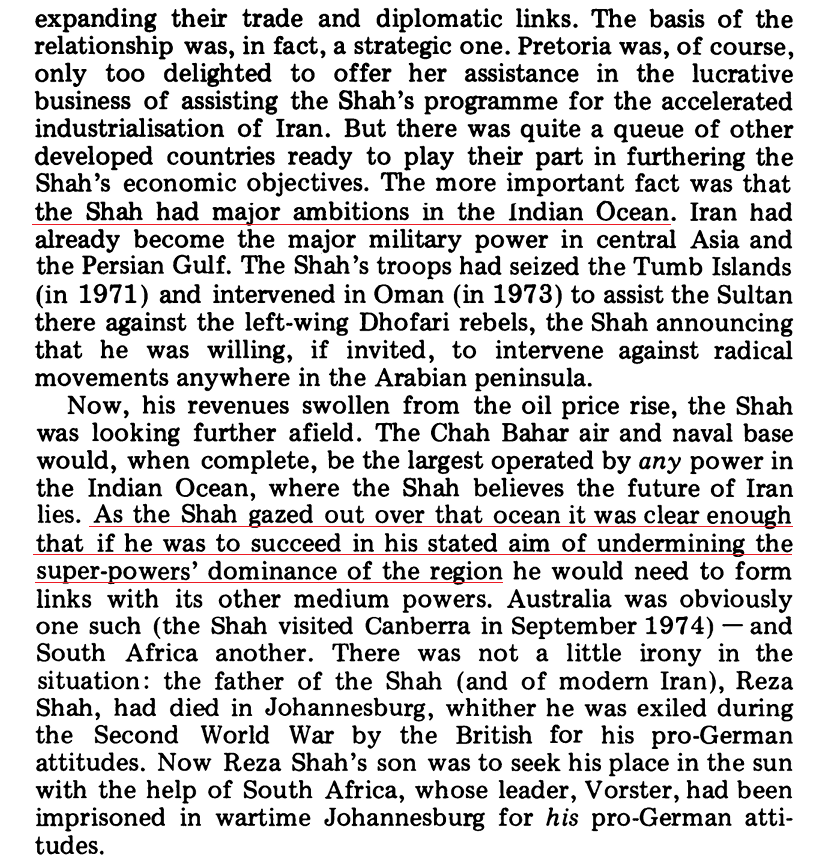
SA ties to Iran. The Shah had grand dreams of an Iranian-dominated East-Africa & Indian Ocean, enabling its independence from both superpowers. Overtures to LatAm.
SA in desperation even attempted to warm up to still Maoist🇨🇳, hoping it could be a moderating influence in Africa.
SA in desperation even attempted to warm up to still Maoist🇨🇳, hoping it could be a moderating influence in Africa.
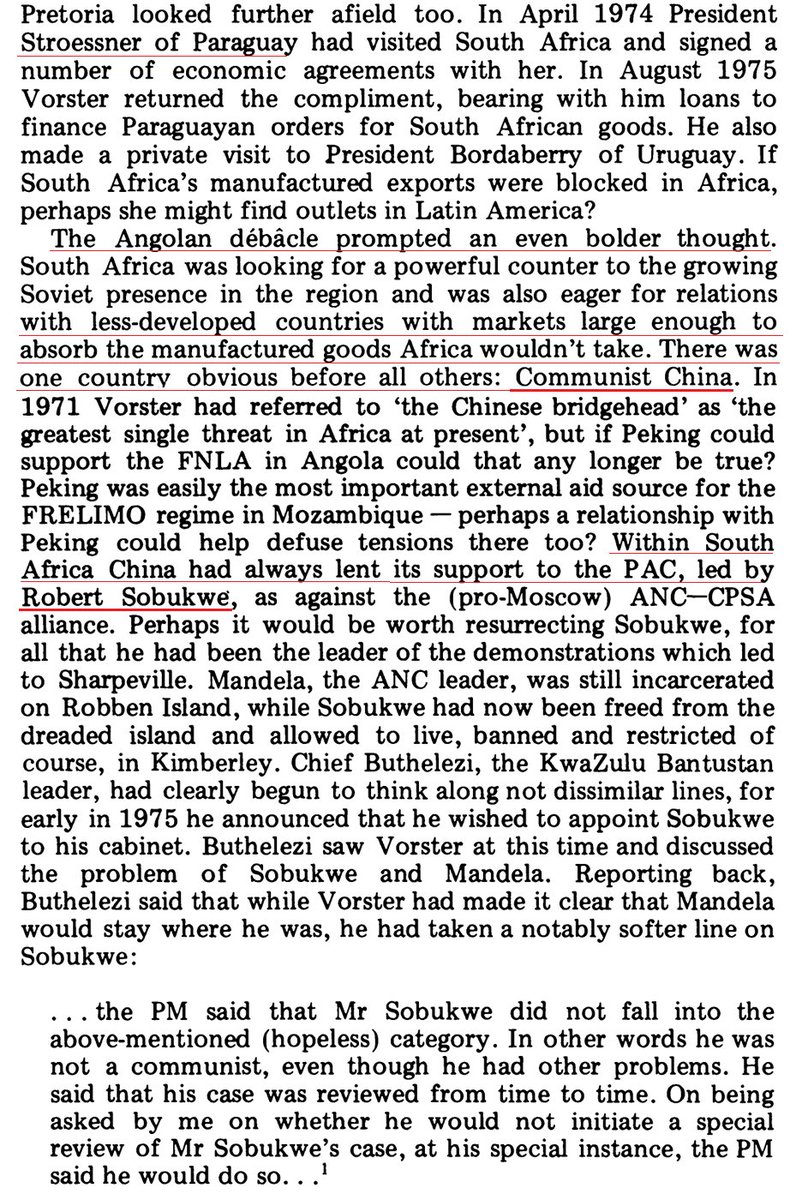
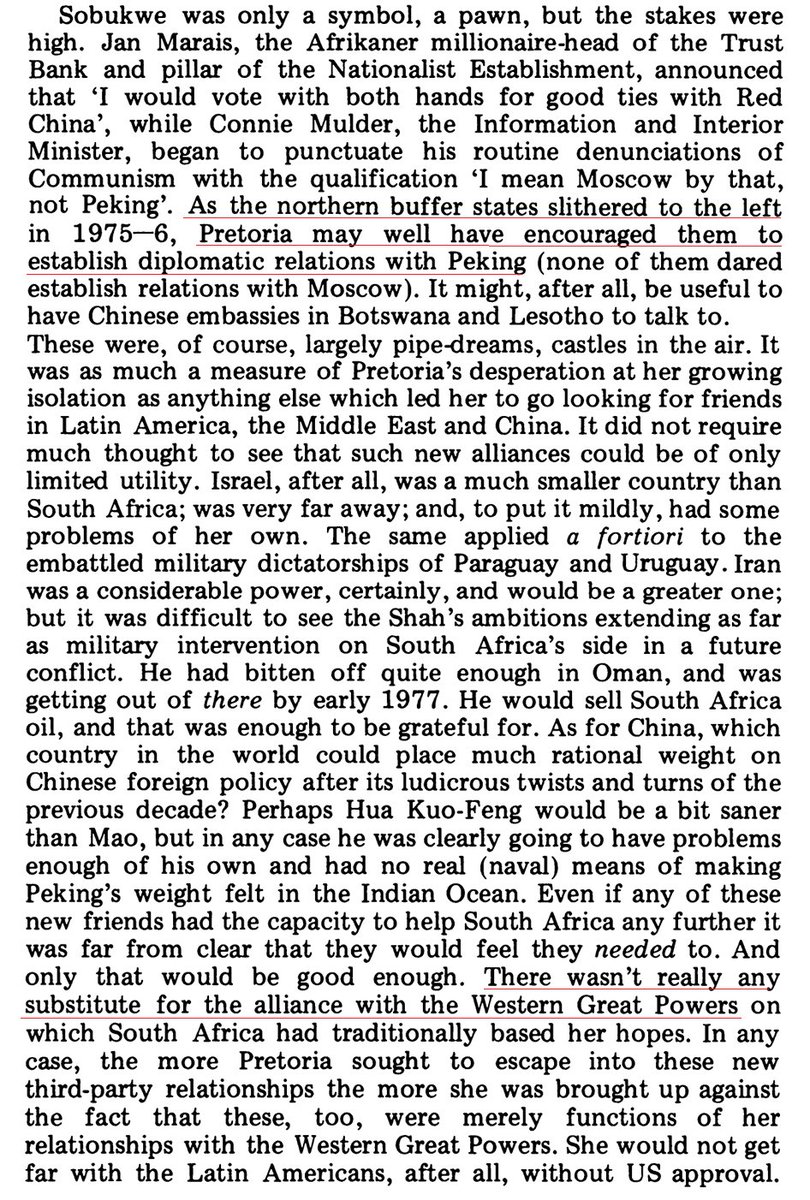
SA joined the world depression by 76, leaving the Bantustan leaders restive. Transkei even asked if it could host the banned ANC.
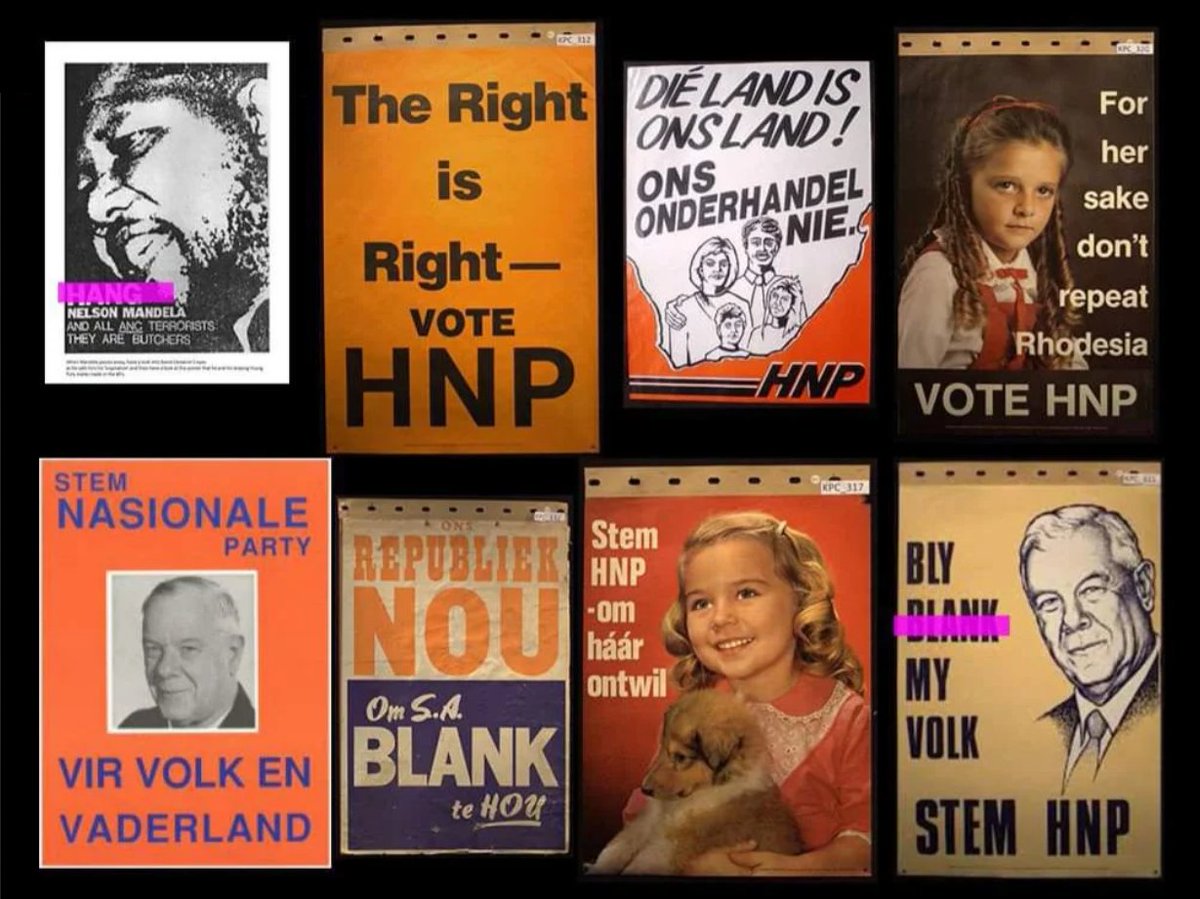
Internal white politics. Vorster was ever-paranoid of NHP outflanking him from the right, despite "campaigning in the most reactionary way possible".
Internal white politics. Vorster was ever-paranoid of NHP outflanking him from the right, despite "campaigning in the most reactionary way possible".
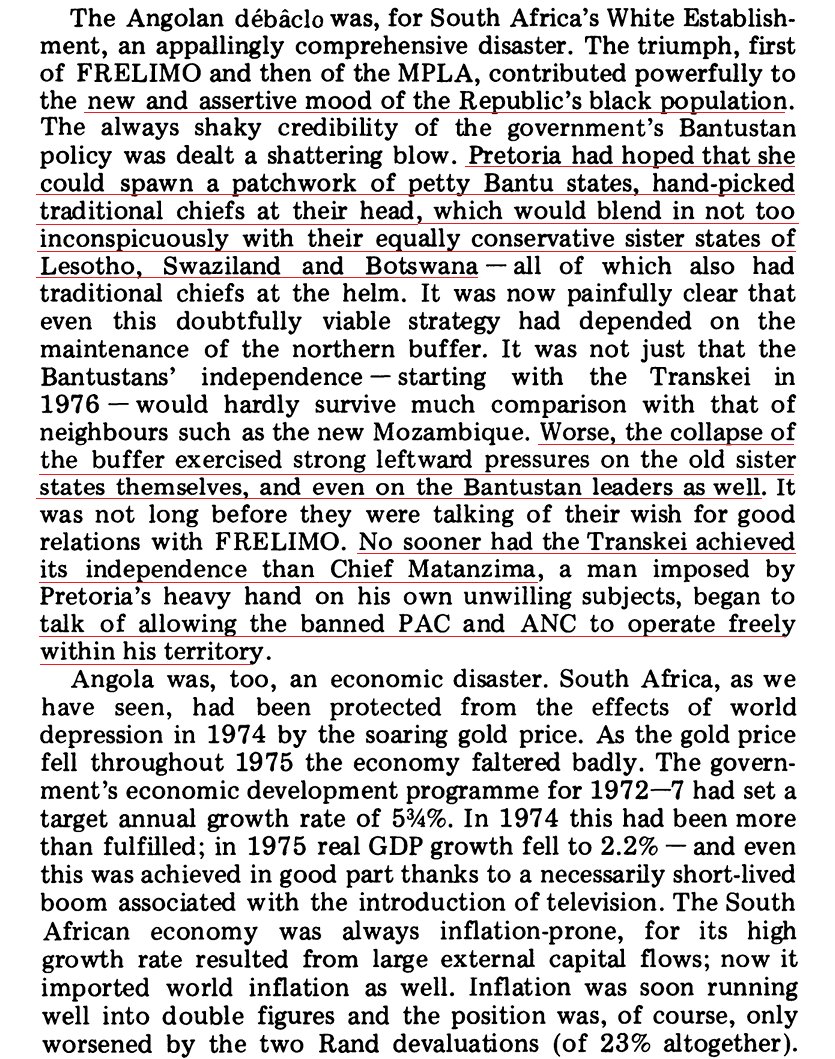
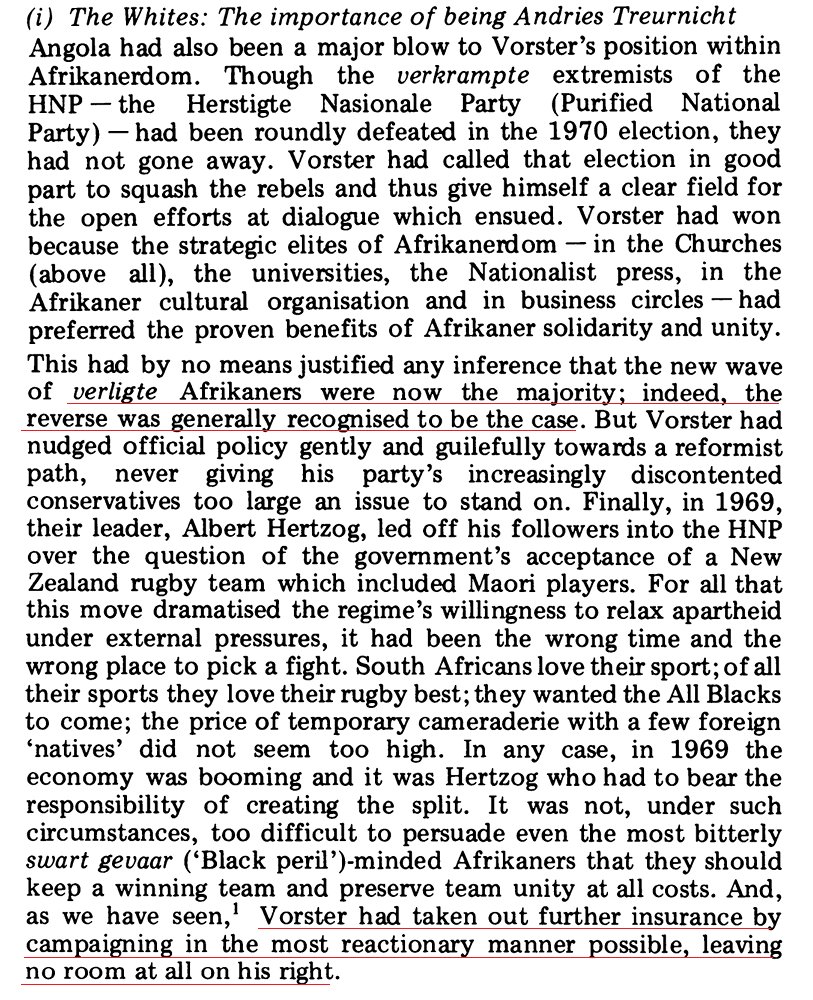
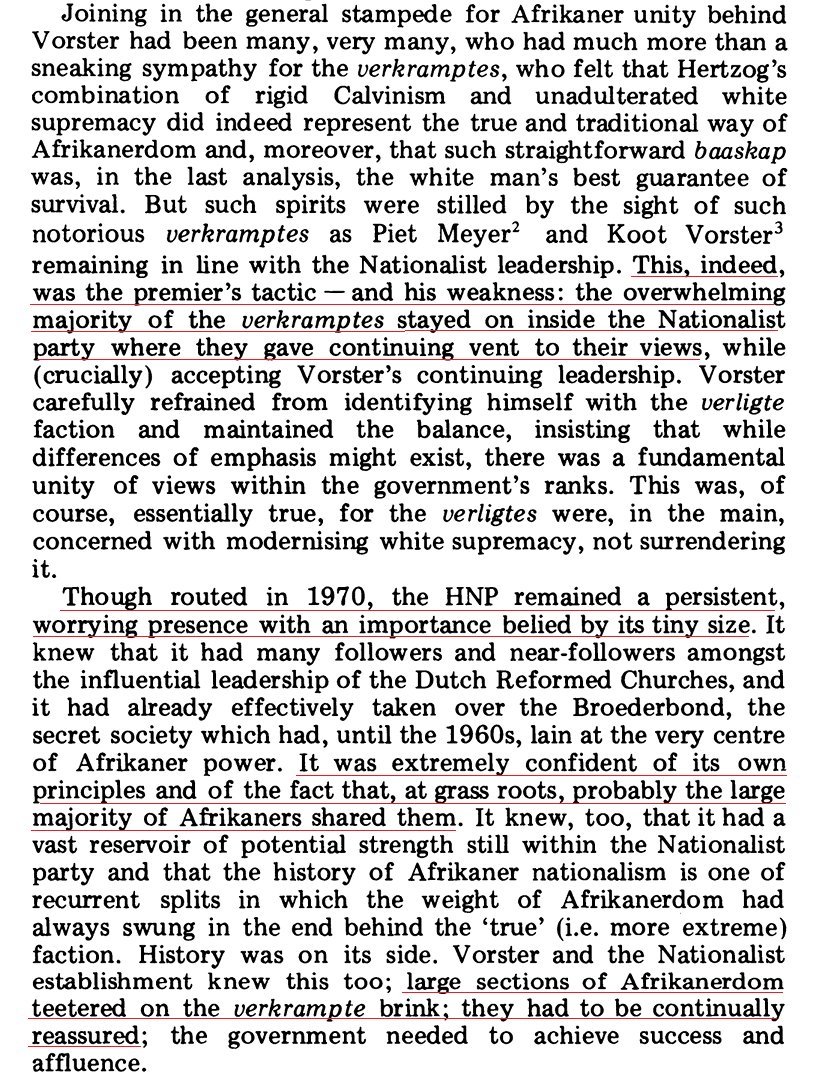

HNP aside, Vorster's own party was full of verkrampte (hardliner) MPs.
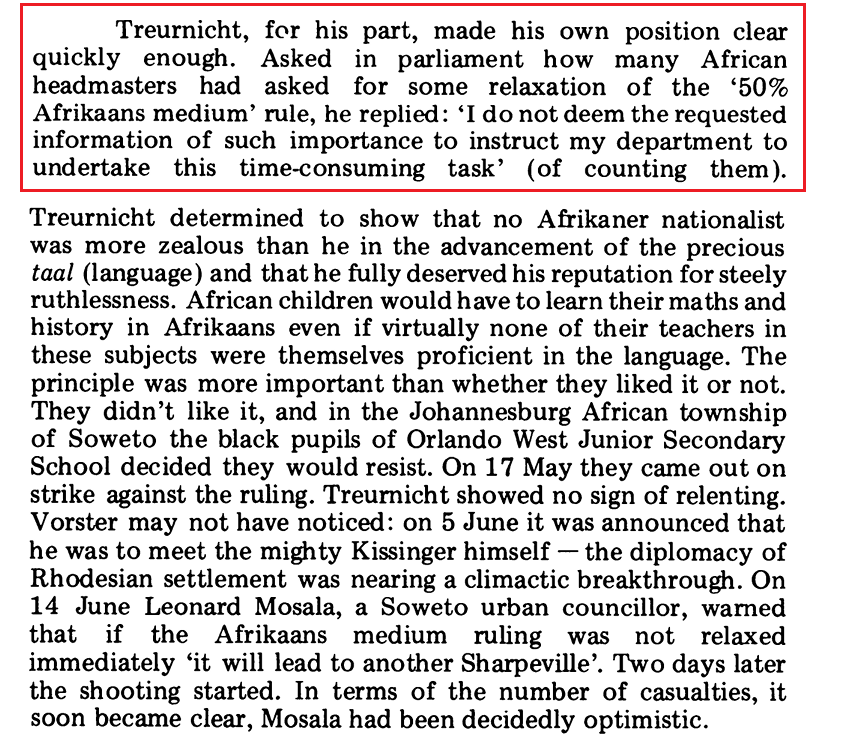
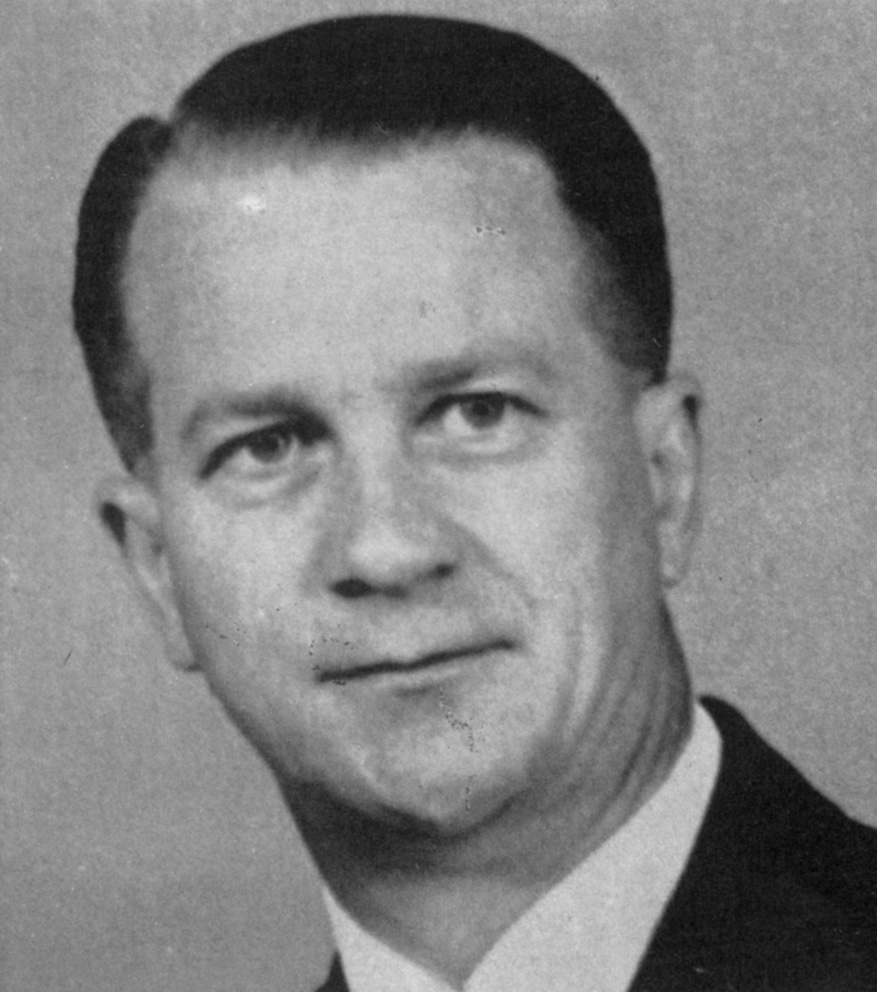
Vorster tried to neuter Treurnicht, the most infamous verkrampte, by appointing him as "Deputy Minister of Bantu Education". His energies were diverted into forcing blacks to learn in Afrikaans at school.
Vorster tried to neuter Treurnicht, the most infamous verkrampte, by appointing him as "Deputy Minister of Bantu Education". His energies were diverted into forcing blacks to learn in Afrikaans at school.

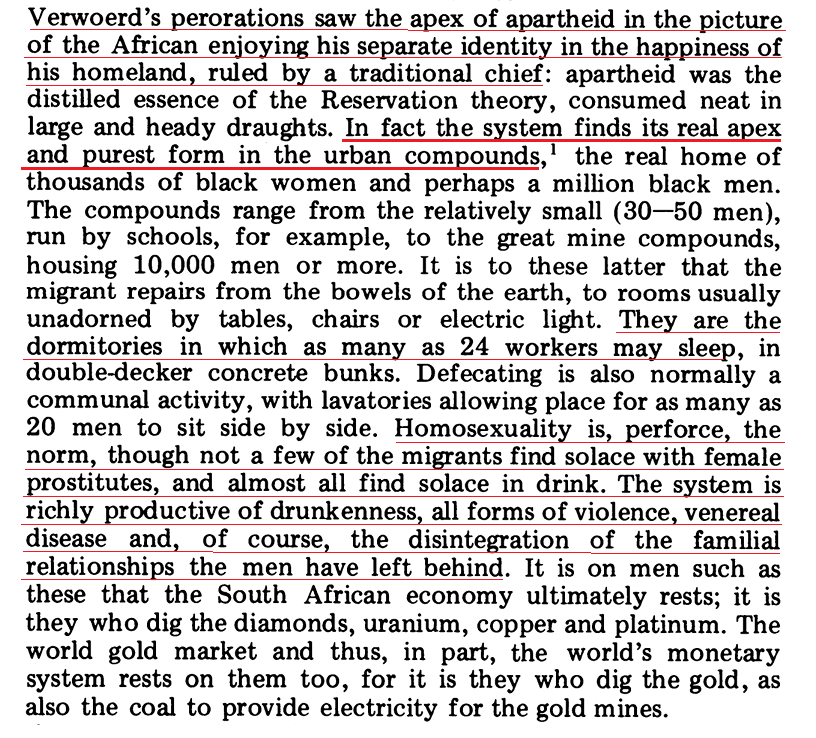
Apartheid in theory & practice. Mass 60s deportations of blacks to the 'homelands.
In the homelands, scant work existed, & unemployment was unrecorded. Blacks were hired as "migrant workers" to be housed en masse nearby in vast dorms, festering dens of alcoholism,🏳️🌈, & violence.
In the homelands, scant work existed, & unemployment was unrecorded. Blacks were hired as "migrant workers" to be housed en masse nearby in vast dorms, festering dens of alcoholism,🏳️🌈, & violence.


Most of SA's miners were foreigners, mining being deemed to dangerous & poorly paid even for SA blacks. Vorster considered unemployment to be more dangerous the terrorism for SA.
Falling gold price, divestment & the emergence of mass strikes cut deeply into mining profits.
Falling gold price, divestment & the emergence of mass strikes cut deeply into mining profits.
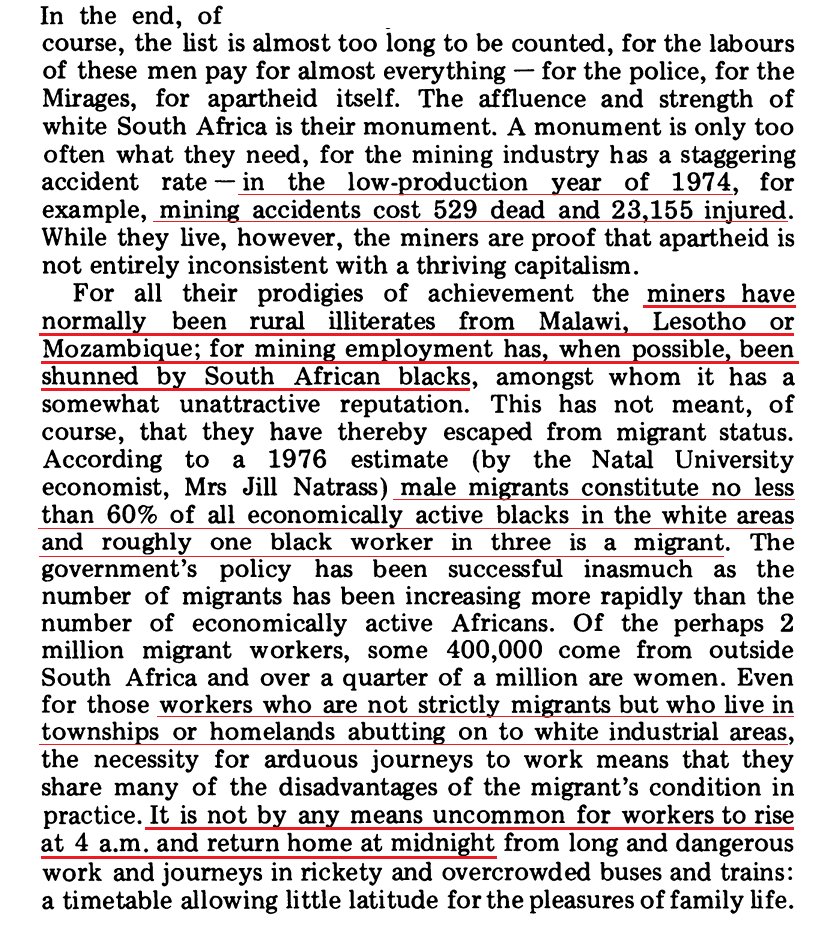
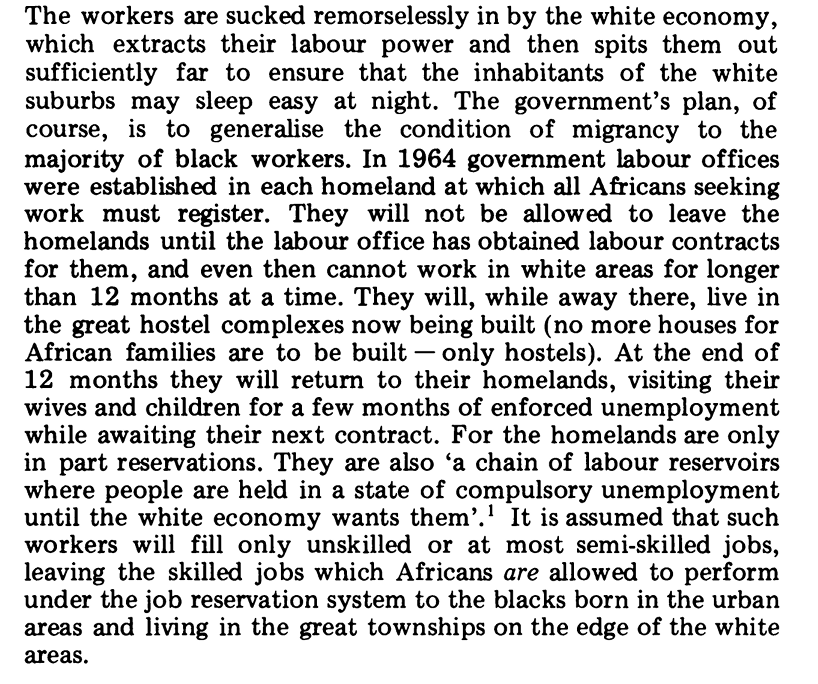
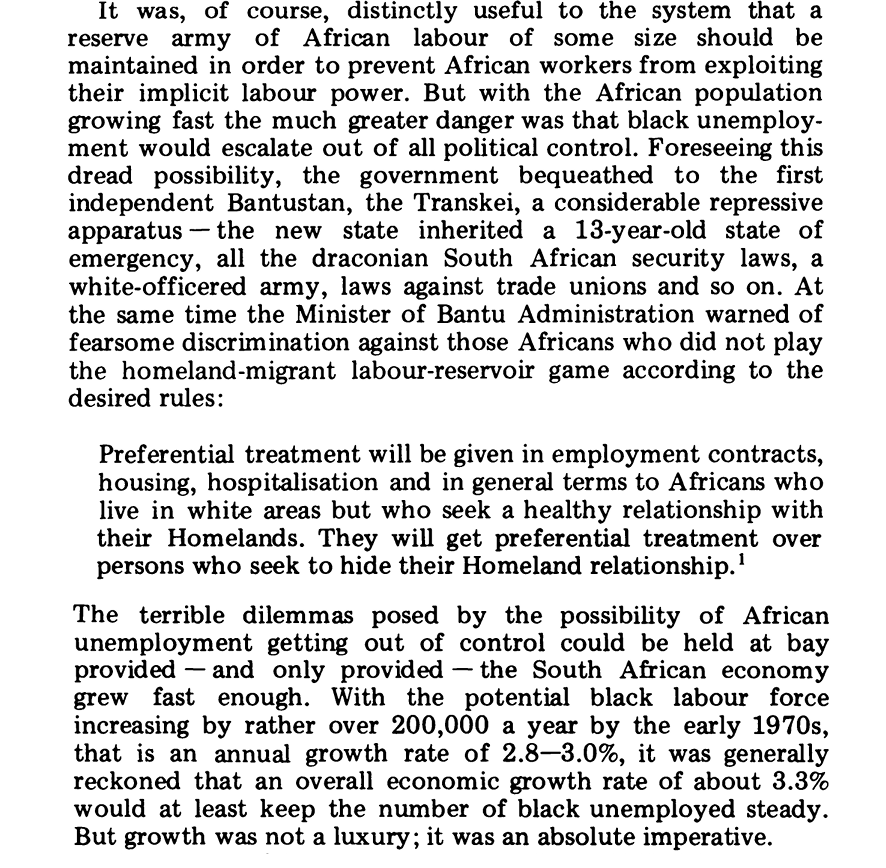
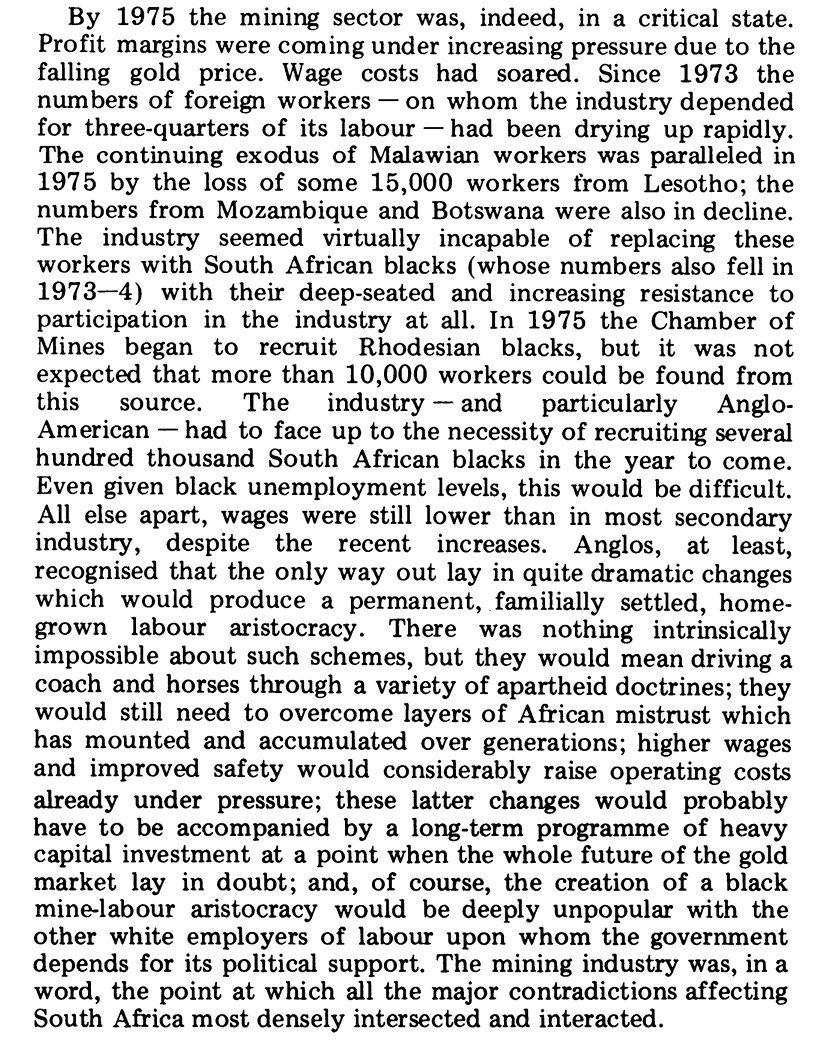
Due to an exploding population, the biggest migrant "dorms" evolved into "Townships", where blacks stayed year-round, originally in defiance of migrancy laws. Their existence made the 'homeland' system a farce.
These slums developed among the highest murder rates in the world.
These slums developed among the highest murder rates in the world.
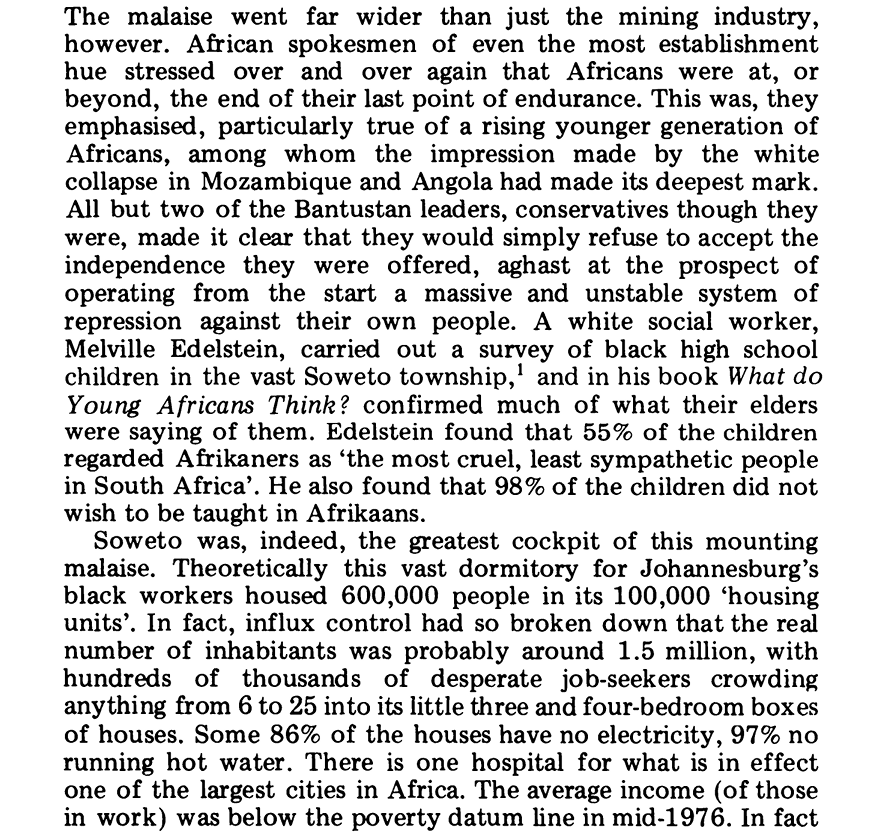
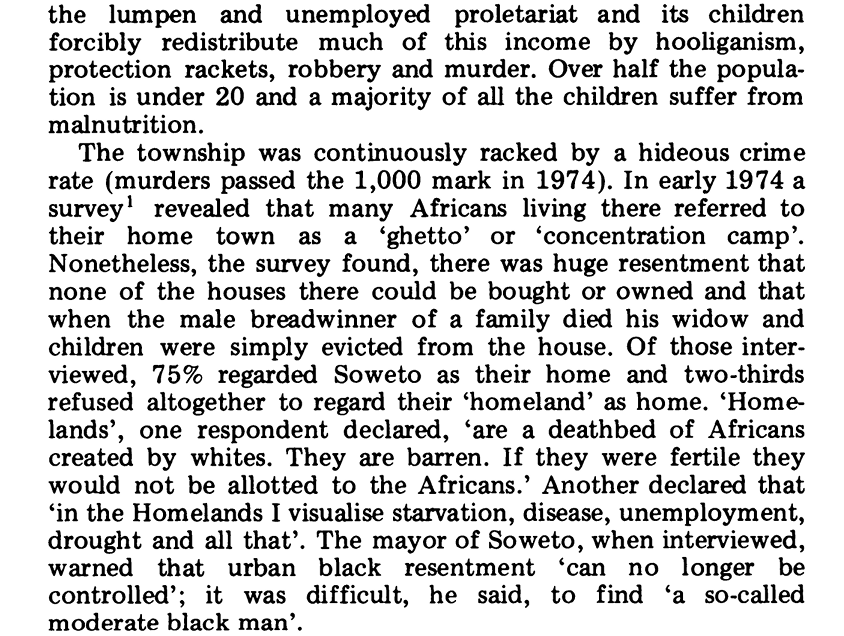
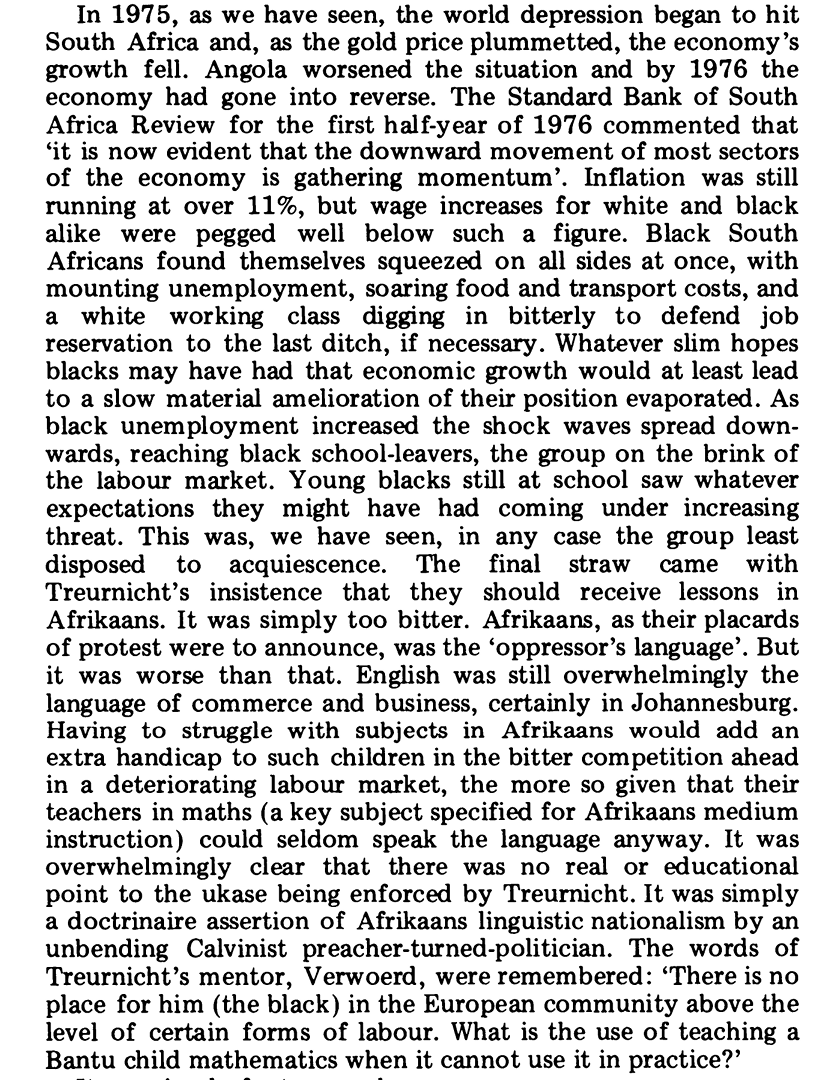

Truernicht's crusade for Afrikaans-medium schooling was too much. 15k schoolchildren demonstrated & unknown number were shot.
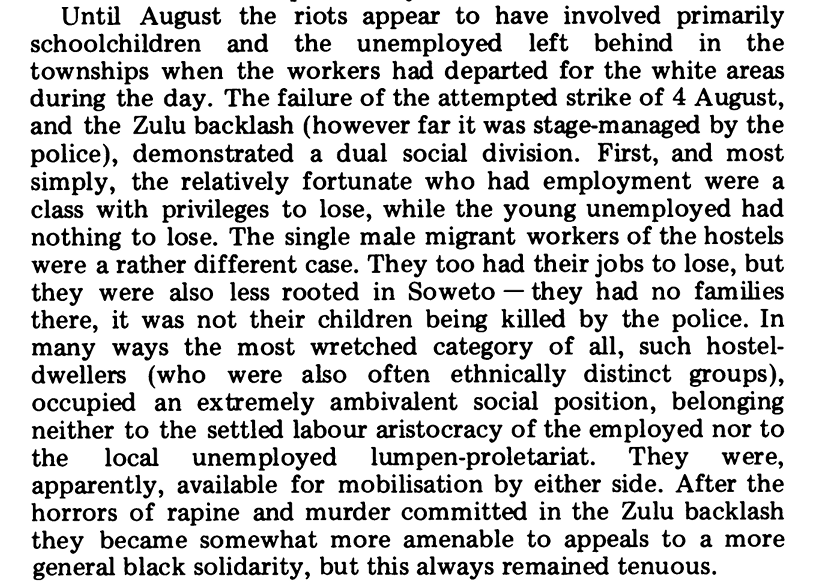
This sparked country-wide riots & strikes. Swanepoel, an infamous Dirty-Harry-like policechief was called in. Zulus organised (?) as strikebreakers.
This sparked country-wide riots & strikes. Swanepoel, an infamous Dirty-Harry-like policechief was called in. Zulus organised (?) as strikebreakers.


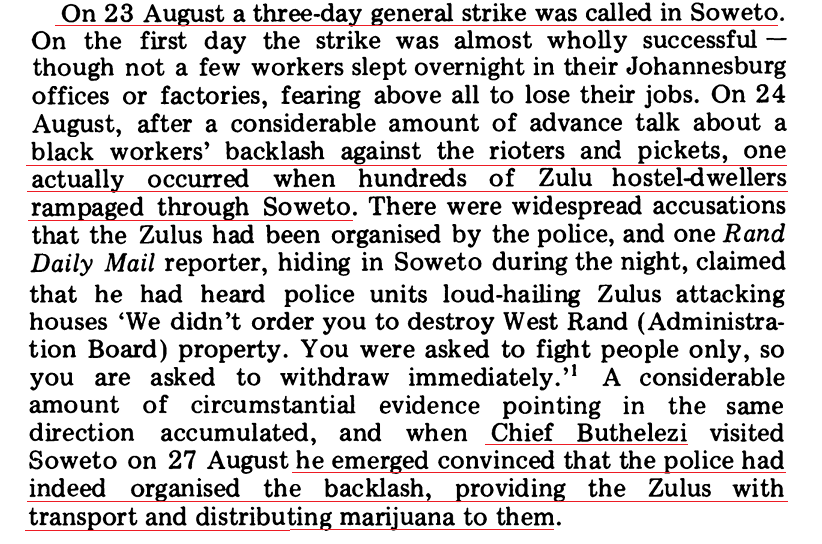

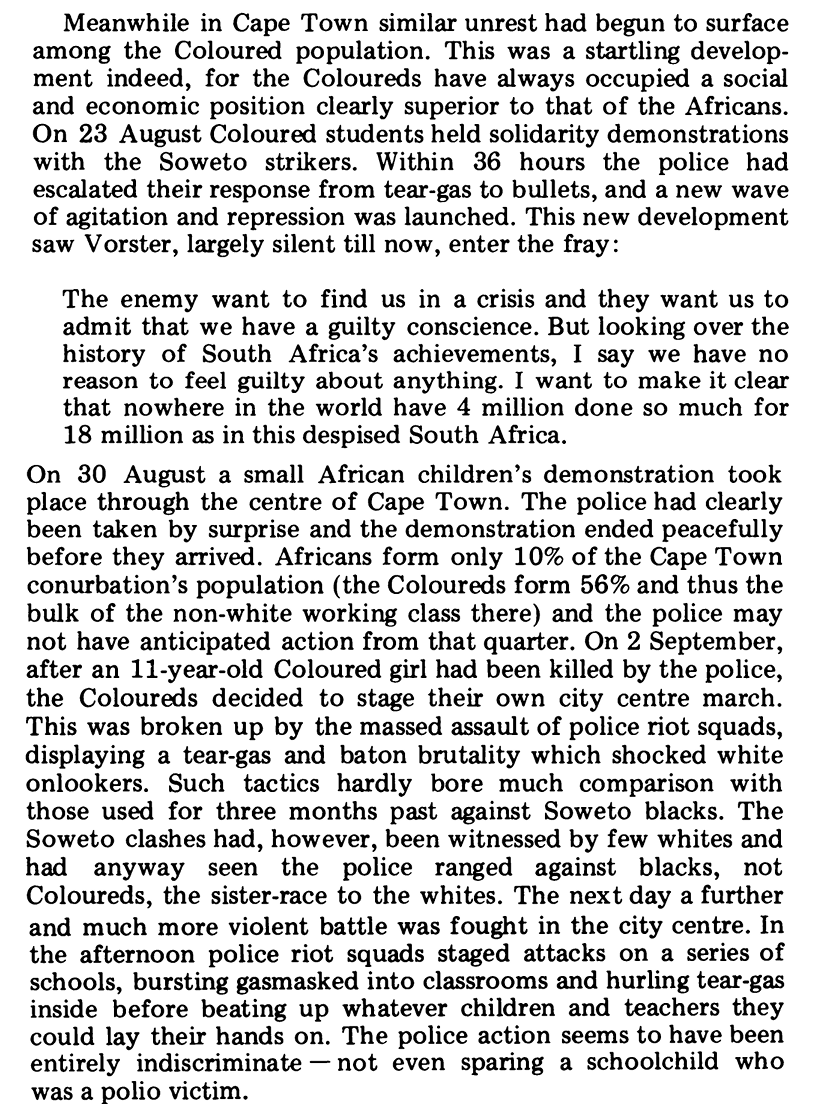
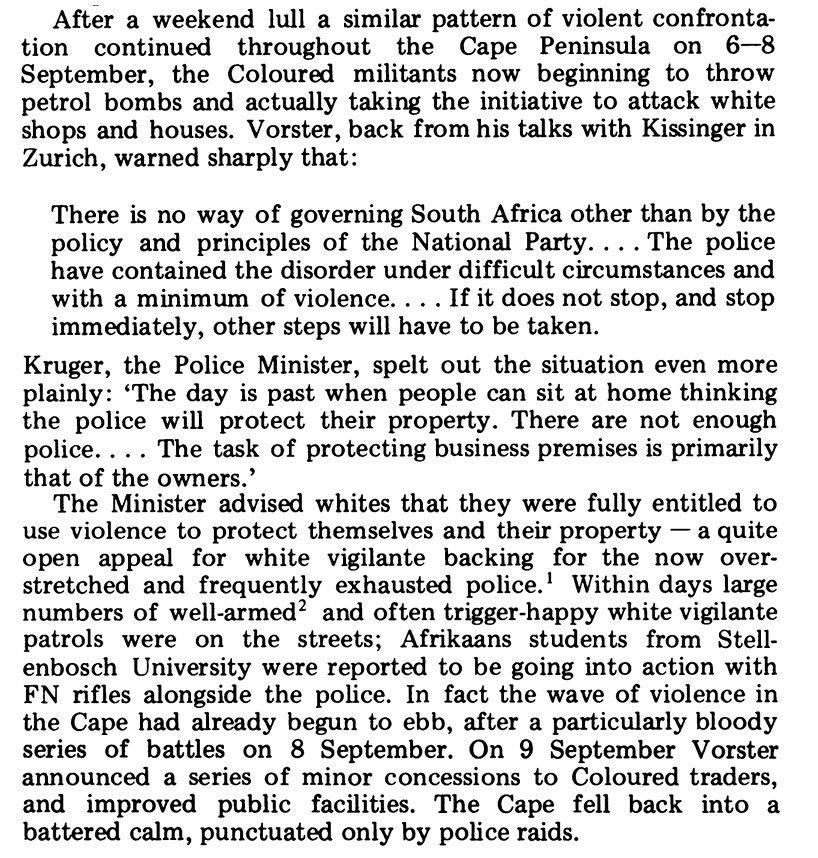
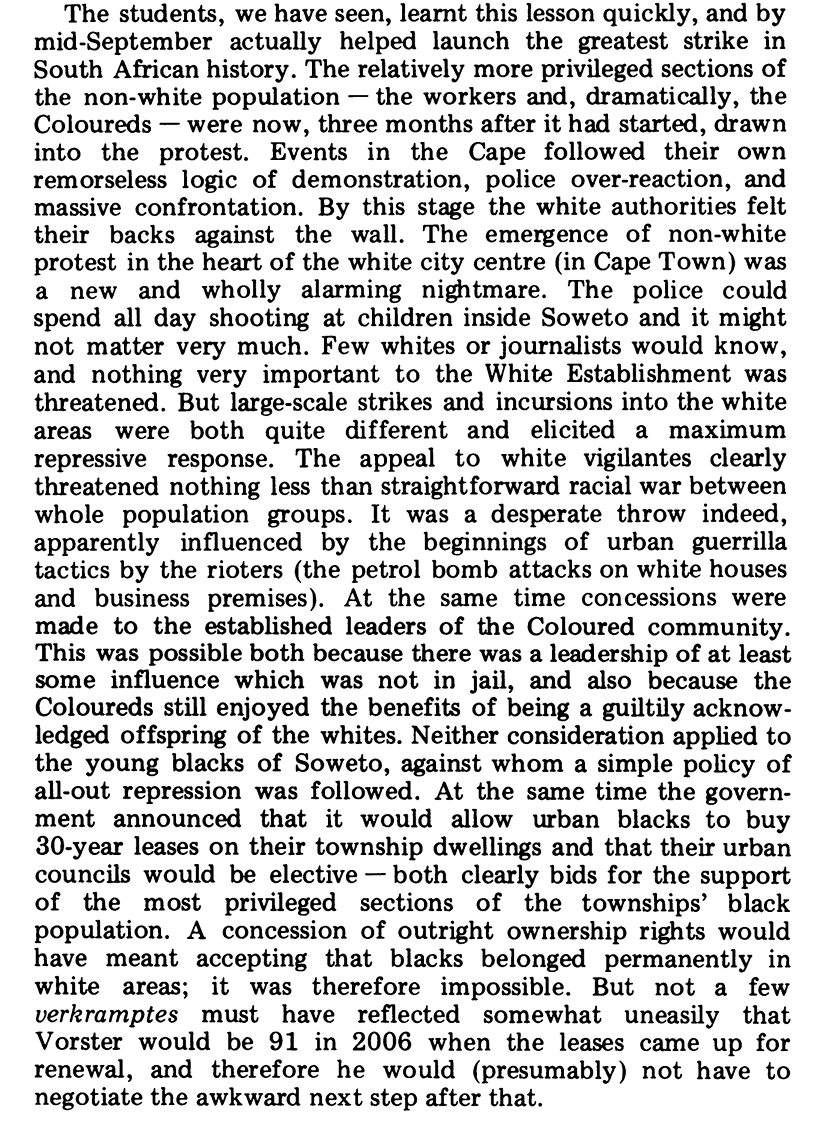
Protests spread to CapeTown & most worringly, to the Coloureds, SA's mullato population. After a coloured girl was killed, petrol bombing of white shops began. By now SA police were so thinly stretched, they endorsed white vigilantilism in order to protect white properties.
SA followed the West into recession by 75, compounded by falling commodity prices, mass strikes, loss of European markets & divestment. Reform-minded elements in SA turned to a siege mentality.
Once-neutral groups like Coloureds & Indians turned against the government.
Once-neutral groups like Coloureds & Indians turned against the government.
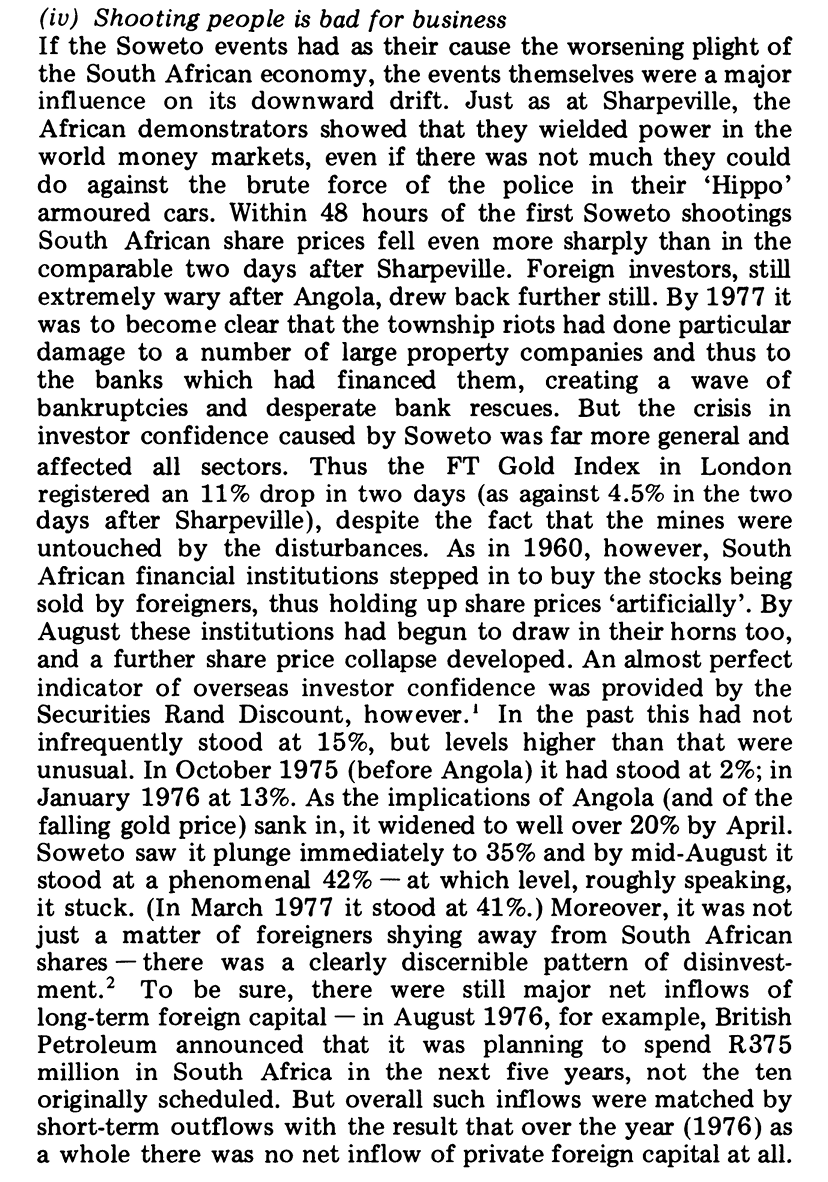
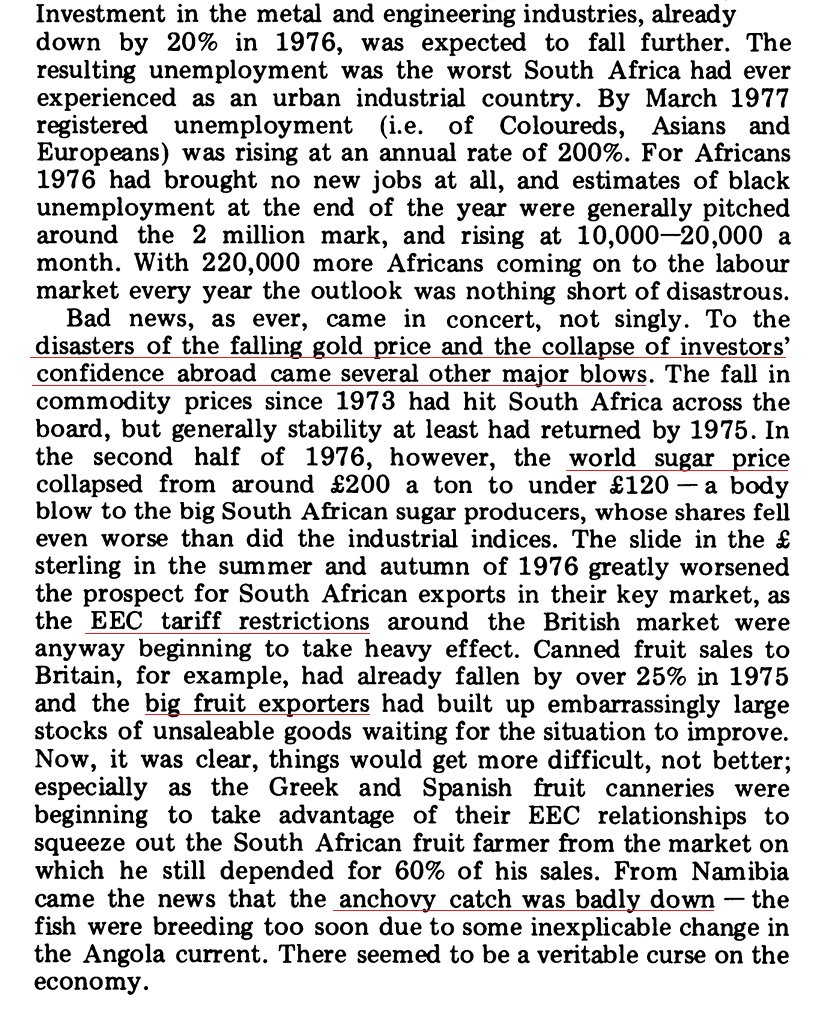
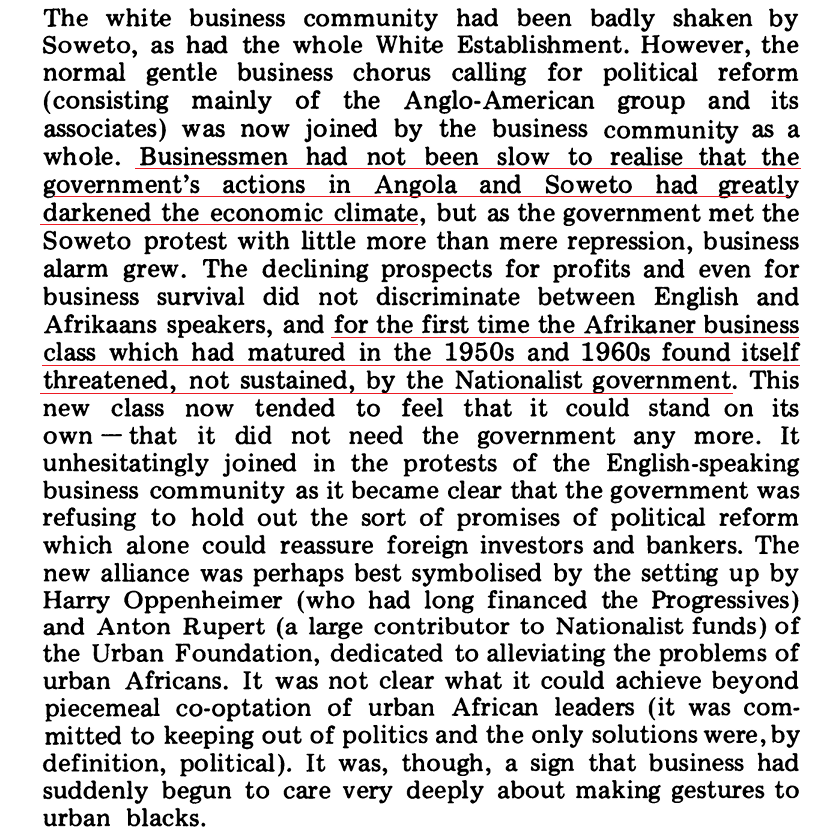
Splits within SA's white establishment, especially the business community, sections of whom were tired of job protections & guarantees for SA's white working class, at the expense of much cheaper black labour.
This business faction however, was scarcely represented in government.
This business faction however, was scarcely represented in government.

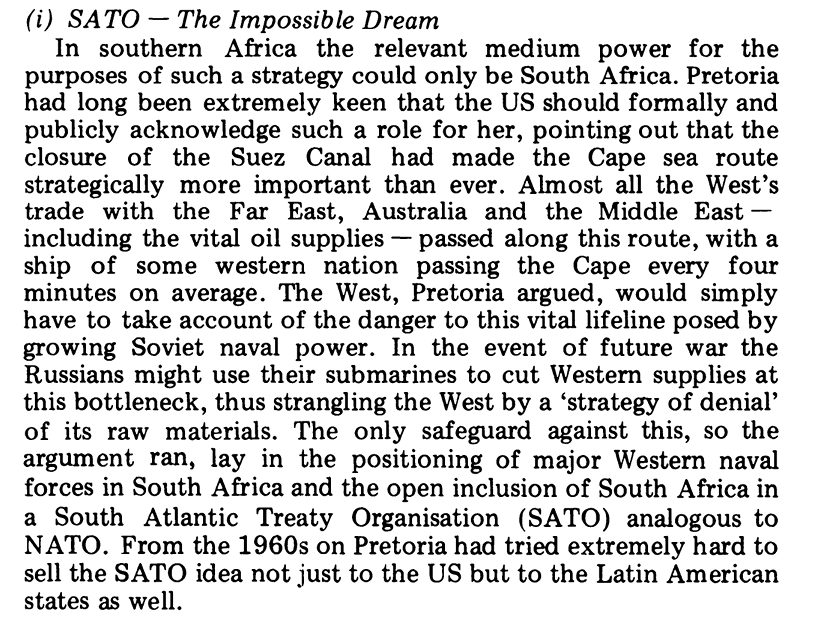
SA's desperation to come under an US sponsored "SATO" an African equivalent of NATO, to guarantee its increasingly precarious position.
Arguments for its creation were founded on fear of Soviet naval expansion. Skeptical US planners however, knew a naval lobby when they saw one.
Arguments for its creation were founded on fear of Soviet naval expansion. Skeptical US planners however, knew a naval lobby when they saw one.
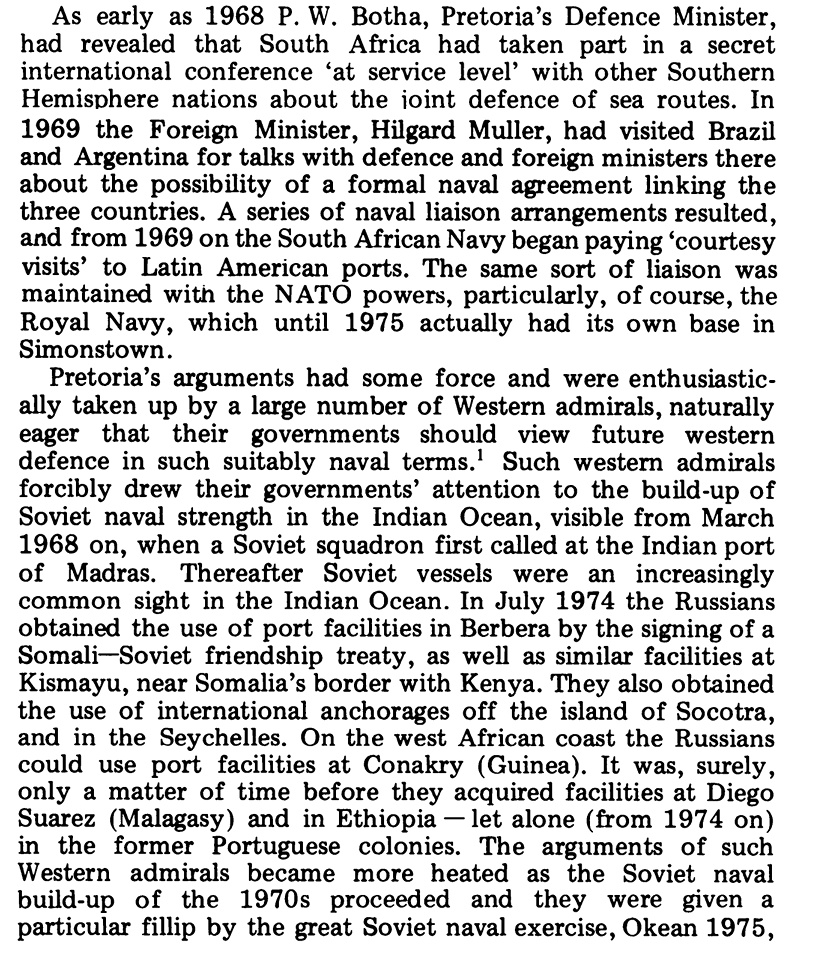
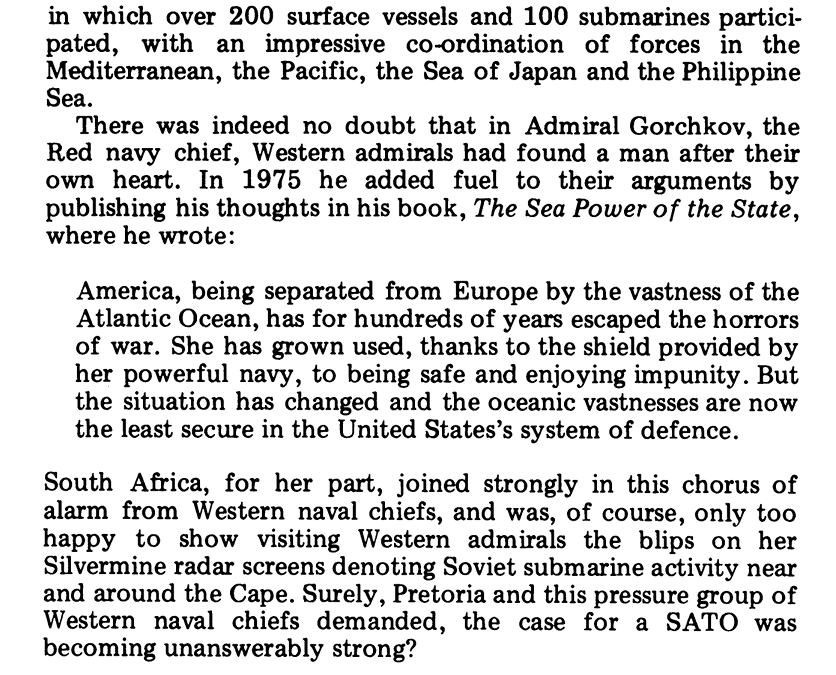
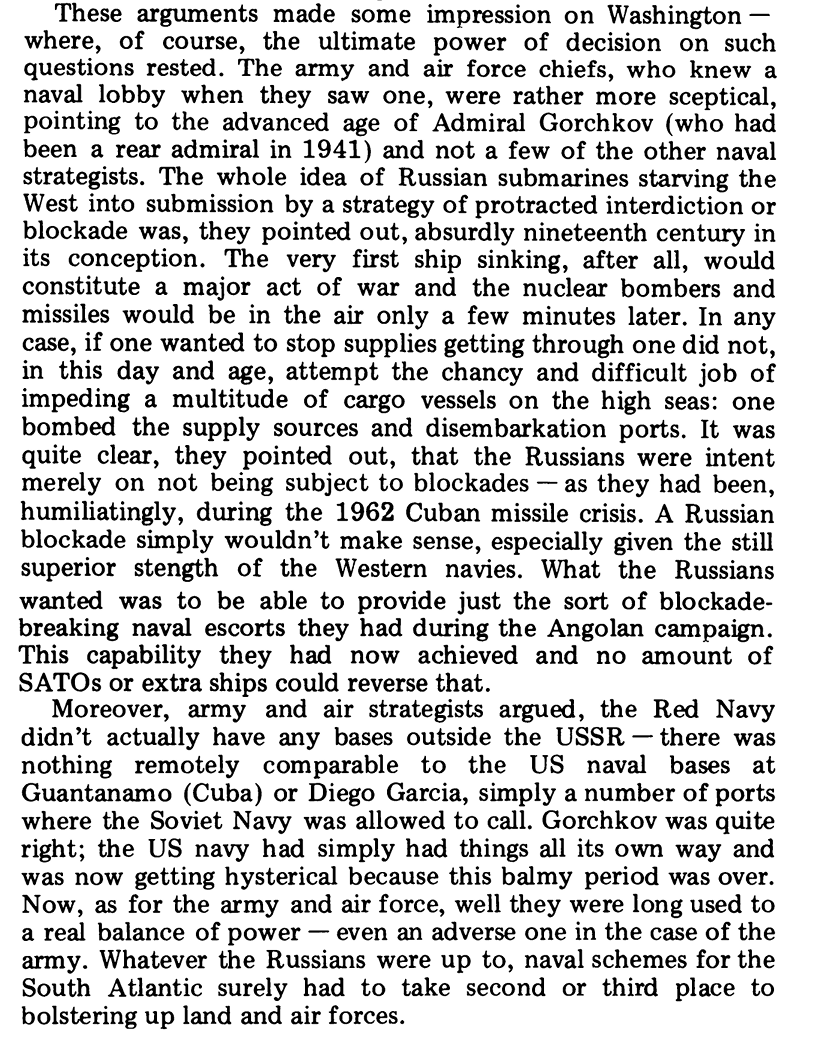
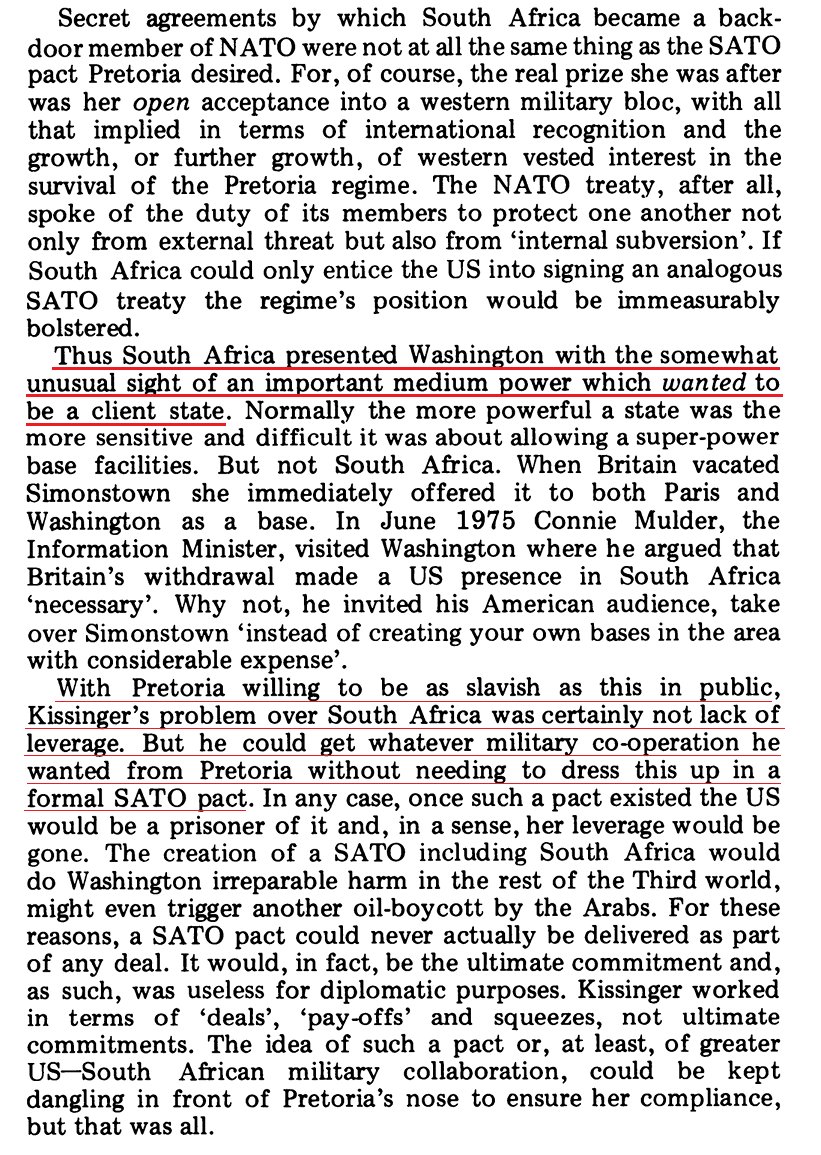
With SA now begging to become a US client-state, Kissinger considered tying the US to an unpopular treaty redundant - enough leverage already. US upped pressure on SA to force Rhodesia to accept black rule. SA public was with Smith, but SA gov worried about bush war spreading.

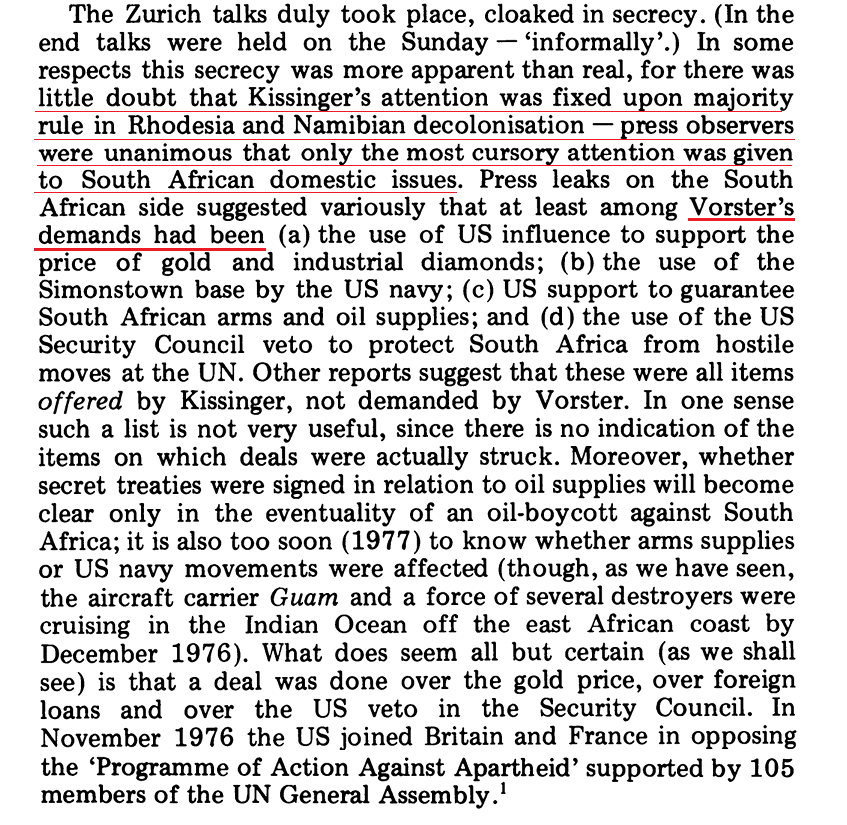
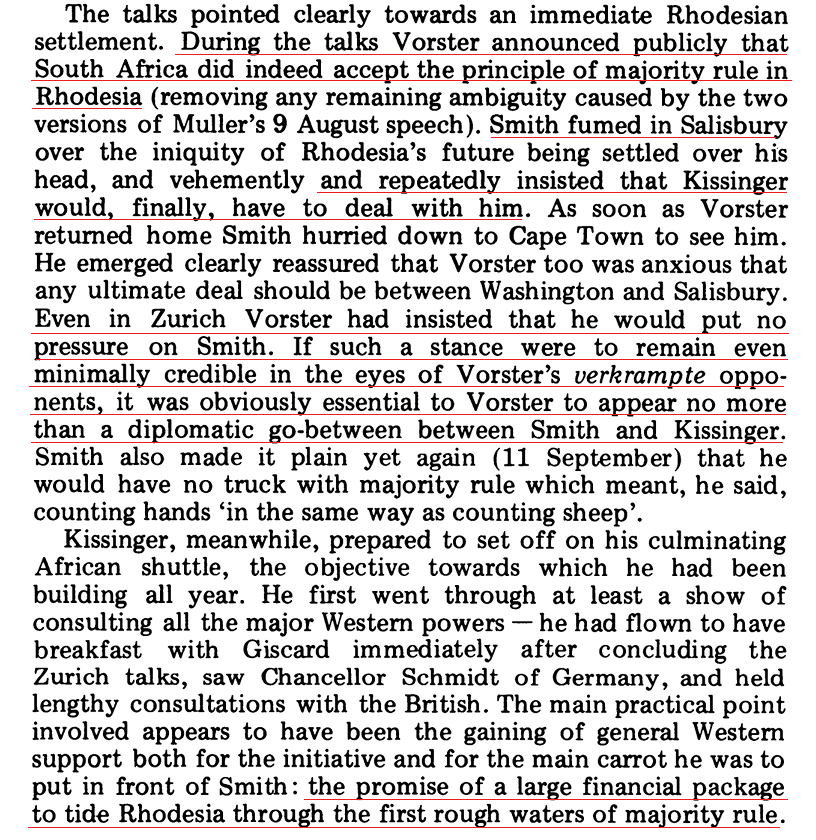
UK, having been outsmarted by Rhodesia's Ian Smith for years, scoffed at Kissinger's boasting he could peacefully achieve black rule there.
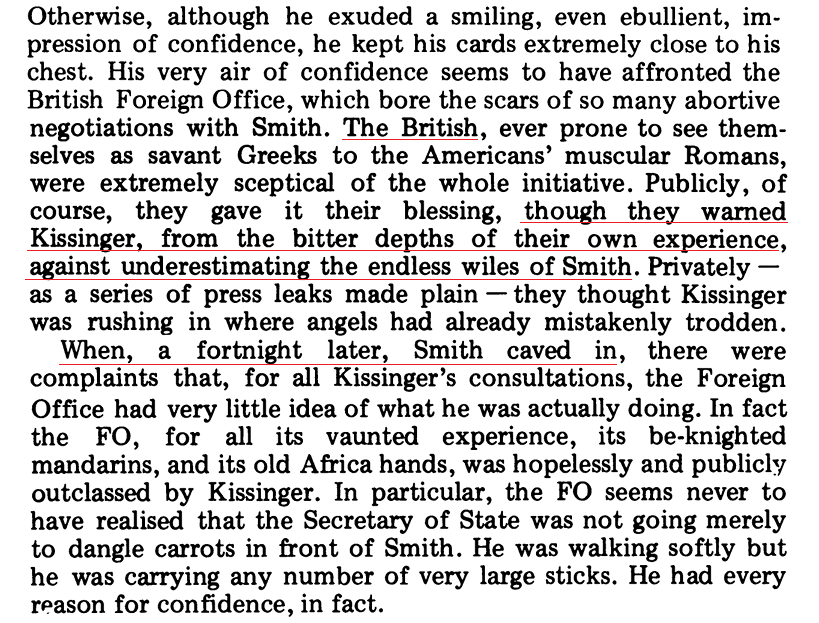
Kissinger flew around Africa meeting with leaders. Zambia's Luanda used his common tactic of effusive crying.
Kissinger flew around Africa meeting with leaders. Zambia's Luanda used his common tactic of effusive crying.
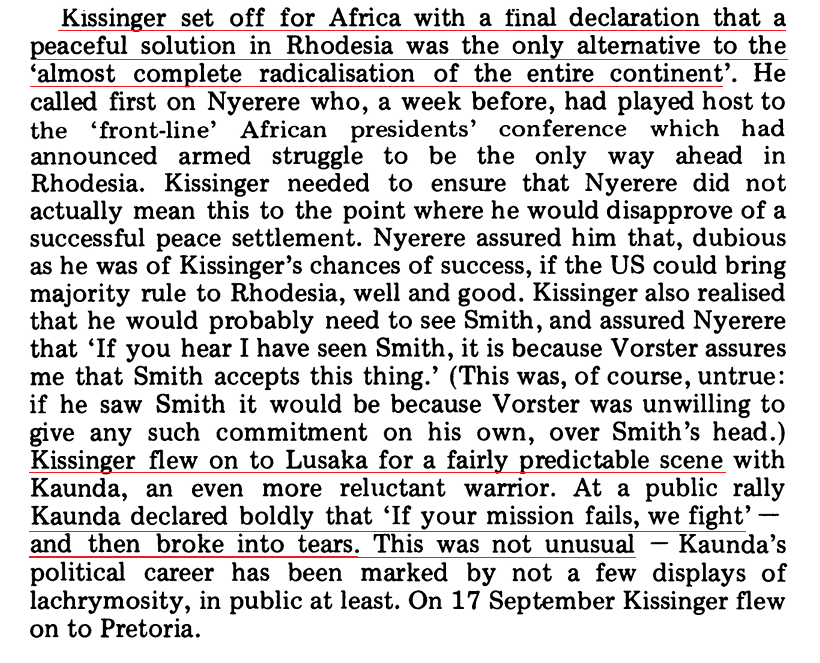
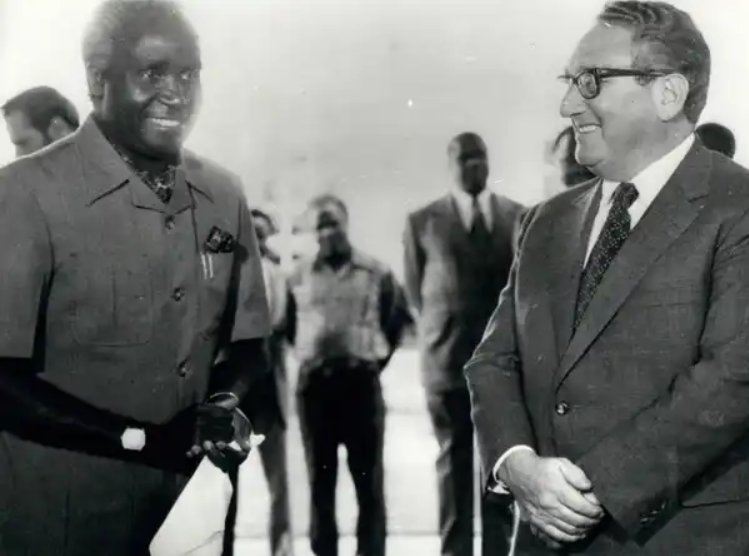
Using carrots & sticks, Kissinger forced Smith to make a public declaration of agreeing to future majority (i.e, black) rule in Rhodesia.
With this statement made, if he turned his back on it later, SA & US could hold his feet to the fire. Only US elections could scuttle the plan
With this statement made, if he turned his back on it later, SA & US could hold his feet to the fire. Only US elections could scuttle the plan
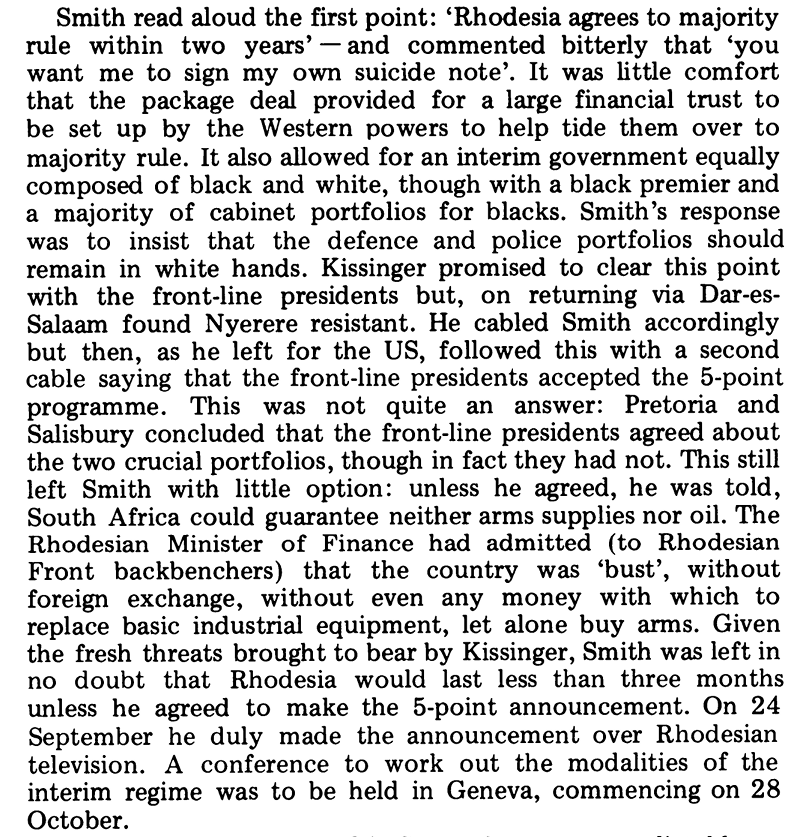
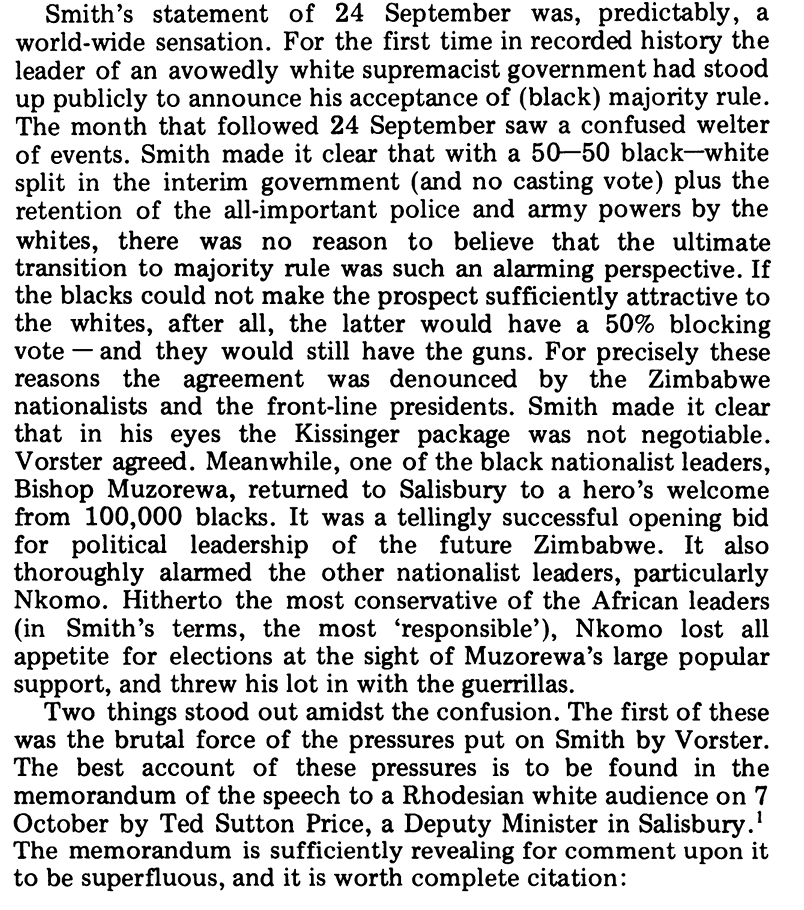
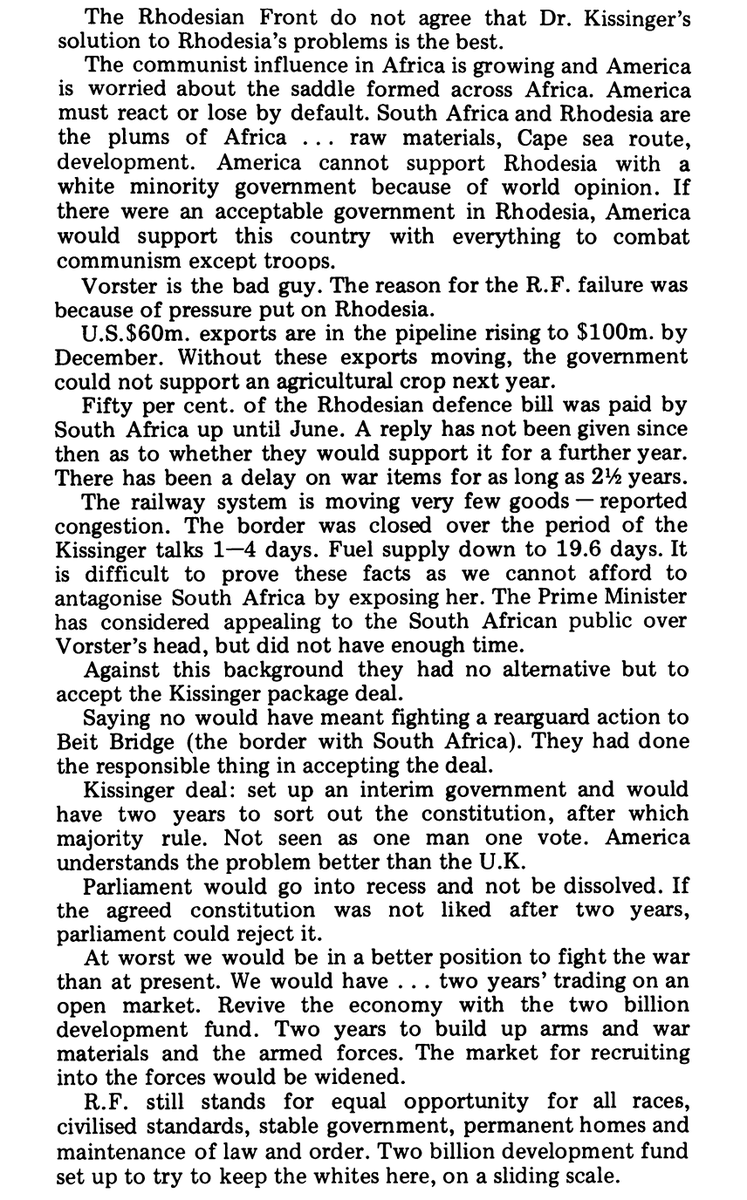
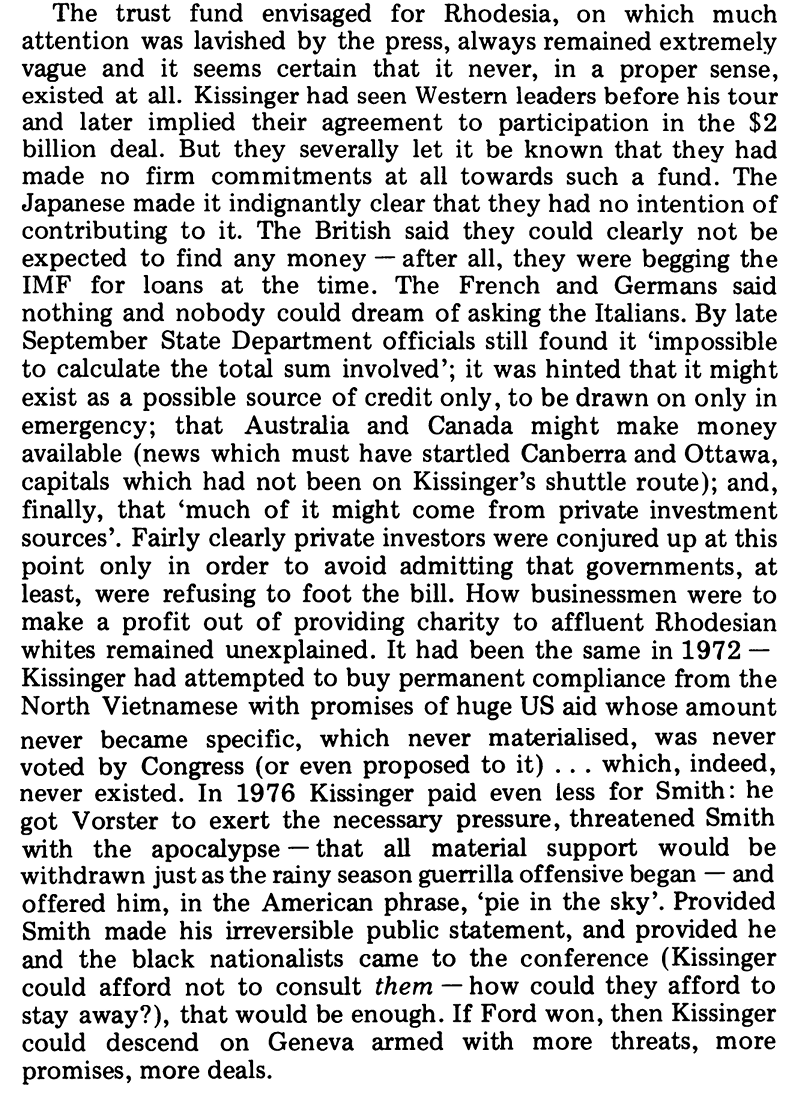
Book's remaining chapters go into deep detail on SA-US-Rhodesian talks, & how Carter's presidency led to rejection of Kissinger's proposed compromise. As Rhodesia ended up with Mugabe, now a historical footnote.
I'd assumed the '82 reprint had updated for events post-77, but no.
I'd assumed the '82 reprint had updated for events post-77, but no.
The last chapter, predicting SA's possible futures are still fascinating, especially when considering 🇮🇱 parallels.
SA's (rejected) plan to come down extremely hard on blacks in practice, whilst filibustering endless talks over tiny concessions to Bantustans, echoes 🇵🇸 & Oslo.
SA's (rejected) plan to come down extremely hard on blacks in practice, whilst filibustering endless talks over tiny concessions to Bantustans, echoes 🇵🇸 & Oslo.


Wishful & risible librul arguments that Apartheid was somehow not compatible with advanced capitalism.
Even in the 60s, the rich NW Euro states were dependent on cheap migrant labour, but from S. Europe. On the same capitalist logic, all Europe now draws it from the 3rd World.
Even in the 60s, the rich NW Euro states were dependent on cheap migrant labour, but from S. Europe. On the same capitalist logic, all Europe now draws it from the 3rd World.

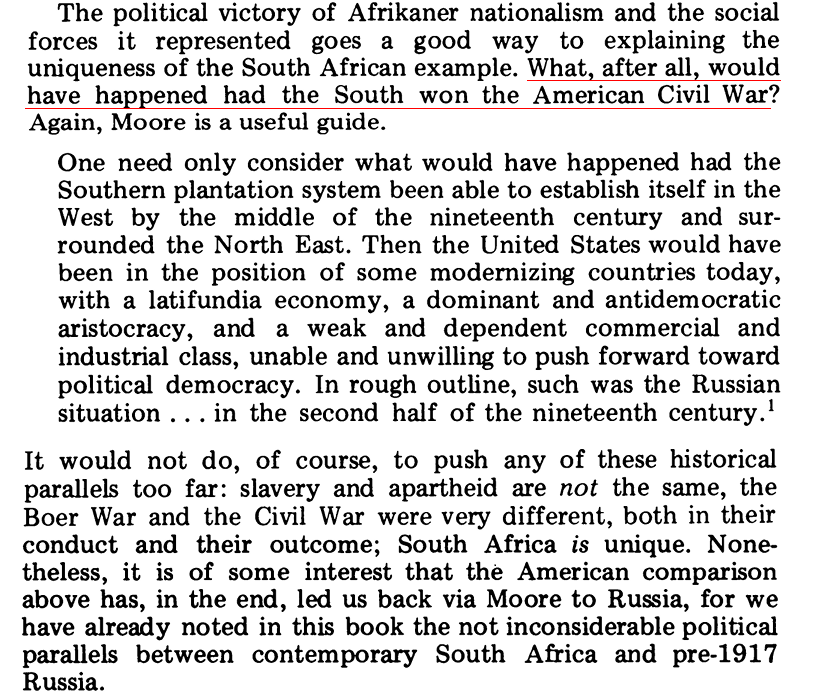
Analogy of Apartheid SA being what the Confederacy would have become had it won the Civil War.
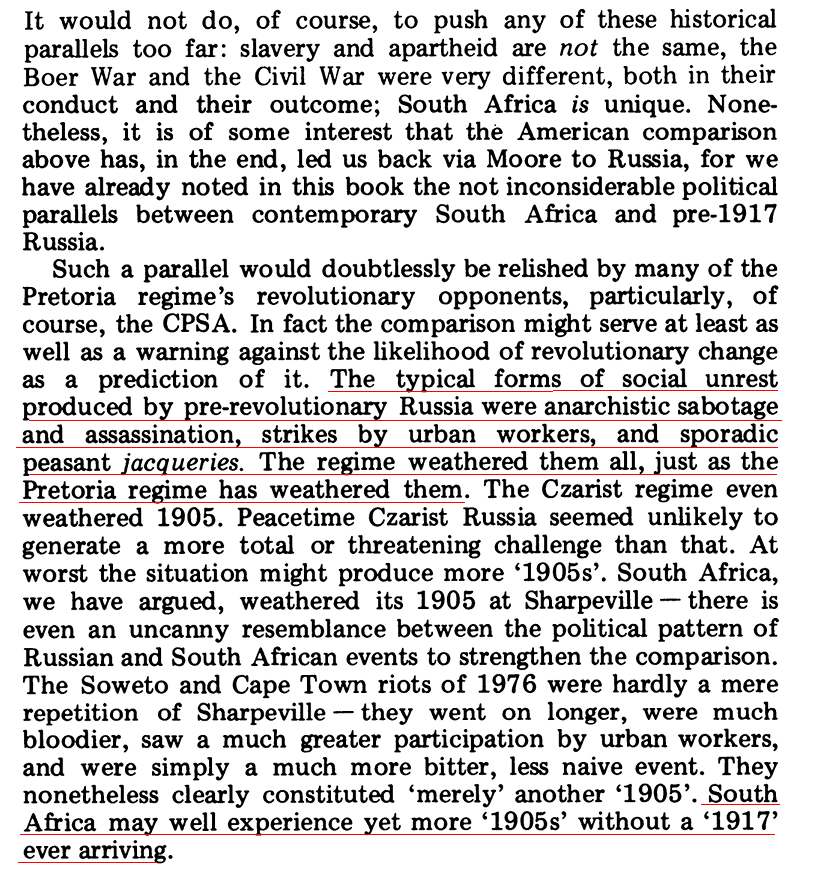
Conversely in comparing SA to Tsarist Russia, author argues that without WW1, it could have easily survived & modernised as a feudal culture- as Japan did. Revolution not inevitable.
Conversely in comparing SA to Tsarist Russia, author argues that without WW1, it could have easily survived & modernised as a feudal culture- as Japan did. Revolution not inevitable.
White SA's key to survival in not being a European colony. For Afrikaners, SA was truly their only home - many grew up in Africa before the first English settlers arrived in America.
Growing dependence of white SA on US & Europe grimly boding for its future.
Growing dependence of white SA on US & Europe grimly boding for its future.
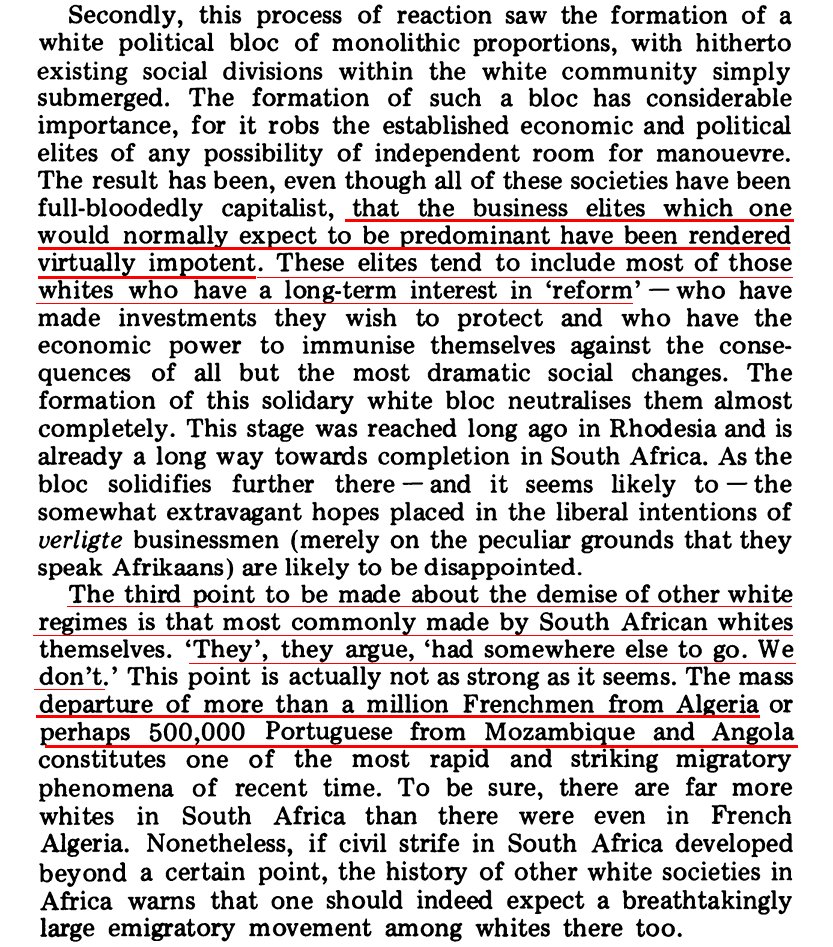

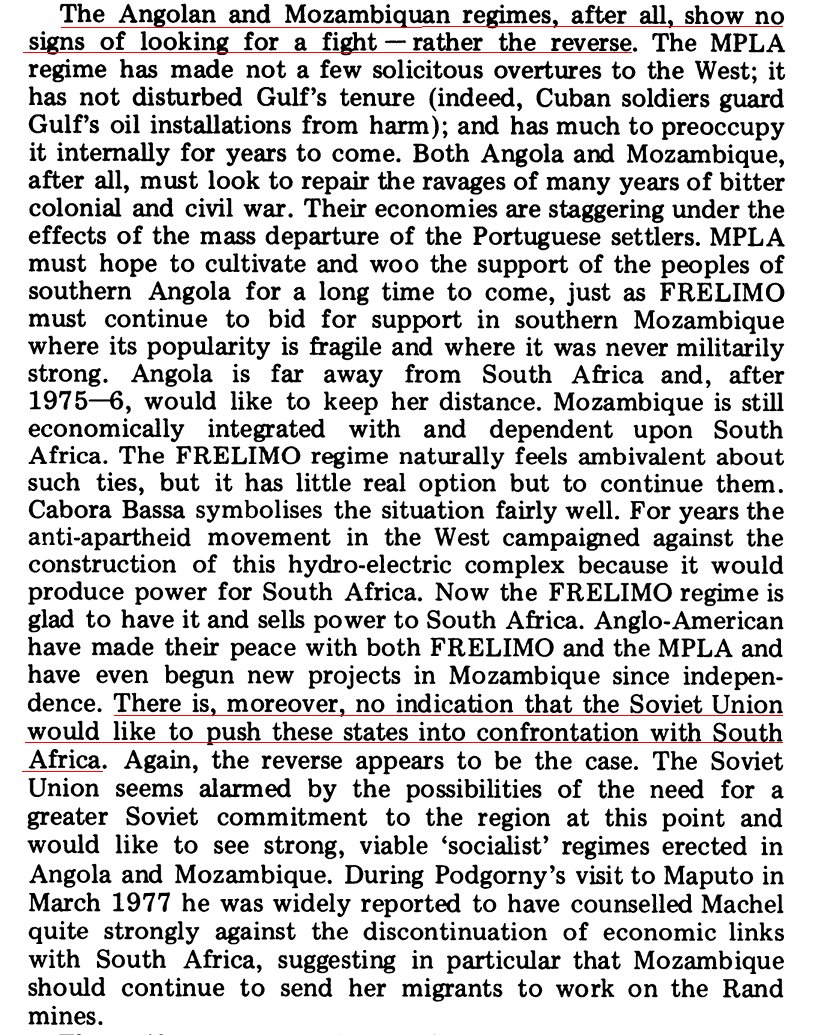

With "sufficiently brutal policy" SA could survive well into the 21st Century.
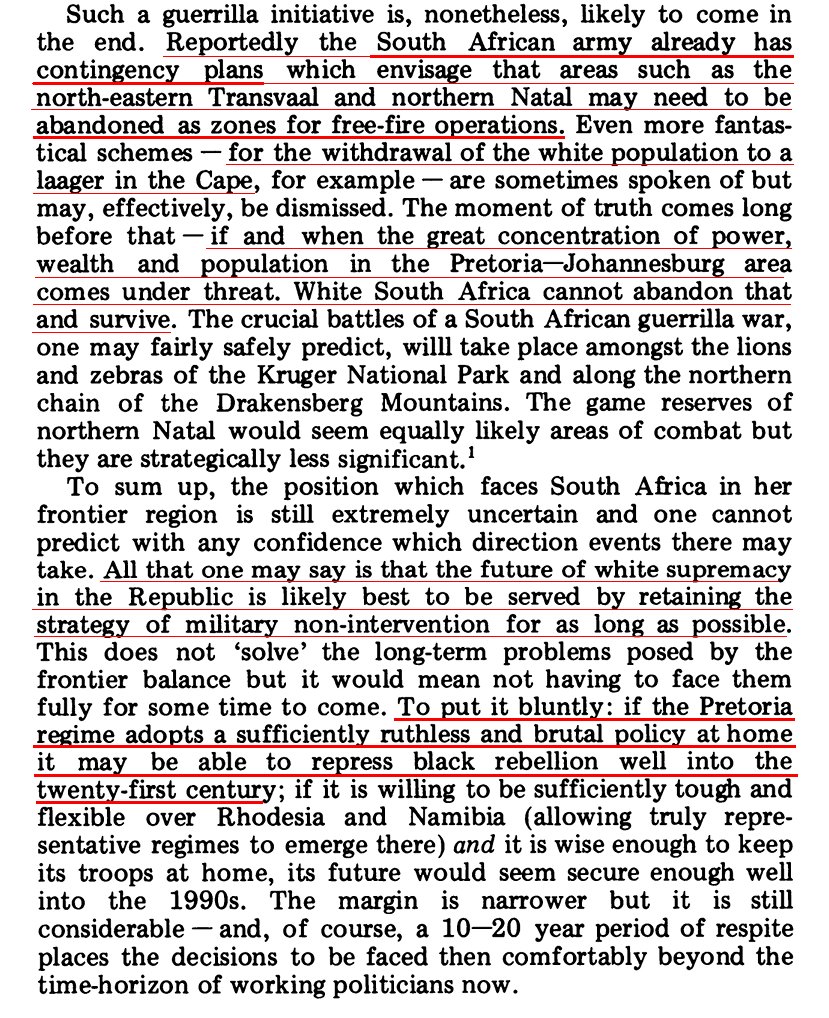
Emergency plans of SA to evacuate whites from vast areas of the country. These subnational divisions would become legal "free-fire zones".
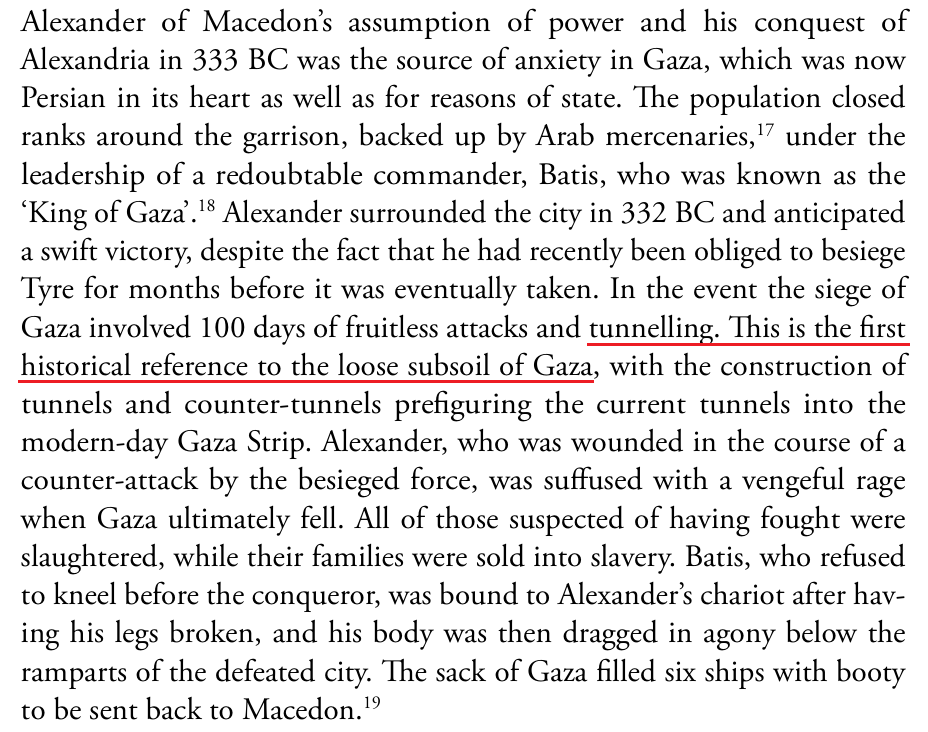
Identical to what 🇮🇱's Ariel Sharon did with Gaza in 2005.
Emergency plans of SA to evacuate whites from vast areas of the country. These subnational divisions would become legal "free-fire zones".
Identical to what 🇮🇱's Ariel Sharon did with Gaza in 2005.
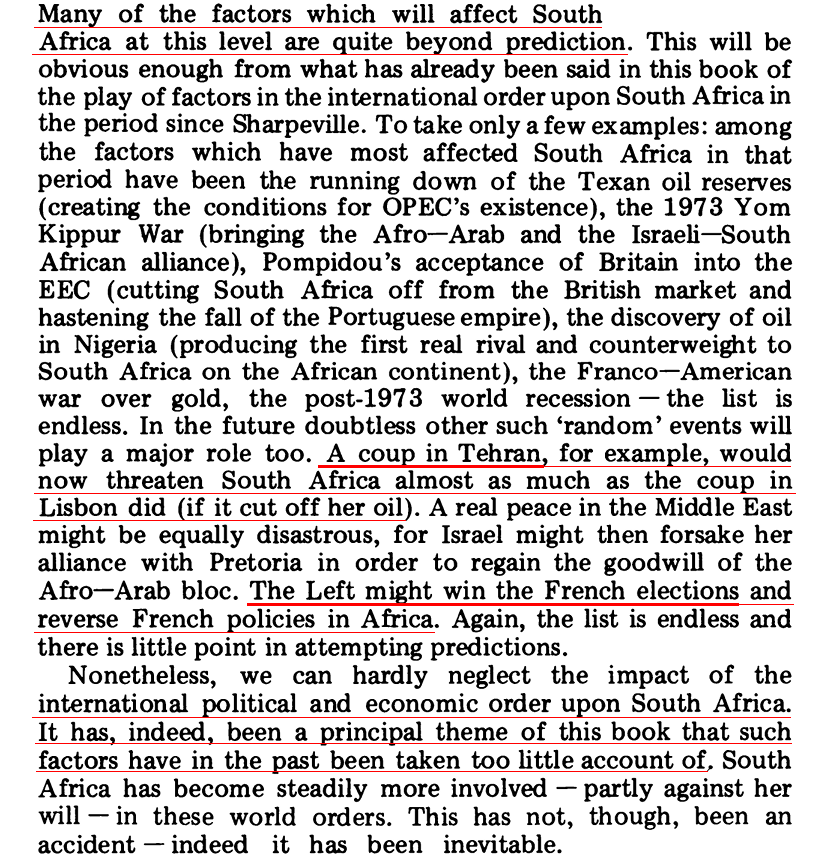
Author analyses from 1977 how future international events could impact SA:
"A coup in Tehran" judged even more disastrous than 🇵🇹-Empire collapse.
"Real MENA peace" - lol.
"The Left might the French elections & reverse policies in Africa" -unsure if Mitterrand changed anything? @phl43
"A coup in Tehran" judged even more disastrous than 🇵🇹-Empire collapse.
"Real MENA peace" - lol.
"The Left might the French elections & reverse policies in Africa" -unsure if Mitterrand changed anything? @phl43
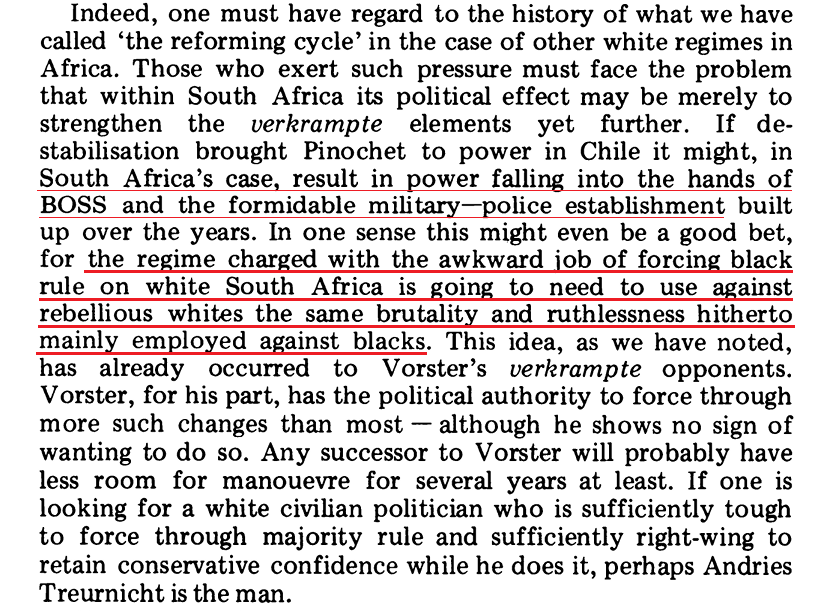
Conclusion on SA's prospects as dependence on US grows. If SA became a true 🇺🇸 "colony", no president could credibly threaten to abandon such a major state to Soviet-aligned black takeoever. Thus tactics used on Rhodesia wouldn't work.
USMC "largely made up the black unemployed".
USMC "largely made up the black unemployed".
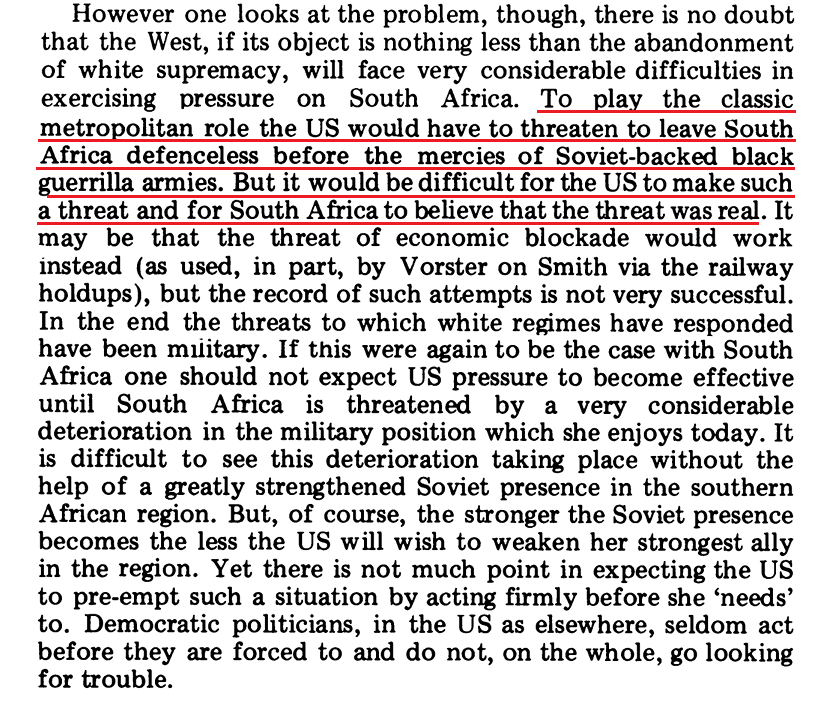
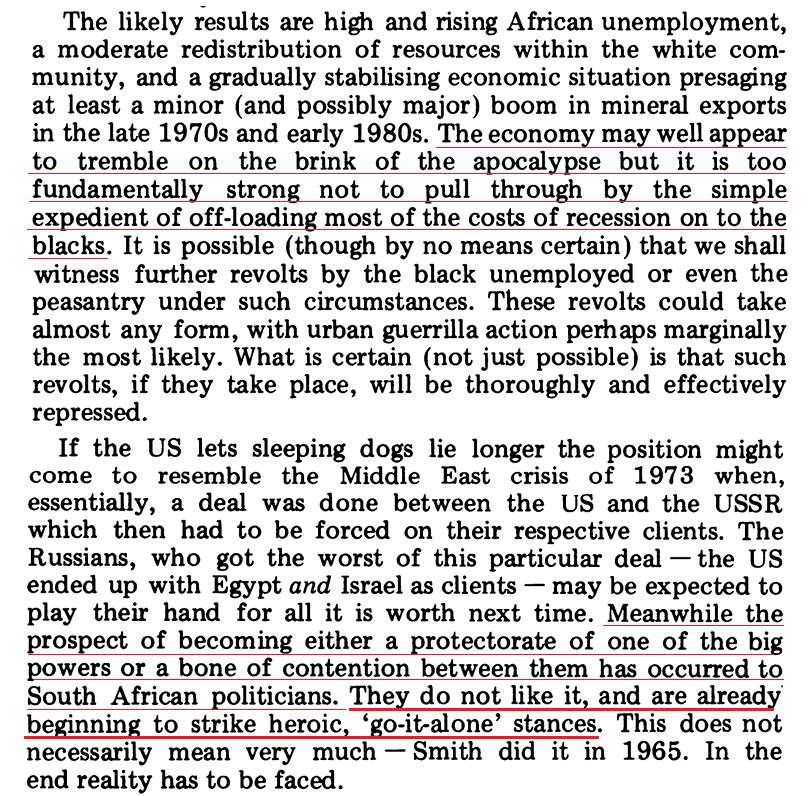
Final possibility of white South Africa, seeing the risk of black rule, refusing to become a US puppet, and striking a heroic, "go-it-alone" stance against the entire world.
This seems to be the path Begin chose for Israel in 1977, & Netanyahu made no turning back from in 2023.🧵
You guys might find parts of this (much too) long thread interesting, especially the view on 1970s world affairs, without the benefit of hindsight.
@uMarhobane @CitizenNill @cartographer_s @k9_reaper @YoungJapanTexts @kunley_drukpa @Martposting @shabashewitz @SamoBurja
This seems to be the path Begin chose for Israel in 1977, & Netanyahu made no turning back from in 2023.🧵
You guys might find parts of this (much too) long thread interesting, especially the view on 1970s world affairs, without the benefit of hindsight.
@uMarhobane @CitizenNill @cartographer_s @k9_reaper @YoungJapanTexts @kunley_drukpa @Martposting @shabashewitz @SamoBurja
• • •
Missing some Tweet in this thread? You can try to
force a refresh