Carl Hendrick Profile picture
Oct 25, 2024 6 tweets 3 min read Read on X
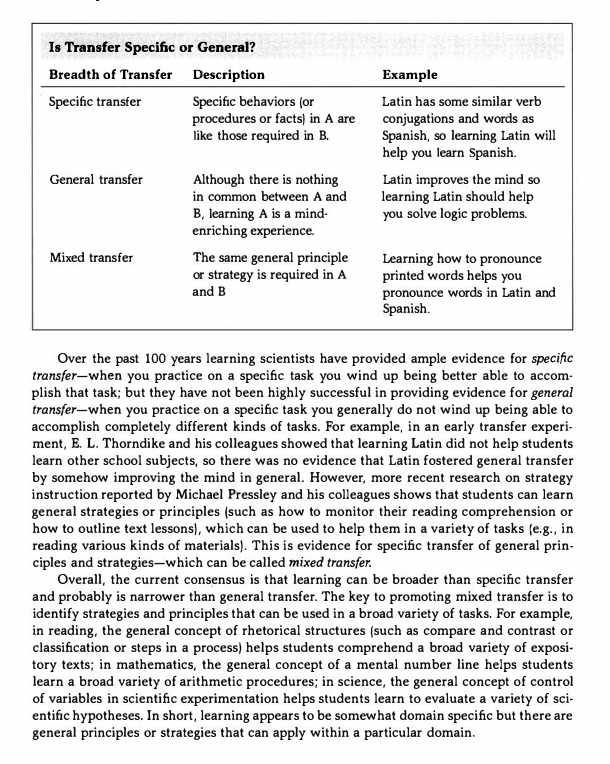
Possibly the most difficult challenge teachers face in instructional design is the “transfer paradox” otherwise known as the deceptive trade-off between immediate performance vs. long-term transfer. A short 🧵⬇️Image
The “transfer paradox” refers to a counterintuitive situation in learning and instructional design: techniques that improve immediate performance often do not lead to effective transfer of skills or knowledge to new and different contexts. In other words, what helps students perform well during initial learning may not prepare them well for applying that knowledge in different situations or problems they haven’t encountered before.
ref. researchgate.net/publication/25…Image
To be clear, I'm talking about relatively near transfer. I'm very skeptical of far transfer as advocated in 21st century skills or generic critical thinking skills. For example, climbing a hill is not going to make you better at persevering at solving equations. This from Richard Mayer is helpful:Image
For effective transfer, learners need to be actively involved in the learning process (cognitively not physically!), engaging in deeper cognitive processes like analyzing, synthesizing, and applying concepts in various ways. When learning is too easy or when cognitive load is too minimal, it can limit these activities, leading to what’s sometimes called “inert knowledge”— a narrow band of knowledge that exists but is not easily applied outside the initial learning situation.

Btw I would admit that a fair criticism of some forms of explicit instruction is that it can limit cognitive load to the point where cognitive engagement is too shallow for meaningful learning to occur. Effective instruction emphasizes teaching for understanding, rather than just teaching for performance, ensuring that learners can apply their knowledge across different contexts, not just replicate what they’ve been shown.
The paradox suggests that there is a need to find a balance between providing enough guidance to avoid overwhelming learners (especially novices) and leaving enough space for them to struggle, explore etc.

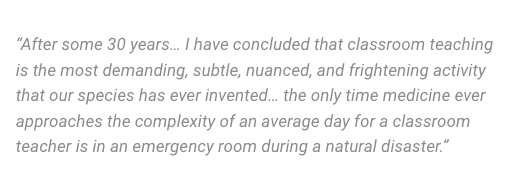
This is hard, really hard. The kind of thing that maybe only comes with years of experience and shows just how complex effective instruction is.Lee Schulman
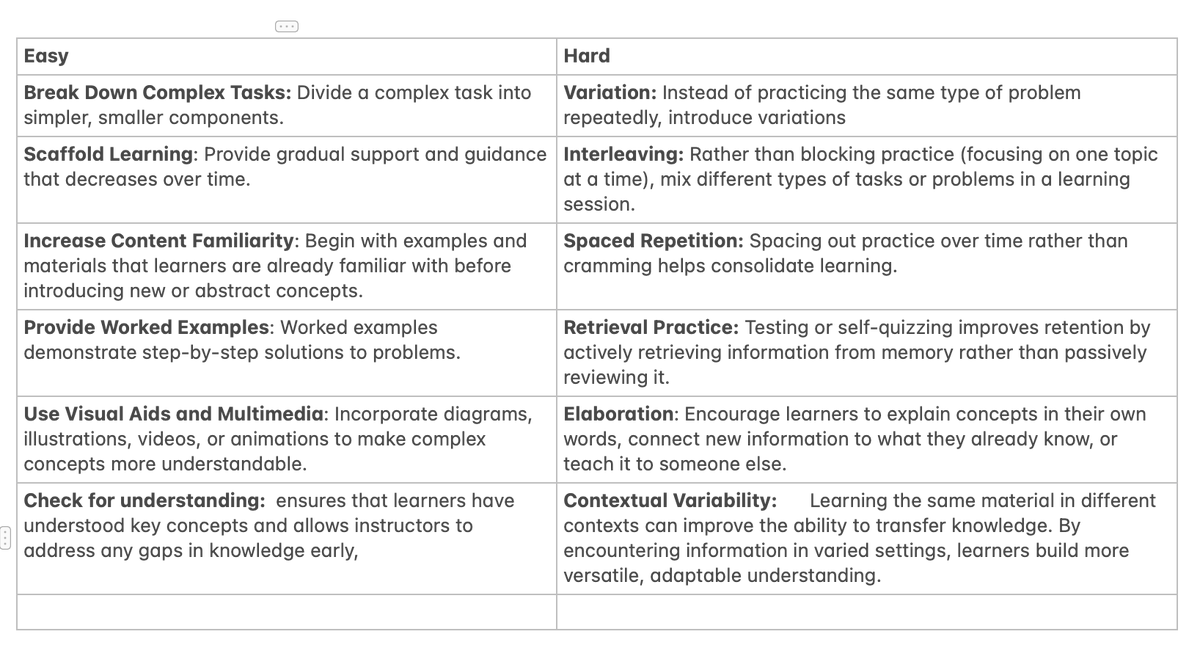
So to learn anything effectively, the process needs to be paradoxically both easy and hard. Like everything else, Shakespeare had a handle on this hundreds of years before everyone else. As Duke Senior says in As You Like It: "Sweet are the uses of adversity."Image

• • •

Missing some Tweet in this thread? You can try to force a refresh

 

Keep Current with Carl Hendrick

Carl Hendrick Profile picture

Stay in touch and get notified when new unrolls are available from this author!

Read all threads

This Thread may be Removed Anytime!

PDF

Twitter may remove this content at anytime! Save it as PDF for later use!

Try unrolling a thread yourself!

how to unroll video
  1. Follow @ThreadReaderApp to mention us!

  2. From a Twitter thread mention us with a keyword "unroll"
@threadreaderapp unroll

Practice here first or read more on our help page!

More from @C_Hendrick

May 11
Three different kinds of AI user are emerging right now which is presenting a novel crisis for education. We could soon see rapid cognitive disparities of a kind we have no historical precedent for. 🧵⤵️
My sense is that the emergence of frontier AI has created 3 types of users right now which is effectively running a real-time social experiment in cognition:
1.) Group 1 (bootstrappers) - those who are using it to bootstrap their thinking and to learn as much as they can
2.) Group 2 (offloaders) - those who use it to avoid all thinking and yet are producing high quality outputs but learn absolutely nothing
3.) Group 3 is (business as usual) - those who more or less ignore it, or use it like a slightly better Google.
In the short run the 2nd group outperforms the otehrs on almost every measure school can see, BUT they do not experience themselves as having lost anything because the thing they lost is precisely the thing that would have noticed the loss (hard-earned, systematised knowledge).
In other words, not only do they not know what they dont know, but everyone else doesn't know what they dont know.
Read 8 tweets
May 2
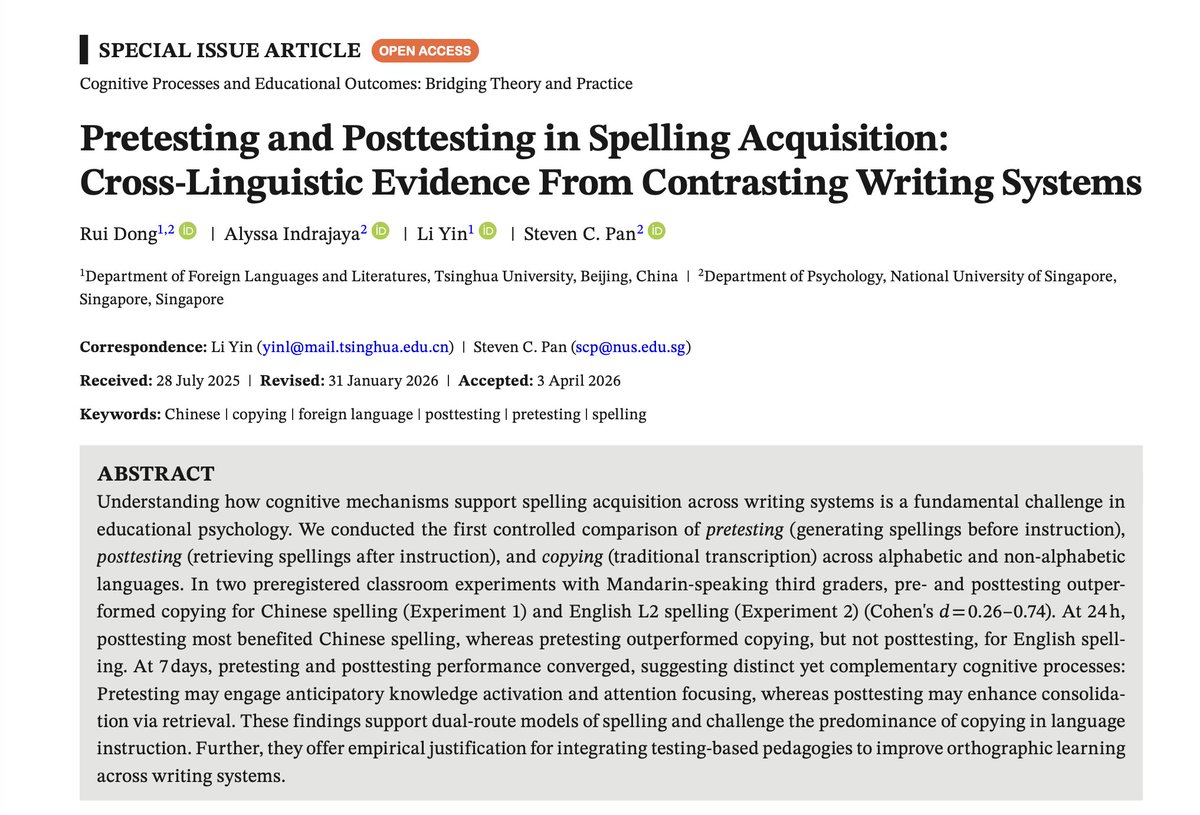
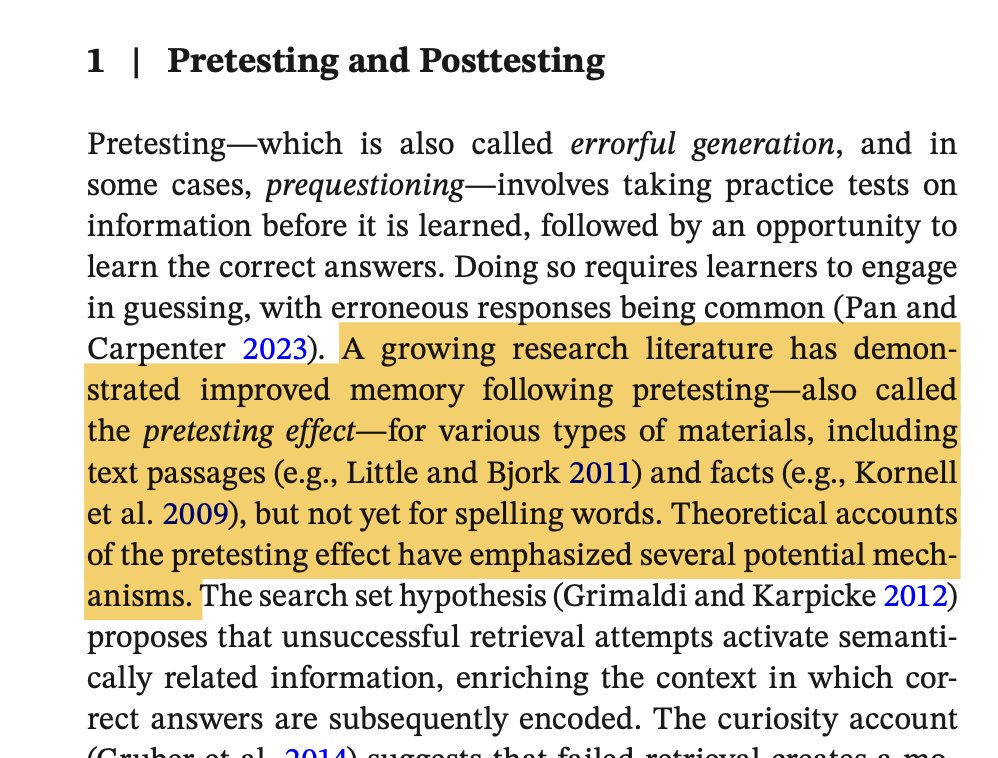
What works in spelling instruction? New study on how to teach it effectively and the pre-testing effect:
- Copying spelling words might be one of the least effective things we ask pupils to do.
- Generating answers before learning can improve spelling, even when pupils are wrong.
- The benefits of testing grow over time, not immediately.
- What matters is not how many times pupils see a word, but how often they retrieve it.Image
One of the rapidly developing areas of research I've been watching closely is "pretrieval" practice and what happens when you test students on material before they learn it.Image
My theory on pre-testing has been that there is some kind of priming effect by quizzing students on to-be-learned material.
The pretesting effect now has a well‑controlled demonstration for spelling, in both Chinese and English. Image
Read 8 tweets
Jan 17
Are natural learning environments really the best way learn? Thread on Herbert Simon and why effective instructional design needs to be artificial. 🧵 Image
In 'Sciences of the Artificial', Herbert Simon described an ant's complex, winding path across a beach.

The complexity isn't in the ant; it's in the environment (pebbles, dunes). Simon argued humans are the same: our complex behavior largely reflects the complexity of the environment we are navigating.

Simon’s claim is brutal and clarifying: Human behaviour looks complex largely because environments are complex. Change the environment and behaviour changes automatically. Leave it untouched and no amount of exhortation will help.Image
Natural learning is brutal. Evolution's method: those who fail to learn, perish. The knowledge we transmit in a single sentence ("don't eat that berry") took generations of fatal errors to acquire. Schools exist precisely because natural learning is slow, cruel, and inefficient.
The artificial classroom isn’t a falling away from a natural ideal; it’s an improvement on natural indifference.
Read 10 tweets
Dec 31, 2025
Working on instructional invariants today and the idea that evaluability is far more important than feedback. In fact, feedback is not an invariant at all.🧵
An instructional invariant is a non-negotiable design condition that must hold for learning to occur reliably.

If violated, it causes learning to fail. Even if everything else appears to be working.

Instructional invariants are constraints on learning environments that prevent predictable failure modes.

They are not a theory of learning. They are a diagnostic tool for design.
Feedback is something the system does. Evaluability is something the learner does. There's a massive difference between the two.
Read 12 tweets
Dec 29, 2025
Reading 'A Pattern Language' by Christopher Alexander and it’s just blowing my mind. His ideas have so much to offer instructional design 🧵 Image
A “pattern” isn’t a recipe. It’s a constraint that, if violated, makes the design fail no matter how pretty the surface is. A room can be any style, but violate “Light on Two Sides” and it will feel gloomy anyway. Image
This is a big lesson for instructional design: you can have the slickest UX, the funniest characters, the best “personalisation" etc but if you violate learning constraints, the product won’t teach. It will just entertain.
Read 9 tweets
Dec 13, 2025
Not everything is worth retrieving. Retrieval practice is powerful, but only when it targets the right knowledge. 🧵Image
As a general rule, knowledge that's central to the discipline should be retrieved.
Threshold concepts:
- Opportunity cost in economics
- Evolution by natural selection in biology
- The concept of a limit in calculus
- Irony in literature.
Hinge points:
A moment in instruction where everything that follows depends on students having grasped what came before. It's the juncture where the lesson either consolidates or collapses. If students haven't understood the concept at this point, proceeding is futile.
1. Retrieve knowledge that future learning depends on.
Example: In maths, fluent retrieval of place value and number bonds underpins everything from fractions to algebra. If students cannot retrieve these instantly, problem solving is a struggle.
Read 8 tweets

Did Thread Reader help you today?

Support us! We are indie developers!


This site is made by just two indie developers on a laptop doing marketing, support and development! Read more about the story.

Become a Premium Member ($3/month or $30/year) and get exclusive features!

Become Premium

Don't want to be a Premium member but still want to support us?

Make a small donation by buying us coffee ($5) or help with server cost ($10)

Donate via Paypal

Or Donate anonymously using crypto!

Ethereum

0xfe58350B80634f60Fa6Dc149a72b4DFbc17D341E copy

Bitcoin

3ATGMxNzCUFzxpMCHL5sWSt4DVtS8UqXpi copy

Thank you for your support!

Follow Us!

:(