Possibly the most difficult challenge teachers face in instructional design is the “transfer paradox” otherwise known as the deceptive trade-off between immediate performance vs. long-term transfer. A short 🧵⬇️
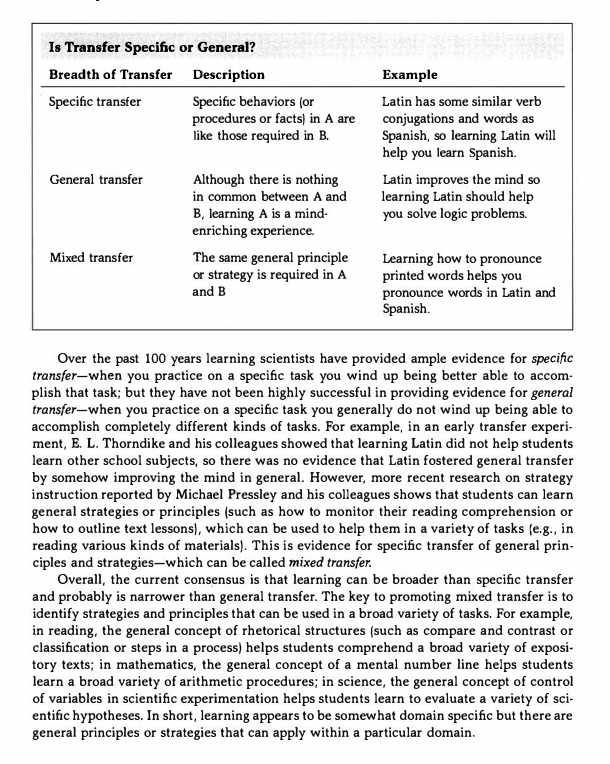
The “transfer paradox” refers to a counterintuitive situation in learning and instructional design: techniques that improve immediate performance often do not lead to effective transfer of skills or knowledge to new and different contexts. In other words, what helps students perform well during initial learning may not prepare them well for applying that knowledge in different situations or problems they haven’t encountered before.
ref. researchgate.net/publication/25…
To be clear, I'm talking about relatively near transfer. I'm very skeptical of far transfer as advocated in 21st century skills or generic critical thinking skills. For example, climbing a hill is not going to make you better at persevering at solving equations. This from Richard Mayer is helpful:
For effective transfer, learners need to be actively involved in the learning process (cognitively not physically!), engaging in deeper cognitive processes like analyzing, synthesizing, and applying concepts in various ways. When learning is too easy or when cognitive load is too minimal, it can limit these activities, leading to what’s sometimes called “inert knowledge”— a narrow band of knowledge that exists but is not easily applied outside the initial learning situation.
Btw I would admit that a fair criticism of some forms of explicit instruction is that it can limit cognitive load to the point where cognitive engagement is too shallow for meaningful learning to occur. Effective instruction emphasizes teaching for understanding, rather than just teaching for performance, ensuring that learners can apply their knowledge across different contexts, not just replicate what they’ve been shown.
The paradox suggests that there is a need to find a balance between providing enough guidance to avoid overwhelming learners (especially novices) and leaving enough space for them to struggle, explore etc.
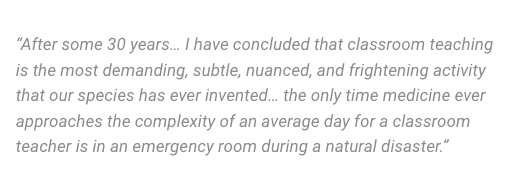
This is hard, really hard. The kind of thing that maybe only comes with years of experience and shows just how complex effective instruction is.
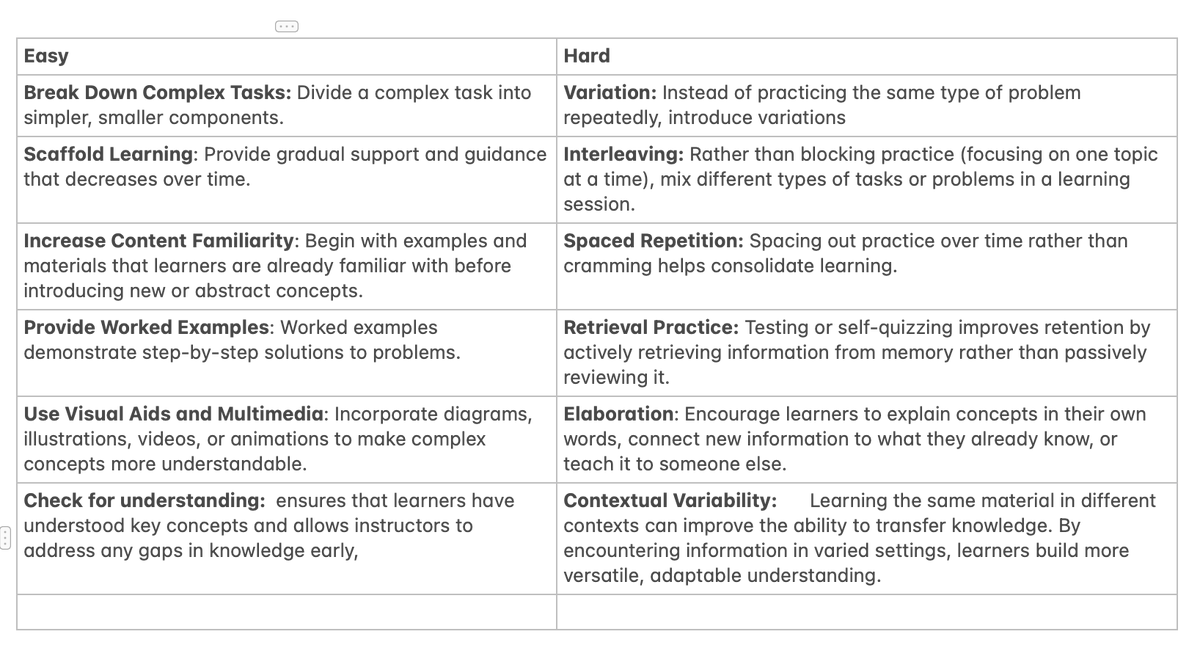
So to learn anything effectively, the process needs to be paradoxically both easy and hard. Like everything else, Shakespeare had a handle on this hundreds of years before everyone else. As Duke Senior says in As You Like It: "Sweet are the uses of adversity."
• • •
Missing some Tweet in this thread? You can try to
force a refresh

Seeing a lot of schools mandating retrieval practice in every lesson but also seeing quite a few misconceptions. A quick thread: 10 ways to get retrieval practice wrong ⬇️ 🧵
1. Not providing enough challenge, especially initially: Giving quizzes, where the first retrieval is very soon after learning, can create the "illusion of competence" where students recall easily on that first attempt, but later performance suffers. The initial retrieval needs to be sufficiently challenging to be effective.
Easy retrieval often involves retrieving information based on superficial cues or associations, rather than engaging in deeper, more elaborative processing. This type of shallow processing can lead to memories that are fragile and easily forgotten.
When retrieval is effortless, the brain doesn't need to work as hard to retrieve the information. Evidence suggests that this lack of effortful retrieval can result in weaker encoding of the memory trace, making it less durable over time.
2. Familiarity is not the same as understanding: Similarly, retrieval practice can lead to fluency, but fluency doesn't always equate to understanding. Teachers should be wary of the "fluency illusion" and use retrieval practice in conjunction with other methods to assess genuine comprehension.
This is similar to how we might recognise a song we've heard many times without necessarily understanding the lyrics or the musical structure. Recognising that a problem us a quadratic equation is not the same as being able to solve it.
Two keys things to bear in mind:
Shallow Processing: Fluency can be achieved through rote memorization or shallow processing, where students focus on remembering isolated facts or procedures without connecting them to underlying principles or applying them in new contexts.
Context-Dependent Memory: our ability to retrieve information is often influenced by the context in which we learned it. If retrieval practice always occurs in the same context (e.g., using the same type of questions, in the same classroom setting), students may develop a false sense of mastery because the retrieval cues are always present. However, when they encounter the material in a different context (e.g., on an exam, in a real-world application), they may struggle to recall or apply the information.
How effective are open-plan classrooms or '21st Century learning spaces'? Is a noisy classroom a 'thinking classroom'? A short thread on why they're a really bad idea 🧵
The idea of open plan classrooms became popular in the 1960s and emerged from a broader concept of 'open education' which included a set of assumptions derived from constructivist thought:
At the heart of this movement was idea that physical passivity means cognitive passivity and in order for learning to be active that there needs to be some kind of physical movement. To achieve this meant to do away with more formal learning approaches to a much more informal approach and this meant reworking the spaces in which learning happens.
Another related idea which took root around this time was the idea of learning styles which asserted the notion that learning was highly idiosyncratic and personal to each person and so for 'kinesthetic learners', formal classrooms were not effective. They needed to be moving around in order to learn. These claims were subsequently found to be without any real evidence. aeon.co/essays/the-evi…
How might teachers and school leaders think about implementing the science of learning in practice?
Some thoughts from my talk at #rEDTO2024
Firstly it's important to say that we still have a large gap between evidence from experimental settings and classroom practice. @TWPerry1's review is a hugely important work and really sets out the limitations of the evidence we actually have.
Where we do have evidence of the science of learning in schools, the interventions are often not done by real teachers in real situations. This is a problem.
#rEDTO2024
When we talk about the science of learning , we are talking about a subset of interrelated fields involving neuroscience, cognitive science and education psychology.
For the purposes of what happens in schools, I believe that Mayer's distinction between the three elements of learning, instruction and assessment in "educationally relevant settings" are the most important to focus on:
1. Science of Learning: The first step involves pinpointing the aspects of the science of learning that hold the most relevance to education. Historically, this field focused on how laboratory animals or humans learn in controlled environments, which had limited educational significance. Recent advances, however, have deepened our understanding of learning in educationally relevant settings, paving the way for developing a science of learning that aligns with educational needs. 2. Science of Instruction: Even if we fully grasp the mechanics of learning, this understanding alone doesn't automatically yield effective teaching strategies. It's crucial to have a method for evaluating the effectiveness of instructional methods based on the principles of the science of learning to determine how and when they work best. 3. Science of Assessment: Applying the science of learning requires a comprehensive way to evaluate what has been learned. Clear learning objectives are vital for designing effective instruction, and accurate assessment of achieved outcomes is essential for measuring instructional effectiveness.
#rEDTO2024
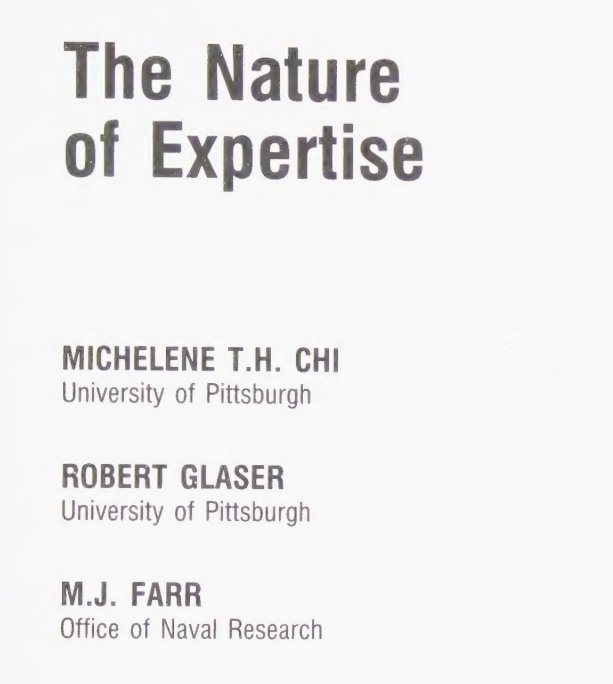
What can we learn from experts on expertise? Some notes from this excellent book 🧵⬇️
1. Experts Excel Mainly in Their Own Domains.
"There is little evidence that a person highly skilled in one domain can transfer the skill to another."
This point is possibly the central one in the book and one which most people struggle with. Being an excellent teacher in one subject doesn't mean you can teach any subject. In fact even within one subject area there is not a lot of transfer: an expert secondary school English teacher would be useless at teaching 5 year olds how to read.
Likewise, teaching students a set of generic skills is unlikely to lead to them becoming proficient in other areas. You can think deeply about something you know a lot about - generalised 'thinking skills' doesn't come into it.
"The obvious reason for the excellence of experts is that they have a good deal of domain knowledge. This is easily demonstrated; for example, in medical diagnosis, expert physicians have more differentiations of common diseases into disease variants (Johnson et al., 1981). Likewise, in examining taxi drivers’ knowledge of routes, Chase (1983) found that expert drivers can generate a far greater number of secondary routes (i.e., lesser known streets) than novice drivers."
2. Experts Perceive Large Meaningful Patterns in Their Domain.
Possibly the biggest difference between experts and novices is that they actually see problems differently.
In education this is a crucial ability. Simply put, expert teachers have a superpower that novice teachers don't: they can see a whole range of things such as pre-empting misbehaviour before it happens to sensing whether a student is not understanding something. They will have a range of different ways of explaining the same thing in a way that meets the needs of all students. This comes not just from extensive experience but specific knowledge.
"It should be pointed out, however, that this ability to see meaningful patterns does not reflect a generally superior perceptual ability; rather, it reflects an organization of the knowledge base."
Does cognitive science claim the brain is like a computer? A short thread ⬇️ 🧵
It's true that phrases such as 'central executive', 'process', 'encoding' and 'retrieval' are used in the field to define how we learn, however cognitive science also acknowledges the fact that we are human and that unlike computers, we have all the attendant biases and cognitive limitations that come with being human.
Blake Richards argues that if we take the definition of computer from computer science then it's not a good metaphor because the differences are too vast to warrant comparison:
Obviously there is the information processing analogy but in terms of memory, it's not really accurate to say that cognitive science views the brain as a computer. Major theorists from the mid-20th Century on (Bartlett/Baddeley/Hitch) broadly agree on one crucial aspect of memory: we don't recall stuff verbatim when we remember something (as if we are taking something out of a file drawer,) we modify or re-write every time we retrieve that knowledge. Computers don't do that.
One of the key things to know from over 100 years of research on learning is the weird paradox that an important part of learning anything is actually forgetting it. A thread on how to harness this principle for effective learning ⬇️ 🧵
In 1914, Edward Thorndike outlined his law of effect (based on experiments with cats) which became the blueprint for the behaviourist idea that positive experiences are reinforced and negative ones are weakened.
But part of this broader theory was his 'theory of disuse' which establishes another fairly simple idea: the less you use something the more you forget it. The key idea is that unless you rehearse learned information and skills, it will fade or 'decay' as he put it, over time (use it or lose it).
Now on the surface this seems like something everybody knows, but like so much about learning, it's really not that simple at all.
The 'decay' part of Thorndike's theory of forgetting was the problem and robustly debunked by John McGeoch in 1932. He advanced the idea that it isn't so much the "disuse" of learned material over time which causes it to be forgotten but rather the conditions under which it is to be recalled.
In other words, the stuff is still there, you just can't remember it.
(I like this paper because it contains one of the spiciest putdowns in early 20th Century psychology, at a time when everyone was unfailingly polite. He says Thorndike is chatting nonsense "because the principle of passive decay has no analogue anywhere else in science, and is illogical." 🌶️)