This is undoubtedly true, but the thing I don't see discussed enough is that doctors and med school aren't so much to blame
Rather, Private Equity is the real culprit for American medicine falling apart
A brief 🧵👇
Rather, Private Equity is the real culprit for American medicine falling apart
A brief 🧵👇
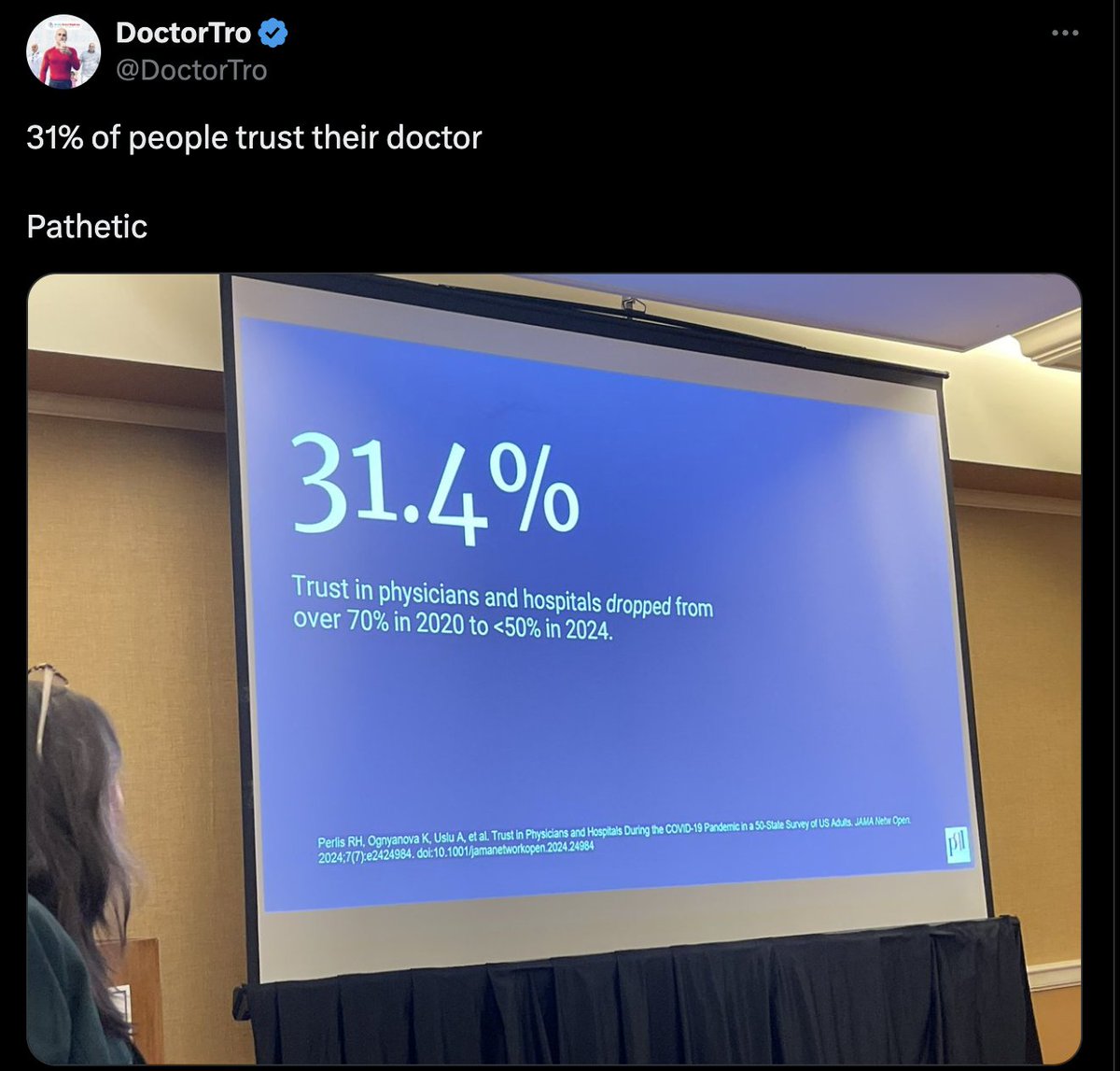
Ok, so this is a subject that medical journals are starting to study, but that hasn't entered public consciousness in the same way that, say "the military-industrial complex" has
But Raytheon isn't the reason the hospital charged you an arm and a leg to amputate the wrong leg. PE is.
Particularly, it is sniffing for returns and found them in medicine, namely in highly cash-generating internal medicine specialties like gastroenterology in which a few extra procedures a day can really boost the bottom line
But Raytheon isn't the reason the hospital charged you an arm and a leg to amputate the wrong leg. PE is.
Particularly, it is sniffing for returns and found them in medicine, namely in highly cash-generating internal medicine specialties like gastroenterology in which a few extra procedures a day can really boost the bottom line

Such is what the American Journal of Medicine noted in a report titled “Private Equity and Medicine: A Marriage Made in Hell.” It provided:
Nearly every study reported in a recent meta-analysis found that PE acquisition led to higher prices. This has been documented in detail in anesthesia practices and in a combination of dermatology, gastroenterology, and ophthalmology practices. These latter studies documented “upcoding” such as seeing a higher percentage of visits claiming more than 30 minutes spent with the patient after PE takeovers. In addition, more new patients are seen and more fee-generating procedures are performed immediately after such takeovers. PE-backed management companies generated a major share of the out-of-network “surprise bills” that received considerable notoriety, as they have acquired major shares in such fields as emergency medicine, pathology, and anesthesiology, where patients do not have the ability to choose “in-network” physicians. Another way PE firms increase their ability to raise fees is by acquiring a dominant share of select specialties in a geographic area. PE firms are particularly attracted to procedure-oriented specialties such as dermatology, gastroenterology, and cardiology, where a few more procedures a week can make a big difference to “the bottom line.”
Nearly every study reported in a recent meta-analysis found that PE acquisition led to higher prices. This has been documented in detail in anesthesia practices and in a combination of dermatology, gastroenterology, and ophthalmology practices. These latter studies documented “upcoding” such as seeing a higher percentage of visits claiming more than 30 minutes spent with the patient after PE takeovers. In addition, more new patients are seen and more fee-generating procedures are performed immediately after such takeovers. PE-backed management companies generated a major share of the out-of-network “surprise bills” that received considerable notoriety, as they have acquired major shares in such fields as emergency medicine, pathology, and anesthesiology, where patients do not have the ability to choose “in-network” physicians. Another way PE firms increase their ability to raise fees is by acquiring a dominant share of select specialties in a geographic area. PE firms are particularly attracted to procedure-oriented specialties such as dermatology, gastroenterology, and cardiology, where a few more procedures a week can make a big difference to “the bottom line.”
The other thing is that costs can, at least in the short term, be cut dramatically to boost profits over the time period these people care about
Such is what the same American Journal of Medicine article noted. It provided:
Why would PE firms invest in medical and dental practices, hospitals, nursing homes, hospices, and other health care entities? These firms typically seek to sell their acquired businesses in 3-5 years, aiming for at least a 50% profit. To do this, they must show sufficient revenue and profit growth to justify a higher sales price or increase the profitability of an entity they own to justify maintaining ownership. To do this, they must increase revenues and decrease operating costs. To achieve higher revenues, they will raise prices, increase the “productivity” of practitioners (ie, ask the physicians and others to see more patients), or seek a more lucrative mix of procedures. To lower costs they will seek lower-cost supplies; in a best case through forcing lower prices on currently used products, in a worst case by substituting inferior products. More often, because the major “cost” in a medical setting is the salaries of personnel, they will seek to substitute lower-paid staff: LPNs for RNs, minimally trained “medical assistants” for nurses.
Such is what the same American Journal of Medicine article noted. It provided:
Why would PE firms invest in medical and dental practices, hospitals, nursing homes, hospices, and other health care entities? These firms typically seek to sell their acquired businesses in 3-5 years, aiming for at least a 50% profit. To do this, they must show sufficient revenue and profit growth to justify a higher sales price or increase the profitability of an entity they own to justify maintaining ownership. To do this, they must increase revenues and decrease operating costs. To achieve higher revenues, they will raise prices, increase the “productivity” of practitioners (ie, ask the physicians and others to see more patients), or seek a more lucrative mix of procedures. To lower costs they will seek lower-cost supplies; in a best case through forcing lower prices on currently used products, in a worst case by substituting inferior products. More often, because the major “cost” in a medical setting is the salaries of personnel, they will seek to substitute lower-paid staff: LPNs for RNs, minimally trained “medical assistants” for nurses.
The result of gobbling up hospitals and near-monopolies in specialities is that quality of care drops like a rock.
Again according to the same American Journal of Medicine article:
What about quality? Here the evidence is a bit more mixed, but the majority of studies looking at this have shown poorer quality. In nursing homes bought by PE firms, Gupta et al found that mortality of Medicare patients within 90 days of discharge from the nursing home goes up by about 10% when a nursing home is PE acquired. In addition, the same researchers found adverse effects on other measures of patient well-being such as scores on mobility, ulcers, and pain. They found a consistent picture of patients doing worse after a nursing home is bought by PE and also saw evidence that the nursing home spending goes up for Medicare by about 6%-8%.
…
As detailed, PE investment in health care unquestionably increases costs while probably decreasing quality.
Again according to the same American Journal of Medicine article:
What about quality? Here the evidence is a bit more mixed, but the majority of studies looking at this have shown poorer quality. In nursing homes bought by PE firms, Gupta et al found that mortality of Medicare patients within 90 days of discharge from the nursing home goes up by about 10% when a nursing home is PE acquired. In addition, the same researchers found adverse effects on other measures of patient well-being such as scores on mobility, ulcers, and pain. They found a consistent picture of patients doing worse after a nursing home is bought by PE and also saw evidence that the nursing home spending goes up for Medicare by about 6%-8%.
…
As detailed, PE investment in health care unquestionably increases costs while probably decreasing quality.
And the quality issue is a real one, particularly for hospitals. As the Lown Institute noted:
The rate of adverse events at PE-acquired hospitals compared to control hospitals increased by 25%, including a 27% increase in falls, 38% increase in central line-associated bloodstream infections (CLABSI), and double the rate of surgical site infections. The authors found the rates of CLABSI and surgical site infections at PE-acquired hospitals alarming because overall surgical volume and central line placements actually decreased.
The rate of adverse events at PE-acquired hospitals compared to control hospitals increased by 25%, including a 27% increase in falls, 38% increase in central line-associated bloodstream infections (CLABSI), and double the rate of surgical site infections. The authors found the rates of CLABSI and surgical site infections at PE-acquired hospitals alarming because overall surgical volume and central line placements actually decreased.
The general problem is that medicine, though long a highly remunerative profession, isn't supposed to be exclusively profit-focused. But then private equity companies use a huge amount of debt to buy practices and hospitals and need to make a large return + pay back the debt in just 3 or so years.
So money becomes the exclusive focus, not patient welfare. Such is what Harvard Law's "Systemic Justice" noted, saying:
Private equity firms “capture value” by rapidly improving a business’s profit-making performance and savagely cutting costs. Senator Elizabeth Warren, who has proposed federal legislation to rein in private equity’s excesses, aptly described the phenomenon: private equity firms “slash costs, fire workers, and gut long-term investments to free up more money to pay themselves.” In the context of health care, private equity firms achieve target returns (usually 20% per year) by increasing provision of both non-essential healthcare services and services that are most highly reimbursed. They put pressure on doctors to see more patients and thus to decrease the amount of time spent per visit.
...
Due to cost pressures imposed by management, practices may switch over to cheaper equipment, hire lower cost providers such as nurse practitioners and physician assistants rather than more expensive MDs and DOs, foist surprise medical bills on unsuspecting patients, and then use vulture-like tactics such as “aggressively suing poor patients” unable to pay astronomical bills. Other common mechanisms to boost profitability include performing more out-of-pocket procedures, increasing surgical volumes, and conducting unnecessary testing. That’s right, you read correctly: unnecessary testing.
...
The infusion of capital from private equity may seem beneficial for a practice struggling to stay afloat financially. But the allure is a false one. Private equity undermines the quality of health care, and it epitomizes the worst of corporate influence on the medical profession. Doctors and investors alike buy into the legitimating narrative that private equity will enable practices to achieve an otherwise unattainable degree of efficiency. It will help standardize medical practice, eliminate waste, and reduce variability, they claim. It will enable medical practices, clinics, and hospitals to expand, innovate, integrate, and implement new models of health care delivery, they argue. Private equity’s promise of cost-cutting and efficiency is portrayed as a panacea to the problem of excessive health care spending. The ruthless pursuit of efficiency may finally help the United States deliver cost-effective care, precisely what is needed when we spend twice as much per capita on health care as do other, comparably wealthy nations.But the efficiency-based narrative just articulated, which I will refer to as the efficiency micro script, is a convenient smokescreen. Private equity investment does not make health care provision more efficient. Instead, it erodes quality, ignores critical countervailing interests such as patient safety, and undermines the patient-physician relationship. A growing body of research provides support for the harmful effects of private equity on health care outcomes. For example, private equity-backed hospitals, when compared with matched counterparts, had lower measures of patient experience and fewer full-time employees per occupied bed. Private equity ownership of nursing homes has been associated with higher mortality for nursing home residents, and according to recent research, an estimated 20,150 lives were lost due to private equity ownership of nursing homes over a twelve-year period studied. In addition to taking a human toll, private equity roll-ups reduce competition and drive up prices because acquired entities use their size and scale to exact higher rates from insurers.Private equity effectively drives a wedge between the interests of patients and the incentives of the providers and the healthcare systems that care for them. In so doing, private equity hides behind a veneer of efficiency while contributing to the very problems it claims to solve.
So money becomes the exclusive focus, not patient welfare. Such is what Harvard Law's "Systemic Justice" noted, saying:
Private equity firms “capture value” by rapidly improving a business’s profit-making performance and savagely cutting costs. Senator Elizabeth Warren, who has proposed federal legislation to rein in private equity’s excesses, aptly described the phenomenon: private equity firms “slash costs, fire workers, and gut long-term investments to free up more money to pay themselves.” In the context of health care, private equity firms achieve target returns (usually 20% per year) by increasing provision of both non-essential healthcare services and services that are most highly reimbursed. They put pressure on doctors to see more patients and thus to decrease the amount of time spent per visit.
...
Due to cost pressures imposed by management, practices may switch over to cheaper equipment, hire lower cost providers such as nurse practitioners and physician assistants rather than more expensive MDs and DOs, foist surprise medical bills on unsuspecting patients, and then use vulture-like tactics such as “aggressively suing poor patients” unable to pay astronomical bills. Other common mechanisms to boost profitability include performing more out-of-pocket procedures, increasing surgical volumes, and conducting unnecessary testing. That’s right, you read correctly: unnecessary testing.
...
The infusion of capital from private equity may seem beneficial for a practice struggling to stay afloat financially. But the allure is a false one. Private equity undermines the quality of health care, and it epitomizes the worst of corporate influence on the medical profession. Doctors and investors alike buy into the legitimating narrative that private equity will enable practices to achieve an otherwise unattainable degree of efficiency. It will help standardize medical practice, eliminate waste, and reduce variability, they claim. It will enable medical practices, clinics, and hospitals to expand, innovate, integrate, and implement new models of health care delivery, they argue. Private equity’s promise of cost-cutting and efficiency is portrayed as a panacea to the problem of excessive health care spending. The ruthless pursuit of efficiency may finally help the United States deliver cost-effective care, precisely what is needed when we spend twice as much per capita on health care as do other, comparably wealthy nations.But the efficiency-based narrative just articulated, which I will refer to as the efficiency micro script, is a convenient smokescreen. Private equity investment does not make health care provision more efficient. Instead, it erodes quality, ignores critical countervailing interests such as patient safety, and undermines the patient-physician relationship. A growing body of research provides support for the harmful effects of private equity on health care outcomes. For example, private equity-backed hospitals, when compared with matched counterparts, had lower measures of patient experience and fewer full-time employees per occupied bed. Private equity ownership of nursing homes has been associated with higher mortality for nursing home residents, and according to recent research, an estimated 20,150 lives were lost due to private equity ownership of nursing homes over a twelve-year period studied. In addition to taking a human toll, private equity roll-ups reduce competition and drive up prices because acquired entities use their size and scale to exact higher rates from insurers.Private equity effectively drives a wedge between the interests of patients and the incentives of the providers and the healthcare systems that care for them. In so doing, private equity hides behind a veneer of efficiency while contributing to the very problems it claims to solve.
All of that means that medicine has devolved
Whether it's a huge increase in falls and infections, or a 10% jump in nursing home deaths, patients can tell the outcomes are worse
Further, prices for procedures are much higher, and ever more unnecessary tests and procedures are done; making costs all the higher
Whether it's a huge increase in falls and infections, or a 10% jump in nursing home deaths, patients can tell the outcomes are worse
Further, prices for procedures are much higher, and ever more unnecessary tests and procedures are done; making costs all the higher
That pisses people off, for obvious reasons, as does the fact that they're being seen by (cheaper to the employer) nurses and assistants rather than doctors, all of whom spend less time with them now than they used to
And so faith in medicine and the doctors who represent it declines; who could trust them?
And so faith in medicine and the doctors who represent it declines; who could trust them?
Read more about this and the citations for the claims here: theamericantribune.news/p/private-equi…
• • •
Missing some Tweet in this thread? You can try to
force a refresh