Over the past year, I've heard the same refrain from many Democratic officials, consultants, and staffers. First, it’s sympathy: “It’s horrific, what’s happening in Gaza, what we're doing.” But then comes the pivot: “Change takes time; the other side is so much more powerful.”
“The politics are complicated,” they say, referencing donors, constituents, and decades of pro-Israel public sentiment. It’s a quiet acceptance of how things are, and maybe even how they have to be. But there’s no real urgency to shift course.
They say we’re up against decades of the AIPAC network's organizing of politicians and public opinion, and that we must be patient. It’s maddening—a quiet admission that few, aside from the most hardened bigots, even attempt to defend the weapons we’re sending to Israel.
The scrutiny seems to land on youth, Muslims, Arabs, and Palestinians trying to shift the status quo. Meanwhile, the well-organized, deeply entrenched forces within the Democratic Party supporting unconditional weapons transfers go largely untouched and unquestioned.
It’s as if the AIPAC network’s grip on power is treated as the inevitable order of things. We’re told to accept this imbalance as fact, as if it’s beyond change, beyond critique—a permanent fixture of political life until a new "time" arrives.
The question isn’t if change takes time—it does. But time can be an excuse or a catalyst.
What is a “ceasefire” when nearly 2 million people have been expelled from their homes, their world reduced to rubble? When displacement is no longer a fear but a fact? It will feel less like peace and more like the completion of a horrific project of ethnic cleansing for which our party is largely responsible.
We’re not entering a post-conflict phase; we’re in a post-ethnic cleansing nightmare. Ethnic cleansing is no longer a distant fear but a brutal, unfolding reality. This is what happens when political convenience is mistaken for strategy and the "right time" is forever postponed.
• • •
Missing some Tweet in this thread? You can try to
force a refresh

There is a profound sadness in watching Harris’s vision for multiracial democracy unravel at its most vital edge—Muslim and Arab Americans.
For nearly a decade, Democratic leaders have correctly warned that Trump’s hatred starts with us, yet Harris’s fear of the AIPAC network and unwillingness to even publicly sit with families impacted by US-supplied Israeli bombs marks a glaring exception in her political vision.
Harris’ inability to see us and engage with our pain isn’t just a failure of strategy; it’s a failure of the very soul of her claim to multiracial democracy.
It’s a promise of multiracial democracy that rings hollow where it should resonate most deeply.
Voting isn’t about a declaration of faith—it’s about finding the coalition that can carry your struggle forward. It’s about leveraging what you have to make the change you seek, even when the choices feel flawed.
The Democratic Party isn’t just Biden and Harris. It’s also the coalition of diverse, working class voters, the legacy civil rights groups, church grandmas, labor unions, climate and reproductive rights organizations, and progressives who help anchor the party.
Seven major labor unions and the NAACP have come out against supplying weapons to Israel, and now they’re mobilizing to defeat Trump. They have the power to make it count. We must build the power in Washington so that their words turn into real priorities for an accountable Harris administration, planting stakes that can’t be ignored.
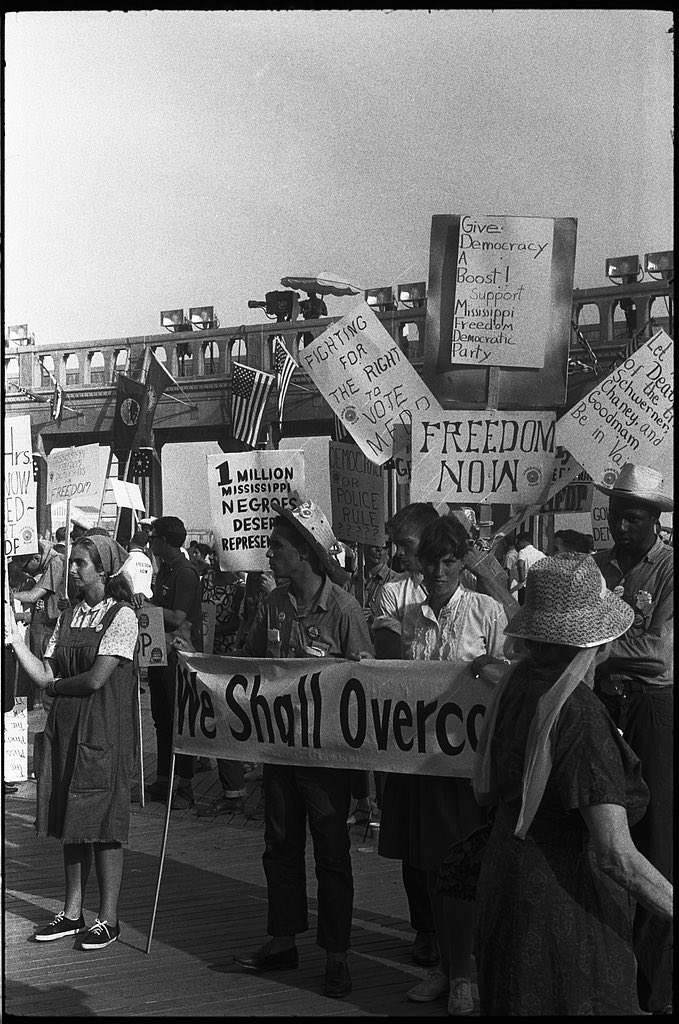
The 60 delegates of the Mississippi Freedom Democratic Party (MFDP) at the 1964 Democratic Convention showed how inside/outside grassroots organizing can challenge entrenched systems, even without immediate wins.
Formed to fight segregation in Mississippi, the MFDP demanded recognition over the all-white, segregationist group. Fannie Lou Hamer’s testimony on Black voter suppression was a turning point, exposing deep racism in the Democratic Party.
When offered just two symbolic seats as a compromise, brokered by LBJ, Rustin, MLK, and the UAW, the MFDP refused. Hamer famously declared, “We didn’t come all this way for no two seats.”
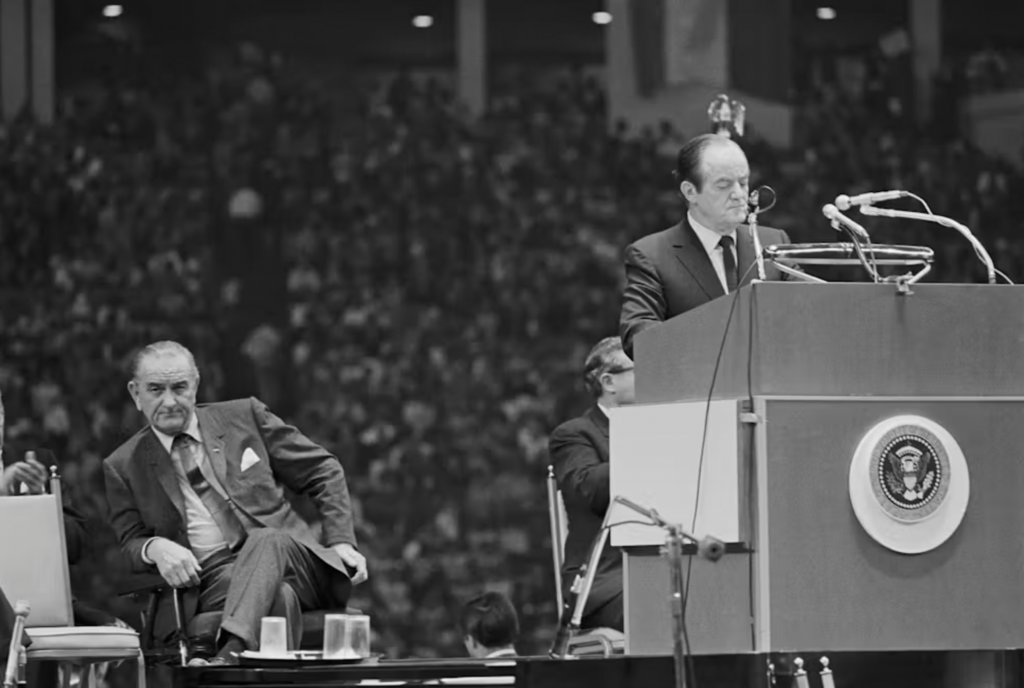
🧵In 1968, America was deeply divided over the Vietnam War, and the Democratic Party was caught in the crossfire. VP Hubert Humphrey found himself in a tough spot, closely tied to President Johnson, whose policies were increasingly unpopular among liberals and young voters.
Humphrey was often sidelined in key decisions, especially on Vietnam. As anti-war protests grew louder, the youth and liberals in the Democratic Party demanded change—a change they didn't see in Humphrey.
At Portland’s Civic Arena, hundreds of college students shouted, “End the war” and “Murderer,” before walking out en masse. In Seattle, protesters disrupted his speech with cries of "Vietnam is a scream of death that does not end."
In his 1997 book, The Vanishing American Jew, celebrity attorney Alan Dershowitz responded by asking, “How can anyone distinguish this incitement to murder from similar incitements by Muslim fundamentalists who quote the Koran as authority for genocide against Jews?”
WHY CEASEFIRE? A ceasefire is necessary to save lives and address the humanitarian catastrophe that is underway in Gaza. Israel’s pursuit of aerial bombardment, siege, and forced population movement policies that many experts say constitute war crimes, and preparing a full-scale ground invasion that will lead to an apocalyptic loss of life.
There is no military solution to the security threat that Hamas poses to Israel. While Hamas must be held accountable, Israel has tried a military solution every four years in Gaza; it always fails to protect Israel or Palestinians.
Even if Israel is narrowly successful in killing or capturing all 30,000 - 40,000 Hamas fighters (a task that will entail unspeakable destruction and casualties), the anger of the Palestinian civilians over their treatment that is the wellspring of Hamas’s support will only deepen, and Israel will be no safer.
From South Africa to Ireland, President Biden has firsthand experience resolving issues of armed conflict, terrorism, and occupation. He knows the best way to end this conflict is to stop the violence, protect civilians on both sides, and use internatioonal leverage to bring the parties together to resolve underlying grievances.
A major obstacle to peace, however, is that our ally, Netanyahu, rejects Palestinian statehood and has shown zero interest in resolving Palestinian grievances.