#IEX Fundamentals, Technical and the other data, a🧵:
IEX has been coming up with great results but market is anticipating coupling fear and hence stock is falling. This is the common perception.
Is this the case, let us deep dive?
Was curious to check which institutions are selling because if I blindly look at charts - then all we see is stoploss. Something very interesting came out. First thing, looking at screener, looks like FIIs and DIIs are buying and retail is selling. Also, evident in falling count of retail investors. So, who is moving the prices down?
Such a market cap stock can be moved up or down only by institutions. Given FII data is quarterly available but mutual fund data is monthly available, looked at the mutual fund data and here is the interesting stuff
69% of all sellers (by MF count) are either index funds or arbitrage funds. They act more on quantitative rules than any long term fundamental analysis
Only 20% of normal holding (assuming they take decisions based on fundamentals) funds are selling
26% of funds are doing nothing but 46% of funds are buying which means only 29% of funds are selling
The 29% of funds which are selling hold 21% of the MF shareholding. Those doing nothing hold 57% of MF shares and those who are buying hold least 22% of MF shares
At least in the MF space, the current selling more based on index readjustments and arbitrage based decisions than fundamental decision, this is what it looks like. Also, ~80% of shareholding in MF is either doing nothing or in buy mode. Retail has been continuously selling.
FIIs we need more granular analysis to conclude anything. The reason t write this thread was - We just look at few lines of data or few days of charts and conclude so many things - devil lies in the detail. Any data, till we can, we should try to go deeper and deeper till we can
I plan to study more on how Arbitrage funds work and specially those active in this counter. However, if someone has idea what they are doing here and how it impacts stock in short term, please enlighten @SahilKapoor
• • •
Missing some Tweet in this thread? You can try to
force a refresh

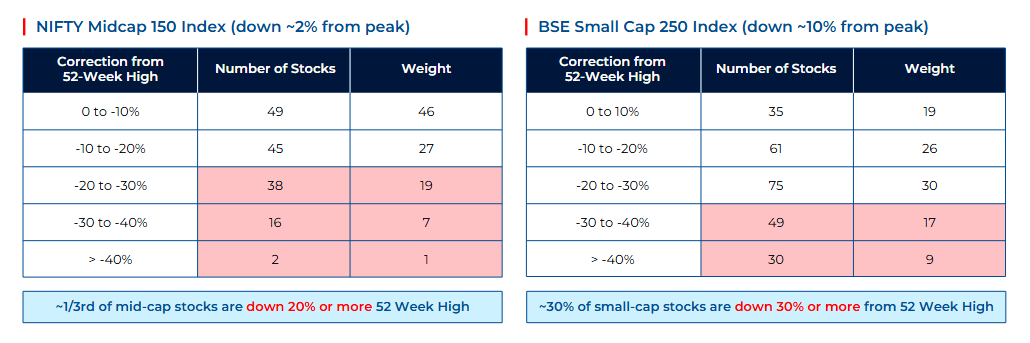
This is quite a bad situation in Mid and Smallcap stocks (Rank upto 500) which is above Rs 8000+ Cr market cap. 30% of midcaps down by 20% and smallcaps down by 30% from their 52W high
However, Big B ki jubaan me bolu to -
Iske age ki tu daastan mujhse sun
Sunke teri nazar dabdabaa jayengi
Let us look at the world below Rs 9000 Cr market cap
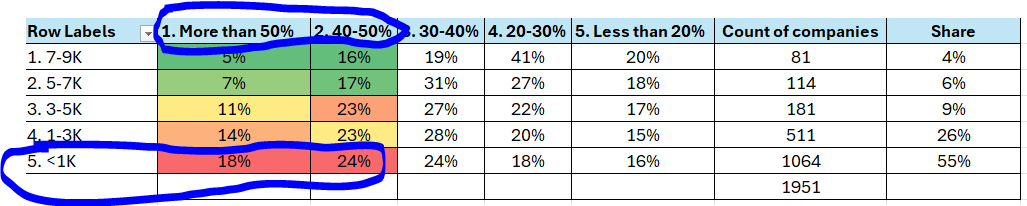
I have taken a universe of companies between Rs 200-9000 Cr. There are 1951 companies
55% of companies are below Rs 1000 Cr market Cap. 42% of these stocks are down by more than 40%.
Yes, if you are holding all the companies in Rs 200-1000 Cr market cap band, 42% of your stocks are down by more than 20%
Imagine the pain the lowest segment is going through
Rs 1000-3000 Cr universe has another 561 companies which is 26% of this universe.
Here, it is no better. 37% of these stocks are down by more than 40%.
So, combining these 2 segments, out of total 1951 companies, we have 1575 companies. 636 out of these 1575 companies are down by 40%
This means 33% of this whole Rs 200-9000 Cr universe is down by Rs 40%
#Ultramarine Annual Report 2025 #AR2025 and some fun facts and why we should look beyond numbers visible to all:
Screener PE: 19.7
PE is based on EPS growth derived from P&L. However, if a business has: 1. High accounting depreciation but low actual maintenance 2. Lot of capex done recently resulting in high depreciation with scope of better asset utilization in times to come
PCE (Price to Cash EPS, a term purely coined on own and not in valuation books) could be a better reference point. There are many situations where PCE either based on cash EPS of OCF based is a better representation of valuation.
When we look Ultramarine from OCF perspective, Ultramarine did Rs 90 Cr of OCF,
Earlier PE: 19.7
OCF based PE/PCE: 15.5-16.5
Below is cashflow statement from AR 2025
It does not stop here. When one looks at the balance sheet of the company, there is something interesting. It has a non-current investment of Rs 498 Cr
This investment is for the value of 20% stake they hold in sister company Thirumalai chemicals.
This is also evident when you look at Thirumalai shareholding. Thirumalai current market cap is Rs ~Rs 2900 Cr. So, this shareholding value comes to Rs 580 Cr as on today. Give 50% holdo discount and this value for Ultramarine comes to Rs 290 Cr
Yesterday, I shared this data point of % of companies hitting 52 week low close to ILFS Oct 2018 number.
Question is what is the significance of this data?
Let us explore
The reason to share this data is much more interesting. In current market, people would say - do not catch falling knife, let it bottom etc.
What if you invested in all those days when more than 20% companies were making 52 week low?
Can you backtest return of all such scenarios since last 10-20 years?
Got reminded of my Face2Face video done 4 years back where I presented lot of backtested outputs including how your returns would pan out
Here is this data right from 2006. The red bars are % of companies making 52W low
Though some of these metric are gaining popularity now, we had done lot of exploratory analysis and backtesting around these metric 4-5 years back when I was conceptualizing Scientific Investing . You can watch the full video here:
For SMALLCAP 250, based on Q3FY25 results so far:
❓Best performing companies?
❓Attractively valued companies?
❓Both attractively valued and best performing?
🧵to answer all such questions to help to filter interesting ideas for research
For NIFTY NEXT 50, based on Q3FY25 results so far:
❓Best performing companies?
❓Attractively valued companies?
❓Both attractively valued and best performing?
🧵to answer all such questions to help to filter interesting ideas for research
For NIFTY 50, based on Q3FY25 results so far:
❓Best performing companies?
❓Attractively valued companies?
❓Both attractively valued and best performing?
🧵to answer all such questions to help to filter interesting ideas for research