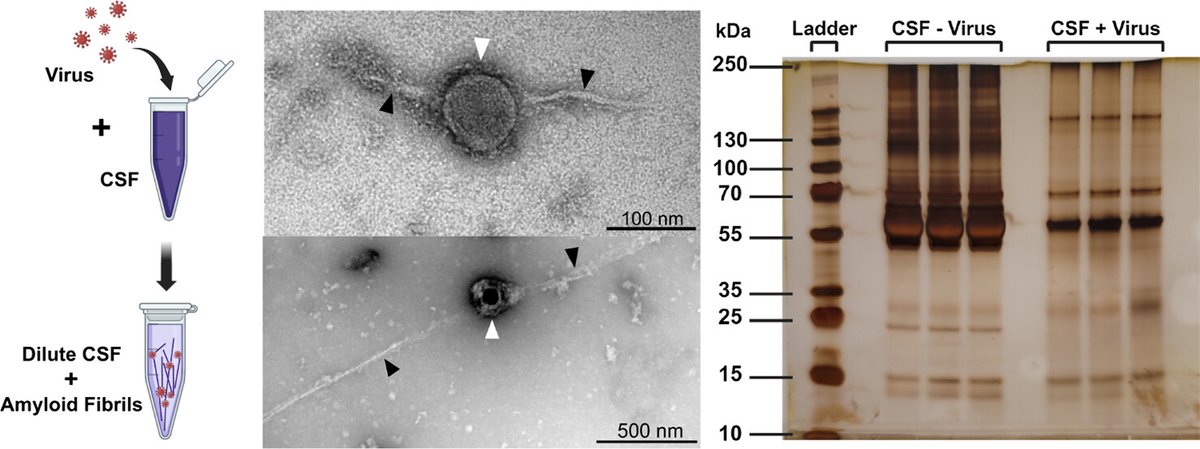
The final version is out! Viruses lead to untemplated amyloid formation of proteins in human cerebrospinal fluid even after UV-inactivation, resulting in a drastic depletion of soluble proteins. 1/6 pubs.acs.org/doi/10.1021/ac…
The resistance of amyloidogenic agents to UV inactivation was the foundation of the protein-only prion hypothesis. We show that, while UV inactivates viral nucleic acids, it does not affect the ability of viruses to act as catalytic surfaces that induce amyloid aggregation. 2/6
Our results support the notion that protein aggregation is a function of the recipient environment, where a subset of proteins are more susceptible to aggregation triggers due to their high concentration (supersaturation) & their ability to interact with nucleating surfaces. 3/6
It also links viral-catalyzed protein aggregation to protein loss-of-function, where this reaction leads to what can only be described as catastrophic protein depletion, something that will certainly be devastating to any biological environment in which it occurs. 4/6
We emphasize that our results are only mechanistical, we don't link a certain virus to a certain disease. However, it removes a major mechanistic barrier that prevented viruses from being considered as potential triggers of amyloid aggregation in neurodegenerative disorders. 5/6
The prion hypothesis, which unduly excluded viruses, mischaracterized a phenomenon of phase transition as replication, limited our ability to understand & treat these diseases & completely messed up the concept of biological information. More here: 6/6theprecipitate.blogspot.com/2024/10/what-i…
• • •
Missing some Tweet in this thread? You can try to
force a refresh

An important paper in @Nature from the influential @MRC_LMB in Cambridge with very imp. points. 1. "The models for templated seeding may need reconsidering". This is a big deal. A strong & clear criticism of conformational templating, the foundation of the prion hypothesis. 1/8
This is done after citing the experimental evidence from numerous papers where templating fails to occur + the dominant nature of 2ry nucleation on fibril surfaces during amyloid growth where templating is impossible. More explanation here: 2/8
Such high-profile, unambiguous critique of templating signals a turning point in the field IMO, where both the theoretical & experimental shortcomings of conformational templating are becoming hard to ignore, prompting a call for "reconsidering" the models of templating. 3/8
Our new book chapter where we elaborate more on physicochemical principles that govern amyloid aggregation. We propose that a simple extension of the thermodynamic hypothesis of protein folding (Anfinsen's dogma) to supersaturated conditions can ..1/10 sciencedirect.com/science/articl…
..fully explain the amyloid phenomenon without the need for the prion hypothesis. We postulate that proteins possess two thermodynamically stable conformations: 1. The native conformation, which is dependent on the primary sequence & is thermodynamically favorable under..2/10
..normal conditions based on specific side-chain interactions. 2. The amyloid, cross-β conformation, which is independent of the primary sequence & thermodynamically favorable under supersaturated conditions, after crossing the so-called nucleation barrier. It's dependent ..3/10
A new study confirming & expanding on the strong epidemiological link between viruses & neurodegenerative diseases (NDDs). There's no real reason to exclude viruses from NDD etiology, especially in relation to the ability of viruses to induce amyloid..1/8 cell.com/neuron/fulltex…
..aggregation. This is where the "protein-only" hypothesis is most damaging imo, by necessitating (with no real biophysical mechanism) the unnecessary process of prion conformational templating. Protein conformations do not require templating, since proteins adopt..2/8
..their conformation spontaneously. This applies to the native conformation (Anfinsen hypothesis) & the cross-β amyloid conformation as well, which becomes more thermodynamically favorable under supersaturated conditions. All that's needed is a nucleation catalyst. 3/8
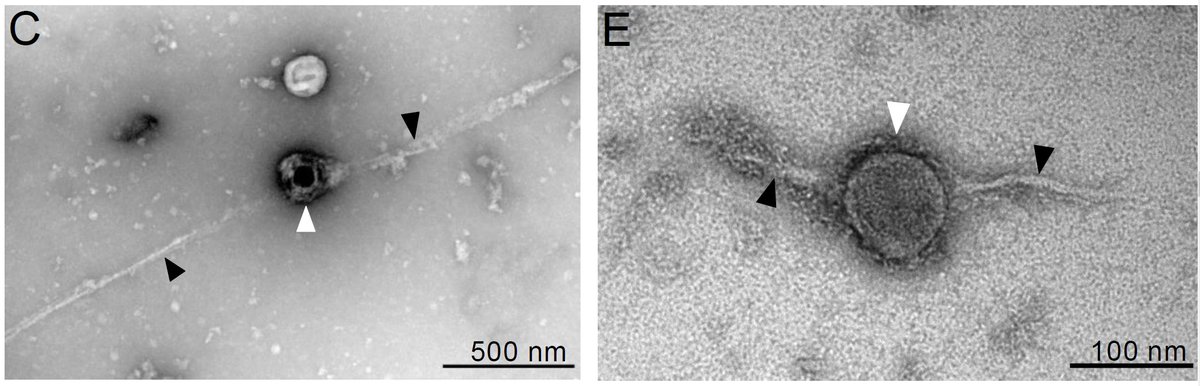
Our new preprint showing that viruses such as HSV-1 & #SARSCoV2 can induce amyloid aggregation proteins in human CSF. Viruses act as nucleation catalysts for amyloid formation, which is driven by protein supersaturation, not conformational templating. 1/7 biorxiv.org/content/10.110…
This is why no prion/protein template was required to obtain these results & UV-inactivation didn’t affect the ability of the viruses to act as nucleation catalysts. While UV-inactivation destroys viral nucleic acids, it does not affect the ability of viruses to act as..2/7
..catalytic surfaces that induce amyloid aggregation via the mechanism of heterogeneous nucleation. The driver (supersaturation) & information (intermolecular backbone hydrogen bonding) for amyloid formation are in the recipient environment, and thus the process doesn’t..3/7
Comparing the success in disease-modifying therapies for SMA to the failure in #Huntington's (HD) can be illuminating. Two successful SMA medications, a small molecule: risdiplam & an oligo: nusinersen, both restore SMN protein levels. For HD, two medications that worsened..1/5
..the disease, a small molecule: branaplam & an oligo: tominersen, both reduced the huntingtin protein levels. Different molecules & different mechanisms, but in the end replacement works in neurodegeneration & protein downregulation worsens the disease. The puzzling part is..2/5
..despite the data of disease worsening being replicated many times in clinical trials of protein lowering, despite phenotype in knockout animals that show important neuronal functions of these proteins, despite the correlation between the depletion of soluble protein levels..3/5