Ammaar Muslim Profile picture
Nov 16, 2024 26 tweets 6 min read Read on X
“Reviewing Hadith against the Qur’an”: A Disputed Principle in Early Islam 🧵

When Shāfiʿī (d. 204) quotes numerous Prophetic reports to support his position in a debate with Shaybānī (d. 179), the latter rejects all of the reports citing a Hadith which has the Prophet state: Image
“Whatever comes to you on my authority then review it against the Qur’an, so if it agrees with it (i.e. the Qur’an) then I said it, and if it opposes it than I never said it” Image
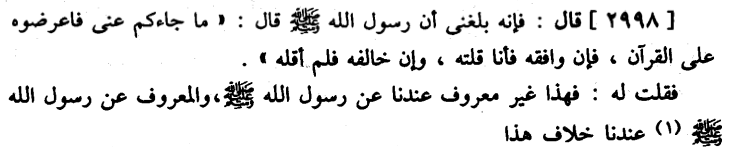
Shāfiʿī, for his part, vehemently rejects this Hadith and counters with a Hadith of his own which somehow predicts the emergence of an attitude exactly like Shaybānī’s.
The Prophet supposedly states: “I should not come across one of you reclining in his seat and when an injunction of mine, be it something I commanded or prohibited, is relayed to him - remarks: ‘We don’t know (about this). What we find in the Book of Allah we follow!’” Image
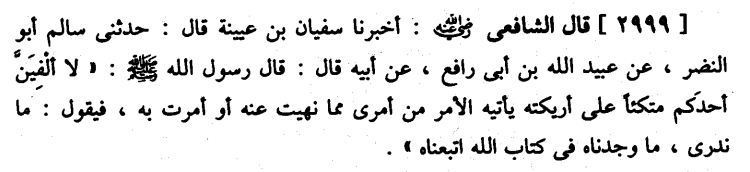
Shāfiʿī’s Hadith would end up in 3 of the 6 canonical works of Sunni Hadith as opposed to Shaybānī’s Hadith which is nowhere to be found therein, having been consigned to the heap of rejected reports.
It is clear that the Ahl al-Ḥadīth were threatened by any notion of giving the Qur’an an upper-hand over Prophetic reports, something diametrically opposed to their epistemology, which can be best summed up by the dictum attributed to Yaḥyā b. Abī Kathīr (d. c. 130):
“The sunna rules over the Book, whereas the Book does not rule over the sunna” Image
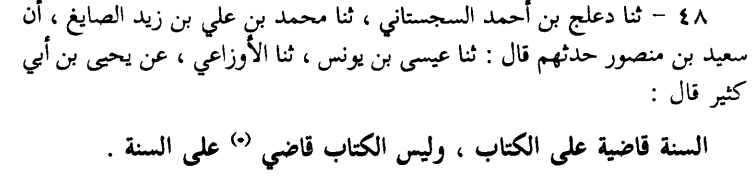
In fact, ʿAbd al-Raḥmān b. Mahdī (d. 198) would go so far as to consider all those reports which require a Hadith to first be reviewed against the Qur’an before acceptance to be a fabrication of the damned zanādiqa (heretics) accused of looking for a way to reject reports. Image
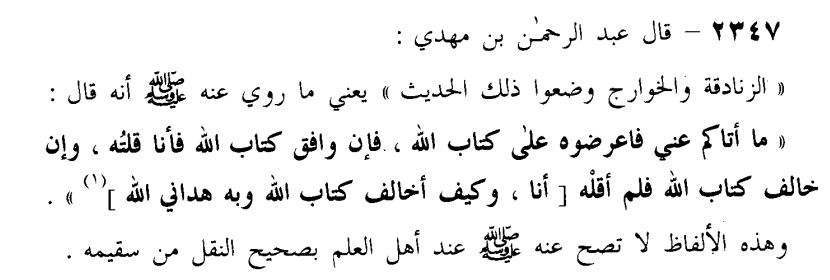
But is this where Shaybānī got his Hadith? From heretics?
Shaybānī does not give us a chain for the Hadith he cites, but Abū Yūsuf (d. 182), Shaybānī’s colleague and fellow student of Abū Ḥanīfa, quotes a Hadith with similar meaning in his treatise authored to refute al-Awzāʿī (d. 157).
Ibn Abī Karīma narrates from Abī Jaʿfar al-Bāqir who has the Messenger of Allah ascending the pulpit after hearing some Jews recount falsities about Jesus and making the following speech:
“A lot of Hadith will be spread about me. So whatever comes to you on my authority which agrees with the Qur’an then it is from me, and whatever comes to you on my authority that opposes the Qur’an then it is not from me!” Image
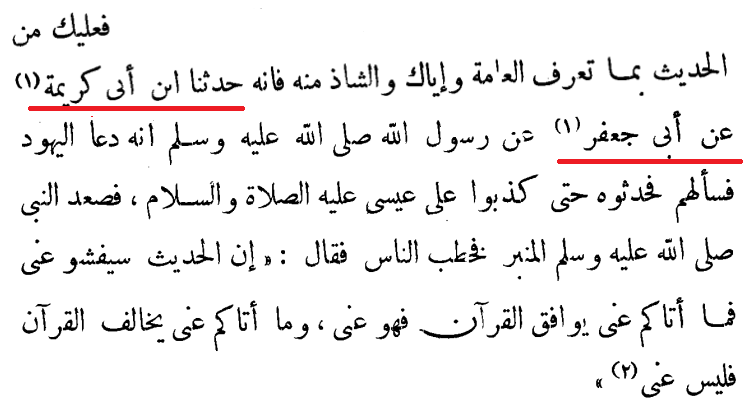
Could Shaybānī have got his Hadith from Abū Yūsuf from Ibn Abī Karīma from al-Bāqir as opposed to some random heretic?
This seems to be confirmed by Shāfiʿī who quotes Shaybānī’s Hadith verbatim in his Risāla and then attacks its chain (without naming its narrators explicitly) as follows: Image
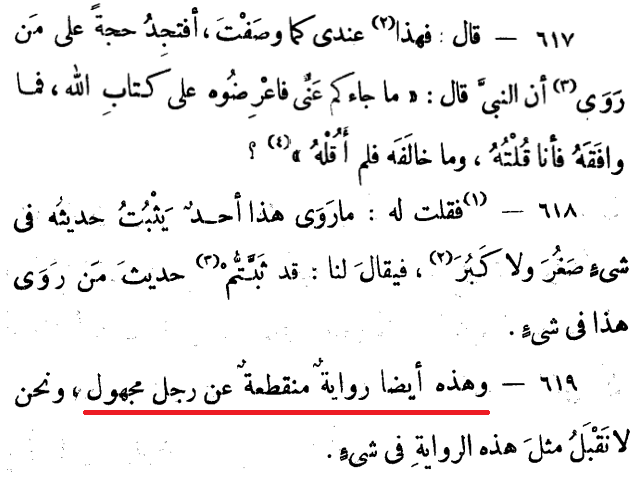
(A) Its narrator (= Ibn Abī Karīma) is majhūl (unknown).
(B) The report is munqatiʿ (disconnected) since we do not know from whom al-Bāqir, who is a tābiʿī, got it from.
But Shāfiʿī is misinformed about (A), for the Hadith critics of the next generation, like Aḥmad b. Ḥanbal (d. 241) and Yaḥyā b. Maʿīn (d. 233), would come to strengthen Ibn Abī Karīma. Image
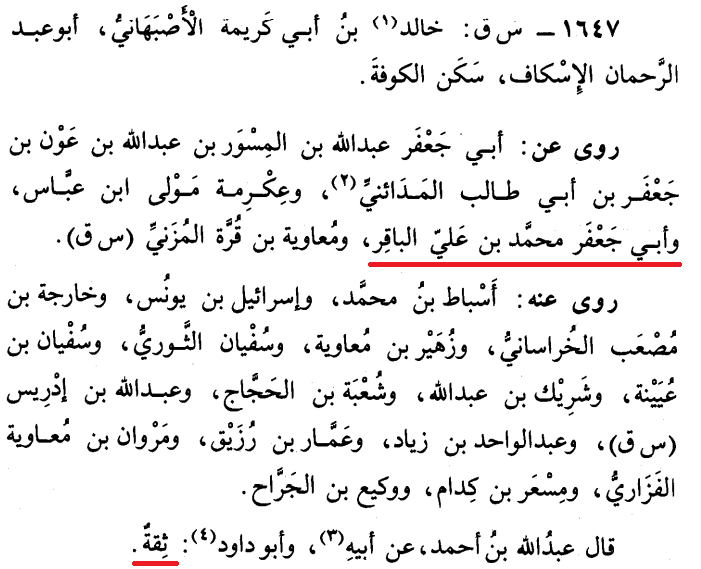
As for (B), then it is common for al-Bāqir to report directly in this way from the Messenger of Allah in both the Sunni and Imami Hadith corpus, something the Imamis attribute to his self-perception as an ultimate authority ...
... who did not need to attribute his knowledge to random companions, having received it as part of a privileged family tradition.
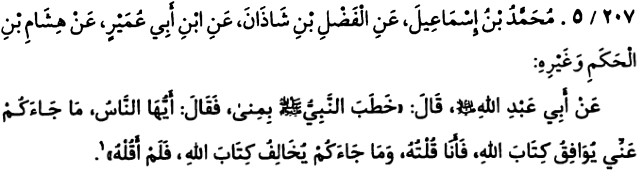
The historical link of this Hadith to al-Bāqir is further strengthened when we find a similar content attributed to his son Jaʿfar in the Imami Hadith corpus.
The Prophet gave a speech at Mina saying: “O people, whatever comes to you on my authority agreeing with the Book of Allah then I said it, and whatever comes to you opposing the Book of Allah then I did not say it” Image
This, then, was one important but disputed fault-line when it came to the acceptance or rejection of Hadith in early Islam.
For the full paper from where this is taken: shiiticstudies.com/2024/11/05/pro…
References: Al-Umm (ed. Rifʿat Fawzī ʿAbd al-Muṭṭalib), v. 8, pp. 35-36, nn. 2998-2999; Ibn Shāhīn’s (d. 385) Sharḥ Madhāhib Ahl al-Sunna (ed. Muʾassasat Qurṭuba), p. 46, n. 48;
Ibn ʿAbd al-Barr’s (d. 463) Jāmiʿ Bayān al-ʿIlm wa Faḍluh (ed. Dār Ibn al-Jawzī), v. 2, p. 1191, n. 2347; Al-Radd ʿalā Siyar al-Awzāʿī (ed. Abū al-Wafāʾ al-Afghānī), pp. 24-25; Al-Risāla (ed. Aḥmad Muḥammad Shākir), pp. 224-225, nn. 617-618;
Tahdhīb al-Kamāl (ed. Bashshār ʿAwwād Maʿrūf), v. 8, pp. 156-157, n. 1647; Al-Kāfī (ed. Dār al-Ḥadīth), v. 1, pp. 173-174, n. 207.

• • •

Missing some Tweet in this thread? You can try to force a refresh

 

Keep Current with Ammaar Muslim

Ammaar Muslim Profile picture

Stay in touch and get notified when new unrolls are available from this author!

Read all threads

This Thread may be Removed Anytime!

PDF

Twitter may remove this content at anytime! Save it as PDF for later use!

Try unrolling a thread yourself!

how to unroll video
  1. Follow @ThreadReaderApp to mention us!

  2. From a Twitter thread mention us with a keyword "unroll"
@threadreaderapp unroll

Practice here first or read more on our help page!

More from @ammaar_muslim

Nov 7, 2025
Censoring the Sīra: The Case of the Altercation between ʿAmmār and a Companion 🧵

The earliest and most famous biography of the Prophet Muḥammad is the one authored by Ibn Isḥāq (d. 150) which survives in the recension of Ibn Hishām (d. 218). Image
Ibn Hishām did not just transmit Ibn Isḥāq’s original work as received but edited it first.
Ibn Hishām gives numerous reasons to justify his decision, including censoring material “some of which is repulsive to narrate, and others which will offend some people if recounted” Image
A good example of this censorship can be found in the report concerning the construction of the Prophet’s masjid at Medina in which the companions participated.
Read 24 tweets
Aug 23, 2025
Umayyads cursing ʿAlī: The Testimony of al-Awzāʿī 🧵

There exists some evidence to indicate that the Umayyads continued to officially sanction the practice of cursing ʿAlī b. Abī Ṭālib even as late as the second century. This thread will document one such piece of evidence ... Image
In an auto-biographical note, the Syrian Imam al-Awzāʿī (b. 88; d. 157), recounts how as an orphan he was taken in by a benefactor who brought him up and managed to enroll him in the Umayyad dīwān al-rasāʾil (department of letters) where he began his career as a scribe. Image
A young Awzāʿī was then dispatched to Yamāma (present-day Riyadh).
It is here, likely between the years 100-110 AH, that Awzāʿī would witness the practice in question first-hand.
Read 17 tweets
May 23, 2025
The Imamate and Salvation 🧵

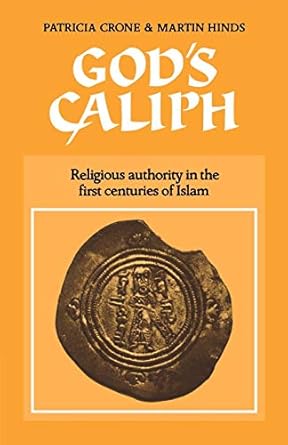
While Patricia Crone (d. 2015) is mostly remembered for the notorious “thought experiment” that was Hagarism which she later moved away from, there is much in her scholarship that has withstood the test of time better, especially her excavation, Image
together with the late Martin Hinds, of the true significance of imāma in early Islam.
Using very early material (numismatics, poetry, orations attributed to early Caliphs etc.) they were able, in their 1986 monograph, God’s Caliph, to demonstrate that the position of the imam/caliph in Umayyad times, and likely going back even earlier, was conceived as that of a
Read 22 tweets
Apr 29, 2025
One Ḥarf or Seven? A Minority Tradition 🧵

It is astounding to note that all the different schools within Islam accept the “canonical” narrative of the Qur’an being revealed in seven aḥruf or “versions” with the sole exception of a minority tradition preserved by Twelvers ... Image
In a report, the early Medinan scholar and Imam, Muḥammad al-Bāqir (d. 114), is quoted as saying:
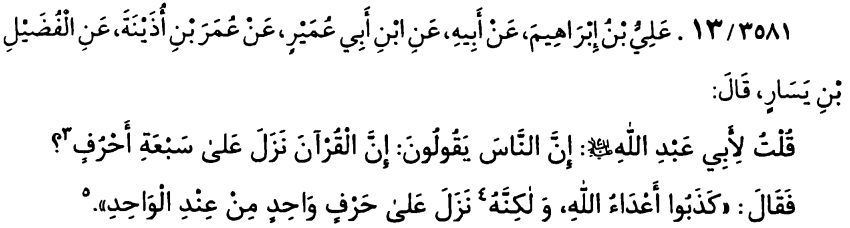
“The Qur’an is one and was sent down from the One (i.e. Allah). All differences originate from the transmitters” Image
When his son, Jaʿfar al-Ṣādiq (d. 148), was asked: “The people say that the Qur’an was revealed per seven aḥruf?”
Jaʿfar responds: “They have lied! Rather it was revealed per one single ḥarf from the One (i.e. Allah)” Image
Read 25 tweets
Apr 7, 2025
Why Fast *6* days after Ramaḍān? 🧵

The rationale behind fasting exactly *6* days after Ramaḍān is taken from the verse: “Whoever comes with one good shall receive tenfold” (6:160). Image
Since 1 good deed has the reward of 10, the reward of fasting for 1 month of Ramaḍān (30 days) will be equivalent to fasting for 10 months (300 days), adding 6 days to this will cover the remaining 2 months (60 days). 360 is the number of days in the traditional Arabic year.
So one who fasts 36 days in a year it is as though he has fasted the whole year “ṣiyām al-sana”, and the one who keeps this up every year it is as though he has fasted his whole lifetime “ṣiyām al-dahr”
Read 15 tweets
Apr 6, 2025
Fasting 6 Days in Shawwāl: A Sunna or Not? 🧵

It is surprising to encounter Mālik b. Anas (d. 179) discouraging the fast of the 6 days in Shawwāl. He is quoted in his Muwaṭṭaʾ as saying that he “had not seen anyone among the people of knowledge and fiqh fasting them” ... Image
In fact, Mālik says that the scholars considered it makrūh, fearing that it would become a bidʿa (innovation) and that the ignorant “would join to Ramaḍān what does not belong to it” if they saw the scholars practising that.
Some scholars, like al-Shāṭibī (d. 790), considered this to be an instance of sadd al-dharāʾiʿ, where a legal act is curtailed because of its potential harm.
In this case, the potential harm is that a non-obligatory act would begin to be considered obligatory. Image
Read 38 tweets

Did Thread Reader help you today?

Support us! We are indie developers!


This site is made by just two indie developers on a laptop doing marketing, support and development! Read more about the story.

Become a Premium Member ($3/month or $30/year) and get exclusive features!

Become Premium

Don't want to be a Premium member but still want to support us?

Make a small donation by buying us coffee ($5) or help with server cost ($10)

Donate via Paypal

Or Donate anonymously using crypto!

Ethereum

0xfe58350B80634f60Fa6Dc149a72b4DFbc17D341E copy

Bitcoin

3ATGMxNzCUFzxpMCHL5sWSt4DVtS8UqXpi copy

Thank you for your support!

Follow Us!

:(