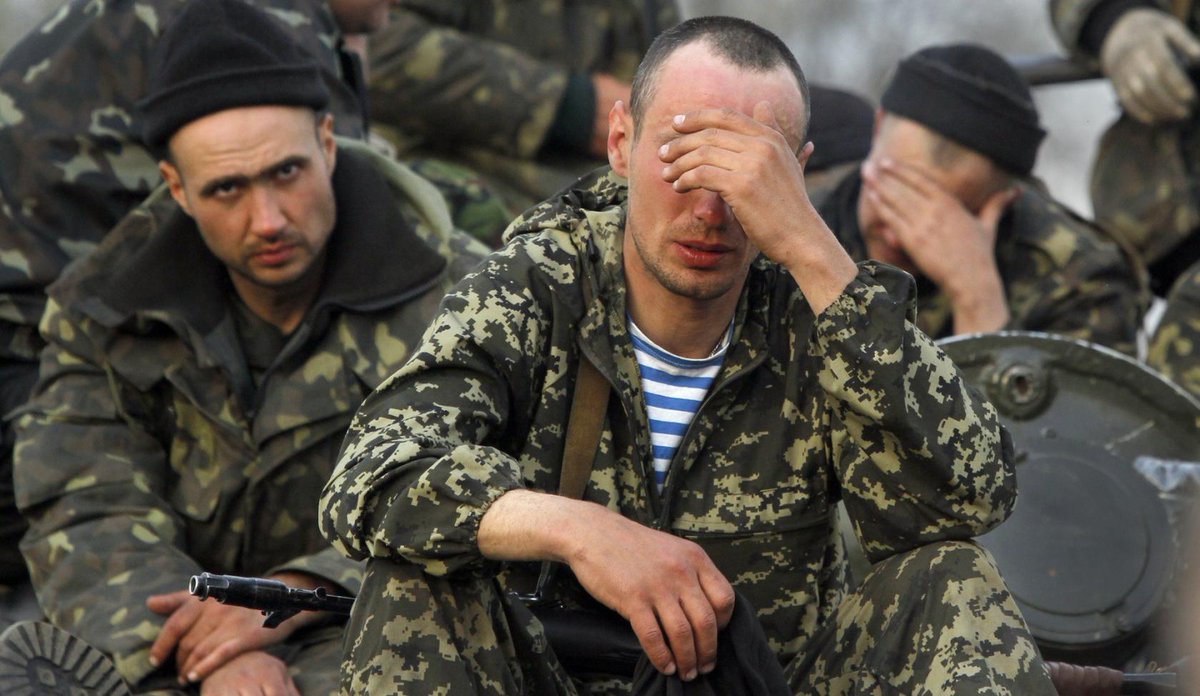
1/ A Russian soldier from Yakutia cut off his own gangrenous leg after spending 17 days on the front line with an untreated severe wound. A lack of medical care and evacuation is reportedly causing wounded Russians to commit suicide or chop off their limbs with axes. ⬇️ 

2/ 38-year-old Alexander 'Shurik' Fedorov spent 17 days in a basement in the village of New York, Donetsk, and was forced to amputate his own leg, which was festering due to a wound. His fellow soldiers were afraid to do the amputation in the field, so he had to do it himself.

3/ Fedorov is now in hospital in Volgograd and is waiting for a prosthesis to be fitted to replace his missing leg. He told a regional newspaper: "I was mobilized to defend the country and served in the Special Military Operation."
4/ "In July 2024, our platoon was on a combat mission in the Donetsk People's Republic, storming the village of Niu-York (Novgorodskoye)." He was cut off with his platoon after being injured in the fighting. They sheltered for 17 days in a damp basement.
5/ "Our guys were delivering medicine, ammunition and food via drones to help us hold out," Fedorov says. "I injected painkillers and endured. But my leg swelled up before our eyes, and it wouldn't fit even in the biggest boot."
6/ Fedorov realised that gangrene had set in and decided that his leg needed to be cut off while his platoon still had a supply of painkillers. However, none of his men wanted to perform the operation. So he did it himself, using a bayonet from his rifle.
7/ "I had to cut off my leg myself, thinking that I absolutely had to stay alive and lead my platoon out of the encirclement," he says. On 19 July, he was finally evacuated and was taken to hospital, where the rest of the leg up to the groin was removed by doctors.
8/ While the official Russian media is hailing Fedorov's ordeal as an example of heroism, Russian bloggers on Telegram are highlighting the failures to provide front-line medical care or evacuation that they say are prompting suicides and soldiers lopping off limbs with axes.
9/ 'Veterans' Notes' comments: "The wounded man was not evacuated for seventeen days. Bitch, seventeen days! And his comrades died from their wounds without waiting for evacuation, and they will not become the heroes of the media and bloggers' stories. But look, we found a hero!"
10/ "No problem, the Yakut is a hero. But he had to become one because of someone's fuck-up. He just wanted to live more than others. And he had no choice but to become a hero.
11/ "And instead of asking the question of why the fighter had to cut off his own leg, everyone carried this news like a banner."
12/ "Some of my subscribers wonder why there are so many videos of our soldiers shooting themselves or blowing themselves up with a grenade when they are seriously wounded. Ask the Yakut who cut off his leg to survive. He will tell you."
13/ Anastasia Kashevarova, who has been campaigning for some time for better medical treatment for Russian soldiers in the field, writes: "It is common for wounded soldiers to be on the line of contact, in trenches, for weeks and months, and many develop gangrene, sepsis,…
14/ …and abscesses. Where limbs can be saved, the situation drags on so much that a light 300 [wound] or a moderate 300 turns into a heavy 300 or 200 [death] - that is, we are personally increasing irreparable losses.
15/ "And all because we created a closed chain of errors from the very beginning, and now we do not know how to get out.
16/ "Incorrect initial calculations led to losses of personnel, we had to carry out mobilization, theft and lies that everything was at the front, led to a shortage of equipment and weapons, and we had to go on an assault again without practicing artillery.
17/ "Lies about the number of volunteers, about the fact that everyone went on leave. This only hits the fighting spirit and does not reflect the real state of affairs at the front.
18/ "As a result, we have reached such a shortage of people at the front that we disband all the specialists and engineers and send them to assault groups. The wounded sit in the trenches because there is no one to do it.
19/ "And the commanders are also hostages to all these mistakes, they are given tasks based on the numbers of shells, personnel, occupied territory, available equipment, which are completely sucked out of thin air and passed on to the very top."
20/ She calls for commanders to not "mindlessly kill" their own men in suicidal 'meat wave' assaults and make evacuation groups mandatory.
21/ "Due to the shortage of people at the front, and it is caused by the irrational use of human resources, they ignore evacuation, there is no time for it."
22/ According to a deserter interviewed earlier this year by the independent Russian publication The Insider, commanders actively discourage evacuation groups and threaten to execute their members if they do not join assault squads.
23/ The deserter says that commanders prefer to leave the seriously wounded to die on the battlefield. He himself had to use a wood-chopping axe to cut off the limbs of wounded soldiers to stop them dying of gangrene before they were evacuated.
24/ "I picked up a guy, he had been lying there wounded for three days, he had burned his own arm and leg. I don’t know how he survived. His arm had already started to rot, necrosis had set in. I asked, “What should I do?”
25/ They told me, “Chop off his arm. Inject everything you have, otherwise he might die from shock.” I got ready and went. I chopped it off with an axe that they use to chop wood... After the fourth time I chopped it off, they told me over the radio how to treat it.
26/ "I didn’t sleep for two days after that. When we were loading him, he was alive, he also made it to the first line alive. After that, I don’t know his fate.
I pulled out another guy - his jaw, his arm up to the shoulder and half his leg were torn off.
I pulled out another guy - his jaw, his arm up to the shoulder and half his leg were torn off.
27/ "They didn't even want to take him. The commander said: "I don't need this, now I have to do something for one more person." The guy said a day later: "I just want to die" – he already understood that it was all over. He 'leaked out'." /end
Sources:
🔹 t.me/olegtsarov/188…
🔹 yakutia.aif.ru/society/lezhal…
🔹 t.me/notes_veterans…
🔹 theins.ru/news/276297
🔹 theins.ru/confession/273…
🔹 t.me/olegtsarov/188…
🔹 yakutia.aif.ru/society/lezhal…
🔹 t.me/notes_veterans…
🔹 theins.ru/news/276297
🔹 theins.ru/confession/273…
• • •
Missing some Tweet in this thread? You can try to
force a refresh