Shoplifting is definitely serious, and it's an area where extremely few people do a lot of harm.
For example: 0.00385% of New York's population were responsible for 33% of the shoplifting arrests in the city.
327 people being arrested more than 6,000 times in a year is insane.
For example: 0.00385% of New York's population were responsible for 33% of the shoplifting arrests in the city.
327 people being arrested more than 6,000 times in a year is insane.
https://twitter.com/jenniferdoleac/status/1858170366851695040

This isn't unprecedented by any means.
The number of burglaries in Leinster plummeted after three men died in a car crash.
The number of burglaries in Leinster plummeted after three men died in a car crash.

Sentencing 11 people was enough to drop one British town's bike thefts by about 90%.

Even when you look in adoption studies, you get a picture that's not surprising.
Consider this: the 1% of adoptees whose biological parents had 3 or more known offenses were responsible for 30% of the convictions among adoptees.
Consider this: the 1% of adoptees whose biological parents had 3 or more known offenses were responsible for 30% of the convictions among adoptees.

As I documented recently, this is a very generally true phenomenon: very few people do a lot of crime.
Locking up a small number of people would make the crime situation in the town, the county, the state, or the nation much better.
Consider the known-criminal homicide rate:
Locking up a small number of people would make the crime situation in the town, the county, the state, or the nation much better.
Consider the known-criminal homicide rate:

Or consider another incredible fact: correctly enforcing a three-strike law in Sweden for violent crime would have halved violent crime rates!
https://x.com/cremieuxrecueil/status/1664453761056505856
A few people, with extensive criminal histories, drive most crime, arrests, etc.
https://x.com/cremieuxrecueil/status/1647031826202935300
When it comes to the population that actually serves jail time, the reasons largely have to do with these people just being impulsive.
Recall that violent crime explains the largest part of the prison population and that getting in dumb fights explains most violent crime.
Recall that violent crime explains the largest part of the prison population and that getting in dumb fights explains most violent crime.
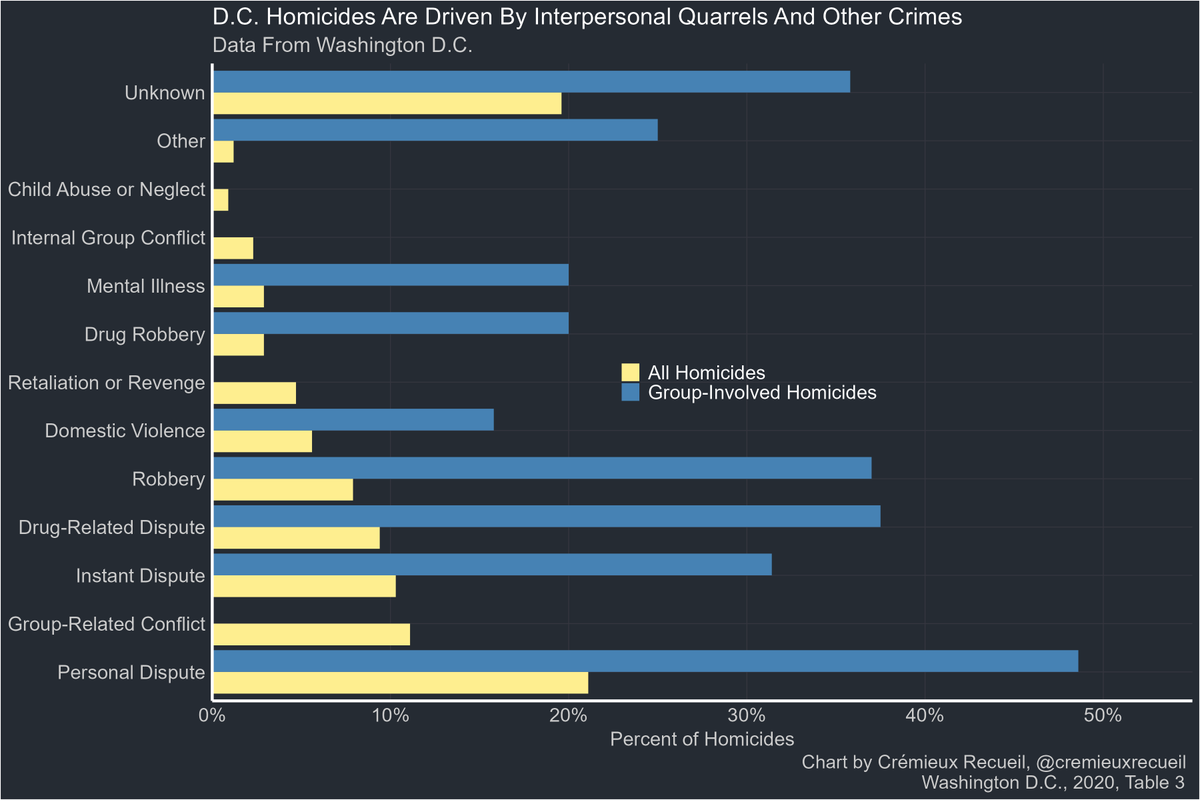
It would be interesting to figure out if there's a way to substantially address this without incarceration, but that seems doubtful right now.
Sources: nytimes.com/2023/04/15/nyr…
independent.ie/irish-news/cri…
road.cc/content/news/c…
science.org/doi/10.1126/sc…
cremieux.xyz/p/minority-rep…
Sources: nytimes.com/2023/04/15/nyr…
independent.ie/irish-news/cri…
road.cc/content/news/c…
science.org/doi/10.1126/sc…
cremieux.xyz/p/minority-rep…
• • •
Missing some Tweet in this thread? You can try to
force a refresh