⚽️⚖️ 𝗠𝗮𝗻 𝗖𝗶𝘁𝘆 𝘃𝘀 𝗣𝗿𝗲𝗺𝗶𝗲𝗿 𝗟𝗲𝗮𝗴𝘂𝗲 - 𝘄𝗵𝘆 𝗙𝗿𝗶𝗱𝗮𝘆’𝘀 𝗔𝗣𝗧 𝘃𝗼𝘁𝗲 𝗰𝗼𝘂𝗹𝗱 𝗯𝗲 𝗰𝗿𝘂𝗰𝗶𝗮𝗹 𝘁𝗼 𝘁𝗵𝗲 𝗳𝘂𝘁𝘂𝗿𝗲 𝗼𝗳 𝘁𝗵𝗲 𝗹𝗲𝗮𝗴𝘂𝗲
This is long and complex… so I will do it in bullet point form rather than the usual prose for simplicity.
Mega🧵!!
First… A LOT of background to set context…
Earlier this year, Man City made a legal challenge against the Premier League’s Associated Party Transaction (APT) rules.
They were brought in by a vote of PL clubs during 2021 to beef up parts of the pre-existing Profit & Sustainability Rules (PSR), specifically the element concerning Related Party Transactions (RPT).
The RPT part of PSR meant that any transaction between a club and a ‘Related Party’ must be at Fair Market Value (FMV).
‘Related Party’ is a specific term within accounting rules. It has a formal definition.
The Premier League (PL) is understood to have feared clubs could circumvent the RPT rules in PSR if they had sufficient legal power… such as a those of states (UAE or Saudia Arabia perhaps).
This is because states would have the power to mask relationships between entities in their countries and make an actual Related Party look independent and ‘arm’s length’. As such, the FMV test would not apply.
The APT rules were introduced to give the PL more power in this area. It broadened the scope of transactions that would be FMV tested by creating its own definition of an ‘Associated Party’ instead of using ‘Related Party’. In my opinion, the biggest difference being a switch in the word “significant” to “material” with respect to influence.
The APT rules also granted the PL more powers to stop / re-value APTs than it had when dealing with RPTs.
In 2024, the PL clubs approved further changes to the APT rules that gave the PL even more powers.
A few months later, Man City initiated legal action against the PL, challenging the legitimacy of the APT rules.
Separately, Man City and the PL have been contesting another matter. The PL charged Man City with 130 breaches of its rules between 2009-2018. These breaches are extremely serious in nature.
The charges were made after a 4-year investigation following a leak of emails that had been hacked from Man City’s servers.
The investigation took a long time because Man City refused to comply with it and repeatedly challenged the merits of the investigation.
First in PL arbitration and then in the English Courts of Law. Man City lost every time and eventually had to hand over all the evidence demanded by the PL.
The hearing on these 130 charges started in mid-September and the first part (deciding on liability/guilt should now be finished). A decision may not be known for several months though.
If the decision is “guilty/liable” (which I very much expect it to be for the majority, if not all, of the charges) then I understand that there will be a second part to the hearing where applicable sanctions are argued for and against.
Now, back to the other matter on the APTs…
This is long and complex… so I will do it in bullet point form rather than the usual prose for simplicity.
Mega🧵!!
First… A LOT of background to set context…
Earlier this year, Man City made a legal challenge against the Premier League’s Associated Party Transaction (APT) rules.
They were brought in by a vote of PL clubs during 2021 to beef up parts of the pre-existing Profit & Sustainability Rules (PSR), specifically the element concerning Related Party Transactions (RPT).
The RPT part of PSR meant that any transaction between a club and a ‘Related Party’ must be at Fair Market Value (FMV).
‘Related Party’ is a specific term within accounting rules. It has a formal definition.
The Premier League (PL) is understood to have feared clubs could circumvent the RPT rules in PSR if they had sufficient legal power… such as a those of states (UAE or Saudia Arabia perhaps).
This is because states would have the power to mask relationships between entities in their countries and make an actual Related Party look independent and ‘arm’s length’. As such, the FMV test would not apply.
The APT rules were introduced to give the PL more power in this area. It broadened the scope of transactions that would be FMV tested by creating its own definition of an ‘Associated Party’ instead of using ‘Related Party’. In my opinion, the biggest difference being a switch in the word “significant” to “material” with respect to influence.
The APT rules also granted the PL more powers to stop / re-value APTs than it had when dealing with RPTs.
In 2024, the PL clubs approved further changes to the APT rules that gave the PL even more powers.
A few months later, Man City initiated legal action against the PL, challenging the legitimacy of the APT rules.
Separately, Man City and the PL have been contesting another matter. The PL charged Man City with 130 breaches of its rules between 2009-2018. These breaches are extremely serious in nature.
The charges were made after a 4-year investigation following a leak of emails that had been hacked from Man City’s servers.
The investigation took a long time because Man City refused to comply with it and repeatedly challenged the merits of the investigation.
First in PL arbitration and then in the English Courts of Law. Man City lost every time and eventually had to hand over all the evidence demanded by the PL.
The hearing on these 130 charges started in mid-September and the first part (deciding on liability/guilt should now be finished). A decision may not be known for several months though.
If the decision is “guilty/liable” (which I very much expect it to be for the majority, if not all, of the charges) then I understand that there will be a second part to the hearing where applicable sanctions are argued for and against.
Now, back to the other matter on the APTs…
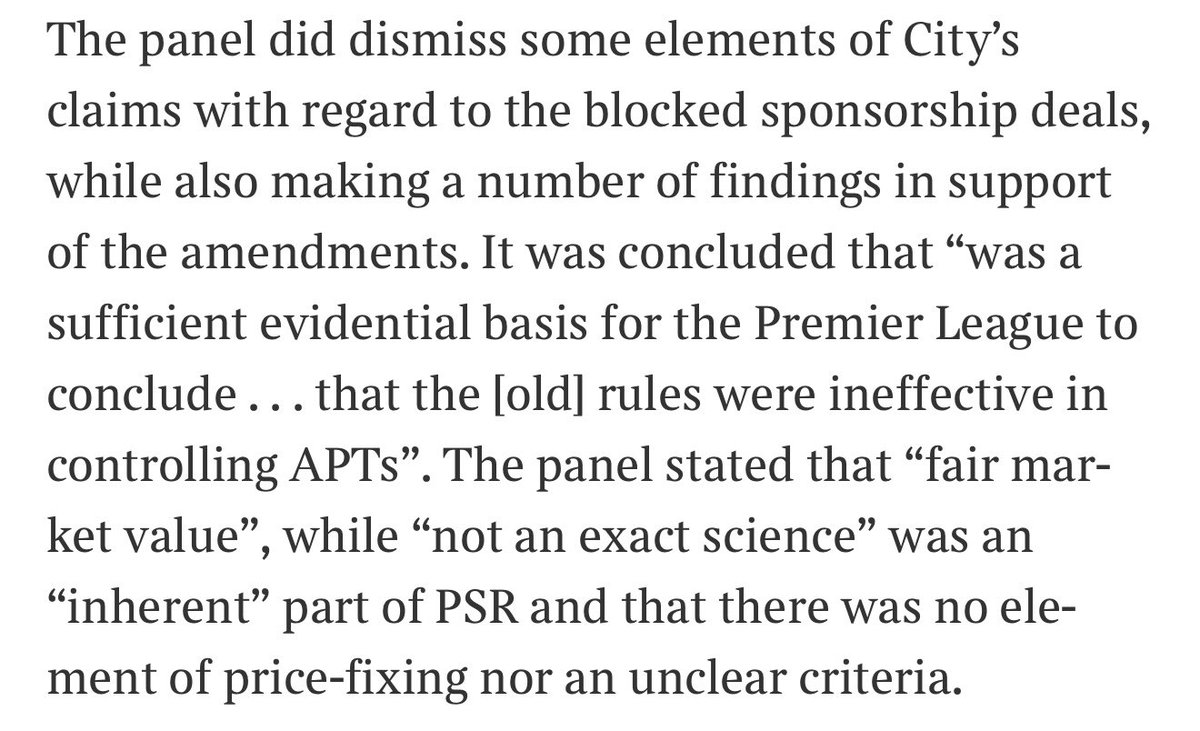
A decision was published in that hearing which revealed that Man City had argued against the lawfulness of FMV as a concept. Had they won this, it would have provided a very strong legal argument with which to win their battle on the 130 charges.
But they failed with this argument.
In fact, they lost on more than 80% of their arguments but they did win some. The Tribunal decided that the recent changes to the APT rules made in 2024 were unlawful and must be reversed.
The Tribunal also accepted an argument made by Man City that an exemption to the APT rules (incorporated when they were first written in 2021, relating to shareholder loans) was also unlawful.
Man City’s position is that this makes the entire section of APT rules unlawful and invalid. They believe they need to be scrapped, and any new rules constructed at a slower pace. They insist the process must not be “rushed”.
The PL’s position is that the rules can still be applied (with a blue pencil test where you effectively ignore the bits deemed unlawful and apply the rest). They also insist that the rules can be made fully lawful with a few minor changes and they want to put these changes to a vote (by the 20 clubs) on Friday 22 November.
14 votes are needed to pass the changes and approve them.
Man City has written to the clubs to pressure them into voting against the PL’s proposed rule changes, threatening legal action if the changes are made. They insist the changes will not make the rules lawful.
They also note that the Tribunal has been asked to provide clarity on the matter (who is right, Man City or PL).
It’s not clear how long the Tribunal will take to answer that question though.
So the PL’s attitude is basically… “let’s put in a fix now which we believe will work and should at least not make the rules any worse than they are now in terms of compliance with law – more changes can further be made if necessary.”
Man City’s attitude is “no-one should do anything for now. Leave the rules as they are.” (Which in their mind, is fully broken).
Now… what I think is actually going on here…
I think this conflict is actually about the 130 charges and that neither party is being fully transparent or on the level.
I believe that Man City are using this matter to box the PL into a corner regarding their position on an important matter related to the 130 charges; a position that Man City wants the PL to take because it might help them avoid the most serious of sanctions.
And I think the PL is trying to duck and weave out of that corner by stooping to Man City’s level!
Now… back to the matter of those 130 charges…
The most serious charges pertain to Man City’s sponsorship contracts with entities such as Etihad.
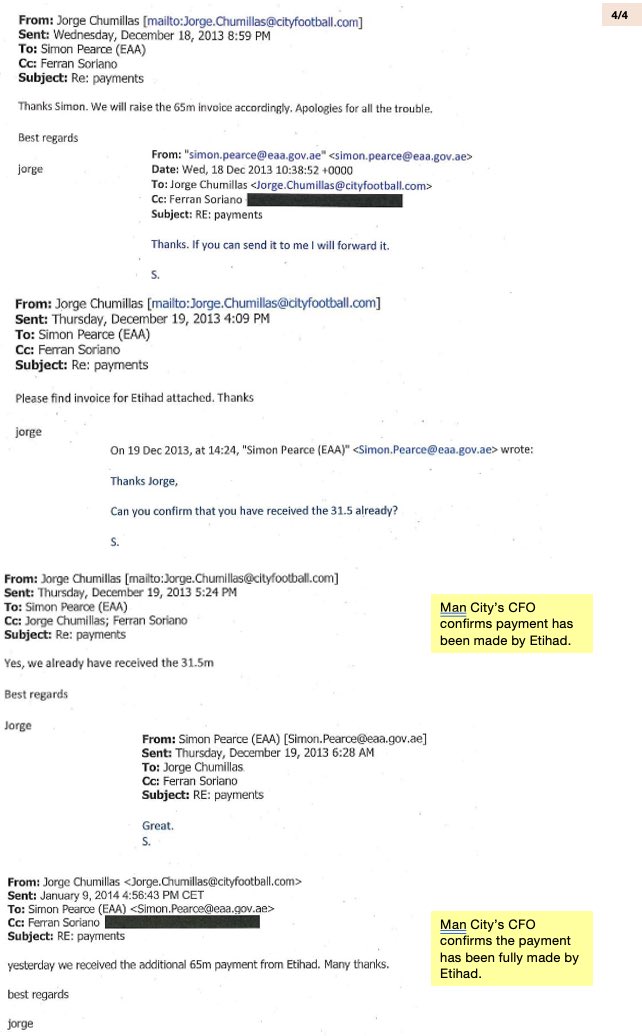
The leaked emails revealed that the sponsorship contracts were being mostly funded by Man City’s corporate owner, a company called Abu Dhabi United Group (ADUG).
The leaks showed that each year, sponsors such as Etihad were funding just a few million pounds whereas the remaining £60m+ p.a. of the sponsorship agreements was being funded by ADUG.
This would mean that Man City were undertaking a conspiracy to covertly circumvent PSR, by channelling equity (owner funds) through sponsors and pretending it was genuine income. This would have enabled them to spend far more than the rules would have allowed otherwise.
These breaches took place between 2009-2018; long before the new APT rules came into force. The RPT rules did apply though.
But they failed with this argument.
In fact, they lost on more than 80% of their arguments but they did win some. The Tribunal decided that the recent changes to the APT rules made in 2024 were unlawful and must be reversed.
The Tribunal also accepted an argument made by Man City that an exemption to the APT rules (incorporated when they were first written in 2021, relating to shareholder loans) was also unlawful.
Man City’s position is that this makes the entire section of APT rules unlawful and invalid. They believe they need to be scrapped, and any new rules constructed at a slower pace. They insist the process must not be “rushed”.
The PL’s position is that the rules can still be applied (with a blue pencil test where you effectively ignore the bits deemed unlawful and apply the rest). They also insist that the rules can be made fully lawful with a few minor changes and they want to put these changes to a vote (by the 20 clubs) on Friday 22 November.
14 votes are needed to pass the changes and approve them.
Man City has written to the clubs to pressure them into voting against the PL’s proposed rule changes, threatening legal action if the changes are made. They insist the changes will not make the rules lawful.
They also note that the Tribunal has been asked to provide clarity on the matter (who is right, Man City or PL).
It’s not clear how long the Tribunal will take to answer that question though.
So the PL’s attitude is basically… “let’s put in a fix now which we believe will work and should at least not make the rules any worse than they are now in terms of compliance with law – more changes can further be made if necessary.”
Man City’s attitude is “no-one should do anything for now. Leave the rules as they are.” (Which in their mind, is fully broken).
Now… what I think is actually going on here…
I think this conflict is actually about the 130 charges and that neither party is being fully transparent or on the level.
I believe that Man City are using this matter to box the PL into a corner regarding their position on an important matter related to the 130 charges; a position that Man City wants the PL to take because it might help them avoid the most serious of sanctions.
And I think the PL is trying to duck and weave out of that corner by stooping to Man City’s level!
Now… back to the matter of those 130 charges…
The most serious charges pertain to Man City’s sponsorship contracts with entities such as Etihad.
The leaked emails revealed that the sponsorship contracts were being mostly funded by Man City’s corporate owner, a company called Abu Dhabi United Group (ADUG).
The leaks showed that each year, sponsors such as Etihad were funding just a few million pounds whereas the remaining £60m+ p.a. of the sponsorship agreements was being funded by ADUG.
This would mean that Man City were undertaking a conspiracy to covertly circumvent PSR, by channelling equity (owner funds) through sponsors and pretending it was genuine income. This would have enabled them to spend far more than the rules would have allowed otherwise.
These breaches took place between 2009-2018; long before the new APT rules came into force. The RPT rules did apply though.
If (or more likely, when) the breaches are sustained, both sides will need to argue for and against the sanctions that should be applied.
The general rule here is the larger the sporting impact of a rule breach, the more severe the sanction should be.
Man City will try to argue that the sporting impact was minimal and I suspect their argument will take this shape:
“Any money received from our sponsor Etihad that originated from ADUG is, in effect, group money. The parties should have been treated as Related and the sponsorship agreements with Etihad should have been treated as RPTs and disclosed as such. Therefore, FMV tests should have been applied.”
They will then use the same or similar analysis on the FMV of their sponsorship agreements that they prepared for a challenge by Uefa 10 years ago, which Uefa relied upon. This analysis apparently claimed that the sponsorship agreements they had were close to fair value.
They will do this to show that the vast majority of sponsorship income should be considered legitimate revenue for the FFP/PSR calculation, even if it was originally sourced from Man City’s owner.
In effect, they will argue that they gained a negligible advantage in monetary value, meaning the sporting impact of their breach was immaterial.
The PL will try to argue that the sporting impact was very serious and I suspect their argument will take this shape:
“Although Man City and Etihad are strongly associated, they do not meet the definition of a Related Party. As such, the money transferred by Man City’s owner (ADUG) to Etihad, to then be paid to Man City as if it were sponsorship revenue was, in fact, hidden equity.
As such, that entire sum that originated from ADUG should be treated as equity in the FFP/PSR calculation and not as legitimate revenue. The sponsorship income is only the portion that was funded from within the sponsor.”
This basis would mean Man City had an enormous illicit advantage, resulting in huge sporting impact.
It would also imply that the PL is making the argument that Etihad and ADUG are NOT legally Related Parties. A surprising outcome.
There are other reasons to suspect this is a position the PL is taking though, such as the absence of charges for rule breaches connected with failure to report the ultimate owner of the club.
So if my theory is correct, how does it intersect with the APT rules and Friday’s vote?
Well, if APT rules are unlawful and unenforceable then what is to stop Man City from securing an extremely large sponsorship agreement with Etihad? One that could keep them alive even if they are related for the next decade! Only the former RPT/PSR rules.
As such, the PL would have to argue that Man City and Etihad ARE Related Parties after all in order to enforce them, thereby undermining the argument they want to make at the hearing on the 130 charges.
This is the corner that Man City are trying to box the PL into.
How is the PL trying to duck and weave out of it? By passing changes to the rules that they can reasonably assert makes them lawful again… even if they’re not!
If the APT rules are updated and the PL has reasonable grounds to believe they are lawful; then for Man City to challenge that, they would have to bring forth a new APT for the PL to test, wait for the outcome and, depending on the outcome, bring legal action (through arbitration) to once again challenge the decision and the rules. It would take a long time… probably long enough for the sanctions to have been argued for and against in the hearing on the 130 charges.
The general rule here is the larger the sporting impact of a rule breach, the more severe the sanction should be.
Man City will try to argue that the sporting impact was minimal and I suspect their argument will take this shape:
“Any money received from our sponsor Etihad that originated from ADUG is, in effect, group money. The parties should have been treated as Related and the sponsorship agreements with Etihad should have been treated as RPTs and disclosed as such. Therefore, FMV tests should have been applied.”
They will then use the same or similar analysis on the FMV of their sponsorship agreements that they prepared for a challenge by Uefa 10 years ago, which Uefa relied upon. This analysis apparently claimed that the sponsorship agreements they had were close to fair value.
They will do this to show that the vast majority of sponsorship income should be considered legitimate revenue for the FFP/PSR calculation, even if it was originally sourced from Man City’s owner.
In effect, they will argue that they gained a negligible advantage in monetary value, meaning the sporting impact of their breach was immaterial.
The PL will try to argue that the sporting impact was very serious and I suspect their argument will take this shape:
“Although Man City and Etihad are strongly associated, they do not meet the definition of a Related Party. As such, the money transferred by Man City’s owner (ADUG) to Etihad, to then be paid to Man City as if it were sponsorship revenue was, in fact, hidden equity.
As such, that entire sum that originated from ADUG should be treated as equity in the FFP/PSR calculation and not as legitimate revenue. The sponsorship income is only the portion that was funded from within the sponsor.”
This basis would mean Man City had an enormous illicit advantage, resulting in huge sporting impact.
It would also imply that the PL is making the argument that Etihad and ADUG are NOT legally Related Parties. A surprising outcome.
There are other reasons to suspect this is a position the PL is taking though, such as the absence of charges for rule breaches connected with failure to report the ultimate owner of the club.
So if my theory is correct, how does it intersect with the APT rules and Friday’s vote?
Well, if APT rules are unlawful and unenforceable then what is to stop Man City from securing an extremely large sponsorship agreement with Etihad? One that could keep them alive even if they are related for the next decade! Only the former RPT/PSR rules.
As such, the PL would have to argue that Man City and Etihad ARE Related Parties after all in order to enforce them, thereby undermining the argument they want to make at the hearing on the 130 charges.
This is the corner that Man City are trying to box the PL into.
How is the PL trying to duck and weave out of it? By passing changes to the rules that they can reasonably assert makes them lawful again… even if they’re not!
If the APT rules are updated and the PL has reasonable grounds to believe they are lawful; then for Man City to challenge that, they would have to bring forth a new APT for the PL to test, wait for the outcome and, depending on the outcome, bring legal action (through arbitration) to once again challenge the decision and the rules. It would take a long time… probably long enough for the sanctions to have been argued for and against in the hearing on the 130 charges.
Why do I think that the PL is “stooping to Man City’s level”? Because I’m not convinced they believe the proposed changes will actually make the rules lawful again.
They plan to include an exemption on shareholder loans issued up until this point (and only remove the exemption for loans issued moving forward). I think they needed to include this proposal to get the rule changes over the line with the club vote (because a good number of clubs have such loans).
But… I just don’t think that will fly. Long term, I think that will still be deemed unlawful (based off of my reading of the Tribunal’s decision and the rationale behind it).
However, I don’t think the PL care! So long as they can argue that there are reasonable grounds for them to believe the rules are lawful, then it puts Man City in the position of having to follow the lengthy process to challenge the rules again. By which time, the pivotal point in the hearing on the 130 charges should be over.
So this is why I think Friday is so pivotal and why the PL is so aggressively pushing to change the rules now and Man City is so aggressively trying to stop the clubs from voting on it.
Making Friday a pivotal point in the hearing on the 130 charges and the future of the league.
And now time to rest my thumbs! 😮💨
They plan to include an exemption on shareholder loans issued up until this point (and only remove the exemption for loans issued moving forward). I think they needed to include this proposal to get the rule changes over the line with the club vote (because a good number of clubs have such loans).
But… I just don’t think that will fly. Long term, I think that will still be deemed unlawful (based off of my reading of the Tribunal’s decision and the rationale behind it).
However, I don’t think the PL care! So long as they can argue that there are reasonable grounds for them to believe the rules are lawful, then it puts Man City in the position of having to follow the lengthy process to challenge the rules again. By which time, the pivotal point in the hearing on the 130 charges should be over.
So this is why I think Friday is so pivotal and why the PL is so aggressively pushing to change the rules now and Man City is so aggressively trying to stop the clubs from voting on it.
Making Friday a pivotal point in the hearing on the 130 charges and the future of the league.
And now time to rest my thumbs! 😮💨
TYPO CORRECTION
Where it says “One that could keep them alive even if they are related for the next decade!”
“related” should say “relegated”
Where it says “One that could keep them alive even if they are related for the next decade!”
“related” should say “relegated”
• • •
Missing some Tweet in this thread? You can try to
force a refresh