Let's talk trauma.
What effect does it have on psychiatric illness? Depending on who you talk to, the answer can be quite contentious.
Fortunately for us, a recent study provided the most powerful test of trauma's impacts to date. This new study used nearly three decades of health data recorded by the Swedish government to enable researchers to tease out the impacts of different events on mental health in samples of up to about half a million people. In addition to all that, this study had a sibling control.
This is by far the single best study of the impacts of traumatic events on mental health.
The first category of impacts I want to talk about is the impact of assault. After people are physically violated by another person, whether with fists, weapons, sexually, or any combination thereof, the events they go through are likely to be in an objective and a subjective sense, traumatic. If someone beats you up, that is undeniably physically traumatic. And thanks to Sweden's incredible record-keeping and high trust in their government, we have extensive, high-quality records for when people get assaulted.
Click in and take a look at this:
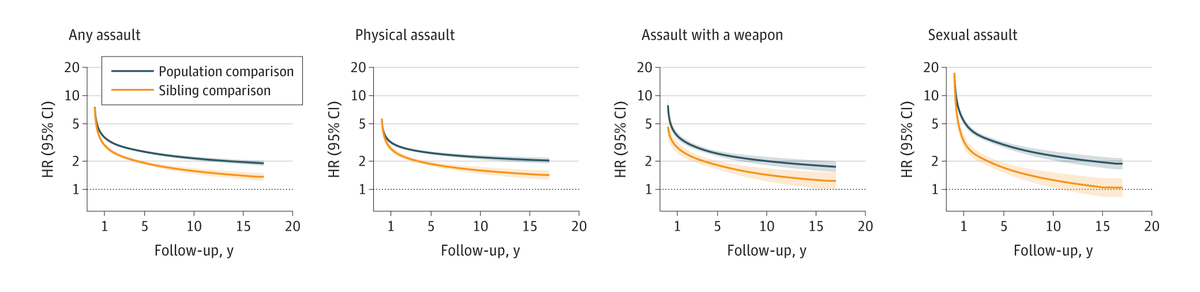
What you're seeing there is that, right after any type of assault, people are vastly more likely to be diagnosed with a mental illness, and the harms fade out rapidly. Each comparison also shows that the effect of being assaulted is confounded: between siblings, the impact is greatly reduced, because for familial reasons, people have different probabilities of being assaulted and having psychiatric issues.
Over the whole observation period of just over one-and-a-half decades, people generally only largely but not entirely recovered. This is curious. Does it mean that people remained mentally ill, or does it mean that they stuck with treatment? We can't differentiate the two things, but we can qualify that, whatever remained was very minor at fifteen years from the event.
Except for the impact of sexual assault, which faded out entirely by the end of the observation period. Why was this one different than the other types of assault? I don't know. One argument someone proposed to me was that sexual assault claims are more overblown than the other types of assault, but we can't know this until we get a breakdown of different types of sexual assault, and that wasn't provided and might be very hard to do. It's certainly the"iffiest" to classify among what we're given, so it's hard to know anything about it.
Next let's talk about all types of injuries that cause people to end up in the hospital or get otherwise documented.
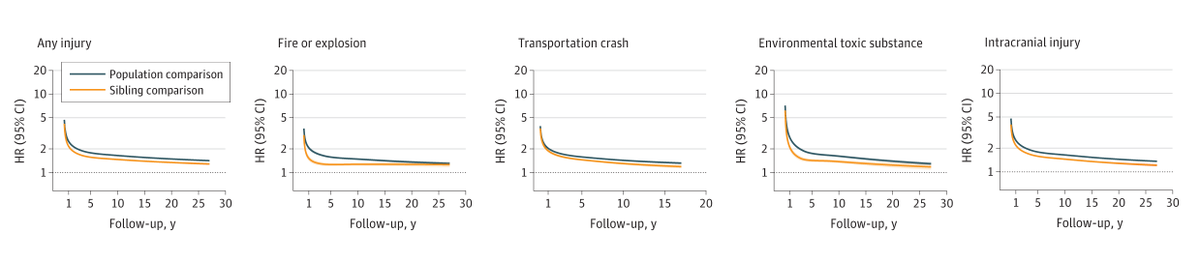
The impacts of injuries had the same form as the impacts of assaults: big effects early on, but they quickly fade. This was true for any type of transportation crash, fires and explosions, and even brain injuries. Confounding was still present across these outcomes, but it looked to be less important than for assaults. With all of this, impacts became small with time, but they remained significant many years out. Same problem as before: We don't know if this reflects continued high mental illness rates, or continued treatment.
Now let's look at the last category of traumatic events: bereavement. This is the loss of a loved one, one of the most emotionally traumatic types of events there is, and the one that's perhaps the most familiar to humanity.
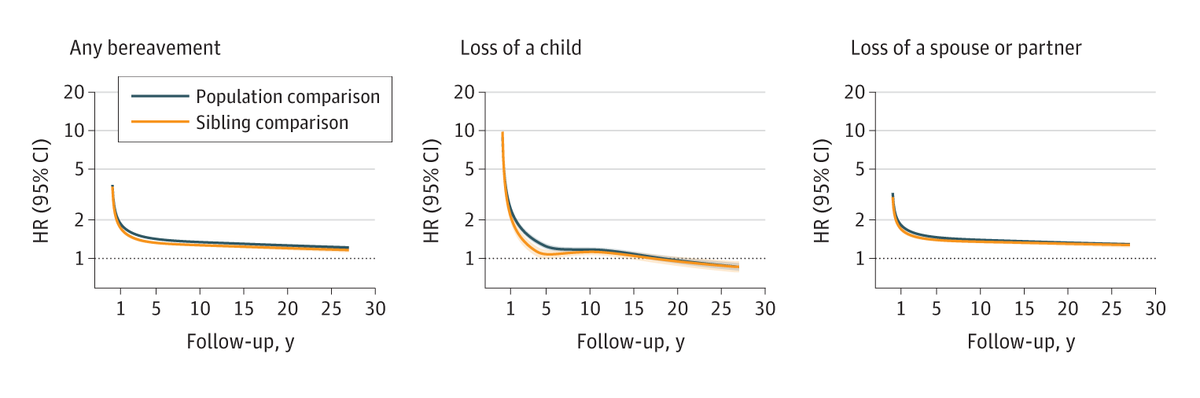
The form of the impact of bereavement is similar to the other types of trauma: big impacts early on, with rapid fadeout. "Loss of a child", however, has a very curious difference in form: for some reason, people end up better off about 20 years down the line. I think this might be a fluke, but if it isn't, then it says something very interesting about people's "trauma response".
Perhaps the most interesting part of the picture we get from the bereavement effects is that it seems bereavement is basically not confounded at all. The loss of a child, spouse, or other type of loved one is sufficiently random that a sibling control didn't do anything, unlike with assaults or injuries, whose effects do show evidence of familial confounding.
Now, what does this all mean?
Well, it seems that trauma does impact the psyche. This has been pretty hotly debated, with good reason. It does appear, based on twin-control studies, and other designs, that trauma effects have been radically overstated. Some people took those results to mean that trauma has no real effect and everything attributed to it was confounding. But not so! There does appear to be something beyond confounding, it's just small.
This threatens the view that trauma is major and the view that trauma is nothing. Trauma can be very important right after it happens, but people really are robust, and the impacts largely do not persist. People do move on.
But though trauma clearly has an immediate effect, I don't think we're capable of dismissing zero long-term effect now, for the simple reason that people will tend to stick with things they've been doing. Once they're "locked in" to some behavior, they'll be likely to stick with it to some degree, so if people start therapy, they might stick with therapy, for example. That could mean that even after they're fully better, they stick with a mental health diagnosis, or that could mean that they remain doing poorly because they were unlucky enough to get the diagnosis. I think there are ways to tease out what's right, but let's move on.
Another interesting thing to look at is exactly which mental illnesses were impacted by trauma. Trauma did not have psychiatrically broad effects. Trauma boosted PTSD, anxiety, alcohol and drug misuse, depression, suicide attempts and successes, it dubiously impacted bipolar disorder, and it did not impact schizophrenia or eating disorders.
In other words, trauma did not impact the most theoretically biologically proximal disorders, it impacted the ones that we know to have a large social element, and to be associated with basic human emotions. It was also associated sensibly. For example, losing a child did not boost anxiety, but it did boost depression.
After all's said and done, I think this is an excellent jumping-off point for future research on trauma, and it's just the sort of large, causally-informative study that everyone should take a moment to update towards. So we're lucky! Hopefully this study will be useful for debate, because it helps to define the major 'truths' of what trauma does: a good amount early on, with fading effects, on sensible outcomes.
Want to learn more? You can read the study here: jamanetwork.com/journals/jamap…
What effect does it have on psychiatric illness? Depending on who you talk to, the answer can be quite contentious.
Fortunately for us, a recent study provided the most powerful test of trauma's impacts to date. This new study used nearly three decades of health data recorded by the Swedish government to enable researchers to tease out the impacts of different events on mental health in samples of up to about half a million people. In addition to all that, this study had a sibling control.
This is by far the single best study of the impacts of traumatic events on mental health.
The first category of impacts I want to talk about is the impact of assault. After people are physically violated by another person, whether with fists, weapons, sexually, or any combination thereof, the events they go through are likely to be in an objective and a subjective sense, traumatic. If someone beats you up, that is undeniably physically traumatic. And thanks to Sweden's incredible record-keeping and high trust in their government, we have extensive, high-quality records for when people get assaulted.
Click in and take a look at this:
What you're seeing there is that, right after any type of assault, people are vastly more likely to be diagnosed with a mental illness, and the harms fade out rapidly. Each comparison also shows that the effect of being assaulted is confounded: between siblings, the impact is greatly reduced, because for familial reasons, people have different probabilities of being assaulted and having psychiatric issues.
Over the whole observation period of just over one-and-a-half decades, people generally only largely but not entirely recovered. This is curious. Does it mean that people remained mentally ill, or does it mean that they stuck with treatment? We can't differentiate the two things, but we can qualify that, whatever remained was very minor at fifteen years from the event.
Except for the impact of sexual assault, which faded out entirely by the end of the observation period. Why was this one different than the other types of assault? I don't know. One argument someone proposed to me was that sexual assault claims are more overblown than the other types of assault, but we can't know this until we get a breakdown of different types of sexual assault, and that wasn't provided and might be very hard to do. It's certainly the"iffiest" to classify among what we're given, so it's hard to know anything about it.
Next let's talk about all types of injuries that cause people to end up in the hospital or get otherwise documented.
The impacts of injuries had the same form as the impacts of assaults: big effects early on, but they quickly fade. This was true for any type of transportation crash, fires and explosions, and even brain injuries. Confounding was still present across these outcomes, but it looked to be less important than for assaults. With all of this, impacts became small with time, but they remained significant many years out. Same problem as before: We don't know if this reflects continued high mental illness rates, or continued treatment.
Now let's look at the last category of traumatic events: bereavement. This is the loss of a loved one, one of the most emotionally traumatic types of events there is, and the one that's perhaps the most familiar to humanity.
The form of the impact of bereavement is similar to the other types of trauma: big impacts early on, with rapid fadeout. "Loss of a child", however, has a very curious difference in form: for some reason, people end up better off about 20 years down the line. I think this might be a fluke, but if it isn't, then it says something very interesting about people's "trauma response".
Perhaps the most interesting part of the picture we get from the bereavement effects is that it seems bereavement is basically not confounded at all. The loss of a child, spouse, or other type of loved one is sufficiently random that a sibling control didn't do anything, unlike with assaults or injuries, whose effects do show evidence of familial confounding.
Now, what does this all mean?
Well, it seems that trauma does impact the psyche. This has been pretty hotly debated, with good reason. It does appear, based on twin-control studies, and other designs, that trauma effects have been radically overstated. Some people took those results to mean that trauma has no real effect and everything attributed to it was confounding. But not so! There does appear to be something beyond confounding, it's just small.
This threatens the view that trauma is major and the view that trauma is nothing. Trauma can be very important right after it happens, but people really are robust, and the impacts largely do not persist. People do move on.
But though trauma clearly has an immediate effect, I don't think we're capable of dismissing zero long-term effect now, for the simple reason that people will tend to stick with things they've been doing. Once they're "locked in" to some behavior, they'll be likely to stick with it to some degree, so if people start therapy, they might stick with therapy, for example. That could mean that even after they're fully better, they stick with a mental health diagnosis, or that could mean that they remain doing poorly because they were unlucky enough to get the diagnosis. I think there are ways to tease out what's right, but let's move on.
Another interesting thing to look at is exactly which mental illnesses were impacted by trauma. Trauma did not have psychiatrically broad effects. Trauma boosted PTSD, anxiety, alcohol and drug misuse, depression, suicide attempts and successes, it dubiously impacted bipolar disorder, and it did not impact schizophrenia or eating disorders.
In other words, trauma did not impact the most theoretically biologically proximal disorders, it impacted the ones that we know to have a large social element, and to be associated with basic human emotions. It was also associated sensibly. For example, losing a child did not boost anxiety, but it did boost depression.
After all's said and done, I think this is an excellent jumping-off point for future research on trauma, and it's just the sort of large, causally-informative study that everyone should take a moment to update towards. So we're lucky! Hopefully this study will be useful for debate, because it helps to define the major 'truths' of what trauma does: a good amount early on, with fading effects, on sensible outcomes.
Want to learn more? You can read the study here: jamanetwork.com/journals/jamap…
• • •
Missing some Tweet in this thread? You can try to
force a refresh