🧵 Kayasthas in the Gahadavala realm: An epigraphical survey
Roughly 100 epigraphical records are known from the times of the Gahadavalas, from 11th to 12th centuries CE. Most of these are copper plate land grants to Brahmins. Unfortunately, there is a paucity of large stone inscriptions the likes of which were issued by other dynasties of the times, viz Chandelas, Kalachuris, Paramaras etc. Thus, it is hard to deduce the exact social conditions and the administrative setup of this dynasty. However, the majority of the grants were written by Kayasthas who seem to have monopolised the record keeping in this kingdom. In this thread we will analyse what these records tell us about the contemporary Kayasthas.
1/12
Roughly 100 epigraphical records are known from the times of the Gahadavalas, from 11th to 12th centuries CE. Most of these are copper plate land grants to Brahmins. Unfortunately, there is a paucity of large stone inscriptions the likes of which were issued by other dynasties of the times, viz Chandelas, Kalachuris, Paramaras etc. Thus, it is hard to deduce the exact social conditions and the administrative setup of this dynasty. However, the majority of the grants were written by Kayasthas who seem to have monopolised the record keeping in this kingdom. In this thread we will analyse what these records tell us about the contemporary Kayasthas.
1/12

x.com/historiakayast…
All in all, 29 writers of Gahadavalas are known by name who authored about 100 extant records. Of these, 12 have been mentioned as Karanika and Kayastha. The fact that Kayastha has been used synonymously with Karanika is attested from two records authored by a certain Thakkura Jalhana during the reign of Govindachandra.
In the first record from Bhadaini of Samvat 1171 (1114 CE), Thakkura Jalhana is mentioned as:
करणिकोद्गतो विद्वांशचित्रगुप्तोपमो गुणैः
"Born in the Karanika lineage, like Chitragupta in qualities"
We posted about this earlier in the thread below:
2/12
All in all, 29 writers of Gahadavalas are known by name who authored about 100 extant records. Of these, 12 have been mentioned as Karanika and Kayastha. The fact that Kayastha has been used synonymously with Karanika is attested from two records authored by a certain Thakkura Jalhana during the reign of Govindachandra.
In the first record from Bhadaini of Samvat 1171 (1114 CE), Thakkura Jalhana is mentioned as:
करणिकोद्गतो विद्वांशचित्रगुप्तोपमो गुणैः
"Born in the Karanika lineage, like Chitragupta in qualities"
We posted about this earlier in the thread below:
2/12
While in the Dhusa village record of Samvat 1172 (1115 CE) Thakkura Jalhana is mentioned as
"श्रीवास्तव्य कुलोद्भूत कायस्थ ठक्कुर श्री जल्हण"
"Thakkura Sri Jalhana, born in the Srivastava Kayastha linegae"
3/12
"श्रीवास्तव्य कुलोद्भूत कायस्थ ठक्कुर श्री जल्हण"
"Thakkura Sri Jalhana, born in the Srivastava Kayastha linegae"
3/12

Although, the remaining writers of the grant are not mentioned by caste, but it is possible that most of also might have been Kayasthas. This is supported by the fact that some wirters were only mentioned by name in some records while their caste affiliations were made clear in other records.
For instance, Thakkura Gaguka, who authored 3 copperplates during the reign of Govindachandra, is mentioned as Karanika in only the latter 2 of records, while in the first he is only mentioned as a Thakkura.
4/12
For instance, Thakkura Gaguka, who authored 3 copperplates during the reign of Govindachandra, is mentioned as Karanika in only the latter 2 of records, while in the first he is only mentioned as a Thakkura.
4/12
x.com/historiakayast…
The majority of the writers of Gahadavala records bore the title of Thakkura. Although, no land grants to Kayasthas are known from the times of the Gahadavalas, but the title of Thakkura suggests that contemporary Kayasthas were a significant part of the landed gentry. Several Kayasthas are know as religious donors from this period. For instance, a certain Srivastava Thakkura founded a large Shiva temple in Kaushambi during the reign of Jayachandradeva aka Jaichand. The record by the founder mentions 5 royal titles of the king suggesting that the he had a close association with the latter.
5/12
The majority of the writers of Gahadavala records bore the title of Thakkura. Although, no land grants to Kayasthas are known from the times of the Gahadavalas, but the title of Thakkura suggests that contemporary Kayasthas were a significant part of the landed gentry. Several Kayasthas are know as religious donors from this period. For instance, a certain Srivastava Thakkura founded a large Shiva temple in Kaushambi during the reign of Jayachandradeva aka Jaichand. The record by the founder mentions 5 royal titles of the king suggesting that the he had a close association with the latter.
5/12
Many Kayastha writers from this period also had the title of Pandita and were known as Shastrins. For instance, Jagadhara who wrote two grants of Jayachandradeva is mentioned as a Pandita and so is his father Pandita Sridhara Kayastha.
6/12
6/12

Kayastha Suraditya, who authored the Sahet-Mahet redord of Govindachandra in Samvat 1186 (1129CE) is described as "sarvvasastravit" or the knower of all Shastras. Seemingly, the contemporary Kayasthas not only monopolised the profession of writing but also rivalled Brahmins in religious learning.
7/12
7/12

However this monopoly and affluence of Kayasthas did not sit well with some contemporary non-Kayasthas. A Brahmin scholar named Bhatta Lakshmidhara who a minister of Govindachandra and the author of Krityakalpataru, a digest of Dharmashastras, quotes from Yajnavalkya Smriti and warns the king against the machinations of Kayasthas. However, it must be noted this sentiment was not entirely rooted in professional jealousy and rivalry. Oftentimes, the ill repute of Kayasthas as corrupt officers was rooted in reality. We have some evidence to suggest that Kayasthas often suffered from the same shortcomings as the bureaucrats from our times. We shall discuss this topic in more detail in an another thread.
8/12
8/12

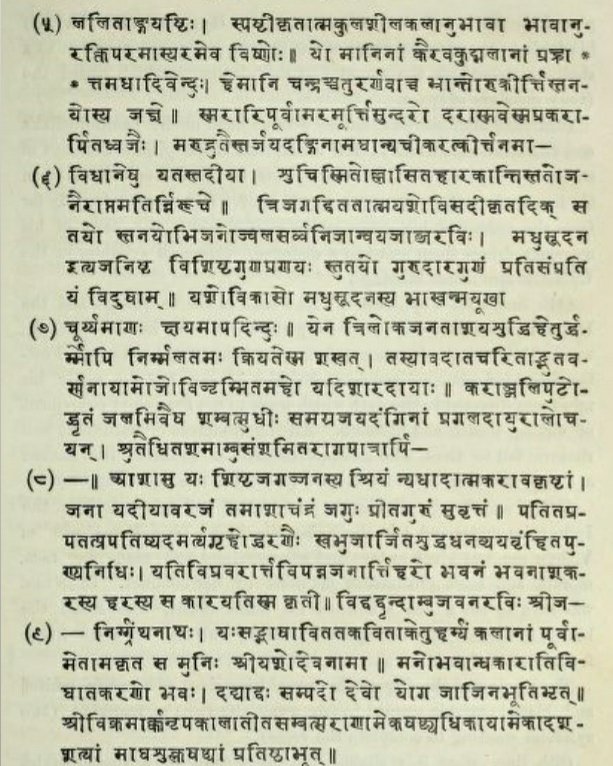
Owing to the paucity of records from the Gahadavala period, no Kayastha ministers are known by name from inscriptions unlike from other contemporary dynasties. However, a large stone inscription of Nana, a Srivastava Kayastha minister of Bhojavarman Chandela from the late 13th century does ring a bell.
9/12
9/12

The family of Nana was originally from Kausamyapura, which has been identified as Kaushambi where his ancestors served as ministers to kings of an unnamed dynasty. Nana's forefather 6 generations ago was a certain Jalhana Srivastava who was an able minister and helped kings in administration. He would have existed sometime in the middle of the 12th century. During this time, Kaushambi, was ruled by Govindachandra of the Gahadavala dynasty. We have seen above that a certain Thakkura Jalhana of the Srivastava lineage is known from 2 records of this ruler. One can't help but wonder if this Jalhana was the same as the ancestor of Nana.
If our identification is correct, it is likely that the family of Nana migrated to the Chandela realm after the collapse of the Gahadavala kingdom some time in the early 13th century.
10/12
If our identification is correct, it is likely that the family of Nana migrated to the Chandela realm after the collapse of the Gahadavala kingdom some time in the early 13th century.
10/12

Kayasthas are also known as ministers of the feudatories of Gahadavalas from inscriptions. For instance, a certain Vidyadhara of Srivastava lineage and a Buddhist by faith, was a minister of a monarch named Madana who ruled around Sravasti. Vidyadhara also was in charge of the elephant cavalry.
11/12
https://x.com/historiakayasth/status/1827359770086666706
Thakkura Ranapala Srivastava, who founded a Vishnu temple in Allahabad and established a new village as an offshoot of the Brahmin village of Bhattagrama in the 12th century is believed to have been a minister of the local Baghel king Sankara Deva who was a feudatory of the Gahadavalas.
12/12
https://x.com/historiakayasth/status/1855601591656808932
• • •
Missing some Tweet in this thread? You can try to
force a refresh