In early 2005, Denmark rolled out a massive expansion of its criminal DNA database: anyone receiving a sentence with a maximum penalty of 18 months or more was now eligible to be added to it.*
Criminal DNA registration skyrocketed overnight, going from 4% to about 40%, and near the end of 2007, it had reached over 60%.
After the reform went into effect, the probability of recidivism with respect to several observable characteristics was smooth, meaning that the odds of reoffending for particular persons before and after the DNA database's expansion didn't change at all on their own: "Both the probability of committing any crime and the number of predicted crimes are smooth through the threshold."
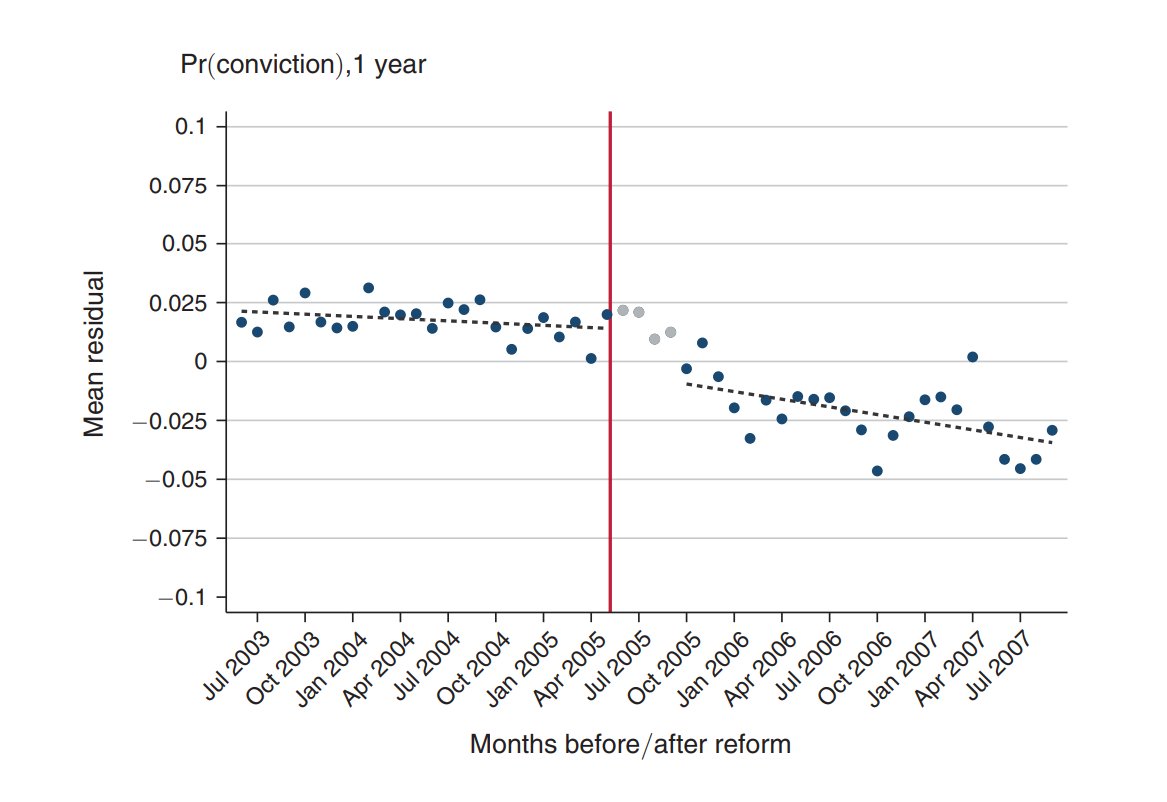
But, for those affected by the reforms, meaning those who got sequenced, something interesting happens: the odds of recidivating markedly decline!
There are major reductions in the probability that genetically profiled individuals go on to reoffend violently, against property, or in terms of possessing illicit weapons. This effect also affects the number of convictions recidivists receive, and it applies broadly, to individuals entering the database on their first or subsequent charges.
The magnitude of this effect is fairly staggering, too: the elasticity is -2.7, meaning that for every 1% increase in the number of criminals in the database, recidivist crime falls by 2.7%. That's enormous (-42% to the 1-year recidivism rate), and that's simply due to the fear that, if you commit a crime again, you'll now be detected doing it.
It's a rational fear! DNA-based criminal detection is a great means of identifying people who were involved in hard-to-solve cases and even regular everyday ones, and DNA can also aid in conviction because, Why were you--a known criminal--at the scene of a crime?
But, you may be wondering, does this only work out in high-trust Scandinavia? This is a Danish study, so you might be wondering if this generalizes. In all probability, the answer is "yes", because Scandinavians are like other humans, but... OK. The answer is "yes", the finding also holds up in Americans.
Several American states have mandated that prisoners need to provide their DNA to the authorities, and after those programs came into place, there was a large reduction in the odds of recidivism for affected criminals. This result is highly significant for violent offenders, but less so for property offenders, with mandates reducing violent recidivism by a whopping 5.7pp over five years, or in percentage terms, they reduced violent criminal recidivism by 21%.
These changes in recidivism rates are staggering. They're economically significant, and they represent major reductions in crime going forward, through increasing the odds of detection for very, very cheap. It does not cost a lot to DNA profile offenders, and if even one life is saved, that covers the costs of getting thousands of offenders genotyped. And these effects are way larger than just saving a single life. Over, say, a decade, this might save hundreds or thousands of lives at the national level, and all we have to do to make that happen is make criminals fear getting caught.
Even if these effect sizes are overestimates by, say, 80%, genotyping offenders likely still passes a cost-benefit test, so let's put science to use, so fewer criminals make the choice to reoffend.
Sources:
aeaweb.org/articles?id=10…
aeaweb.org/articles?id=10…
* Two things. This is basically saying that people given felony sentences were eligible, and also, police--rather than just medical personnel--could add people after the reform went into effect.
Criminal DNA registration skyrocketed overnight, going from 4% to about 40%, and near the end of 2007, it had reached over 60%.
After the reform went into effect, the probability of recidivism with respect to several observable characteristics was smooth, meaning that the odds of reoffending for particular persons before and after the DNA database's expansion didn't change at all on their own: "Both the probability of committing any crime and the number of predicted crimes are smooth through the threshold."
But, for those affected by the reforms, meaning those who got sequenced, something interesting happens: the odds of recidivating markedly decline!
There are major reductions in the probability that genetically profiled individuals go on to reoffend violently, against property, or in terms of possessing illicit weapons. This effect also affects the number of convictions recidivists receive, and it applies broadly, to individuals entering the database on their first or subsequent charges.
The magnitude of this effect is fairly staggering, too: the elasticity is -2.7, meaning that for every 1% increase in the number of criminals in the database, recidivist crime falls by 2.7%. That's enormous (-42% to the 1-year recidivism rate), and that's simply due to the fear that, if you commit a crime again, you'll now be detected doing it.
It's a rational fear! DNA-based criminal detection is a great means of identifying people who were involved in hard-to-solve cases and even regular everyday ones, and DNA can also aid in conviction because, Why were you--a known criminal--at the scene of a crime?
But, you may be wondering, does this only work out in high-trust Scandinavia? This is a Danish study, so you might be wondering if this generalizes. In all probability, the answer is "yes", because Scandinavians are like other humans, but... OK. The answer is "yes", the finding also holds up in Americans.
Several American states have mandated that prisoners need to provide their DNA to the authorities, and after those programs came into place, there was a large reduction in the odds of recidivism for affected criminals. This result is highly significant for violent offenders, but less so for property offenders, with mandates reducing violent recidivism by a whopping 5.7pp over five years, or in percentage terms, they reduced violent criminal recidivism by 21%.
These changes in recidivism rates are staggering. They're economically significant, and they represent major reductions in crime going forward, through increasing the odds of detection for very, very cheap. It does not cost a lot to DNA profile offenders, and if even one life is saved, that covers the costs of getting thousands of offenders genotyped. And these effects are way larger than just saving a single life. Over, say, a decade, this might save hundreds or thousands of lives at the national level, and all we have to do to make that happen is make criminals fear getting caught.
Even if these effect sizes are overestimates by, say, 80%, genotyping offenders likely still passes a cost-benefit test, so let's put science to use, so fewer criminals make the choice to reoffend.
Sources:
aeaweb.org/articles?id=10…
aeaweb.org/articles?id=10…
* Two things. This is basically saying that people given felony sentences were eligible, and also, police--rather than just medical personnel--could add people after the reform went into effect.



• • •
Missing some Tweet in this thread? You can try to
force a refresh