Archaeo - Histories Profile picture
Dec 12, 2024 1 tweets 2 min read Read on X
The 'Trier Gold Hoard' was the largest Roman gold hoard ever discovered. Comprising of 2516 gold coins weighing 18.5kg, found in Trier, Germany, in September 1993, during construction works; nearly 1800 years after it was hidden.

The discovery of the Gold Hoard in Trier in 1993 caused quite a sensation. On 9 September 1993, an excavator unearthed and ripped apart a bronze cauldron during excavations for an underground parking garage. Part of cauldron and some coins went to a dump site, initially unnoticed. After the first coins were detected at the excavation site, treasure hunters also began to search the earth at the dump site.

An amateur archaeologist, Erich Eixner went back to the excavation site at night and found the larger part of the bronze cauldron, containing 560 coins and an additional lump of 1500 coins,  using his metal detector. He informed the authorities of his discovery and received about 20,000 DM, a fraction of the estimated worth. Greater inspection revealed that it was not simply someone's personal fortune but most likely an official treasury. Treasury had been carefully administered and had grown over time. Hoard equated to the annual salary of around 130 Roman soldiers. The aurei (gold coins) feature a total of 27 emperors, empresses and members of the imperial family, and some are still considered unique to this day.

According to researchers; the hoard was hidden for the first time in 167 AD, probably because of the Antonine Plague. The last time it was probably buried in a cellar, dring civil war, while Augusta Treverorum was beleaguered by  Clodius Albinus, since latest coins were struck 196 AD, under Septimius Severus. Clodius Albinus had caused a revolt against Emperor Septimius Severus when he appointed his son Caracalla as successor to the throne instead of Albinus. The former administrator of the hoard presumably took the knowledge of the secret stash with him to grave.

The earliest coins in the hoard were minted 63 AD, during reign of Nero. Around 99% of the coins were minted before 167 AD. Only 6 coins were struck between 193-196 AD. Coins weigh between 5.8-7.6gram. 40 Roman emperors and their relatives are depicted on the coins. Total number of coins originally in the bronze cauldron is estimated to be 2650.

Today, this unique ensemble is exhibited in the coin collection at the Rheinisches Landesmuseum Trier. The state museum is among the largest archaeological museums in Germany and displays a total of 12,000 coins in its exhibition. In addition to archaeological finds, the Gold Hoard presentation room also provides extensive information on the emergence of the monetary system and how ancient, medieval and modern money has been produced.

#archaeohistoriesImage

• • •

Missing some Tweet in this thread? You can try to force a refresh

 

Keep Current with Archaeo - Histories

Archaeo - Histories Profile picture

Stay in touch and get notified when new unrolls are available from this author!

Read all threads

This Thread may be Removed Anytime!

PDF

Twitter may remove this content at anytime! Save it as PDF for later use!

Try unrolling a thread yourself!

how to unroll video
  1. Follow @ThreadReaderApp to mention us!

  2. From a Twitter thread mention us with a keyword "unroll"
@threadreaderapp unroll

Practice here first or read more on our help page!

More from @archeohistories

Jan 5
In a sense, the camel is passing into history - at least in Saudi Arabia. Though there are still herds to be seen, the era of the great camel caravans has passed, and throughout the Arabian Peninsula the effects, to those who notice, are evident: untended desert wells and abandoned caravan routes. Soon, hundreds of centuries of tradition will have vanished. 🇸🇦🐫

Today, to be sure, camels are still raised for food - milk and meat - and for racing, but rarely for transport; camels cannot compete with the cross-peninsula Boeings, fast freight trains and trailer trucks that, by 1980, were providing most of the transportation for Saudi Arabia's goods and passengers.

As a symbol of a vanishing world, however, the camel continues to intrigue the Western world - partly because the camel, when introduced in countries outside the Middle East, left an enduring impression and a host of stories. In Australia, for example, in 1860, camels were imported from Peshawar and Afghanistan in hopes that they could help Australians explore the arid outback of that then-unknown continent. They acquitted themselves so handsomely that by the end of the century 6,000 more had been shipped in from British India. And until very recently the odd descendants could still be seen, at sunset, drinking from waterholes in the outback.

Similarly, aficionados of America's frontier history have long been fascinated by the oft-told tale of the U.S. experiment with the camel.

In 1857, the United States Congress, seeking an efficient means of getting mail to the west coast through the arid country beyond the Rockies, appropriated $30,000 to buy 75 camels from the Arab world, the center of camel breeding and export.

They were an instant success. Not only did they thrive on the thorn bushes and straw that the desert and their new masters could provide in the way of food, but also, padding silently out of the alkali flats of the Southwest, unnerved numerous Plains Indians, whose horses needed no urging to vacate the premises at a gallop.

Furthermore, camels made the transition to the New World - commands in English instead of Arabic, hauling mail sacks instead of firewood - without noticeable mental anguish. As General Beale, commanding the Army's camel corps, reported, the camels were "the most docile, patient and easily managed creatures in the world, and infinitely more easily worked than the mule."

Generals, of course, have a somewhat different perspective from that of soldiers, so it's not surprising that Beale's mule skinners-turned-camel drivers didn't agree. They said that the camels stank, spat, kicked, bit and made nasty noises. On the other hand, as one unkindly soul pointed out, so did the mule skinners, and in any case, when it came to a plowing contest in Alabama, an Army camel beat its mule competition hooves down.

The camel's easy adaptation to life in America may be less surprising if you remember that the New World was its historical homeland. Zoologists surmise that in the eons before the ancestors of the American Indian migrated across the Bering Sea to the American continent, the camel's forebears migrated the other way -to Asia. Those who stayed behind became extinct, except for the South American cousins, which include the llama and the vicuna. And in Asia, at some point, the species that had migrated from America developed into two different types: the Bactrian or two-humped camel - a short-legged, heavily furred creature found today in Asia from China to the Black Sea -and the dromedary, or single-humped camel, which inhabits southwest Asia, the Arabian Peninsula and North Africa. The dromedary is the creature that has so fascinated the West and, when domesticated, contributed so importantly to the history of the Arab East.

© Daniel Da Cruz and Paul Lunde

#archaeohistoriesImage
No one is sure when the camel entered history; some estimates say it was about-3000B.C. But in any case, funerary decorations in the pyramids show, the camel was known in Egypt before the Assyrian conquest of the seventh century B.C. (See Aramco World, May-June 1973), yet by that time the camel had already been established for 400 years in Syria and Palestine, a result of the Midianites' invasion in which they came "as grasshoppers.. .for both they and their camels were without number..." The Midianites vanished into history, but the camel remained and multiplied. Job, says the Bible, in one of its 31 references to camels, owned 6,000.

It was the Arabs, however, who came to realize, and develop, the full potential of the camel. Indeed, without the camel the entire history of the Arab world might have been quite different. Domestication of the camel enabled early Arabs to explore and master the deserts of the Middle East, develop and monopolize the ancient trade routes between southern Arabia and the Mediterranean, establish mercantile networks and centers in northern and central Arabia, and later, after the rise of Islam, to carry their faith to the borders of China, North Africa and France; because of the camel, Arab armies could move swiftly and unexpectedly across terrain thought impenetrable by distant foes. And though attacks were often made on horseback, once the camel saddle was developed to the point where riders could use lances effectively, camels became tactically important too.

The camel was also a vital element in the daily life and the culture of the Bedouin; it was his chief source of food, raw materials, transport and wealth. Until recent times the desert dweller drank the camel's milk, feasted on its meat, fashioned rope from its wool, made shields and water buckets from its skin, bound wooden saddles together with its sinews, burned its droppings as fuel, and even turned to it for medicines; according to the 11th-century Manafi 'al-Hayawan ("The Uses of Animals"), the camel's hump was a specific for dysentery, its marrow a cure for diphtheria, and its brain, when dried, a treatment for epilepsy.

The camel's chief role, nevertheless, was as a beast of burden because, as a pack animal, the camel was incomparable. Strong, fast and cheap, the camel could carry up to 1,000 pounds on a short haul -more than an elephant - and up to 600 pounds almost forever: 20 to 30 miles a day for weeks on end, often going without any water for three straight days and sustaining itself on nothing but thorns, leaves and other bitter desert plants.

In addition, the camel had a long working life and could traverse terrain that would - and did - kill mules and oxen. The camel, indeed, was so efficient that much of the Arab East, until recently, never needed to develop more than a rudimentary system of roads. The Arab world, in fact, abandoned the roads built by the Persians and Romans before the advent of Islam, as well as the chariots and ox-carts that the Persians and Romans had developed. Why? Because camel transport was 20 percent cheaper than ox-carts (See Aramco World, May-June 1973), its chief competitor.

Behind this astonishing catalog of virtues is an extraordinary example of adaptive biology. Nature has provided the camel with ideal equipment to survive and flourish in harsh, arid environments. The camel's sight and sense of smell, for example, are exceptionally acute: the oblique flaps over the nostrils can be opened or closed at will to detect distant odors or shut out blowing sand, and a double row of eyelashes helps protect its eyes from the sand.

Then there's its divided upper lip. Prehensile and extensile, it permits the camel to examine its food by touch before ingesting it, even if its usual diet makes this particular faculty seem unnecessarily delicate. And its broad feet are padded with thick mass of fibrous tissue which permits silent, painless progress across flinty ground as well as stability in soft sand.
More important, given the environment in which it evolved, is the camel's remarkable ability to go without water for extended periods - an adaptation which has given rise to countless myths and amusing theories.

One, first put forward by Pliny the Elder, is that the camel has a built-in reservoir. As late as 1801, British zoologist George Shaw was insisting that independent of the four stomachs . . . the camels have a fifth bag which serves them as a reservoir for water." Another is that the camel stores water in the hump. This theory was based on the fact that in the hot season the camel's hump gets progressively smaller. Scientists speculated that the unwatered camel produced water within its body by breaking down the fat in its hump. Since one pound of fully oxidized fat actually does yield 1.1 pounds of water, a camel with 100 pounds of fat in its hump might seem to be carrying 110 pounds -13 gallons - of potential water.

Neither of those theories, so to speak, holds water. The camel has no special water-storing organ, and while there are pouches in the animal's rumen, or first stomach, it holds less water than that of the cow or other ruminants. As to the hump hypothesis, the fact is that the camel, while inhaling oxygen to oxidize the fat, loses more water by evaporation from the moist surfaces of its lungs than it gains from the fat.

Still, the camel can survive without water for long periods in even the most extreme conditions. Exceptional specimens can carry a rider 50 miles a day for five days before requiring water, and King 'Abd al-'Aziz, founder of Saudi Arabia, once related that a picked messenger, mounted on a racing camel, covered 530 miles in five and a half days. More remarkable was a dash of 800 miles in eight days, from Riyadh to Iran, made a number of years later: 100 roadless miles a day!

Witnesses have also observed camels in the Sahara going without water for a full winter while thriving on green plants having a high water content. Conversely, a thirsty camel on a hot summer's day has been observed to drink 27 gallons in 10 minutes. How can the one metabolic feature be reconciled with the other? Where does the water come from, and where does it go?

The answer, apparently, is an array of adaptations which, together, make the camel's metabolism a wonder of the animal kingdom. Its diet, for instance, consists mainly of fibrous, spiny bushes, low in nutritional value, and its taste has become so specialized that except in extremity it refuses food with a high protein value. But the camel's digestive system is such that it can extract nutrition even from that meager diet; part of the urea that the camel's kidneys extract from its blood is passed back to the stomach where, in combination with partially digested cellulose from vegetable fibers, it gets reprocessed into new protein.

Those invaluable kidneys also enable the camel to tolerate brackish well water which in the desert is often contaminated by salts. The water is dangerous to men, but camels thrive on it. In coastal areas the camel can also eat dried fish or seaweed as salty as the sea itself. In both cases the kidneys remove the excess salt with great efficiency before returning most of the precious water to the bloodstream.

Neither of those mechanisms, however, explains fully the camel's ability to withstand great heat with low water requirements. Not until the 195(78 did studies in North Africa, by biologist Knut Schmidt-Nielsen, show just how the camel pulls off a trick no other animal can duplicate.
Read 5 tweets
Sep 23, 2025
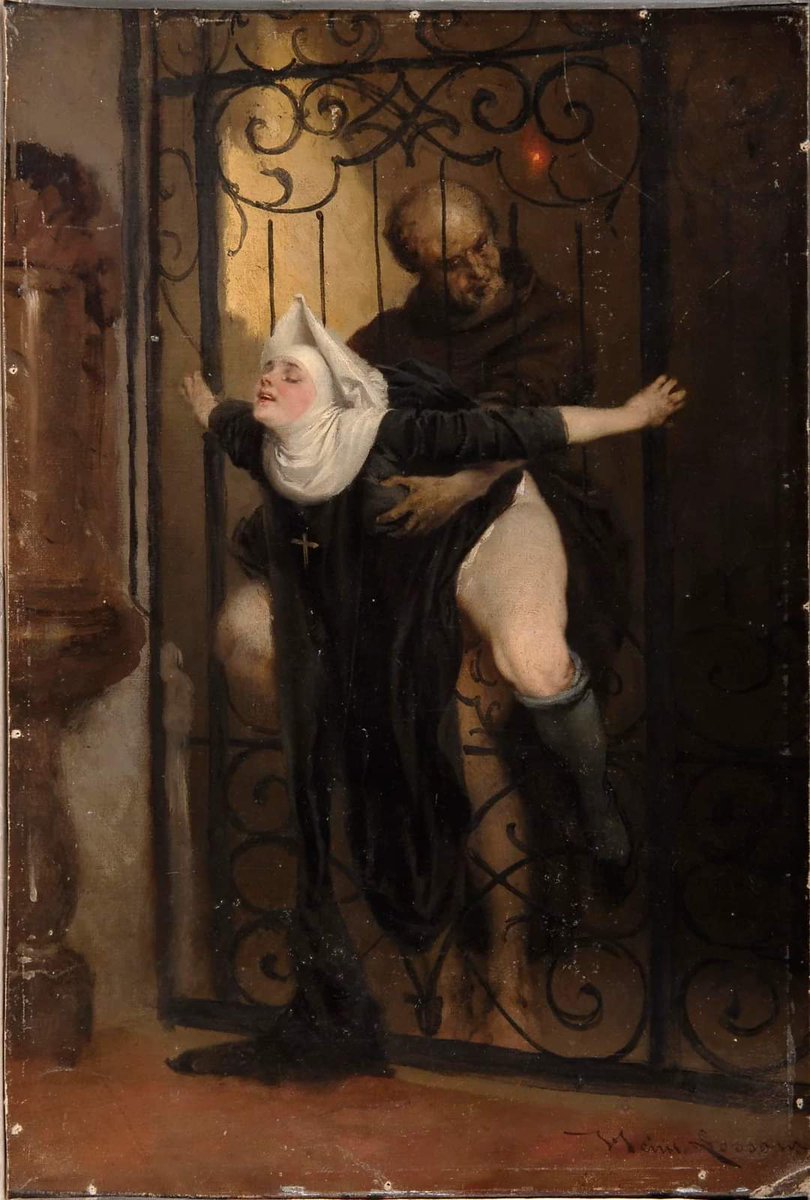
“The Sin” – a captivating and controversial painting created by Heinrich Lossow in 1880. This intriguing artwork alludes to the notorious Banquet of Chestnut, an event that still stirs debate and speculation today. Although some dismiss it as mere rumor, the banquet’s story – filled with shocking details and licentious behavior – has captured the imagination of many over the centuries.

On October 30th, 1501, former Cardinal Cesare Borgia, son of Pope Alexander VI, supposedly hosted a decadent dinner party. The evening’s entertainment, as chronicled by Johann Burchard, featured naked courtesans crawling around amid candelabras, collecting chestnuts using only their mouths. As if that weren’t scandalous enough, prizes were given to those guests who engaged in intimate acts with the courtesans most frequently. Talk about pushing the boundaries!

Interestingly, Lossow’s painting focuses on the sexual aspect of the banquet rather than the chestnut-gathering courtesans. The exact reason for this artistic choice remains a mystery. It’s important to note that the Banquet of Chestnut’s existence is primarily supported by Burchard’s Latin diary, Liber Notarum, and its validity has been a subject of much debate.

According to Burchard, the banquet was held at Cesare’s apartments in the Palazzo Apostolico, with fifty courtesans present to entertain the guests. In his diary, he vividly describes the scene, providing the only known written account of this infamous event:

“On the evening of the last day of October 1501, Cesare Borgia arranged a feast at his chambers in the Vatican with ‘fifty honest prostitutes,’ called courtesans, who danced in the afternoon with servants and other people present, first in their clothes and then naked. After dinner, candelabra with burning candles were removed from the tables and laid on the floor, and around were scattered chestnuts, which the courtesans picked up, while Papa, Cesare, and his sister Lucretia watched. Giving prizes to those who could perform the act often with courtesans. The winners were awarded with tunics of silk, shoes, and other things.”

Despite Burchard’s detailed account, modern scholars have cast doubt on the story of the Chestnut Banquet, questioning its plausibility and pointing out that it appears only in his memoirs.

Lossow’s painting, depicting this salacious tale, caused quite the uproar when it was unveiled. The artist faced harsh criticism from both art critics and the general public, and even the Church condemned him for his brazen portrayal of such sinful activities.

In the end, the truth about the Banquet of Chestnut may never be fully revealed. But one thing is certain: Lossow’s “The Sin” continues to captivate and intrigue us, inviting us to ponder the scandalous events it so vividly portrays.

Despite the heated controversy surrounding “The Sin,” Lossow’s painting has left an indelible mark on the art world and popular culture. Its bold depiction of the alleged Banquet of Chestnut has inspired countless discussions and analyses, making it a fascinating subject for art enthusiasts, historians, and curious minds alike.

The painting has also served as a reminder of the complex and contradictory nature of the Borgia family, whose influence and power during the Italian Renaissance are well-documented. As members of the clergy, the Borgias were expected to uphold high moral standards, but tales of their excesses and debauchery have continued to fuel interest and speculation about their lives.

While “The Sin” might have been criticized for its brazen portrayal of the Chestnut Banquet, it’s important to remember that art has the power to provoke conversation and challenge prevailing attitudes. In this sense, Lossow’s work can be seen as a daring exploration of human nature, desire, and the fine line between fact and fiction.

#archaeohistoriesImage
Over time, the painting has acquired a certain mystique, drawing attention not only for its subject matter but also for the artistic skill and talent of Heinrich Lossow. The detailed brushstrokes, the captivating use of color and light, and the intricate composition of the scene all contribute to the painting’s enduring appeal.

As we continue to marvel at “The Sin,” we are reminded of the power of art to transport us to different times and places, to shed light on the complexities of human behavior, and to ignite our imaginations. Whether the Banquet of Chestnut is a historical fact or an exaggerated tale, Lossow’s painting has undoubtedly secured its place in the annals of art history.

So, the next time you encounter “The Sin” or any other artwork that evokes strong emotions, take a moment to appreciate the artist’s ability to tell a story, spark conversation, and, in some cases, even challenge societal norms. And remember, a painting like “The Sin” is not just a snapshot of a particular event; it’s also a window into the complexities of human nature and the never-ending quest for truth.

As for the current whereabouts of “The Sin,” it’s a bit of a mystery! The painting has had a rather elusive history, and its exact location today isn’t publicly known or widely documented. It’s possible that the artwork is part of a private collection, safely tucked away from the public eye. Occasionally, art pieces like this resurface at auctions, exhibitions, or in the collections of museums, so there’s always a chance that “The Sin” might make a grand reappearance someday.

In the meantime, you can find images and reproductions of the painting online, allowing you to study and appreciate Lossow’s captivating work from the comfort of your home. And who knows? Perhaps one day, the enigmatic “The Sin” will once again be displayed for all to see, sparking fresh conversations and debates around the notorious Banquet of Chestnut and the extraordinary artistry of Heinrich Lossow.

The painting alludes to the scandalous Banquet of Chestnut, an event allegedly hosted by former Cardinal Cesare Borgia, son of Pope Alexander VI. The Borgia family played a prominent role in the politics and religion of the Italian Renaissance, making them a fascinating subject for artists and historians alike.

The primary source of information about the Banquet of Chestnut is the diary of Johann Burchard, a protonotary apostolic and master of ceremonies at the Vatican. Burchard’s account is the only known written evidence of the event, which has led to much debate over the banquet’s historical accuracy.

When “The Sin” was unveiled, it caused quite a stir among art critics, the public, and the Church. The painting’s explicit content and depiction of immoral acts, particularly in connection with the clergy, led to widespread condemnation of Lossow and his work. Lossow chose to depict the sexual aspect of the banquet rather than the chestnut-gathering courtesans. The reasons for this decision remain a mystery, but it has undoubtedly contributed to the painting’s notoriety and allure.

The current location of “The Sin” is unknown. It’s possible that the painting is part of a private collection, hidden from public view. Its secretive nature only adds to the painting’s mystique and intrigue. These tidbits offer a glimpse into the fascinating world of “The Sin” and the story it portrays. Lossow’s painting continues to captivate audiences with its blend of artistry, scandal, and historical mystery, ensuring its place in the annals of art history.
According to the panel for a symposium titled “The Banquet of the Chestnuts: History, Propaganda, or Legacy?” held at a prestigious university. Here is a potential scenario:

Professor Julian Kline: As an expert on the Renaissance, Professor Kline brings a balanced, evidence-based approach to the panel. He suggests that while Burchard’s account is fascinating, it’s necessary to consider the political climate of the time and the possible exaggerations that might have occurred in historical accounts.

Richard Thorn: Thorn passionately questions the Church’s moral authority, citing the Banquet of the Chestnuts as an example of its leaders’ debauchery. He presents it as evidence of the need for secular values and challenges his fellow panelists to consider the implications of such an event on the Church’s credibility.

Father Dominic O’Brien: Father O’Brien, on the other hand, represents the Church’s perspective. He acknowledges past wrongdoings but emphasizes that the actions of individuals like Alexander VI and Cesare Borgia are not representative of the Church’s teachings or of the conduct of many other Church leaders.

Dr. Isabella Rossi: Dr. Rossi, drawing upon her knowledge of the Renaissance era, provides a broader cultural context to the discussion. She argues that the event, if it occurred as described, mirrors the decadence and hedonism prevalent among the wealthy and powerful of the time.

Sarah Martin: As a high school teacher, Martin emphasizes the moral implications of the banquet. She advocates for learning from history and using past missteps as cautionary tales to instill values of responsibility and integrity.

Carlos Borgia: As a direct descendant of the Borgia family, Carlos brings a unique perspective. He shares his family’s side of the story, acknowledging their notorious reputation but also challenging the panel to consider the role of political propaganda in shaping historical accounts.

This group provides a diverse range of perspectives, and their discussions would likely offer a comprehensive understanding of the Banquet of the Chestnuts and its significance.

Moderator: Welcome, esteemed panelists. Today, let’s delve into the notorious Banquet of the Chestnuts and its depiction by Heinrich Lossow in “The Sin.” Let’s start with a key question: do you believe the event as described by Burchard actually took place? Julian, let’s start with you.

Professor Julian Kline: The historian in me is skeptical about accepting Burchard’s account wholesale. It’s very detailed and salacious, which makes it compelling, but we must remember the political context. The Borgias had many enemies, and it would not be surprising if accounts of their activities were exaggerated or even fabricated to damage their reputation.

Father Dominic O’Brien: I echo Julian’s skepticism. It’s important to remember that many in the Church, both then and now, have led lives of piety and humility. While we know that there were certainly individuals who did not uphold these virtues, such scandalous stories can often be products of political agendas rather than truthful accounts.

Richard Thorn: That seems like a convenient explanation, but we also can’t dismiss the account because it’s uncomfortable. The fact is, such accounts are part of a long history of alleged misconduct by church leaders. Could Burchard’s account be exaggerated? Possibly. But that doesn’t mean it’s entirely false.

Dr. Isabella Rossi: What we need to consider is the spirit of the times. This was the Renaissance, after all – an era of excesses and indulgence for the powerful. While we can’t ascertain if the event took place exactly as described, we can’t dismiss the possibility of such an event happening in that cultural and historical context.

Sarah Martin: Regardless of whether the event actually happened, its story serves as a stark reminder of the dangers of unchecked power and corruption. These historical accounts have their value in teaching us important lessons.
Read 5 tweets
Sep 14, 2025
Most people in the West today associate genies with lamps and wishes and certain quirky magical powers. This is largely thanks to a few pieces of popular media, including I Dream of Jeannie and Disney’s version of Aladdin with that unforgettable blue genie who steals the show.....

Genies are actually supernatural creatures with an incredible past that stretches back 5,000 years. They’re malevolent tricksters, benevolent spirits, and everything in-between. Many people today even believe genies are real, though they don’t expect them to grant any wishes. At least, not willingly, and not without some ironic consequences.

Genies, or jinn/djinn as the Arabic word is usually Romanized, come from a long line of mythological creatures dating back to the third century BC. They’re often called demons or spirits, but that doesn’t quite line up with our modern Western concepts of those words.

Jinn are intelligent, free-willed creatures who live close to nature and are endowed with all sorts of magical powers. Some of them are good, helping people and obeying the law, but some are evil; they trick humans and cause all kinds of mischief. Still more jinn sit somewhere between pure good and evil, making them quite complex as far as mythological characters go. Jinn are even said to have banded together into tribes, formed their own religions, and written laws to govern their cities.

Jinn were supposedly created by god out of the “fire of a scorching wind” or “smokeless flame,” giving them certain wispy and changeable characteristics. This is in contrast to humans who were sculpted from mud and clay, making us firm, solid, and not so changeable or mysterious. Compare a mysterious warm wind blowing out of the far desert with a clay pot and you’ll get an idea of the flavor difference, there.

The race of jinn is filled with different categories or classes of spirits. These include the rebellious shaitan (a proposed inspiration for Satan), ifrit (a particularly strong and cunning type of jinn), and the extremely powerful and dangerous marid. In ancient stories, marid jinn are usually the ones we find imprisoned in bottles. Sort of makes the jinn’s transition into cuddly, friendly genies a little more dramatic, doesn’t it?

Details of what powers jinn have varies greatly between sources. They’ve been said to transform into wolves, birds, and reptiles; they can dive to bottom of the sea where one located pearls as large as eggs; they can even vanish, teleport, and both weave magic carpets as well as command them to fly. One tale insists genies created a magic carpet 27 miles in length.

One constant in the legends is that genies are tricksters who delight in playing pranks of both harmless and harmful kind. They can also change their appearance at will, owing to their creation out of fire or wind. They do seem to follow some patterns in their choice of physical manifestations, however, favoring perfect copies or twisted likenesses of humans, various types of animals, and even human/animal hybrids.

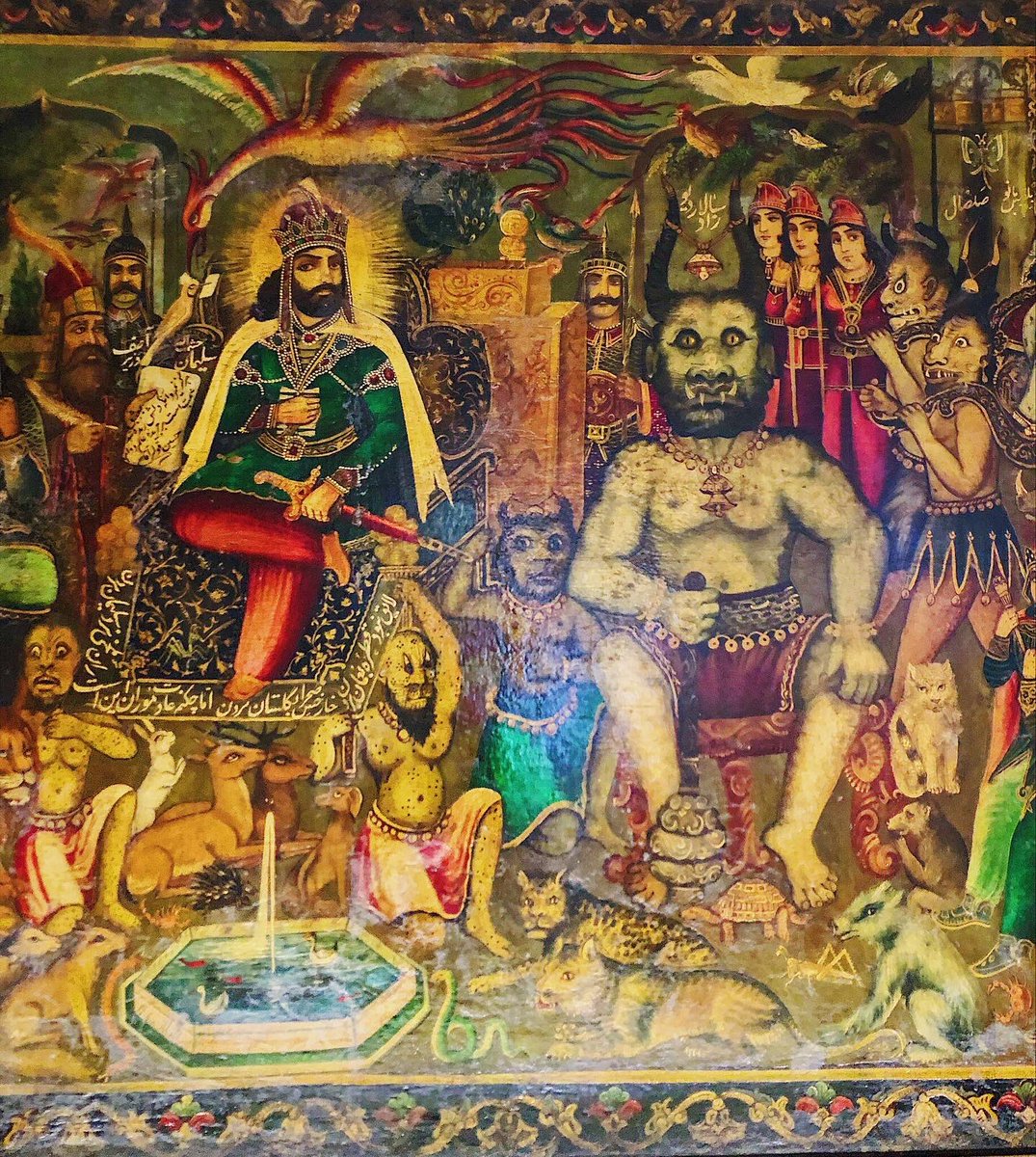
And then there’s a 12th century story of Queen of Sheba, who was said to have a human father and jinn mother. This story insisted jinn always have thick fur on their legs and the hooves of a donkey, no matter which form they take. This was actually used in identification of genies even while they’re in disguise, as it was in unmasking the queen of Sheba as half jinn. If you saw someone who always hid their legs or had a suspicious amount of hair there, you could be pretty sure they were of the jinn.

But jinn can also take on more bizarre and unsettling forms, like description below from same sources of Sheba legends:

“Jinn came in every shape and size, some with hooves, with long tails and flapping ears; some with bodiless heads and headless bodies.”

📷 : Iranian painting of Queen Sheba at King Solomon’s court surrounded by jinn. The painting is in Iranian coffeehouse painting style, located at Tehran’s Moghadam Museum.

#archaeohistoriesImage
Just imagine a procession of disembodied heads and headless, hairy-legged, hoofed creatures shambling by. Doesn’t exactly make you want to go out and ask them to grant any wishes.

According to legends, the race of jinn eventually angered god, which led to their destruction. Only a small group of the most faithful were left intact. The remaining jinn scattered across the world, only appearing to humans when they wanted to cause mischief or harm. Their cities crumbled, their culture vanished, but the jinn themselves are still said to be around, they’re just not as common or numerous as they once were.

Tracing the history of jinn is a gigantic task that offers very little in the way of definitive answers. It’s difficult to locate reliable or consistent sources, partly because we’re digging through thousands of years of stories written or passed orally by different people in different cultures across centuries of time.

This does leave us with an interesting breadcrumb trail to follow, though: language. If we take a brief look at the word “jinn” and its cognates, we find some pretty tantalizing clues about genies, especially their constant relation to lamps and wishes in the West. Keep in mind that tracing linguistic history isn’t an exact science and many experts disagree on the details below. Still, in the world of genies, we’ll take what information we can get our hands on.

In 1st Century AD, Roman empire reached the borders of what is modern day Syria. Here, the people of the city of Palmyra had their own interpretation of jinn legends that was a little different from the history we described before.

A Palmyran gny (sometimes jny or ginnaya) was a spirit of sorts that watched over people, homes, and families like a guardian angel. No curses or wishes or mischief, just benevolent beings looking out for mankind. It’s this interpretation of jinn that was reinforced in ancient Roman culture and would eventually make its way to the modern day West.

The Latin word genii refers to benevolent attending spirits such as this, not their older, more sinister cousins. The singular form of genii is genius (pronounced like gay-nee-oos), which is actually related to the modern English word genius. Back in the day, people who were intelligent, creative and talented attributed those qualities to their genius, their guardian spirit. If you were a genius, you could thank your genius for that.

Fast forward 1,600 years or so and this definition has only gotten stronger. The root form gen- found in words like genie means to produce, create or inspire; or a warm or cheerful manner. Modern English still carries those fragments in words like generate and genial. This gave the English speaking world of the early 1700s even more reason to assume genies were a certain way, instead of their ancient Middle Eastern selves.

Today, whenever you see the word genie, jinn, djinn, or any number of variant spellings, you’re usually seeing different forms of the same word. This is because transliterating Arabic script into the Roman alphabet isn’t a precise endeavor. Inevitably different words will be rendered in different ways, which has led to handfuls of different spellings over the centuries.

In the beginning of 18th Century a collection of stories made its way to Europe that Westerners today are still pretty familiar with: Arabian Nights, also called One Thousand and One Nights.

Antoine Galland was a French orientalist and archaeologist who was the first to translate the Arabian Nights stories for a European audience. The initial volume appeared in French in 1704, and eleven more volumes would follow over the next dozen years. The English language version would release a decade or so later, then known as The Arabian Nights’ Entertainment.
When Galland came across the Arabic word jinni, he thought it sounded a lot like the French word génie (zh-yee-nee). But jinni referred to demons or spirits of old, and génie was closer to the guardian spirit definition originating in Latin. Galland simply used génie to refer to jinn, which was accurate in many ways, perhaps inaccurate in others, but still a decent fit. This act formally united the two meanings under one word. Now, referring to a genie could either mean a mystical spirit from the Arabian world, or a benevolent spirit that watched over people.

We have an idea of where genies came from and how they lost some of their ancient mythological status and became tame. Now let’s get into this business of genies, lamps, and wishes.

The stories in Arabian Nights had been floating around the ancient world for hundreds or thousands of years before Europe got wind of them. When Galland brought the tales to France and saw how popular they were, he actually added a few new stories to the collection. These were reportedly relayed to him orally by a Syrian storyteller Antun Yusuf Hanna Diyab, who is likely the original author.

What were these add-on tales? They included Ali Baba and the Forty Thieves and Aladdin’s Wonderful Lamp. These are tales most westerners immediately associate with Arabian Nights, yet they were written and added to the collection in the modern era. That doesn’t mean they aren’t fantastic tales, of course, just that they aren’t exactly ancient.

Aladdin brought with it a serious genie/bottle connection that is likely the reason modern genies are always trapped inside them. We’ll get to that in just a second. Before Aladdin, though, Arabian Nights did connect genies with bottles and genies with wishes, just not in such an obvious or memorable way.

The Arabian Nights tale “Story of the City of Brass” follows a group of travelers searching the Sahara to find a lost city. Of brass. Their side-quest is to locate a vessel that supposedly held a jinn imprisoned by King Solomon. The life of Solomon and his god-given jinn-controlling ring is a fascinating topic on its own, but this seems to be the first legend that trapped a genie in a small container.

In another story from Arabian Nights a fisherman actually discovers this brass vessel and opens it. A gigantic evil jinni named Asmodeus immediately pops out. After being trapped for 400 years, Asmodeus wasn’t in the greatest of moods. He reveals he has long contemplated how to reward/punish the one who freed him from his prison. One of his ideas was to grant this person three wishes. (Instead, he lets the fisherman choose how he will be killed.) This seems to be the earliest specific reference to three wishes being granted by a freed genie.

Back to Aladdin. In the original tale, Aladdin is recruited by a sorcerer to retrieve an oil lamp from a magic cave filled with traps. The sorcerer gives Aladdin a ring that’s supposed to protect him in this cave. Far into his journey, Aladdin starts to fret and rubs his hands together. A genie pops out of the ring and whisks Aladdin back home, oil lamp in tow. Aladdin’s mother sees the lamp is dirty and decides to clean it. Rub rub rub, another more powerful genie appears, this one bound to do the bidding of whoever holds the lamp. Aladdin becomes rich and powerful, the sorcerer comes back to stir up trouble, people die, other people live happily ever after, so on and so on.

This formed a pretty solid connection between genies, lamps, and wish granting. Because the Aladdin story was immensely popular, it entered the 18th century’s version of pop culture and has been passed on and expanded upon ever since.
Read 4 tweets
Mar 11, 2025
Mesopotamia - “the land between two rivers” gave birth to many of the world’s first great cities. The splendid city of Babylon, located between the waters of the Euphrates and Tigris some 97km south of Baghdad 🇮🇶, was one of them. Unlike the many towns that fell and disappeared, Babylon was resilient, rising from its own ashes time and again, even as new conquerors invaded and took over. The pleasure its occupiers enjoyed came at a price, however, since the highly desired Babylon would always be seen as a prize for the taking.

Babylon has resonated in Judeo-Christian culture for centuries. The books of the Old Testament recount the exile of the Jews to Babylon following the sack of Jerusalem, by whose waters they “sat down and wept.” By the time of the New Testament, the city had become a potent symbol: the corrupt earthly twin city to the pure, heavenly New Jerusalem.

Outside the biblical tradition, Babylon intrigued Greek and Roman writers, who added to the rich store of legends that have come down to the present day. The Greek historian Herodotus wrote about Babylon in 5th Century BC. A number of inconsistencies in his account have led many scholars to believe that he never traveled there and that his text may be closer to hearsay than historical fact. Popular tales of Babylon’s fantastic structures, like the Tower of Babel and the Hanging Gardens, may also be products of legends and confusion. Yet to historians and archaeologists, Babylon is a real bricks-and-mortar place at the center of the vibrant Mesopotamian culture that it dominated for so many centuries.

The site of Babylon was first identified in 1800s in what is now Iraq. Later excavations, undertaken by German archaeologist Robert Koldewey in late 19th and early 20th Centuries, established that the city had been built and rebuilt several times, most notably on a lavish scale by its king, Nebuchadrezzar II (r. 605–561 BC). Koldewey’s finds revealed an ancient locus of culture and political power. These excavations unearthed what was to become one of the most magnificent Babylonian landmarks built by Nebuchadrezzar II: the dazzling blue Ishtar Gate, now reconstructed and on display at the Pergamon Museum in Berlin.

Babylon first rose to prominence in the late Bronze Age, around the beginning of 2nd millennium BC, when it was occupied by people known as the Amorites. A series of strong Amorite kings—including King Hammurabi, famous for compiling the world’s first legal code, enabled Babylon to eclipse the Sumerian capital, Ur, as the region’s most powerful city. Although Babylon declined after Hammurabi’s death, its importance as the capital of southern Mesopotamia, now known as Babylonia, would linger for millennia.

For the rest of 2nd Millennium BC, constant struggles popped up over control of Babylon. It was successively occupied by Hittites and Kassites; later, Chaldean tribesmen fought for dominance with another tribe, the Aramaeans from Syria (a tribe that had also sparred with Israel). By 1000 BC, Assyrians, who had established a powerful empire in northern Mesopotamia, gained the upper hand. But despite periods of stable rule, Babylon would always fall to someone else. Given this pattern of constant conquest—Cyrus the Great in 6th Century BC, and Alexander the Great two hundred years later—it is perhaps more helpful to see the city not as one Babylon, but as several Babylons, the product of traditions built over thousands of years.

Babylonians themselves were keenly aware of the great antiquity of their civilization. One of Nebuchadrezzar’s successors, Nabonidus, is now known to modern historians as “the archaeologist king.” A learned man, he restored region’s ancient architectural and cultural traditions, especially those from Akkadian Empire, which had dominated Mesopotamia in 3rd Millennium BC, a period that, from perspective of his own era, would have already seemed in the distant past.

🎥© AI MediaTek
© National Geographic

#archaeohistories
Babylon enjoyed its heyday during 7th-6th Centuries BC, when it was believed to be largest city in the world. A new dynasty founded by a tribe known as the Chaldeans had wrested control from Assyrians in early 600s BC. The second ruler of Chaldean line became notorious for both cruelty and opulence: Nebuchadrezzar II, the king who sacked Jerusalem and sent the captive Jews to the capital of his new and increasingly powerful regional empire.

A successful military man, Nebuchadrezzar used the wealth he garnered from other lands to rebuild and glorify Babylon. He completed and strengthened the city’s defenses, including digging a moat and building new city walls. Beautification projects were on the agenda as well. The grand Processional Way was paved with limestone, temples were renovated and rebuilt, and the glorious Ishtar Gate was erected. Constructed of glazed cobalt blue bricks and embellished with bulls and dragons, the city gate features an inscription, attributed to Nebuchadrezzar, that says: “I placed wild bulls and ferocious dragons in the gateways and thus adorned them with luxurious splendor so that people might gaze on them in wonder.”

Babylonian citizens saw their city as a paradise—the center of the world and symbol of cosmic harmony that had come into existence when its supreme divinity, the god Marduk, defeated the forces of chaos. The spread of the cult of Marduk across Mesopotamia was proof of Babylon’s prestige. No ancient city was so desired and feared, so admired and denigrated. But in the Hebrew tradition, Nebuchadrezzar was a tyrant, and Babylon a torment. The king had conquered Jerusalem in early 6th century BC and exiled Hebrews to Babylon. The Bible says that he also stole sacred objects from the Jewish temple and took them back to Babylon to place in the temple of Marduk.

To punish his disrespect, the Bible recounts in the Book of Daniel how Nebuchadrezzar’s line will fall. In the story, Belshazzar, successor to the throne, holds a feast served on the sacred vessels looted from Jerusalem. During the festivities, a ghostly hand appears, and strange writing appears on the wall, forming the mysterious words: Mene, Mene, Tekel, Upharsin. The exile Daniel is brought in by the terrified king to interpret the writing on the wall. Daniel reads it as: “God has numbered the days of your kingdom ... [it] is given to the Medes and Persians.”

Daniel’s prediction did come to pass: In 539 BC, Babylon fell to the Persian king Cyrus the Great, and the Jews returned home from exile. The city would be conquered two centuries later by Alexander the Great in 331 BC. Although Alexander had planned to make Babylon the capital of his empire, he died before that came to pass. The great city would eventually be abandoned by his successors, and the splendors of Babylon would pass into the realm of legend.Image
One of the most famous stories about Babylon is that of the Tower of Babel, a story that some biblical scholars believe may be based on a mistranslation, or ingenious pun. The Book of Genesis tells how the survivors of the Great Flood wanted to build a tower that would reach the heavens, but God smites the builders for their arrogance and disperses them over the Earth, where they are forced to speak many different languages.

The story originates in a Hebrew belief that the name Babel was formed from the Hebrew word meaning confusion or mixing up (and from which the English word “babble” is derived). Ironically, this interpretation was itself a confusion of languages. In Akkadian, the root of the words Babylon and Babel does not mean to mix; it means “gateway of the gods.”

Archaeologists believe that the tower referenced in the Bible story may be the Etemenanki, a giant ziggurat in Babylon dedicated to Marduk. Its name means, suggestively, the “temple of the foundation of heaven and earth,” which dovetails with the names mentioned in the story. When it was surveyed in 1913, the Etemenanki revealed that the tower that supposedly reached right up to the heavens would have been, in reality, nearer 61 meters (200 feet) in height.

Another colorful story to come out of the ancient city is that of the fabulous Hanging Gardens of Babylon, one of the Seven Wonders of the Ancient World. There are many theories surrounding the gardens, from their exact location to the identities of their builders. Some suggest the gardens formed a part of the royal palace in Babylon itself, while others believe they were built in another city altogether. One origin story claims that Nebuchadrezzar had them built for his wife, Amytis.

In the course of Koldewey’s excavations of the ancient city, his team identified a mysterious structure in one corner of Babylon’s southern palace. It was made of 14 long rooms with vaulted ceilings laid out in two rows. A complex of wells and channels were found at the site. Even amid the academic atmosphere of this project, a certain willingness to believe in Babylon’s fantastic stories lingered. Was this the infrastructure that supplied the legendary Hanging Gardens of Babylon? The scholarly consensus has a rather more prosaic theory as to this structure’s role: a storehouse used for the distribution of sesame oil, grain, dates, and spices.Image
Read 4 tweets
Feb 24, 2025
Slave Market in ancient Rome (1884 CE), by Jean-Léon Gérôme (1824-1904) :

It depicts an Ancient Roman slave auction in progress. At the center of a high dais is a completely nude woman having been recently undressed by the slave dealer situated to her right, who is displaying her to the crowd as they bid on her. The woman shields her eyes with her right hand due to the humiliating predicament of being publicly exposed in front of such a large crowd. Another nude young woman sits fearfully at the first woman's feet, covering her breasts with her legs in a protective pose, however, this leaves her genitals exposed to the crowd. Behind her is an older clothed woman holding an infant, she is surrounded by two naked children who she is probably the mother of. Her face has a look of dread as she knows she is to be auctioned soon, most likely being separated from her children forever. Behind the auction booth, two men are keeping an account of the sales, with a row of enslaved men looking on from behind them. It is one of his six slave-market scenes set in either ancient Rome or 19th Century Istanbul that Gérôme painted during his career....

Slavery was considered normal in virtually all cultures in ancient times, and the Romans were no exception. The portion of the population that was enslaved varied across the Empire, with an estimated 15% Empire-wide. Overall, perhaps one household in seven owned slaves, but rates of ownership were much higher in Italy and Sicily. In those regions, perhaps as high as 30% were slaves during the early Empire.

Slavery was the engine that powered parts of the Roman economy and supported the elite Roman lifestyle. It was fueled by massive influxes of men, women, and children captured during Rome’s military campaigns. As the Republic and then the Empire expanded to its greatest extent under Trajan, more than a million persons from regions as distant as Judaea and Britannia lost their freedom. Each conquest pumped a fresh supply of cheap labor toward the estates, businesses, and homes of rich and average citizens alike.

With an economy so dependent on slave labor, it is no surprise that the Roman state chose to regulate the trade in slaves. The slave markets were under the administrative authority of aediles in Rome and quaestors in other locations. Sales were documented by the exchange of a witnessed bill of sale.

For the poor soul who had just been enslaved, the slave market was a rude introduction to the debasing life that awaited them. “Full disclosure” was the rule for slaves and cattle in what was usually a caveat emptor commercial world. Slaves on the auction block were displayed naked so potential buyers could thoroughly inspect before bidding. A placard was hung around the neck of each slave that revealed (from a buyer’s perspective) the positive and negative characteristics of the person for sale. The seller (mango) was required to provide correct information about the geographic origin of the slave, any known health problems, tendency to run, attempted suicides, and any other known ”defect.” The placard also had to reveal whether the slave was undischarged from noxa, i.e., had committed an offense for which the owner was responsible either to pay restitution or to hand over the slave.

Roman law provided for “return for refund” if an unreported defect was found within six months after purchase. If a slave had an undisclosed health problem, even if the seller had no way to know about it, the slave could be returned for a full refund of the purchase price.

#archaeohistoriesImage
The number of slaves a person owned was a conspicuous measure of wealth. While the private home of an average person living in Rome might use five to twelve slaves, the urban residence of the elite might have up to five hundred performing tasks that only needed a small fraction of that total. A large agricultural estate might employ two or three thousand.

The low status of a slave was evident in the legal Latin term for one: res (a thing, an object, property). In Digest (a compilation of centuries of Roman law written in AD 533), a slave is a res mortales (mortal thing) whose injury is treated as simple damage to property.

The standard terms for farm slaves further illustrate the subhuman status of slaves. A farm implement, like a plow, was an instrumentum. The ox pulling the plow was an instrumentum semivocalis. The slave driving the ox was an instrumentum vocalis, a talking tool. Their lodging was an ergastulum (private prison), and on some estates, farm slaves might sleep and even work in chains.

But as brutal as life could be for a Roman slave, there was hope for not just freedom but a bright future. The children of a slave freed by a Roman citizen became Roman citizens with full rights themselves. Publius Helvius Pertinax, the son of a freed slave, even became emperor. In this, Roman slavery was fundamentally different from the practice in much of the world.

Slaves could be privately or publically owned. Their living conditions and opportunities were highly variable, depending on the temperament of their owner and the nature of their assigned work.

Private Slaves :

Private slaves were broadly divided into two categories: urban slaves (familia urbana) and country slaves (familia rustica). The former often had well-defined and rather limited duties, with plenty of time for going to the baths, running their own small businesses on the side, and waiting for orders in the company of other slaves. They frequently became familiar and even friends with their masters; the gift of freedom (manumission) was not uncommon during the owner’s lifetime or in his will.

The farm slaves usually served under a slave or ex-slave overseer (vilicus), who worked them from dawn until dusk, seven days a week, until they wore out and were disposed of accordingly. Unless an owner decided to free a fraction of his farm slaves in his will, servitude was usually until death.

As a general custom, a master would give his slaves a sum of money (peculium-slave’s purse) to spend as they chose. Although the peculium technically belonged to the master and he could take it back at any time, slaves were often allowed to accumulate the money and apply it toward purchasing their freedom. Urban slaves often had some free time for activities that could earn extra money. Technically, this also belonged to the master, but it was commonly treated as belonging to the slave.

Particularly talented slaves might serve as business agents for their owners. As living “things” (res mortales), slaves could not make legally binding commitments on their own. The peculium was the basis for the legal rules where a slave was an agent pledging his master’s credit in trade and contracts with third parties. The chief steward (dispensator, procurator) for many of the elite was a trusted slave or a former slave who had been freed for his excellent service.Image
Public Slaves :

Cities and towns often owned slaves directly and used them for public works, such as building roads, maintaining aqueducts, and cleaning and maintaining sewers and public accommodations such as latrines and public baths. The number was limited by the common practice of contracting out public services. For some crimes, the convicted person might be sentenced to a term of service on the same projects as public slaves.

Private slaves in public offices
Roman government was based on the often unpaid service of the wealthy elite. The nobleman who was elected or appointed to a government post was expected to provide his own administrative staff. These normally came from among his slaves and clients (freedmen and others who depended on the noble patron for personal favors). The practice extended even to emperors in the early Empire. Until the reign of Claudius, the close personal assistants of the emperors were almost entirely the emperor’s own slaves. Trusted slaves handled petitions coming in and instructions going out, acting as gatekeepers with exceptional power over what received the emperor’s attention. Some men chose to enslave themselves for the opportunity for such service, with the expectation that they would be freed later with the emperor as their patron and unlimited opportunities because of that.

The emperors from Claudius to Trajan employed their freedmen as their inner cabinet, men whose skills were known and whose loyalty could be trusted (except for the ones who assassinated Domitian). Hadrian changed the practice by requiring his immediate cabinet to be men of the equestrian order, but the execution of the real work under them was still the responsibility of the slaves and freedmen of the equestrians.

Even though it was officially a degradation of status, free women often married the servi Caesaris and the liberti Augusti who were the civil servants of the Empire. Many emperors valued the loyalty resulting from the hereditary service of fathers and sons. The slaves were often manumitted at the minimum age of 30 to become freedmen with all the advantages of being the client of an emperor. The fortunate ones were also awarded the “gold ring” or received a “restitution of free birth” ruling that allowed the former slave to become an equestrian if he had the required 100,000 denarii.

Penal Slaves :

For the same crimes that might send a member of the senatorial or equestrian orders into exile for a period of time, the ordinary citizen or peregrine might be sentenced to a term of service on public works projects, with or without accompanying fines or substantial loss of property.

A free man convicted of some crimes might be stripped of all property and made a permanent slave. A sentence of damnatio ad metalla sent the condemned man to work in the mines or quarries. An alternative sentence was ad gladium, which sent him to a gladiatorial training school. Both ad metallum and ad gladium were essentially death sentences after the state got some work or entertainment out of the condemned man.

A slave convicted of a crime was often executed immediately after trial by crucifixion or by being killed and eaten by beasts (damnatio ad bestias) as the morning or midday event in an area.Image
Read 5 tweets
Feb 16, 2025
An amazing stone slab carving showing a woman giving birth (11, 600 years old) From Gobekli Tepe 🇹🇷 the Archaeological site of the Worlds oldest known religious structure. Predating Stonehenge by over 6000 years. Discovered by Klaus Schmidt it features Megalithic Stone Slabs arranged and Carved with Abstract Animal and Plant Designs, done by a Prehistoric/Neolithic hunter gatherer people.

The eminent pre-historian Andrew Collins has just released a book of extreme importance for posture research—Göbekli Tepe: Genesis of the Gods. The experiments with more than 80 ritual body postures used by humans to access shamanic states for at least 36,000 years should be investigated by anyone who wants to thin the veil obscuring the Göbekli Tepe shamanic cultists.

Klaus Schmidt, who has so far excavated four out of the twenty or so anticipated carved and incised circles of T-shaped stones, says they were used for rituals; they were sanctuaries. Geophysical surveys have detected many more circles, yet only about five percent have been excavated. Nearly all researchers believe these circles were sacred space. Schmidt, an archeologist with German Archeological Institute and University of Heidelberg, began his excavation in 1995. The public began hearing about this amazing site around 2000. Local inhabitants of the bleak plateau at the southern limits of the Anti-Taurus Mountains 8 miles northeast of Şanlıurfa, Turkey, refer to the “tell” or hill covering the site as Göbekli Tepe, which means “Hill of the Navel” in Turkish, or some say “Potbelly.” This name going way back in time is local ancestral memory that suggests pregnancy. The oldest carbon dates at the site are Pre-Pottery Neolithic (PPNA) going back to 9500-8500 BC, which really got my attention.

Catastrophobia describes a series of cataclysms 13,000 to 11,500 years ago during the Younger Dryas, a mini ice age that ended abruptly 11,500 years ago. Scientific analysis of this period, in particular by science historian, D.S. Allan, and Oxford-based geologist and anthropologist, J. B. Delair, describes a cosmic disaster 11,500 years ago that disarranged the solar system and severely impacted Earth. (1) This trauma changed human consciousness, and hunter-gatherers learned to farm. Those who survived during a few thousand years more of dramatic climate change and rising seas were a multi-traumatized species afflicted with what I call catastrophobia—extreme fear of starvation and chaos. This word is catching on now that paleoanthropologists have completed an accurate picture of global migrations and settling during the last 100,000 years. (2) Ironically, at first the word didn’t get much attention because the book was released when the World Trade Towers crumbled to the ground in September 2001. Regardless, evidence for the cataclysms followed by a human cultural regression has been building since the 1950s, when Immanuel Velikovsky’s Worlds in Collision sold millions of copies ripping open repressed memory. (3) Maps of the Ancient Sea Kings by the cartographer Charles Hapgood inspired the eminent new-paradigm writer Graham Hancock to explore these mysterious mariners. Hancock describes a seafaring global culture that lived before 12,000 years ago on the continental shelves now inundated by rising seas. (4) This new paradigm captivated the public mind, so my publisher asked me to update Catastrophobia. This clarifying picture of the past is magnificent support for our discoveries of the postures used by shamanic cultures for 50,000 years.

© Şanlıurfa Archeology Museum

#archaeohistoriesImage
The 2011 edition of Catastrophobia titled Awakening the Planetary Mind: Beyond the Trauma of the Past to a New Era of Creativity has a whole new audience. Bored by old-paradigm Darwinian archeology that claims the human species has always advanced, young researchers hear me when I say we are a very damaged species because we were almost destroyed. Seeking what really happened to us so recently, they paint and pierce their bodies like hunter-gatherers at the end of the last ice age! Meanwhile, the recovery of our real story makes us realize people did survive radical climate changes, information that young people know they may need. Well, Göbekli Tepe goes right back to these great changes, so it is a gateway that can help us imagine who we were before we regressed. I think cosmic contact was severed 11,500 years ago. The recovery of the advanced astronomical knowledge of our ancestors is piercing the pain of human separation from the universe. Andrew Collins said to me in a recent email that he “probably didn’t fully understand the term catastrophobia until I started to piece together the motives behind the construction of Göbekli Tepe some 12,000 years ago. Then suddenly it all made sense! God, those people must have lived in fear, and without psychologists in those days, it was a matter that could only be rectified by shamans, which is exactly what I think happened.”

I’ve been thinking about the evocative circles filled with great humanoid beings for ten years. Göbekli Tepe appears to be a temple built by the survivors of the great cataclysm, a truly monumental achievement considering their probable state of mind and the amount of work to construct it. Archeologists estimate up to 500 individuals were needed to extract each pillar from nearby quarries and erect them, and there are thought to be around 200 large pillars in total at the site. Also I wondered whether the pillar of the humanoid figure with long oddly bent arms and long fingers reaching into their groins was a posture. When I was mentoring Marianne Carroll in 2011, she wondered the same thing, and we’ve been exploring it since.

Back to 1999, I was struck by exactly the same hand position on the Nevali Çori pillar, a nearby ancient cultic site. My illustrator drew this pillar for Catastrophobia from a photo taken at Nevalı Çori by Andrew Collins. I chose it to awaken ancient memory in my readers, since this beautiful place was about to be inundated by a dam. Considering the hand positions—oddly bent elbow and long fingers clutched under the belly that appears to be pregnant—anybody who knows our postures would immediately think “Birthing Posture!” Goodman says, “the pivotal, the most significant, rituals of the hunter gatherers and later of the horticulturalists, who created these figurines, centered around the celebration of birth.” She also said way back in 1990, “Some of these figures [Birthing Posture] are quite large and may well have marked the sacred places where such important rites were celebrated.”

The same hand and arm positions exist on the torsos of the Easter Island heads (Moai) statues that are relatively the same height (15 feet) as the Göbekli Tepe humanoids. In 2010, when archeologists dug down below the heads, they were resting on bodies with same odd hand position. When I saw the first photos of these unburied torsos, I was astonished to see they closely match the size, arm, and hand positions of the Nevalı Çori and Göbekli Tepe pillars..
These widely separated tall humanoids in the Birthing Posture suggest that a global shamanic culture used this posture. Goodman catalogued Bear Posture figurines that are found in virtually all pre-historic sites on both continents going back to 8,000 years ago, the sure sign of an originating culture thousands of years earlier. (11)Were survivors using the Birthing Posture for procreation, even to enhance their DNA? Think of how precious each child would have been! Andrew Collins came up with the same idea from a completely different perspective, a synchronicity that makes me think we are identifying the essential shamanic practices of post-cataclysmic cultures. Let’s look at what Collins has discovered.

Collins uses archeo-astronomy (dating the alignments of ancient sites by precession of equinoxes) to investigate the activities of the Göbekli cultists. Seeking the originating culture of this advanced site, he goes farther back to 17,000 years ago, before human culture regressed. He was the ideal researcher to do this because of his earlier studies of regional archeology in From the Ashes of Angels, and of late Paleolithic archeology in The Cygnus Mystery. In The Cygnus Mystery, Collins posits our ancestors believed life (DNA) originated in the heavens, specifically in the region of the Cygnus constellation. This is because Paleolithic sites, such as Lascaux Cave, many megalithic sites, and the Giza Plateau pyramids all have symbolism and orientations to Cygnus because its brightest star, Deneb, was the Pole Star for a few thousand years starting 18,500 years ago. Also, cosmic rays from Cygnus X-3 have impacted human evolution to be discussed in a moment. Gazing out past the Pole Star’s location by precession, many ancient cultures believed this part of the sky was a birthing region, a place of human origin. This region of the sky was sacred to the ancient Egyptians, and to the Maya as Xibalba, the great dark rift of the Milky Way. Finding these specific cosmic orientations in widely separate cultures suggests the existence of a pre-cataclysmic sky religion practiced by advanced astronomers.

Cygnus X-3 is a unique “microblazer” that spews to Earth a broad spectrum of frequencies from radio waves to gamma rays and even cosmic rays. In fact, Cygnus X-3 is one of the only accepted sources for high-energy gamma rays and cosmic rays reaching the earth. Moreover, a “growing number of scientists are considering that cosmic rays might have played a role in human evolution (my italics) causing either mutations in DNA, or even the deletion of DNA sequences . . .” Did these ancient cultures use the Birthing Posture to enhance their DNA? A US think tank went public in 2005 with its conviction that a binary system (Cygnus X-3) producing powerful jets of cosmic rays triggered a rapid acceleration in human evolution during the last ice age. You will need to study The Cygnus Mystery to consider this astonishing possibility. For my purposes in this short paper, in 2006 Collins presented clear evidence that this region of the sky inspired global cultic beliefs 17,000 years ago. With more consideration of the influence of Cygnus, Collins thinks survivors at Göbekli were multi-traumatized, yet they still managed to build this sacred temple to record their knowledge of human cosmic contact with our place of origin in the heavens. And, they carved beautiful examples of Birthing Posture to save their precious knowledge of procreation. There’s more: Pillar 18 in Enclosure D (Figure-1b) at Göbekli targets Cygnus.
Read 7 tweets

Did Thread Reader help you today?

Support us! We are indie developers!


This site is made by just two indie developers on a laptop doing marketing, support and development! Read more about the story.

Become a Premium Member ($3/month or $30/year) and get exclusive features!

Become Premium

Don't want to be a Premium member but still want to support us?

Make a small donation by buying us coffee ($5) or help with server cost ($10)

Donate via Paypal

Or Donate anonymously using crypto!

Ethereum

0xfe58350B80634f60Fa6Dc149a72b4DFbc17D341E copy

Bitcoin

3ATGMxNzCUFzxpMCHL5sWSt4DVtS8UqXpi copy

Thank you for your support!

Follow Us!

:(