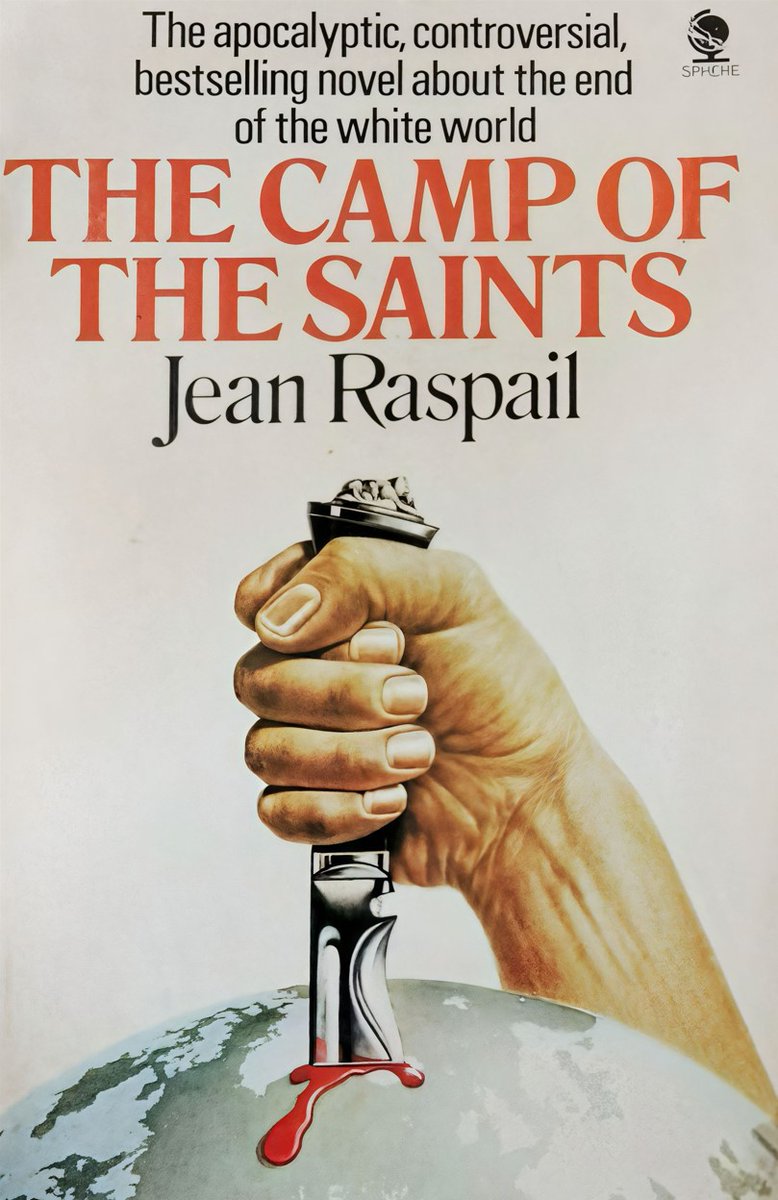
1/ Jean Raspail's "The Camp of the Saints" is no ordinary novel—it’s prophecy. Written in 1973, it foretells a West paralyzed by guilt and overrun by mass migration. Once banned, now buried, its warnings ring louder with every headline. Let's discuss 🧵👇
2/ Jean Raspail’s "The Camp of the Saints" is more than a novel; it’s a work of prophetic truth. Like all really great novels, it captures timeless realities—in this case, a harrowing indictment of the moral and cultural rot infecting the West. Its dystopian narrative critiques unchecked immigration, self-destructive altruism, and the paralysis of Western civilization.
The story begins with a famine in India. In desperation, a million refugees, led by a grotesque figure known as the "turd eater," commandeer a fleet of decaying ships and set sail for Europe. They bring with them not only hunger and disease but also an existential threat to the cultural and ethnic identity of the West.
Europe’s elites—politicians, church leaders, and the media—respond with blind enthusiasm. Cloaked in the insidious language of "human rights" and "universal brotherhood," they champion the invaders, dismissing any opposition as bigotry or selfishness. Centuries of liberal humanism, manipulated postmodern Christianity, and recent decades of Marxist ideology have left the West ideologically disarmed, incapable of defending itself against its enemies.
As the fleet nears Europe, the contradictions of this moral collapse become painfully clear. Leaders hesitate to act, fearing accusations of cruelty or racism. Sound familiar? It should because it's what’s happening today.
The refugees are not stopped at sea, nor are they quarantined upon arrival. Instead, the elites gamble the future of their nations on the untenable belief that such an influx can be absorbed without catastrophic consequences.
The consequences are devastating. France is the first to fall, its government overthrown by a radical leftist junta that turns the military against native resistance. Chaos reigns as rape, robbery, and destruction are sanctioned. Millions of Europeans flee their homes, while others cling to the hope that someone else will act to preserve their civilization.
The invaders, meanwhile, consolidate their power. Any pretense of diversity within their ranks is eliminated as they focus their collective strength on dismantling the remnants of Western society. The spectacle is watched with excitement by non-Europeans around the world, emboldened by the collapse of a once-dominant civilization.
Other European nations follow in France’s footsteps, collapsing under the weight of mass migration and elite betrayal. Switzerland, the last holdout, eventually succumbs to international pressure, marking the complete obliteration of the West.
Raspail’s narrative forces readers to confront the uncomfortable truths of Western decline. It is not merely an external threat but an internal sickness—a combination of cowardice, guilt, and ideological manipulation. The novel’s grim portrayal of the future is not just a warning but a call to recognize and confront the forces that seek to dismantle Western civilization and destroy its people.
3/ The suppression of "The Camp of the Saints" isn’t the outright burning of books but something more insidious. Though technically available, its price and stigma ensure its lessons remain buried. The West’s elites don’t fear its exaggerations—they fear its truths.
Raspail’s vision was never meant as a precise prediction but as a warning about unchecked immigration and the collapse of the cultural and moral backbone needed to resist it. And yet, much of what he described in 1973 reads less like fiction and more like today’s headlines.
Consider the West’s current trajectory: plummeting birthrates among European populations, unchecked migration from the Global South, and an elite class eager to celebrate this transformation as progress. Even the rhetoric of the novel—pleas for human rights, accusations of racism against dissenters, and appeals to guilt—mirrors our present day.
Across the entire West, demographic replacement is not a conspiracy theory; it’s openly acknowledged by its proponents, who dress it up in euphemisms like "diversity" and "multiculturalism." Meanwhile, native populations are silenced by a cocktail of media propaganda, academic indoctrination, and legal persecution for speaking out.
The truth is what makes Raspail’s work dangerous to those in power. He forces us to confront the long-term consequences of the West’s self-inflicted wounds: the loss of ethnocultural identity, the breakdown of social cohesion, and the eventual erasure of the very people who built Western civilization.
But Raspail’s relevance doesn’t stop at diagnosis—it extends to the emotional and spiritual toll of witnessing decline. His descriptions of Europeans paralyzed by guilt and fear, unwilling to act even as disaster unfolds, strike at the heart of our current malaise.
If there is any lesson to be drawn from "The Camp of the Saints," it’s that guilt and passivity are luxuries we can no longer afford. The demographic and cultural transformation of the West is not an inevitable process but a choice—one that can and must be rejected if Western civilization is to survive.
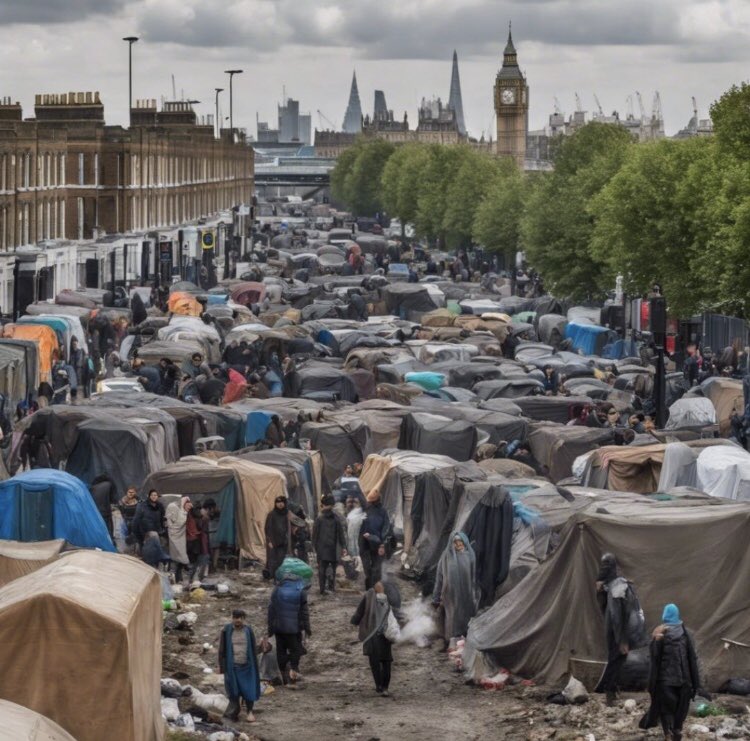
4/ At the core of Raspail's "The Camp of the Saints" lies a searing critique of the moral framework that has paralyzed the West. It is not the famine in India nor the arrival of the refugees that spells disaster—it is the West’s spiritual decay, its pathological altruism, and its suicidal refusal to affirm its own identity. The novel interrogates the idea of universalism, suggesting that, stripped of a robust cultural backbone, it becomes a weapon against the very civilization that birthed it.
Universalism, in its idealized form, promises equality and unity, but Raspail lays bare its darker consequences. Applied without discretion, it demands self-sacrifice from one group to benefit another, with no consideration for reciprocity or limits. The Western elites, intoxicated by their own moral posturing, embrace this ideology not as a means of elevating others but as a vehicle for their own absolution. They offer up their nations, their traditions, and their people on the altar of a dogma that deifies guilt and condemns self-preservation.
The refugees in "The Camp of the Saints" are not villains in the traditional sense. They are portrayed as desperate, even pitiable. But their plight becomes weaponized by the West’s internal betrayers: its media, its clergy, and its politicians. These actors do not merely fail to defend their civilization—they actively dismantle it, wielding the language of compassion and justice as a cudgel against dissenters. Raspail forces readers to grapple with an unsettling question: can a society that prioritizes the needs of others above its own survival endure?
The novel also exposes the hollowness of the West’s secular replacement for traditional faith. Having abandoned Christianity’s spiritual framework but retained its emphasis on guilt and redemption, the elites concoct a bastardized moral code that demands endless atonement for colonialism, racism, and other historical sins. But this new creed offers no salvation, only perpetual self-flagellation. In their zeal to appease the world, they leave their nations defenseless, their cultures unmoored, and their people demoralized.
5/ In depicting this collapse, Raspail does not shy away from the emotional toll. The despair of the average European, caught between the tidal wave of migration and the betrayal of their leaders, is palpable. Many turn inward, retreating into apathy or hedonism, while others succumb to despair, recognizing the futility of resistance in a system rigged against them. Yet, even in this bleak landscape, there are glimmers of defiance—characters who refuse to surrender, who cling to their heritage, even in the face of overwhelming odds.
The novel’s enduring power lies in its duality: it is both a damning indictment of the West’s weaknesses and a call to arms. Raspail does not offer a roadmap to salvation, but he does issue a challenge—to reject the narratives of guilt and passivity, to reclaim a sense of pride and purpose, and to act while action is still possible.
Raspail’s work remains a vital, if controversial, touchstone for understanding the crises of our age. It is not a comfortable read, nor is it meant to be. Its purpose is to provoke, to unsettle, and ultimately, to awaken. The enemies of Western civilization, and of all European peoples, do not fear "The Camp of the Saints" because it is fiction—they fear it because, beneath the veneer of hyperbole, it is truth.
The question "The Camp of the Saints" leaves us with is not whether the West can be saved, but whether it has the will to save itself.
For those interested in obtaining a cost-effective physical print edition of "The Camp of the Saints," please visit and follow @CarThulePub.
At the end of the day, securing physical copies of actual banned books is imperative.
If you enjoyed this thread, consider following me on X. I write 4–7 essays per week on topics ranging from history and literature to philosophy and more.
I also run a Substack dedicated to my writing. Recently, I've been sharing new translations of Friedrich Nietzsche and Julius Evola.
1/ The modern West staggers amidst civilizational decline—fractured by hyper-individualism, polarization, and alienation. To chart a way forward, we must look back. Aristotle laid out the principles of human flourishing. What can his timeless vision teach us today? 🧵👇
2/ The West’s Forgotten Foundations
"Classics" once meant the study of Greek and Latin alone. Now it encompasses the foundational works of Western civilization—philosophical and literary—that shaped its trajectory. These enduring works elevate the mind and reveal truths vital to the West’s survival.
T.S. Eliot expanded this idea, describing the classics as an unbroken tradition binding Homer to the present—a "simultaneous order" of meaning bridging epochs. His call to revive this tradition was both a plea and a warning. Even in his day, the West’s grip on its heritage was slipping, a loss we now face in full measure.
Today, the classics barely whisper, their wisdom buried beneath the rubble of modernity. Shallow distractions and ideological noise drown out their timeless truths. If we let these ancestral voices fade, we inherit a barren cultural wasteland, severed from millennia of insight we cannot hope to recreate.
The West’s intellectual collapse is clearest in its rejection of the classics. Once pillars of true education, the works of Aristotle and Plato are now dismissed by self-styled progressives. This arrogance, typical of our age, blinds us to the eternal principles that anchor human existence. Without ancestral guidance, we drift aimlessly, like architects defying gravity.
We live with the wreckage of detachment. Politics are dysfunctional, communities fractured, and culture consumed by pathological individualism. Families and traditions—pillars of continuity—are replaced by vapid consumerism and fleeting pleasures. Rootless men drift, untethered from their inheritance.
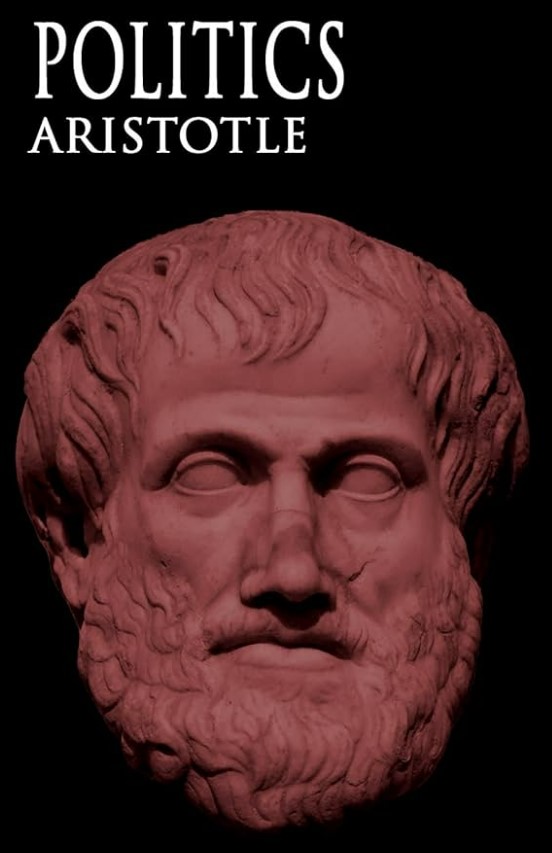
In this chaos, the classics offer lifelines, none more so than Aristotle's "Politics." Unlike Plato’s lofty "Republic," dreaming of utopias, Aristotle speaks to reality—pragmatic, grounded, and rooted in human nature. He envisioned a society built on virtue, responsibility, and balance, warning against multicultural dissolution, the erosion of citizenship, and the drift toward tyranny.
Aristotle’s message cuts through modern noise, exposing liberalism’s vacuity and offering a path to coherence. To abandon him is to sever ourselves from wisdom and invite the collapse of the civilization we claim to defend.
3/ Aristotle the Man
To grasp why Aristotle’s thought remains vital, we must first consider the man himself. Born in 384 BC in Stagira, Aristotle stood at the twilight of the Greek polis (cite-state) and the dawn of Macedonian ascendancy. His father, Nicomachus, served as physician to King Amyntas III of Macedonia, linking Aristotle early to power. At seventeen, he joined Plato’s Academy, spending two decades under his mentor’s influence. Yet where Plato theorized utopias, Aristotle focused on reality, addressing human nature as it is, not as he wished it to be.
After Plato’s death, Aristotle traveled extensively, engaging with the broader Hellenic world, before returning to Macedonia as tutor to Alexander the Great. In shaping the mind of the boy who would conquer Asia, Aristotle influenced a world far beyond the walls of any polis. His role was not purely academic—he became a philosopher intimately entwined with power, a figure at the very nexus of the tide of history.
Aristotle's most salient work, "Politics," stands as an immortal pillar of Western thought—a guide not only to the classical polis but also to the dilemmas of modernity. Where Plato’s "Republic" veers into abstraction, Aristotle grounds his work in the undeniable truth that man is a “political animal,” naturally drawn to form bonds within “communities” that shape his life and purpose. The polis was, for him, the culmination of human association: the space where individuals pursue virtue and achieve true flourishing (eudaimonia).
Aristotle rejected Plato’s dream of philosopher-kings and rigid utopias in favor of attainable governance. His ideal was a balanced polity, blending democracy and oligarchy, sustained by a virtuous middle class. He recognized the fragility of social harmony and warned of forces that fracture it: unchecked individualism, unnatural inequalities rooted in wealth or heredity rather than merit, and the erosion of civic cohesion.
For Aristotle, diversity without integration was a poison. A society fragmented by clashing identities and unshared purposes inevitably degenerates—into chaos at best, tyranny at worst. His warnings could not reverberate more powerfully in today’s fractured Western world.
Ironically, the Panhellenic unity Aristotle envisioned—a Greece united by shared ethnoculture and common purpose—was not realized by the city-states he admired but by the Macedonian kings he served. Philip II and Alexander achieved what the squabbling poleis never could: uniting the Greek world under one banner. But this unity came through force, not consent; it was a victory of might, not virtue. For Aristotle, who valued persuasion and deliberation, this would have been a bitter recognition of the limits of his ideals.
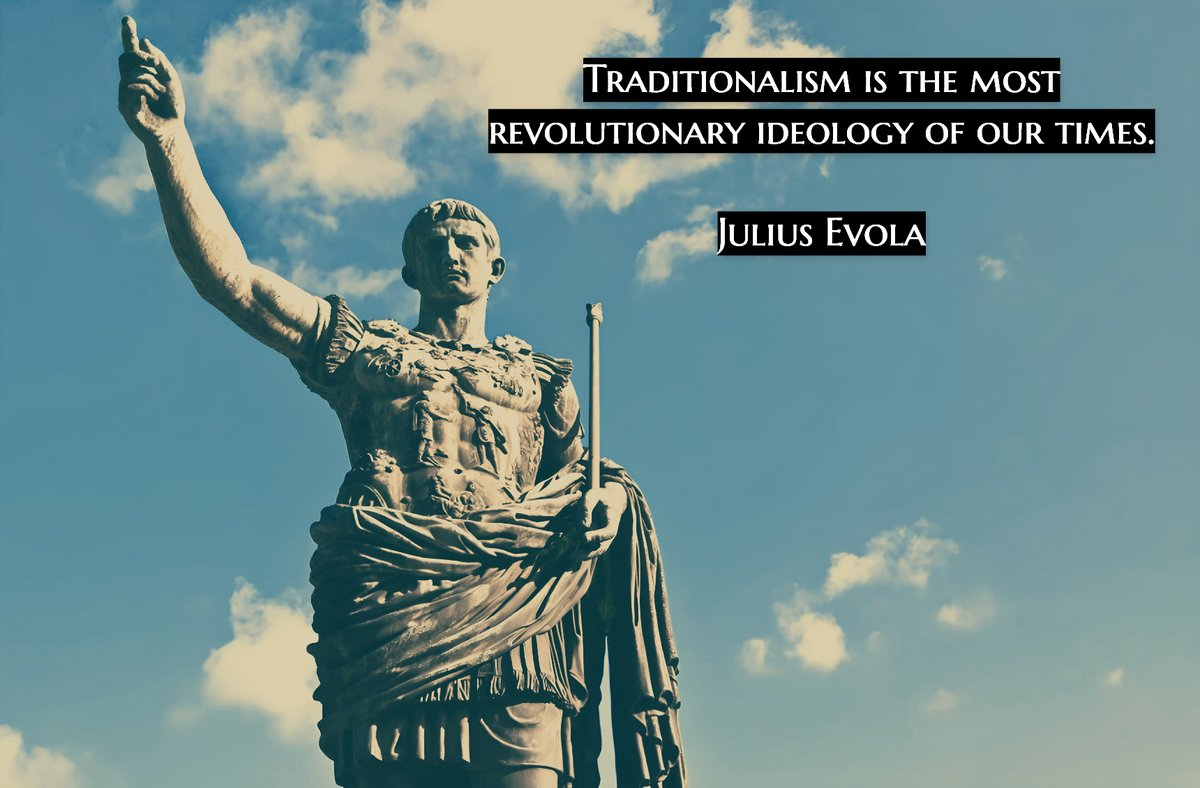
1/ Julius Evola was many things, but above all, he was a revolutionary in the truest sense—a radical traditionalist who sought not merely the end of the current order but the rebirth of a new one. Let’s discuss. 🧵👇
2/ Tradition: The Pillar of Evola’s Philosophy
This essay serves as an introductory primer on Julius Evola, focusing on key ideas from "Revolt Against the Modern World," "Men Among the Ruins," and "Ride the Tiger." It does not aim to exhaustively cover his body of work. I will address his final work, autobiography, and what he considered his most important work, "The Path of Cinnabar," in a separate thread.
At the core of Evola’s philosophy lies Tradition—a metaphysical foundation that informs his critique of modernity and connects humanity to the divine. Far from being mere nostalgia for past customs or rituals, Evola’s Tradition transcends time and space. It represents immutable principles that structure the cosmos and reveal humanity's higher purpose.
While Evola’s conception owes much to René Guénon’s perennialist philosophy, it bears his unique interpretation. For Evola, Tradition is not a human construct but a revelation of divine truth—a sacred order woven into the fabric of existence. It binds the sacred and the profane, anchoring the temporal world in eternal principles.
Tradition manifests through a sacred hierarchy that reflects the divine order of the cosmos. Each individual, institution, and role occupies a rightful place, determined by spiritual and intellectual virtues rather than material concerns. Kings embody celestial authority, ruling not for ambition but as stewards of divine will. Warriors champion cosmic justice, defending the sacred order. Priests mediate between the earthly and transcendent, guiding humanity toward higher truths. This hierarchy ensures harmony, aligning human society with the eternal.
Evola contrasts this vision with modern egalitarianism, which he saw as denying natural distinctions and undermining sacred order. In a traditional society, leadership arises naturally from those endowed with spiritual insight, martial valor, and intellectual clarity—qualities aligned with cosmic principles. Power serves a higher purpose, flowing from the duty to uphold eternal truths.
Crucially, Evola viewed Tradition as a living force, enduring beyond the rise and fall of civilizations. While its forms may vary across cultures and epochs, its essence remains constant. From the Indo-European legacy to the Roman imperium and the medieval warrior-aristocracies, Tradition emerges as the axis uniting humanity with the divine.
For Evola, Tradition is the sacred law of existence, the axis mundi around which life must revolve to align with its higher purpose. To live by Tradition is to transcend the individual and temporal, participating in the cosmic order that elevates humanity toward the eternal. Far from being a relic of the past, Tradition remains a living reality, calling the discerning few to restore its rightful place as the guiding principle of life.
3/ Modernity: A Metaphysical Rupture
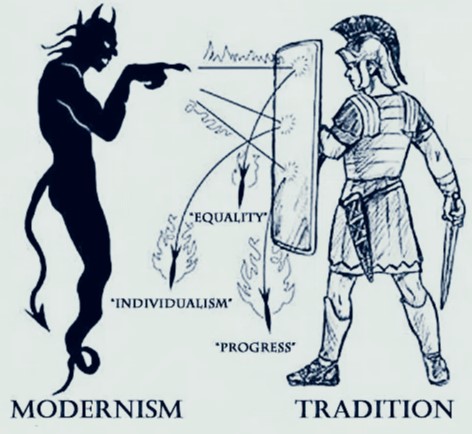
Julius Evola regarded modernity not as a triumph of progress but as humanity’s catastrophic fall—a rebellion against the eternal principles that once upheld the sacred cosmic order. For Evola, modernity represents a metaphysical rupture: the severance from Tradition, which provided civilizations with clarity, hierarchy, sovereignty, and transcendence. These solar values guided humanity toward the divine, offering structure and meaning. In contrast, modernity embodies chaos and disintegration, fueled by egalitarianism, materialism, and individualism—forces that corrode humanity’s spiritual foundation and replace it with emptiness.
The destruction of sacred hierarchy, according to Evola, represents modernity’s gravest sin. Egalitarianism, far from being a virtuous ideal, serves as a weapon against the divine order. By denying distinctions in human abilities, intellect, and alignment with higher principles, it disrupts the natural structure of existence. The solar principle, affirming the authority of the eternal over the temporal, is discarded, leaving disorder in its wake. Modern ideologies like liberalism, democracy, socialism, and communism rise to prominence, enthroning mediocrity and degrading humanity to a shallow pursuit of material comfort.
Progress, the idol of modernity, Evola dismissed as a dangerous illusion. Its advancements in technology and economics do not liberate but enslave, deepening humanity’s bondage to mediocrity and materialism. Modern man—the "last man" of Nietzsche—is weak and aimless, content with fleeting pleasures and devoid of transcendent aspirations. This figure stands in contrast to the heroic man of Tradition, who embodies courage, discipline, and alignment with eternal principles.
Yet Evola’s critique of modernity is not without hope. He saw the ruins of the modern age as a crucible for the spiritually strong. These "differentiated individuals" reject mediocrity and chaos, embracing the solar values of hierarchy and transcendence. They do not seek to restore the past but to forge a new order rooted in timeless truths. For these men, the ruins of modernity are both battlefield and opportunity—a chance to rise above egalitarianism, materialism, and the illusion of progress.
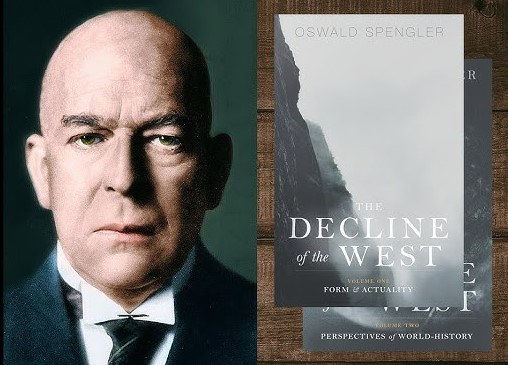
1/ Oswald Spengler’s "The Decline of the West" revives the ancient, cyclical view of history in a revolutionary way. Cultures and Civilizations, like living organisms, are born, thrive, and decline. His greatest contribution is shattering the modern myth of progress. 🧵👇
2/ An Organic Vision of History
Oswald Spengler’s “The Decline of the West” shattered the modern understanding of history by rejecting the prevailing myth of linear progress. For Spengler, history does not ascend along a straight, ever-improving path but unfolds cyclically, mirroring the life of an organism: birth, growth, maturity, decline, and inevitable death.
In Spengler’s framework, Civilizations and Cultures are not abstract or interchangeable constructs but discrete living forms—each a unique organism with its own internal logic, distinct expressions, and singular destiny. “Each Culture,” Spengler declared, “has its own new possibilities of self-expression which arise, ripen, decay, and never return.” Unlike the modern conceit of a continuous march toward universal enlightenment, history, as Spengler saw it, is a succession of self-contained cycles, each adhering to its own natural trajectory.
Spengler’s vision directly confronts the Western liberal conception of history as a triumphant, unbroken march of progress—from the Stone Age to the present. This conceit reached its zenith in Francis Fukuyama’s naïve proclamation of the “end of history,” which celebrated liberal modernity as humanity's final political and cultural form. Yet Spengler argues that such thinking is not only delusional but deeply alien to the worldview of most ancient and pre-modern civilizations.
Thinkers like Thucydides, Polybius, and Giovanni Battista Vico understood history not as a linear progression but as an ebb and flow governed by forces far beyond human control. Thucydides, in his account of the Peloponnesian War, illustrated the timeless patterns of power, hubris, and decline. Polybius introduced the concept of anacyclosis, the cyclical transformation of political systems from monarchy to tyranny, aristocracy to oligarchy, and democracy to mob rule. Giambattista Vico, writing during the Enlightenment, reinforced this cyclical view in “The New Science,” arguing that societies advance and regress through recurring stages of growth, maturity, and decay. These thinkers shared a vision of history deeply rooted in the eternal cycles of nature, a perspective that Western modernity has largely discarded.
The West’s belief in its own permanence and superiority, according to Spengler, represents an arrogant denial of life’s fundamental laws. Civilizations rise and fall, just as seasons change and as life inevitably gives way to death. The West, blinded by its faith in rationalism and progress, has refused to acknowledge its own organic limits—a denial that makes its decline all the more certain.
One may disagree with Spengler’s conclusions, but one cannot dismiss him. His critique remains a searing challenge to those who cling to the comforting but hollow illusion of perpetual advancement. The genius of Spengler’s framework lies in its immediacy: it reveals itself in the world around us. Anyone who observes the state of the modern world with Spenglerian clarity can see the truth of his insights.
Civilizations, like the living forms he describes, build monuments, empires, and systems of thought, but they are ultimately bound by the same organic rhythms that govern all life. What rises must fall. What blooms must wither. Spengler’s vision is a stark reminder that no Culture—least of all our own—is exempt from the cycles of history. The natural laws that birthed our greatness will just as surely preside over our decline.
3/ Kultur: The Blossoming of Vitality
In the early stages of a people’s historical existence, their vitality is unmatched. Spengler called this phase Kultur, likening it to the springtime of their development—a period when the inner essence of a people bursts forth in unparalleled creative energy. This is the age of creation, when art, religion, philosophy, and social structures emerge as authentic expressions of a people’s distinct soul.
For Spengler, Kultur refers to the organic, formative phase of a society’s existence—a time when its spiritual essence shapes every aspect of life. It stands in contrast to Zivilisation, which represents the later, sterile phase when the creative vitality of Kultur has faded, giving way to materialism and decay. By keeping this distinction clear, Spengler underscores that what he calls a "Culture" in its living, generative phase is fundamentally different from a "Civilization," which he sees as its lifeless and mechanized successor.
Spengler emphasized that each Culture has its own unique character, its own “prime symbol” or animating idea, which shapes its art, architecture, and worldview. For the West, this is the “Faustian soul,” driven by an insatiable yearning for the infinite. This relentless spirit finds its highest expression in the soaring Gothic cathedrals, with their towering spires that seem to stretch endlessly heavenward, and in the discovery of linear perspective during the Renaissance, which created a visual metaphor for the infinite depth of space. “The Faustian Culture,” Spengler wrote, “wills the infinite, pursues it, and will not rest until it attains it.”
During Kultur, tradition serves as the foundation of society, binding it together with shared beliefs and values. Religion functions as both a spiritual and communal anchor, infusing every aspect of life with meaning. It is not merely an institution but the lifeblood of the Culture, providing a framework for its art, ethics, and worldview. The religious art of this phase is not decorative but deeply symbolic, embodying profound metaphysical truths that resonate with the Culture’s soul.
This period is also marked by a sense of wonder and discovery. Science and philosophy, still in their infancy, are not yet dominated by rationalism or utilitarianism but are inspired by a desire to uncover the mysteries of existence. In this phase, intellectual pursuits are deeply connected to the sacred and the transcendent. Philosophers like Aristotle in the Classical world or Thomas Aquinas in the medieval West sought not just to explain the natural world but to understand humanity’s place within a divine cosmic order.
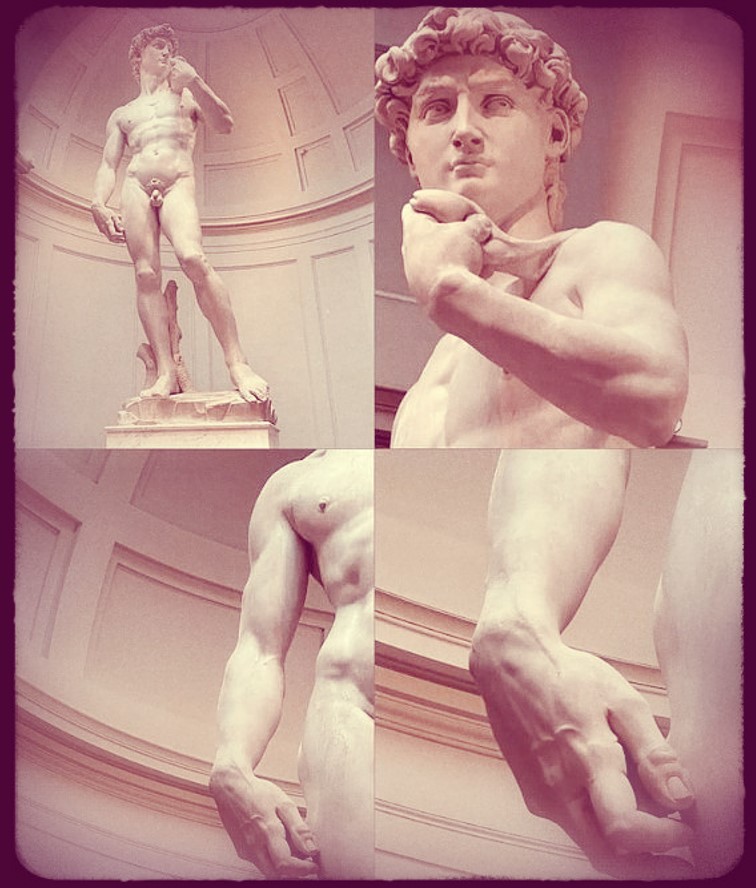
For clarity’s sake, Spengler did not consider Classical Civilization—encompassing ancient Greece and Rome—to be a part of the West, but rather its own unique and distinct Kultur. To him, the Classical world had its own soul, defined by a focus on the immediate and tangible, epitomized by the perfect form of the statue and its rootedness in the present.
Yet even as Kultur reaches its zenith, the seeds of its eventual decline are already present. The dynamism and unity that characterize the early stages of a Culture inevitably begin to wane. Over time, the creative energy of Kultur becomes codified, its religious fervor ossifies into dogma, and its traditions become burdens rather than sources of inspiration. The living force of the Culture begins to fade as it transitions from its organic, youthful springtime to the rigidity of maturity.
Spengler viewed Kultur as the purest and most vital phase of a civilization’s life, a period when the collective spirit of a people manifests itself in its most authentic and profound forms. It is here, in this blossoming of vitality, that the essence of a Culture is laid bare, creating the works and ideas that define its legacy for centuries to come. However, like the blooming flower that inevitably withers, Kultur cannot endure forever. Its vital energy gives way to the sterility of Zivilisation, where the focus shifts from creation to preservation, from growth to decay.
1/ Reading Carl Schmitt is crucial for understanding modern politics. The Left implicitly grasps his insights on power, using them to dominate institutions like academia and media. They don’t want you to read him—which is exactly why you must. 🧵👇
2/ Carl Schmitt, the German jurist and political theorist, stands as one of the most incisive and controversial intellectuals of the 20th century. Renowned for works like The Concept of the Political and Political Theology, Schmitt's critiques of liberalism and his myriad insights into sovereignty, the state, democracy, and modernity itself remain as unsettling as they are illuminating. His ideas expose the ideological pretensions of modern governance, challenging the liberal orthodoxy that dominates contemporary political discourse.
Central to Schmitt’s thought is his most famous and far-reaching concept: the friend-enemy distinction. This principle forms the bedrock of his entire political philosophy, asserting that the essence of all politics lies in a collective’s ability to define itself through the clear identification of friends—those who share its identity, culture, and values—and enemies—those who threaten its existence or sovereignty. This distinction is not a metaphor or an abstract philosophical point; it is existential and thus very real. The enemy represents a genuine, concrete threat that demands recognition and, if necessary, confrontation. Politics, Schmitt argues, begins where this distinction is made.
Liberalism, with its fixation on universal peace, economic exchange, and moral relativism, recoils from the friend-enemy distinction, preferring instead to obscure it under the guise of "tolerance" and "progress." Yet in doing so, it denies the reality of conflict that underpins human existence and the state itself. Schmitt saw this rejection not as noble but as dangerous, for it renders liberalism incapable of grappling with power and sovereignty.
Ironically, while liberalism as an ideology refuses to acknowledge the realities of the friend-enemy distinction, the modern Left in the West has either knowingly absorbed Schmitt’s principles or, more likely, grasped them intuitively. Their dominance over institutions like academia, media, and culture stems from an implicit understanding of the political as an arena of conflict where defining and targeting the "enemy" is essential.
In this sense, the Left wields power far more effectively than the so-called "Right," weaponizing Schmittian insights to dismantle opposition while cloaking their maneuvers in the language of morality and progress. This tension between liberal idealism and the Left's pragmatic grasp of power provides the perfect entry point into Schmitt’s critique of liberalism’s faulty anthropology and its incompatibility with democracy.
3/ The Faulty Anthropology of Liberalism
One of Schmitt’s most incisive critiques of liberalism is its inherent incompatibility with democracy. Schmitt saw liberalism not as a complement to democratic governance but as its destroyer, undermining democracy from within due to its fundamentally flawed view of human nature. Liberalism rests on a naïve anthropology: it assumes man is a rational actor, governed by materialistic impulses and the pursuit of self-interest.
This assumption, however, crumbles under scrutiny. The concept of bounded rationality—the idea that individuals operate within cognitive and informational limitations—reveals that even rational actors often settle for satisfactory (what works) rather than optimal (what is best) decisions. More importantly, human behavior, as seen throughout history, frequently defies the tidy calculations of economic rationality. Schmitt highlights this divergence, noting that man is not merely "sinful" or "irrational" in theological or philosophical terms; he is also inclined to act against so-called rational economic interests. Modern pundits echo this observation when they decry voters who prioritize cultural or moral values over fiscal pragmatism.
Liberalism’s reductionist anthropology casts man as homo economicus, a being driven solely by the pursuit of economic gain and upward mobility. This diminishes the richness of human existence, denying the deeper motivations that transcend material concerns: the yearning for art, the bonds of community, the sanctity of religion, the preservation of culture, and the sovereignty of the nation. By dismissing these aspirations as irrational or regressive, liberalism exposes its own shallowness, unable to comprehend or address the deep and many needs that define human life and underpin the political.
1/ The Classics, the bedrock of Western civilization, are under siege. Modern academia weaponizes them for deconstruction, stripping them of their European soul. This is not scholarship—it’s an attack on our heritage, a campaign to sever the West from its ancestral roots. 🧵
2/ The study of the Classical canon is under siege, subjected to a deliberate campaign to subvert the foundations of Western civilization, European identity, and our ancestral patrimony. What was once a rigorous academic discipline dedicated to preserving and interpreting the enduring wisdom of ancient Greece and Rome—the cornerstone of European identity—has been co-opted to undermine the very heritage it once safeguarded. This is no academic evolution but an ideological assault aimed at erasing Western civilization and its people.
Modern academia no longer approaches the Classics as treasures of timeless wisdom. Instead, they are reframed as relics of a "problematic" past, accused of perpetuating oppression and inequality. This distortion denies their role as milestones of human achievement and reduces them to tools for ideological critique. By recasting the foundations of Western civilization as inherently oppressive, these narratives declare the modern world illegitimate—a world that, they argue, must be destroyed.
Donna Zuckerberg epitomizes this corruption. To her, ancient texts are not treasures of wisdom but weapons for advancing grievance politics, reducing the towering achievements of our ancestors to props in a tiresome tale of "White men versus the world."
This is no scholarship—it is a calculated cultural assault. The intellectual bedrock of the West is being hijacked, stripped of its wisdom, and weaponized against itself. The aim is clear: to delegitimize our heritage and replace it with narratives engineered to corrode its meaning and obliterate its power.
The evidence is undeniable—look no further than the flood of historical revisionism poisoning popular culture and rewriting the story of who we are.
3/ This trend is emblematic of a broader academic movement rooted in postmodern deconstructionism, aimed at dismantling traditional disciplines and severing their connection to the Western peoples who created them.
The Classics are reduced to frameworks of critique, their value judged not by their intrinsic merit but by their alignment with ideological fashions. The glorious achievements of figures like Homer, Virgil, and Cicero are no longer viewed as sources of inspiration but as obstacles to a utopian vision of multicultural egalitarianism—a vision perpetually out of reach, as all utopias are.
This reframing is more than an attack on the Classics; it strikes at the idea of a shared European heritage. By erasing the distinctly European character of these works, ideologues strip them of their power to unite and inspire future generations. The West’s achievements are painted as "universal" only in a way that divorces them from their roots and devalues their significance.
Books like "Not All Dead White Men" by Donna Zuckerberg exemplify this ideological project, focusing less on the intellectual substance of classical literature and more on dismantling its perceived role in perpetuating "structures of oppression."
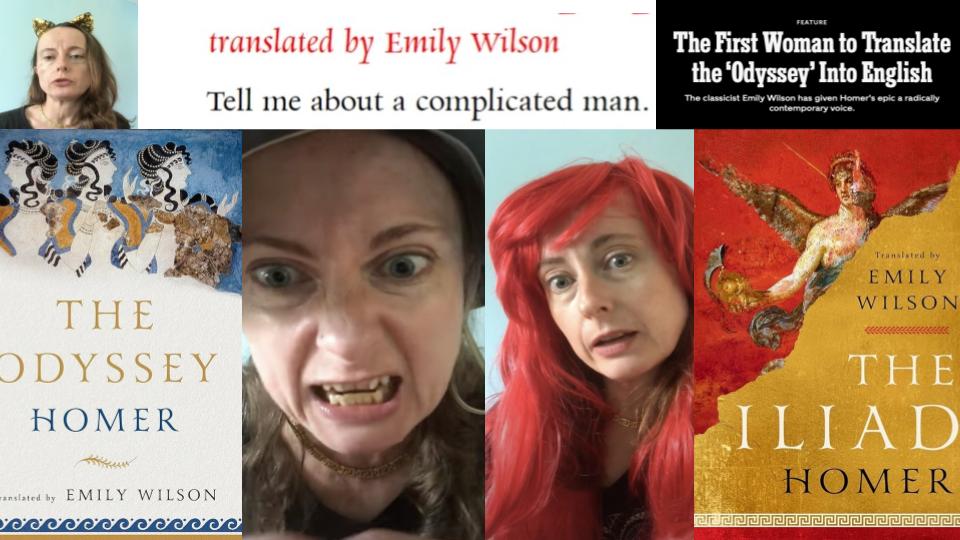
Similarly, Emily Wilson’s recent translations of Homer, including "The Odyssey" and "The Iliad," represent another front in the campaign to reframe the Classics. Prioritizing modern "relevance" over fidelity, Wilson describes Odysseus as a "complicated man" and includes absurd phrases like Hector’s "Swiftfoot, Blondie, Flame, and godlike Sparkle," cheapening the moral seriousness of Homer’s epics and reducing their heroic ethos to banality.
1/ Thanksgiving is more than a day of feasting—it’s the story of a people who defied the odds, conquered the wilderness, and forged a new world. A testament to grit, faith, and the pursuit of greatness, it embodies the American spirit: born of struggle, shaped by triumph. 🧵👇
2/ Thanksgiving: A Celebration of Harvest, History, and Identity
Thanksgiving Day, at its core, is America’s reimagining of the ancient harvest festival—a tradition as old as agriculture itself. These rites, rooted in the Neolithic shift to settled farming, symbolized humanity’s triumph over nature—the taming of the earth to yield sustenance and life. Far from being mere acknowledgments of abundance, they were sacred affirmations of survival and continuity, forged in the crucible of necessity. Across the ancient European world, harvest festivals honored the deities and spirits believed to govern fertility and prosperity, binding communities to soil and sky in a covenant of toil and gratitude.
Among the Greeks, Demeter, the goddess of grain, was venerated in ceremonies that reflected the cyclical rhythm of life and death embedded in the seasons. The Celts marked their harvest with bonfires and feasts, acknowledging the land’s gifts before winter’s onset. In Persia, Zoroastrians celebrated Mehrgân, a festival of thanksgiving linking cosmic order with earthly sustenance. Yet it was in Europe—where Indo-European peoples refined agrarian systems and elevated the plow to a cornerstone of civilization—that these traditions found their most profound expression. Here, the harvest festival became a timeless emblem of the symbiosis between human labor and the fertility of the land.
In the rural communities of pre-industrial Europe, harvest festivals were more than celebrations; they were acts of collective gratitude, marking survival through the unpredictable trials of weather, war, and disease. These gatherings solidified social bonds and reinforced a shared identity, rooted in the enduring cycles of agrarian life. Songs, dances, and rituals mirrored the vitality of a people whose existence was still shaped by the raw forces of nature.
3/ The Roots of Thanksgiving in America
Thanksgiving, contrary to popular myth, did not originate with the Pilgrims at Plymouth. The first recorded Anglo-American Thanksgiving took place in 1619 at Berkeley Plantation in Virginia, where a small group of settlers gave thanks to God for their safe arrival. Unlike the grand narratives that now surround Plymouth, this Southern Thanksgiving was humble—a quiet act of faith and resilience. Yet, history has largely overshadowed this moment with the romanticized tale of 1621, favoring myth over nuance.
The Pilgrims’ Thanksgiving has become the defining symbol of the holiday, its enduring appeal rooted in the settlers' extraordinary struggle for survival. When the Mayflower anchored off Cape Cod in late 1620, the colonists faced an unforgiving winter that claimed over half their number. By spring, the colony teetered on the brink of collapse, preserved only by the leadership of figures like William Bradford and Myles Standish and their steadfast belief in divine providence.
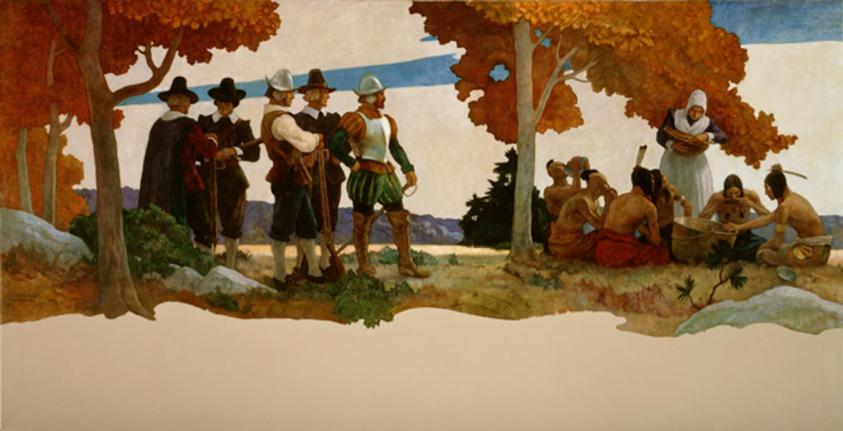
The famed feast of 1621, shared with the Wampanoag under Chief Massasoit, is celebrated as a moment of "multicultural" harmony, but its reality was far more complex. This gathering was not merely a celebration of goodwill but a calculated alliance born of necessity. The Pilgrims relied on Wampanoag agricultural knowledge, especially the teachings of Squanto, who showed them how to fertilize their crops with the remains of fish. For the Wampanoag, the alliance with the settlers offered a strategic buffer against rival tribes during a time of ongoing intertribal tensions.
The New England the Pilgrims encountered was not an untouched wilderness. The region had been devastated by waves of disease—likely smallpox and other pathogens introduced by earlier European explorers. What remained was a land marked by loss, depopulated villages, and a fragile tribal political landscape. The Wampanoag, weakened by inter-tribal war and epidemic, gambled on their alliance with the Pilgrims, seeking to bolster their position against regional rivals.
This partnership was neither idyllic nor permanent. It was a tenuous pact forged in a crucible of hardship, mistrust, and survival. The Pilgrims navigated a volatile frontier fraught with danger, while the Wampanoag wrestled with the implications of welcoming a new, unpredictable force into their lands. The 1621 Thanksgiving, though a moment of shared sustenance, was born out of diplomacy as much as gratitude—a fragile truce in a world defined by struggle and uncertainty.
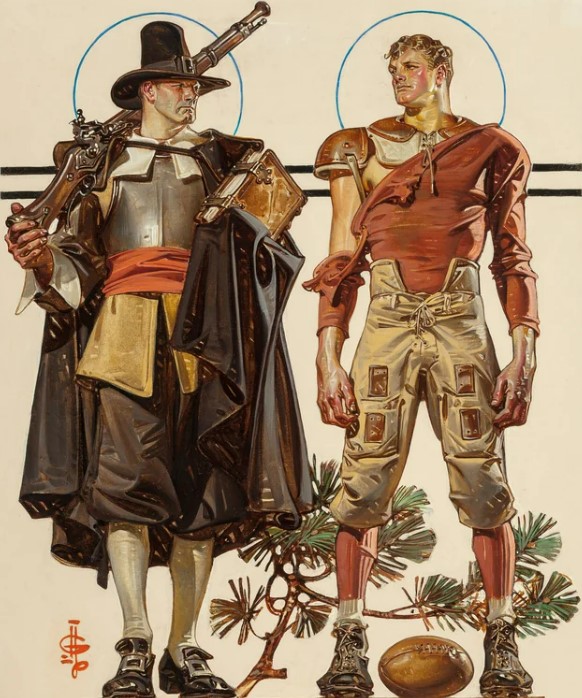
Far from today’s sanitized imagery, the first Thanksgivings were testaments to European perseverance. The Pilgrims, battered by famine and disease, forged a foothold in an unforgiving land through sheer resolve, faith, and ingenuity. Thanksgiving endures as a symbol of their triumph—a celebration of survival, labor, and the unyielding will to build a future against all odds.