
This was a very interesting operation by Ukraine to destroy a 'partisan immobilized' fuel train with Switchblade 600's, to burn the fuel.
The burning fuel will require that the annealed rails under the cars to be replaced to prevent derailments.
RuAF rail vulnerability🧵
1/
The burning fuel will require that the annealed rails under the cars to be replaced to prevent derailments.
RuAF rail vulnerability🧵
1/
https://twitter.com/bayraktar_1love/status/1868329876182192275
This will require a Russian military railway service train to be deployed to this spot for possible future Ukrainian Switchblade 600 follow up strikes.
2/
2/
https://x.com/TrentTelenko/status/1686437246499508281
I've mentioned the vulnerability of Russian trains to Switchblade 600 back in April 2022.
A Switchblade 600 with a Javelin warhead is powerful enough to destroy the control section of a rail engine...
3/
A Switchblade 600 with a Javelin warhead is powerful enough to destroy the control section of a rail engine...
3/
https://x.com/TrentTelenko/status/1511417240142426121
...or can be flown into the forward train wheel assembly, blowing it to h--l and causing the derailment of a moving train.
The stated range of a Switchblade 600 loitering munition is 40km.
This means when it reaches 40km it has...
4/
The stated range of a Switchblade 600 loitering munition is 40km.
This means when it reaches 40km it has...
4/
https://x.com/RALee85/status/1800648705189580886
...dozens of minutes to search an area for a target.
If you know exactly where a target is, like a stopped train, the Switchblade 600 munition can fly more than 70 km in a straight line using elevated radio repeater support or forward controllers.
5/
If you know exactly where a target is, like a stopped train, the Switchblade 600 munition can fly more than 70 km in a straight line using elevated radio repeater support or forward controllers.
5/
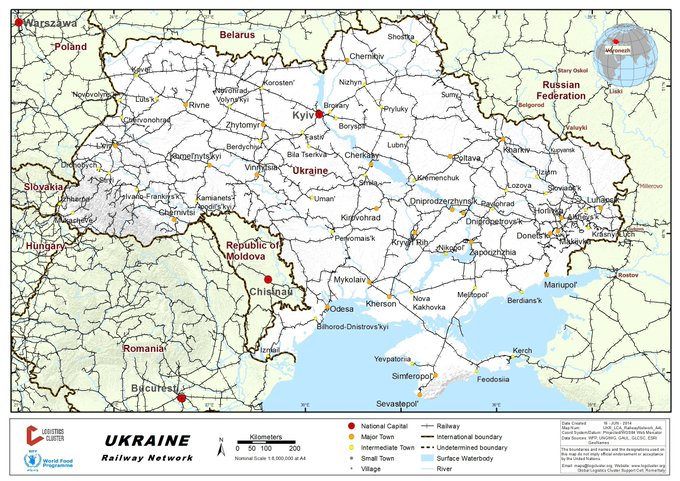
While you can do the same mission with a GMLRS.
A low flying Switchblade 600 can be launched far closer to, or even behind, enemy lines to ravage railway operations.
This gives the munition a bigger anti-train footprint behind Russian lines.
6/
A low flying Switchblade 600 can be launched far closer to, or even behind, enemy lines to ravage railway operations.
This gives the munition a bigger anti-train footprint behind Russian lines.
6/
https://x.com/TrentTelenko/status/1511417245452414987
Despite being available to Ukraine for over a year, this strike appears to be the first time that Switchblade 600 was used for the railway interdiction role I mentioned in April of 2022.
Hopefully we will see more such Ukrainian train strikes.
7/7 End
Hopefully we will see more such Ukrainian train strikes.
7/7 End
https://x.com/UAWeapons/status/1649115118339227657
@threadreaderapp unroll please.
• • •
Missing some Tweet in this thread? You can try to
force a refresh




