Does Dark Chocolate Prevent Diabetes? 🍫🩸
1/5) 🧵A new study in BMJ claimed 5+ servings/week of dark chocolate reduced T2D risk by 21%. Let’s break it down...
🍫The Study🍫
This was a large-scale observational study where they looked at associations between chocolate intake and the development of T2D over three cohorts:
👉Nurses’ Health Study (NHS)
👉Nurses’ Health Study II (NHSII)
👉Health Professionals Follow-up Study (HPFS).
A total of 111,654 participants were included where they looked at association between types of chocolate (dark and milk) versus T2D.
The main reported findings were as follows:
(1) “Participants who consumed ≥5 servings/week of dark chocolate [but not milk chocolate] showed a 21% lower risk of T2D
(2) Intake of milk, but not dark, chocolate was positively associated with weight gain.
1/5) 🧵A new study in BMJ claimed 5+ servings/week of dark chocolate reduced T2D risk by 21%. Let’s break it down...
🍫The Study🍫
This was a large-scale observational study where they looked at associations between chocolate intake and the development of T2D over three cohorts:
👉Nurses’ Health Study (NHS)
👉Nurses’ Health Study II (NHSII)
👉Health Professionals Follow-up Study (HPFS).
A total of 111,654 participants were included where they looked at association between types of chocolate (dark and milk) versus T2D.
The main reported findings were as follows:
(1) “Participants who consumed ≥5 servings/week of dark chocolate [but not milk chocolate] showed a 21% lower risk of T2D
(2) Intake of milk, but not dark, chocolate was positively associated with weight gain.
2/5) Major Healthy User Bias Confounding
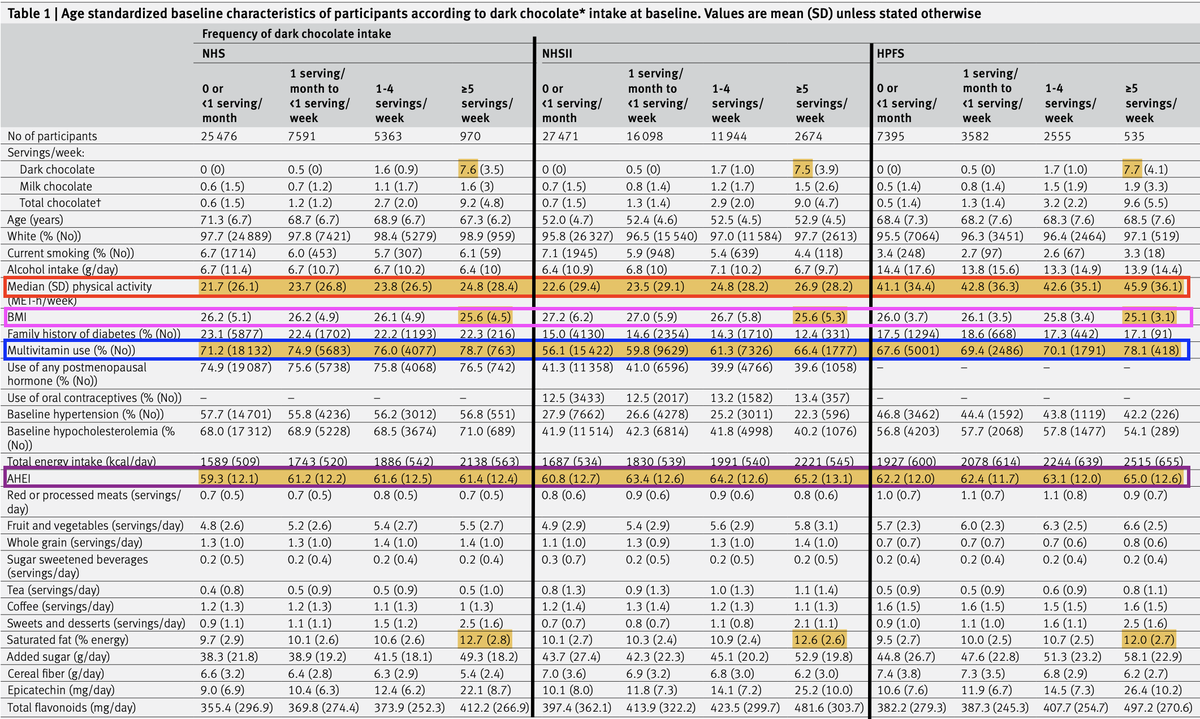
Unfortunately, there was a clear signal of healthy user bias in the study.
You can see that there is a consistent and mostly dose-dependent trend towards those who ate more dark chocolate exhibiting
👉more physical activity (red)
👉more multivitamin use (blue)
👉higher overall diet quality score (purple)
👉lower BMI (pink)
Conversely, for high milk chocolate users had suggestions of less healthy living, including higher smoking rate and lower diet quality score.
Furthermore, in a subgroup analysis, there also found no association between dark chocolate consumption and T2D risk among individuals with a lower quality diet, consistent with the idea that confounders (the healthy user bias we mentioned) were carrying the lion’s share of the reported effect.
And, of note, the authors wrote, “we cannot entirely rule out the role of confounding in our observed associations… residual or unmeasured confounding, or both, may still exist.”
Unfortunately, there was a clear signal of healthy user bias in the study.
You can see that there is a consistent and mostly dose-dependent trend towards those who ate more dark chocolate exhibiting
👉more physical activity (red)
👉more multivitamin use (blue)
👉higher overall diet quality score (purple)
👉lower BMI (pink)
Conversely, for high milk chocolate users had suggestions of less healthy living, including higher smoking rate and lower diet quality score.
Furthermore, in a subgroup analysis, there also found no association between dark chocolate consumption and T2D risk among individuals with a lower quality diet, consistent with the idea that confounders (the healthy user bias we mentioned) were carrying the lion’s share of the reported effect.
And, of note, the authors wrote, “we cannot entirely rule out the role of confounding in our observed associations… residual or unmeasured confounding, or both, may still exist.”
3/5) Internal Inconsistencies Among the Cohorts
Another big red flag is that there was massive heterogeneity among the studies.
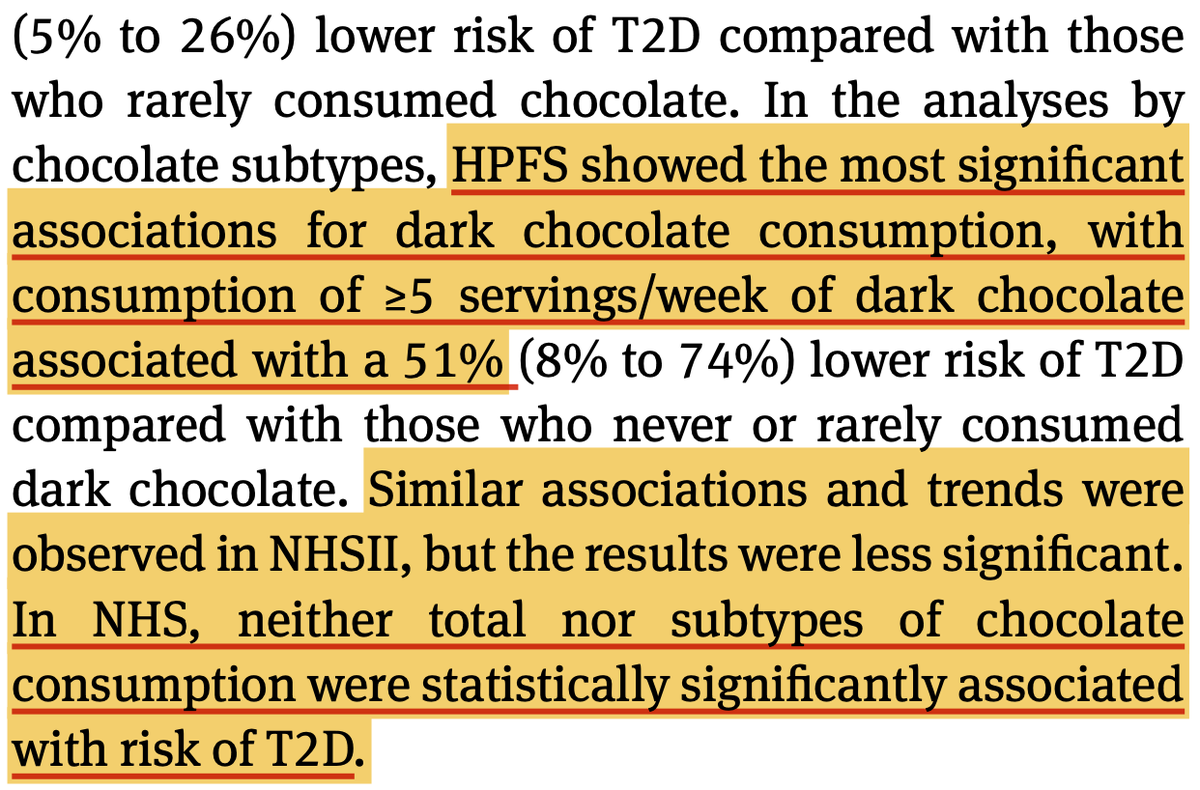
In fact, they were primarily driven by one of the three, with a supposed 51% reduced risk of T2D in heavy chocolate users in the Health Professionals Follow-up Study (HPFS), which I think it quite an absurd value, and one with a giant confidence interval at that (8% to 74%), and no association noted in the Nurses’ Health Study (NHS).
The paper reads, “In NHS, neither total nor subtypes of chocolate consumption were statistically significantly associated with risk of T2D.”
If this was a biological phenomenon based on reliable data, one would expect the data to be more consistent. Instead, the data appear as noisy as an attention-hungry elephant with a bullhorn.
Another big red flag is that there was massive heterogeneity among the studies.
In fact, they were primarily driven by one of the three, with a supposed 51% reduced risk of T2D in heavy chocolate users in the Health Professionals Follow-up Study (HPFS), which I think it quite an absurd value, and one with a giant confidence interval at that (8% to 74%), and no association noted in the Nurses’ Health Study (NHS).
The paper reads, “In NHS, neither total nor subtypes of chocolate consumption were statistically significantly associated with risk of T2D.”
If this was a biological phenomenon based on reliable data, one would expect the data to be more consistent. Instead, the data appear as noisy as an attention-hungry elephant with a bullhorn.
4/5) And what’s “dark chocolate” anyway? Are we talking 95% or 100% dark chocolate bars? Or 50% “dark chocolate” truffles.
Since it’s a self-reported questionnaire, these items get lumped, although they’re obviously not the same.
Actually, in the discussion they do define dark chocolate – a somewhat arbitrary term – with a lower bound of 50% cocoa. I don’t know about you, but to me that’s candy, not true dark chocolate. Just my two cents.
Then again, I’m a chocolate snob.
Since it’s a self-reported questionnaire, these items get lumped, although they’re obviously not the same.
Actually, in the discussion they do define dark chocolate – a somewhat arbitrary term – with a lower bound of 50% cocoa. I don’t know about you, but to me that’s candy, not true dark chocolate. Just my two cents.
Then again, I’m a chocolate snob.
5/5) TLDR, I do think dark chocolate can be a health food. But I don't think these data add much to the story and that the headlines are little more than headlines.
Enjoy your chocolate, but don't target chocolate to prevent diabetes.
For more nuance and details, see today's Newsletter, where I provide more thoughts and also some practical advice on getting more bang for your chocolate buck. #StayCurious open.substack.com/pub/staycuriou…
Enjoy your chocolate, but don't target chocolate to prevent diabetes.
For more nuance and details, see today's Newsletter, where I provide more thoughts and also some practical advice on getting more bang for your chocolate buck. #StayCurious open.substack.com/pub/staycuriou…
• • •
Missing some Tweet in this thread? You can try to
force a refresh