Yesterday, two Russian tankers carrying 8,600 tonnes of fuel oil faced catastrophic accidents in the Black Sea. One split in half, with casualties, while the other ran aground
These dilapidated tankers, built in 1969 and 1982, are the symbol of the “strong Russian economy” 1/
These dilapidated tankers, built in 1969 and 1982, are the symbol of the “strong Russian economy” 1/
They are also illustrating the Russian strategy of by passing sanctions - using a shadow fleet of ran down, uninsured tankers that violate every imaginable regulation
Russia says “f..ck you” to the rules of the world, per usual 2/
Russia says “f..ck you” to the rules of the world, per usual 2/
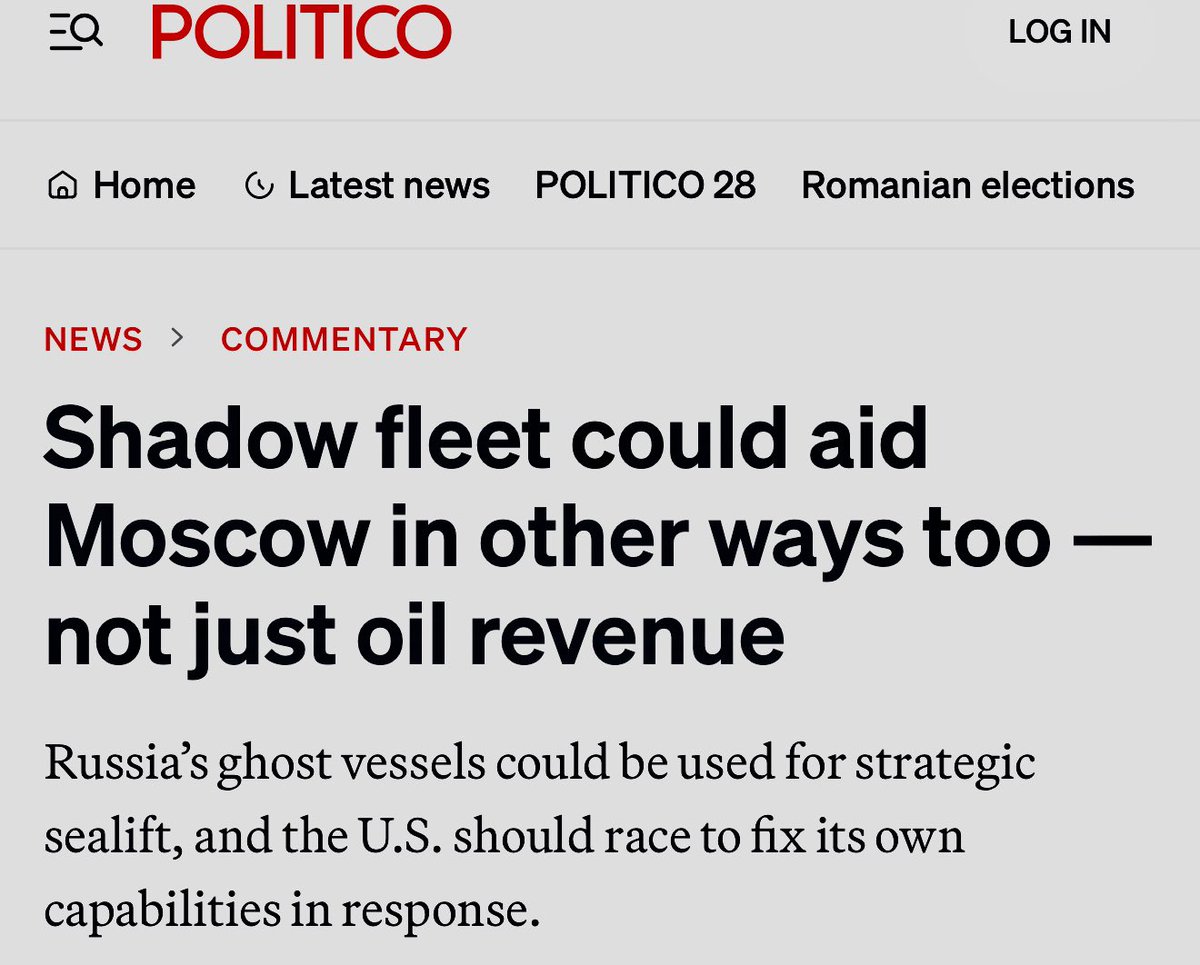
Politico makes an intriguing point that the Russia shadow fleet is now 17% of the total global. So, it is humongous and, thus, can be used to channel arms around without detection
That is a scary thought and another reason to enforce sanctions against the shadow fleet 3/
That is a scary thought and another reason to enforce sanctions against the shadow fleet 3/
So, we now see three fundamental reasons why the Russian shadow fleet should contained and minimized:
1. To deny Russia revenues from sanctioned oil
2. To prevent environmental disasters
3. To prevent illicit arms deliveries 4/
1. To deny Russia revenues from sanctioned oil
2. To prevent environmental disasters
3. To prevent illicit arms deliveries 4/

Our KSE Institute monitors and regularly publishes the Russian shadow fleet and oil tracker. Here is the latest
5/kse.ua/wp-content/upl…
5/kse.ua/wp-content/upl…
The report offers specific recommendations for the sanctions and enforcement, which if implemented, will severely restrict the shadow fleet. The key are
Oil Spill Insurance Disclosure Requirement:
•All vessels passing through critical waterways (e.g., the Gulf of Finland, Danish Straits, and Aegean Sea) should disclose their Protection and Indemnity (P&I) insurance coverage
•Insurance should meet the standards of the 1992 International Convention on Civil Liability for Oil Pollution Damage (CLC) and International Maritime Organization (IMO) guidelines
•Disclosure should include three years of audited financial statements and credit ratings from reputable agencies 6/
Oil Spill Insurance Disclosure Requirement:
•All vessels passing through critical waterways (e.g., the Gulf of Finland, Danish Straits, and Aegean Sea) should disclose their Protection and Indemnity (P&I) insurance coverage
•Insurance should meet the standards of the 1992 International Convention on Civil Liability for Oil Pollution Damage (CLC) and International Maritime Organization (IMO) guidelines
•Disclosure should include three years of audited financial statements and credit ratings from reputable agencies 6/
Multi-Tiered Enforcement Mechanism:
•Diplomatic Outreach: Pressure flag state authorities and classification societies to enforce adequate oil spill insurance regulations
•Commercial Incentives: Make entities involved in non-compliance (e.g., flag registries, ship owners) liable for damages
•Designation of Non-Compliant Vessels: Sanction ships without adequate insurance to remove them from commercial operations
•Exceptional Interdiction: In critical circumstances, physically stop tankers that pose clear environmental risks 7/
•Diplomatic Outreach: Pressure flag state authorities and classification societies to enforce adequate oil spill insurance regulations
•Commercial Incentives: Make entities involved in non-compliance (e.g., flag registries, ship owners) liable for damages
•Designation of Non-Compliant Vessels: Sanction ships without adequate insurance to remove them from commercial operations
•Exceptional Interdiction: In critical circumstances, physically stop tankers that pose clear environmental risks 7/
Leveraging Coalition Jurisdictions:
•Utilize the legal frameworks of the US, EU, and UK to enforce secondary sanctions and designation strategies to deter shadow fleet operations
•Align coalition efforts to strengthen oversight in the shipping industry and make non-compliance economically unviable for operators 8/
•Utilize the legal frameworks of the US, EU, and UK to enforce secondary sanctions and designation strategies to deter shadow fleet operations
•Align coalition efforts to strengthen oversight in the shipping industry and make non-compliance economically unviable for operators 8/
Mitigating Environmental Risks:
•Assert coastal state rights to safeguard against inadequately insured tankers, leveraging legal provisions under UNCLOS and IMO regulations
•Reserve the right to intervene physically when shadow fleet operations violate international safety standards
These measures aim to improve transparency, enforce regulatory compliance, and mitigate the environmental risks posed by Russia’s shadow fleet 9/
•Assert coastal state rights to safeguard against inadequately insured tankers, leveraging legal provisions under UNCLOS and IMO regulations
•Reserve the right to intervene physically when shadow fleet operations violate international safety standards
These measures aim to improve transparency, enforce regulatory compliance, and mitigate the environmental risks posed by Russia’s shadow fleet 9/
If you want to support the analytical and education work of KSE, you can donate here
10Xfoundation.kse.org.ua
10Xfoundation.kse.org.ua
• • •
Missing some Tweet in this thread? You can try to
force a refresh