I've been involved with three US Army FMTV reset programs.
So this newest report from Ukraine's Defense Express on the the repairability problems with Russian AFV's out of their reserves is so much fun to share with you all.
1/
So this newest report from Ukraine's Defense Express on the the repairability problems with Russian AFV's out of their reserves is so much fun to share with you all.
1/
https://twitter.com/TrentTelenko/status/1505370289378664450
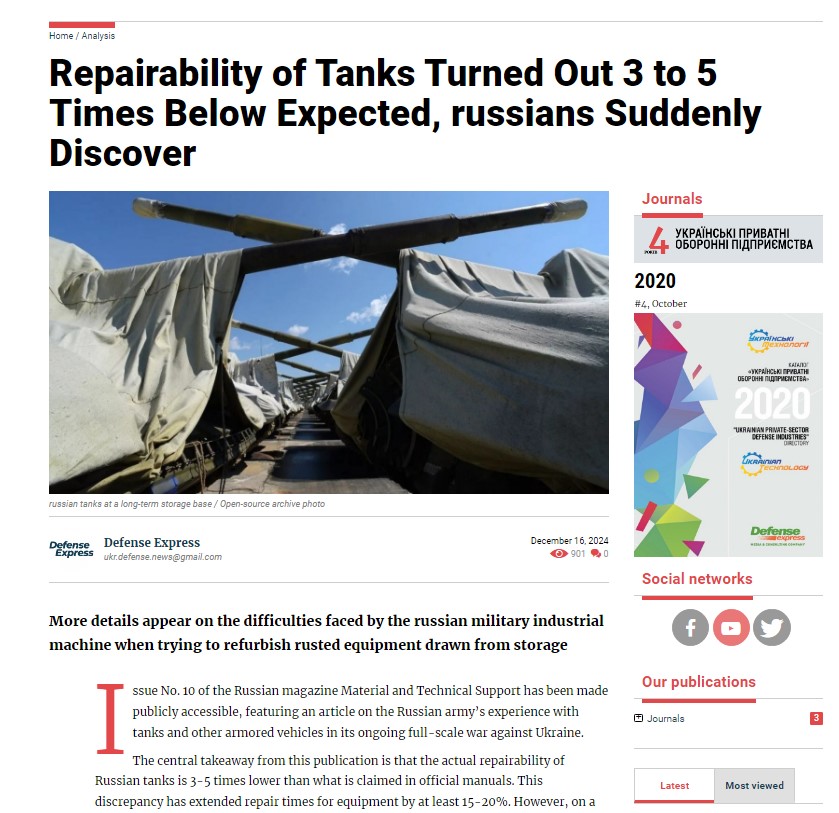
Defense Express pulled an article from the No. 10 issue of the Russian magazine "Material and Technical Support" on how horrid the vehicles coming out of reserve are plus problems with battle damaged reserve vehicles.
2/
en.defence-ua.com/analysis/repai…
2/
en.defence-ua.com/analysis/repai…
The 2nd paragraph starts with this:
"The central takeaway from this publication is that the actual repairability of Russian tanks is 3-5 times lower than what is claimed in official manuals. This discrepancy has extended repair times for equipment by at least 15-20%."
3/
"The central takeaway from this publication is that the actual repairability of Russian tanks is 3-5 times lower than what is claimed in official manuals. This discrepancy has extended repair times for equipment by at least 15-20%."
3/
Then it gets worse:
"For instance, fire control systems in T-72 and T-80 tanks have non-interchangeable components. Additionally, there are as many as seven different engine types used in russian armor, further complicating logistics and repairs."
4/
"For instance, fire control systems in T-72 and T-80 tanks have non-interchangeable components. Additionally, there are as many as seven different engine types used in russian armor, further complicating logistics and repairs."
4/
and worse:
"The magazine also draws attention to how incomplete the armored vehicles arrive from storage bases. Upon receipt, these vehicles require engine replacements, battery charges, and replenishments to the spare parts and tool kits."
5/
"The magazine also draws attention to how incomplete the armored vehicles arrive from storage bases. Upon receipt, these vehicles require engine replacements, battery charges, and replenishments to the spare parts and tool kits."
5/
and worse:
"Compounding these issues, numerous malfunctions were reported in communication systems, electrical equipment, and fire control systems. Addressing all these faults required specialists from repair plants, manufacturing plants, and storage bases."
6/
"Compounding these issues, numerous malfunctions were reported in communication systems, electrical equipment, and fire control systems. Addressing all these faults required specialists from repair plants, manufacturing plants, and storage bases."
6/
Although I expect this sentence was utter horse💩-
"As a result, preparing tanks from mothballed reserves for combat operations could take up to 10 days."
I've worked reset with 3116 caterpillar engines and early WTEC one and two transmissions Allison on the FMTV trucks.
7/
"As a result, preparing tanks from mothballed reserves for combat operations could take up to 10 days."
I've worked reset with 3116 caterpillar engines and early WTEC one and two transmissions Allison on the FMTV trucks.
7/
The turnaround time for rebuilding an old power pack with that engine and those transmissions was several weeks to a couple of months.
T-62, T-64 or early T-72 tank power packs out of production for more than 35 years have to be a months long effort.
8/
army.mil/article/13871/…
T-62, T-64 or early T-72 tank power packs out of production for more than 35 years have to be a months long effort.
8/
army.mil/article/13871/…

This passage on Russian kinetic battle damage repair is very interesting:
"The article also provides insight into how different types of damage affect tank functionality. When armor is penetrated, the power plant units, stabilizers, automatic gun loaders, fuel tanks, optical and electro-optical systems, and communications equipment can be destroyed or disabled."
9/
"The article also provides insight into how different types of damage affect tank functionality. When armor is penetrated, the power plant units, stabilizers, automatic gun loaders, fuel tanks, optical and electro-optical systems, and communications equipment can be destroyed or disabled."
9/


As is this one on damage from explosive shaped charges:
"When a tank is struck by a shaped-charge projectile, its effects depend on what components lie in the path of the blast. If the affected area contains powder-based propellant charges, detonation and fire may occur. Damage to the engine or transmission system often results in a fire, which can lead to fuel tank explosions and, in some cases, ammunition detonation."
10/
"When a tank is struck by a shaped-charge projectile, its effects depend on what components lie in the path of the blast. If the affected area contains powder-based propellant charges, detonation and fire may occur. Damage to the engine or transmission system often results in a fire, which can lead to fuel tank explosions and, in some cases, ammunition detonation."
10/


What this Russian repair article leaves out there are 5 generations of 125mm gun and five different 125mm autoloaders between the T64, T-72 and T-80.
The attrition guru Frederick Lanchester is smiling.
11/11 End
The attrition guru Frederick Lanchester is smiling.
11/11 End

@threadreaderapp unroll please
• • •
Missing some Tweet in this thread? You can try to
force a refresh