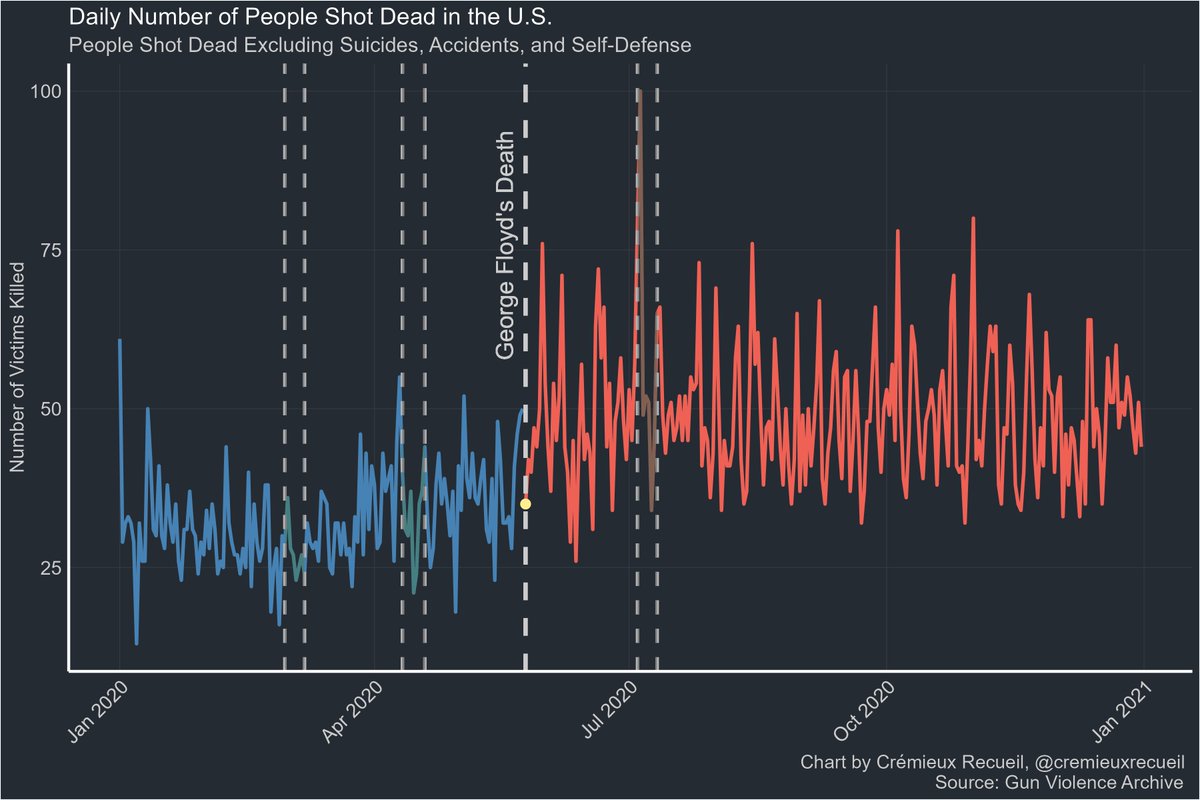
And here we have it: Daily homicide data!🧵
The massive increase in homicides in the last week of May of 2020 started in the days after George Floyd's death.
The massive increase in homicides in the last week of May of 2020 started in the days after George Floyd's death.
https://x.com/cremieuxrecueil/status/1846989051410186642

The Floyd Effect principally refers to the impact of George Floyd's death on homicide numbers in the U.S. through diverse mechanisms, such as reduced cooperation with police, reduced police activity, presence, and willingness to confront potential criminals, and maybe more.
The effect primarily occurred due to an increase in firearm violence that was largely isolated to African Americans. The effect is timed to the
- Year
- Month
- Week
- Day
of George Floyd's death.
- Year
- Month
- Week
- Day
of George Floyd's death.
Since it's hard to eyeball series like the above for structural breaks, I've produced a version that has a 7-day moving average and splits off the date of George Floyd's death to its own little yellow ball on May 25th.
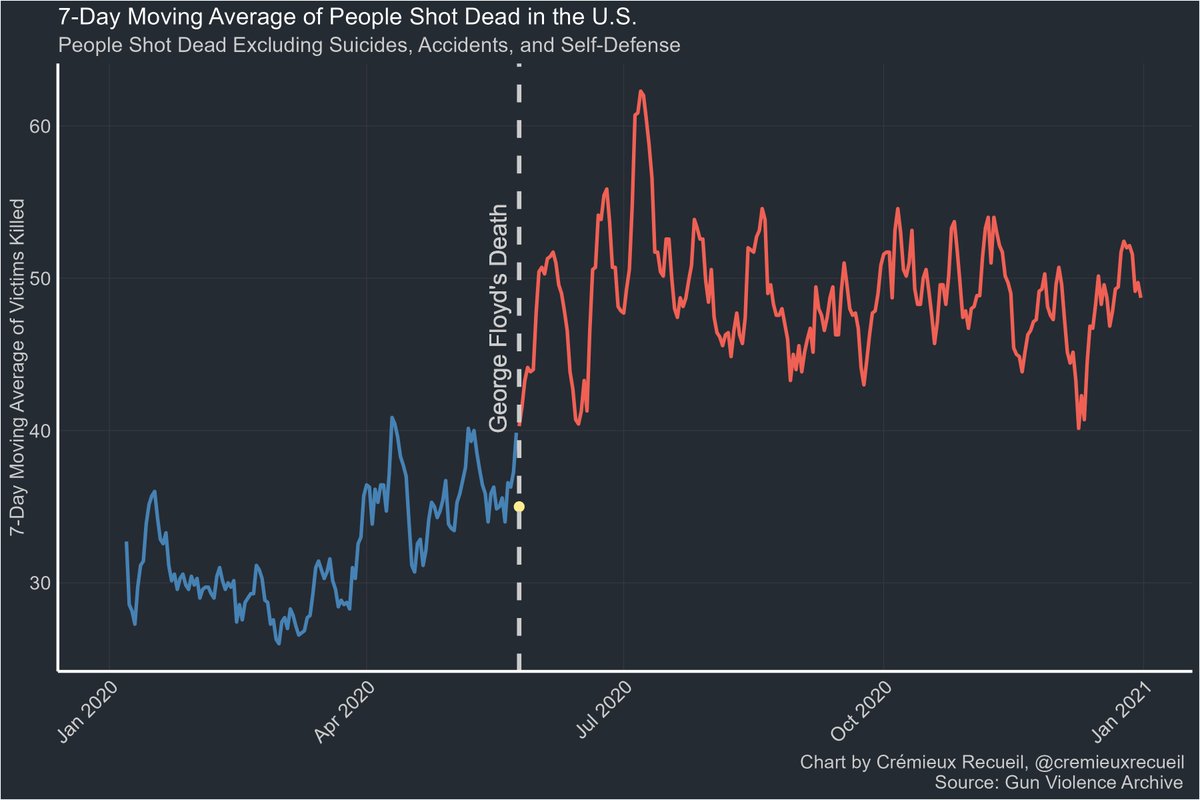
This break has several features that make us certain it is timed to Floyd's death rather than the preceding pandemic lockdowns.
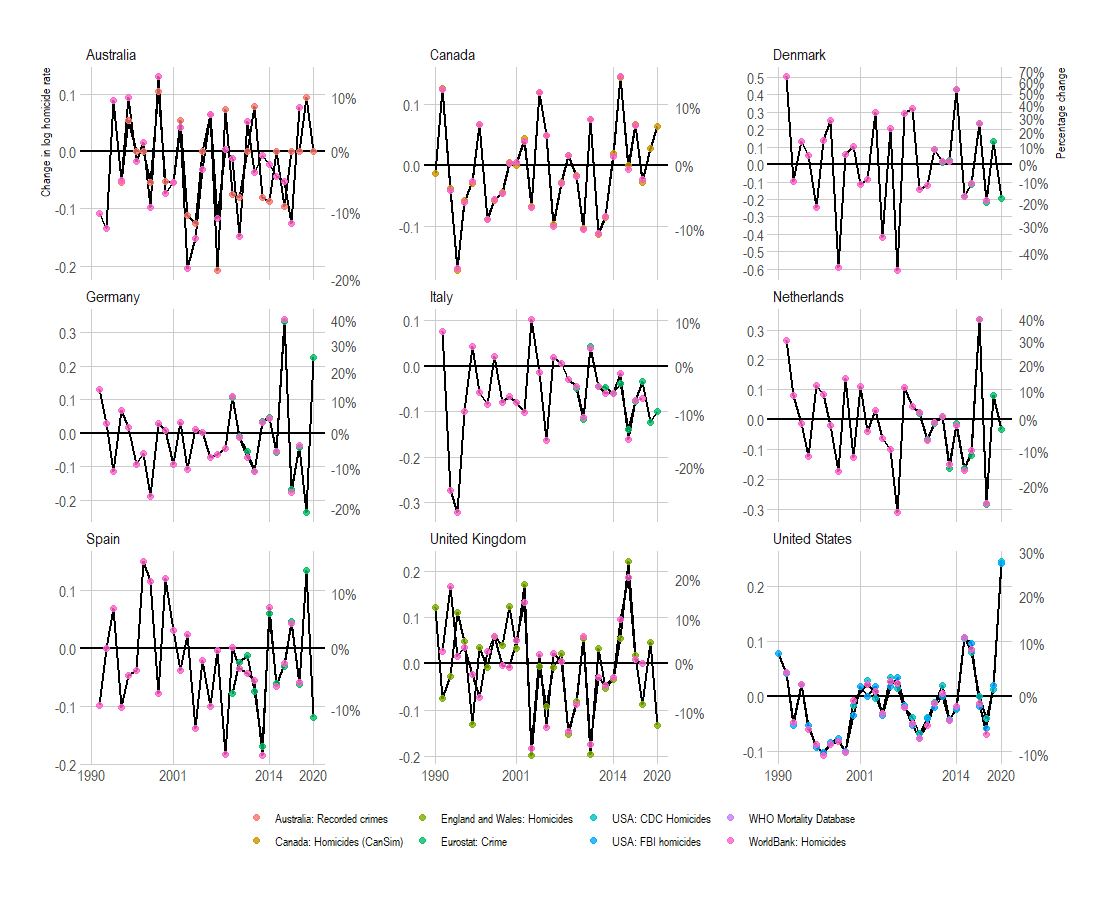
For example, among first world nations, the increase in homicides was only observed in the U.S.
Were this a pandemic thing, that wouldn't be the case.
For example, among first world nations, the increase in homicides was only observed in the U.S.
Were this a pandemic thing, that wouldn't be the case.
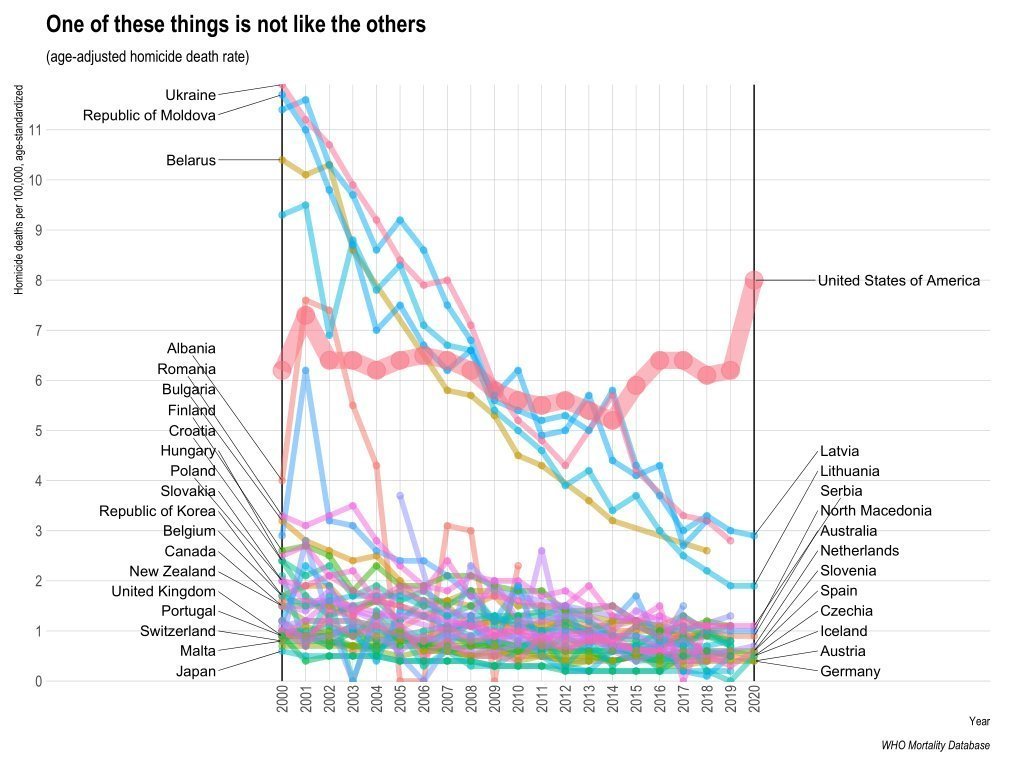
Among comparable nations, only the U.S. broke its post-1980s homicide rate record in 2020.
This isolation occurred despite the global presence of BLM protests (and some riots), lockdowns, and much else.
This isolation occurred despite the global presence of BLM protests (and some riots), lockdowns, and much else.
Turning back to the U.S., the number of gunfire incidents tracked by ShotSpotter was somewhat ahead of 2019 numbers going into the year, as were homicides, gun injuries, and so on.
But the major divergence from 2019 only occurred in the week of George Floyd's death.
But the major divergence from 2019 only occurred in the week of George Floyd's death.

Using data from Minneapolis, the city in which George Floyd died, we can see that weekly firearm assault injuries spiked immediately upon his death and not prior.
This spike bring firearm assaults over substantially over the previous year abruptly, like the spike in homicides.
This spike bring firearm assaults over substantially over the previous year abruptly, like the spike in homicides.
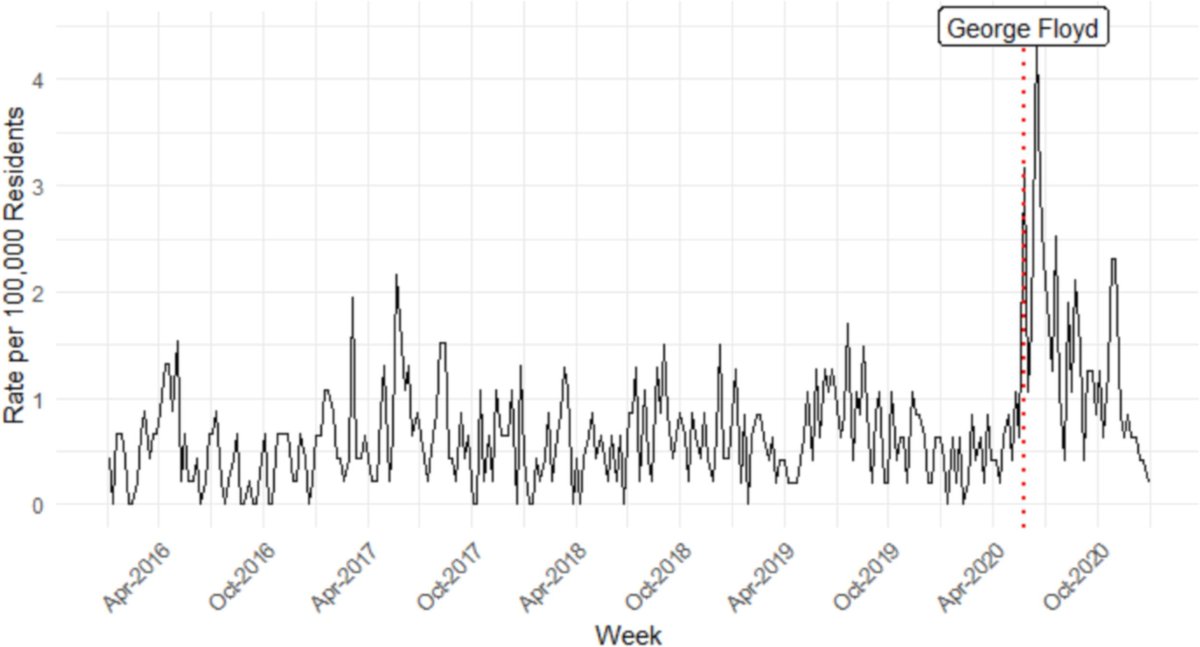
Similarly, the murder rate in Minneapolis skyrocketed only in the week of George Floyd's death.

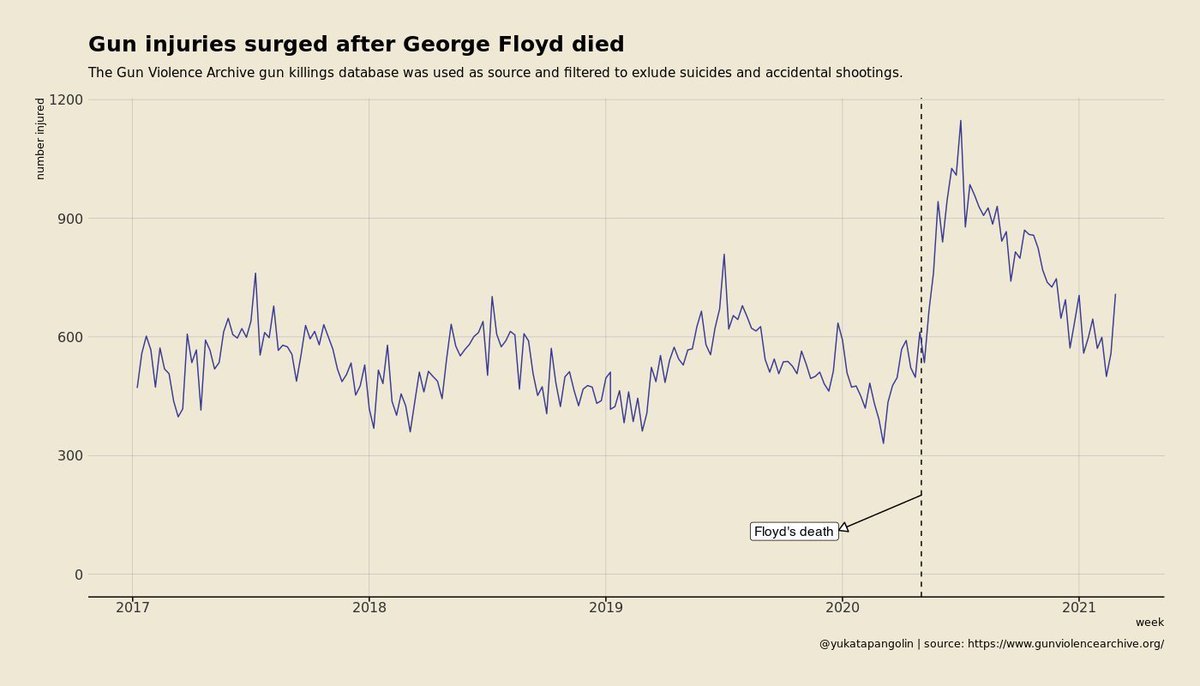
Again using information on gun violence in the form of data on gun injuries, we see that the increase that marked 2020's wave of violence kicked off only after Floyd's death.
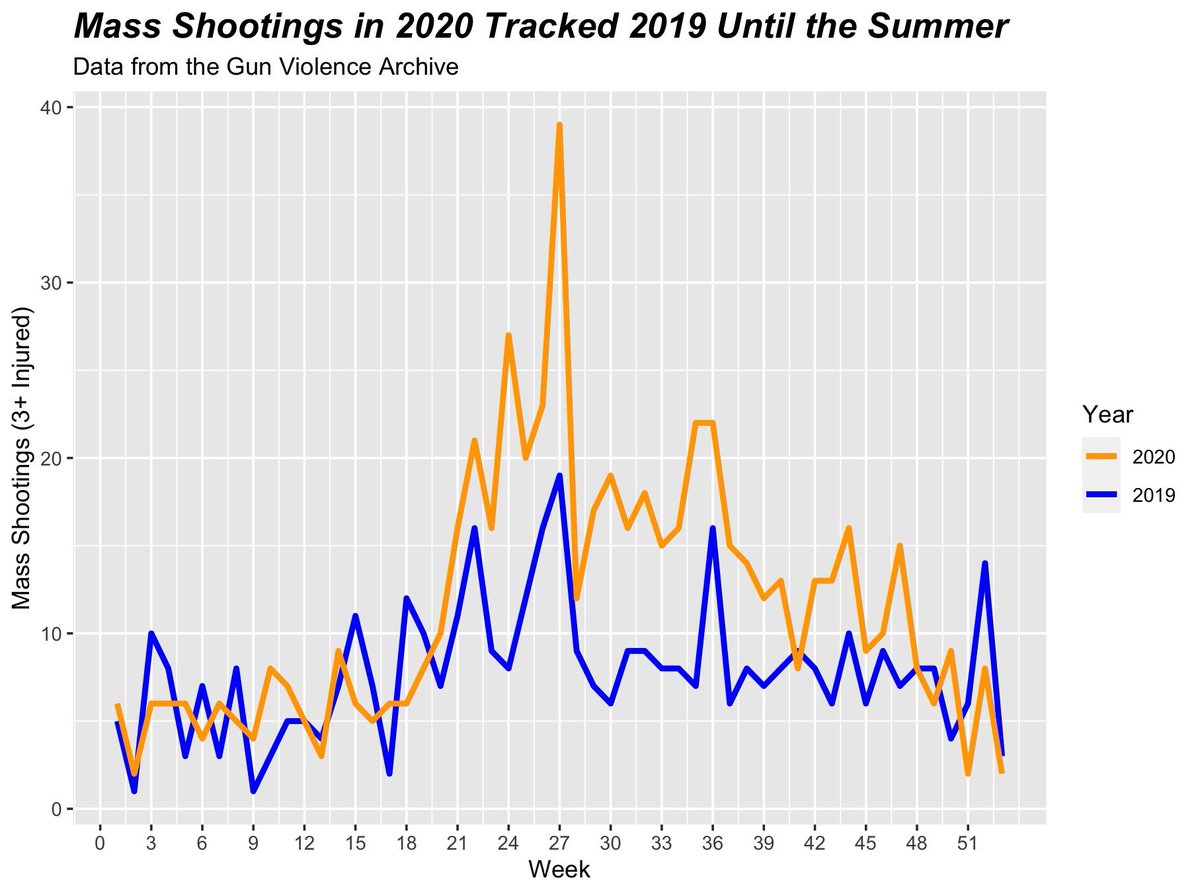
If we look at gun violence through the lens of mass shootings, then we see something similar:
2020 and 2019 were alike until roughly the week of George Floyd's death, then they diverged substantially.
2020 and 2019 were alike until roughly the week of George Floyd's death, then they diverged substantially.
If we forecast 2020's homicides using earlier data, we don't see this effect.
The initially higher rates of violence observed in 2020 relative to 2019 do not turn into an isolated spike that abruptly raises the rate of homicides for the rest of the year after May 25.
The initially higher rates of violence observed in 2020 relative to 2019 do not turn into an isolated spike that abruptly raises the rate of homicides for the rest of the year after May 25.
If we want to look at data that more clearly illustrates the mechanisms of the Floyd, we can. There's plenty of it.
For example, the ratio of gun casualties to 911 calls declined when 2020 started, but it abruptly fell and persisted at a low level throughout the rest of 2020.
For example, the ratio of gun casualties to 911 calls declined when 2020 started, but it abruptly fell and persisted at a low level throughout the rest of 2020.

If we use empirical breakpoint detection methods on the daily data from 2020 (Bai-Perron test shown) or from an extended series, we always get our best performance with just one break.
Namely, a break centered on May 22-28, surrounding the day Floyd died, May 25.
Namely, a break centered on May 22-28, surrounding the day Floyd died, May 25.
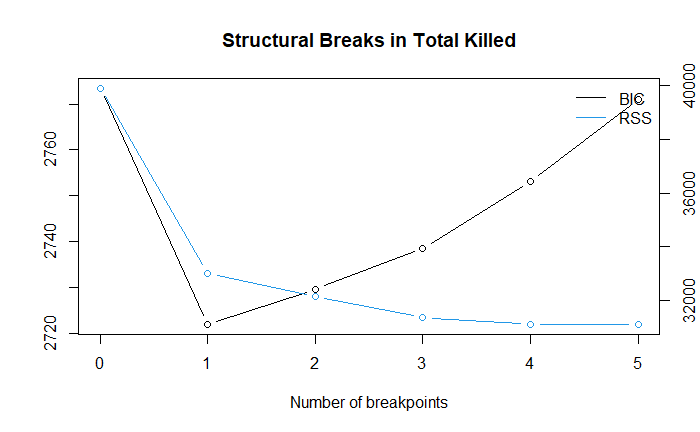
No breakpoint detection method I'm aware of picks up on earlier dates or later dates that are evenly spaced around Floyd's death.
What matters for the large increase in homicides in 2020 was an abrupt spike in one week, and such a spike is unprecedented in prior or later years.
What matters for the large increase in homicides in 2020 was an abrupt spike in one week, and such a spike is unprecedented in prior or later years.
In 2018, 2019, 2021, or 2022, there's no spike around Memorial Day (the day Floyd died), nor even was there in the daily data for 2020: Everything came after and was unique to 2020.
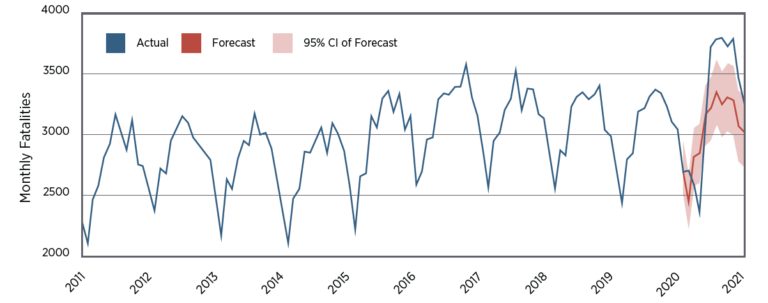
Given the proposed etiology of the Floyd Effect as something to do with police presence, perceptions of enforcement likelihood, etc., it's no wonder that the Floyd Effect also extended to automobile fatalities.
Compared to AAA's 2020 forecast, May saw a massive, abrupt increase.
Compared to AAA's 2020 forecast, May saw a massive, abrupt increase.
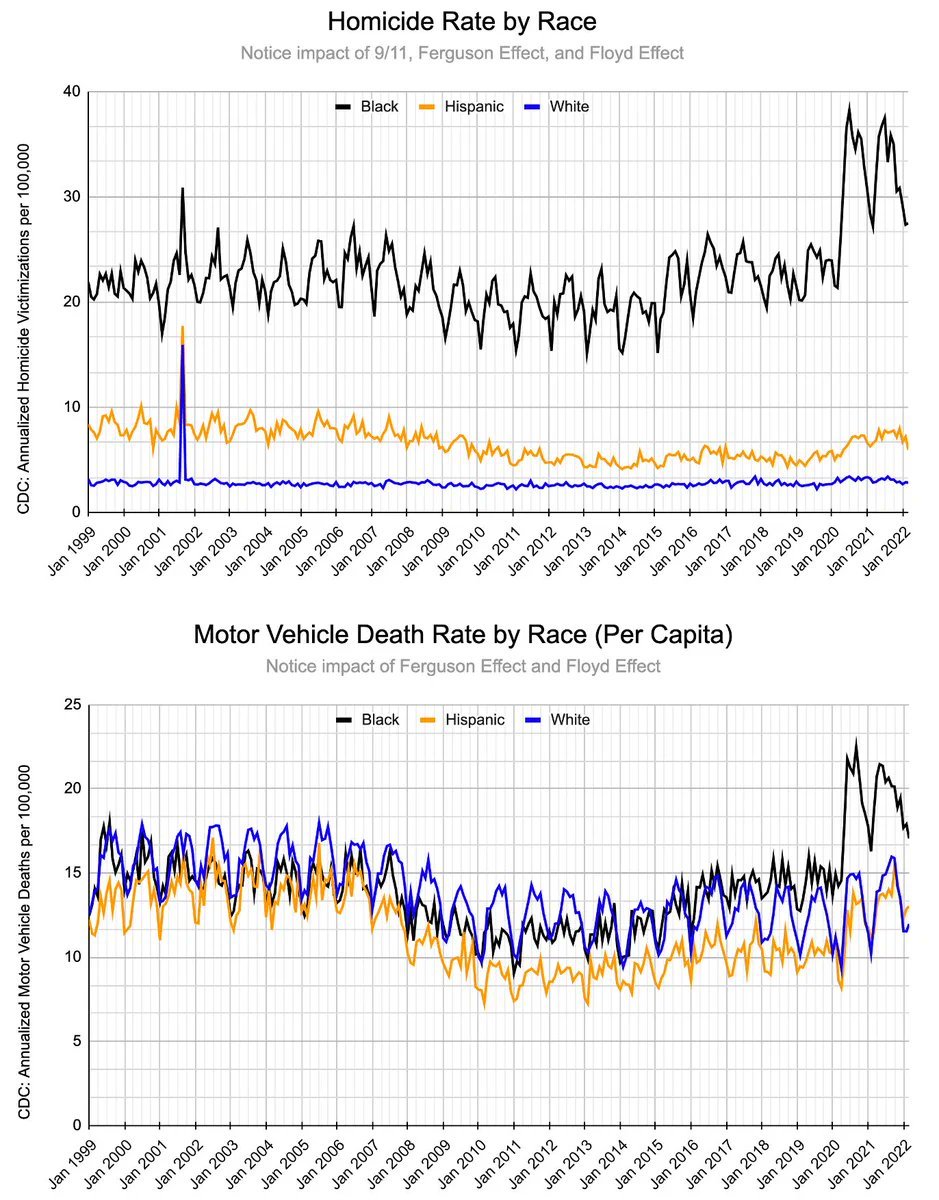
Like the increase in homicides, gun violence, and so on, CDC data suggests that the Floyd Effect on automobile accidents and fatalities was likewise largely racially-specific and isolated to Blacks.
There's much more to strengthen the case that this was isolated to after Floyd's death, but I'm going to cut this off shortly.
So to reiterate, we are talking to a well-timed race- and country-specific spike that occurred in no other year before or since, with no real pre-trend.
So to reiterate, we are talking to a well-timed race- and country-specific spike that occurred in no other year before or since, with no real pre-trend.
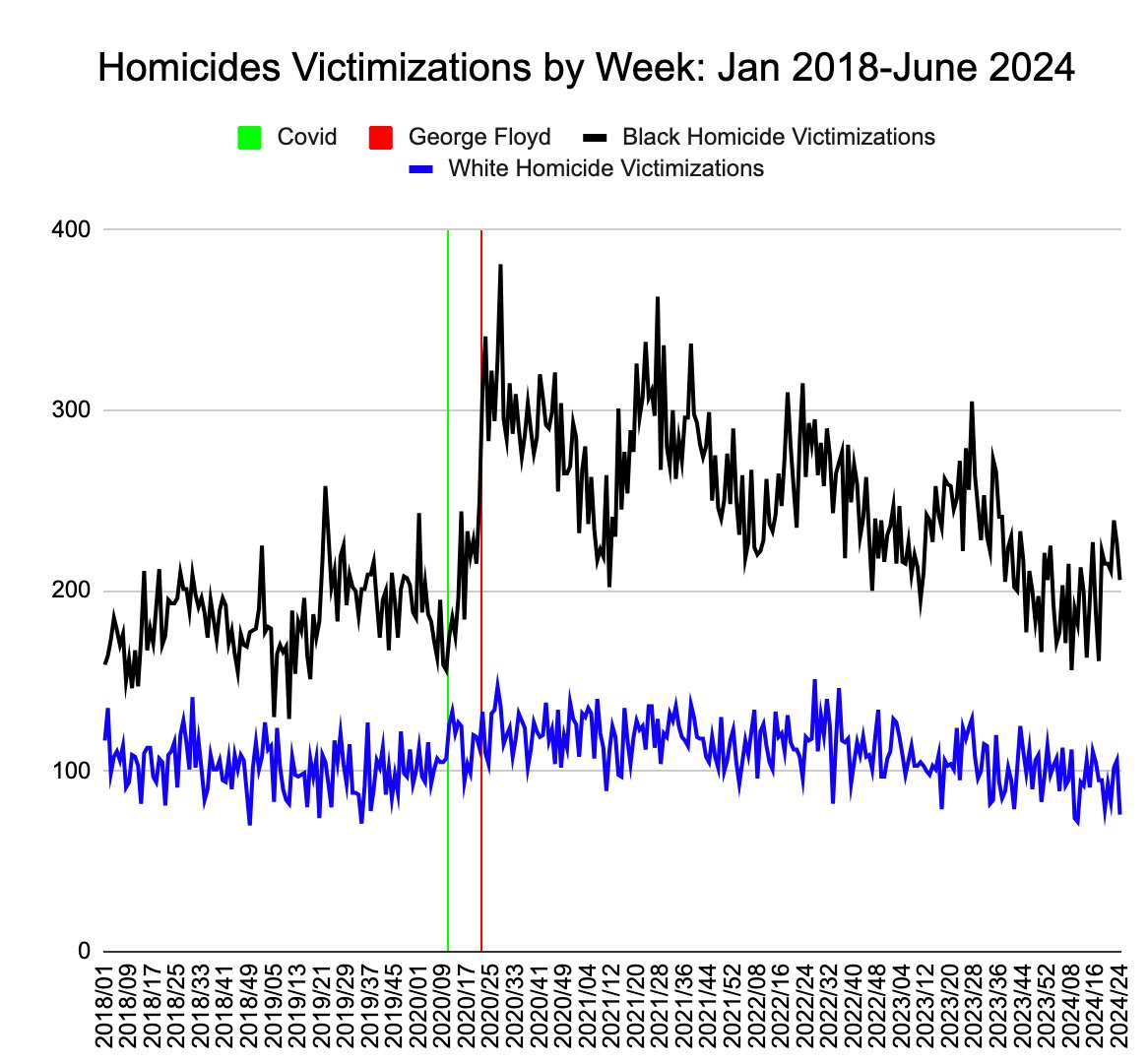
To explain this in any other way than via a reaction after George Floyd's death requires bringing in data that explains all of this together while somehow nixing Floyd's death timing.
I'm not aware of any credible attempts at that.
America suffered through the Floyd Effect.
I'm not aware of any credible attempts at that.
America suffered through the Floyd Effect.
Sources:
Gun Violence Archive
WHO Mortality Database
ShotSpotter
CDC WONDER
sciencedirect.com/science/articl…
web.archive.org/web/2023050922…
web.archive.org/web/2024082817…
Gun Violence Archive
WHO Mortality Database
ShotSpotter
CDC WONDER
sciencedirect.com/science/articl…
web.archive.org/web/2023050922…
web.archive.org/web/2024082817…
P.S.
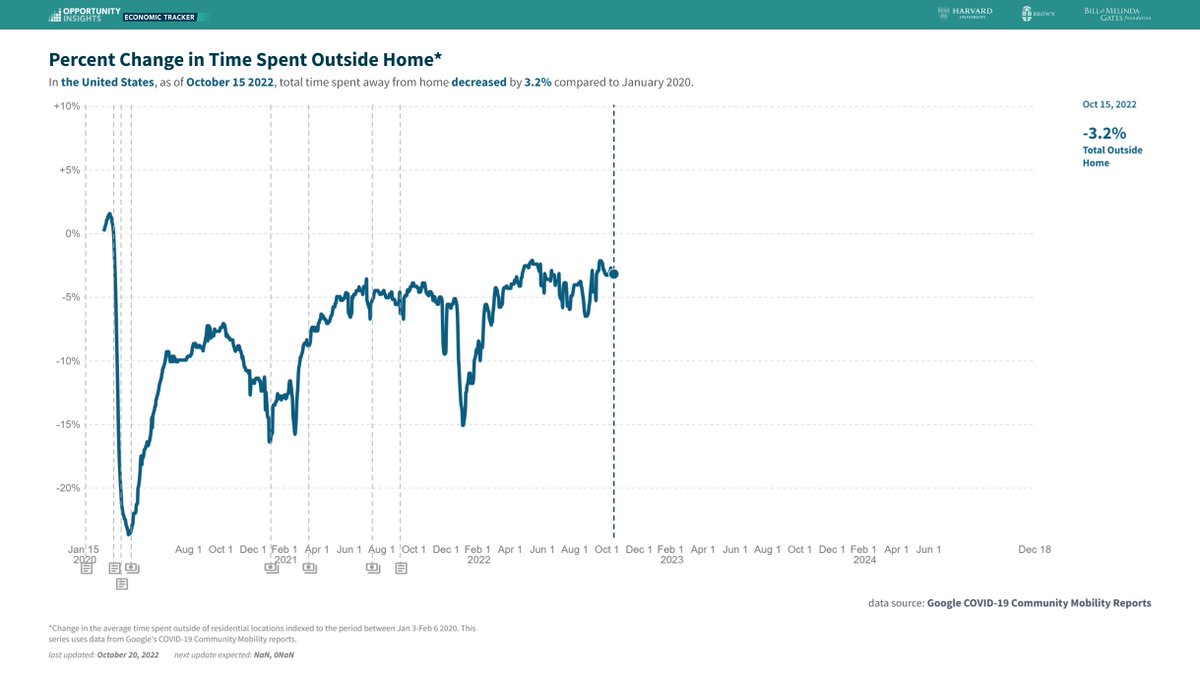
Strengthening the notion that this was not pandemic-related, daily and weekly homicides are only weakly correlated with and not Granger-caused by this metric, cell phone-gathered time spent outside the home: tracktherecovery.org
Strengthening the notion that this was not pandemic-related, daily and weekly homicides are only weakly correlated with and not Granger-caused by this metric, cell phone-gathered time spent outside the home: tracktherecovery.org
P.P.S.
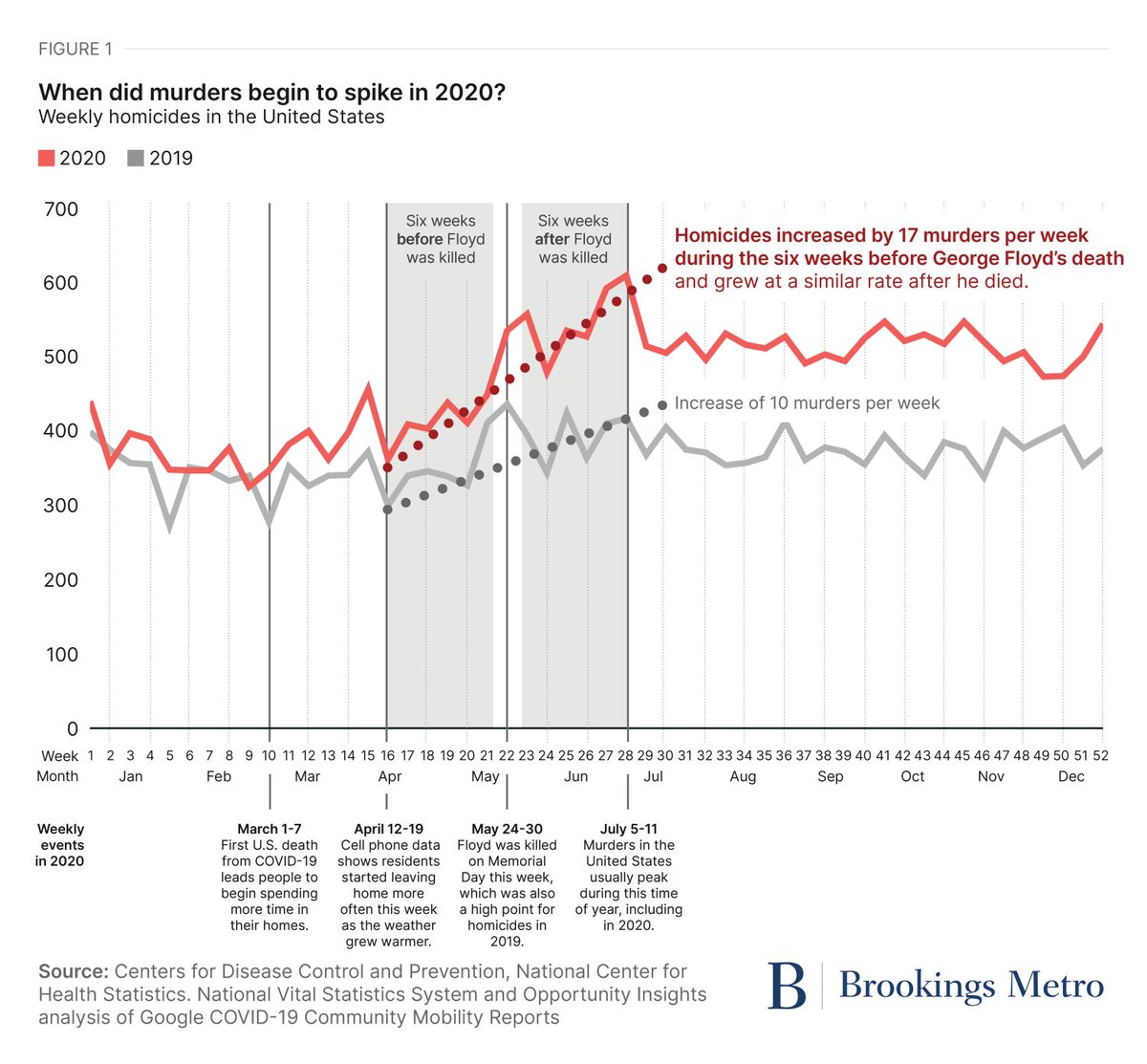
There's a Brookings piece arguing that the Floyd Effect isn't real and, instead, 2020's rise in homicides is due to several factors they picked out arbitrarily and which aren't supported when you use more measures.
Their theory is laid out in this chart:
The chart suggests if people spend time indoors, homicides should be lower. They're visibly not. Maybe the authors only think that spending time in- or outdoors has effects in one direction for some reason.
The idea that 'people stop spending time indoors and thus homicides increase' is not supported by the data. It's not Granger causal, it's not supported by later years, correlations aren't even meaningfully there just switching to daily data or gun use metrics, and they're certainly not there for automobile fatalities, for which the result was far below forecast in April! Needless to say, there is only negative empirical support for their proposed breaks prior to Floyd's death.
The other really weird thing about this is that they arbitrarily picked some 6-week intervals around Floyd's death to draw lines through. Why...? The apparent justification by cell phone-tracked mobility outside the home doesn't work out empirically because that's not even well-correlated with homicides, nor does it seem to matter throughout the rest of the year, in later years, etc. It's just arbitrary and they almost-certainly know it, they just wanted to draw random lines.
Also, why do they stop drawing their lines six weeks after Floyd's death? The spike in the week of Floyd's death leads to the average for the rest of the year after July 5th-11th already. There's no need to go further, and this decision isn't justified by the thing they've stated it's justified by, namely, that it's the usual time things spike. That's not supported in... 2013, 2014, 2015, 2016, 2017, 2018, or even, as their chart shows, 2019! It's supported in 2021-23, but they couldn't have known that ahead of those years happening and the resulting cyclicality they engendered (see: my weekly plot).
If we similarly arbitrarily choose weeks to draw lines from at 7 weeks, the support for their theory declines, but why do that? We know it's not robust from daily data anyway, and it's negatively justified in the first place. Plus, their last component of justifying it was a red herring: the week of Memorial Day.
They remark that the week of Memorial Day was a high point for homicides in 2019. OK, but it wasn't a high point in 2020. It was the high point in 2019, and it was just about the post-Floyd average in 2020. In fact, most of the increase from 6.5 weeks before to 6.5 after is in that one spike in the week of Floyd's death. If we arbitrarily go from nadir to peak, it's just a large portion of it, and most of the subsequent change. But there was no massive Memorial Day-related spike in 2019, nor in other years. This it not precedented. It must be discussed, not ignored by arguing based on nothing that this huge, unprecedented jump upwards, is just like any other year.
In most years, you can just draw a straight line from the beginning of January's homicides to the end of December's homicides. That doesn't work in 2020, and most of that difference is in one, single spike.
Their theory? Releasing the poor out on the streets. But then, what of later years? Why didn't the spike happen earlier? Why not among Whites, Asians, and Hispanics? Hispanics and Blacks are similarly poor, and yet Hispanics experienced only a meager increase in homicides. Their race-agnostic explanation capitalizes on race-specific effects while ignoring race. In the process, it errs, because we have so much more race-specific information, like race-specific time-to-crime, automobile fatalities, cooperation with police, and more.
While the Floyd Effect explains the timing of tons of different things all at once, their theory can only explain one thing and it does so through assumptions that they cannot justify, but which we can justify discarding.
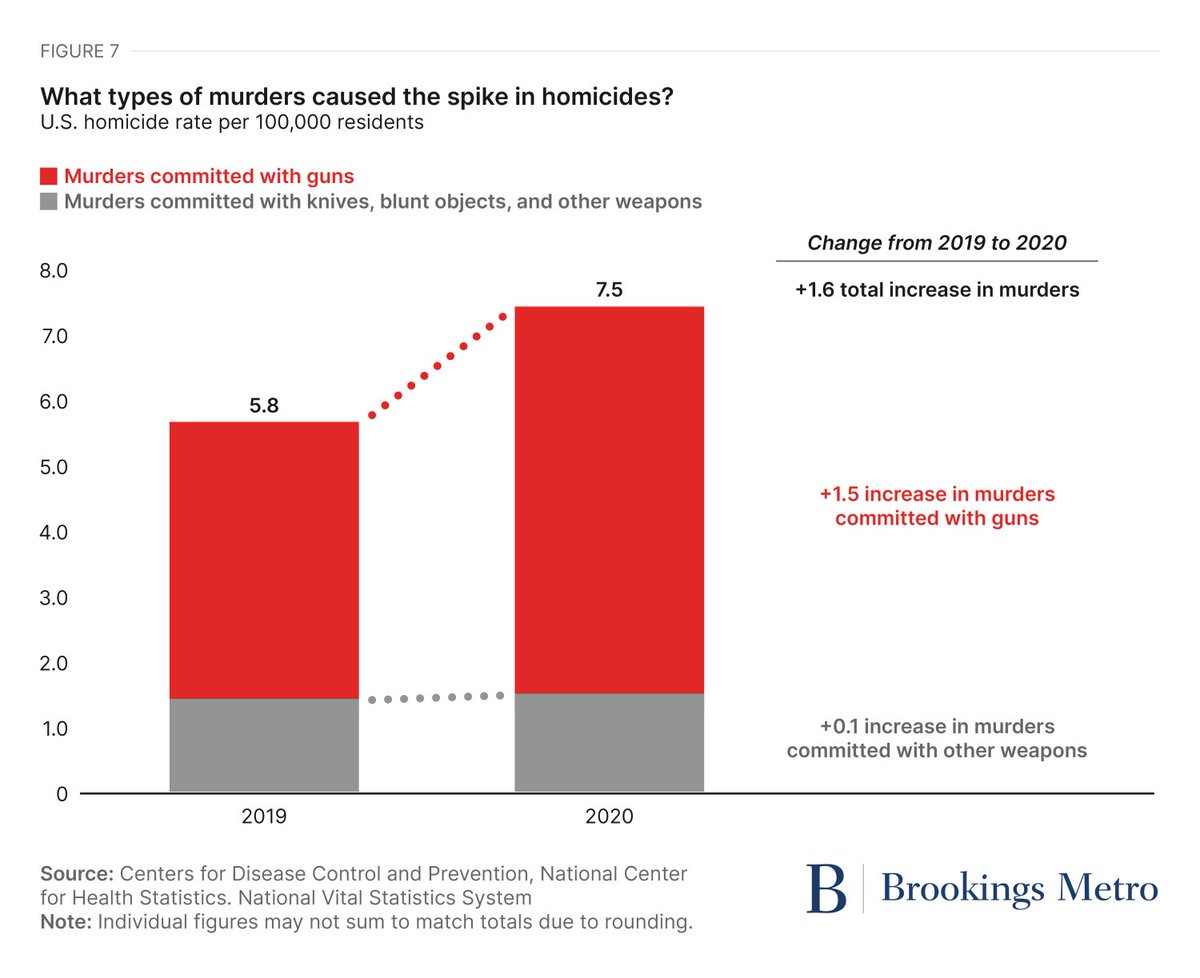
The only really good thing is the graph showing that the increase in homicides is down to guns:
They use this to cast aside international evidence. But they forget: We have so much more to account for, and this doesn't help them with that. Moreover, as shown in my thread above, if we focus in more on guns, then apparent support for their chosen theory also evaporates because the timings become that much more off even if we believe their negatively-justified causal assumptions.
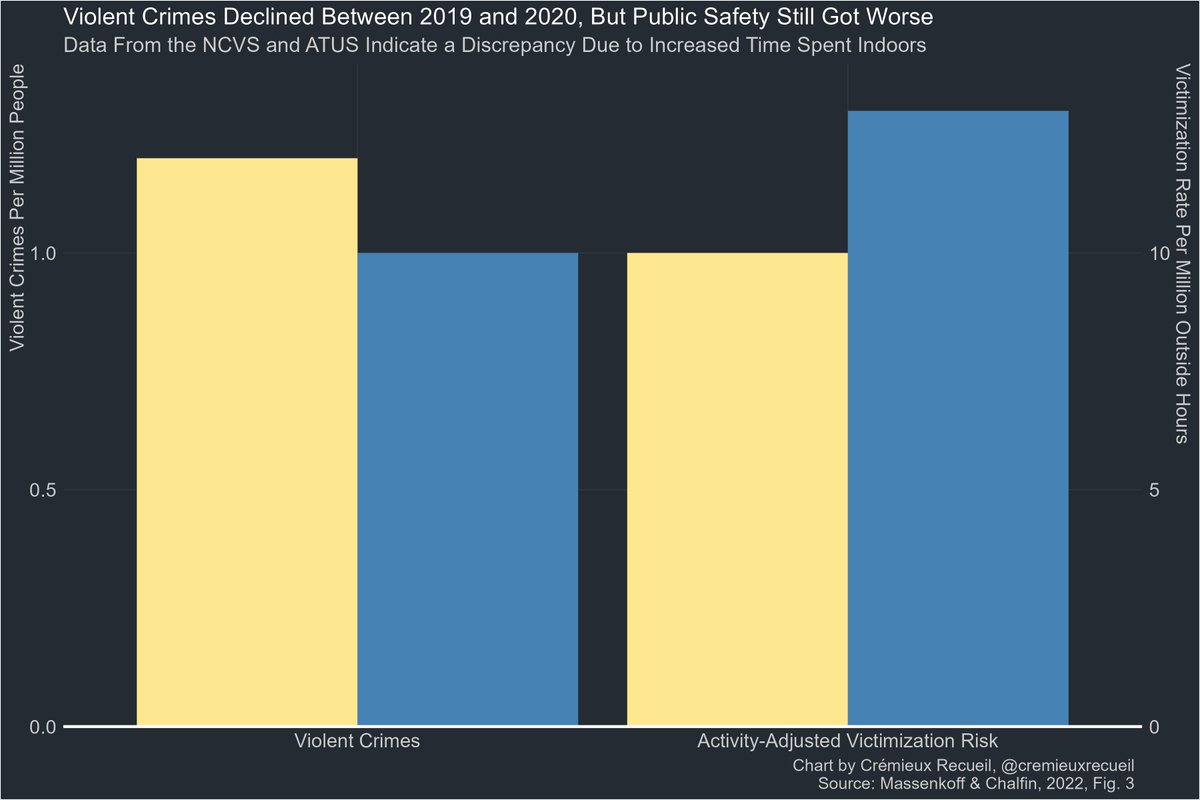
But other data also pushes America's violence problems in 2020 away from just talking about guns. For example, adjusted for the reduced level of outdoors time that the authors of this Brookings piece reasoned from, violent victimization risk (blue) went up!
Other countries saw quite the opposite. Perhaps they could handwave that away because of guns. Maybe they could handwave everything away by way of guns. Maybe they could claim that Blacks got in so many more accidents in the period following Floyd's death due to attempts to flee people with guns. But at that point, they'd be stretching the limits of any sensible person's credulity.
Brookings has published a stupendous exercise in massaging away reality and I have to commend them for throwing away their credibility over something that they didn't even need to talk about.
Here's the piece: brookings.edu/articles/why-d…
Victimization risk source: x.com/cremieuxrecuei…
And yet another fun thing to think about given it doesn't work so well with their views: In South Africa, the lockdown didn't visibly affect homicides, but the part of the lockdown in which alcohol was banned did: x.com/cremieuxrecuei…
There's a Brookings piece arguing that the Floyd Effect isn't real and, instead, 2020's rise in homicides is due to several factors they picked out arbitrarily and which aren't supported when you use more measures.
Their theory is laid out in this chart:
The chart suggests if people spend time indoors, homicides should be lower. They're visibly not. Maybe the authors only think that spending time in- or outdoors has effects in one direction for some reason.
The idea that 'people stop spending time indoors and thus homicides increase' is not supported by the data. It's not Granger causal, it's not supported by later years, correlations aren't even meaningfully there just switching to daily data or gun use metrics, and they're certainly not there for automobile fatalities, for which the result was far below forecast in April! Needless to say, there is only negative empirical support for their proposed breaks prior to Floyd's death.
The other really weird thing about this is that they arbitrarily picked some 6-week intervals around Floyd's death to draw lines through. Why...? The apparent justification by cell phone-tracked mobility outside the home doesn't work out empirically because that's not even well-correlated with homicides, nor does it seem to matter throughout the rest of the year, in later years, etc. It's just arbitrary and they almost-certainly know it, they just wanted to draw random lines.
Also, why do they stop drawing their lines six weeks after Floyd's death? The spike in the week of Floyd's death leads to the average for the rest of the year after July 5th-11th already. There's no need to go further, and this decision isn't justified by the thing they've stated it's justified by, namely, that it's the usual time things spike. That's not supported in... 2013, 2014, 2015, 2016, 2017, 2018, or even, as their chart shows, 2019! It's supported in 2021-23, but they couldn't have known that ahead of those years happening and the resulting cyclicality they engendered (see: my weekly plot).
If we similarly arbitrarily choose weeks to draw lines from at 7 weeks, the support for their theory declines, but why do that? We know it's not robust from daily data anyway, and it's negatively justified in the first place. Plus, their last component of justifying it was a red herring: the week of Memorial Day.
They remark that the week of Memorial Day was a high point for homicides in 2019. OK, but it wasn't a high point in 2020. It was the high point in 2019, and it was just about the post-Floyd average in 2020. In fact, most of the increase from 6.5 weeks before to 6.5 after is in that one spike in the week of Floyd's death. If we arbitrarily go from nadir to peak, it's just a large portion of it, and most of the subsequent change. But there was no massive Memorial Day-related spike in 2019, nor in other years. This it not precedented. It must be discussed, not ignored by arguing based on nothing that this huge, unprecedented jump upwards, is just like any other year.
In most years, you can just draw a straight line from the beginning of January's homicides to the end of December's homicides. That doesn't work in 2020, and most of that difference is in one, single spike.
Their theory? Releasing the poor out on the streets. But then, what of later years? Why didn't the spike happen earlier? Why not among Whites, Asians, and Hispanics? Hispanics and Blacks are similarly poor, and yet Hispanics experienced only a meager increase in homicides. Their race-agnostic explanation capitalizes on race-specific effects while ignoring race. In the process, it errs, because we have so much more race-specific information, like race-specific time-to-crime, automobile fatalities, cooperation with police, and more.
While the Floyd Effect explains the timing of tons of different things all at once, their theory can only explain one thing and it does so through assumptions that they cannot justify, but which we can justify discarding.
The only really good thing is the graph showing that the increase in homicides is down to guns:
They use this to cast aside international evidence. But they forget: We have so much more to account for, and this doesn't help them with that. Moreover, as shown in my thread above, if we focus in more on guns, then apparent support for their chosen theory also evaporates because the timings become that much more off even if we believe their negatively-justified causal assumptions.
But other data also pushes America's violence problems in 2020 away from just talking about guns. For example, adjusted for the reduced level of outdoors time that the authors of this Brookings piece reasoned from, violent victimization risk (blue) went up!
Other countries saw quite the opposite. Perhaps they could handwave that away because of guns. Maybe they could handwave everything away by way of guns. Maybe they could claim that Blacks got in so many more accidents in the period following Floyd's death due to attempts to flee people with guns. But at that point, they'd be stretching the limits of any sensible person's credulity.
Brookings has published a stupendous exercise in massaging away reality and I have to commend them for throwing away their credibility over something that they didn't even need to talk about.
Here's the piece: brookings.edu/articles/why-d…
Victimization risk source: x.com/cremieuxrecuei…
And yet another fun thing to think about given it doesn't work so well with their views: In South Africa, the lockdown didn't visibly affect homicides, but the part of the lockdown in which alcohol was banned did: x.com/cremieuxrecuei…
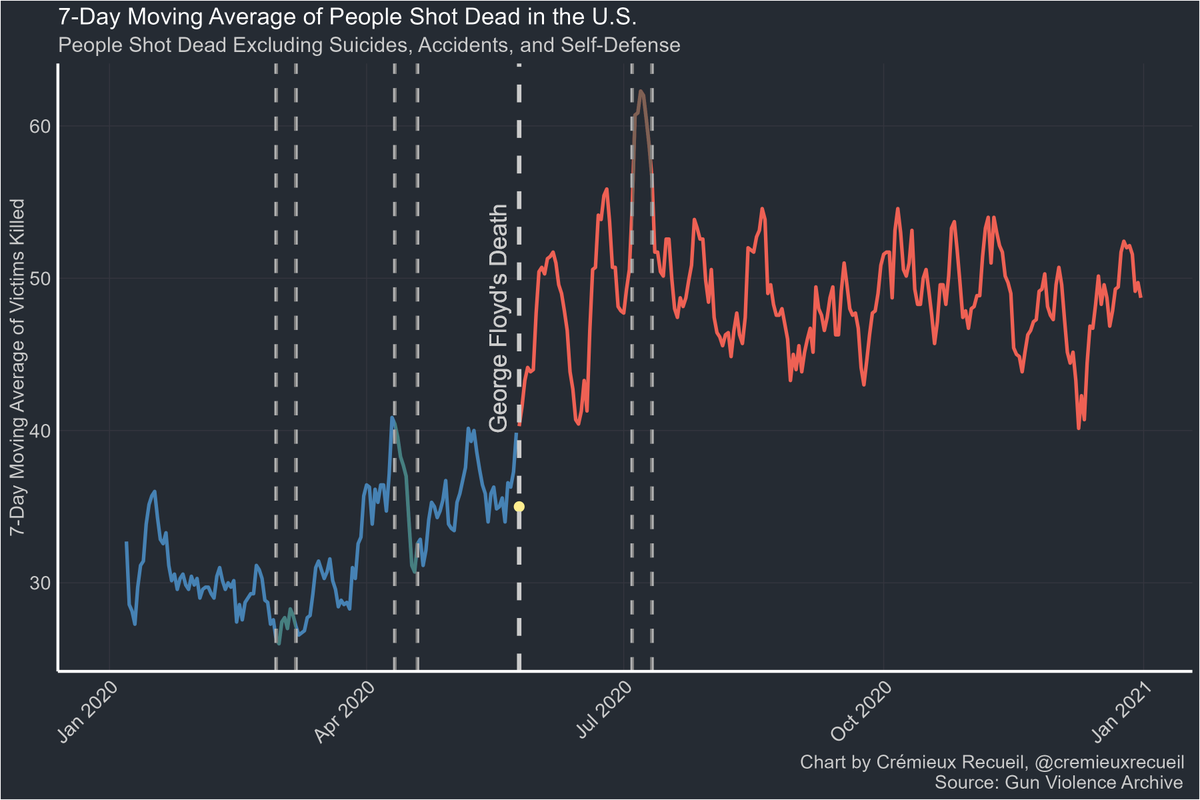
Non-averaged chart with their proposed but negatively-justified breaks labeled on it:
Forgot to leave this here:
https://x.com/tgof137/status/1869840169416921441
• • •
Missing some Tweet in this thread? You can try to
force a refresh