After a gravely ill leader, Romania's 47yo Nicolae Ceaușescu, a little-known figure from security forces, rises to power.
In Russia, a sick Yeltsin is succeeded in by 47yo Vladimir Putin, another quasi-unknown figure from security forces.
Ceaușescu suffered from mysophobia, an exaggerated fear of microbes and infections and tended to avoid close contact.
In between the infinitely long tables and his long COVID isolation, Putin too seems to have the same fear.
Ceaușescu's early years saw rapid economic growth mainly fueled by oil prices, earning him notable popular support.
Likewise, Putin’s first years were marked by oil-driven growth, turning him into a pretty popular leader.
From the very start, Ceaușescu aimed to play a prominent role in international politics and fancied himself to be a notable global figure.
Similarly, Putin displayed an equal drive to assert himself as the influential leader of a superpower on the world stage.
In 1974, Ceaușescu altered the Romanian Constitution, cementing himself as president for life with essentially unchecked powers.
In 2020, Putin alters the Russian Constitution to allow him to more or less remain president for life with unlimited authority.
Amid the growing poverty, Ceaușescu's personality cult expands to absurd levels, while his security forces begin hunting imaginary "agents of foreign services".
Putin's personality cult and the hunt for "foreign agents" seems to be following a very similar pattern in Russia,
At the time of his execution, Ceaușescu was just one month shy of turning 72, having ruled Romania for 24 years.
Today, Putin, at 72, has also been in power in Russia for precisely 24 years.
• • •
Missing some Tweet in this thread? You can try to
force a refresh

OTD 35 years ago, Ceaușescu delivered what would become his final speech, addressing 100k people forcibly gathered there so he could stage a facade of popular support for his regime.
In one of the most iconic moments of modern history, he will lose control of the crowd.🧵
Bucharest would soon be engulfed in revolution, with an ever increasing number of people taking to the streets in the following hours.
To the sound of "Death to the dictator!", people begin to carve the communist coat of arms out of the Romanian flags they were carrying.
Much like he did in what was at that point the free city of Timisoara, Ceausescu decides to use deadly force.
Soon, the regime's soldiers, tanks and APCs would begin to fire on the unarmed masses of protesters, leading them to defiantly chant "WE WILL DIE AND WILL BE FREE!".
With a lot of whatever little is left of our democratic world soon to head towards the polling stations, and since voting our way into idiocracy can occasionally be tricky business, I've refined my list of ten very simple rules follow as to ensure we rise to the occasion.🧵
1. It can never happen to you!
It is essential to acknowledge that ending up in a full-fledged dictatorship is something that can only happen to other people. Of all times and places, you alone were lucky enough to find yourself in the one spot magically immune to it.
2. Cherry-pick the electoral promises!
Of all things said or promised by your favorite candidate, It is of utmost importance to keep in mind he obviously only intends to do the things you agree with. Everything you personally disagree with, he can't or won't actually do.
To make our collective plunge into idiocracy ever so slightly more convenient, I've compiled a list of seven very simple rules to keep in mind next time you happen to find yourself voting. Enjoy!🧵
1. Cherry-pick the electoral promises!
Of all things said or promised by your favorite candidate, It is of utmost importance to keep in mind he obviously only intends to do the things you agree with. Everything you personally disagree with, he can't or won't actually do.
2. Trust in social media!
Keep in mind that social media platforms and influencers, especially does with Russian or Chinese origin or sympathies, always have your very best interests at heart and must not be subjected to the same scrutiny or distrust as "legacy media".
Since a lot of my compatriots seem to have forgotten just why it was we where all so desperately eager to join NATO in 2004 and the EU in 2007, I figured I'd do a thread comparing Romania today with the "sovereign" Romania of 2003, the pre-EU, pre-NATO one.
In 2003, shortly before joining NATO, Romania's GDP stood at $57 billion, while the GDP per capita was a meager $2700.
Today, the country's GDP is almost 7 times bigger, standing at $350 billion while the GDP per capita surpassed $18k, reaching that of a high-income economy.
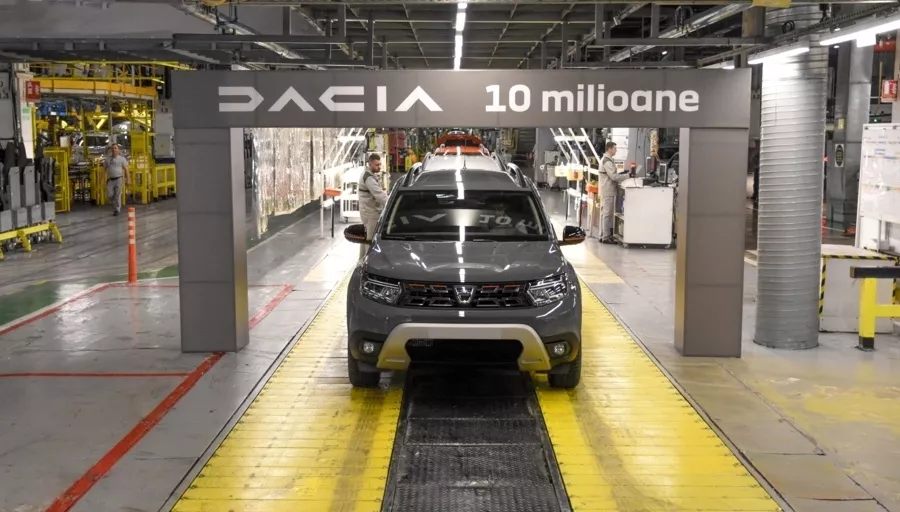
With "we're buying everything from the EU" and "we're not producing anything anymore" as the favorite populist mantra, Romania is now exporting $127 billions worth of goods yearly, 10x more than in 2003.
The country's imports lagged behind, only growing by an order of 8.
In less then an hour, the Romanian president will be addressing the nation (and is likely to make some important announcements).
If interested, feel free to bookmark this thread. I'll be updating it with the main points of his speech.🧵
"One candidate benefited from massive illegal exposure despite declaring 0 campaign funds. As per information obtained by our secret services, his campaign was supported by a foreign state."
"What follows now? [...] Once the new government is formed, they will be deciding and organizing the new set of presidential elections. [...]"
For anyone interested in the parliamentary elections taking place in Romania today (which are vastly more important than last week's presidential ones), feel free to bookmark this thread.
I'll do my best to do an hourly or so update on it (or whenever something of note comes up). Worth noting there's a strong possibility round one of the presidential elections might get annulled and repeated based on the outcome of today's election.
The first exit-polls (which proved wildly inaccurate last week) will be released at 9PM local time (when voting inside the country will have concluded).
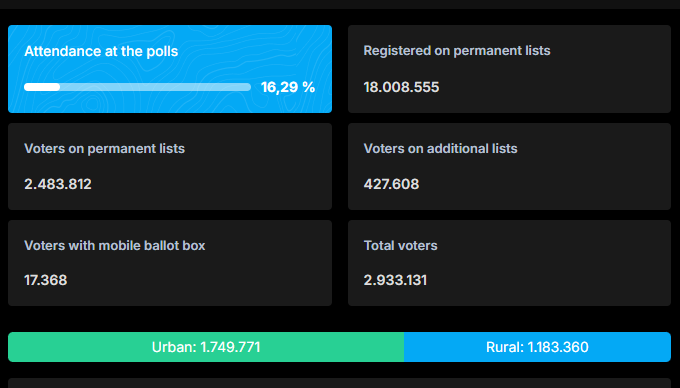
The main thing I'll be looking for until then is the voter turnout, which unfortunately has a bit of a glass ceiling this time as people can only vote in their county (Romania is split into 41 counties) of residence.
Another important thing to look for is the distribution of votes in-between urban and rural area. While rural areas historically tend to vote for the current incredibly corrupt ruling party, the urban areas tend to go towards reformist parties. The votes likely to go to the right-wing wackos seem somewhat evenly split between the two.
So far, the turnout looks pretty good and it is likely to be the highest we've had in over a decade.
Not a lot of trust can be awarded to the latest polls given how inaccurate they proved last week, however, for what is worth, they seem to believe the main right-wing nationalist party will win (with a couple of smaller right-wing ones likely to make the 5% electoral threshold).
Our corrupt PM's party is likely to get second place while the pro-EU reformists are believed to come in 3rd. Nevertheless, expect absolutely anything to happen, especially if we end up with a record high voter turnout.