Linguistic Discovery Profile picture
Dec 26 13 tweets 4 min read Read on X
How was writing invented? And why?

Here’s the story of how the growing trade networks and complex administration of the earliest civilization evolved into the world’s first writing system. 🧵 1/13

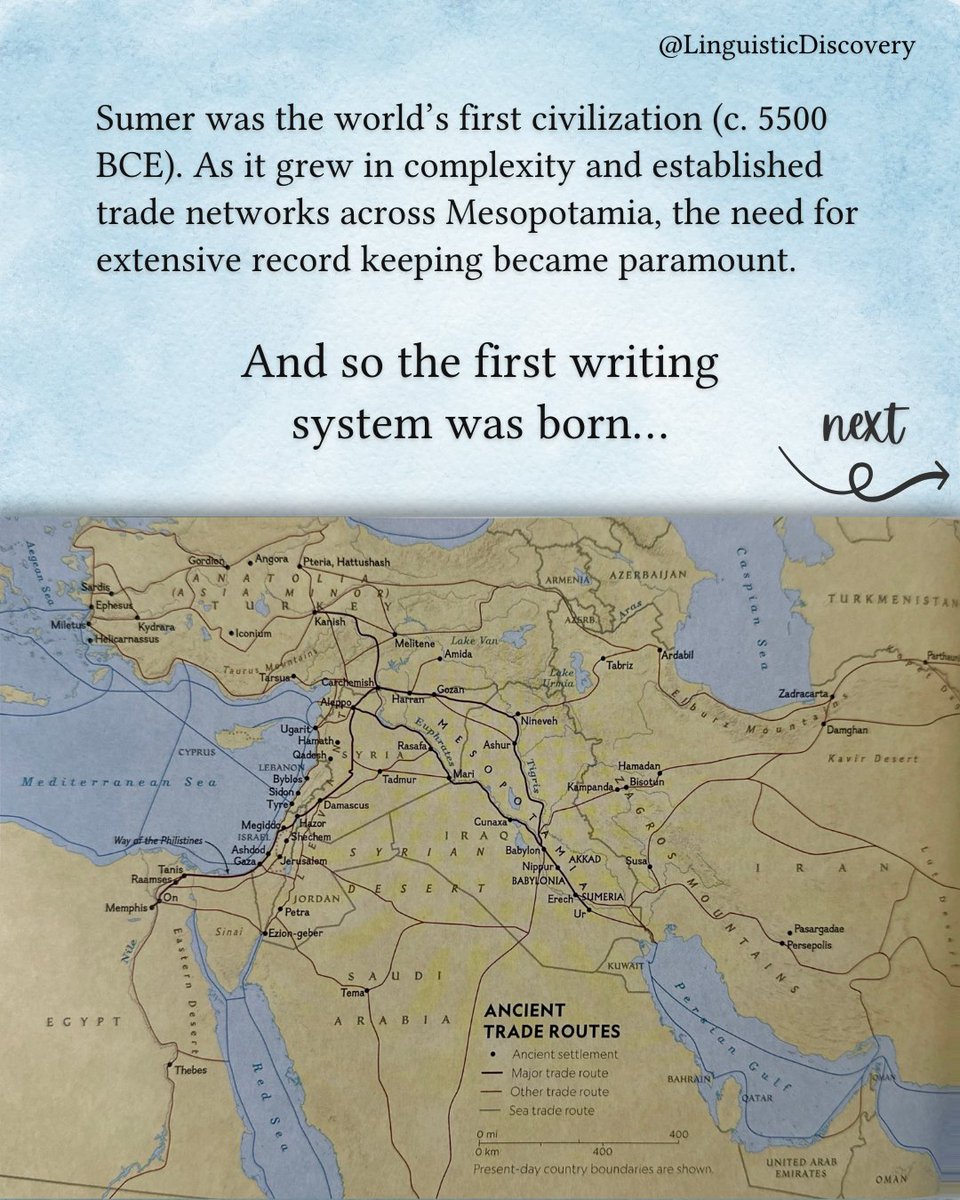
#Sumerian #cuneiform #Babylonian #Mesopotamia #counting #numbers #numerals #archaeology #trade #history #linguistics #writing #languageSumer is the world’s first civilization (c. 5500 BCE). As it grew in complexity and established trade networks across Mesopotamia, the need for extensive record keeping became paramount.  And so the first writing system was born…  Image: Map of ancient trade routes in Mesopotamia.
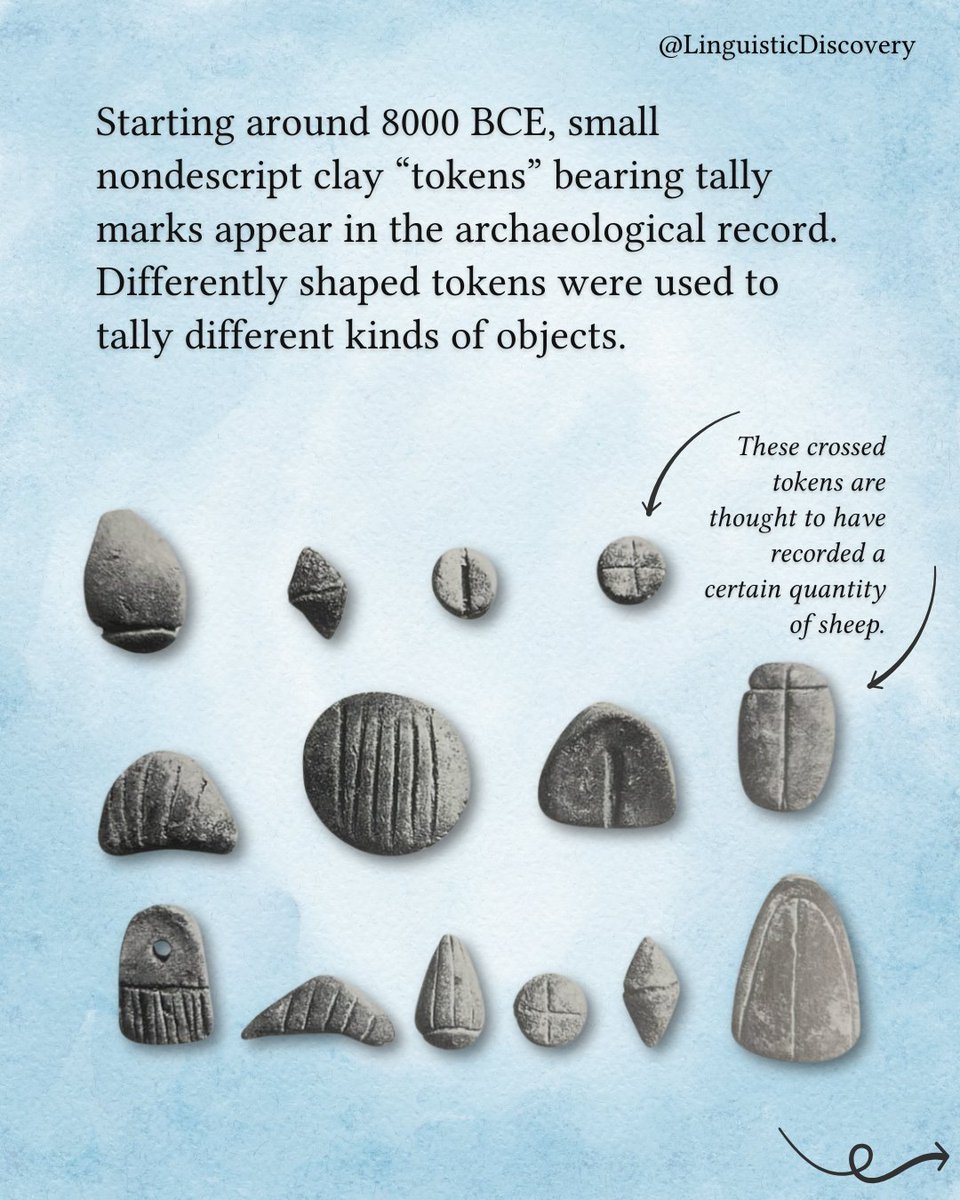
2/13 Starting around 8000 BCE, small nondescript clay “tokens” bearing tally marks appear in the archaeological record. Differently shaped tokens were used to tally different kinds of objects.  Image: A collection of tokens of various shapes and sizes, some with tally marks, some with other patterns. Several have a cross etched on them, thought to have been used to record a certain quantity of sheep.
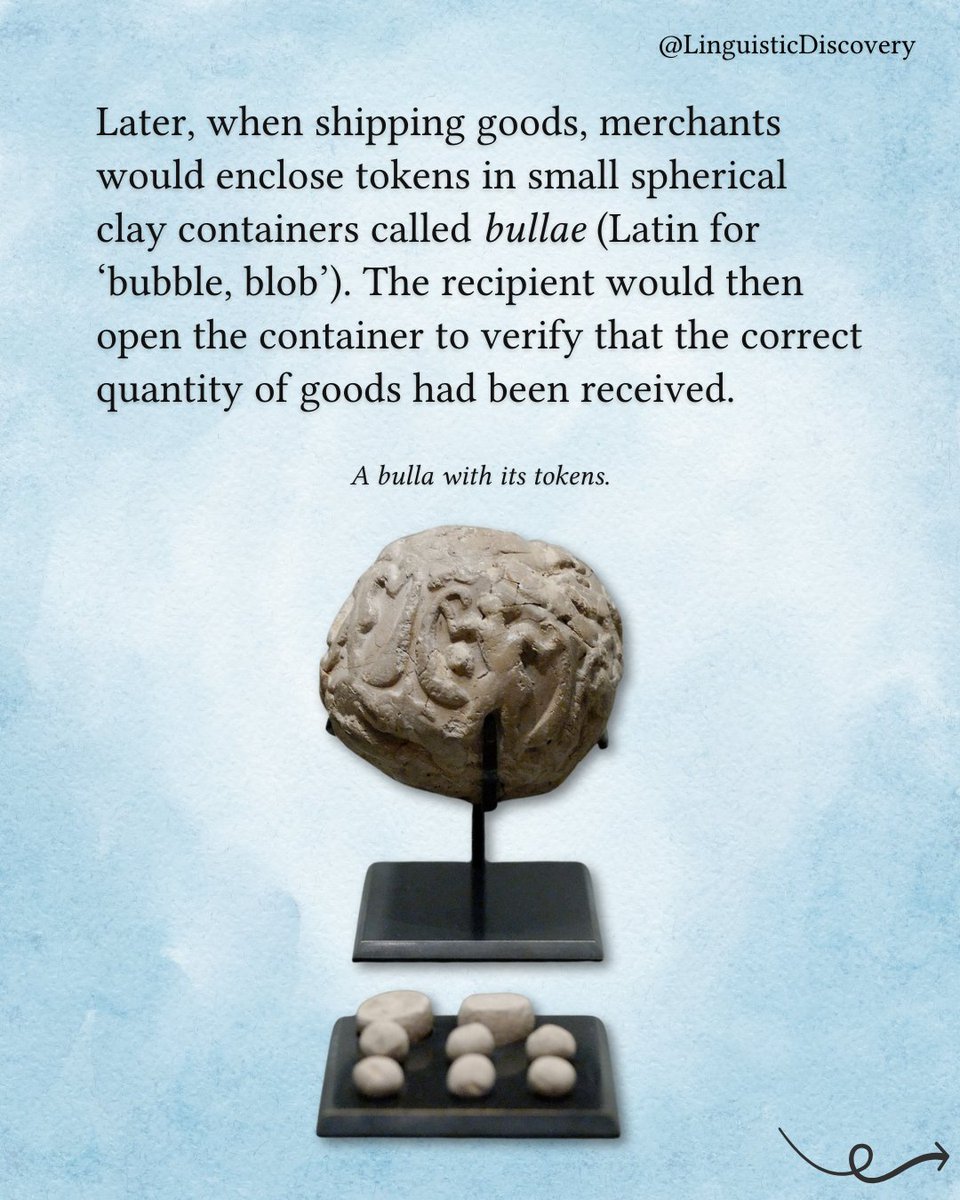
3/13 Later, when shipping goods, merchants would enclose tokens in small spherical clay containers called bullae (Latin for ‘bubble, blob’). The recipient would then open the container to verify that the correct quantity of goods had been received.  Image: A spherical clay bulla, with its tokens sitting in front of it.
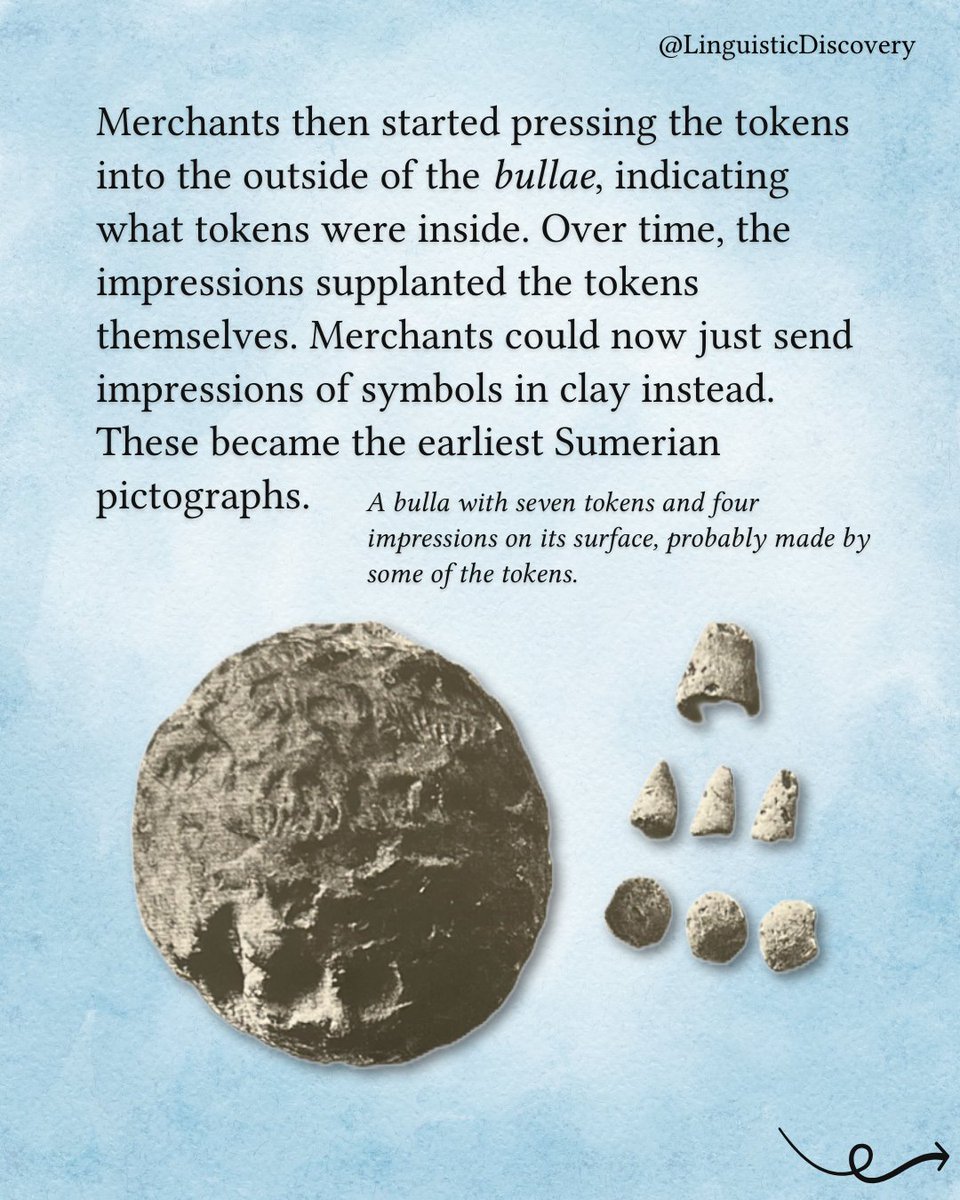
4/13 Merchants then started pressing the tokens into the outside of the bullae, indicating what tokens were inside. Over time, the impressions supplanted the tokens themselves. Merchants could now just send impressions of symbols in clay instead. These became the earliest Sumerian pictographs.  Image: A closeup of a spherical bulla, showing impressions on its outer surface, alongside the set of tokens used to make those impressions.
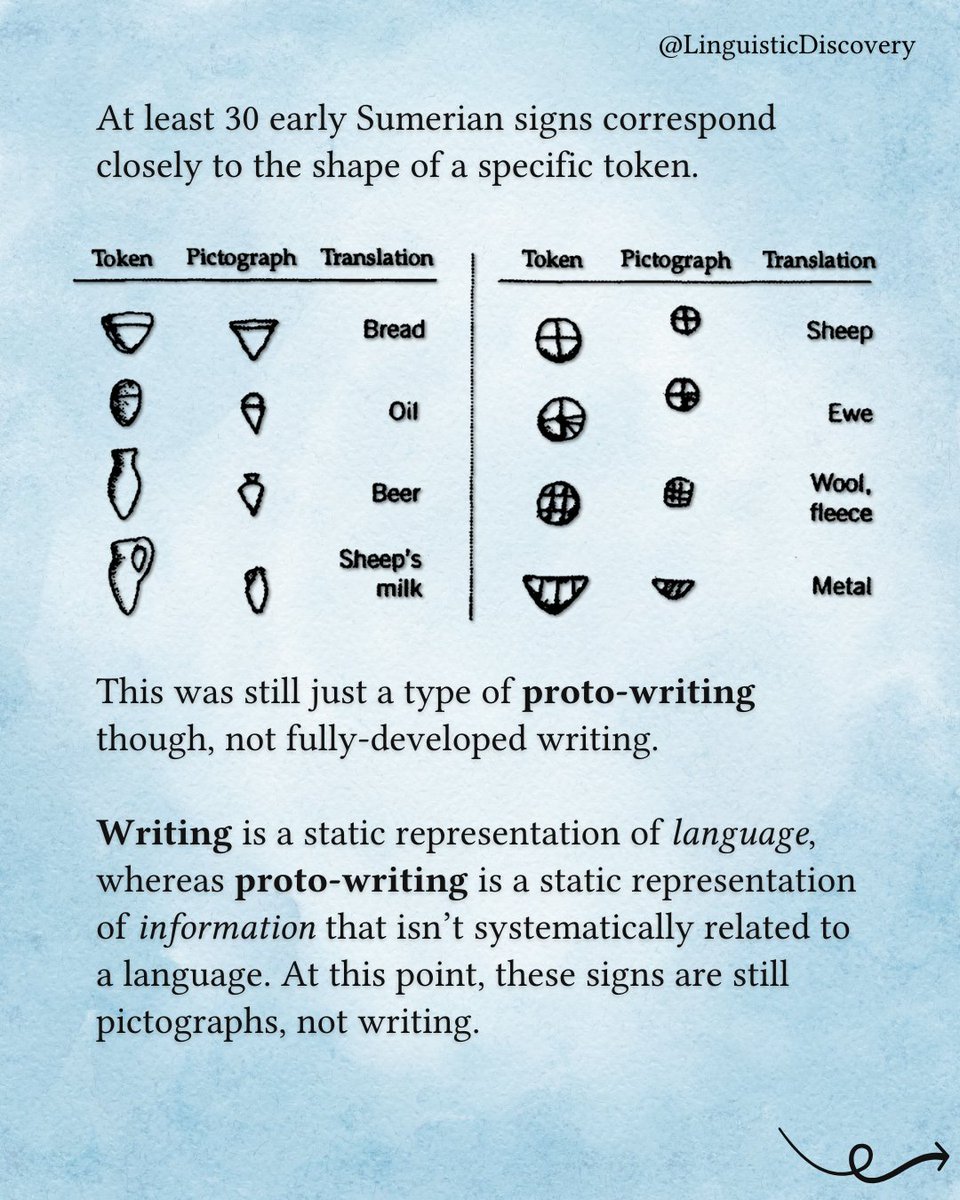
5/13 At least 30 early Sumerian signs correspond closely to the shape of a specific token.  Image: A table showing a drawing of a token in the left column, a pictograph in the middle column, and a translation in the right column. For example, the token for ‘sheep’s milk’ looks like a clay vase (amphora), as does its pictograph. Each of the displayed tokens shows striking similarities.  This was still just a type of proto-writing though, not fully-developed writing.  Writing is a static representation of language, whereas proto-writing is a static representation of information that isn’t systemat...
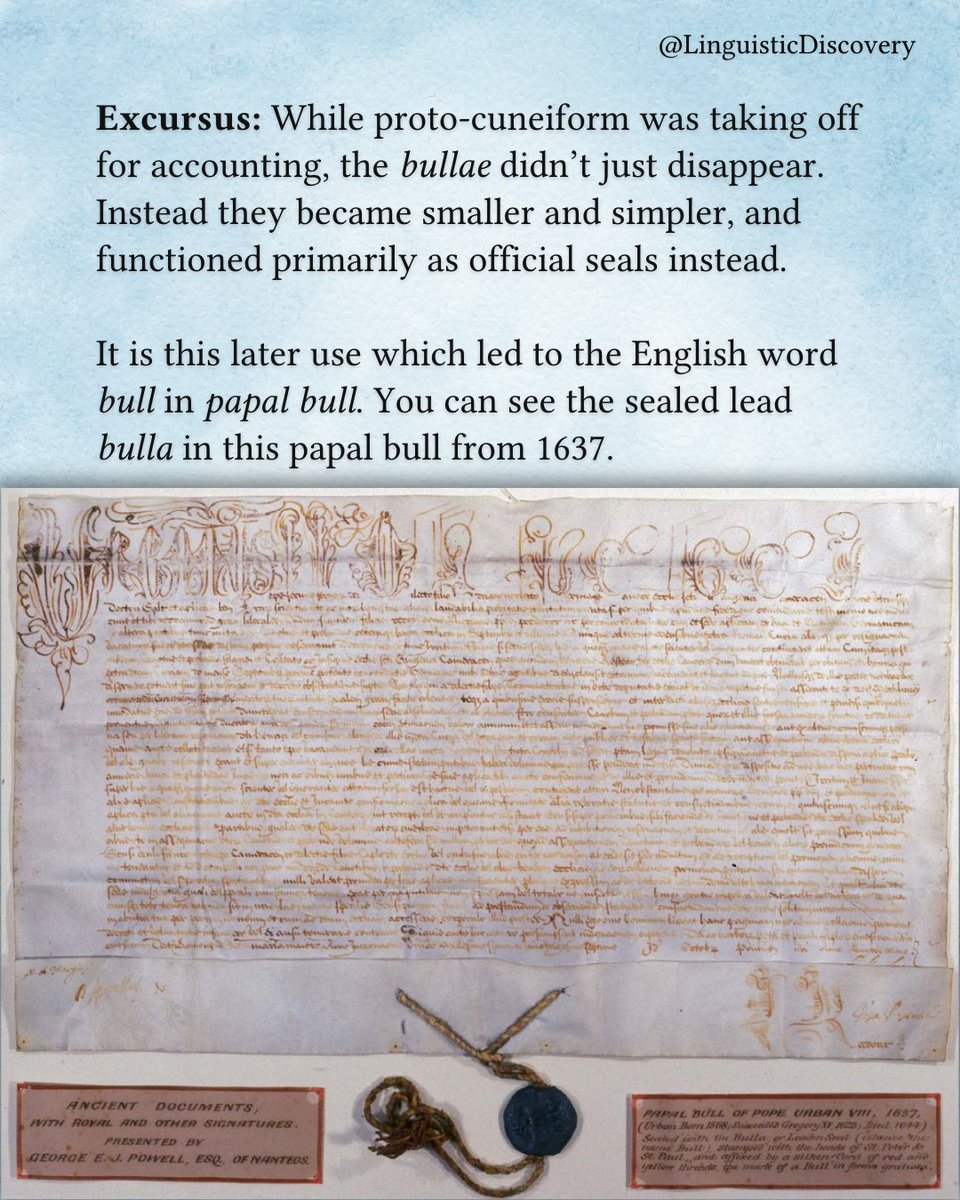
6/13 Excursus: While proto-cuneiform was taking off for accounting, the bullae didn’t just disappear. Instead they became smaller and simpler, and functioned primarily as official seals instead.  It is this later use which led to the English word bull in papal bull. You can see the sealed lead bulla in this papal bull from 1637.  Image: A papal bull, showing a roundish bulla seal tied to the document with a cord.
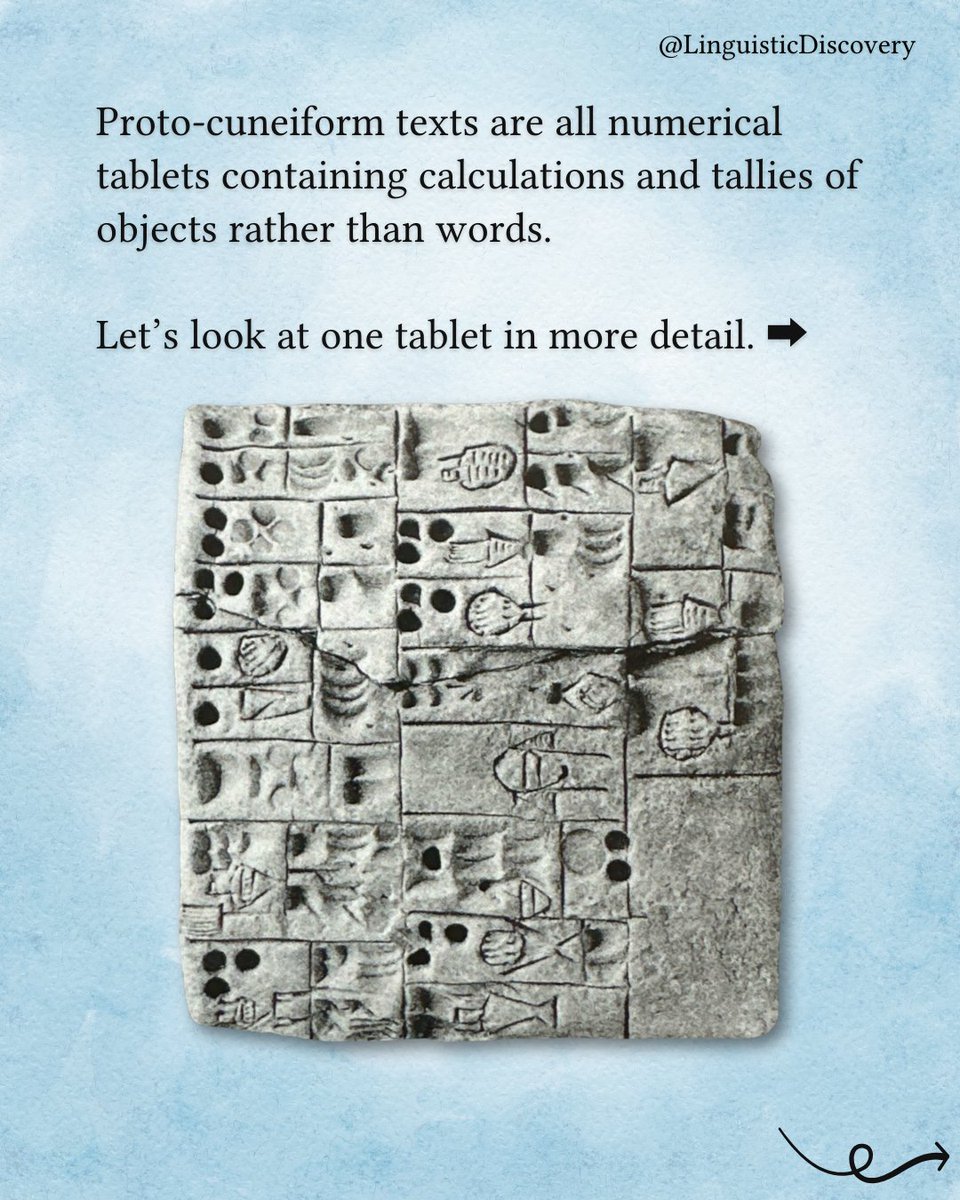
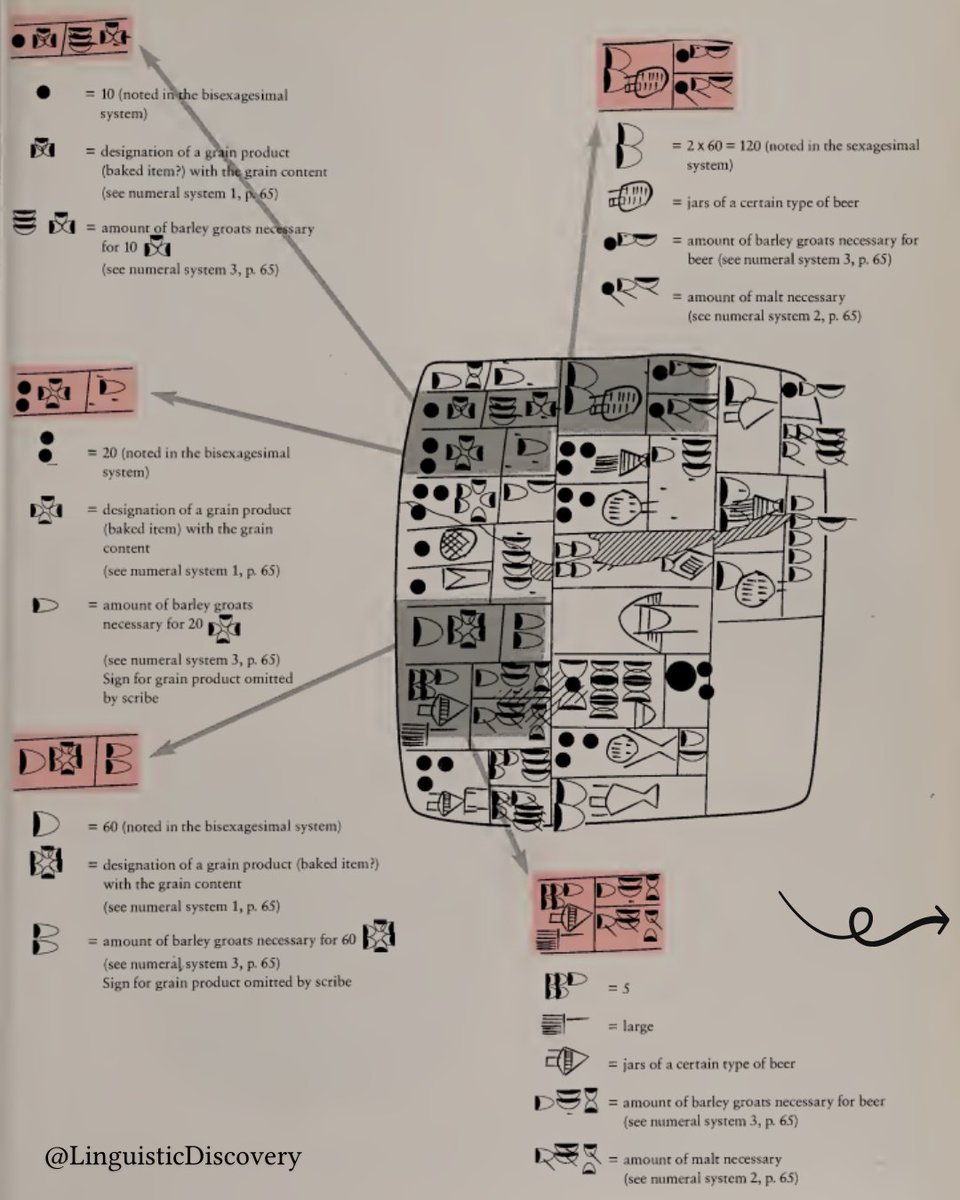
7/13 Proto-cuneiform texts are all numerical tablets containing calculations and tallies of objects rather than words.  Let’s look at one tablet in more detail.  Image: A closeup of a square gray tablet, with lots of rectangles and squares cut into its surface. Within each square/rectangle are repetitive tally marks and circles.
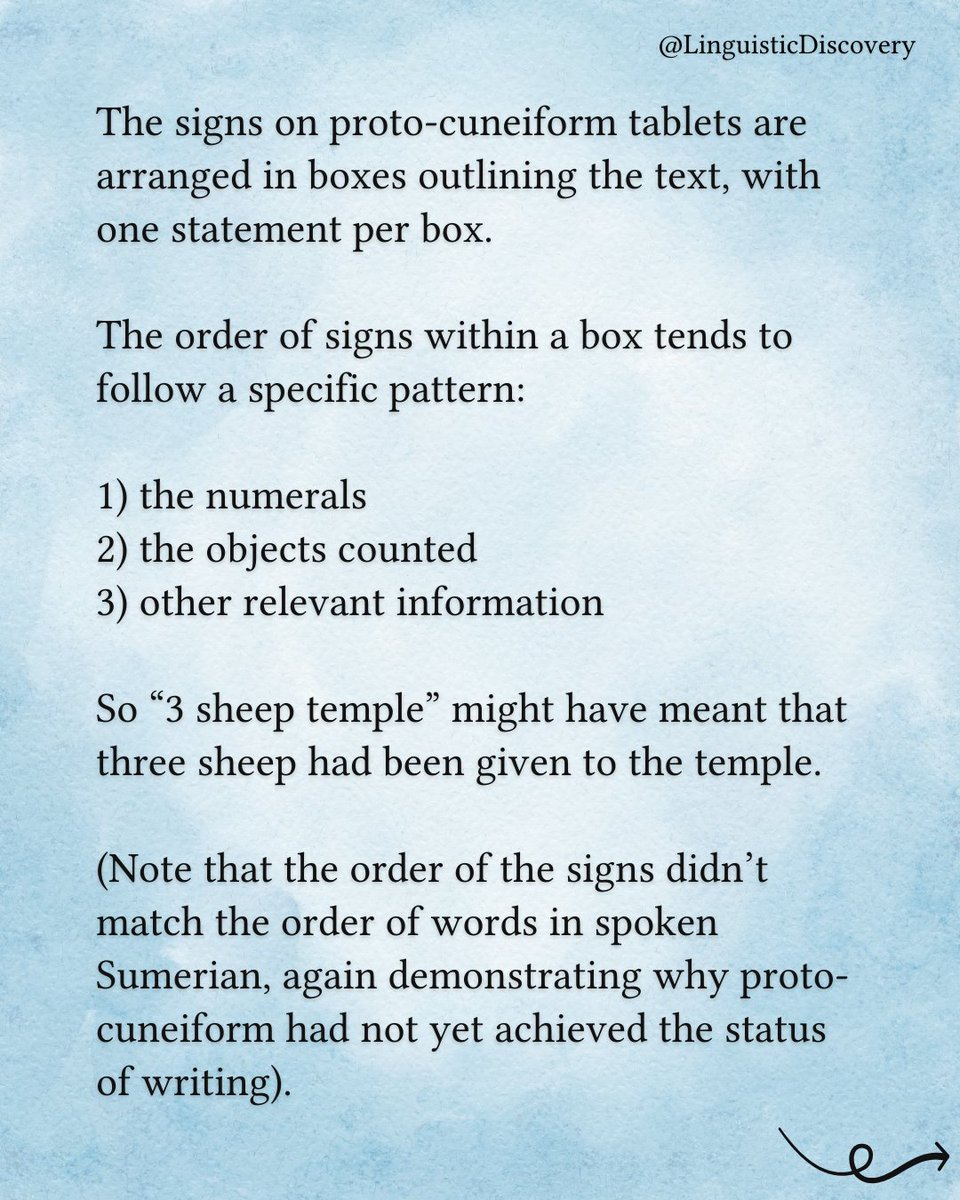
8/13 The signs on proto-cuneiform tablets are arranged in boxes outlining the text, with one statement per box.  The order of signs within a box tends to follow a specific pattern:  1. the numerals 2. the objects counted 3. other relevant information  So “3 sheep temple” might have meant that three sheep had been given to the temple.  (Note that the order of the signs didn’t match the order of words in spoken Sumerian, again demonstrating why proto-cuneiform had not yet achieved the status of writing).
9/13 A page from the book “The story of writing”, with an analysis of several statements from the tablet on the slide before last. One statement is analyzed as: 10 (noted in the bisexagesimal system) + designation of a grain product + amount of barley groats necessary for 10.
10/13 Over time, the pictographs became more abstract. Scribes began to write using a wedge-shaped stylus, giving the signs their distinctive wedges.  Image: A progression of signs: 1) a pictograph that is clearly an image of a head; 2) that same image turned sideways; 3) a stylized, angular version of that same image, though still arguably discernible as a head; 4) the same image represented using wedges; 5) a more compact version of the former; 6) the same sign, but after cuneiform had been standardized to a small set of signs at certain allowable angles; at this point the sign no longer even r...
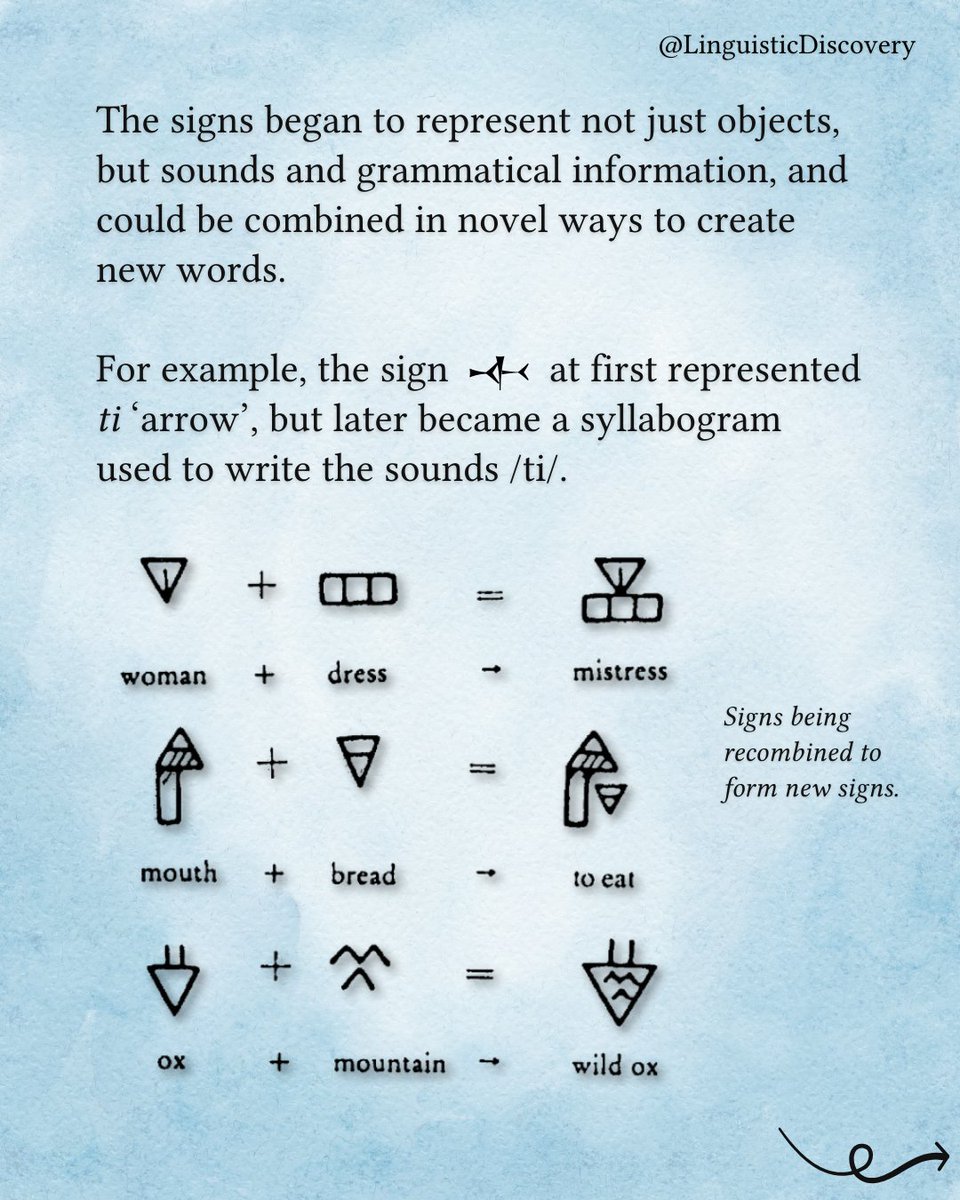
11/13 The signs began to represent not just objects, but sounds and grammatical information, and could be combined in novel ways to create new words.  For example, the sign 𒋾 at first represented *ti* ‘arrow’, but later became a syllabogram used to write the sounds /ti/.  Image: A table of signs being combined into compound signs: woman + dress = mistress; mouth + bread = to eat; ox + mountain = wild ox.
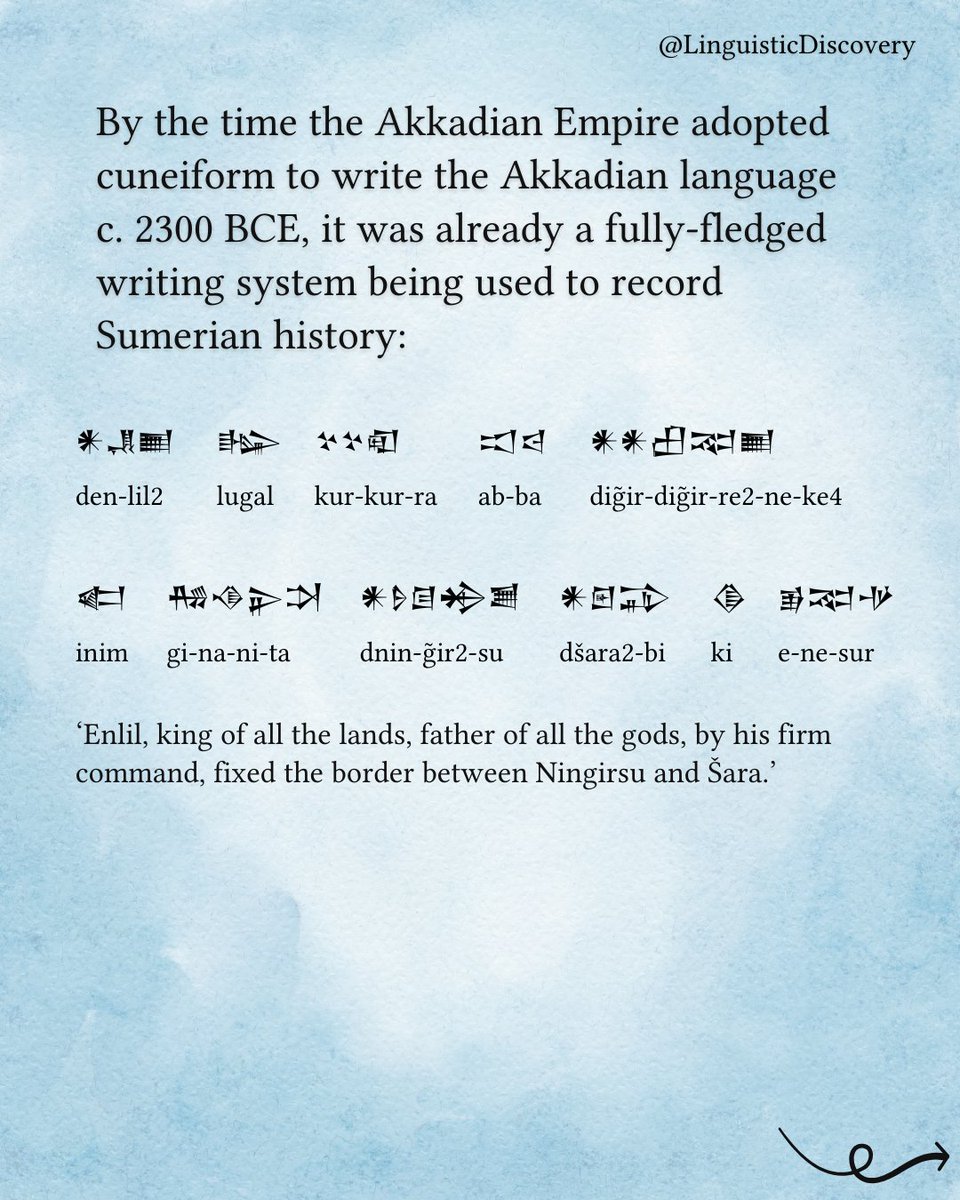
12/13 By the time the Akkadian Empire adopted cuneiform to write the Akkadian language c. 2300 BCE, it was already a fully-fledged writing system being used to record Sumerian history:  What follows is a word-by-word text first in cuneiform, then its phonemic reading, then its translation.  𒀭𒂗𒆤 den-lil2  𒈗 lugal  𒆳𒆳𒊏 kur-kur-ra  𒀊𒁀 ab-ba  𒀭𒀭𒌷𒉈𒆤 dig̃ir-dig̃ir-re2-ne-ke4  𒅗 inim  𒄀𒈾𒉌𒋫 gi-na-ni-ta  𒀭𒊩𒌆𒄈𒋢 dnin-g̃ir2-su  𒀭𒇋𒁉 dšara2-bi  𒆠 ki  𒂊𒉈𒋩 e-ne-sur  ‘Enlil, king of all the lands, father of all the gods, by his firm command, fixed the border between Ningirsu and Šara.’
If you enjoyed this thread and want to help me educate the world about language diversity and the science of language, consider becoming a patron!

Perks include:

👀 early access to articles/videos
➕ bonus articles/videos for subscribers only
🆓 ad-free videos
💝 support the channel!

Price: $5/month (USD)


13/13patreon.com/LinguisticDisc…And that is the story of how trade and the growing complexity of the world’s first civilization led to the invention of writing.  Enjoy this post and want to help educate the world about language diversity?  Consider becoming a patron!  Perks:  1) early access to articles/videos  2) bonus articles/videos  3) ad-free videos  4) support the channel!  Price: $5/month (USD)  patreon.com/LinguisticDiscovery

• • •

Missing some Tweet in this thread? You can try to force a refresh

 

Keep Current with Linguistic Discovery

Linguistic Discovery Profile picture

Stay in touch and get notified when new unrolls are available from this author!

Read all threads

This Thread may be Removed Anytime!

PDF

Twitter may remove this content at anytime! Save it as PDF for later use!

Try unrolling a thread yourself!

how to unroll video
  1. Follow @ThreadReaderApp to mention us!

  2. From a Twitter thread mention us with a keyword "unroll"
@threadreaderapp unroll

Practice here first or read more on our help page!

More from @lingdiscovery

Jan 1
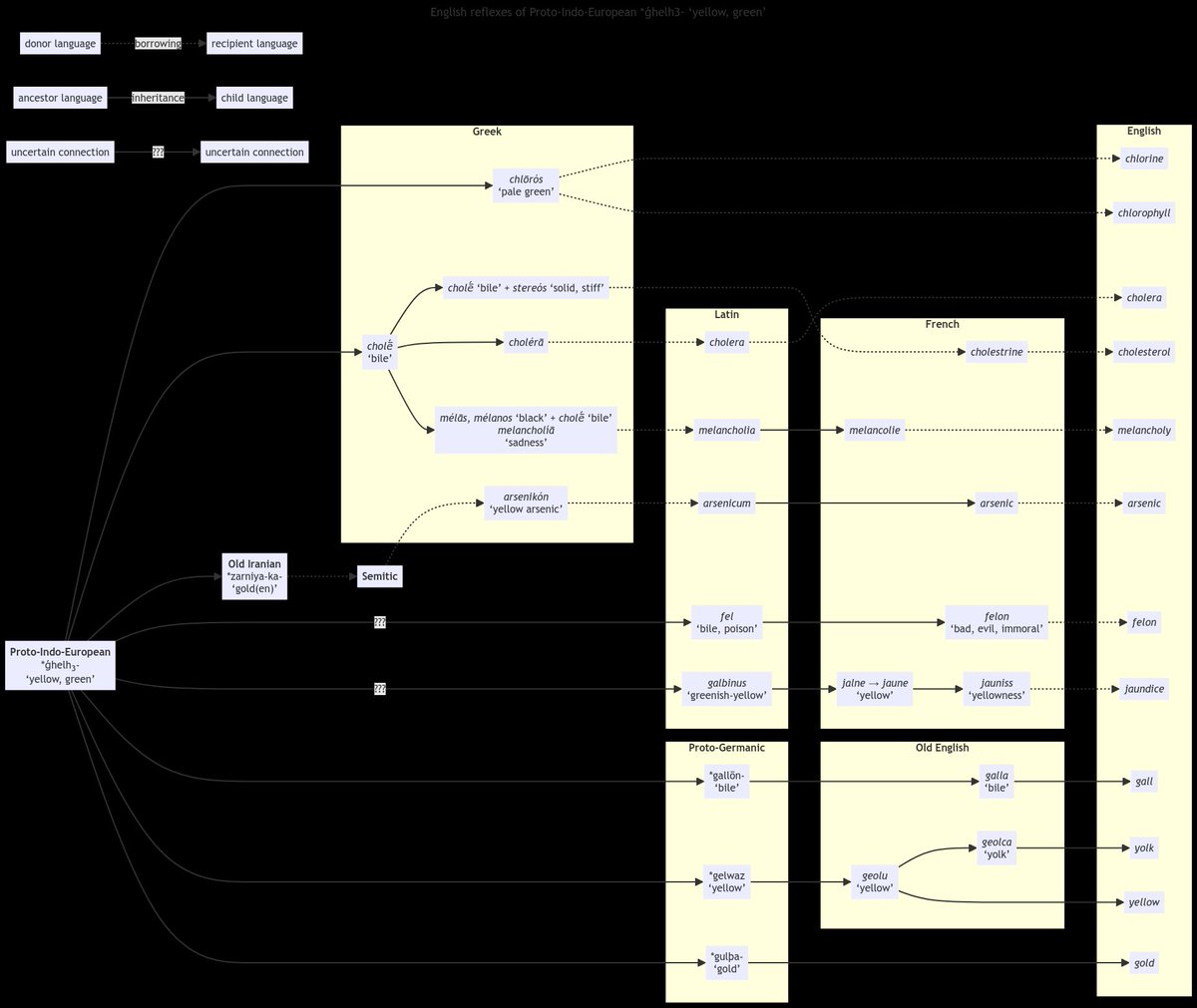
The Proto-Indo-European language (the hypothesized original ancestor language of most modern languages in Europe and South Asia, hereafter abbreviated “PIE”) had a root *ǵʰelh₃- ‘yellow, green’. 1/16 Image
Aside: How can this word refer to both ‘yellow’ and ‘green’? Historically, color terms in the world’s languages referred to a broader range of colors than they do today, and focused more on the texture or brightness of the object rather than its hue. 2/16
en.wikipedia.org/wiki/Color_term
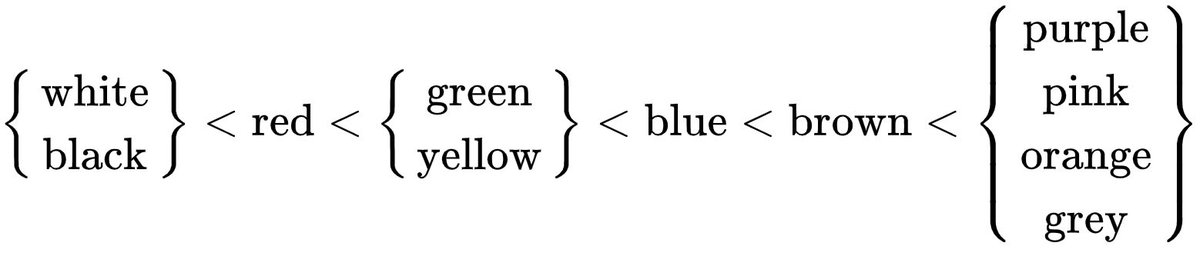
Aside Cont.: Over time, color terms gradually shift to focus on hue rather than brightness, and make more nuanced distinctions between those hues. *ǵʰelh₃- existed at a time before that shift happened. 3/16 Image
Read 16 tweets

Did Thread Reader help you today?

Support us! We are indie developers!


This site is made by just two indie developers on a laptop doing marketing, support and development! Read more about the story.

Become a Premium Member ($3/month or $30/year) and get exclusive features!

Become Premium

Don't want to be a Premium member but still want to support us?

Make a small donation by buying us coffee ($5) or help with server cost ($10)

Donate via Paypal

Or Donate anonymously using crypto!

Ethereum

0xfe58350B80634f60Fa6Dc149a72b4DFbc17D341E copy

Bitcoin

3ATGMxNzCUFzxpMCHL5sWSt4DVtS8UqXpi copy

Thank you for your support!

Follow Us!

:(