About the paper behind this figure: The moral circle
🧵
🧵

The paper is from Nature, entitled "Ideological differences in the expanse of the moral circle" by Waytz et al. They combined a few different surveys to produce this study.
The first takes a broad look at the moral differences between conservatives and liberals:
Their 'love' scale produced statistically significant differences for all measures, although the absolute differences themselves were small.
Their 'love' scale produced statistically significant differences for all measures, although the absolute differences themselves were small.

The largest was "Love of all others," where liberals gave a higher rating. The second largest was "Love of Family," where conservatives gave the higher rating.
An 'identification' scale had larger effect sizes; conservatives identified strongly with the country, while liberals identified strongly with all of humanity at roughly equal effect sizes.

Next, participants went to allocate a 'budget' of 100 'moral points,' allocating to one category meant not allocating to any other.
The very liberal rated humans and nonhumans roughly equally, while people who were very conservative rated humans much higher than nonhumans
The very liberal rated humans and nonhumans roughly equally, while people who were very conservative rated humans much higher than nonhumans

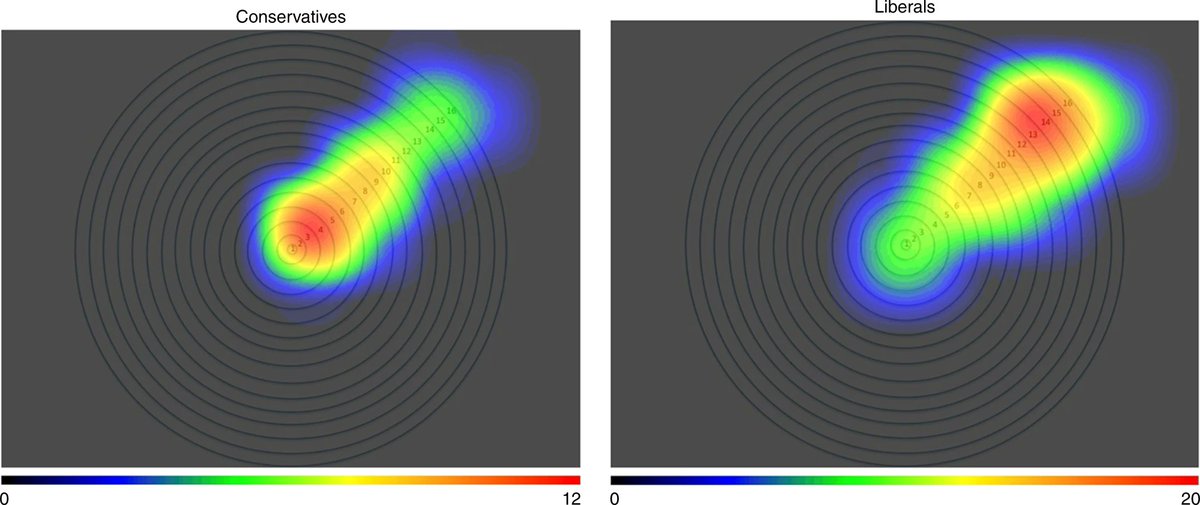
The next survey was on the moral circle itself. This is the chart they used:
Participants were asked to identify their highest personal moral allocation, from 1, their immediate family to 16, everything in existence.
Participants were asked to identify their highest personal moral allocation, from 1, their immediate family to 16, everything in existence.

This is that visualization. Since the fixed scale and the extent of the moral circle show similar effect sizes in their political differences, you can also think of this as a heatmap of where liberals and conservatives are more represented in their moral allocation.
Another task was to allocate without a fixed budget. Participants were allowed to give any number of points to each category. Below are the proportions, where the same pattern emerges:

This shows that this is not some artifact of greater moral care, as without a fixed budget, liberals and conservatives gave very similar amounts of total moral consideration.
In other words, this is each person's ideal distribution of moral concern. Given constraints, this pattern is just more exaggerated.
So overall, liberals and conservatives have similar amounts of moral care; they just allocate it differently.
• • •
Missing some Tweet in this thread? You can try to
force a refresh