As Ukrainian forces continue to annihilate North Korean troops and occasionally take them prisoner, some intriguing details have come to light. A short thread đź§µ 1/9
Capturing POWs has proven challenging as North Koreans and Russians alike are apparently instructed to kill wounded NK soldiers to prevent them from falling into Ukrainian hands. Yet recently Ukrainians have successfully captured two NK soldiers alive. 2/9
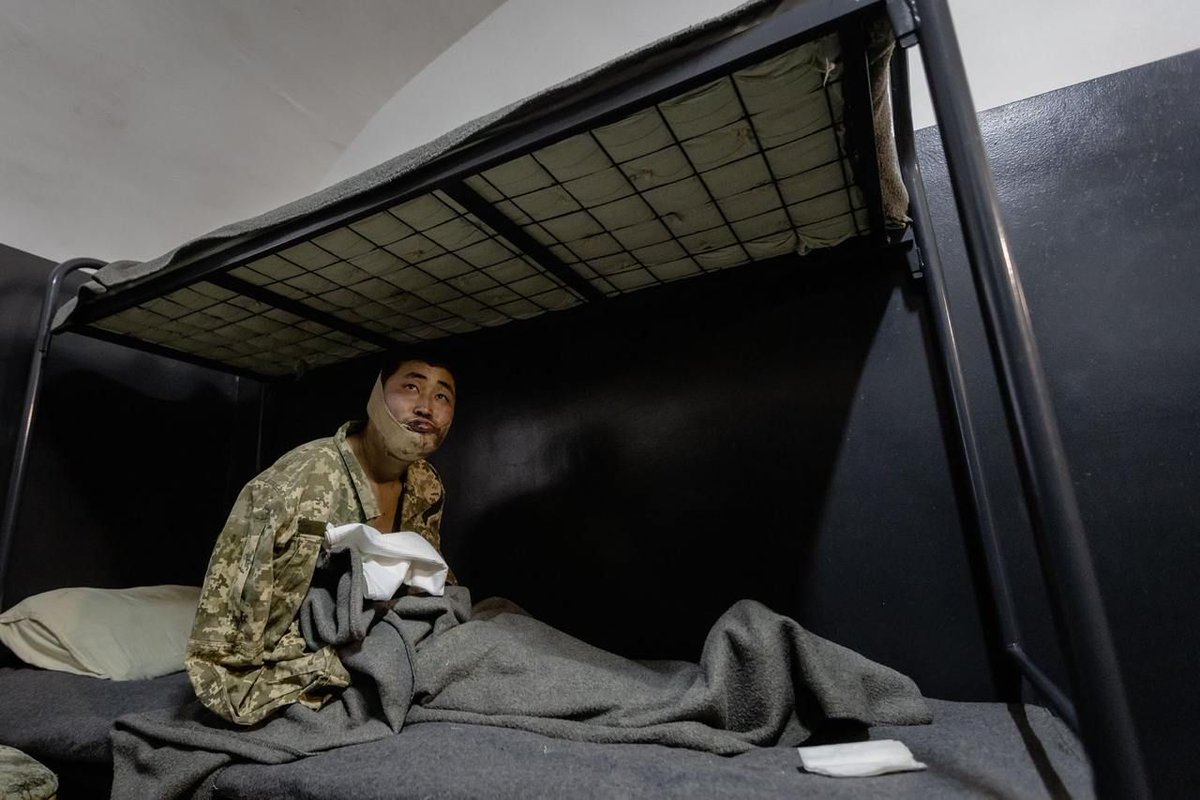
Both individuals carried Russian military service cards alleging they were born in the Tuva Republic, a region included in the Russian Federation. Russian non-regime media also report that the Russian authorities transferred identities of actual Tuvans to drafted NK soldiers. 3/9
The choice of Tuva is understandable: native Tuvans bear a physical resemblance to North Koreans. 4/9
By the way, Russia’s former Defence Minister Sergei Shoigu is himself of Tuvan origin. 5/9
The fact that the captured NK soldiers’ documents claimed Tuva as their birthplace corroborates earlier findings. Russian service cards recovered from the killed NK soldiers similarly falsely listed the Tuva Republic as their place of birth. 6/9
Yet another particularly interesting discovery was a diary found on one killed NK soldier. Ukrainian Special Operations Forces translated a number of pages from that diary, which the former owner had regularly updated, and one part was especially revealing for me. 7/9
Here is a DeepL translation (UA->EN) of that part. It reveals that the soldier’s motivation to fight was not connected to Russia’s war itself but stemmed from his loyalty to the NK regime – loyalty that appeared partly driven by a sense of guilt over something he had done back home. 8/9
Of course, this is just one example, and it would be unwise to generalise. However, at least in this specific case, the soldier’s motivation to fight in a distant foreign land was not about bringing about a global communist revolution – something that would be too natural for many 20th century communists – but, curiously, about his own individual interests. 9/9
The Russian fake news story about Ukraine’s alleged attack on Putin’s residence near Lake Valdai appears to have been a spontaneous response to reports of a positive outcome from the Trump–Zelensky meeting at Mar-a-Lago last Sunday. 1/6
The Kremlin had clearly hoped that the meeting would go awry. In an attempt to contribute to such an outcome, Putin held a phone conversation with Trump shortly before the latter met Zelensky, obviously to predispose the US president against Ukraine. 2/6
When it became clear that the meeting had produced no dramatic rupture between Trump and Zelensky, the Kremlin moved to improvise. The disinformation campaign was put together so hastily that the Russian authorities failed to construct even a minimally plausible façade. 3/6
In Western democracies, intelligence services increasingly buy data and analyses from private firms. These companies provide OSINT reports, satellite imagery, and cybersecurity expertise, allowing governments to boost capabilities without permanently expanding bureaucracies. 1/11
In Russia, this outsourcing logic found an analogue in the fusion of state propaganda and private enterprise. Yevgeny Prigozhin’s Internet Research Agency (IRA) pioneered commercialised political warfare, blurring lines between business interests and Kremlin objectives. 2/11
The IRA served both Prigozhin’s and state aims, attacking Russian opposition figures, supporting Assad, and targeting Ukraine. Its hybrid model of influence showed how private actors could profit from and reinforce Kremlin foreign policy agendas. 3/11
Since 2010, when Viktor Orbán returned to power, he and Fidesz have been steadily checking off the boxes for building a mafia state in Hungary. At some point, Orbán seems to have decided never to leave power again. 1/11
With the opposition weak, the EU unwilling to act, and cheap Russian energy fuelling populism, Orbán’s model appeared flawless. But since early 2025, that illusion has begun to unravel. 2/11
As Russia grows concerned about the resumption of US arms deliveries to Ukraine and the introduction of new, more damaging sanctions by the US, it is playing yet another trick to delay Washington’s measures. 1/5
This latest ploy is the so-called “new and different approach” allegedly proposed to Marco Rubio by Russian Foreign Minister Sergey Lavrov during their meeting in Malaysia earlier today. 2/5
What exactly this “approach” entails remains unclear. Rubio himself said he “wouldn’t characterise it as something that guarantees peace, but it’s a concept [he] will take back to the president today”. 3/5
Putin’s daughter, Katerina Tikhonova, is rumoured to be under consideration as a potential successor to her father as Russia’s leader. This idea is presumably being pushed by the Kovalchuk brothers, who are close to Putin. 1/5
I still don’t really see Putin vacating his position before his physical demise – although, of course, he could remain the major power broker behind whoever he selects to succeed him. 2/5
However, I’m curious about a different issue. 3/5
Western mainstream media have played a major and deeply disturbing role in amplifying the ideas of Russian fascist ideologue Alexander Dugin, both in the West and beyond. 1/10
By falsely portraying Dugin as having considerable – if not definitive – influence on Kremlin thinking, they encouraged far-right as well as non-far-right sympathisers of the Putin regime around the world to regard his fascist ideas as legitimate critiques of Western liberal democracy. 2/10
The warped logic underpinning this is as follows: if one agrees with Putin’s view of the West, and if Putin is presumed to be influenced by Dugin (as Western media often claim), then it appears reasonable to turn to Dugin’s work as the supposed source of Putin’s anti-Western outlook. 3/10




